

Shut the bedroom door at bedtime with a monitor on the dresser, and when you look at it again the number is far above what it showed at dinner. That reading is an indoor carbon dioxide level, and it is not a verdict on the monitor or on how clean the room is: CO2 is what a closed room fills with when people breathe in it, so the number tells you how much outdoor air the room is getting and nothing else. What that gas does inside a person is a question for a doctor, and this page reads the room, not the person. The sections below give you the outdoor number to hold a reading against, what each band says about ventilation, and the order to change things in, free fixes first.
Quick Answer
Indoor CO2 under about 1,000 ppm is Health Canada’s guideline for a home’s 24-hour average, and under about 800 ppm is what one monitor maker calls a well-ventilated room. Outdoors, the baseline is about 420 ppm. A reading above 1,000 ppm means the room needs more fresh air, not a new device.
What a normal indoor carbon dioxide reading is, against the air outside
A CO2 ppm reading of 900 sounds like a verdict, but it is half a measurement. The other half is the air outside the window, so this section starts from the outdoor figure and builds the room’s number on top of it.
The outdoor number is the zero line
The outdoor air baseline sits at about 420 ppm today, the figure Airthings prints for its monitors and the reference a room gets read against. Older sources print anywhere from 380 to 500 ppm, which tells you the baseline moves with the year and the street instead of staying fixed. A house with no one in it and the windows open drifts toward that outdoor figure; a closed house with people in it climbs away from it.
Read the room as the gap above it
Subtract the outdoor reading from the room’s and what is left is what the people and the shut door added. A 900 reading with 420 outside is a gap of about 480 ppm, while the same 900 with 500 outside is about 400. That is why a single quoted number misleads a little: the room cannot be judged without the street.
Health Canada’s guideline for homes is 1,000 ppm as a 24-hour average. Note the word average. It is a long-term line for the whole day, not a ceiling for the peak in the last hour before you wake, when a shut bedroom is at its highest. A reading above 1,000 ppm at that hour does not mean the guideline was broken, and a low afternoon does not mean the bedroom was fine overnight.
The cheap check takes ten minutes. Carry the monitor out to the porch or the yard, let it sit for 10 to 15 minutes, and read it. If it lands near 420 ppm, the monitor and the room agree about where zero is. If it lands far off, every indoor number it has given you is shifted by the same amount, and now you know the correction.
It is the test that owners of inexpensive monitors keep recommending to each other, because it needs nothing but the monitor, and it is where how big the gap between indoor and outdoor air really is starts to show.
Write the porch number on a strip of masking tape and stick it to the back of the monitor. Every reading after that is a subtraction you can do at a glance, and when the tape number changes at your next outdoor check, you have just seen the monitor drift.
The reading bands and what each says about the room
Four bands are printed on most monitors’ apps, and none of them is a law. This section sets them next to what each one says about the air in the room, because a band is only useful for the next move it points to.
Under 800: the room is changing its air
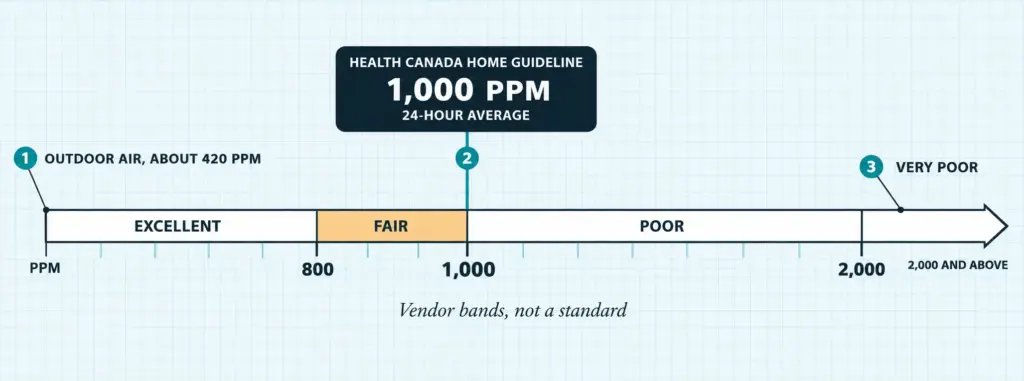
Airthings, a monitor maker, scales its readings like this: under 800 ppm is excellent, 800 to 1,000 is fair, 1,000 to 2,000 is poor, and above 2,000 is very poor. Those are a vendor’s labels on its own app, not a standard, and the scale is only useful if you keep that in mind. Under 800 means the room’s air exchange with outside keeps pace with the people breathing in it. A monitor in a room with one occupant and the door open rarely leaves this band; the number moves most when the door closes.
| Band (vendor scale) | What it says about the room | The next move |
|---|---|---|
| Under 800 ppm | The room is trading air with outside as fast as people use it up | Leave it alone and keep the door open |
| 800 to 1,000 ppm | The door has been shut a while, or the room is small for who is in it | Open the interior door before it climbs |
| 1,000 to 2,000 ppm | More breathing than fresh air; the room is closed | Bring in outdoor air, one change at a time |
| Above 2,000 ppm | A sealed room, a crowd in a small space, or a source that is not people | Same order, then look for an unvented appliance |
800 to 1,000: the door has been shut a while
This is the band where nothing is wrong yet and something is about to be. The door has been shut a while, or the room is small for the number of people in it, and the reading is creeping up rather than jumping. People who log their bedrooms describe it as the door shut, the number climbing, and it is the cheapest moment to act, since opening the interior door now can keep the room from ever reaching the next band. A reading that sits here all afternoon with the door open is a different case: it points to a room with very little air coming in from outdoors.
1,000 to 2,000 and above: the room needs more fresh air
Past 1,000 ppm the advice changes from watch it to act, and the action never varies: more outdoor air. Between 1,000 and 2,000 the room is closed with people in it. Above 2,000 something has gone further, whether a sealed room, a crowd in a small space, or a source of CO2 that is not a person, such as an unvented fuel-burning appliance (covered below). In every band the monitor is reporting ventilation, and a number is only as good as the sensor behind it, which is why what an air quality monitor actually measures is worth knowing before you trust any of these cutoffs.
Why the figures you read online disagree
The room gives you one reading, but the line it is held against changes from page to page. This section sorts out whose figure is whose, so you can see why one bedroom is fair on one page and fine on another.
A vendor band, a government guideline and a rule of thumb
Three different kinds of number get called the limit. A vendor band, like the four above, is a scale a company prints on its own app so its monitor can show a color. A government guideline, like Health Canada’s 1,000 ppm for a home, is written for a stated purpose over a stated time: a 24-hour average.
A ventilation rate, such as the 15 cubic feet per minute per person the Minnesota Department of Health gives for a classroom and 17 for an office (both ASHRAE-based), is a design figure for how much fresh air a building’s system should supply. It tells an engineer what to bring in, not what your monitor should read.
The average matters more than it looks. A 24-hour average and a spot reading are different kinds of number, so an evening spike on your monitor cannot be compared directly to Health Canada’s line; the comparison needs the whole day’s average, which many monitor apps will show you. Put the three kinds side by side and most of the disagreement disappears, because the figures are answering different questions. The table sorts them by who sets each one and whether it was checked against its source.
| The figure | Who sets it | Checked against the source |
|---|---|---|
| 800 / 1,000 / 2,000 ppm band edges | A monitor maker (Airthings), printed on its own scale | Yes, as that vendor’s labels |
| 1,000 ppm, 24-hour average | Health Canada, a guideline for homes | Yes, and it names the average |
| 15 and 17 cfm per person | Minnesota Department of Health, ASHRAE-based ventilation rates | Yes, but a building figure, not a home limit |
| About 420 ppm outdoors | No one sets it; it is the outdoor air, published as a range | Yes, within a range (older sources print 380 to 500) |
The same room can sit in fair on one page and fine on another because each page measures against a different line, not because the room changed.
The 1,000 ppm number that nobody can source
The marker most often printed next to 1,000 ppm is credited to ASHRAE, the standards organization for heating and ventilation. That credit is disputed: one secondary summary says ASHRAE sets no indoor CO2 limit and that the 1,000 figure grew out of a long-running misreading of its ventilation guidance. ASHRAE’s own text was not available to check this against, so it is reported here, not settled.
What this page can attribute to a named source is Health Canada’s guideline, and that one comes with its 24-hour average attached. When 1,000 ppm is used as a hard line for a single hour, you are looking at a rule of thumb.
What puts carbon dioxide up in a house, and what a high reading does not mean
A closed room fills with CO2, and with the stale air you notice on waking, the way a closed car fills with breath on a cold morning. The cause is almost always the people and the shut door, not the machine on the dresser.
People and a closed door
People breathing in a closed room are the main source of indoor CO2, and the shut door is what turns a steady supply into a climb. A ten by twelve foot bedroom with an eight foot ceiling holds about 960 cubic feet of air, which is not much for two sleepers to work through over eight hours, and nothing carries the used air away. Engineers call that missing turnover air changes per hour, and a shut door pushes it toward zero.
A house holds what its people make; the same logic explains why a house holds more moisture than the air outside, where breath and showers play the part CO2 plays here. A vendor’s overnight test and a study of Wellington, New Zealand homes point the same direction: a closed bedroom builds CO2 faster at night than the same room does by day. For the causes that belong to one particular house, why the number is high in a particular house goes room by room.
Fuel-burning appliances and tight buildings
A tight building, one with little air leaking in around windows and doors, lets the number build faster because less of a trickle is replacing the room’s air. That is good for a heating bill and poor for a reading.
Unvented fuel-burning appliances add CO2 too: a gas stove running with no hood that vents outdoors, or an unvented gas space heater. If your reading spikes while you cook on gas and falls well after the burners are off, you have found a source that is not a person. The carbon monoxide rule that goes with those appliances has its own section below.
What a high number does not tell you
A high number says the room is closed. It does not say the monitor is wrong, and it says nothing about dust, smoke or humidity, because the monitor counts one gas. The Minnesota Department of Health and Health Canada both point out that a stuffy room collects other things besides CO2, so the number is best read as a cue to ventilate, not as a measure of everything in the air. Logged overnight, the curve climbs after the door shuts and falls within minutes once it opens, which is the pattern behind why the reading climbs at night.
Read the monitor with the door shut just before you get into bed, and again the moment you wake, before you open anything. The difference between the two numbers is what the night added, and it is the number to beat the next time you change something.
The order to fix a high reading, one change at a time
A reading above the line has one cure, which is more outdoor air, and this section lists the ways to bring it in from the free one to the last. Change one thing, wait until the number stops moving, and read again before touching the next.
First, the interior door and a window
Start with the interior door, because it costs nothing and acts fastest. Open it, leave everything else alone, and read the monitor once the number settles. In a shut bedroom the reading falls within minutes once the door opens, though how long a high reading stays up depends on the room’s size and on how much air each opening lets through.
If the number is still above 1,000 ppm, an open window is the second change: raise one a few inches. That is its own change and it gets its own reading. Two changes at once would tell you the room improved and nothing about which one did it, and the next high reading will need the one that worked.
Then, the exhaust fan
A bathroom exhaust fan or a kitchen one is the next thing most people try, and it works only when air has somewhere else to come in. In a house shut tight it pulls the replacement air through cracks and gaps, and the bedroom’s CO2 barely moves. Run it with the bedroom door open and a window raised somewhere, so the fan sends the room’s air out and the window lets outdoor air in, then read the monitor. Over a gas stove, a range hood that vents outdoors counts as one of these fans.
Last, the HVAC fan setting
The HVAC fan comes last because it is the least predictable. Set to fan-only or circulate, it keeps air moving through a closed house, and a commenter in a home-ventilation thread recommends exactly that for stuffy rooms.
But moving air is not the same as bringing it in: unless the system has a fresh-air intake (builders call that mechanical ventilation), the fan only shuffles the house’s own air, and a bedroom far from the return can stay high. It also costs electricity. The blower’s rating label gives its watts, and watts times the hours it runs is the kilowatt-hours it adds each day, so let the reading decide whether the setting earns it. The complete sequence, with the reading to expect at each step, is in the full order for lowering CO2 at home.
Where the monitor goes, and why its number drifts
Every fix above depends on a reading, and the reading depends on where the monitor sits and how well it was built. This section covers monitor placement, the sensor inside and the drift that shows up as the months pass, and it is where the five monitors on this page belong.
Where the monitor sits
A monitor on a dresser by the door reads high every time someone walks past, because it is sampling moving air, not the room’s. The placement guides that monitor makers publish put it at breathing height, about 3.5 to 5 feet (1.0 to 1.5 m) off the floor, and about 3.3 feet (1 m) from an operable window. Those are the makers’ guides, not a standard, and they are sensible: put it where you could sit, out of any draft and away from vents.
For a bedroom, a nightstand or a shelf at bed height beats the floor or the ceiling. A monitor moved from one room to another also needs time before its number means anything, and how to measure CO2 in any room covers that settling time.
NDIR versus an estimate
Two kinds of sensor can sit behind a number labeled CO2. An NDIR sensor, also called an infrared sensor (non-dispersive infrared), shines infrared light through a small chamber of room air and measures how much the CO2 absorbs, so it reads the gas itself. An eCO2 figure is calculated from a VOC sensor (volatile organic compound), which makes it an estimate based on a different gas, as Atmotube’s own guide explains. The two numbers are not interchangeable, and the spec sheet, not the product title, is where to check which one you are buying.
The INKBIRD Indoor Air Quality Monitor NDIR CO2 Detector is the one budget monitor in this group whose listing names the sensor in its title, and that is the line to look for. It has only about 70 ratings, a thin sample, so how it holds up over a year has not had time to show in the reviews, and the rest of its specs, its range included, are worth reading on the listing before you buy. For the CO2 question it does the same job as the dearer ones.
Calibration and the reading that drifts
Cheap sensors move, and sensor drift is the name for it. The community word for it is that the reading drifts: the number slides over the months while nothing in the room has changed, and the phrase calibrate it first turns up for a new monitor’s opening week. The outdoor check from the first section is the free test for both.
The Airthings 2960 View Plus is the premium multi-sensor here, and its listing names CO2, particles, VOCs, humidity, temperature and pressure, which is a lot to buy if the question is only CO2. Reviewers say a 7-day calibration has to be done first and that the unit read the room badly until it was, and a three-year owner wrote that accuracy got worse the longer he kept it.
The premium pick is the obvious one, but for CO2 alone a multi-sensor monitor gives the same reading as a single-purpose one, and every extra sensor is one more thing to drift. How accurate home air quality monitors are covers what to expect from them over time.
A smaller step down is the Airthings 322 Wave Enhance, which lists CO2 and VOCs. What its listing shows does not say which CO2 sensor it uses, so check the maker’s sheet before assuming NDIR, and at about 45 ratings the sample is too small to show a pattern either way.
If the monitor lives on a nightstand, the display matters more than the sensor count. The GoveeLife Smart Air Quality Monitor CO2 Detector H5140 has a display and a CO2 alarm you can read from bed, and 4.4 stars across 242 ratings. Its listing does not state the sensor type or the range it reads, so those are the two lines to confirm on the spec sheet, and it should not be assumed to be NDIR.
On the budget end, the Temtop CO2 Monitor Indoor Air Quality Monitor Portable CO2 Meter has the largest sample in this set, 765 ratings at 4.3 stars, and reads CO2, temperature and humidity. Its title does not name the sensor either, which means the same spec-sheet check applies before you treat it as NDIR.
If two monitors on the same shelf disagree, carry both outside together and let them sit side by side. The one that lands nearer the outdoor baseline is the one to trust, and the gap between them is the size of the error you have been reading around.
Whichever one sits on the shelf, the outdoor check is how you find out whether it has drifted, and picking between them is a separate question: how to choose a home air quality monitor takes it on.
Carbon dioxide is not carbon monoxide
Both gases are read in ppm, and that is the only thing they share. A CO2 monitor does not detect carbon monoxide, and a carbon monoxide alarm does not read CO2: they are different gases with different jobs. The scales differ too.
According to the EPA’s own figures for carbon monoxide in homes, “Average levels in homes without gas stoves vary from 0.5 to 5 parts per million (ppm).” Near properly adjusted gas stoves the levels are often 5 to 15 ppm, and near poorly adjusted stoves 30 ppm or higher.
The one rule that goes with carbon monoxide is simple: if the alarm sounds, leave the house and call the emergency number. A CO2 monitor cannot do that job, even when it reads high in a kitchen with the gas stove running, and an alarm is no substitute for a CO2 monitor either. They hang on the same wall for different reasons.
The apartment where the window barely opens
Most advice assumes a window that opens wide and a door that stays open. This section is for the rental where the sash moves a few inches and the HVAC has two buttons.
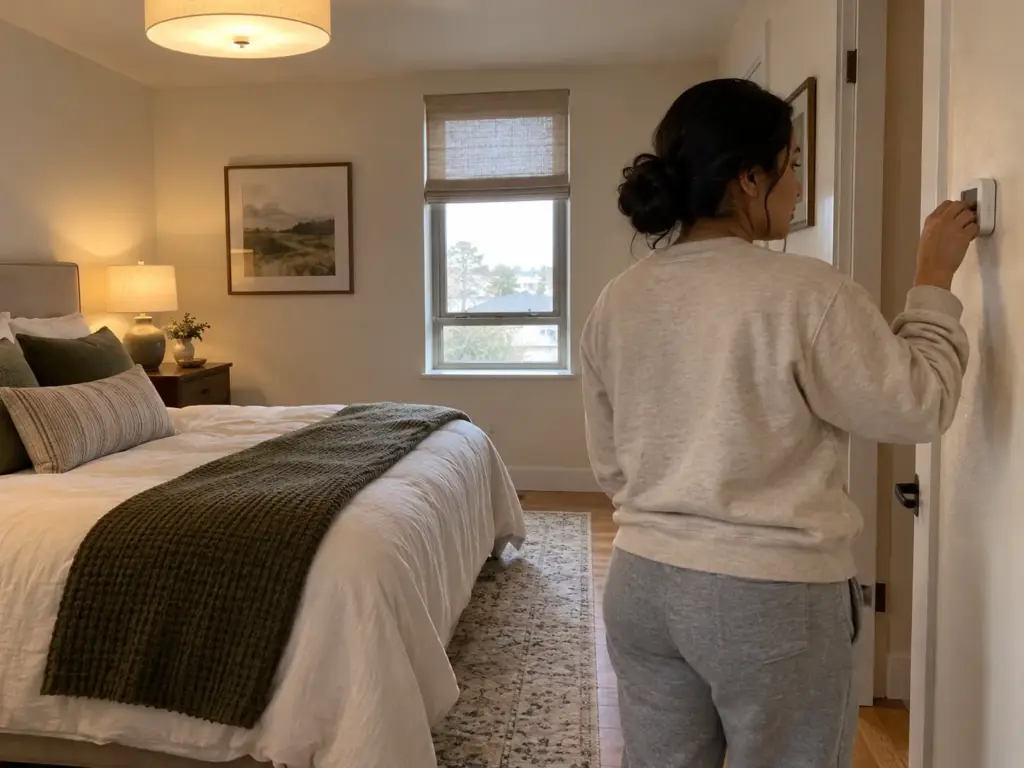
What a few inches of window still does
A window raised a few inches with the bedroom door open does more than either alone, because together they give the air a way in and a way through. You will not feel the difference, so go by the monitor and not the draft: with the door open and the window cracked, the reading often settles inside the first band before the HVAC fan matters. If the sash will only move a hand’s width, leave it there overnight and read the monitor in the morning. Opening it wide is the common advice and it fails here, because the window will not do it; the few inches you have are the whole supply, and the outdoor reading is the number the room can approach.
The two-button HVAC and the fan setting
With a thermostat on the wall and no ducts you control, two settings usually matter: fan on and fan auto. Fan on, or circulate, keeps air moving through a closed apartment, but it does not bring in outdoor air unless the system has a fresh-air intake.
Whether yours does is a question for the property manager or the equipment’s label. And there is a ceiling: when no fix brings the reading down, the question stops being the monitor and becomes the building. The person to call then is the property manager or an HVAC contractor, with your logged readings in hand.
Keep a short note on your phone: the date, whether the door and window were open, the monitor’s number and the porch number. A property manager can act on a week of readings with the conditions beside them. They cannot act on a room that feels stuffy.
What an air purifier or a houseplant cannot do for this number
After the fixes, the two things people reach for first are a purifier and a plant, and neither is on the list because neither moves this number. A standard air purifier filters particles such as PM2.5, the dust and smoke that a CO2 monitor does not count, and no CADR, MERV or HEPA figure applies to CO2, which passes through those filters as the gas it is. A houseplant takes in some CO2, but against a room full of people breathing the amount is negligible.
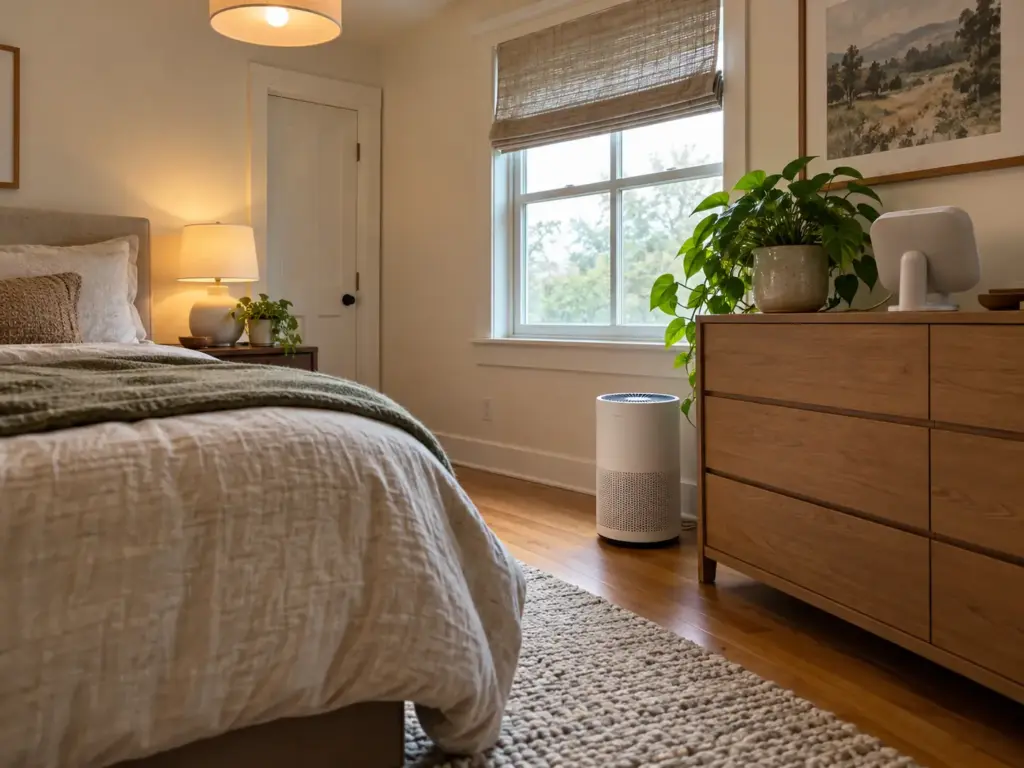
So a purifier can run all night in the bedroom while the monitor stays exactly where it was. It lowers the dust the monitor does not measure and leaves the CO2 it does. If the purchase you were about to make was a purifier for this reading, the best purchase is none: outdoor air is free, and the cheap monitor does the same job as the expensive one for this question. A purifier has jobs of its own, with a running cost in watts, and those belong to a different question.
Read it against the porch, then open one door
Three things carry over from this page. Read the room against the outdoor number, not against one quoted line, because the gap is what your household added. Treat the bands as one vendor’s scale and 1,000 ppm as a government guideline for a home’s 24-hour average, never as a limit for a single hour. And when the number is high, bring in outdoor air one change at a time, because nothing else lowers it.
A week from now, with the monitor in the same spot, take it to the porch again for ten minutes. If the outdoor reading has slid from where it started, the monitor has drifted and the house has not, and the same check at month three tells you whether that slide is steady. Tomorrow night, leave the interior door open and read the monitor before bed and again on waking, then set those two numbers beside the ones from a night with the door shut.
Frequently Asked Questions
01What is a bad CO2 level in a house?
A reading above about 1,000 ppm means the room needs more fresh air, and one monitor maker’s scale calls anything above 2,000 ppm very poor. Those bands are a vendor’s, while 1,000 ppm is Health Canada’s guideline for a home’s 24-hour average.
02How do I fix high CO2 levels in a house?
Bring in more outdoor air, one change at a time: open the interior door, raise a window a few inches, run an exhaust fan, then set the HVAC fan to circulate. Read the monitor between steps so you know which change worked.
03What causes high indoor CO2 levels?
People breathing in a closed room are the main source, and a tight building lets the number build faster. Unvented fuel-burning appliances and a gas stove add CO2 too. More air from outside is what brings the reading back down.
04Does an air purifier lower CO2?
No, a standard air purifier filters particles from the room’s air and does not remove CO2, so the monitor’s number stays where it was. Outdoor air is what lowers it. The purifier works on dust, which a CO2 monitor does not measure.