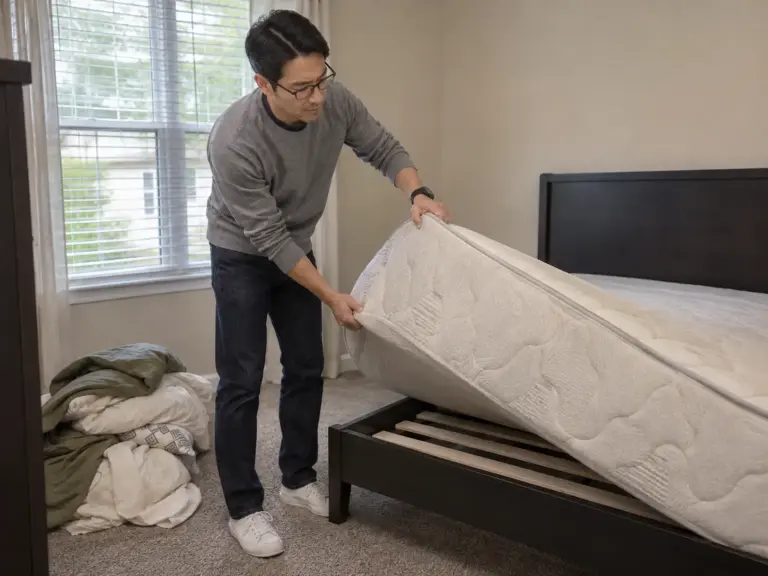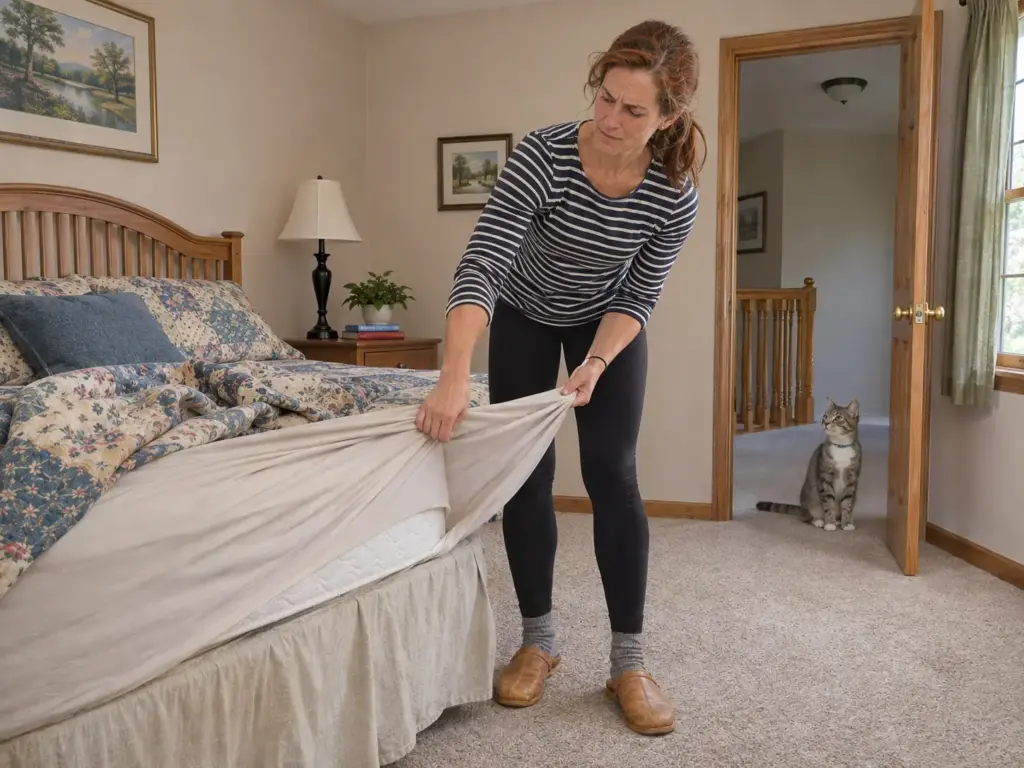
You have kept the cat out of the bedroom for months. The door shuts every night, and the room reads the same as the day you started. How to reduce cat allergies in the house comes down to where one protein sits, and the closed door never reached the biggest holder of it: the mattress you sleep on.
Fel d 1, the protein in cat dander and cat saliva, settles on cloth and stays put, so the house gets worked in a fixed order, from the surface with the most hours on it to the one with the fewest, with each fix checked against the number its owner publishes. Whether cat protein at home has anything to do with how you feel, and what to do about that, is a question for an allergist; everything below stays on the house.
Quick Answer
The allergen is a protein the cat makes and the hair only carries, and it settles and sticks, so the house gets worked in this order.
- Strip the bed, wash the bedding with detergent, then zip the mattress into a cover.
- Wipe door tops, sills, sofa backs and baseboards with a damp cloth.
- Vacuum with a sealed, bagged machine before you wash the floor.
- Size one bedroom purifier by CADR: about 78 cfm for a 10 by 12 room.
- Fit a MERV 13 furnace filter if the blower and the slot allow it.
- Read the bedroom humidity and keep it between 30 and 50 percent.
What Fel d 1 Is and Why It Sticks to a House
The closed door never touched what is in the house, because what is in the house is a protein. Cat hair is only the carrier that moves it from the cat to the cloth, and that changes what a clean room has to mean. A clean room now means a low allergen load on the surfaces, not a hair-free floor. Once the target is a protein that settles, the order of the work follows from where it settles.
The protein, not the hair
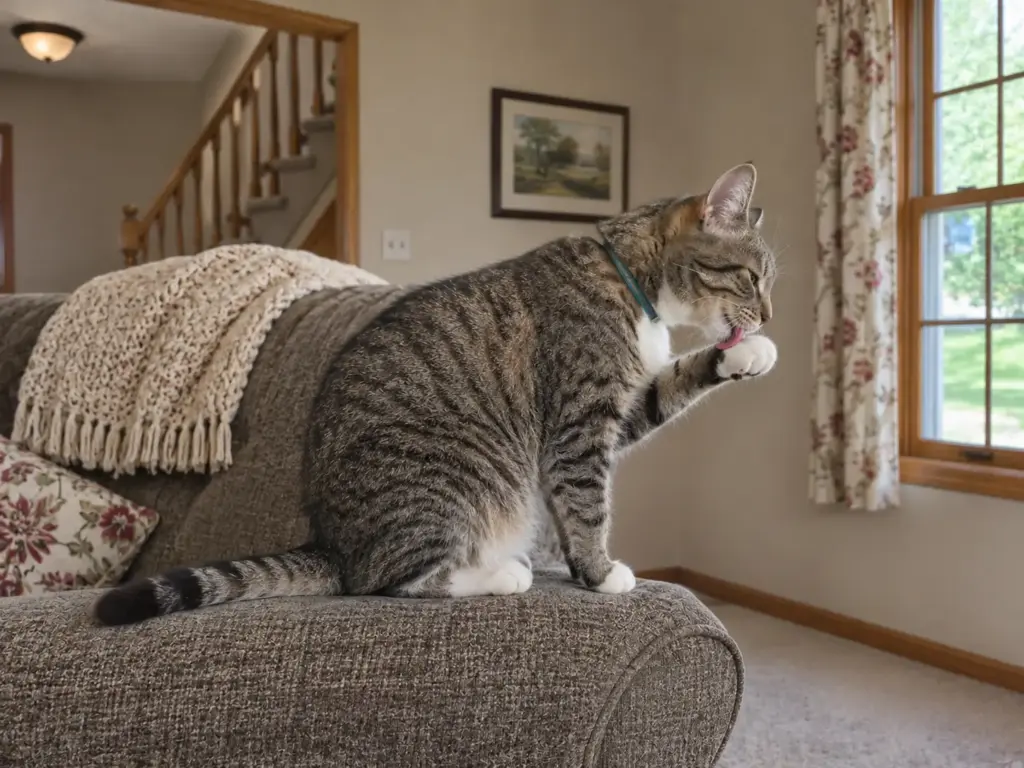
Fel d 1 is a protein the cat makes in its glands. In the glands measured in a 1990 immunology study, the tear (lacrimal) gland held 390 to 780 mU/g, the sublingual gland 610, and the submandibular gland only 40 to 50, and the authors write that the source is not completely known. The coat carries the protein because the cat grooms it on, so hair is a delivery route, and the thing worth removing from a house is what the hair leaves behind. That is a different job from picking hair off a sofa.
Why it lands on cloth and stays there
In 22 bedrooms, pet allergen sat mostly in the 2.5 to 10 micron fraction: particles big enough to drop out of the air faster than the finest ones and to lodge in fabric when they land. Carpet, drapes, upholstery and a mattress all give that kind of particle somewhere to settle, and a hard floor gives it less. And the places it lands are rarely the places a cat is seen to lie. The back of the sofa, the baseboard, the window sill and the top of a door collect it where a vacuum wand never goes.
Then comes the letdown that follows a new machine. The carpets are deep-cleaned, the vacuum is sealed and bagged, and the first evening on the sofa still feels dusty. The machine did its job; the floor and the air are separate jobs, and the sofa back belongs to neither, which turns the rest of this article into an order of work with several purchases inside it.
The other triggers an indoor space holds beside cat protein, and the order for dealing with them, are laid out in the guide to allergies in the house and the 30 to 50% humidity band.
Why the Mattress Comes Before the Bedroom Door
The door is the habit everyone tries first, and it fails for a simple reason: it keeps the cat out of the room and leaves the bed, the surface that carries most of the hours of the night, exactly as loaded as before. The mattress is the reservoir in that room. Everything else about a cat-free bedroom waits on it.
The door keeps the cat out, not the load
The allergen load has an order, and the order follows hours of contact.
The mattress and pillows come first, then the sofa the household sits on every evening, then the carpet and the drapes, and the baseboard comes last. One order with a reason beats a list of habits in no order, because it says what to do tonight and what can wait a month. A ten-year-old mattress goes to the top of that list. Closing the door for months changes little while that mattress is what you lie on.
Strip, wash and what the water temperature does and does not do
The free steps come first.
Keep the cat off the bed, strip it, and wash the sheets, pillowcases and any washable cover with detergent and a full agitation cycle. On temperature, the measurement is looser than the 130 to 140 °F instruction people attach to bedding. According to the laundry study on cat and dust-mite allergen in bedding, “Using detergent solutions at 25 degrees for at least 5 minutes was sufficient to extract most mite and cat allergen from dust of bedding.” Twenty-five degrees there is Celsius, about 77 °F, and washing at 60 °C (140 °F) pulled out only slightly more.
The hot-water figure is a dust-mite number, because it is the mite protein that heat denatures. The cat protein comes out with detergent and agitation, so a cool or warm cycle is not a failed wash. The care label on the fabric sets the temperature.
Encase the mattress
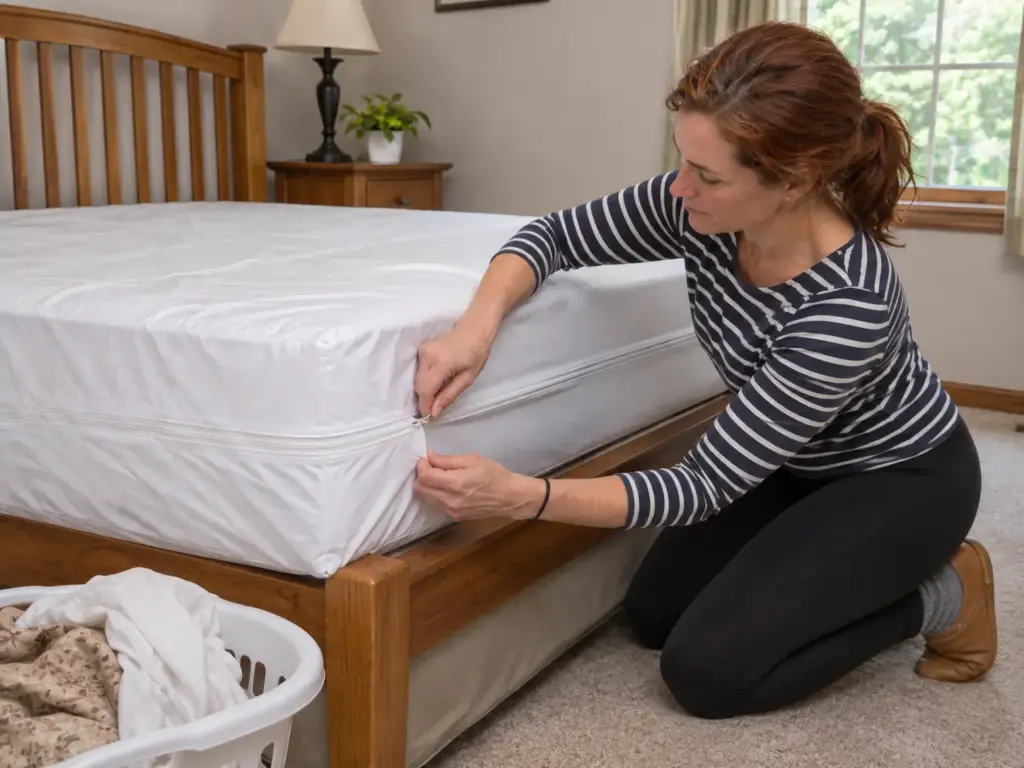
The paid change that follows the free ones is a zippered cover that closes all six sides of the mattress.
The Utopia Bedding Queen Size Mattress Protector Zippered fits mattresses up to 15 inches deep and goes through a washing machine, which is the point: the wash finally reaches a layer that can be washed, and the mattress underneath cannot be. The fabric tears easily and the size runs large, and the claims for its waterproof layer are disputed, so buy it for the encasement and treat any moisture barrier as a bonus. Measure the mattress’s depth and size before ordering. It is the cheapest real change in this article.
The zipper corner is the weak point of any cover: a tear there puts the reservoir back in contact with the sheet.
Run a finger along every zipper corner each time the cover comes off. A split there shows in a few seconds, long before the fabric looks worn, and it is the one spot where the encasement stops doing its job.
Carpet, Drapes and the Sofa in a House You Can’t Renovate
Tearing out the carpet fixes the surface problem and does nothing for a renter whose landlord owns the floor. The rest of the soft surfaces can be handled without touching a lease, and most of it needs only a washing machine and a damp cloth.
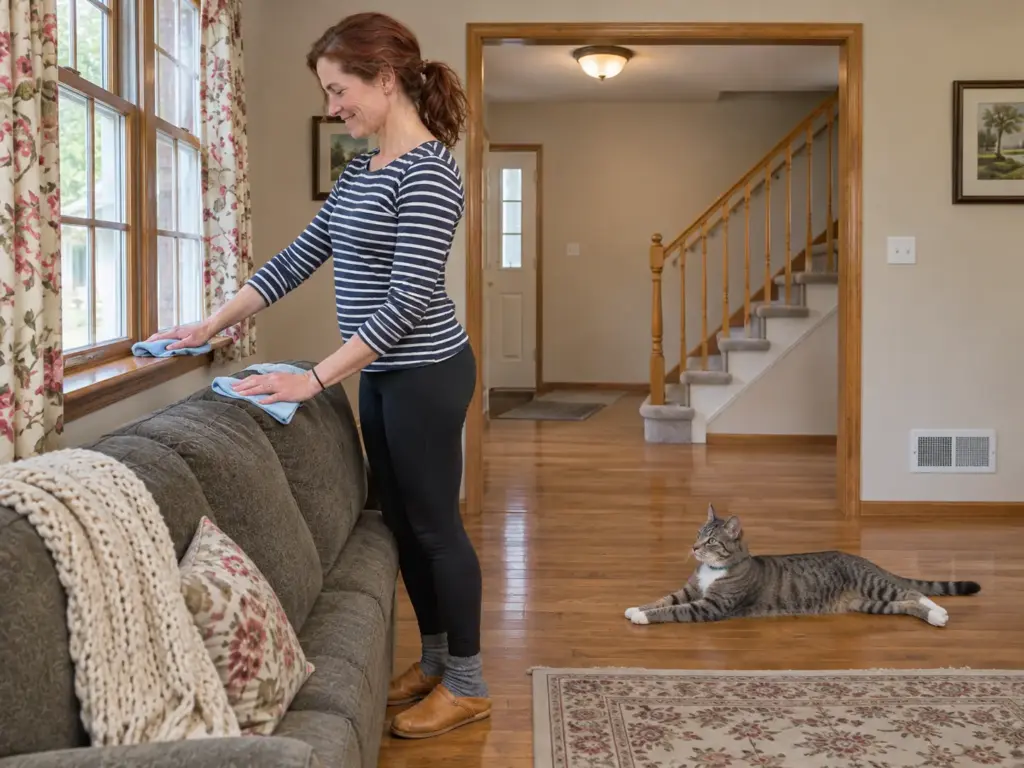
Carpet, rugs and drapes
Soft surfaces hold the load. Wall-to-wall carpet, area rugs and drapes give it somewhere to settle, and hard flooring gives it far less, and that is the logic behind tearing carpet out.
Renovating is not an option in a rental, so the version that fits keeps the carpet and gives it the sealed vacuum described below. Where there is a hard floor, a washable runner can replace a rug. Drapes that can be washed go in with the bedding, and drapes that cannot can come down when the room gets its session. None of it needs a landlord’s permission.
The sofa and the throw
A washable throw over the back of the sofa, and over the spot the cat likes best, turns that surface into something that can be washed with detergent like the bedding. It is the sofa version of the mattress cover. The back of the sofa is where the load stays longest, because the vacuum wand never goes there and the cat rarely sits there to be noticed.
The damp cloth instead of the dry sweep
Vacuuming the floor and never wiping anything else is a common way for the work to end up half done. The walls, the sills, the tops of doors, the sofa backs and the baseboards are where the settled load actually sits. A damp cloth lifts settled dust and holds it; a dry duster or a dry broom tends to fling the fine part back into the air as airborne particles, a re-suspension that settles again a few feet away. A sunlit room shows the mechanism: a dry swipe sends the fine part spinning through the beam.
Work from the top down, so that anything that falls lands on a surface you have yet to wipe. Door tops and sills first, then the sofa back, then the baseboards. The cloth goes in the wash afterward.
Rinse the cloth in the sink, or drop it straight into the wash. Shaking it out over the floor puts back what the wipe just picked up, and the room goes back to where it began.
A Vacuum That Keeps What It Lifts
Wiping handles the surfaces a hose cannot reach. The vacuum handles the floor and the cloth, and it only does that job if the machine does not blow the fine part of what it lifts straight back out of its exhaust.
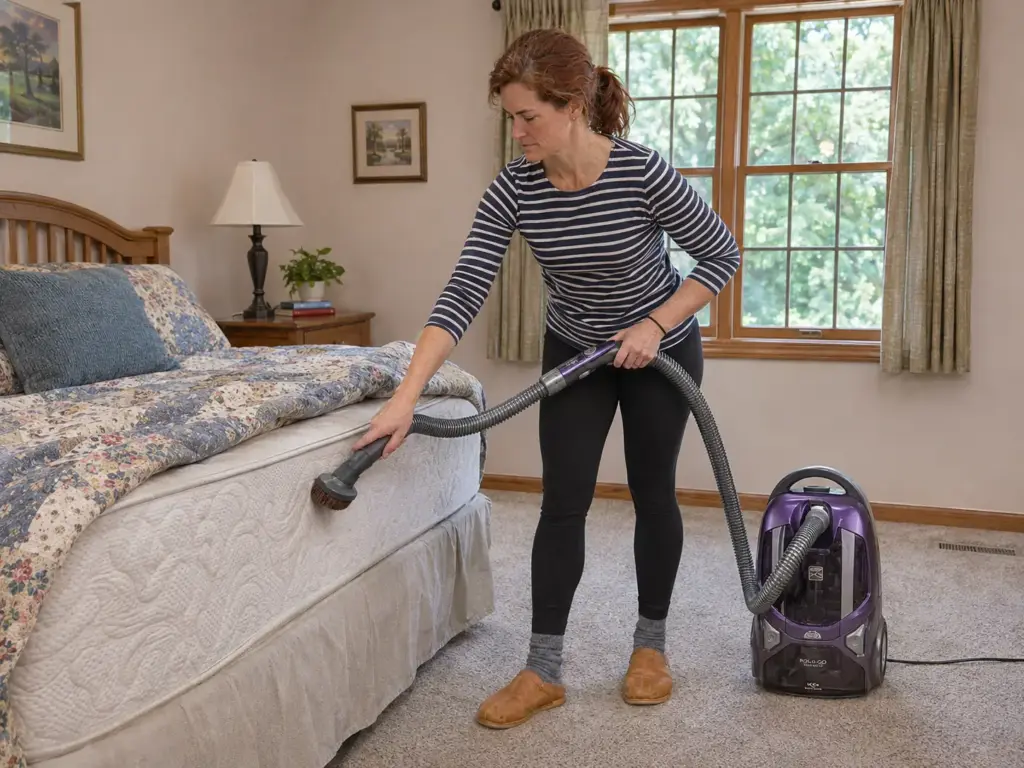
Sealed and bagged, not just labeled HEPA
A HEPA label on the box says a filter exists. It does not say the air passes through it.
No standards organization certifies household vacuums, so “sealed” is the maker’s claim on the listing, and what you look for is a bag, an air path closed from the intake to the HEPA filter, and a housing with no seams for air to take instead. That closed path is what a sealed system means, and it is what makes a HEPA vacuum worth the name. Air takes the easiest route, and a HEPA filter at the end of a leaky path filters only the air that happens to go through it. A bagged machine also keeps what it lifts in the bag until it is thrown out, where a bagless one empties a bin into the room.
A full bag and a clogged filter cut suction first, and the owner rarely notices until the carpet stops coming clean. Change the bag before it looks full.
The order of one session
The routine is the order, repeated. Fresh sheets followed by a vacuum puts the load back over clean linen, so the sequence matters more than the day of the week:
- Strip the bed and start the bedding wash.
- Wipe the high surfaces with a damp cloth, from the top down.
- Vacuum the mattress edge, the sofa and the curtains, then the floor.
- Damp mop the hard floor.
- Remake the bed with the washed bedding.
The two Kenmores
With money for one machine, put it into a sealed, bagged vacuum before a purifier, because the vacuum works on the soft surfaces where the protein waits and the purifier works only on the air. The Kenmore Intuition BU4020 Bagged Upright Vacuum Pet Friendly is the budget answer to the sealed-system question: a bagged upright with a completely sealed air path and HEPA filtration, according to the maker, a lift-up pod, two motors, HEPA bags and a 14-pound weight. Some units stop working altogether, and the marks for function and value are mixed, so keep the paperwork.
The step-up is the Kenmore 600 Series 81615 Pet Friendly Bagged Canister Vacuum, a bagged canister with a triple HEPA system, two motors, a Pet PowerMate head and a telescoping wand that reaches 10 feet. A canister with an upholstery brush gets to the mattress edge, the sofa and the curtains, which is where the settled load is, and an upright covers the floor. At 22.6 pounds it is heavy to carry upstairs, several break around month three, and the marks for value are split. The cheaper upright does the same sealed-bag job on the floor, and the choice comes down to whether the soft surfaces or the carpet are the bigger part of the house.
The Purifier, Sized by CADR and Not by the Box
The surfaces keep feeding the room, and a purifier works only on the air of that room at that moment. So the number that decides is the one the carton prints in the smallest type, and the one the carton shouts is a different number.
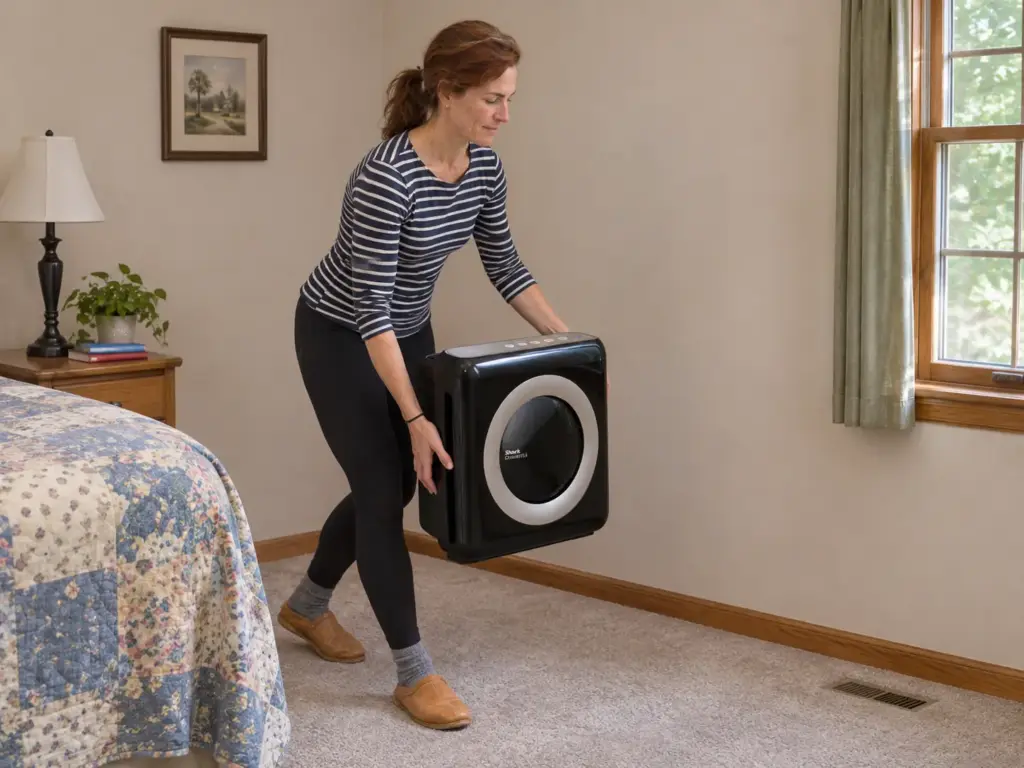
The number on the box and the number on the table
The EPA sizes a portable air purifier, which it calls a portable air cleaner, by its CADR, the clean air delivery rate in cubic feet per minute (cfm), against the floor area of the room: 65 cfm for every 100 square feet, calculated for an 8-foot ceiling, as laid out in the EPA guide to air cleaners in the home. Room size is the other half of the sum: a 10 by 12 bedroom is 120 square feet, so it needs about 78 cfm; a 300-square-foot room needs 195. The Coway Airmega AP-1512HH has a smoke CADR of 246 cfm, which the EPA table puts at roughly 380 square feet, while its carton promises 1,748 square feet in an hour. Same machine, two promises, and only one of them is a CADR.
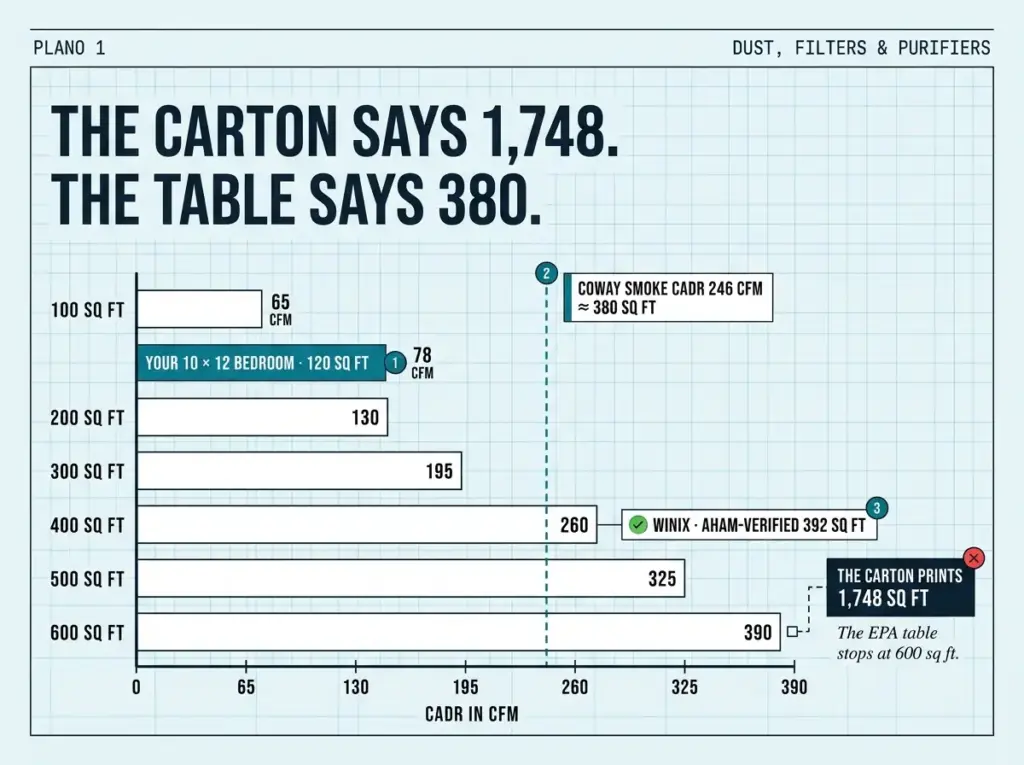
The carton’s figure is a coverage claim for one hour of running; the EPA’s table reads the CADR. Ceilings taller than 8 feet need more cfm than the table gives, and a CADR is rated at one fan speed, generally the top one, so the label’s number is the number at the loudest setting.
What a purifier reaches and what it does not
In the 22-bedroom air filtration study, air filtration cut airborne Fel d 1 by a median of 76.6 percent. That figure is airborne, in that room, while the unit runs. It never reaches the mattress, the sofa or the carpet, where the protein waits, and it does nothing for a room with the door open to the rest of the house. The unit also breathes badly against a wall: it needs open space around its intake and its exhaust.
An air quality monitor with a particle counter sees particles, and a PM2.5 reading in micrograms per cubic meter (µg/m³) is a pointer to what a filter is doing, so what a monitor can and cannot read in a room matters before one is trusted to judge a purifier. A cheap sensor can sit a few points off, and how far a cheap sensor can be off is worth knowing before a reading changes a decision. One purifier in the bedroom comes first, because the bedroom is the room with the most hours in it; the rest of the house can wait.
Two units against the number
The Coway Airmega AP-1512HH Mighty is a four-stage portable HEPA unit: a washable prefilter, a deodorization filter, a bipolar device and the HEPA filter itself, with a smoke CADR of 246 cfm and a three-year warranty. Read its coverage as the 380 square feet the EPA table gives, because the carton’s hour-long figure is a one-pass claim, and it has no app. A 78 cfm bedroom sits well inside that, which leaves the fan free to run below its top speed.
The Winix 5510 is a true HEPA unit with an AHAM Verifide rating for 392 square feet, a high-deodorization carbon filter, a washable fine-mesh prefilter and an auto mode driven by an air quality sensor. That verified rating is the number a buyer can actually use. Its PlasmaWave ionizer produces ozone, and the EPA says to avoid cleaners that intentionally produce ozone, so the HEPA stack carries the work and the ionizer adds nothing the room needs. Either unit clears the bedroom’s 78 cfm with room to spare; a filter replacement is the part of the purchase that gets budgeted late.
The Furnace Filter and What the Blower Can Pull
The furnace filter is not a purifier, and the first thing to settle is whether the fan even runs. A house with no furnace, no ducts and one window unit can skip this section: the bedroom purifier is the filter there.
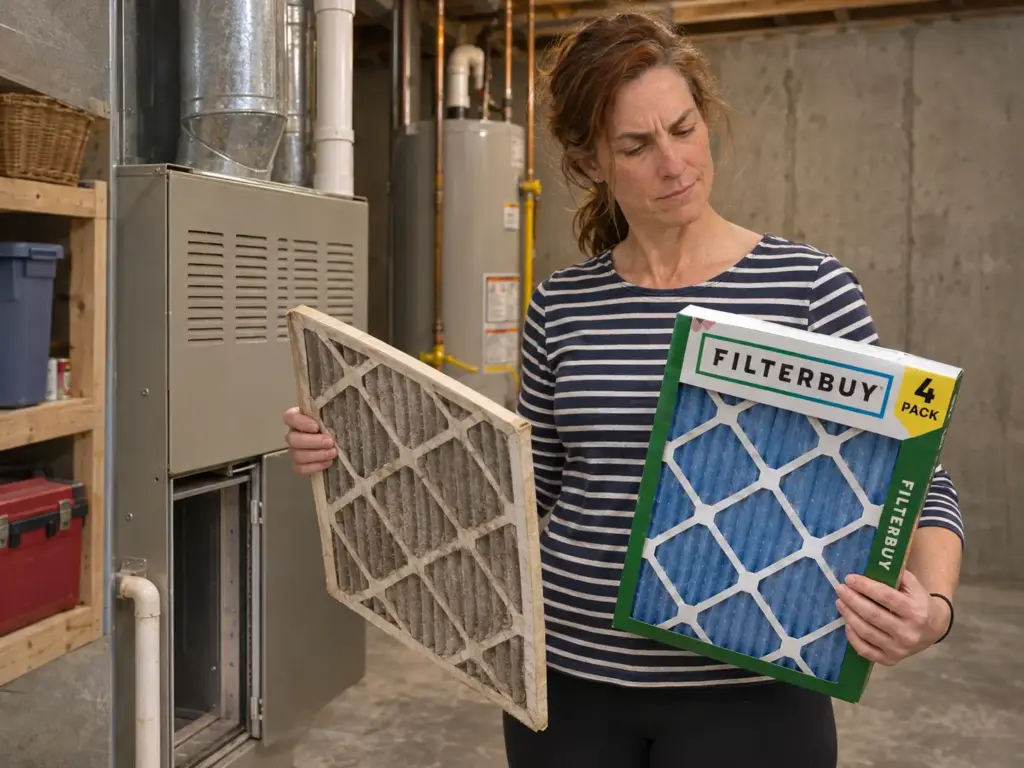
MERV 13 is the floor, the blower is the ceiling
MERV is the rating from ASHRAE Standard 52.2.
The EPA says to choose a filter rated at least MERV 13, or as high as the system fan and filter slot can accommodate, and that MERV 13 and above must show at least 50 percent removal of the smallest particles tested. MERV 13 is the floor. The ceiling is the blower in the air handler.
A 1-inch MERV 13 puts more load on the fan than a 4-inch media filter does, because the same media is folded into less filter thickness, and the pressure drop across it is what the fan feels. The slot decides which one the house can take.
How often the fan runs and when the filter loads
Furnace and HVAC filters filter only while the system runs, and in most homes that is less than 25 percent of the time in the heating and cooling seasons. In a mild week the fan barely runs and the filter does nothing at all. Makers typically say to replace a furnace filter every 60 to 90 days, sooner if it comes out heavily soiled, and in a house with a cat the filter loads on the cat’s clock, so look at it instead of dating it. A loaded filter starves airflow first, which makes checking the filter and the slot the free step before buying a different MERV.
The slot before the box
Measure the slot before ordering. The nominal size of a 16 x 25 x 1 filter is a rounded label, and the actual dimensions are 15.50 x 24.50 x 0.75 inches. A pleated filter that arrives a quarter inch short lets air go around it at the edge, and the number on the box does nothing there.
The Filterbuy 16x25x1 Air Filter MERV 13 Smoke and Allergy Defense comes as a four-pack of pleated, electrostatic MERV 13 filters, which suits the 60-to-90-day change a maker prints. The filters measure smaller than the nominal size, and how much airflow one costs depends on the blower, so a thin slot is where a restrictive filter shows up first. If the system whistles or the airflow at the vents drops after a swap, the slot is telling you the filter is too much for it.
Read the size printed on the frame of the old filter: the nominal size and the actual size both appear there. Order by the nominal size, then check the actual one against a tape measure in the slot.
The Cat Itself: Grooming, Wipes and the Egg-Protein Food
The cat is where the protein is made, so it is tempting to start there. The changes at the cat’s end are the ones with the smallest and least measured effect, and they come after the bed, the surfaces and the machines.
Brushing and wiping the coat
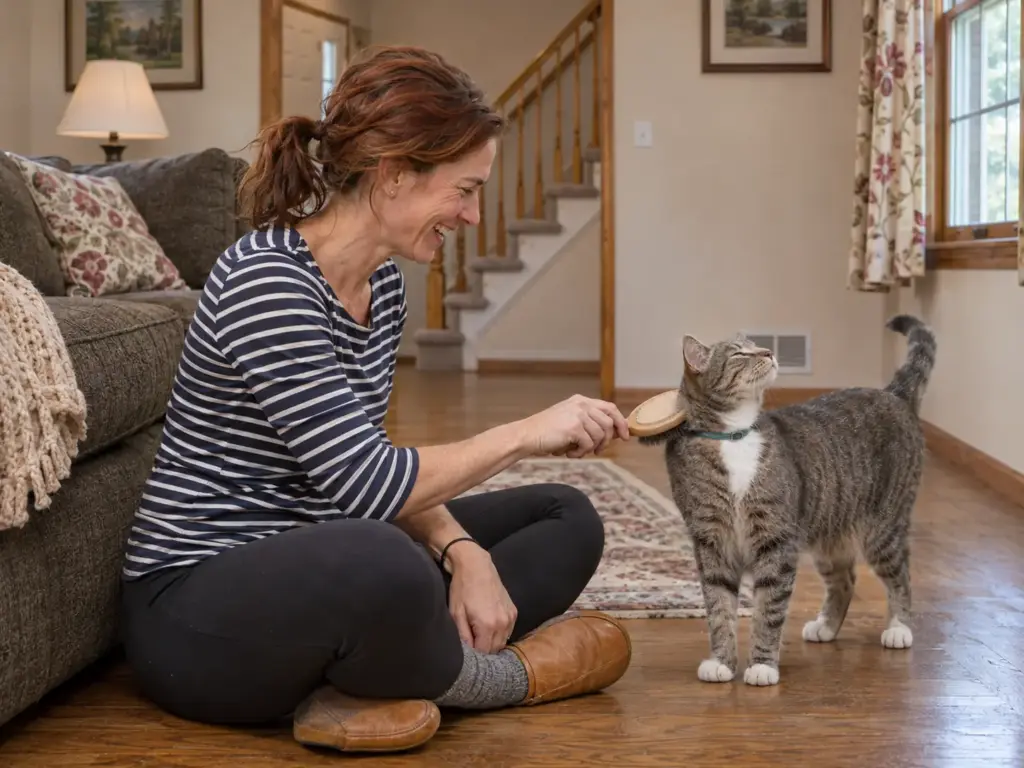
The coat carries the protein because the cat grooms, so brushing or wiping moves what sits on the coat.
It does not touch where the protein is made, and it is not the reservoir. Treat it as a small lever and keep it after the mattress, the vacuum and the purifier. A damp cloth or dander wipes along the coat, and a brush, move the same protein from the fur to the cloth or the brush, which then goes in the wash instead of back onto the sofa. Do it somewhere the cloth and the brush can be cleaned, and away from the bed.
A food with an egg-protein ingredient
The one measured change on the cat’s side is a Fel d 1-reducing food, a cat food with an egg-protein ingredient that contains antibodies against Fel d 1. In the food maker’s own published trial, salivary active Fel d 1 in the cats fell by 30 percent in the first trial and 24 percent in the second by the third week of feeding. It is a measured change in the cat’s saliva, and it arrives over weeks. The brand is left unnamed here, and the trial is the maker’s, so the figure is the maker’s.
Where this sits in the order
The cat’s end is the last thing to change, because the load already in the mattress, the sofa and the carpet does not move when the cat’s saliva does. The order stays the one the article opened with: the bed, the soft surfaces, the vacuum, the bedroom air, the furnace filter, and then the cat.
Month Two, and Where the House Stops Helping
A few weeks in, the filters have loaded, the second purchase has arrived, and the house turns out not to be a sealed room. Some of what the machines lowered comes back.
Filters are the second purchase
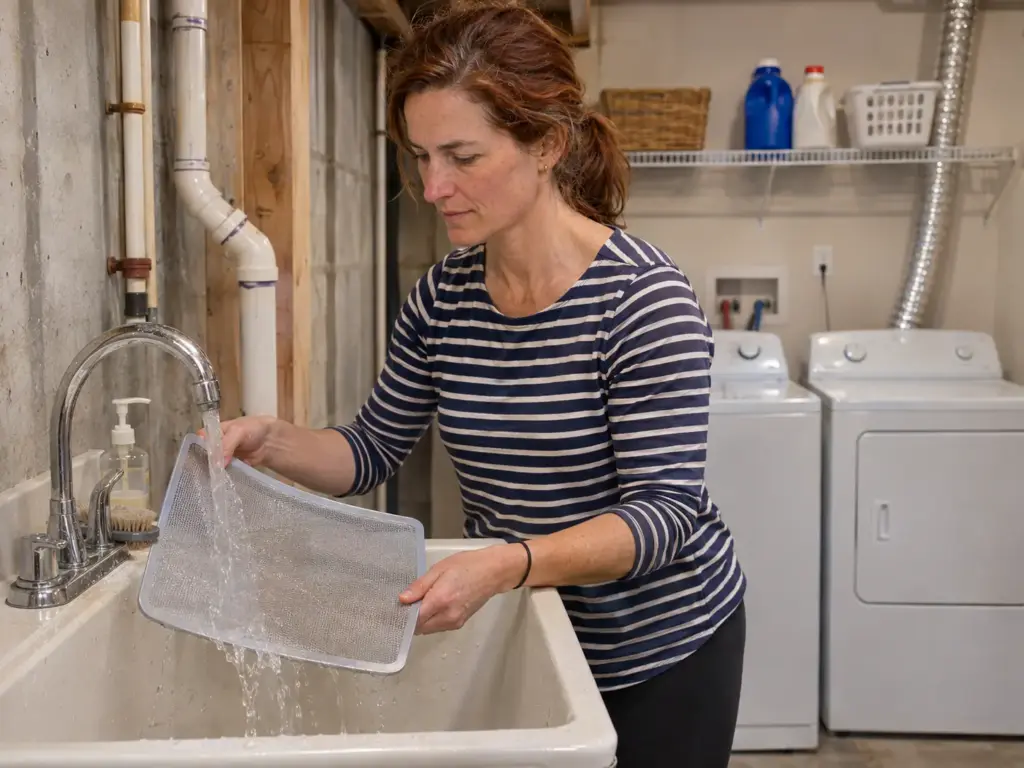
The prefilter on a purifier loads in weeks, and a washable one has to be washed or the airflow falls, so prefilter cleaning goes on the calendar.
A purifier with its door shut and a prefilter that was never washed moves less air at month two than the carton said at day one. The replacement filter is the cost nobody budgets for, and the yearly consumable is what makes a cheap unit expensive by year two: take the filter’s price at its replacement interval, divide it out over the year, and compare units on that figure. A purifier is also not a sealed room. The 76.6 percent from the bedroom study is airborne, in one room, while the unit runs, and the surfaces keep feeding the air.
Pull the prefilter out and hold it up to a window after the first few weeks. If the light barely comes through, it is already restricting the unit, and the CADR on the carton no longer applies.
The humidity band and the meter
An inexpensive humidity meter changes more decisions than any device on this page. According to the EPA humidity guidance for a home, “Keep indoor humidity below 60 percent (ideally between 30 and 50 percent) relative humidity.” Above 60 percent is where dust mites and mold find their conditions, and you cannot see the number without a meter. What a bedroom reading should be depends on the season and the room, and the free fixes come before any device: the free fixes for a reading that is too high are all things the house already has.
When it is not the air at all
A mattress that is ten years old is the first thing to encase. A damp wall, a window that sweats or a leak is a building problem with a different source, and past the free fixes it is a professional’s. If the meter stays above 60 percent after those fixes, a dehumidifier sized for a bedroom is the device that answers a reading that stays high. The house can lower the load; it cannot finish it.
Strip the Bed Tonight, Then Check the Filters in Four Weeks
The order is the article.
The bed comes first: strip it, wash the bedding with detergent, and zip the mattress into a cover. Soft surfaces come next, with washable throws and a damp cloth from the top of the door frame down to the baseboard, followed by a sealed, bagged vacuum run in the right sequence. After that comes the air: a bedroom purifier sized by CADR to the room’s square footage, and a furnace filter as high in MERV as the blower and the slot allow. The cat’s own end comes last, because it moves the least.
For later, look at the purifier’s prefilter and the furnace filter after a few weeks of the cat shedding, since in a house with a cat they load faster than the calendar says, and take a humidity reading again once the free fixes are in. Tomorrow night’s first move is the one with the biggest return: strip the bed, wash everything washable with detergent, and let the mattress cover go on before the sheets do. Then put a meter in the bedroom and read it the next morning.
Frequently Asked Questions
01How do I reduce cat allergens in an apartment I can’t renovate?
Start with the mattress and bedding, then wipe soft surfaces with a damp cloth and vacuum with a sealed, bagged machine. A washable throw on the sofa and a bedroom purifier sized by CADR need no landlord’s permission and leave the floor alone.
02Does hot water wash cat allergen out of bedding?
Hot water is not the main factor: detergent and agitation take most cat protein out of bedding even at 77 °F (25 °C). The 130 to 140 °F figure belongs to dust mites, so follow the care label for the fabric.
03Is a vacuum with a HEPA label enough?
Only if the whole machine is sealed. A HEPA label on a leaky housing can let fine particles blow back out, so look for a bag, a sealed air path and a HEPA filter; the sealed part is the maker’s claim.
04What MERV rating should the furnace filter be in a house with a cat?
The EPA says at least MERV 13, or as high as the system fan and filter slot can accommodate. Measure the slot first, because a 1-inch MERV 13 loads the blower harder than a 4-inch media filter does.
05Does a purifier in the bedroom work if the cat is already kept out of the room?
It cleans the air of that room and never the mattress or the carpet, so it lowers what is airborne while it runs. Size it by the CADR against the room’s area at 65 cfm per 100 square feet.