You have a basket of wet laundry, a rack in the corner of the one room with a door that shuts, and a window that opens four inches. By the third day the clothes smell before they are dry, and the wall behind the rack is cold and wet to the hand. That is where how to dry clothes indoors usually ends when the load is treated as a chore instead of as water added to a room: a wash hangs its whole load of water in the air, the air can only take what its humidity has room for, and the room’s reading, not the weight of the wash, decides whether tonight’s load fixes a dry apartment or starts a damp wall. The order below gets a load dry without the window running: read the room, take the free water out, give the rest one small room and one way out, move air through the garments, understand what heat does, and add a device only when the reading says the room cannot take it.
Quick Answer
Hanging a wash adds water to air that may already be close to full, so the order matters more than the rack.
- Read the room first: under 60% humidity, ideally 30 to 50%, is the EPA’s range.
- Spin the load once more and roll heavy pieces in a towel before hanging.
- Hang it in the smallest room you can shut, with a window cracked or an exhaust fan that vents outside.
- Space the pieces and put a fan under the rack, not aimed at the clothes.
- If the glass still runs by morning, add a dehumidifier sized for the room.
Read the Room Before You Hang the First Shirt
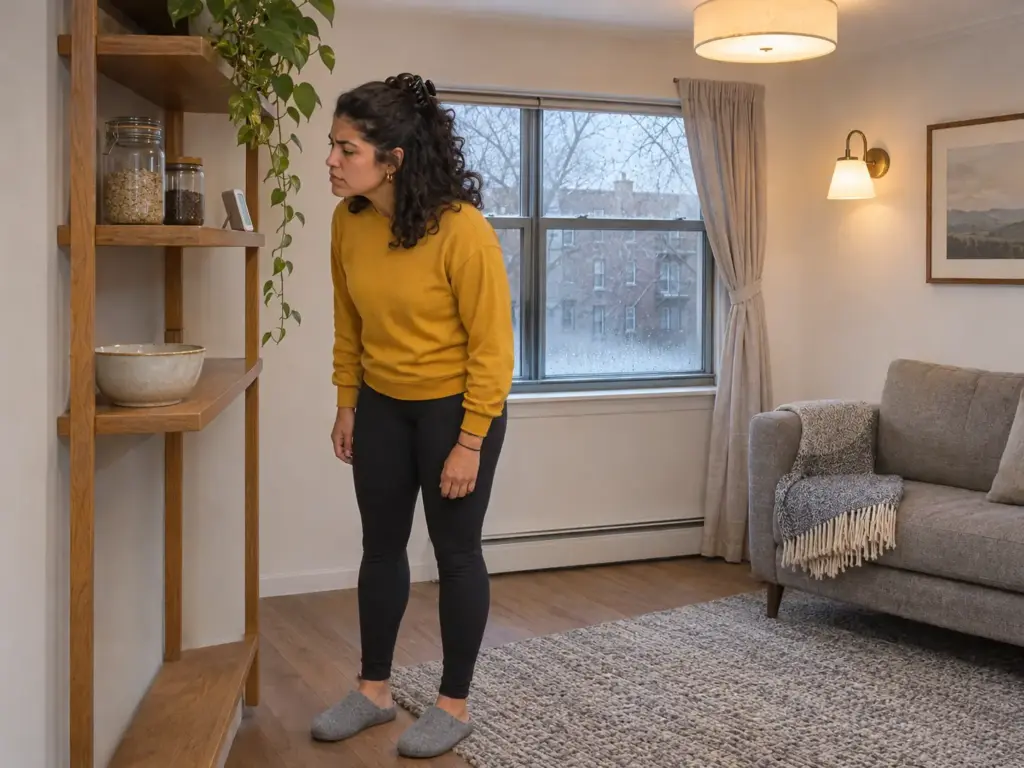
The same wash is a gift to one room and a problem in another, and the only thing that tells you which is a number the room already carries. Take that number before the rack comes out of the closet. Indoor drying is a moisture decision first and a rack decision second, and winter drying in an apartment is where the decision gets tight.
The Band the Whole Article Is Measured Against
The ruler for everything that follows is the EPA’s humidity range for a home. According to the EPA, “If possible, keep indoor humidity below 60 percent (ideally between 30 and 50 percent) relative humidity.” A room reading 25% is dry enough that a wash is free moisture the house wants. A room at 55 to 60% cannot take another load, and the same rack that helped the first room makes the window run in the second.
That is also why the article’s central paradox exists. A winter house is dry, the kind of dry that gives a spark off the doorknob, and a wash hanging in it is the cheapest humidifier it will ever have. Whether this room wants the wash or fights it comes down to where the reading sits against that band.
Why January Allows What November Does Not
The ceiling falls as the weather turns. The EPA’s list of where indoor moisture comes from names drying clothes indoors as a source of excess moisture, next to long showers and cooking, and reproduces ASHRAE’s maximum indoor relative humidity by outdoor temperature: 35% at 20 °F (−7 °C), 30% at 10 °F (−12 °C), 25% at 0 °F (−18 °C), 20% at −10 °F (−23 °C) and 15% at −20 °F (−29 °C). Above that line, the room-side glass starts to sweat, because the glass is the coldest surface in the room.
The dew point is the same idea told in degrees: the temperature at which the air gives up its water onto a surface. Window condensation is that moment, and it shows up first on the glass because the glass is the surface that sits furthest below room temperature.
Run the headroom exactly. A room at 25% with 20 °F outside has about ten points before the glass sweats, so it can take a wash. The same room at 25% with 0 °F outside has none, and a load there is already past the glass-safe ceiling. A November load that fits can be a February load that does not.
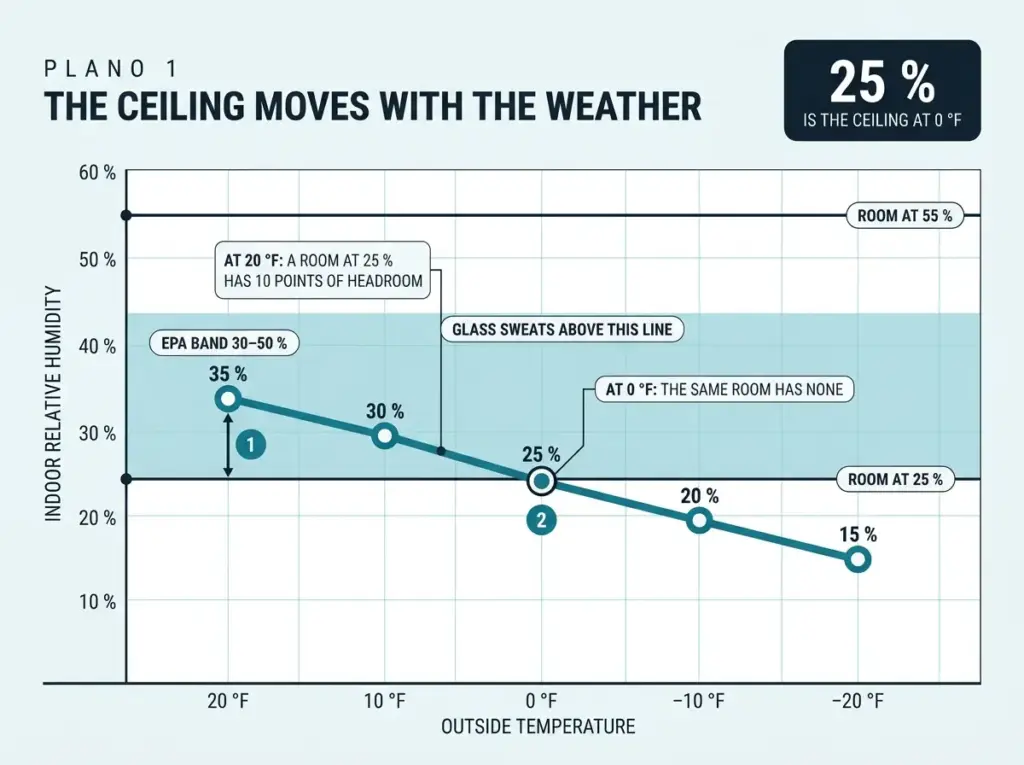
The hour matters as much as the date. The reading at dawn, after the heating has been off the longest, is the worst of the day and the hour at which the glass is wettest. If the dawn reading has the room, the wash can go up at night.
The Cheapest Thing That Changes the Decision
A meter. The AcuRite 00613 (model 00613B) is a small digital hygrometer and thermometer that keeps the day’s high and low on the screen, with no app and no Bluetooth to set up. Stand it across the room, away from the radiator and the rack, and read it at bedtime and again at dawn; how many readings around a room it takes to trust one is its own short routine.
Its weak spot is the usual one for cheap meters: units can disagree with each other by a few points, and some stop working within days, so a second meter is the check before any decision rides on one. A Govee H5075 is the version with a phone log for anyone who wants a graph instead of a screen.
Take the Water Out Before the Rack Gets It
Any water removed before the load hangs is water that never enters the room, which makes these the cheapest humidity moves in the house. They also come first because they cost nothing and take four minutes.
One More Spin, and a Towel Roll for What the Machine Left
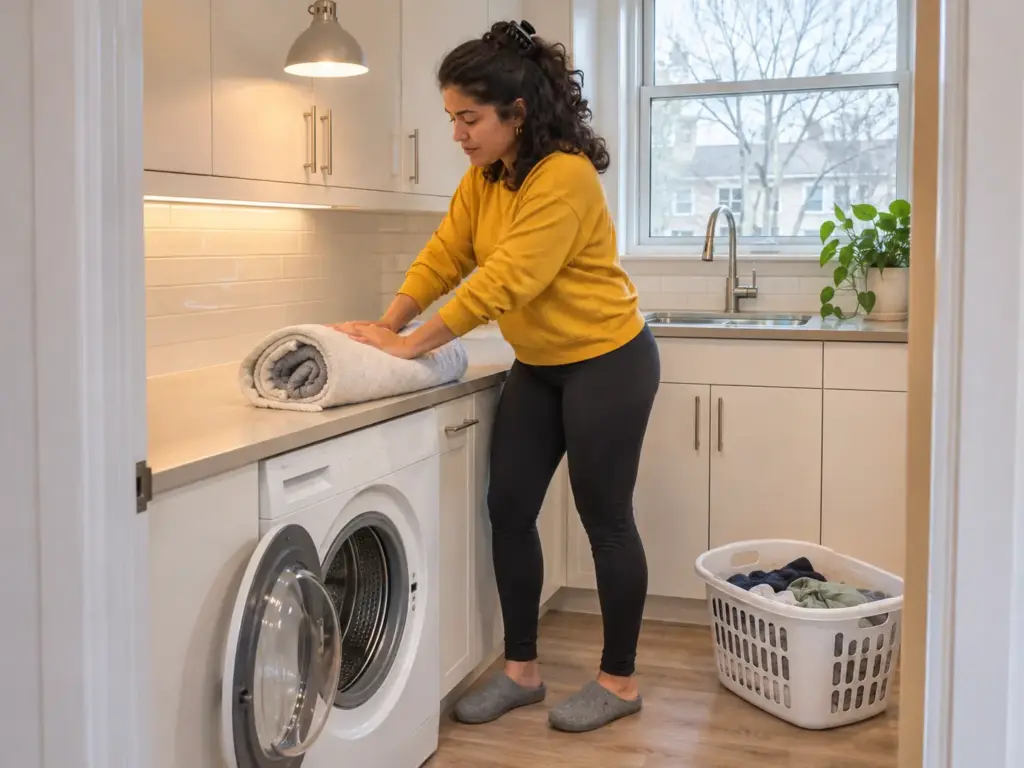
Run one more spin after the main cycle ends and shake each piece out before it goes up, so the folds do not hold the water. A load that comes out a little too wet sets the whole evening: the minutes saved at the machine are paid back in the room’s air for the next twelve hours. For the one heavy piece, a thick sweater or a sweatshirt, lay it on a towel, roll them together and press; that reaches what a spin cannot. The order the free fixes come in before any unit puts a dehumidifier last, and this is the first step on that list.
Weigh the basket wet before the extra spin and again after it: the pounds the spin removed are pints that never reach the room, and the difference tells you whether the minutes were worth it.
Weigh the Basket Wet and Dry: Your Own Count
The count worth trusting for how much water a load puts in the room is the one from your own bathroom scale. Weigh the basket wet, weigh it again when the clothes are dry, and subtract: one pound of water is one pint (0.45 L). That difference is the water that will be in the room’s air, and the reading from the first section says how much of it the room can take. No published figure for water per load is as good as this one, because it is the load you are actually hanging.
Bedding and other thick fabrics are the loads where the weighing pays off most, since a duvet or a heavy towel pile can hold several pints after the machine is done, and a pints-per-day rating on a dehumidifier is only useful once you know your own number.
When the Answer Is Outside, Not Inside
On a dry day with the temperature allowing, the free move is the line outside. ENERGY STAR’s own advice about drying clothes outdoors is the first answer it gives: if there is no clothes dryer, dry the clothes outdoors rather than hanging them inside. Everything after this point is for the days that line is not an option.
One Small Room, a Shut Door and One Way Out
Water that came out of the machine and into the room has to go somewhere, and the room it is in decides how fast the air fills. Containing it in one place is what stops it reaching the cold wall of every other room.
The Smallest Room You Can Shut
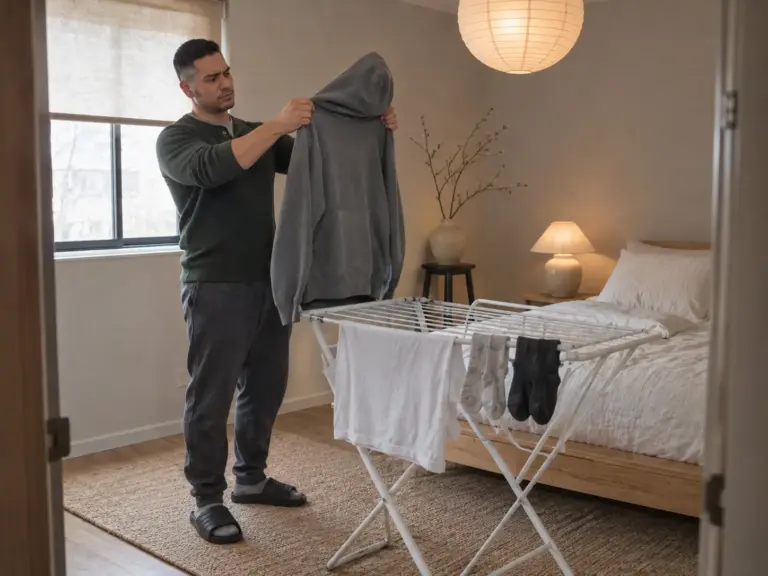
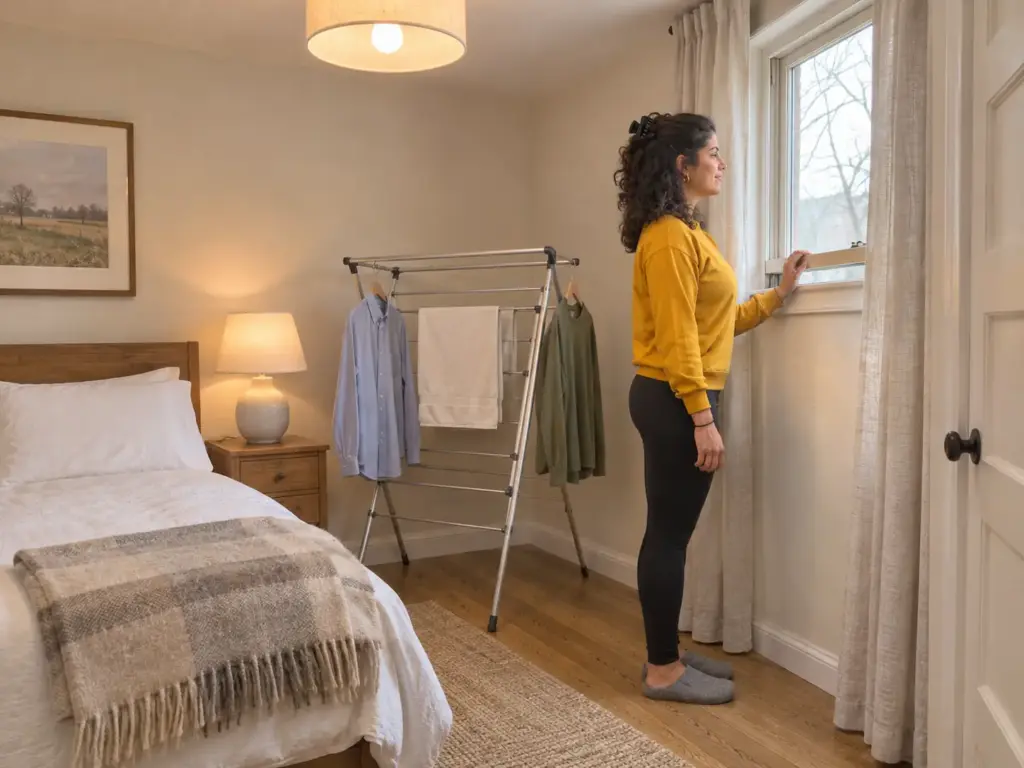
Pick a drying zone and keep the door shut: a bedroom of ten by twelve feet, with one window that opens four inches, is a fair case.
For apartment drying, a laundry room or a utility room with a door and a vent is the better pick when there is one, and the bathroom with its exhaust fan running is the next candidate.
The smallest room that holds the rack fills fastest, which is why the way out goes with it. Once the air in a closed room is saturated it stops taking water altogether, and the load sits at damp instead of drying. That stale air is the cue to open the window, because air exchange with the outside is what restarts the drying, and the EPA humidity range is the line that tells you when it is needed. ENERGY STAR puts a space where laundry dries in its wettest category, 90 to 100% relative humidity, which is the institution saying in one line what you see when the room stops drying anything.
A Way Out: The Window, the Fan That Actually Vents
Crack the window even four inches with the door shut. If a second window exists on another wall, a cross-breeze between the two moves more air than either window alone, and that ventilation is what carries the water out of the room. Then check the bathroom exhaust fan, because the EPA’s rule that exhaust fans must vent outside, not into the attic, is the free check that most rental bathrooms fail: a fan that vents into the attic moves the moisture one floor up and keeps it in the building. The same rule applies to a dryer vent.
Heating that goes off overnight makes the room colder, and colder air gives the same water a higher relative humidity. The glass is wettest at the hour the heating has been off longest. That is the morning’s reading, and it is why a load that behaved at bedtime can read differently at dawn.
When It Was Damp Before the Wash Went Up
Read the room on a day with no wash in it before blaming the rack. The EPA lists drying clothes indoors as one source among several, and a blocked or disconnected dryer vent, a bathroom fan that goes nowhere or a wall that was already cold and wet are the building’s own causes. How a jump at the shower tells a wash apart from a leak is a pattern worth knowing here: a spike that follows a shower and falls is a source you can manage, and a number that stays high on a quiet day is the room.
The window glass is the instrument. The wipe test that turns the glass into a reading works like this: a film that wipes away in the morning is the load, and a film that is still there at noon with no wash in the house is the room.
Space the Load and Put a Fan Under It
The room is contained and has a way out; the load now needs air moving through it, because a wet garment pressed against another dries at the speed of the wettest fold. Space and airflow do more than the make of the rack.

Space: Why Eight Inches Beats a Tight Row
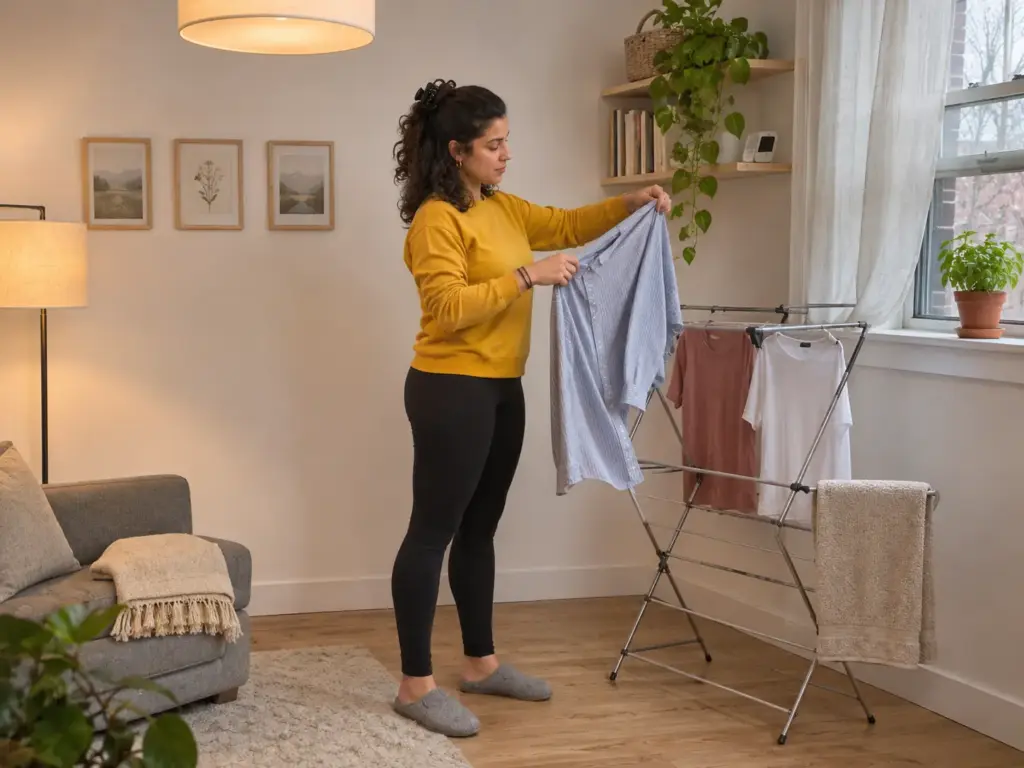
Give each piece about eight inches and put the heavy items, jeans, towels and sweatshirts, where the air is moving. Thick seams are the ones that stay damp on the second day while the light pieces are already put away, so the heavy piece goes up first and gets the most room. A ceiling hook or a line spaces a load better than any rack in a room that has them. Where floor space is short, an over-the-door airer or a wall-mounted drying rack gives the same spacing off the floor, and a clothes drying rack with a second tier is for the pieces that are light enough to hang over each other.
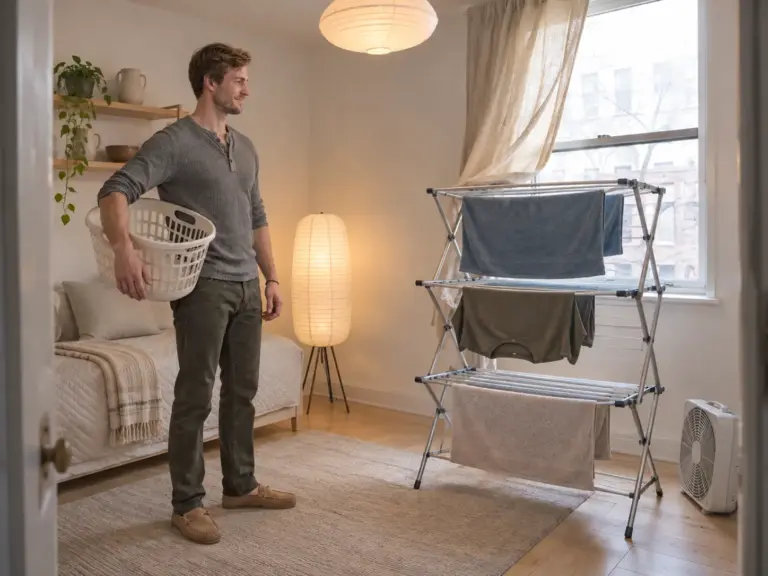
For a room without hooks, the BLACK+DECKER 3 Tier Expandable Laundry Rack (model BD05904) gives about 24.6 ft of line in a three-foot footprint, which is what the spacing rule needs, and its steel frame folds to about 3 inches so it lives behind a door. Its limit is written on the listing: 30 lb, which one wet duvet exceeds. Any steel accordion rack with about 24 ft of line does the same job, because the line length and the fold matter more than the brand.
A Fan Under the Rack, Not Pointed at the Clothes
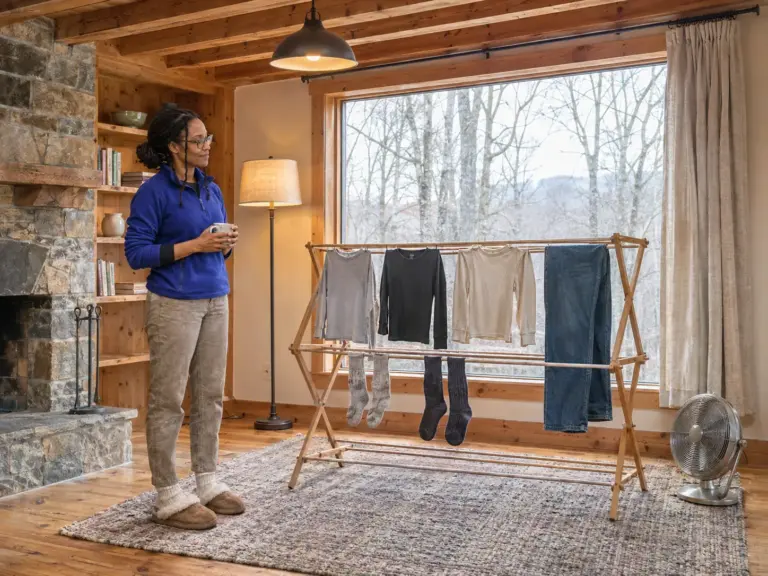
A box fan on its lowest setting, or a ceiling fan turning above the rack in a room that has one, is all the airflow the job needs.
A fan placed underneath the rack moves air through the whole hanging load, where a fan aimed at the front of it dries the first row and leaves the rest. A rack in front of an open window with a fan at the other end of the room dries a load fast even in a cold room. Under a fan the hem and the seam dry at the same time as the sleeve, and the heaviest piece decides when the room can be opened again. The moves to make before a fan or a unit are the same free ones: spin, space, open, then buy.
Hang the jeans and towels at the end nearest the fan and the T-shirts at the far end: the light pieces finish early anyway, and the heavy ones get the strongest air.
Where Warm Air Dries and Where It Only Warms
Space and air are in place, and the radiator and the heated rack are what most people reach for first. Heat does help, and the reason it does not finish a load by itself is that warm air has to carry the water somewhere.
Heat Helps, but the Water Still Has to Leave
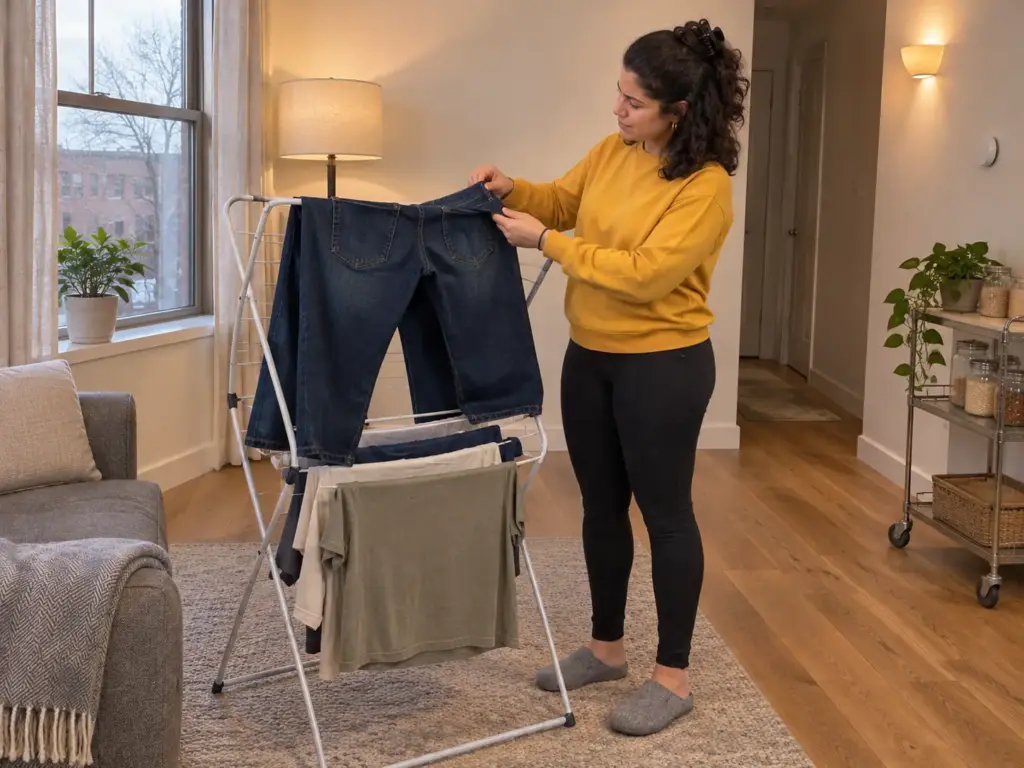
Warm air holds more water, but a closed room that is warm and saturated dries nothing. Heat the room and crack the window at the same time, so the moisture has somewhere to leave. Room temperature helps because warmer air takes up more water, but a space heater pointed at the load is a poor trade: it dries one side of the fabric and puts a hot element next to cloth, so keep it away from the rack and let the radiator or the room’s own heat do the warming. A rack parked near a heating vent overnight, with the load already spun a second time, can be dry by morning, and then the hour-by-hour story matters: the hour-by-hour overnight pattern once the heating goes off is when the same water starts landing on the glass.
What the Published Tests Say About Hours
The drying clocks come from published tests of specific devices, and each is that one device in that one test, not a promise for your room. In the Independent’s heated-airer test a T-shirt took about an hour and jeans about three under a heated pod. In the Telegraph’s review towels took about six hours on a covered 300 W airer.
And in the Good Housekeeping Institute’s test, a whole load went from wet to dry in 2 hours 17 minutes with a 20 L dehumidifier in a closed room at 64 °F (18 °C). Plan on hours for overnight drying, since the heaviest piece sets the clock, so build the evening around the towels. A tumble dryer or a vented dryer does the job in one cycle, and that is the standard every indoor setup here is competing with.
The 300 W Heated Airer, With and Without Its Cover
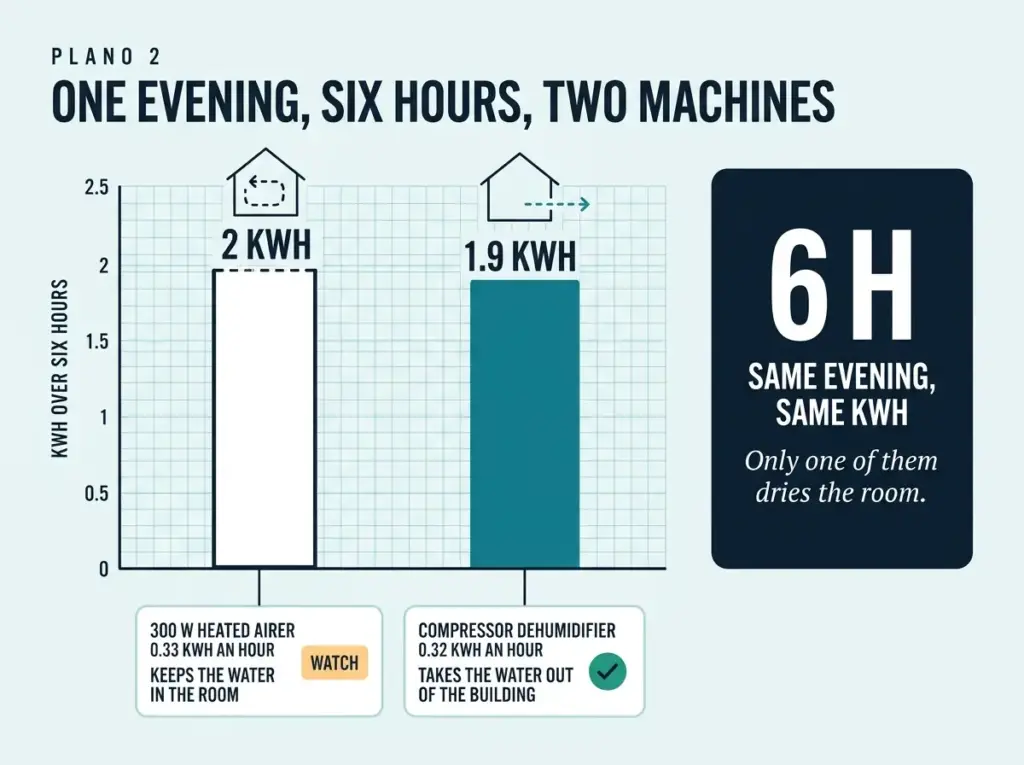
A heated clothes airer is a rack with 300 W of heating in its rails, and a covered heated airer adds a zip-on cover over the whole load. The Telegraph metered a three-tier unit at about 0.33 kWh an hour on a smart plug, so six hours is about 2 kWh.
Covered or open changes the drying time more than the brand does, and that is where the flaws sit: a cover traps the water under the fabric, so the airer goes with an open window or a dehumidifier; it dries slower than a dehumidifier in a cold room; and the cover smells of the last load it dried. At month two the rails also carry scale in a hard-water house. Lift the cover at the half hour and feel the seam, not the sleeve, because a covered airer is dry on the outside and damp underneath.
The Dehumidifier, Sized in Pints for a Room With a Wash in It
Everything free has been tried and the reading says the room still cannot take the load. The only fix on the list that both dries the clothes and takes the water out of the building is a dehumidifier, and it is sized off the laundry, not off the floor.
How Big: Pints for a Room With a Wash in It
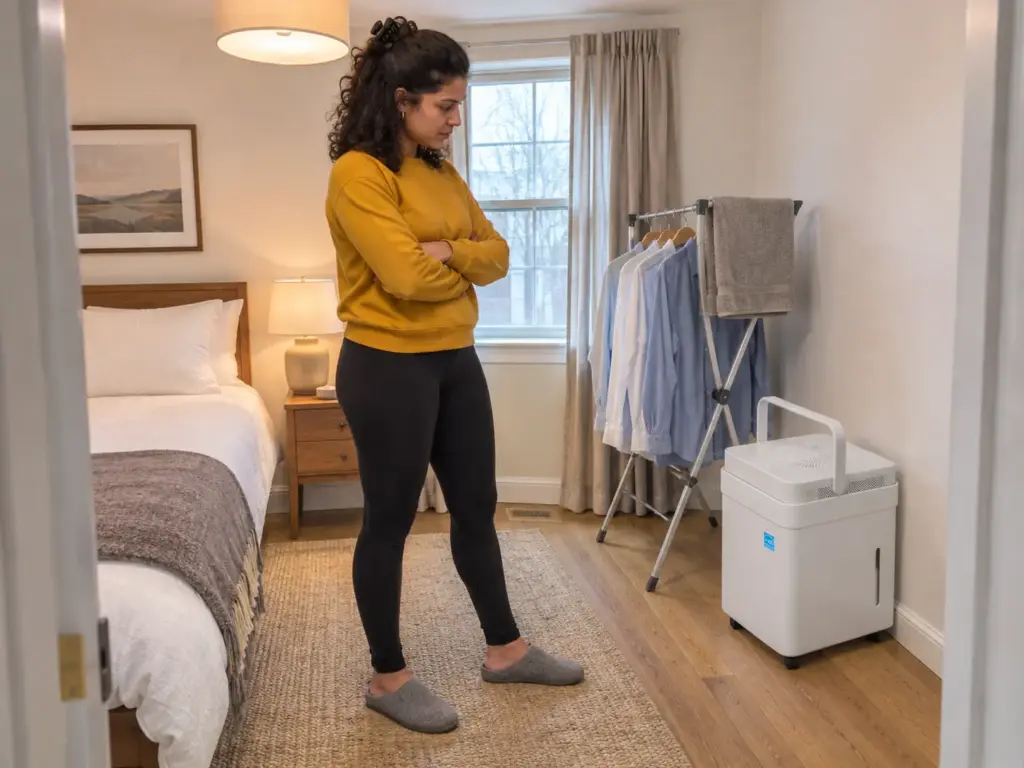
How ENERGY STAR sizes a dehumidifier for laundry starts with the wettest condition the room reaches. A space where laundry dries sits in its Wet category, 90 to 100% relative humidity, and that category asks for 30 to 50 pints a day for a room under 2,000 square feet. A 20-pint unit is a bedroom unit, and the chart asks for more the moment a wash is in the room. Sized in pints for a room whose glass sweats is the same sizing question from the window’s side.
A pint rating is also not comparable across years. The same Midea unit is sold as 20 pint today and was sold as 30 pint under the pre-2019 DOE test, because the 2019 test moved from 80 °F to 65 °F. Two listings showing 20 and 30 for the same class of machine are not contradicting each other.
A desiccant dehumidifier works in a cooler room where a compressor unit loses output, at the price of more watts, and both units below are the compressor kind. A compressor unit too small for the room does nothing you can feel, even stood under the rack, and it needs a warm room to work: the 2 hours 17 minute test ran at 64 °F (18 °C).
The Bedroom Unit and the Open-Plan Unit
The Midea Cube 20 Pint (model MAD20S1QWT) is the one that fits a bedroom: 20 pints a day, a target you set between 35 and 85%, a continuous drain option so it does not stop with a full bucket overnight, and an ENERGY STAR listing. It weighs 33 lb as a cube. Its weak point is reliability, because units can die after a few hours of use, and the bucket is heavy enough that emptying it is a chore.
The Pro Breeze 50 Pint (model PB-D-23) is the size ENERGY STAR asks for when a wash is in an open room or more than one load a day goes up. It is rated at 86 °F and 80% humidity, ships with the drain hose, and has a 10-pint bucket and a 30 to 80% target. It is the splurge of the two, and the Midea costs a fraction of it.
Water removal on the big unit is mixed, with some units pulling a lot and others almost nothing, and some stopped within the first two weeks. For one bedroom the Midea is the easier unit to live with; judged by pints, decibels and the bucket, the bedroom pick has its own page.
Once the unit is in the room, the number to set once the unit is in the room is the one the reading gave you, inside the 35 to 85% the Midea allows.
What the Evening Costs in kWh
A compressor dehumidifier draws about 0.32 kWh an hour at full tilt, per the Good Housekeeping Institute’s test, so six hours is about 1.9 kWh. That is almost the same as the heated airer’s 2 kWh, and the difference is that the dehumidifier takes the water out of the building while the airer leaves it in the room.
The tank is the receipt. The pints per day on the label are the ceiling, not the daily result. A twenty-liter bucket that fills every few days during a drying week is water that would otherwise be in the plaster.
Why the Same Load Dries Clean in Six Hours and Smells in Three Days
The room, the air and the device are settled. What is left is the odd fact that nothing about the clothes changes between the load that comes out clean and the one that smells, and that the difference is the clock.
The Clock: Dry Before the Smell Has the Time
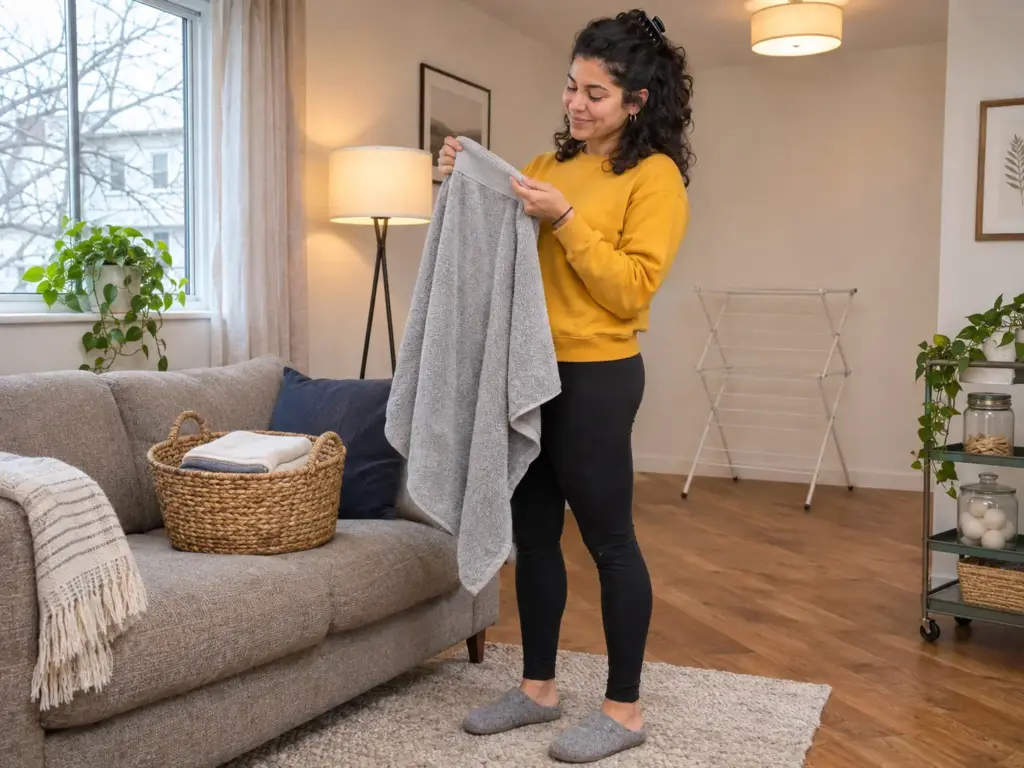
The moment a load goes from dry to musty is a timing problem. The same wash dries clean in six hours and smells in three days, and the clothes did not change between the two. The room’s reading, the spacing and the way out in the sections above were all for this: get the load dry before the smell has the time. Thick items are the ones that go musty, because they are still damp on day two while everything light is already away.
Check the back of the waistband and the inside of a thick seam before you take a load down: a heavy seam that feels cool to the touch is still wet inside, even when the surface is dry.
The Thick Seam and the Stiff Towel
Fold-dry is the standard to aim for: dry enough to fold and put away. Damp-dry, the halfway point after a spin, leaves the last hour to happen on the rack, which is why spacing clothes matters more than the clock on the wall.
A musty smell, or a musty odor that the rack keeps between loads, usually means the load sat damp too long, and a drying rack smell that stays after the clothes are put away means the rack itself needs a wash. When the smell comes back even though the drying is fast enough, the fix moves from the room to the wash: a detergent with lipase, a warm wash and white vinegar in the rinse are the moves usually tried, and none of them is proven to work every time. Stiff clothes and stiff towels are detergent residue left in the fabric, not a drying problem, so an extra rinse cycle, a lighter dose and no fabric softener on towels are the fix. An extra spin cycle at the end of the wash also pulls out more water before the hang.
One more check belongs before the rack gets blamed. A washing machine whose door seal traps water can give the same smell before the load ever hangs, so check the washing machine seal and leave the door open between loads.
The Wall Behind the Rack, the Full Tank and Week Six
The first week lies: a load dries, the glass is clear and the rack looks fine. What matters is what the same setup looks like when it has run every wash day for six weeks.
The Cold Wall Behind the Rack
The wall behind the rack is the February test. It feels colder than the rest of the room because it is, and why water lands on the coldest surface first is the mechanism behind it. A rack pushed against it makes the air behind the rack the stillest in the house.
A wall that stays wet is one of three things, a cold wall, still air or water from the building, and cold, still or wet, the three causes behind a wall that stays damp is the sorting to do before the load takes the blame. When a wall stays cold, wet or dark with no wash in the house, that is the building’s problem, and the next step is a professional, not another rack.
The Tank, the Meter and the Rails at Week Six
Both dehumidifiers and the meter in this article have the same weak point: early failure. Units that stop in the first week or two, and a meter whose reading drifts or whose screen dies, are how these parts behave, so check the first meter against a second one after the first week. The setup that survives the winter is the boring one: a rack, a fan pointed at it and a dehumidifier, with clothes washed in the evening and dry by morning.
And read the room at dawn in week six with the rack empty. If that number is higher than it was in week one, the room has been drifting up for a month.
Tonight’s Wash, in Order
The reading decides, and the weight of the load does not. A room at 25% in a mild week takes a wash, and the same room at 55% cannot. After that the order is fixed: spin the water out, roll the heavy piece in a towel, hang one load in one small room with the door shut, a window cracked and a fan under the rack, add heat only if the water can leave, and size a dehumidifier in pints when the reading says no.
Check back on a few things: the glass the morning after, the meter against a second one after a week, the bucket that fills every few days, and the wall behind the rack at week six. What a humidity reading of 50 percent means in a house is the reference to hold those readings against.
For tonight, read the room at bedtime and again at dawn, wash and spin, and hang the heavy piece first with a fan under it and the window cracked. If the reading says the room cannot take it even then, the unit for one room is the next step. And if the same house is dry in January, when a room unit or the whole house is the right humidifier for a dry winter is decided by the same two readings.
Frequently Asked Questions
01How can I dry my clothes inside without a dryer?
Spin the load once more, roll the heavy piece in a towel, and hang it in one small room with the door shut, a window cracked and a fan under the rack. Check the room’s humidity first: under 60 percent, ideally 30 to 50, is the EPA’s range.
02What is the quickest way to dry clothes indoors?
Take the water out first, then move air and remove moisture: a fan under the rack and a dehumidifier in a closed room. One 20 L unit took a whole load from wet to dry in 2 hours 17 minutes in a published test at 64 °F (18 °C).
03Is it okay to dry your clothes indoors?
Yes, if the room can take the water. The EPA counts indoor clothes drying as a moisture source and says to keep humidity under 60 percent, ideally 30 to 50. If the glass runs by morning, the room cannot.
04How can I dry my clothes inside a room?
Choose the smallest room you can shut, give the load eight inches between pieces and put the heavy items where the air moves. Open the window a few inches or run an exhaust fan that vents outside.
05How do I dry clothes indoors without them smelling musty?
Get the load dry before the smell has time: spin it again, space it, move air through it, and keep the room under the band. Thick seams are the last to dry; if the smell returns even with fast drying, the fix is in the wash.