
You wake up, pull back the curtain, and the lower half of the bedroom glass is clouded with a film of water. So you type is condensation on windows normal into your phone, hoping the answer is a towel and not a phone call. The glass is the coldest surface in the room, so the room’s warm air meets it first and gives up its moisture there; the film is a reading of the room, not a flaw in the window. Morning condensation on the inside of the glass is the ordinary case.
What follows is which side of the glass the water is on, the reading to take against the cold outside, the fixes in order with a look at the glass between each, and the signs that the building, not the room, is the source. The year-round band lives in the ideal humidity range.
Quick Answer
A film on the room side of the glass that wipes off on a cold morning is normal: it is the room’s moisture meeting the coldest surface in the room. It is not normal between the panes, running onto the sill, or staying all day after the room’s humidity is in range.
Which Side of the Glass the Water Is On
The verdict hangs on a place before it hangs on a number. A double-pane window has two sides worth checking, and water on one of them means the opposite of water on the other. So before you reach for a meter or a window company’s number, find out which side you are looking at.
The 10-second wipe test
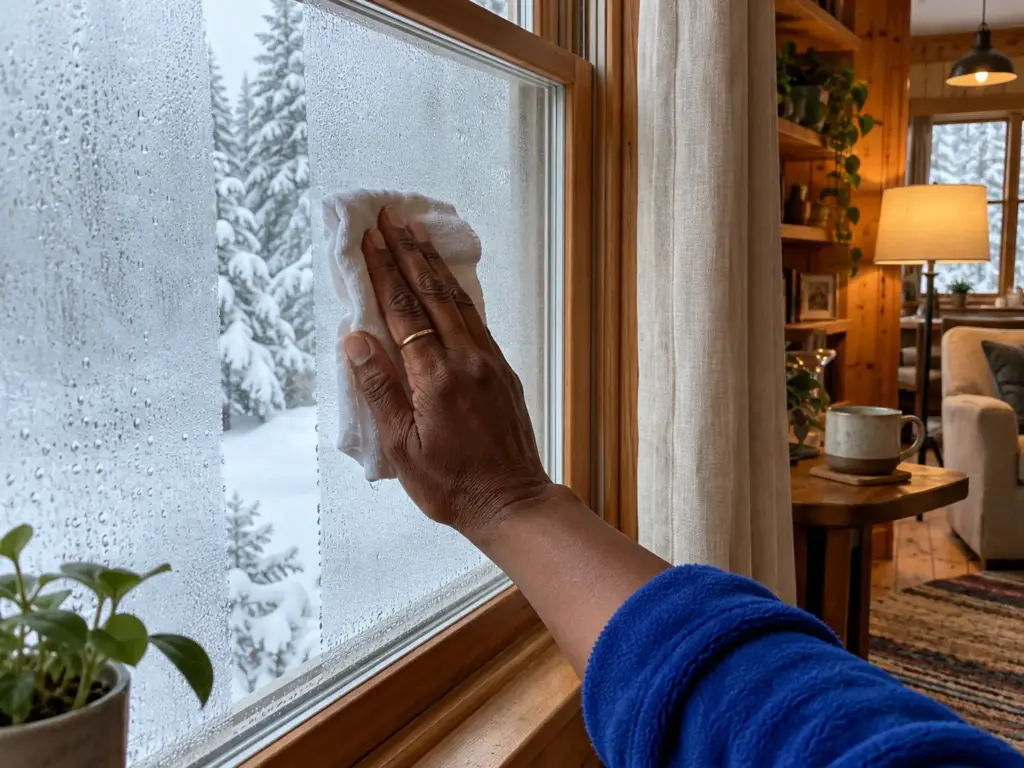
Normal condensation is inside window condensation that a dry cloth removes. So take a dry cloth and wipe the window in a single spot on the lower pane. Water that comes off on the cloth was on the room side of the inner glass. A haze that stays after the wipe, or a cloud you can see sitting inside the insulating glass, is between the panes, where no cloth can reach.
Do it first thing in the morning, when the film is at its worst, and pick the lower edge of the lower pane. That strip is the coldest part of the window glass surface, so it is the first place a film shows and the last place it clears.
Two outcomes, then, and they point in opposite directions. Room side condensation is a reading of the room’s air, and the sections after this one are about taking that reading. Fog between the panes is not a reading of anything, and the last part of this section says why.
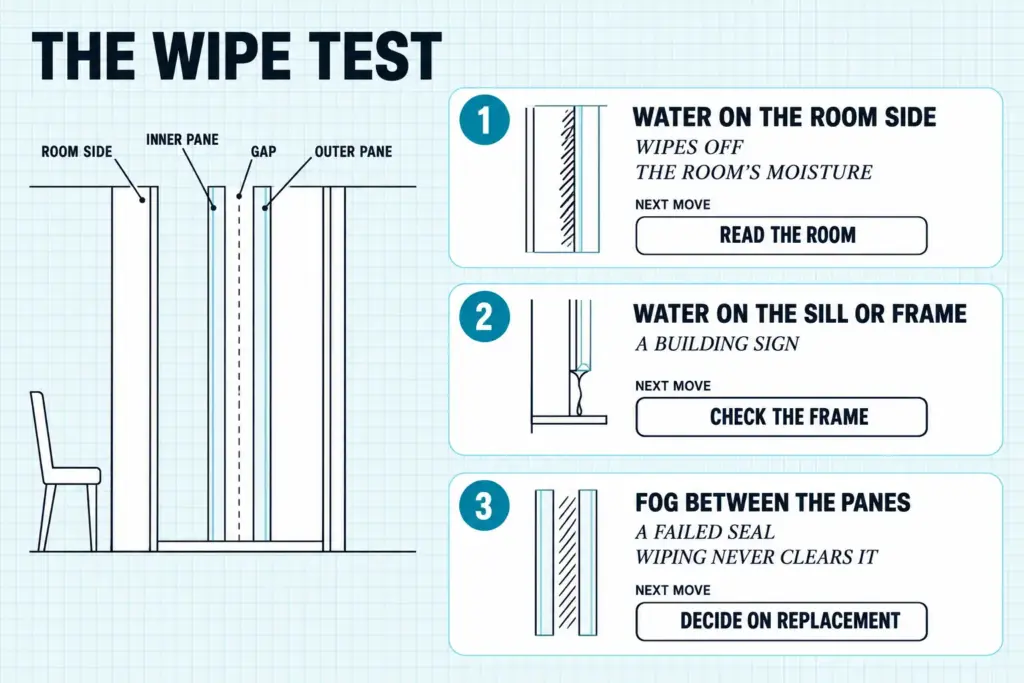
Water on the room side: the room’s moisture
Warm air carries more water vapor than cold air can hold. When room air touches the inner pane it cools right at the glass and drops what it can no longer carry, the same thing that happens to a glass of ice water left on a table. Once the glass is colder than the air’s dew point, moisture on glass is the result.
That is why the film starts along the bottom edge and creeps upward on the coldest mornings.
Note how high the film climbs when you wipe, not just that it is there. A film confined to a thin strip along the bottom edge means the room is close to the line for that day’s cold. A film that reaches halfway up the pane means a much larger part of the glass is below what the room’s air can tolerate, and the room is further past it.
In a well-sealed house this is the ordinary case. A film around the edges of new glass can show up the first winter after windows are installed, when none appeared the winter before. Check first that it is inside the house, not between the panes. The asker had already checked that it was “inside the house not between the panes.”
New windows are much better than the old ones, and a house that is tighter than it was makes this common in well-sealed houses. That is normal. A tighter window lets less room air leak out, so moisture that a leakier one hid now shows on the glass. That is normal. It is also information, and the next section is about reading it.
Fog between the panes: the seal, not the room
Fog or a haze trapped inside the glass sandwich, condensation between panes, is a different animal. The window makers’ own pages agree on the cause: the seal around the gap has failed, and moist air has leaked into a space that was sealed to stay dry. Window seal failure shows up as a fogged double pane, and wiping does nothing, because the water is not on any surface you can reach. A single pane window has no gap to trap fog, so what shows on one is always room-side film.
Lowering the room’s humidity does nothing either, for the same reason. The moisture is sealed in the gap, and the room’s number has no way in or out. If the wipe test puts the haze between the panes, stop adjusting settings; the question has changed, and whether the window needs replacing is the one to take up next.
What the Room Reads Against the Cold Outside
No single percentage answers “is this normal.” The same room reading that leaves the glass dry on a mild morning can bead it on the coldest one, so the outside temperature is the missing half of the question. What you want is one reading, taken in the right place, with the cold outside in view.
The EPA band, and why it is not a pass mark for the glass
Start with the reference. According to the EPA’s guide to mold and moisture in the home, “If possible, keep indoor humidity below 60 percent (ideally between 30 and 50 percent) relative humidity.” The same guide names condensation on windows as a possible sign of high humidity. That band is a ceiling for the whole house over the year, and it is a good one.
It is not a pass mark for the glass. The glass has a ceiling of its own, and that ceiling moves with the outside temperature. A room that reads 45 percent sits inside the EPA’s band of 30 to 50 percent and can still bead the lower pane in a hard freeze, because the surface of the glass is far colder than the air arriving at it.
People trade single numbers for this problem, and each can be right for one window on one night. None is right for every window on every night.
The same reading on a mild morning and a hard-cold one
The outside temperature is where the numbers stop disagreeing. North Dakota State University Extension works it out for one case of double pane condensation: with a double-pane window and the house at 40 percent relative humidity, condensation should begin to appear once the outside temperature dips below zero, 0°F (−18°C). With triple glazing it waits until closer to minus 40°F, which is also minus 40°C.
That is a rule of thumb from a 2011 extension release, not a building code, and the 40 is the extension’s figure, not the EPA’s band. Keep the logic: the colder it is outside, the lower the room has to read before the glass stays dry.
Read it as two mornings. On a mild one, 40 percent leaves the glass dry. On the coldest morning of the winter, the same 40 percent can bead it. Nothing about the room changed; the glass did.
Even with the bedroom door cracked, the heat turned up and the bathroom exhaust fan on, some condensation can remain on the coldest days. A reading can be in range and the glass can still fog. The glass has the last word, so use the number to predict the glass, never to overrule it.
If you want the principle as a table, the full chart by outdoor temperature gives the bands. This section is only the reason they step down as the cold deepens.
Taking the reading at the bedroom wall, not the hallway
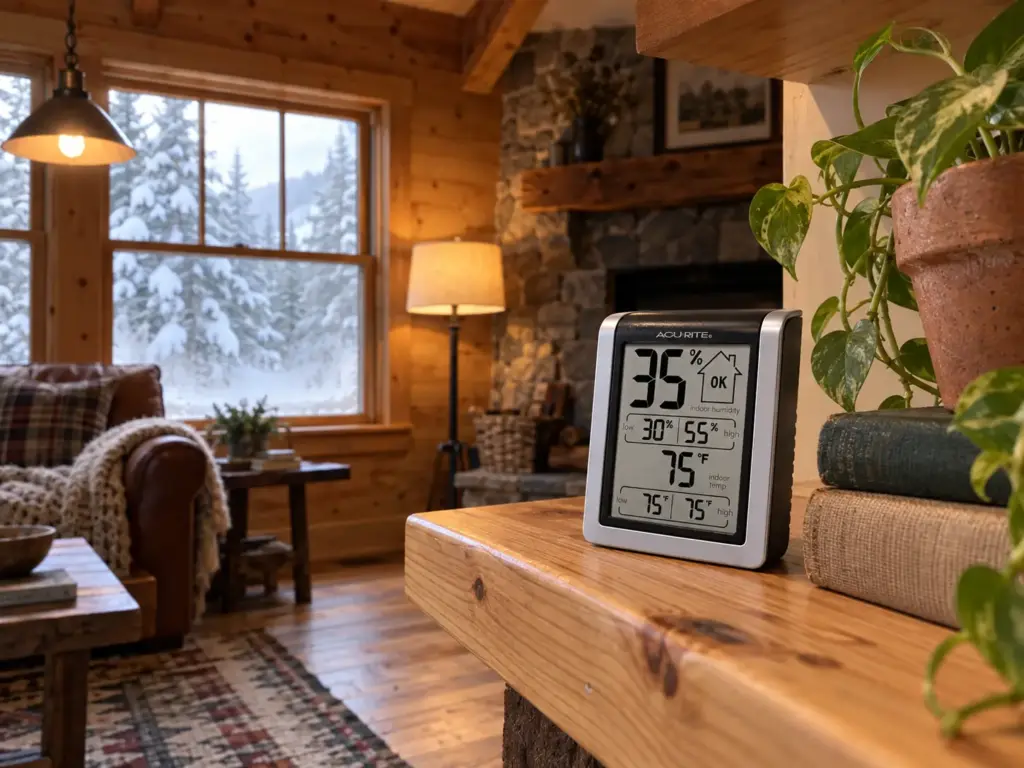
Where you read matters as much as what you read. Put the meter on the bedroom wall at about sleeping height, an arm’s length or more from the window, and well away from the bathroom door and the kitchen. A meter on the windowsill reads the wettest air in the room, the thin layer next to the cold glass, so it makes a normal room look worse than it is. Where to put the meter has the longer version.
If a meter already sits on the sill, move it to the bedroom wall for one night before you trust it. Sill readings run high because they sample the air that is about to condense. A reading from the wall is the one that compares with the EPA’s band.
The free reading is already in hand: the wipe test told you the side, and the height of the film told you how far past the glass’s limit the room is. A meter turns that into a number you can lower and compare.
The cheapest way to take it tonight is the AcuRite 00613 Indoor Thermometer & Hygrometer, a small display unit with a wireless indoor sensor, one AA battery and a humidity range of 16 to 98 percent. Its listing prints that range but no accuracy band, so there is no way to know how far to trust a one-point change. Read it for direction, and for the gap between an evening and a morning, not for a single digit.
Why the Film Is Worst After a Closed Night
The pattern is probably the one you already see: clear glass in the afternoon, a film at dawn, gone again by lunch. That is not the window changing its mind. Overnight condensation is a closed night’s worth of moisture with nowhere to go, meeting the coldest glass of the day, and it clears when the day’s ventilation and warmth catch up.

Three pints a person, and a shut door
North Dakota State’s extension puts the water each person adds to the air at about 3 pints of vapor a day from breathing alone, and showers, cooking and laundry add more on top. Two people in a closed bedroom hand a share of that to a small volume of air with the door shut and nothing carrying it out.
A common short fix is to open the door, or open the window a tiny bit. The door is the easy half. The window half has a cost, which the fixes section below puts on the table.
How much humidity a bedroom should hold overnight is a question of its own, and what humidity suits a bedroom has that number. This section only explains why the glass is wettest after a closed night.
Closed curtains and blinds keep the glass cold and the air still
Closed curtains and closed blinds make it worse in a way that is easy to miss. They trap a pocket of still, cold air against the glass, so the pane behind them is the coldest and the least stirred, and the film is usually heaviest there and the last to clear. Opening them at night helps for the same reason.
The extension notes that drapes left open at night reduce condensation behind them, then adds the bill: “Unfortunately this causes energy losses.” The room gets a little colder and the furnace works a little more. That is the trade, and it belongs in the decision rather than being hidden from it.
With two windows in the room, pull one curtain back overnight and leave the other closed, then compare the two panes in the morning. It tests the pocket of still air without changing anything else, and the difference between the two panes is the share of the film the curtain accounts for.
The peak is the number the glass answers
The glass answers the maximum, not the average. A reading at lunch, when the film has gone, tells you almost nothing; the number that matters is the night’s highest, which you never see unless you are awake to read it or the meter holds it for you.
The Govee H5075 Bluetooth Hygrometer Thermometer does hold it: it has a 3-inch LCD, a max and min record, and a phone app that can alert you when the room crosses a line you set, which is useful if you want to know the moment the number leaves your range. The maker’s sheet puts humidity accuracy at plus or minus 3 percent RH, so a one-point change is not news; a trend across a night is.
One thing to check before relying on it: the listing gives two different Bluetooth ranges, 164 feet and 196 feet, so the distance that actually works from your bedroom to your phone is something to try in the house before you count on an alert.
The peak explains one more thing: why the morning glass can look much worse than the room felt when you sat in it at noon. The glass is answering the worst hour of the night, not the room you see in daylight. Why windows sweat overnight covers the whole mechanism; it is enough here to know which hour the glass is answering.
The Fixes in Order, With a Reading Between Each
The fixes only work as a sequence. Take them one at a time, free and likeliest first, because the glass is the slowest instrument in the house: a change made tonight shows on the lower pane only tomorrow morning. That makes one fix per morning the honest test, and it is the only way to know which fix worked and which overshot.

First, the door and the fans, then read the glass
Start with the two changes that cost nothing. At night, open the bedroom door a few inches so the room’s air can mix with the rest of the house, which is the cheapest ventilation there is. Run the bathroom fan during and after a shower and the kitchen range hood while cooking, so the moisture those make never reaches the bedroom. Then read the glass the next morning before touching anything else.
Each has a catch. A fan moves moisture off the glass, but it removes it from the house only if it vents outdoors. North Dakota State’s extension warns that a fan venting into the attic can cause unseen moisture problems, including mold growth, so where the duct ends is part of the fix. Opening the curtains at night, the other free change, carries the energy loss from the last section.
The change people reach for next is to crack the window for a few minutes, and it works, up to a point. On a mild night a tiny gap lets in enough fresh air. On the coldest nights the air that leaves takes the heat with it, so the furnace pays for the drier room, and as the asker found, it may not be enough: still some condensation at −29°C (about −20°F) with the door cracked and the fan on.
The better call on a hard-cold night is the door and the fans first, the window for a few minutes at a time, and acceptance of a thin film along the lower edge. How to lower humidity at home lists the full set of fixes; this section gives only the order and the cost of each.
Keep a one-line note each morning: the change you made, the night’s highest humidity reading, and how high the film climbed. Three mornings of that is enough to see which change moved which number, and it keeps you from changing the humidifier and the fan on the same night.
Second, the humidifier setting, then read again
If a humidifier runs in winter, whether a portable one in the bedroom or a furnace humidifier, it is often the biggest source of water you control, and the setting is free to change. Lower it one step and read the glass the next morning. One step, not three. If the film thins, you found it.
The overshoot shows up at the bedroom wall: the glass goes dry but the meter drops under 30 percent, the bottom of the EPA’s band, and the room has traded a wet window for dry air. The right setting is the highest one the glass tolerates that week. It moves with the outside temperature, which is why the same setting that worked in November can fail in January.
Third, the dehumidifier, only if the reading stays out of range
A dehumidifier comes into it only if the bedroom-wall reading stays above the band after the first two changes, and it comes last for a reason. It lowers the room’s reading, but it does not warm the glass. The obvious pick for a wet window is not the one that fixes it on the coldest nights, which are the nights it was bought for.
So treat it as a device for a room whose humidity stays high on mild days too, not as a winter answer for cold glass. Dehumidifiers for window condensation is the place to compare units; this article names no model.
When the Water Is Not the Room’s
Some water is not the room’s moisture at all, and no setting will move it. The sill, the frame and the seal belong to the building, and they report in their own way.
Water running onto the sill or the wood
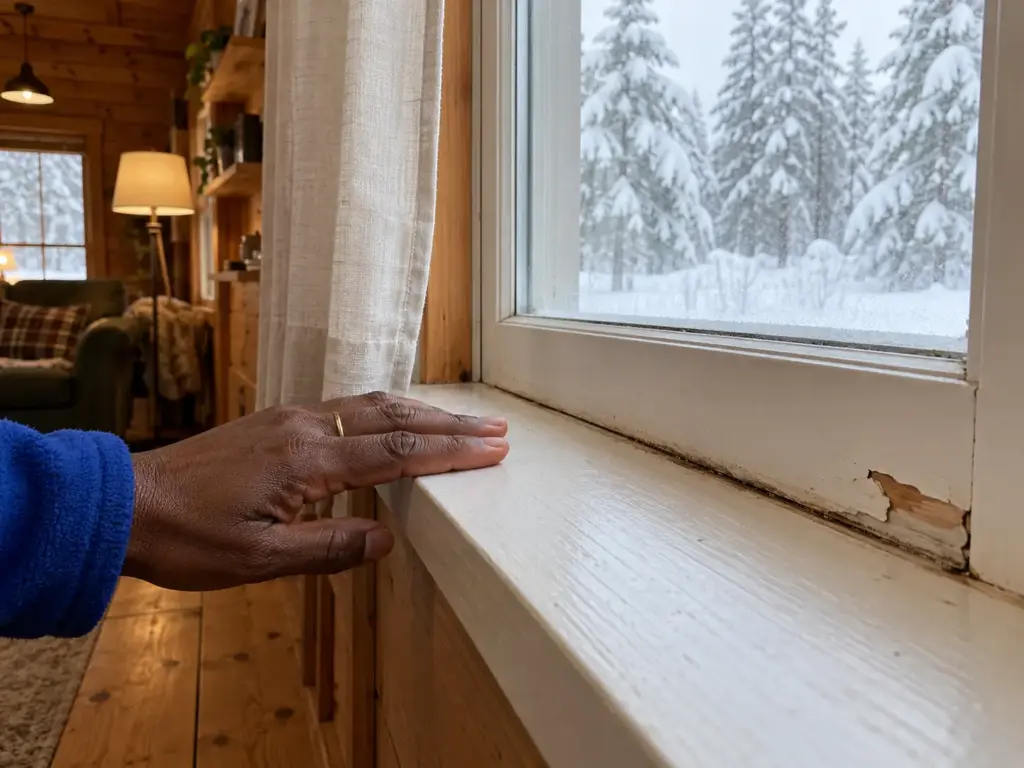
A film on the glass is the room’s moisture meeting a cold pane. Water that runs down, pools on the sill and soaks the wood is more than the frame can shed. Window makers agree on this one, and the wood is the first to show it. Window sill water that comes back every day is a different problem from a film on the glass.
If the sill is wet every morning after a week of the free fixes, either the room is still giving the glass more water than the window can handle, or one spot of the frame is far colder than the rest. Keep the free fixes going and treat the sill as the thing you are watching.
A dark line or spots on the frame
Dark spots or a dark line where the glass meets the frame, or along the sill, are a building sign, and mold on window frame edges is the usual name for them. They mean moisture has been sitting there long enough for something to grow, which tells you where the water goes and how long it stays.
The EPA’s guide says to act quickly to dry the wet surface and reduce the moisture source, and that is the first move. Spreading dark patches on the frame or on the wall behind it are a job for a contractor. Whether condensation means mold is a separate question with its own page.
What to do before calling anyone
Three checks, in order. The wipe test: which side is the water on. The reading: the bedroom wall, against the cold outside. The fixes, in the order above, one per morning.
If the room reads in range, the film is gone after a morning and the sill is still wet, the source is the building: the seal, the frame, a leak, or a fan venting into the attic. That is where the do-it-yourself fix ends. A window company is the call for a failed seal, and a contractor is the call for a damp frame or a wall that stays wet.
One caution against calling too early. If the windows are new, a film in the first winter is not a defect. A tighter window shows what its leakier predecessor hid.
Reading the Glass Again as the Cold Deepens
The verdict is not fixed for the winter. The setting that held in November can fail in January, because the glass has less margin as the outside drops and the same room reads too high. A film that comes back in the hardest week does not mean the fix failed. Re-read the room at the bedroom wall, lower the cap one step, and read the glass the next morning.

The meter matters more here than in autumn, and so does its limit. A budget hygrometer is good to a few points, and the Govee’s maker figure is plus or minus 3 percent RH, so a one-point change between two mornings is noise. A drift of several points across a week, with the film climbing higher on the pane, is a trend. How winter shifts the number covers the seasonal setting.
Tomorrow Morning: Wipe One Spot, Change One Thing
Three things to keep:
- Wipe one spot and see which side the water is on.
- A room-side film on a cold morning is the room’s moisture and is normal; fog between the panes or a sill that runs is not.
- Change one thing, then read the glass the next morning.
Tomorrow night, open the bedroom door a few inches or turn the humidifier down one step, not both. In the morning, wipe the lower pane, note how high the film climbs, and take the reading at the bedroom wall. That single line is all the data the next change needs.
In the first hard-cold week, look at the lower pane when you wake and at the night’s highest reading on the meter. If the film climbs higher than it did in autumn with the same setting, the cap goes down a step.
Frequently Asked Questions
01Should I worry about condensation on windows?
Not if it is a thin film on the room side of the glass that wipes off with a dry cloth on a cold morning. Worry when it sits between the panes, runs onto the sill, or stays after the room’s humidity is in range.
02Is it normal to have condensation on brand new windows?
Yes, often, because a tighter window lets less room air leak out, so the room’s moisture meets the glass and shows as a film that a leakier window hid. It is common in well-sealed houses.
03How much condensation on windows is normal?
A light film along the lower edge of the inside glass on the coldest mornings, gone by midday, is about as much as an ordinary room produces. Beading that runs down, or a film that stays all day, is more than cold glass explains.
04Does condensation mean my house is too cold?
Not usually, because it means the glass is colder than the room’s air can tolerate at its current humidity, so the first fix is a lower reading. A warmer house warms the glass and cuts the film.
05Is condensation on windows normal in the morning?
Yes, it is the usual time, because the room has collected the night’s moisture and the glass is at its coldest just before dawn. A film that fades by midday is the normal pattern.