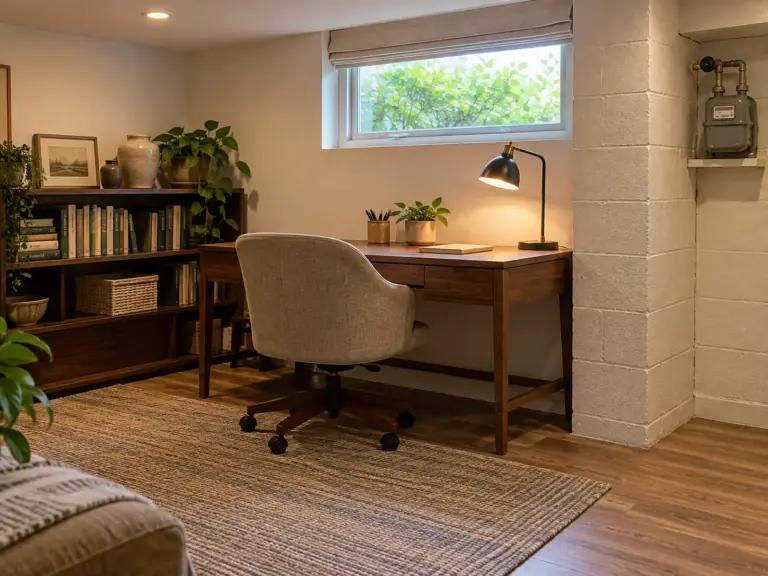
You go downstairs and the air is heavy, the room smells musty, and the bottom of one wall looks darker than the rest. What causes basement humidity in a room like that comes down to three routes: liquid water from the ground and the roof, vapor that passes through the concrete itself, and warm outside air that condenses on the coldest surface in the house, which is nearly always a basement wall or slab. The household then adds its own moisture on top of all three. Find the route first, because the fix that works for one door does nothing for the others.
Quick Answer
Water reaches basement air by three routes: liquid water from the ground, vapor passing through the concrete, and humid outside air condensing on the coldest surface, plus what the house adds. One free check tells you which is running: whether the wet sits on the wall, on the floor, or only in the air.
Water, Vapor and Warm Air Are the Three Routes Into a Basement
A basement is where the ground, the outside air and the house meet, so basement moisture has three possible doors, and the room feels the same whichever one is open. The musty smell after a storm, the heavy air in August and the damp corner of a freshly finished room can each come through a different door. A reading that runs high everywhere is a different search, laid out in the piece on when the whole house reads high, not just the basement; this guide stays with the sources that belong to the basement.

Liquid water and the ground
The University of Minnesota Extension’s guide to moisture in basements lists liquid water from rain and groundwater first among the sources, and the scale explains why: a 1-inch rain puts about 1,250 gallons on the roof of a 2,000-square-foot house. Without grading, gutters and downspouts that send it away, some of that water ends up against the foundation. The water table also rises with flooding and with the season, so a basement that stayed dry in a dry spring can seep in a wet fall. This door has a signature, and it is the calendar: the wet arrives with the storm and leaves days later.
Vapor that passes through the concrete
Vapor is the silent door, and the name for it is vapor diffusion. Moisture in vapor form moves from the wetter ground through concrete walls and floors toward the drier air inside, pushed by the difference in vapor pressure, with no crack to find and no puddle to see. Foundation waterproofing and polyethylene sheeting slow that movement. The usual sign is a room that reads and smells damp while the walls look dry and the weather offers no explanation.
Outside air that arrives warm and humid
The third door is the one most often mistaken for a leak. Warm, humid air that gets into a basement meets a cold wall and slab, and the moisture it drops there looks exactly like seepage; the Extension notes that homeowners often read it as wall leakage when it is condensation. On top of all three doors the household adds its own water: humidifiers, an unvented clothes dryer, showers and cooking, and more of each once the basement is finished.
A common question is whether the foundation leaks or the damp is normal. Either answer can be right, depending on which door is open, and the check that tells them apart takes one observation.
Leak or Condensation? How to Tell Which One You Have
Asking whether there is a leak is usually less useful than asking which clock the wet follows: the rain’s or the weather’s?

A leak keeps the storm’s schedule. Condensation keeps the thermometer’s and the dew’s. A third case is neither, with walls that stay dry to the touch while the room smells and reads damp. One observation sorts the three before any money is spent.
What a leak leaves behind
Liquid water that comes through a wall or a floor joint leaves its mark at the base: a wet strip along the bottom of the wall, a saturated lower course of block, a thin trickle, standing water on the slab. Those are the symptoms the Extension lists for liquid water, and what they share is timing. A leak shows up after the storm, stays for days, and returns to the same spot every time it rains hard. It ignores the thermometer, so a hot dry week does not bring it back and a cold wet one does.
What condensation leaves behind
Condensation follows the weather instead. It collects as beads or a film on the surfaces that run cold, which in a basement means the wall, the slab and any cold-water pipe, and it appears on warm, humid days, worst when the basement windows have been open. When the humid spell breaks, it dries with no storm involved. The Extension lists condensation on cold walls and floor in summer as a symptom of its own, separate from water coming through the wall, and sorting by the clock is how you tell the two apart: wet that follows the rain is the ground, and wet that follows the heat and the humidity is the air.
Write each reading on a line with the day’s weather beside it: dry spell, hot and sticky, the morning after a storm. Two weeks of those lines show which clock the basement keeps, while a number with no weather beside it settles nothing.
Read the room’s air, not the wall
The third case needs a meter, not a hand on the wall. When the wall is dry to the touch and the room still smells musty, the moisture is in the air, and the air has to be read in the middle of the room, several feet from the walls and off the floor, where the concrete is not cooling it. According to the EPA’s guide to mold, moisture and your home, “If possible, keep indoor humidity below 60 percent (ideally between 30 and 50 percent) relative humidity.” The “if possible” matters: a basement in a humid August may never reach 50, and the number to aim for in winter is a different target again, while the pillar on indoor humidity levels holds the band for the whole house.
A hygrometer such as the AcuRite 00613 Indoor Thermometer Hygrometer reads temperature and relative humidity together, which is all this step needs, and it changes more decisions than a new appliance does. Treat one reading with care. No accuracy figure is confirmed on its listing, and a basic hygrometer can sit a few points off, so a second one, upstairs or beside the first for a day, shows whether the number can be trusted.
A basement that reads well above the floor above it is a basement problem, and two cheap sensors, one in each place, can show it in two numbers. Placement against a cold concrete wall, and the plastic-sheet test that separates moisture in the wall from moisture in the room, are covered in where to put a sensor against a cold concrete wall.
Put the two observations together and the routes start to sort themselves. A wall that stays wet while the middle of the room reads under 60 percent points toward water coming through it. A dry wall with a mid-room reading above 60 points toward the air. A wet wall and a high reading together often mean more than one door is open, and then the fix has to follow the wettest one first.
Why a Cold Basement Wall Gets Wet on a Warm Day
The first two sections said the wet can come from the air; this one explains why the coldest surface is always the first to show it. The answer is a temperature, and it sits on the wall rather than in the room.
The cold surface sets the dew point
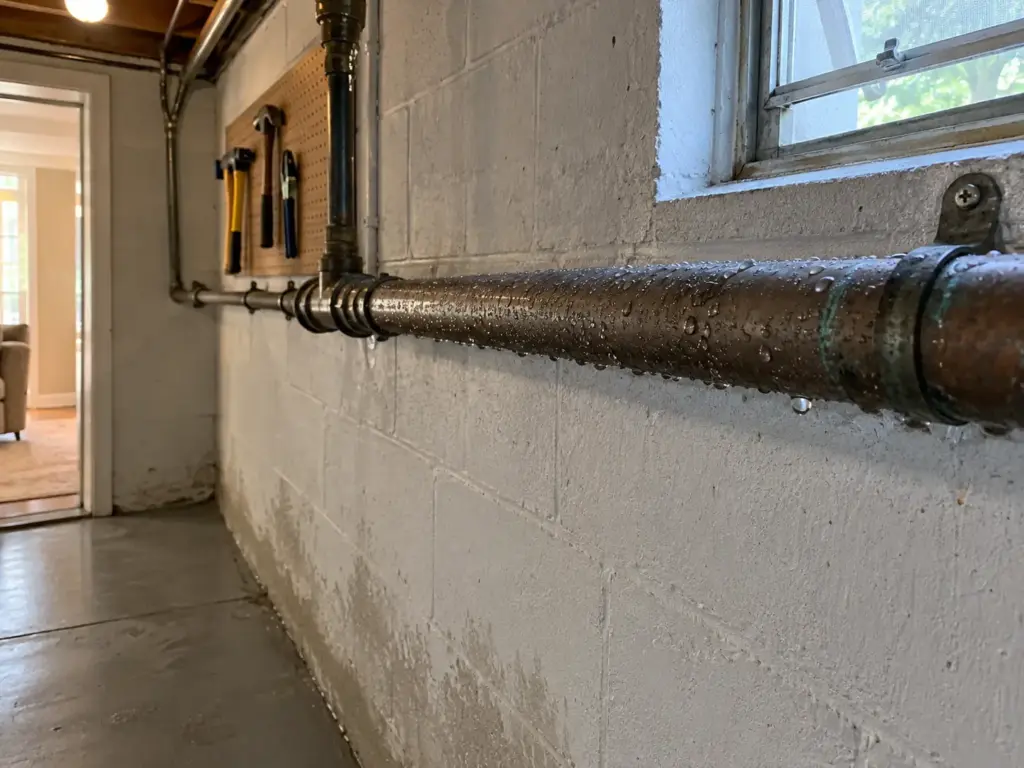
The ground keeps the wall and the slab cold through the summer. Air that is warm and humid cools the moment it touches them, until it can hold no more water, and the surplus lands on the surface as liquid. That temperature is the dew point, and the wall reaches it before the room does: the air touching the concrete is far closer to saturated than the air in the middle of the room, so the wall can sweat while the meter in the room still reads a number that looks fine. Add a few points of humidity to the room and the moment arrives earlier, and the wall shows it first.
How much worse this gets in August than in January is a separate question, and why the season changes the answer has its own article.
Put a hand on the cold-water pipe on a humid day. A cold-water pipe is often colder than the wall, so beads can form on it before the wall looks wet, which makes the pipe an early warning that the air is near its limit down there.
The window you opened to freshen the air
Opening the basement window on a hot day is the oldest instinct in the house, and in summer it works backward. The Extension’s advice is not to ventilate a basement directly with warm, humid air in the summer; if it has to be ventilated, it recommends doing it through an air-conditioning system or a desiccant-type heat exchanger. A window does the opposite, because it lets in the very air that condenses on the slab.
Where the house has central air, the cheap version is to leave the basement’s cold-air return open in summer, so the air conditioner pulls the room’s air across its coil and dries it on the way. That is the obvious pick only for a house with ducts. A rental, or a house with one window unit upstairs, has no return to open, and an air conditioner on the floor above does not reach the basement, so the free changes are plainer: keep the window shut on humid days, vent the dryer outdoors, and read the meter before opening anything. Glass follows the same rule on the room side, and the same thing happens on a window in plain sight.
When Rain Is the Source, Start at the Gutters and the Grade
If the wet follows the storm, the water is coming from outside, and the cheapest fix is on the lawn, not in the basement. Two things decide how much reaches the foundation: how much falls on the roof, and where the downspouts and the soil send it.
How much water a roof sends to the foundation
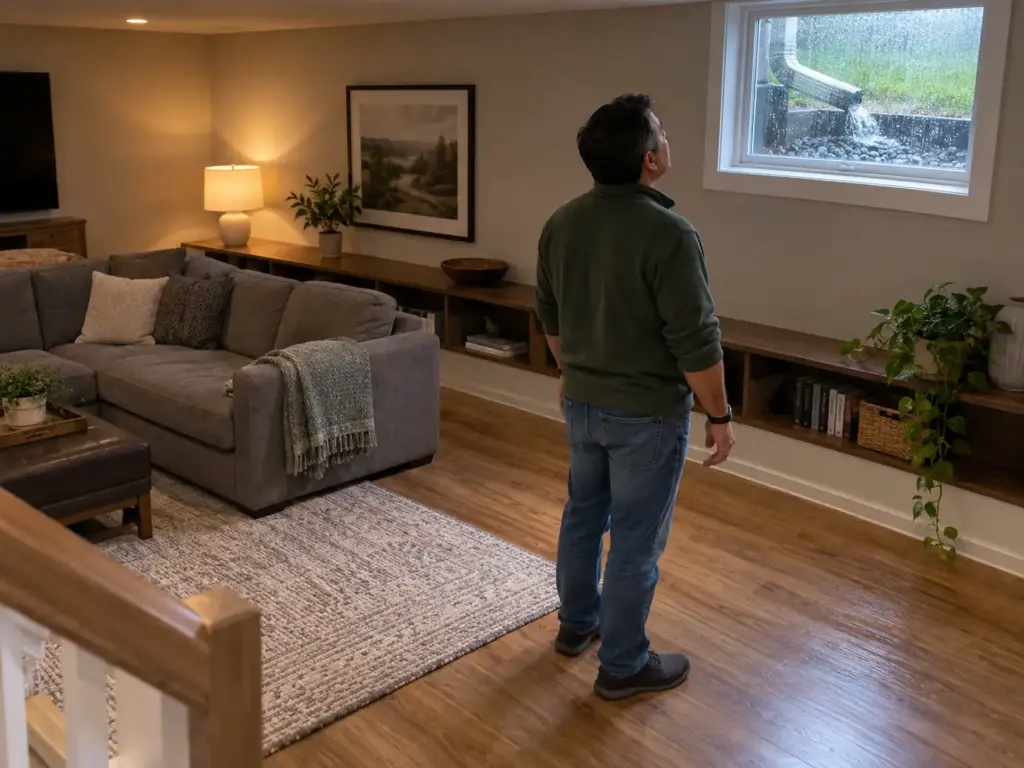
Rain on a roof is a volume problem. One inch of rain over 2,000 square feet is about 1,250 gallons, and the arithmetic holds: each square foot of roof collects roughly 0.6 gallons per inch of rain, so multiplying your roof’s footprint by 0.6 scales the figure to your house. All of that has to go somewhere, and a clogged gutter or a downspout that ends at the wall puts it against the foundation in one spot. A finished walk-out basement can still need a dehumidifier all day every summer even after new gutters and downspouts, so gutters are the first step and not always the last.
The slope, the downspouts and the extensions
The Extension’s targets are specific and cheap to check. The soil should slope away from the wall at least 1 inch per foot for at least 6 feet, which a level and a tape measure confirm; backfill settles over the years, most of all under stoops, where water collects against the wall. Plan on at least one downspout per 50 linear feet of eave, with an extension that discharges at least 4 feet beyond the wall.
A downspout with no extender or splash block is worse than none, because it drops the roof’s whole volume in one concentrated place beside the basement. Window wells act as a drain beside the wall when they are built wrong, so a well that stays full after a storm belongs on the walk-around list too.
After a hard rain, look for the dark splash line on the foundation where a downspout lands, and for any puddle still standing beside the wall the next day. Both take a few minutes to find and tell you which downspout to extend first.
Cracks, Seepage and the Ring of Dampness at the Wall Base
If the outside is fine, the water may still be in the wall itself, drawn up from the footing the way a towel draws water out of a puddle. Three things set what shows on the wall: the concrete’s pores, the soil under it, and any crack.
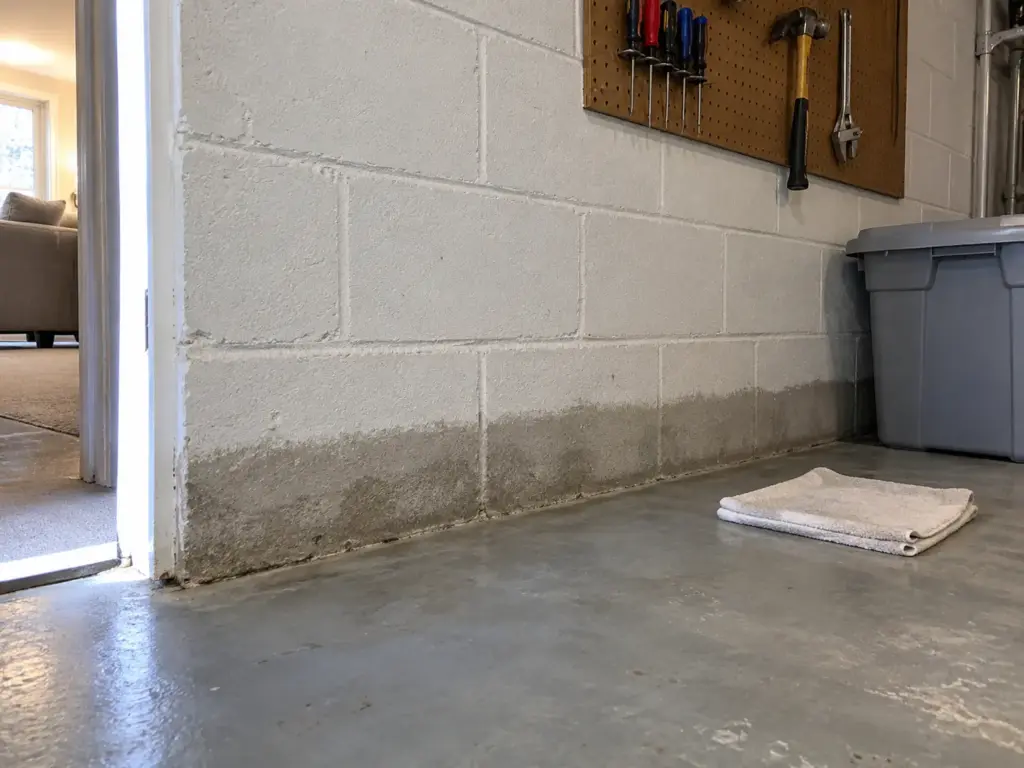
What the dark ring at the base is
Capillary suction does the work, and the climb it produces is called capillary rise. Water is drawn upward through the small pores of the concrete footing and slab, and sideways through the walls, and the height where it stops makes the ring of dampness at the base of many walls, very common at cold joints. A ring that runs at the same height all the way around points at the soil and the concrete, not at one hole. A single patch that darkens after every storm points at a single entry.
How high the damp climbs, by soil
How high the damp climbs depends on what the house sits on. The Extension prints a figure for each soil: water can climb less than a few inches through gravel, 1 to 8 feet through sand, 12 to 16 feet through silt, and 12 to 20 feet through clay. Those are the reach of the draw through the soil’s pores, so treat them as a ceiling and not a prediction for your wall.

Still, the table changes how a ring reads. In gravel, a ring of a few inches is all the draw can deliver, so a wet band taller than that has another source. In clay the draw could feed a band as high as the wall, so the soil alone explains very little and the other clues, the timing and the weather, carry the reading.
Cracks that are only cracks
Concrete and block foundations usually develop some cracks, and most are the ordinary result of settling. The Extension adds that drainage usually removes the water from them, though repair may be needed; where a crack stops being ordinary is covered in the building section below. A dehumidifier can hide a problem for a year or two: a small crack in the foundation wall can be the moisture source, and the unit keeps the symptom under control until the crack is found. Coating the inside of the wall is the tempting response, but the Extension calls an interior membrane or coating a temporary solution, because the water is still there and eventually finds another path.
The Air a Basement Pulls In and the Moisture the House Adds
Even with dry walls and good gutters, a basement breathes. Warm air rises through the house, the basement makes up the difference, and everything the household produces ends up somewhere.
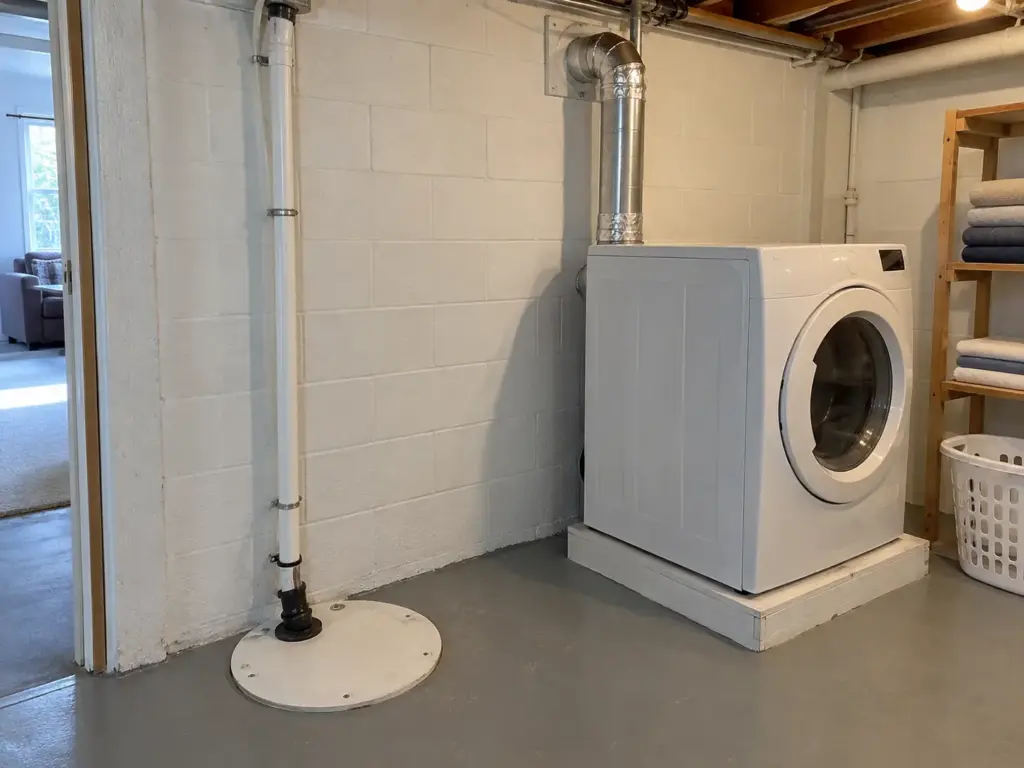
Stack effect, sump pits and block cores
Warm air leaves the top of a house, which puts the basement under negative pressure and draws moist air in through any crack or opening in the foundation, including an open sump pit. That is why the Extension says a sump should have an airtight cover. In a concrete block foundation the air also travels through the block cores, especially when the top course is left open. An open pit is an opening the whole house draws air through.
Sealing that air leakage starts with a cover, the cheapest fix here and the one with the most visible result. What that pulled-in air does to the rooms above is its own question, taken up in what the basement’s air does to the floors above.
The dryer, the shower and the stove
The household’s own moisture is the other half. The Extension names humidifiers, unvented clothes dryers, showers and cooking, and notes that finishing a basement increases all of them. The EPA’s mold house tour says clothes dryers must vent to the outdoors, and a dryer vent that ends inside the house is a humidifier with a lint trap. In summer, a basement that feels damp can start with the air conditioner: check its condensate tray and drain before blaming the walls.
The free fixes that match these causes fit on a short list: cover the sump, vent the dryer outside, run the bathroom fan and the range hood, and move the humidifier upstairs. The order to try them in belongs to the free fixes in the order to try them, so here each gets one line and no more.
New Concrete Gives Back Water for Months
A basement can be built perfectly and still be wet in its first summer, because the water that went into the slab has to go somewhere. Concrete is poured wet and dries out slowly, and the moisture leaves into whatever air is nearest.
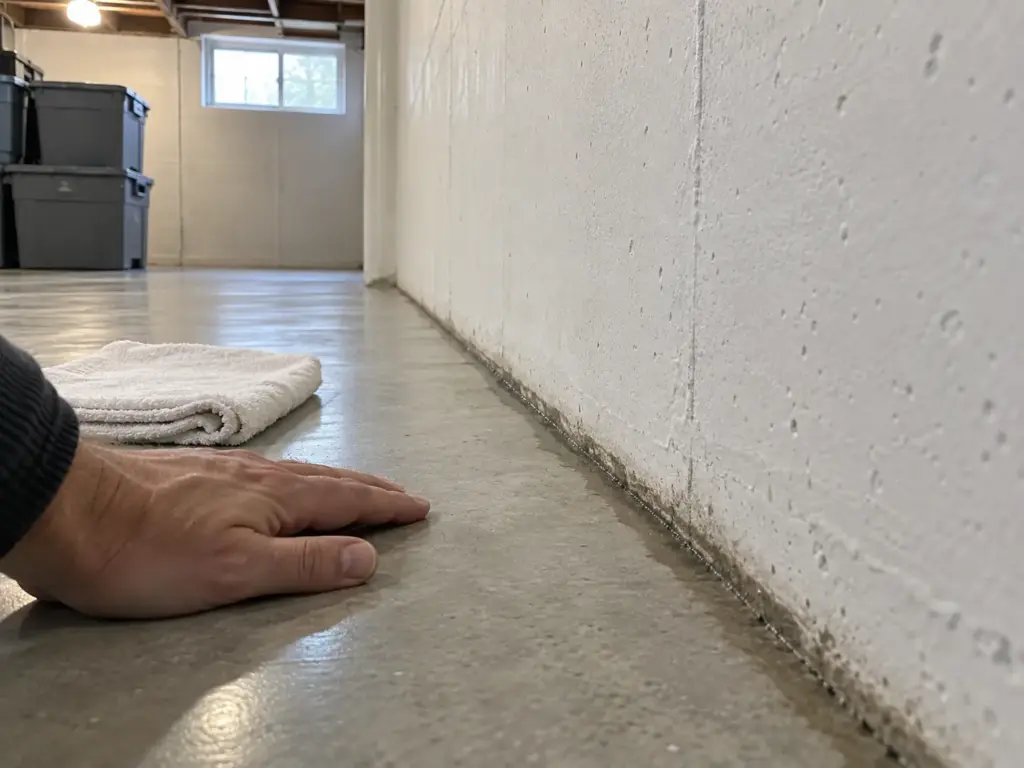
The Extension counts this as an interior source of its own. In a typical house, new concrete can hold about 0.2 gallons per square foot of wall and 0.1 gallons per square foot of floor, and it may take many months, even years, for a new house to come into equilibrium with its environment.
Run the arithmetic for your own basement as a ratio: multiply the wall area (the perimeter times the wall height) by 0.2, multiply the floor area by 0.1, and add the two. The wall figure is double the floor figure per square foot, so a basement with a lot of wall for its floor area gives back more water. That total is what the room has to shed over many months, not what a dehumidifier will collect in a day.
The usual pattern is a lot of water in the first summer, and years later a dry basement, with the musty smell gone and the unit running far less. That is a month-two report and a year-three report about the same slab. In a new build, the first dehumidifier is a bridge and not a permanent fix, and the number to watch is how much the bucket collects at month six against the first month. A falling count says the slab is drying out; a flat one says to look for another source.
The bucket also helps tell new concrete from a leak. Water that new concrete gives back falls steadily and keeps no appointment with the weather, while a leak jumps after a storm and then eases. Say the reverse too: an older house with a new problem is not this section, because concrete that cured long ago rarely starts giving water back, so a basement that was dry last year means a source changed. That sends you back up to the gutters, the wall and the household’s own moisture.
When the Fix Is the Building, Not the Air
Some wet is not a humidity problem, and no appliance will fix it. This section names the signs, and the point at which to call someone who works on foundations.
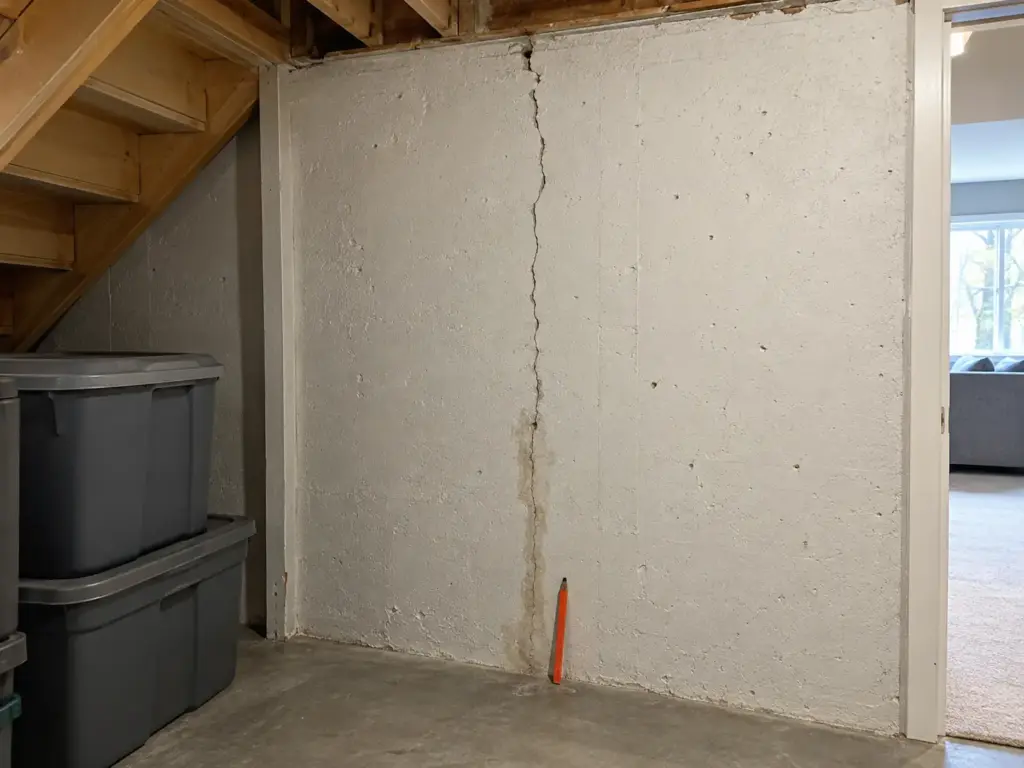
Signs that the water is structural
A unit that runs, gets emptied and runs again can be hiding a source. The signs are standing water on the floor after rain, a wall that bows inward, water trickling out of the wall, a dark ring that keeps growing, and a new patch that appears in the same spot every wet week. One contractor’s rule of thumb, which is not a standard, is that a crack wider than about 1/4 inch deserves a professional’s look. Efflorescence, staining, blistering wall covering and mold are on the Extension’s symptom list too, and here they are read as proof the moisture has been there a while; what mold on a wall means has that question to itself.
A concrete wall behind finished framing that was never sealed can be a large moisture source, and there is no telling until someone opens the wall. For a leak that comes and goes, a sensor placed where the water first appears is a cheap reading, and catching a leak early with a detector covers that route.
What to ask before any repair
The Extension’s order of repair works as a checklist of questions. Remove interior moisture sources first, then correct the grading, gutters and downspouts, and only then consider an interior or exterior drainage system, such as drain tile that carries the water to a sump; if the plan is to finish the basement, deal with the water before the drywall goes up.
A quote that jumps to the last step has skipped three cheaper ones, so ask whether grade and gutters were looked at. Ask what the work does with the water, since an interior coating hides it and does not remove it.
If the Air Is the Source, a Dehumidifier Fixes the Air and Can Hide the Wall
Once the water has been ruled out as the first cause, the moisture left is in the air, and that is the job a dehumidifier is built for, with one flaw the box leaves out. The free fixes come first and the unit comes last, for reasons the next three parts spell out.
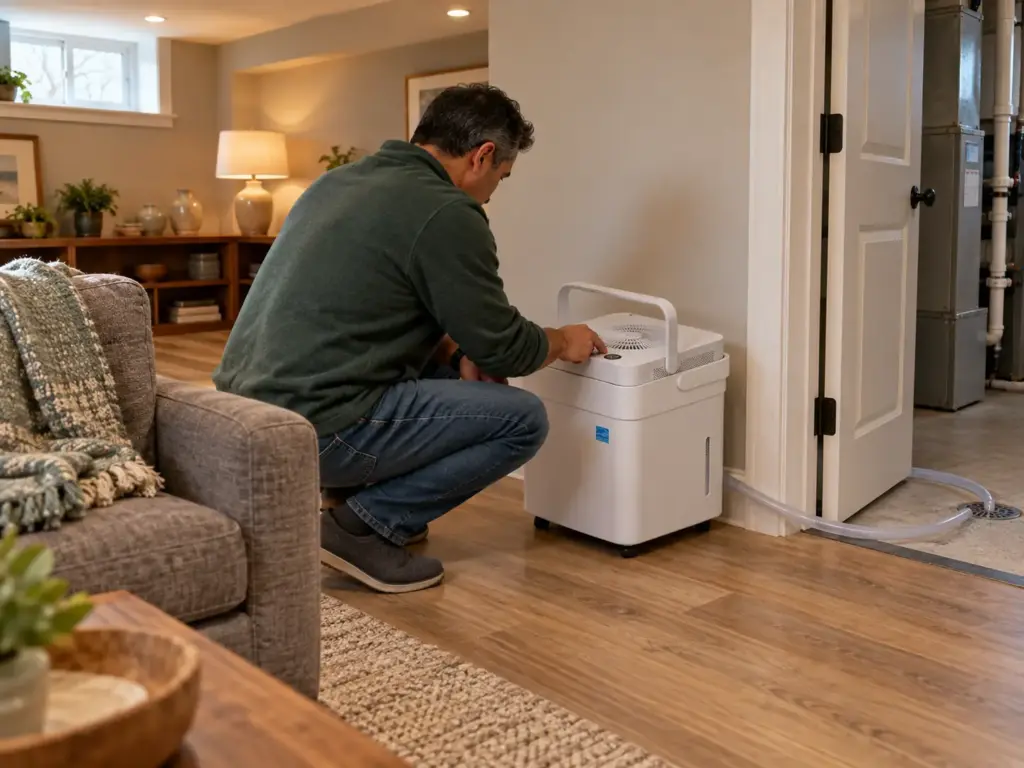
What a dehumidifier does for the air
A dehumidifier pulls moisture out of the room’s air and collects it as water, which lowers the reading on the hygrometer in the middle of the room. North Carolina State Extension’s mold and moisture checklist puts the trigger at 60 percent: above it, consider a dehumidifier, and empty and clean the drip pan regularly, because a full tank or an overflowing pan stops the unit. Two decisions follow the trigger, how big a unit the basement needs and how long to run it.
A common shortcut is to buy a dehumidifier and set it to 45 percent. It skips the order: find the source first, then size the unit. A unit is the third step, after a reading and after the source, and it is a poor trade if the source is a downspout with no extension: the unit runs all day in July because the source was never stopped, and runs again next July for the same reason. A cheaper extension fixes that.
When the source really is the air, though, nothing else lowers the number as fast.
Start the unit and change nothing else for a week. If the bucket count, the hygrometer reading and the wall are all read against one change, you know what the unit did; if the gutters were fixed the same weekend, you will not.
How it can make a wet wall worse
The University of Minnesota Extension writes the catch plainly. It says that “Dehumidification can be used as a means of reducing the symptoms of humidity and odor in a basement” but is not a permanent or complete solution, and that in a basement with moisture problems a dehumidifier may cause greater damage. By drying out the air, the unit draws moisture into the room more rapidly, which the Extension ties to efflorescence and spalling of the concrete. The room reads better while the wall pays for it.
That makes the unit’s own display a number to double-check. If the basement has a floor drain, the Midea Cube 50 Pint Dehumidifier, in its no-pump variant, is rated for 50 pints a day and a stated 4,500 square feet, a figure you can check against your own floor area, and it drains by hose to the drain with no bucket to empty. Its humidity sensor draws negative feedback in the listing’s review summary, with customers reporting inaccurate readings, so set and judge it by the hygrometer in the middle of the room and not by the display. A sensor that reads high keeps the unit pulling after the air has reached the target, and the concrete is where that extra drying lands.
Where the water goes
A dehumidifier’s water has to leave one of three ways: a bucket you empty, a hose that runs to a floor drain, or a built-in pump that lifts it. The choice depends on whether the basement has a floor drain, and where the hose should end is worked out in where to drain it.
For a basement with no drain on the floor, the Frigidaire 50 Pint Dehumidifier with Built-In Pump lifts the water through a hose to a sink or a drain line, which answers where the water goes when the floor offers nowhere. It is rated for 50 pints a day. Opinion on its noise is mixed in the listing’s review summary, with some reviewers fine with it and others bothered, so it is a weak mark against the unit and not a repeated complaint; a corner away from the room people use is where the sound matters least. The cheaper path still wins if the hygrometer shows the air was never the problem.
Name the Door, Fix the Source, Let the Unit Come Last
Three things carry the rest of this guide:
- Find the door before buying anything. A wall wet after rain, beads on a warm day and a musty room with dry walls are three different problems with three different fixes.
- Fix the outside and the household’s own sources first, the appliance last, and read the meter between changes so you know which one moved the number.
- A dehumidifier lowers the air and can hide a wall that is still wet.
A month from now, compare the bucket’s volume with its first week and check whether the dark ring at the base of the wall has moved. A bucket that is falling and a ring that holds still say the source is under control.
Tomorrow, put the meter in the middle of the room and write down which clock the dampness has followed, the rain’s or the weather’s, then take the same reading after the next change. The routine that holds the number down once the source is known is in keeping it low once you know the source.
Frequently Asked Questions
01How do I reduce the humidity in my basement?
Find the route first: wet after rain points outside, beads on warm days point to condensation, and a musty room with dry walls points to the air. Then fix that cause, free changes before any appliance, reading the meter after each one.
02Why is my basement suddenly so humid?
Something in the sources changed: warm, humid weather arrived, a window was opened, a downspout or sump cover failed, a dryer or humidifier moved in, or the slab is in its first summer. Run the leak-or-condensation check to see which one it is.
03Is 70% humidity in a basement bad?
It is high for the house: the EPA says to keep humidity below 60 percent if possible, ideally between 30 and 50, so 70 points to a moisture source worth tracing. Staining or mold on a wall is a building sign, covered in what mold on a wall means.
04Is 80% humidity in a basement normal?
It is not a reading to live with. At 80 percent the air is close to saturated, so the coldest surfaces, the wall, the slab and any cold-water pipe, will wet first. Trace the route before anything else.
05Can a dehumidifier make a damp basement wall worse?
Yes, it can: drying the air can pull moisture through the concrete faster, which the University of Minnesota Extension ties to efflorescence and spalling. The unit treats the air, not the wall, so find the source first and use the unit to hold the air afterward.