The meter on your dresser says 50 percent at bedtime and 58 at dawn, and nothing new came into the room. Why is indoor humidity higher at night when nobody added any water? Relative humidity can climb sharply at night, because cooler air reads wetter even when it holds the same water. Tracking the air over a day shows when to open the windows and when to keep them shut. The answer is mostly arithmetic: the same water fills a bigger share of cooler air, so the percentage can climb while the house adds nothing.
Two readings tell you whether the house also added water, and they come first, then what the house stops doing after dark and the one change to make, with the basics of indoor humidity as the groundwork.
Quick Answer
The reading climbs after dark because cooler air holds less water, so the same water fills a bigger share of what the air can hold. The house added water only if the dew point climbs across the night, not the percentage. Two readings, bedtime and dawn, show which one it was.
Cooler Air Holds Less Water, So the Percent Climbs
The number on the meter is a percentage, and a percentage always has something underneath it. Change that something and the number moves, whether or not any water came or went. At night, the something shrinks.
What the percent is a share of
Relative humidity, the number your hygrometer prints, compares the water in the air with the most that air could hold at its current temperature. Warm air holds more, cooler air holds less, and the meter reports the ratio. The EPA states the direction in one sentence: according to the EPA’s guide to the main ways to control moisture in your home, “As the temperature goes down, the air is able to hold less moisture.”
A useful way to picture it: cooler air is a smaller container holding the same water, so the percentage tells you how full the air is. A room is warmer by day and cooler by night, so one amount of water (the absolute humidity, which does not change) produces two different readings.
How much a few degrees of cooling moves it
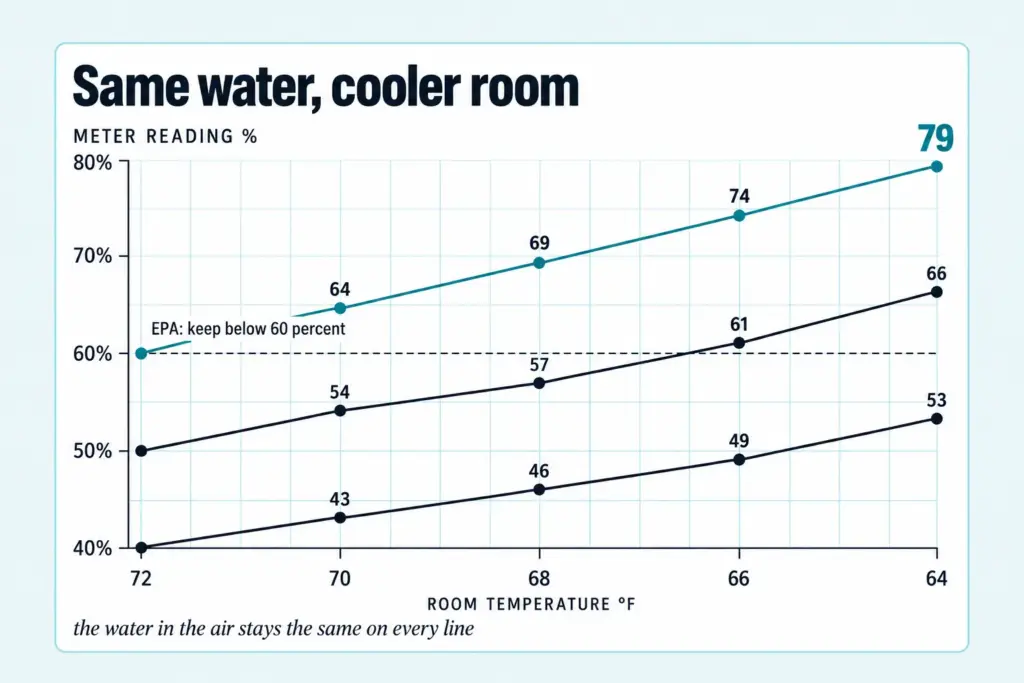
Here is a rule of thumb, arithmetic on how the air’s capacity changes and not a published standard: the amount of water the air can hold roughly halves for every 20 °F (11 °C) of cooling. That works out to about 3.5 percent more reading, as a share of itself, for every degree Fahrenheit the room loses. To predict a number, multiply the starting percent by 1.035 once per degree of cooling.
A room that reads 50 percent at 72 °F (22 °C) lands near 57 percent at 68 °F (20 °C) and near 66 percent at 64 °F (18 °C). A room that starts at 60 percent climbs to about 69 and then about 79 over the same two steps. No water arrived in either room. The drop of four degrees was enough to move the first one seven points.
Why the afternoon number sets the wrong baseline
The evening reading looks fine because the room is still carrying the afternoon’s warmth. Measured against that warm baseline, the dawn number looks like a failure, when it is the same water in a room that has simply cooled. Judge the night against a prediction, not against last afternoon.
The same effect has a winter version, where the cold outside decides how high the indoor reading can safely sit; the ceiling that moves with the outdoor temperature is covered on its own page, so the figures stay there.
Two Readings Tell You Whether Water Arrived
A rise is normal, so the useful question is narrower: was it only the cooling, or did the house add water too? That takes three steps with one cheap meter, and the answer comes out of a subtraction.
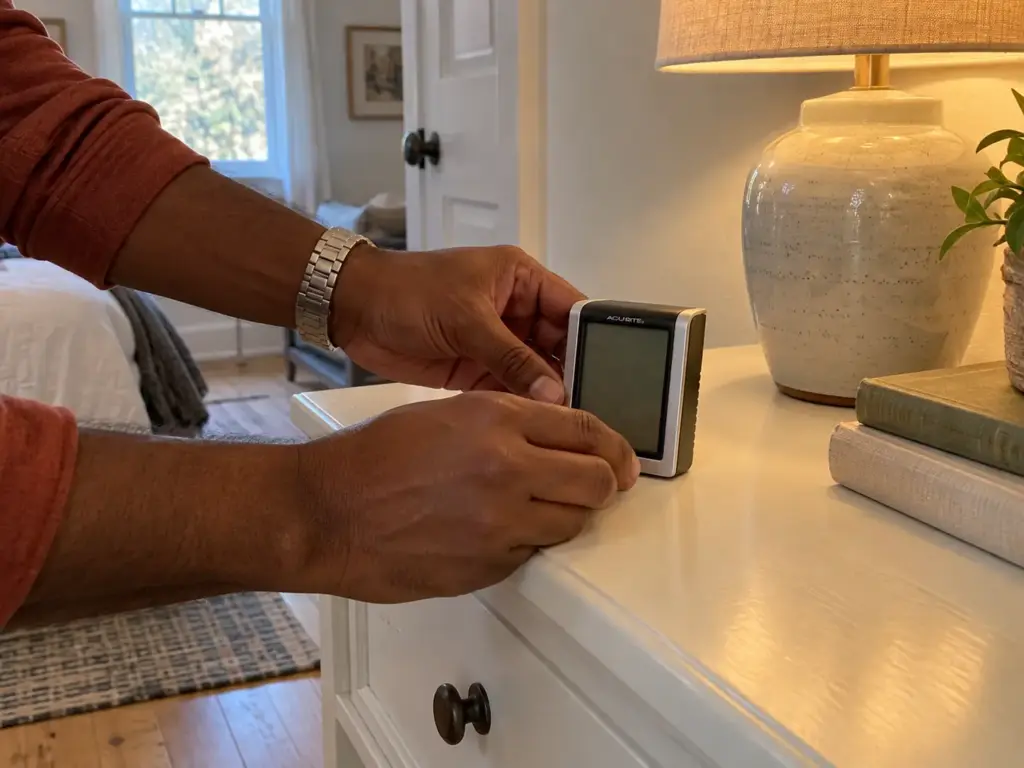
Take the evening and the dawn reading
Read the temperature and the percent twice, once at bedtime and once on waking, from the same spot: at the height of the bed, away from the window and away from any vent. Write both pairs down. Three readings from one meter explains the placement in more detail.
The AcuRite 00613 (Amazon) is the plain way to get both numbers side by side: one display, one AA battery, a humidity range of 16 to 98 percent, and a five-pack, so the spare meters can go in other rooms. It remembers nothing, with no app and no log, so the bedtime and dawn numbers are ones you copy onto paper yourself.
A meter that has sat against a cold outside wall reads the air next to that wall, which is not the air you sleep in. Move it to the nightstand for one evening and compare the two spots before you trust the dawn number.
Predict the dawn number from the temperature drop
Take the evening percent and multiply it by 1.035 once for every degree Fahrenheit the room cooled. Start at 50 percent at 72 °F, let the room fall 4 °F overnight, and the prediction is about 57. If dawn shows 57, the cooling did all of it and the water did not change.
This is also where the dew point earns its place.
The dew point is the temperature the air would have to fall to before water appears on a cold surface, and it tracks how much water is in the air rather than how full the air looks. If the room cools and nothing is added, the dew point stays put while the percentage climbs. If water arrives, the dew point climbs too.
Most meters do not print it, which is why the test uses a prediction instead. The Govee H5051 app does not show it either.
What a bigger rise than predicted points to
Suppose dawn reads 63 where the prediction said 57. Six points of unexplained rise means water arrived in the room overnight, and the next section looks at where from. A gap of one or two points is the meter’s own error, and the gap that counts as a signal starts at five (a rule of thumb, called one).
Because a cheap meter can be off by a few points, read one meter twice rather than two meters once. No app is needed, only a pen on the nightstand, and the same two readings on three nights in a row say more than one.
What the House Stops Doing After Dark
If the dawn number ran above the prediction, the house is the source, and the house does less of its water-removal work at night than by day. Three things change after dark: the removal slows, the sources are still in the room, and the room closes.
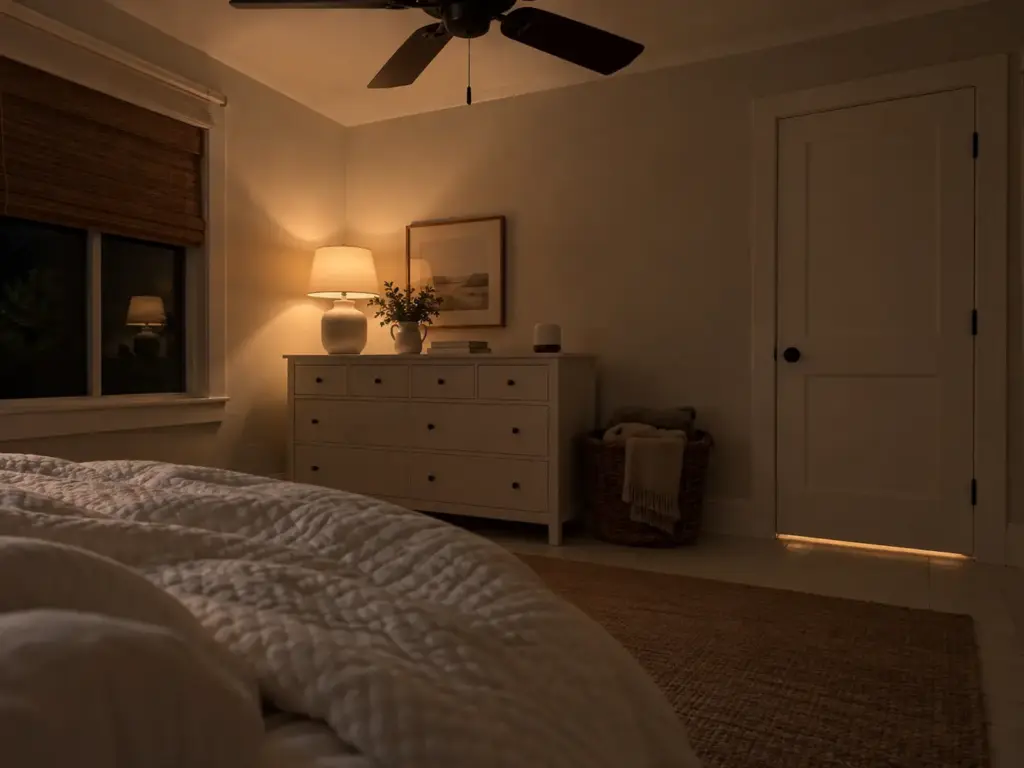
The air conditioner removes water only while it runs
The EPA lists dehumidifiers and air conditioners among the ways to take moisture out of indoor air (see the EPA’s list of moisture sources and fixes). The point that follows is the one that matters at night: a unit pulls water out only while it is running. When the thermostat is satisfied and the AC is off, nothing is removing water, and whatever the house is still giving off stays in the air.
The evening’s water is still in the room
A long shower, dinner on the stove, wet towels and a load of laundry hung to dry all put moisture in the air, and the EPA’s advice is to vent the first two with the bath fan or the range hood. If the fan was off by nine, that water is still in the room at bedtime. A humidifier set too high shows up as moisture on cold surfaces, and one left running through the night keeps adding more. Source hunting in daylight is covered in finding the source when the whole house runs high.
Look at the window condensation before you look at the meter. The cold pane is the first surface to show a wet room, so beads along the lower edge with a dry wall beside the frame say the room’s air holds more water than that glass can keep up with. It does not name the source, but it tells you the dawn number is not a meter glitch.
A closed room keeps whatever it gets
The EPA notes that a tight, energy-efficient house holds more moisture inside, and may need a fan or a brief open window. In a very tight room, with insulation and new double glazing, humidity can average high and reach higher still when the door is shut. Poor circulation is the likely cause, and the same closed-room logic shows up in carbon dioxide, which climbs in the same sealed bedroom for the same reason.
A useful rule: when the number rises day after day while the outdoor air stays dry, the moisture is coming from inside. The daytime twin of this puzzle, a house wetter than the air outside, is the subject of why the house can run more humid than outside.
The First Change, and the Night It Backfires
The free fixes are the right place to start, and they work only if you make one change at a time and read again. Three changes on one night leave you with a better number and no idea which one earned it. The order, likeliest first, goes below.
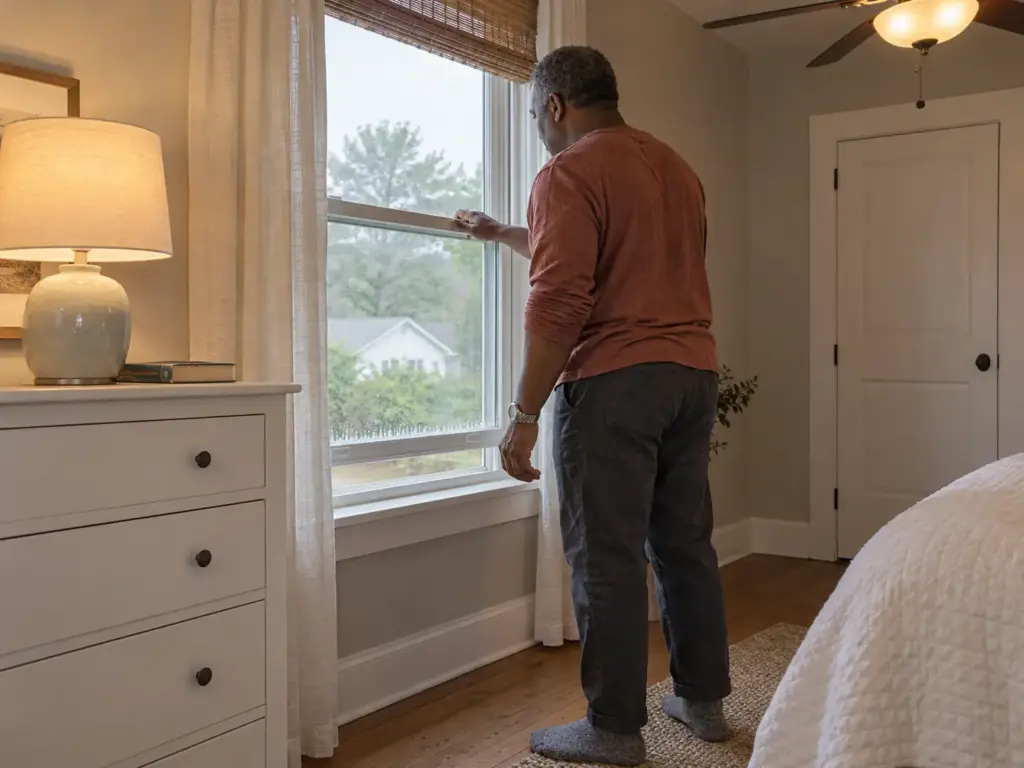
Move the evening’s water out first
Run the bathroom exhaust fan until the mirror clears and a few minutes past that. Take wet laundry out of the bedroom. Lower the humidifier’s setting, or stop it for the night. Pick one.
The full lowering routine, with the order that works, is in the free fixes in the order that works.
Open the window only when outside is drier
An open window is the most quoted fix, and it is also the one that backfires. It helps only when the air outside holds less water than the room does. On a humid night, an open window brings the water in, so a rising number can simply mean outside air is coming in. In dew-point language, the window helps only when the outside air holds less water than the room.
Read the dawn number again before the next change
A change that works shows in the next morning’s dawn pair, not the same night. One night does not tell; three nights in a row do. Compare each dawn reading with its own prediction, using the same two readings from the section above, and only then touch the second fix.
Keep the rest of the night routine boring while you test. If the window is open on Monday, the fan runs on Tuesday and the humidifier is off on Wednesday, the three dawn numbers answer nothing.
Some mornings the water will not leave no matter what you change. A window that sweats every day, a wall that darkens, a damp basement under the bedroom: those are the building, not the night routine. The hour-by-hour story of glass that sweats overnight tells the glass side, and a damp basement reaches the rooms above it explains the floor below.
When a Dehumidifier Is the Last Fix
If the dawn number still runs above the prediction after the free changes, the bedroom needs water taken out, and this is where a machine earns its place. It treats only one of the two cases: a dehumidifier removes water, so it helps the “water arrived” reading and does nothing about the percentage that rises because the room cooled. The obvious purchase stops being obvious if the test said the cooling did it all.
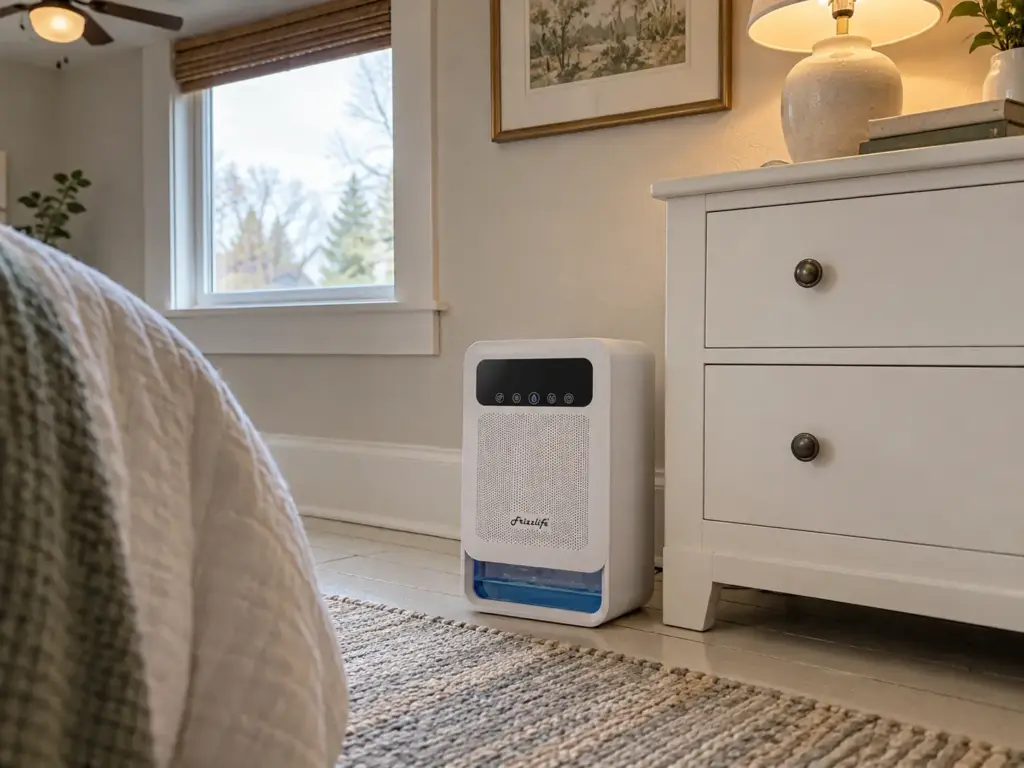
The Frizzlife DH80 (Amazon) is a compact unit with a 135 oz (about 4 L) tank, a 1 to 24 hour timer and a sleep mode the listing rates at 28 dB. A dehumidifier shuts off when its tank is full, which is a stop rule to plan around: once it stops, the reading climbs back.
The listing describes it as a semiconductor unit for small spaces and says the humidity level cannot be set by hand. It prints no pint rating, so size it by the room’s reading, not by the box. The dehumidifier bucket question is where the listing is weakest. Buyers’ questions on the listing ask “Why does the water tank only collect a little water every day” and whether the daily figure on the page is accurate; no answers appear beside them, so treat the daily output as a number to verify in your own room.
Judge it by the dawn number again, not by the tank. A unit that fills its tank by midnight and shuts off is telling you the water arrives faster than one tank can carry out, which is information, not a failure. A bedroom dehumidifier by pints, decibels and bucket is the next decision when the free fixes were not enough.
Log One Night Before You Judge the Change
Two readings are a snapshot and a night is a curve. This is where a logging meter earns its keep, and where the cheap meter’s tolerance has to be stated.
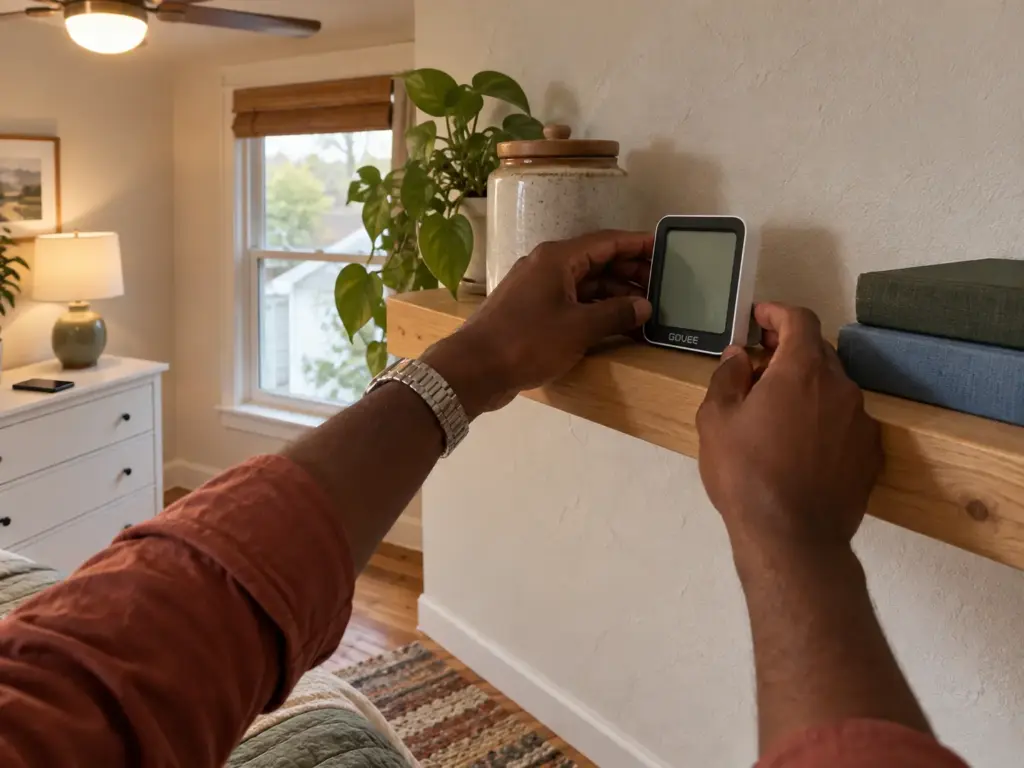
What a night-long log shows that two readings cannot
A log shows the evening shower as a spike that has not come down by midnight, the moment the AC cycles off, and the slope of a room that is simply cooling. None of that is visible at bedtime and dawn.
The Govee H5075 (Amazon) records temperature and humidity through the night without a trip to the room. The app keeps a 20-day graph and exports up to two years of data as a CSV file, and Bluetooth reaches about 60 m (about 196 feet). The catch is that it is Bluetooth only, with no Wi-Fi, so you read the data when your phone is near the meter and see nothing from the office.
If you want alerts while away from home, the Govee H5051 (Amazon) adds Wi-Fi, an LCD and app alerts. It connects only on a 2.4 GHz network, some units drop off the network, the display is not backlit, and it cannot show the dew point. The included batteries are worth replacing at the start. If you do not need the data away from the sensors, the H5075 is the better choice.
How much error to expect from a cheap meter
The Govee listing states ±3 percent humidity and ±0.54 °F. Read that as a margin on any single number: two meters can disagree by as much as six points, which is the reason to read one meter twice and keep the five-point line from the test above. Keep the AcuRite and the Govee units in separate rooms rather than comparing them with each other.
The bounds for the dawn number come from the EPA. In the EPA’s brief guide to mold, moisture and your home, the advice is: “If possible, keep indoor humidity below 60 percent (ideally between 30 and 50 percent) relative humidity.” What a good humidity level for a bedroom is goes into the band for the room itself.
Put new batteries in the meter before you judge it, then average the dawn number over three nights and hold that average up against the 60 percent ceiling. One odd night, or one tired battery, should not decide the next change.
Sometimes the number never leaves the high band no matter how many changes you make. At that point it is a building or a source question, not a night one, and keeping mold off bedroom walls below 60 percent is the next stop. For how long a reading stays up after the source stops, see how long levels stay high.
Write the Prediction Down Before You Fix Anything
Three things carry over. The percent climbs after dark because cooler air holds less water, and that alone can move a reading several points. The test is the predicted dawn number against the real one, and a gap of five points or more says water arrived. And the fixes go one at a time, with a reading between them.
A month from now, look at the three-night average of the dawn number and check the meter’s battery, since a number you have started to distrust may be a tired meter and not a wetter room. Tomorrow, write the evening temperature and percent before bed and the dawn pair after, make one change that night, and compare the dawn number with your prediction, not with last week’s.
Frequently Asked Questions
01Is it normal for indoor humidity to increase at night?
Yes, up to a point. Cooler air holds less water, so the same water reads as a higher percent. It is a problem only when the rise runs well above what the cooling predicts.
02How can I reduce humidity in my bedroom at night?
Move the evening’s water out first: run the exhaust fan, take laundry out, lower the humidifier. Change one thing and read the dawn number again. A dehumidifier is the last fix, not the first.
03Does keeping the AC on help with humidity?
While it runs, yes: the EPA lists air conditioners among the ways to remove moisture from indoor air. It removes water only when it is on, so it does nothing in the hours it is off.
04Is 70% humidity too high for a bedroom?
It is above the EPA’s advice to stay below 60 percent, with 30 to 50 ideal. Check the window glass and the walls, then use the two-reading test to see whether it is cooling or added water.
05Is humidity higher at night or during the day?
The percent is usually higher at night in the same room, because the air is cooler. The amount of water can be the same all day, which the dew-point test checks.