
The first properly cold week arrives, the window glass that sweated in October is dry, the carpet gives you a snap of static electricity at your fingertips, and the meter on the shelf reads well under where it sat a month ago. That is when people ask why is indoor humidity so low, and the answer starts outside the house: cold air carries very little water, and a forced-air furnace warms it without adding any, so the percentage falls even though no water has left the house. What happens after that is a question of what carries water out of the house, so this page runs the percentage first and then the drains in the order to check them, inside the wider picture of Indoor Humidity Basics. How dry air feels in a person, or anything about breathing, skin or sleep, belongs to a doctor; this page reads the house.
Quick Answer
Cold outdoor air carries very little water, and heating it indoors adds none, so the percentage falls with no water lost. How far it falls depends on how fast the house swaps its air and which drains carry water out: leaks, exhaust fans, the dryer vent, and cooling equipment. Check them in that order, one at a time.
Cold Air Warmed Indoors Reads Dry Without Losing Any Water
The house did not lose water between last month and this week; the air that came in did, and dry indoor air in winter is mostly that air warmed up. Before any drain gets the blame, the cold itself sets a floor under the reading, and it helps to know where that floor sits.
Why a Furnace Lowers the Number but Removes No Water
Relative humidity is the water vapor in the air as a share of what that air could hold at its temperature, and warm air can hold far more than cold air. “Heating dries the air” is the shorthand, and it is slightly wrong: the water vapor is still there and the dew point has not moved, but the denominator got bigger. According to the EPA’s own guide to controlling moisture in the home, “As the temperature goes down, the air is able to hold less moisture.” The furnace adds heat and no water, so the heated air arrives in the room with its small load of water spread over a much larger capacity.
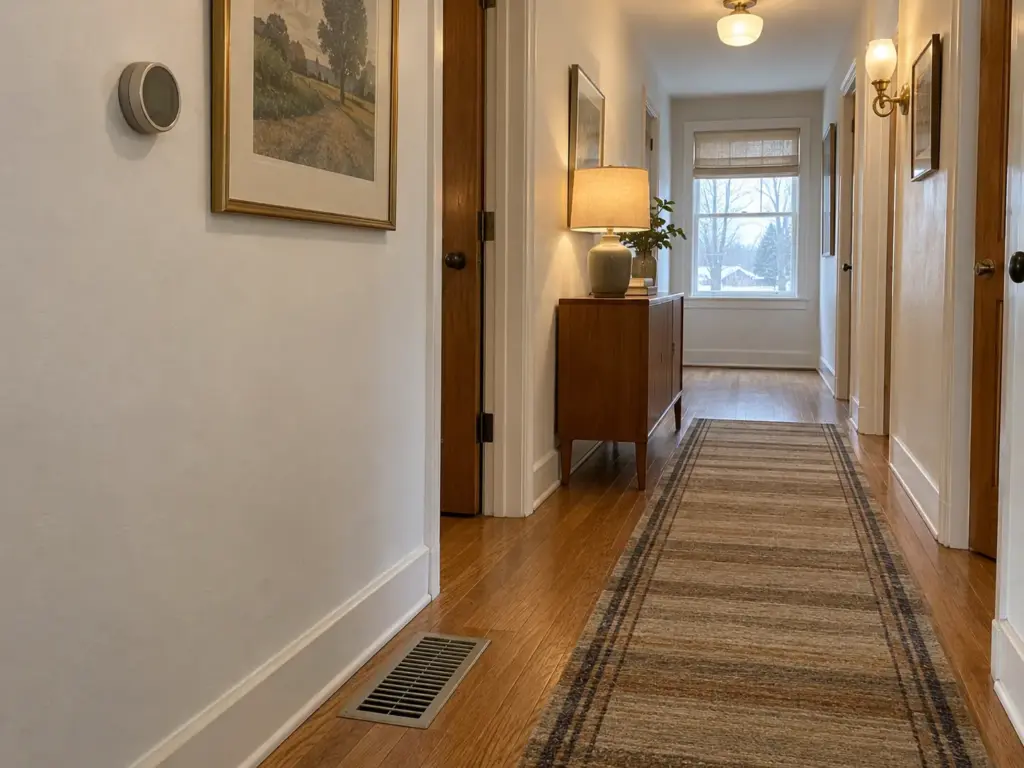
That is why a house with no leak, no fan and no cooling equipment at all can still read low on a cold day. The thermostat set to 70°F (21°C) in the hall, frost on the outside of the glass and a meter sitting near 20%: the room can look exactly like that without anything being wrong with it. A heat pump or baseboard heat does the same thing, since any heat source warms the air without adding water.
What the Arithmetic Gives on a 20°F Day and a 32°F Day
The numbers in this section are a calculation, not an EPA figure, and they assume a 70°F (21°C) room at sea-level pressure (the EPA page prints no indoor temperature). Outdoor air at 20°F (-7°C) and 50% relative humidity holds about 1.4 grams of water per cubic meter, its absolute humidity. A 70°F room can hold about 18.4 grams per cubic meter. Heat that outdoor air to 70°F, add nothing, and the reading is about 8%.
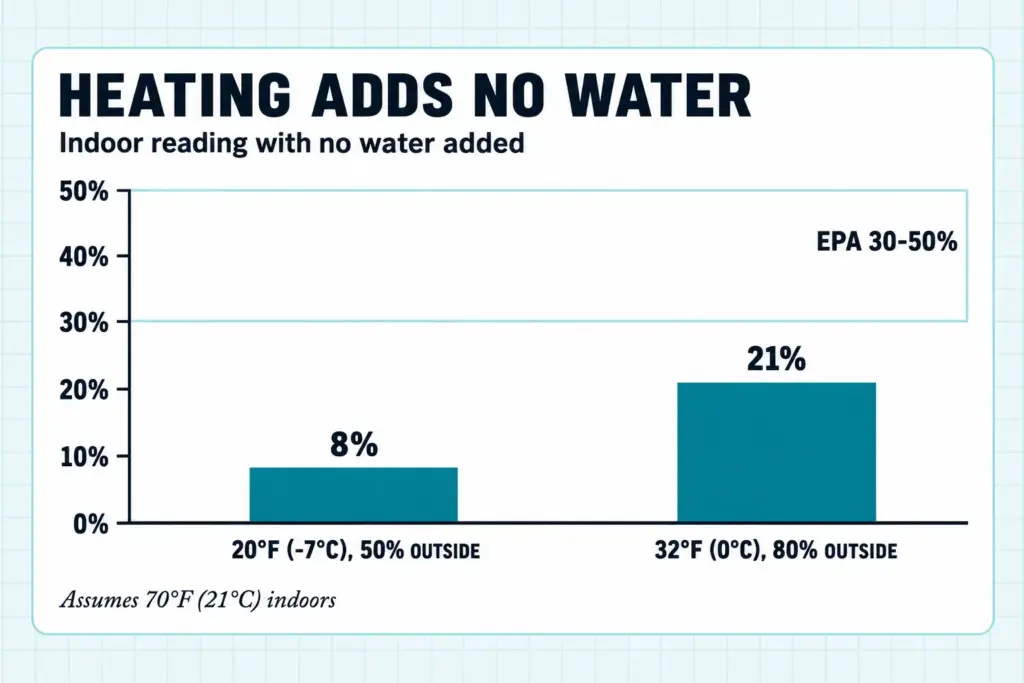
A milder cold day moves the floor up, but not by a lot. At 32°F (0°C) and 80% outdoors, the air holds about 3.9 grams per cubic meter, and the same heating to 70°F gives about 21%. So a house that adds no water of its own would read 8% on the colder day and 21% on the milder one, and the weather did all of it.
Why Real Rooms Read Above the Floor
Real rooms sit above those floors because people, showers, cooking and plants add water, and that is the subject of a later section. Heating cold outside air to a normal indoor temperature drops its relative humidity sharply, so winter air is dry. Two houses on the same heating can still read very differently, and an old house with leaks often reads drier. Same weather and same furnace type; what differed was the house.
One detail only shows up across days: the reading tends to be lowest on the coldest morning and climbs a few points on a mild afternoon, with nobody touching a fan. A low number on the coldest day can also simply be correct, because the ceiling the EPA sets by outdoor temperature is a ceiling, not a floor, and it falls as the cold deepens. For the season as a whole, see how the winter band shifts with the cold.
The Leaks That Swap Your Air for Dry Air
The arithmetic sets the floor; air leakage is what keeps a house pressed close to it. A house is not a sealed box, and every gap is a small, free exchange of indoor air for outdoor air.
Why a Drafty House Reads Lower Than a Tight One on the Same Heat
The EPA states the tight-house half of this in one line: “A tight, energy efficient house holds more moisture inside.” The inverse is this page’s inference, and it follows directly: a leakier house sheds more of its moisture than a tight house does and takes in more of the dry outdoor air, which is why two houses on similar heat can read 20 points apart. Drafts can be the biggest culprit in an older house, especially one with new windows that were not sealed well.
The effect also moves with the weather. The same house reads lower on a windy cold day than on a still cold day at the same temperature, because wind pushes more outdoor air through the same gaps.
The Free Check: Where the Cold Air Is Coming In
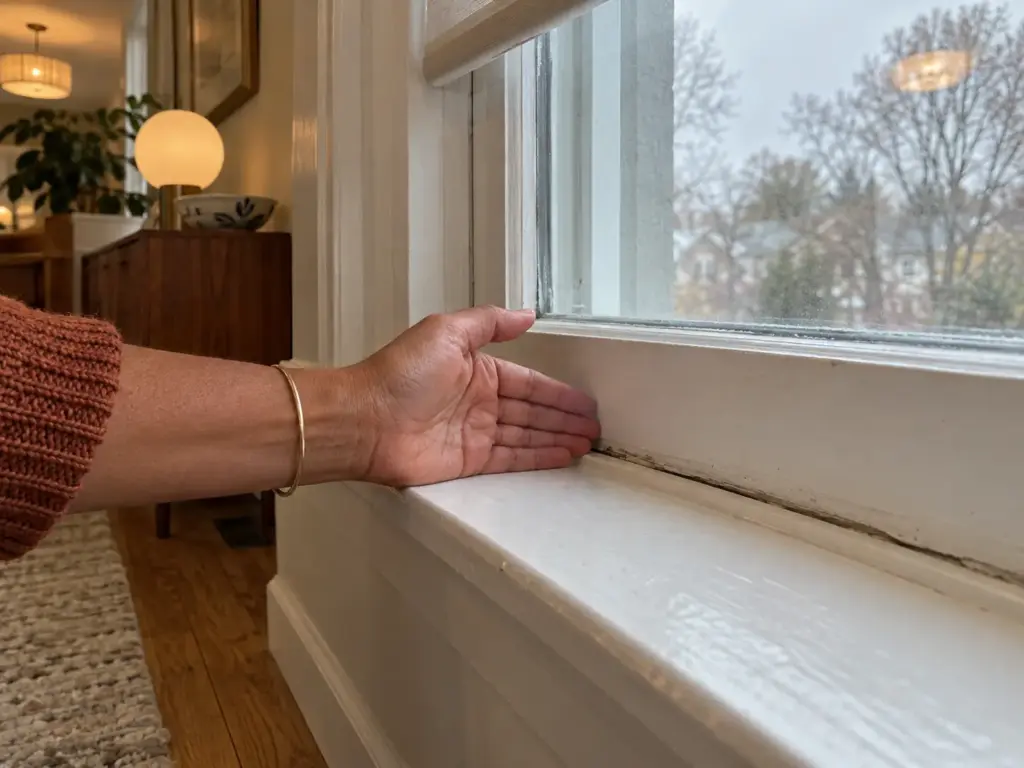
Before anything is bought, take the back of a hand along the bottom of each window sash, along door edges and across outlet plates on a cold, windy day. Hands find a moving draft long before eyes do. The check costs nothing, works the same in a rental, even one with a shared wall, as in a house, and it tells you whether the leak is a gap you can close or just the building.
Do the hand check once, then close only the worst leak. If you seal the sash, the door and the outlets in one weekend, you will not know which one moved the reading, and you will not know whether you gave up too much fresh air.
Weatherstripping, caulk or storm windows come after the check, never before it, and one spot at a time. Sealing everything in one pass backfires in a house that was already tight: closing the last gaps raises the percentage and cuts the air exchange together, so the CO2 climbs while the glass looks better. The leak you seal is also fresh air, which is the trade the next section is about, so read the room again after each spot you close.
When the Leak Is the Building
Some leaks are not a weekend job. Sealing an old house without extensive renovations can be very hard, and that is not the owner’s fault: an old house with no vapor barrier has a ceiling on what its humidity can reach. In a rental, a landlord’s loose window is not yours to fix either. What you can do is know the ceiling, keep the other drains in check, and ask a contractor about the house itself if the draft is serious; a blower door test is how air leakage gets measured.
Fans and Vents That Carry Water Outside, and What Closing Them Costs
Leaks are accidental drains; these are the ones you chose, and the EPA recommends them. The bathroom fan, the kitchen range hood and the dryer vent all send moisture outside on purpose, which is the right call in a damp house and the wrong one in a dry one that runs them out of habit.

How Much Water the Bath Fan, the Range Hood and the Dryer Send Outside
The EPA tells owners to use exhaust fans in bathrooms and kitchens to remove moisture to the outside, and its instruction for the dryer is as short as it gets: “Vent your clothes dryer to the outside.” (That is all in the EPA’s guide to moisture control.) A dryer vented outside sends the water of a wet load out with its exhaust; the water of an unvented one would land in the room. Either way, a fan or a ventilator left running long carries more water out, so the reading falls.
The fan left on “to be safe” long after the mirror clears is the usual culprit, and so is a ventilator (an energy recovery ventilator or a heat recovery ventilator, ERV or HRV) left on a high ventilation setting all winter. Neither is a fault. They are doing what they were installed for, in a house that now has less water to give.
The Trade: The Drain You Close Is Also the Fresh Air
The EPA puts both needs into a single sentence: “Be sure that your house has a source of fresh air and can expel excessive moisture from the home.” That is the trade. The same airflow that carries water out carries stale air out, so closing a fan to hold the percentage also holds back the fresh air that keeps the room from getting stuffy. Turning off the fan is the easy answer, and it works on the number it targets and costs you on the one it ignores.
Never turn off a combustion appliance’s vent, or an exhaust the building requires, to save humidity. That is a safety rule, not a humidity setting.
After any fan change the reading barely moves in the first hour and settles over a day, so compare mornings, not minutes. Run the bath fan for the shower plus a few minutes, set the ventilator one notch down, and read the meter at the same hour the next day.
Reading CO2 Before You Change a Fan
Once a fan is running less, the water stays in the room, and so does the stale air. What indoor carbon dioxide levels actually mean in a house is the page for the CO2 half, and it is the CO2 ppm reading that rises when a drain closes. The free change comes first: run the fan less, then read the humidity meter and the CO2 monitor again before touching anything else.
If you want the CO2 number on a shelf, the Aranet4 is a wireless CO2 monitor that lets you see the cost of the change (Amazon), with the INKBIRD NDIR CO2 detector as the lower-cost alternative (Amazon). The flaw is the same for both: they add a second number to read, and they report only what the air does at the shelf where they sit, not in the rest of the house.
When the CO2 climbs after you cut a fan, the answer is not to switch the fan back on to its old setting; it is to find a middle one. The fresh-air fixes and the flaw of each are written out so you can pick the one that costs the least water.
Cooling Equipment That Pulls Water Out
The last deliberate drain sits in the window or the basement: the machine whose job is to take water out of the air. An air conditioner cools the air and its coil collects water as it does, so a unit that runs for hours lowers the percentage as a side effect. Why windows sweat when the AC is on describes the same coil from the glass side.

A dehumidifier does the same job on purpose. If its target is set at or under the lower end of the band, the reading sits low by design, and it keeps cycling because it can never reach what it was told to reach. Check the target before anything else; what humidity to set a dehumidifier to owns the number. The unit that never stops cycling is almost always the one set under the band.
A window air conditioner in a rental bedroom in July lowers that one room, not the house, and the reading in the rest of the apartment may be fine; a central air conditioner dries the whole house the same way. One change, then read: raise the dehumidifier’s target by a notch or run the cooling unit for a shorter spell, and wait a day before the next move.
When the House Has Little Water to Add
After the drains come the taps, and what the house adds has its own page. The same drains empty a busy house less than a quiet one, because a busy house keeps refilling.

The EPA lists the sources: long showers, running water, cooking moisture from boiling or steaming, houseplants and drying clothes indoors. A house where nobody is home from morning to evening, nobody cooks much and nothing is drying on a rack has almost none of them, so the leaks and the fans win every day. Age and sealing, more than the owner, explain why houses on the same heat can differ so much.
The pattern shows across a season. The coldest week reads lowest and the reading climbs after it; no figure for the season is promised here, because no source gives one. Over a single day, the reading rises a few points in the hour after a shower and falls back by lunch. If that rise never shows up at all, the house is not adding anything, and why the reading climbs at night covers the opposite pattern.
Which Drain to Check First, and the Reading After Each
Every drain is on the table now, so here is the order: a second meter first, then the free checks, one at a time, with a reading after each. Free and likeliest comes first, and the reading you compare is always the same hour, the same spot and the same weekday.

Step 0: A Second Meter Before Any Drain
Before blaming the house, make sure the number is real. Before trusting a low reading, check the meter itself. A second meter is the cheapest way to tell whether the house is low or the first meter is.
The Govee H5075 is a small Bluetooth hygrometer and thermometer that works through an app (Amazon), and the AcuRite 00613 is a 3-inch analog dial with no app or Bluetooth (Amazon) for the lower-cost option. A pocket hygrometer is only as good as its calibration and can sit a few points off the first meter; that is the reason for two meters, not one.
If the second meter agrees with the first, the house is low. If it does not, the house may be fine. The full meter check, the relative humidity band and the signs in the building (static, a trim gap, wood shrinkage) belong to Can indoor humidity be too low? Check the meter first.
Steps 1 to 4: Leaks, Fans, Ventilator, Cooling, One at a Time
Work down this list, one step at a time, and read the same meter at the same hour of the next morning between steps.
- Leaks. The back-of-the-hand check along sashes, doors and outlets on a cold, windy day. Close the worst gap only, then read. A reading that rises a few points means the leak mattered.
- Bath fan and range hood. Run each for the task plus a few minutes, not an hour. A reading that holds higher the next morning means the old run time was a drain.
- Dryer vent and ventilator setting. Keep the dryer vented outside, and set the ventilator one notch lower. Read the CO2 once after this change, because this is the step where fresh air goes down with the water.
- Cooling equipment’s target. Raise the dehumidifier’s setting by a notch, or run the window unit for a shorter spell. A reading that climbs over a day means it was set too low.
The reference for the band is the EPA’s, from EPA’s brief guide to mold and moisture in your home: “If possible, keep indoor humidity below 60 percent (ideally between 30 and 50 percent) relative humidity.” That 60 percent ceiling is the EPA’s own; the 30 to 50 percent inside it is the target. But the target depends on the day. On a very cold morning the EPA’s ceiling allows 25% at 0°F (-18°C), so chasing 40% on that day can put condensation on the glass and fog the windows, and a reading of 25% may already be the right one.
Write each reading on a note taped near the meter with the outdoor temperature beside it. A reading of 22% on a 15°F morning and 22% on a 40°F afternoon are two different stories, and the note is what tells you which one you have.
What to Do When Every Drain Is Closed and the Reading Is Still Low
If the reading stays under the band after the free checks, the fix side begins: how to raise indoor humidity takes it from here. In a leaky house a humidifier barely moves the number, so air sealing comes before adding humidity.
And if the drains are checked, the second meter agrees and the house still cannot hold a number, the cause may be the building itself. That is a call to a professional for the house, a contractor who can look at the air sealing, not a reason to keep adding devices.
One Check Along the Window Sash Tomorrow, and the Reading the Morning After
Three things carry the page. Cold air carries little water, and warming it adds none, so the number falls with nothing lost. The drains are leaks, fans and vents, and cooling equipment, and each one is also fresh air. Check them in order, free first, with a reading after each.
A month from now, after the next cold snap, read the same meter at the same hour of the morning, and read the CO2 once after any fan change. The one move for tomorrow is the hand along the window sash on a cold day, and the reading to take is the one the morning after.
Frequently Asked Questions
01How do I fix low humidity in a house?
Check the drains first: leaks, then fans and vents, then cooling equipment, one at a time with a reading after each. Only after that does a humidifier come in, and that is the next article: how to raise indoor humidity.
02Is 40% indoor humidity too low?
No. The EPA puts the ideal at 30 to 50 percent, with 60 percent as the ceiling, so 40 percent sits inside the band. Some sites call anything under 40 low, but the EPA page sets no floor. Check the meter against a second one first: can indoor humidity be too low.
03What does low indoor humidity do to a house?
In the house, it shows as static on the carpet, wood shrinkage that shows as a trim gap or a hairline gap between floorboards, and window glass that stays dry. Those are signs to confirm with a second meter before anything is changed.
04Is it normal for indoor humidity to drop in a cold snap?
Yes. The EPA’s ceiling table drops from 35 percent at 20°F to 15 percent at -20°F, so a lower reading on the coldest days is expected. See indoor humidity levels by outdoor temperature.
05Is it better to live in high humidity or low humidity?
Neither. The band decides, and the meter tells you which side of it the room is on. The wider picture is in Indoor Humidity Basics.