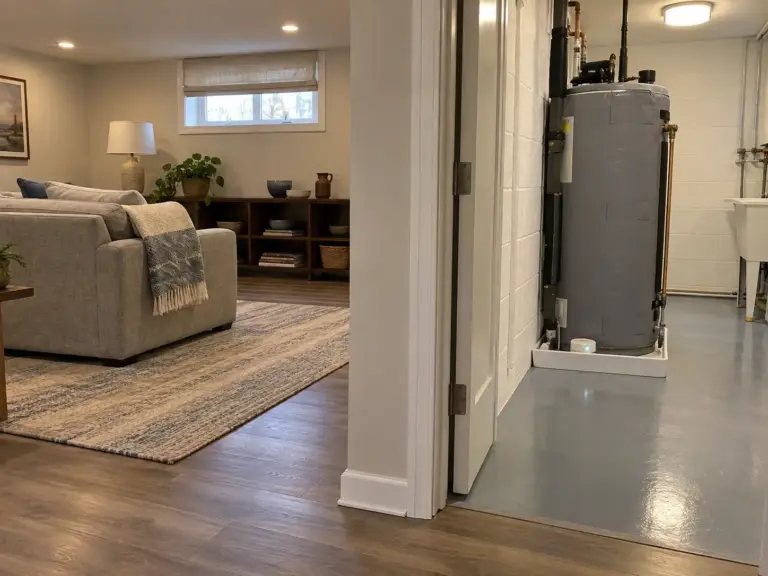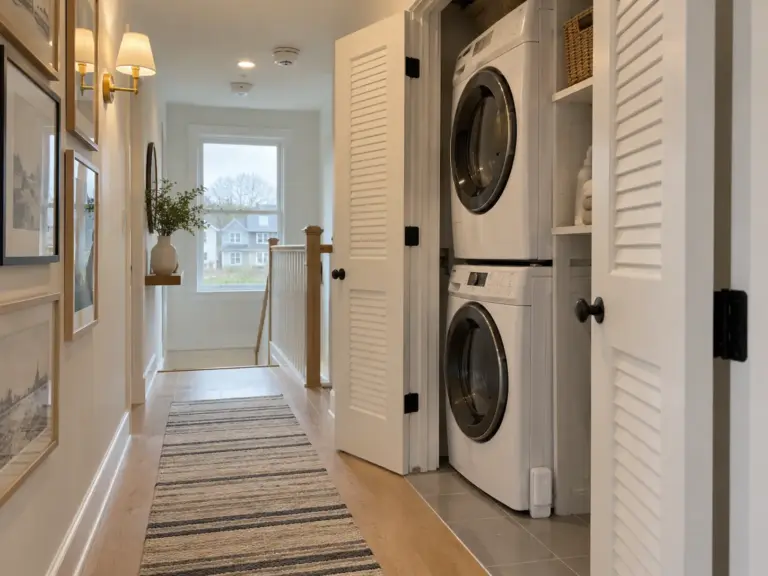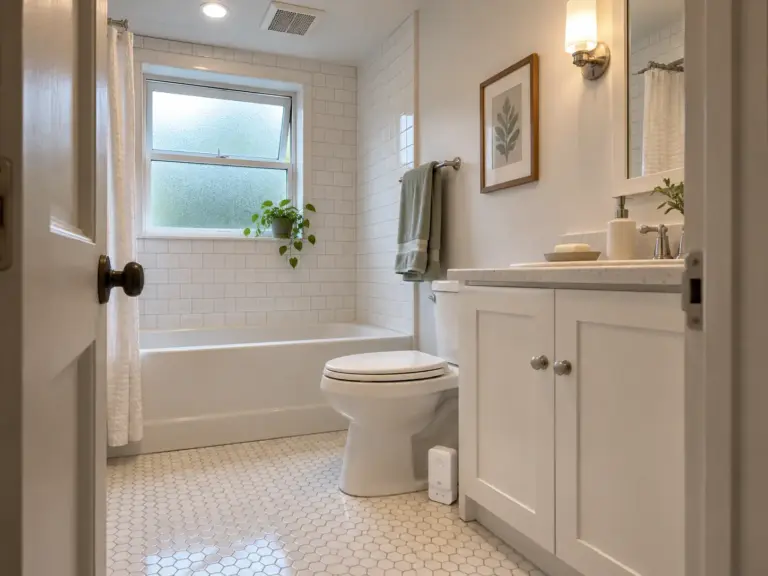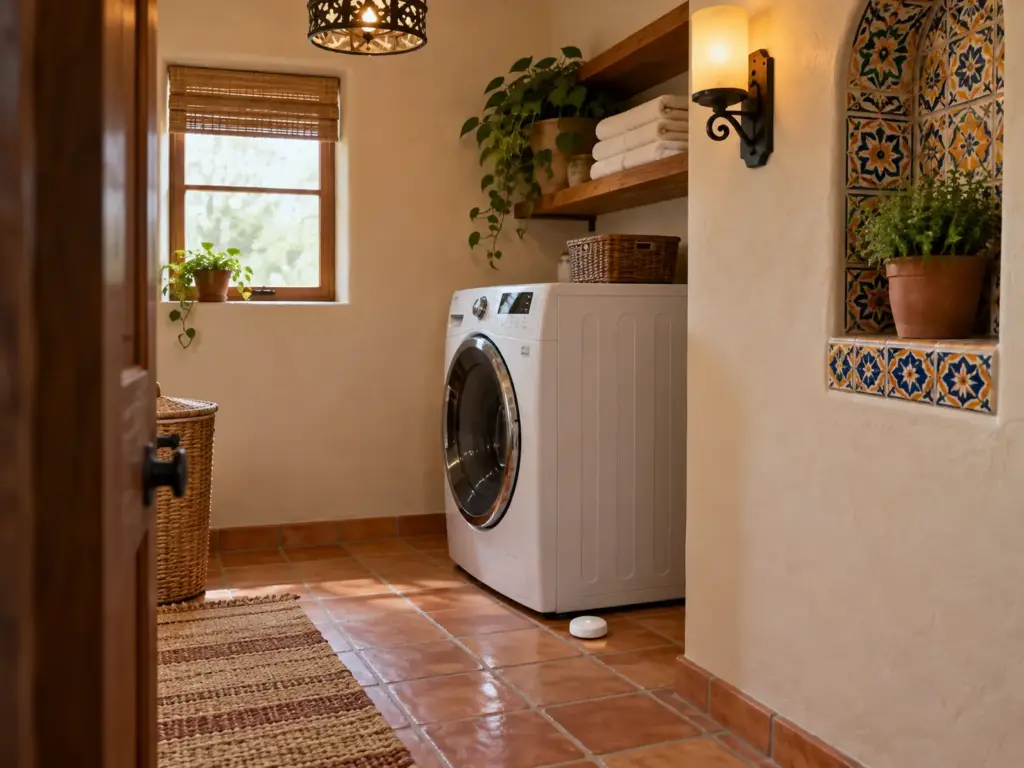
A flat plastic disc sits on your laundry-room floor for a year and nothing happens, so it is easy to picture it as something that smells water the way a smoke alarm smells smoke. It doesn’t smell anything.
So how do water leak detectors work? Two bare metal contacts, which makers call conductive probes, a battery and a small radio wait with a gap between them, and the whole device is a switch that only a liquid carrying dissolved minerals can close. What follows traces that gap from the contact to your phone, sorts the four kinds of detector by what each one cannot see, and says what the contacts turn into after a few months and why none of it replaces a humidity reading.
Quick Answer
A water leak detector is a switch. Two metal contacts sit with a gap between them, and when a liquid carrying dissolved minerals touches both, current crosses and the sensor sends an alert. So it reads water only where water touches its contacts, and it cannot see a leak that never reaches them.
What the Two Contacts Actually Do
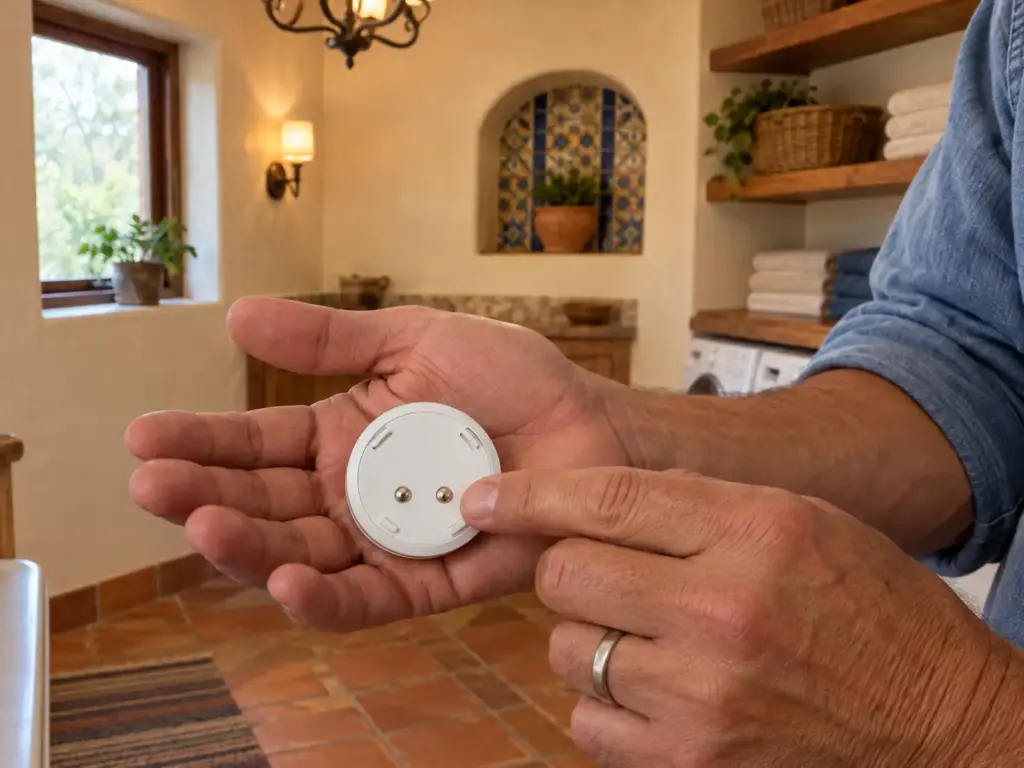
Turn a leak sensor over and the underside gives it away: two small metal dots, sometimes four, and nothing else that looks like a sensing part. If the whole device is a switch, what does water do to it, and why should the kind of water matter? The three parts below answer that in order, and if you are still working out whether you have a leak at all, how to detect a water leak starts with the meter and the room instead.
A switch that water closes
While the floor is dry, there is air between the contacts, and air passes no useful current, so the circuit sits open. Water on the floor changes that. Once a liquid spans the gap, forming a water bridge between the contacts, current crosses, a small circuit board notices, and the radio sends its message.
A water leak sensor is basically a continuity sensor: two metal contacts, sometimes more, that complete a circuit when water touches any two of them.
Electrical continuity just means an unbroken path, and that is the one thing the device asks about. The battery, the chip and the radio inside the housing exist to report whether that path exists right now. Nothing else is measured: not how much water there is, not how long it has been there, not whether the air above it is damp.
Why the water has to carry minerals
The contacts do not detect water as a substance. They detect a path for current, and a path needs charge carriers. In water those are dissolved ions, the minerals and salts tap water picks up on its way to your faucet. Ordinary tap water carries plenty of them, which is why an ordinary spill closes the gap.
The physics is plain: the U.S. Geological Survey defines specific conductance this way, and its overview says, “As concentrations of dissolved ions increase, specific conductance of the water increases.”
The flip side follows from the same line. Water with few dissolved ions conducts less, so how a given sensor responds to very pure water is a test to run in a real room, not something a spec sheet settles. Mop water, soap water and damp dust carry ions too, and that matters again in the fourth section.
Why both contacts must touch the same wet surface
Closing the circuit takes liquid across the gap, not liquid near it. A sensor maker’s help page for a sump-pump probe says so without hedging: “Both prongs have to be touching the same surface.” A probe tilted on a bump or a bit of debris, with only one prong down, never triggers.
That makes the sensor’s shape part of the sensing. Lying flat on a smooth floor, it reads a thin film as readily as a puddle. The same disc sitting on a lifted edge or a warped board can have one contact in the air and a spill beside it, and it will report a dry floor.
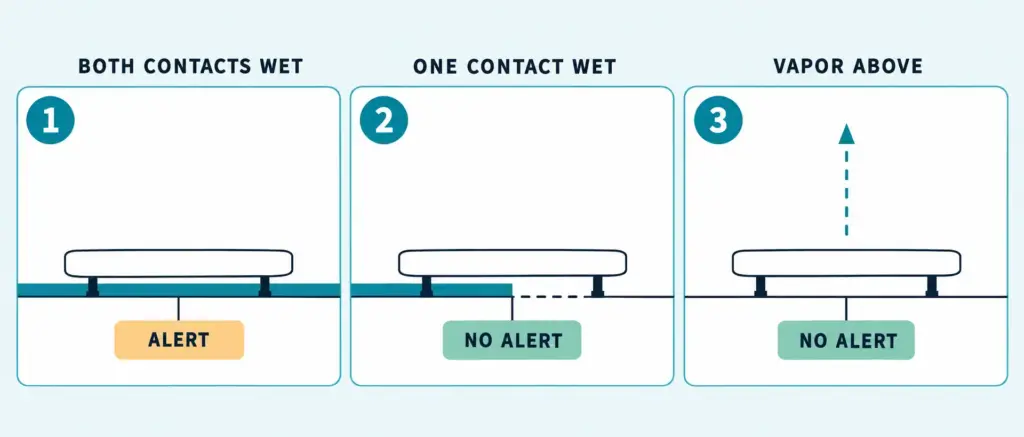
Where the contacts sit on the housing also decides what counts as a leak. A puck-style sensor stands on metal feet, so water has to span any two of them. Even a small splash can set it off, which is useful near a laundry sink. The same puck carried two more contacts on top, which catch a drip falling from above. A model with feet only and a model with top contacts therefore see different leaks, and the underside of the sensor, not the box, tells you which one you own.
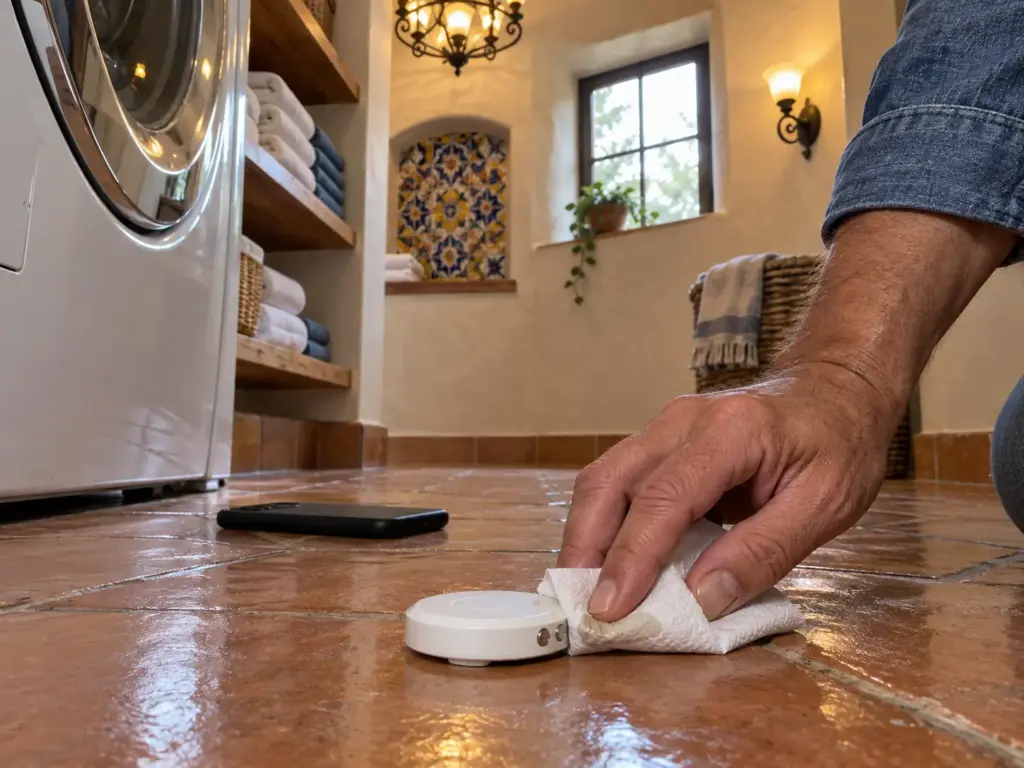
Before you trust any placement, press a damp paper towel to both contacts and watch for the alert. The monthly wet test in the fourth section is that same move, repeated.
Once the sensor is in place, press a flat hand on it. If it rocks or lifts at one edge, one contact is hanging in the air; shift it a few inches onto flat floor before you stick it down.
From the Contact to Your Phone: the Alert Chain
Once a drop has closed the gap, the sensor has done about all the sensing it will ever do. Everything after that is a radio, and a radio can fail while the contact is perfectly wet. The question for this section is what stands between the contact and your phone, and the three parts below read as the links of one chain.
The sensor, the base and the app
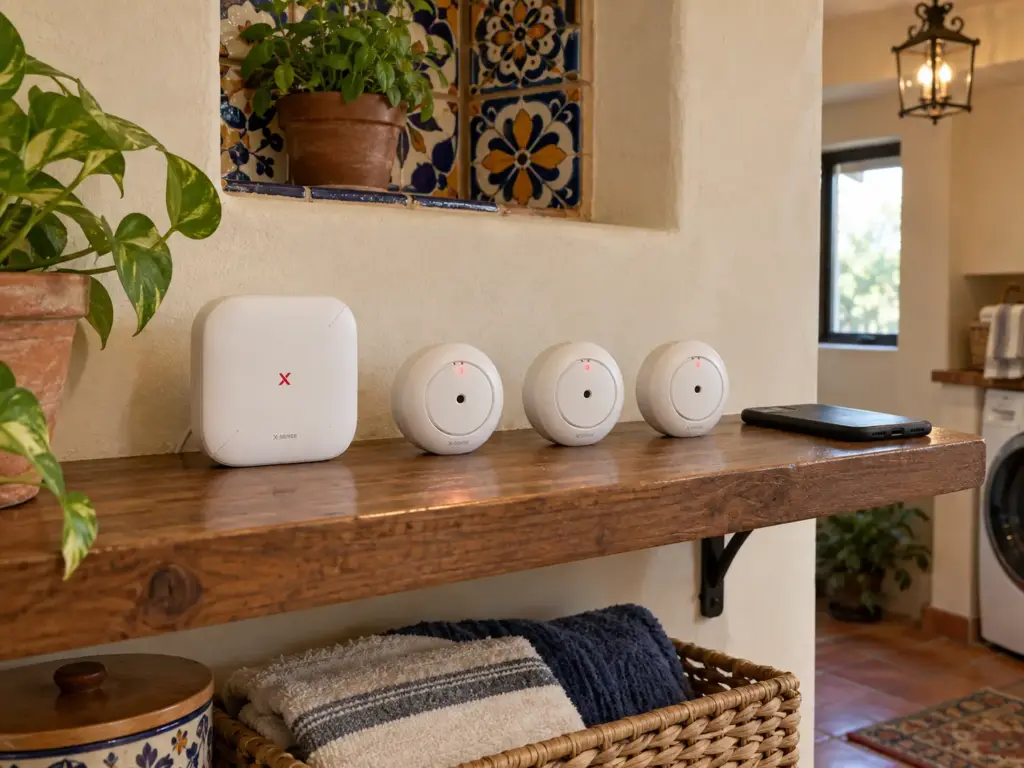
The chain runs in order. The contact closes, the sensor’s radio sends a short message, a base or your home Wi-Fi receives it, an app turns it into a push alert, and some units also sound a siren in the room. The radio itself can be Wi-Fi, Zigbee or Z-Wave, which differ in what they talk to, not in what the contact does.
The X-Sense Wi-Fi Water Leak Detector Kit shows the whole chain in one box: a base station that sits between the sensors and your home network, three sensors, a 120 dB alarm and an app. The base is also the link that can break.
Sensors tucked into a cabinet beside a metal washing machine, under the kitchen faucet, are the kind of spot that loses the signal. The instructions warn that metal and a closed cabinet door block it. The physical point is the useful part: metal and closed doors are the things a maker names, so where the radio sits matters as much as where the contacts sit.
The no-hub route
The other design drops the base. The SwitchBot WiFi Water Sensor is a single sensor that talks straight to your home Wi-Fi, with no hub, a 100 dB alarm and an IP67 rating. Touched with a semi-damp paper towel, it both sounds and pushes an alert to the phone.
What you give up shows in two places. It only works on 2.4 GHz Wi-Fi, which is worth checking on a rental where the router belongs to someone else, and the sensors may need a reset after the Wi-Fi goes down. The two designs break in different places: one at the base, the other at the router.
What happens when the Wi-Fi drops
When the Wi-Fi drops, the contact still closes. What goes dark is the alert. A sensor can sit in a puddle while the phone shows nothing, because the break is at the radio, not at the water. Many units add a siren in the room for exactly this case, which helps if you are home and does nothing if you are not.
Some apps also flag a sensor as offline or warn of a low battery, and one maker notes those messages are easy to mistake for a leak alert, so read the app message before you go looking for water.
Range claims make the gap easy to miss. Check the signal where the sensors will live rather than trusting the claimed 120 meters (about 394 feet), since building materials and interference decide the real figure. A claim like that sounds like it covers a house with room to spare; a laundry closet with a steel door and a router two walls away is a different map. The free fix costs nothing: carry your phone to the sensor’s spot before you fix it down, and trigger it there.
Run the damp-towel test at the sensor’s final spot with the cabinet door shut. A test on the kitchen counter proves the contacts work and says nothing about the radio, and the radio is the link most likely to fail in a closed, metal-lined cabinet.
If the radio turns out to be the weak link in your house, that is the question to bring to the model pick: a water leak detector that keeps reporting is the one worth looking for.
Four Kinds of Detection and What Each Cannot See
“Water leak detector” names four different devices, and they do not read the same thing. One reads a spot, one reads a line, one reads the flow inside a pipe, and one is a disc that swells. Knowing what each reads tells you what each one misses.
Point sensors and sensing cables read where they touch
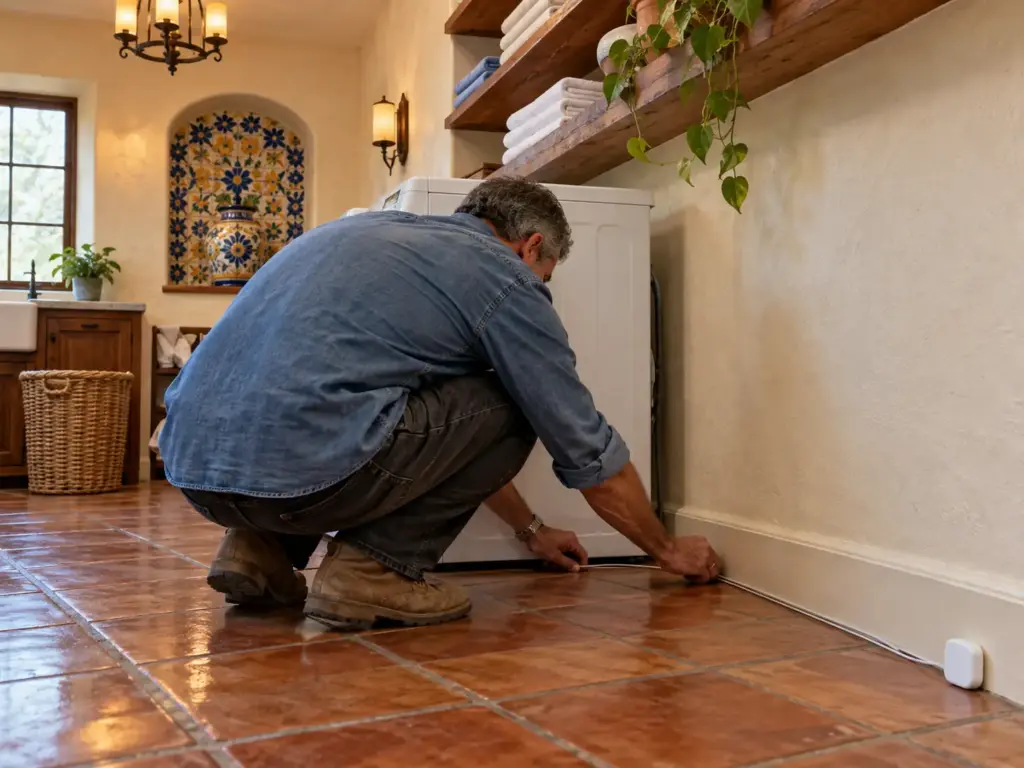
A point sensor, the puck on the floor, reads the spot it sits on. A sensing cable is the same circuit stretched out: a long pair of conductors that closes wherever liquid touches them, so it can cover a path behind a dishwasher or along the baseboard. Both close only on liquid that reaches them, by the rule from the first section.
That is why the useful question is never how good the sensor is, but where the first drip lands. A sensor on the far side of the room reports a leak after the water has crossed the room. A hidden leak inside a wall cavity, in a crawlspace or in a slab leak reports nothing until water finds its way out, because nothing has touched a contact.
A flow monitor reads the pipe, not the floor
A whole-house flow monitor sits on the main water line and watches water move, not arrive.
Two designs do the watching. A mechanical flow sensor uses an impeller, a small wheel the flowing water turns. An ultrasonic flow sensor sends sound along the pipe both with and against the flow and compares the transit time of the two signals, which gives a flow rate without any moving parts. If water keeps flowing for longer than a household normally uses it, the system alerts and, with a valve fitted, can close the line.
Its blind spot is the opposite of the contact sensor’s. A leak-detection vendor’s own list of what its systems miss includes very slow leaks below the monitor’s flow threshold, slow evaporation leaks and condensation from HVAC equipment. A drip too small to cross the threshold passes unseen, because the monitor never sees it as flow.
The two devices look at opposite ends of the same leak: the flow monitor at the pipe before the water leaves it, the contact sensor at the floor after it arrives. Neither covers what the other misses, which is the honest reason some houses carry both. Whether a flow monitor and a valve are worth adding depends on where your water would come from.
The disc under a reverse-osmosis line
Under a reverse osmosis drinking-water filter sits a third design with no circuit to close. An absorbent shutoff disc expands when it gets wet and stops the water flow. It is built for one place, the few inches under that filter’s fittings, and it reads nothing beyond them.
What the Contacts Become After a Few Months
A switch with bare metal in a damp corner is not the same switch later. The surface of the contacts is the thing that changes, and a change there can make a sensor miss a leak or announce one that is not there. So the question for this section is what happens to the contacts and how you would know.
Crust and corrosion on the prongs
A sensor maker’s help page for a sump probe says the probe detects water but is not designed to live in it: “submerged contacts corrode in months.” Read that for what it is, a maker’s claim about contacts that sit in water, a sump and not a dry floor. A sensor lying on a dry laundry-room floor has no such figure attached, and any number here would be a guess, so none is printed.
What a dry floor does leave is the slower kind of change. Another maker’s troubleshooting page lists mineral residue and corrosion among the things to look for on the probes, and says to replace a unit whose probes are heavily corroded. A home with hard water is where that mineral crust builds fastest, since the minerals stay behind when the water dries.
The failure can also sit out of sight. A sump-side probe can give false alarms while its face looks dry, because the connectors can corrode. Check the connectors, not only the probe face. A dry-looking surface is not proof that the contacts underneath are free of crust.
A film that closes the gap for no reason
The cleaning habit is where people go wrong. Hard water can leave crust on the contacts, and periodic cleaning can help when that is the trouble. The sensor maker’s own troubleshooting page points the other way: cleaning products can “leave a film that traps moisture or creates a conductive path between the contacts.”
That sentence is the mechanism from the first section turned around. Soap, a leftover cleaner and damp dust all carry ions, so a film that bridges the gap reads as water even when the floor is dry.
What the maker recommends is a soft, dry cloth for dust, soap film and mineral residue, then letting the probes dry, with no solvents, abrasive pads or harsh cleaners. That is the advice here too; the descaler is not.
False alarms have a second source worth ruling out before blaming the sensor. Mopping and splashes leave a thin film under a disc after the floor looks dry, and a sweating cold pipe or a damp slab can put beaded condensation across both contacts. If that sounds like your corner, what causes basement humidity sorts out whether the water is liquid, vapor or warm air.
The monthly wet test
A sensor that has never alarmed has proven nothing. One unlucky case is a sensor that stops alerting at about a year, with good batteries, and gives no warning when it goes dead. The failure shows only when water arrives and the sensor stays silent, so check it on purpose, whichever sensor you own.
The cure is a habit the maker’s guidance backs, a monthly test. Start with the unit’s own test button or the app’s device test if it has one; one maker’s help page checks a probe by touching a wet fingertip to both prongs at once and wiping them dry afterward.
Where a wet test is fine, press a damp paper towel, wrung out so it stops dripping, flat across both contacts, watch the phone, then dry the contacts. Doing just that before placing the sensors shows whether the alert reaches the phone. Three things get tested in one move: the contacts, the radio and the app.
If you own two identical sensors, press the same damp towel to one and then the other. The one that stays silent is the problem, and you learn that without waiting for a real leak to find out.
Why a Leak Sensor Is Not a Humidity Sensor
A leak sensor and a damp room end up on the same worry list, but they read different things. A leak sensor closes on liquid touching two contacts. A hygrometer reads water vapor in the air as a percentage of relative humidity. A room can read damp for weeks while the leak sensor in the corner stays silent, because nothing has touched its contacts.

Product pages blur the line. Some retail pages list moisture detectors that read humidity in the air under the same heading as leak sensors, as if they were one instrument. A university facilities team describes its own installs the same loose way: University of Washington Facilities, describing its own installs, writes that “Both the sensor and the extension cable detect moisture, steam or a change in temperature” and goes on to the alert. A plain contact closes on liquid, not on steam or a temperature change, so wording like that points to another sensing method or a loose description.
One case stays open: whether a plain contact sensor trips on the thin, mineral-poor water that collects in an air conditioner’s drain pan or a dehumidifier’s drain is not something this article can settle, and it is a test to run with your own sensor, not a finding.
Before buying anything that says it detects moisture, find the line in the spec that says how. Liquid on the contacts means a leak sensor. Humidity, steam or temperature means a different instrument, or a loose claim, and either one changes where it can go.
If the question in your house is the air and not the floor, start with how to measure indoor humidity, then pick the reader for it: a cheap indoor humidity checker answers the vapor question that no contact can.
Wet-Test One Sensor Tomorrow, Then Again in a Month
Three things carry over from all of this. The sensor is a switch that a mineral-carrying liquid closes, so it reads water only where that water touches both contacts. The alert can fail at the radio while the contact is wet, so test where the sensor lives, not on the counter. And the contacts change, so a sensor that has never alarmed has proven nothing.
In a month, repeat the same damp-towel test on the same sensor, note whether the phone answers as fast as the first time, and look at the contacts for crust or a film while you are there. Tomorrow, wet-test one sensor you already own, or the first one you buy, and read the phone; then take the next decision, where to put water leak sensors. And if the test turns up water that stayed where it fell, the drying window for the wall is short: how fast mold grows on a wall is where that question begins.
Frequently Asked Questions
01How accurate is a water leak detector?
A water leak detector is accurate about one thing, whether liquid is currently touching both of its contacts, and it reports nothing about how much water there is. It also misses any leak that never reaches the contacts, and crust or a cleaner film on them can change the reading.
02Will a water leak sensor go off from humidity?
Water vapor in the air does not close a plain contact circuit, because the circuit needs liquid touching both contacts at the same time. Beaded condensation, damp dust or a film left by a cleaner can bridge them, though. Some products sense other things, so check the spec.
03Do water leak detectors work without Wi-Fi?
The contacts still close without Wi-Fi, and many units sound a siren in the room, but the phone alert needs the connection to reach you. Without a hub, every sensor may need a reset after an outage.
04How often should you test a water leak sensor?
Test a water leak sensor monthly, by pressing a damp paper towel to both contacts and watching for the alert on your phone. Test it where it will live, since metal and walls change the signal. Use the unit’s own test button first if it has one.
05Do water leak detectors shut off the water?
No, a water leak sensor only sends an alert, and shutting off the water takes a separate shutoff valve, which some whole-house systems include. Whether a valve is worth adding depends on where your water would come from.