
You set a new digital hygrometer on the shelf, and before you have stepped back the number on its display has changed twice. Is that the room’s humidity, or the sensor’s first guess?
Knowing how to measure indoor humidity comes down to three decisions: where the meter sits, how long it has been there, and how many times you read it. Relative humidity is a ratio that shifts with air temperature, so a reading beside a cold window and a reading beside a lamp describe two different rooms. What follows takes them in that order, then the point where the meter’s own error decides nothing, then the checks that need no meter at all.
Quick Answer
The number that counts comes from one meter, one room and a short routine.
- Place a hygrometer at sitting height in the middle of the room you use.
- Keep it clear of walls, windows, vents, radiators and sinks.
- Wait until two reads, a few minutes apart, show the same number.
- Read it three times across a day, not once.
- Compare the calmest reading with the EPA band: below 60 percent, ideally 30 to 50.
- Near a line, read again tomorrow before you change anything.
How to Measure Indoor Humidity in the Room You Actually Use
The first reading is usually a guess, because the first place most people set a meter is the windowsill or the kitchen counter, and those hold the coldest and the wettest air in the house. Choose the room first and the spot second, and leave the argument about the band itself to the ideal humidity levels guide, which keeps it in full.
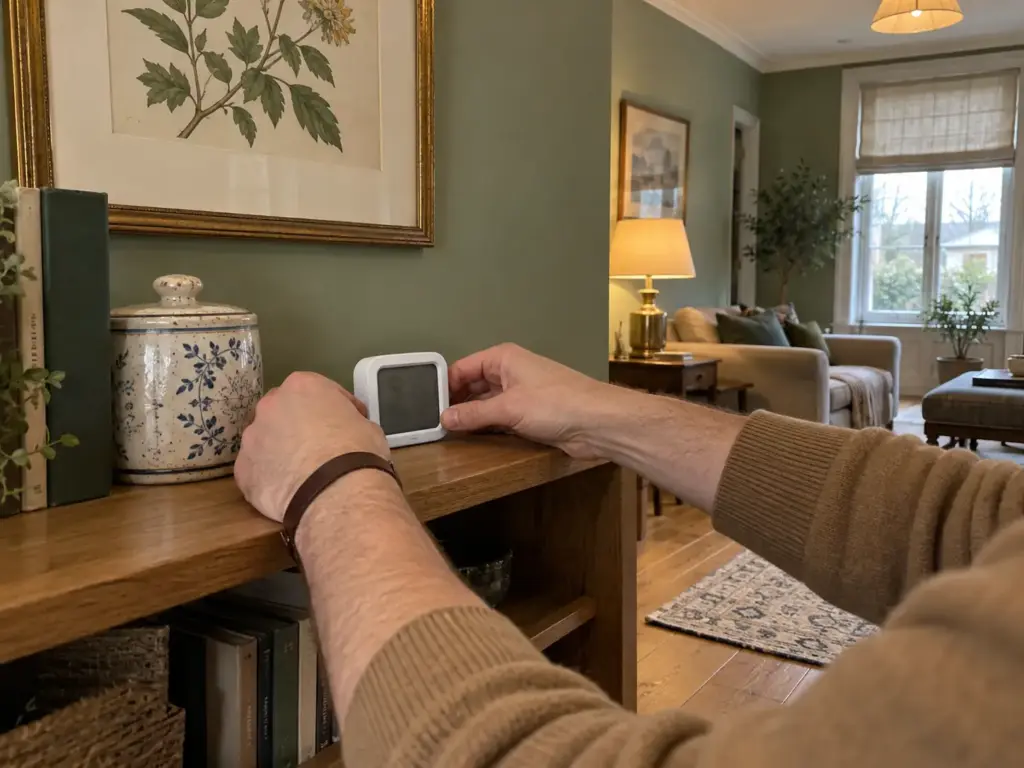
Start with the room you spend the night in or the one that feels wrong
Measure one room before you measure the house. A whole-house survey gives you eight numbers that disagree for eight good reasons, and none of them tells you which room to act on. Take the bedroom, or the room where the glass sweats or the air smells close, and make it the room for every reading that follows. Moving the meter between rooms from one day to the next turns a log into noise, because each room has its own moisture sources and its own cold surfaces.
Sitting height, middle of the room, clear of walls and heat
Put the meter where you would put your head if you were sitting down: a table or a shelf at that height, in the middle of the room, a few feet from the outside wall. Walls and glass run colder than the room, and air next to a cold surface carries a higher relative humidity than the air in the middle. The same meter carried from a closed door to the center of the room gives a different number after the same wait, so the spot is part of the reading, not a detail around it.
Where a reading lies: the window, the vent, the sink, the radiator
Four places give a number that is true for the spot and false for the room. The window sill is cold, and so is any exterior wall. An air vent or a radiator throws warm, dry air at the sensor and drops the reading.
A sink or a stove puts moisture in the air within arm’s reach, and the EPA lists cooking and showering among the things that add humidity to a house, so a spot beside either measures the event rather than the room. A closed-off bathroom can grow a mildew patch on the ceiling after frequent hot showers, while the rest of the house stays fine. A meter placed in that closed room would have told a true story about that room and a false one about the house.
If the room cannot be rearranged and every shelf is next to something, a cheap humidity checker you can trust covers placement in exactly that case.
Stick a small piece of tape on the shelf where the meter stands. When it gets knocked, dusted or moved to charge a phone, the tape tells you where it goes back, and your week-two reading is still comparable to your week-one reading.
Give the Meter Time Before You Believe the Number
A display updates in seconds, but the sensor behind it has just been carried in from another room, and the number it shows first is that room’s. Waiting is the cheapest step in the whole routine, and the one most readers skip because the screen already looks finished.
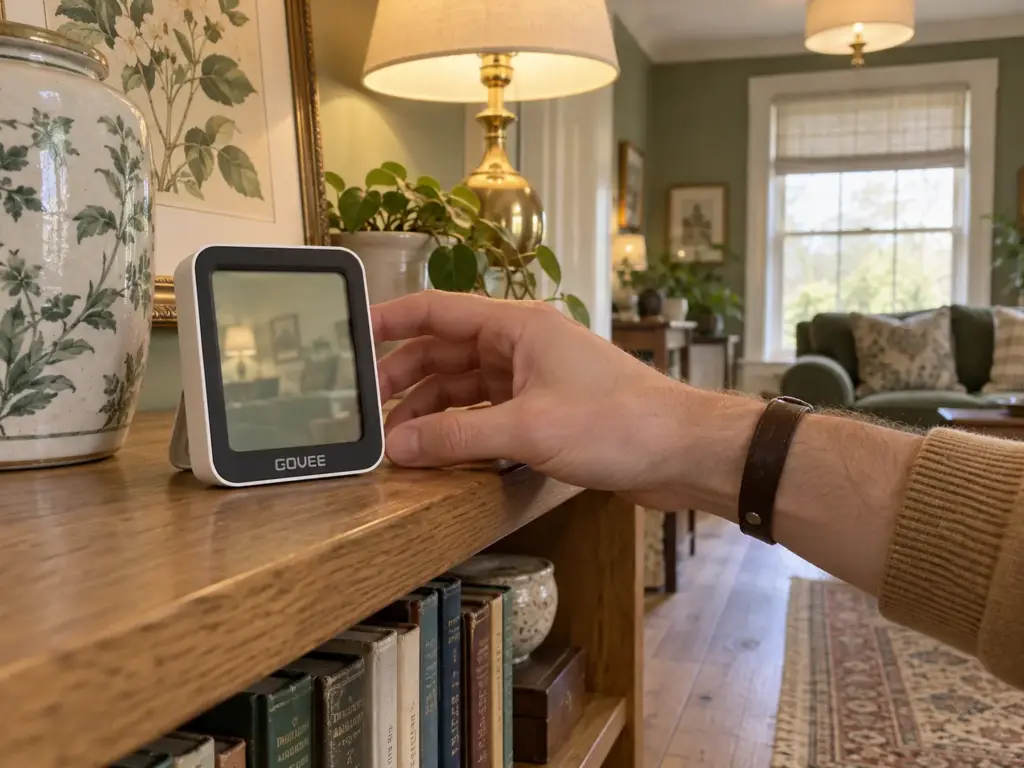
Why the first number is the last room’s
A refresh rate and a settling time are two different things. The refresh is how often the screen redraws; the settling is how long the sensor takes to match the air around it. If you carry a meter from the kitchen to the bedroom, the sensor starts out holding the kitchen’s air and drifts toward the bedroom’s, so the digit you see in the first moments describes the place you just left. A shower, a stove or a pot of pasta in the previous stretch does the same thing from the other direction: the number is the event, not the room.
A meter that seems to disagree with its neighbor has sometimes just been carried in and read too soon, and that is worth ruling out before you blame either one.
How to know it has settled
Leave the meter in place and read it again. When two reads a few minutes apart show the same number, the sensor has caught up. A digit that creeps by a point or two over the first stretch and then stops is the sensor catching up, not the room changing. A digit that keeps walking in one direction is something else, either an event in the room or a spot that is catching a draft.
This is a rule you watch for, not a minute count, and that is deliberate. The Govee H5075 is a good example of the gap: its maker prints a 2-second responsive speed, which is the screen, and prints no settling time at all, which is the part you are waiting for, so a screen that moves fast tells you nothing about whether the number has stopped. What it does offer is an app with a 20-day curve of readings, and that curve shows the creep and the plateau more plainly than a glance at the display.
If your meter is part of an all-in-one, the same wait applies to its humidity figure; a humidity and air quality monitor against a separate hygrometer covers when the combined unit’s number can stand on its own.
Take Three Readings Across a Day, Not One
One reading is a photograph of a single minute. The humidity of a house is a day of minutes, and the three that explain it are not the three most people take, which tend to be Saturday at noon, Saturday at noon, and Saturday at noon.

The three readings: before the day starts, after a shower or a meal, last thing at night
The routine below is a method of procedure, not a finding from a study, so treat it as a way of reading rather than a law.
Take the first reading before the day starts, with the room as it spent the night. Take the second after the room has had its shower or its dinner, with the door where it normally is. Take the third at the end of the night before you turn out the light. Same spot, same meter, same room, and readings at different times of day rather than three in a row.
Written down side by side, the three show something one number cannot: how far the room swings, and how it gets there. A room that sits at the same number all day has a different problem from one that climbs each evening and never gives it back.
Which one counts, and which two explain the others
The reading the room is judged by is the one with no shower, no cooking and no open window in the stretch before it. That is usually the first, the morning one. Compare that number with the humidity band.
The EPA’s mold course puts it this way: “Indoor relative humidity (RH) should be kept below 60 percent — ideally between 30 percent and 50 percent, if possible.” Notice the “if possible”; it is a ceiling to stay under with a target underneath, not a number to hit to the decimal. That is the guidance this article reads every number against.
The other two readings are context. The evening one after a shower and the next morning’s one in the same room show how long the room takes to hand the moisture back, and that gap is the real data. A morning number close to the evening one means the room holds what you give it.
One more thing before you compare winter to summer: the band moves with the weather outside, so a January reading and an August reading are not judged against each other. What the cap should be at this outdoor temperature has the shifting target.
A log you can keep on a phone note
A note on the phone is enough: date, time, the number, and one word on what happened before it (shower, stove, window open, nothing). Three numbers become a pattern only when they carry their circumstances. The note also protects you against the most common mistake in the whole routine, which is changing something in the room and forgetting what the reading was before the change.
Add the state of the door to every entry. A shut door and an open one change how much of the house’s air reaches the room, and without that word in the log a swing between two entries looks like a mystery instead of a clue.
How long a high reading stays high is a separate question that needs days of entries rather than three in a day; how long a high reading stays high picks up where this log leaves off.
When the Reading Lands Near a Line, the Meter’s Error Decides Nothing
A meter says 58 and the line is 60. The honest answer is neither “fine” nor “too high”. It is “ask the meter how far it can be wrong”, and a good share of that answer sits in a figure on the maker’s own page.
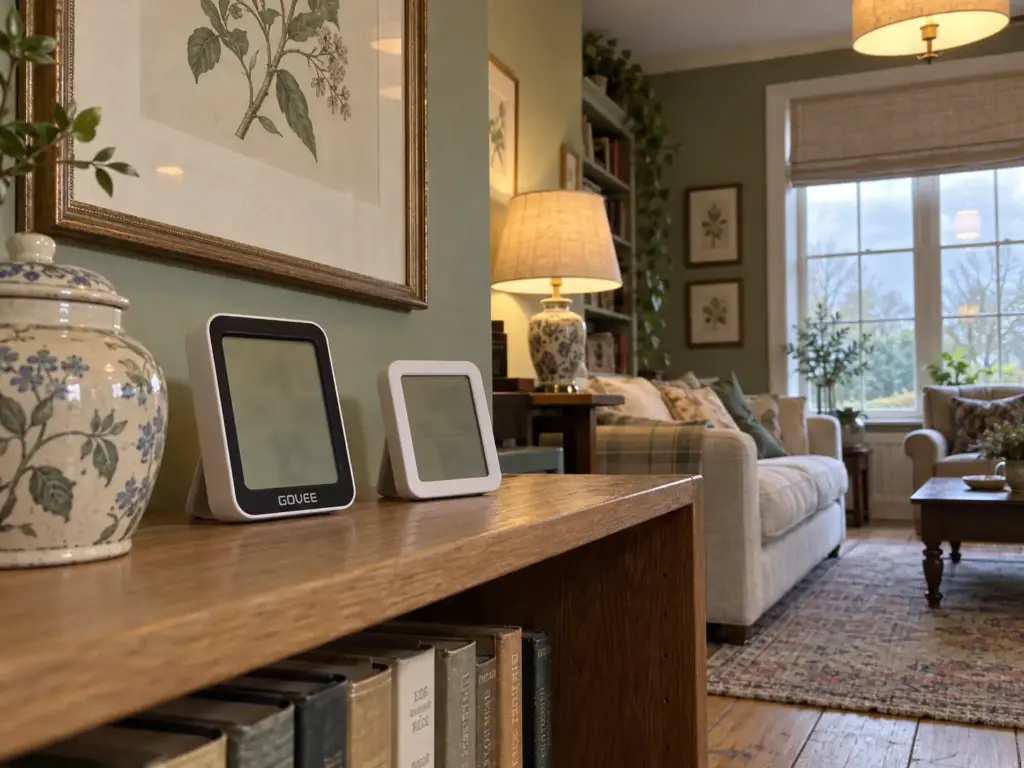
The one published figure and what it does to a reading near 60 or near 30
The Govee H5075’s maker rates its humidity accuracy at plus or minus 3 percent relative humidity. Take that at face value and a reading of 58 could be a room at 55 or a room at 61, which sits on both sides of the EPA’s line. The same logic holds at the other end: a 32 does not tell you the room is clear of 30. Inside the meter’s own error of a line, the reading decides nothing yet.
That is the only error figure in this article that comes from a maker. Cheap meters vary a lot, and some read low humidity less accurately than high. Those are opinions from people with meters on their walls, not specifications, and they disagree with each other by a factor of ten. Keep the maker’s number, treat the rest as the reason to check.
Whether this is true of monitors in general is the question behind are air quality monitors accurate, which applies the same error-band reasoning to the all-in-one units.
Two meters side by side
The cheap way to find out whether a near-line reading means anything is a second meter next to the first. Two meters crosscheck each other, which is the simplest way to catch a bad one. A budget pick for the second job is the AcuRite 00613, a digital display thermometer and hygrometer.
Set the two on the same shelf, let both settle, and read them together. If they agree, you know the pair is consistent, and if they differ by more than the maker’s figure says they should, one of them is telling you something about itself and not about the room.
What the community numbers do and do not prove
Accuracy varies from unit to unit, so a claim about one meter does not settle the question. A second meter does more than any spec. What they do prove is that the question is open, which is why the cross-check earns its place.
Read the two meters again a month later. A meter that passed on the shelf in week one can drift by month two, which is the complaint behind the cheap meter’s reputation, so the cross-check is repeated rather than done once. Two meters that agree at one humidity and drift apart at another are saying something about the cheaper one. The room has not changed between them.
When the pair disagrees, swap their positions on the shelf and settle them again. If the gap follows the meter to the new spot, it is the meter; if it stays with the spot, the shelf is the problem.
The rule that follows is short. A reading near a line gets one more reading tomorrow, same spot, same hour, before anything in the house is touched.
The Checks With No Meter, and What They Can and Cannot Tell You
The glass of ice water and the wet-and-dry thermometer are old tricks, and they answer a smaller question than a meter does.

The ice-water check, sometimes called the ice cube test, is a yes-or-no sign. Fill a glass, add ice, stand it in the room, and watch the outside of the glass. Water appearing on the outside means the air by the glass holds a good deal of moisture; no water means it does not.
That is all it says. It gives no percentage, and it is too coarse for any detailed monitoring. If the room’s glass windows already sweat, you have a version of this test running for free, and condensation on windows deals with what that means.
The wet-bulb and dry-bulb method is the other one. A wet-bulb check is a simple way to test a meter: two thermometers, one kept wet, and a table that turns the difference between them into a humidity reading. If you want to use the method, use a published wet-bulb table from a reliable source.
Neither check gives a percentage to hold against the EPA band. For a number you can act on, a meter is the answer, and a meter costs a fraction of what a fix applied to the wrong problem would.
What to Do With the Number
A number in the band needs nothing but a second look next month. A number outside it needs one change, not three, and the direction the number points decides which one.

In the band: nothing to change
Between 30 and 50 percent, or comfortably under 60 with a steady log, leave the room alone. Repeat the routine when the season turns, since the outdoor temperature will move the target, and add a note if the room starts behaving differently.
Above the line: the free change first
A reading above 60 means more moisture is coming into the room than is leaving it. Start with what the house already has. Run the bathroom exhaust fan through the shower and a while after, open a window for ten minutes, or leave the door open so the damp air spreads.
Then read the room again the next morning before touching anything else. That reading is the only proof the change worked, and if it did not move the number, you have learned that the source is somewhere else. A dehumidifier is a later step, not the first one.
How to lower humidity at home lays out the fixes in order, and if the free ones do nothing, find the source of a high humidity reading before buying anything. When the source turns out to be the building, a damp wall or a leak, a professional is the right call, and no setting on a meter will change it.
Below 30: the other direction
Under 30, the air is dry, and the change runs the other way: if a humidifier is running, its setting goes up a step, and the overshoot shows up as water on the glass, which tells you to turn it back down. Can indoor humidity be too low covers it in full. The next decision after the number is usually the meter it came from, and the monitors guide above is where that buying decision gets made.
The One Reading to Take Tomorrow, and the Pair to Take Next Week
Three things to keep. The spot and the wait come first, since a meter at sitting height, away from walls and heat, read once it has stopped moving, is the only number worth writing down. The three readings come second: the calm one is judged against the EPA band and the other two explain it. And near a line, the meter’s own error decides nothing yet, so read again before changing anything.
A week from now, read the same spot at the same hour, with the second meter beside the first, to see whether either has drifted. Then tomorrow morning, before you do anything else in the room that matters, take one reading with no shower, no stove and no open window before it, write it down with the state of the door, and leave the room as it is.
Frequently Asked Questions
01How can I tell what my indoor humidity is?
Read a hygrometer at sitting height in the middle of the room, away from walls, windows and vents, once it has settled. The number is relative humidity in percent, and the EPA’s line is below 60.
02Is 70% humidity inside a house bad?
Seventy percent is above the EPA’s line of below 60 percent for a house, so more moisture is coming in than leaves. Read again tomorrow in the same spot, then find the source.
03How long does a hygrometer need before I read it?
The maker’s sheet for the meter checked here prints a screen refresh and no settling time. Leave the meter in place and read it again until two reads a few minutes apart match.
04Do I need two humidity meters?
Not to start. A second meter beside the first is the cheap way to learn whether a reading near 60 or 30 means anything, because a single meter can be off by a few points.
05Can I measure humidity without a meter?
A glass of ice water and the wet-and-dry thermometer method both exist, but neither gives a percentage to compare with the EPA band, so treat them as a rough sign rather than a reading.