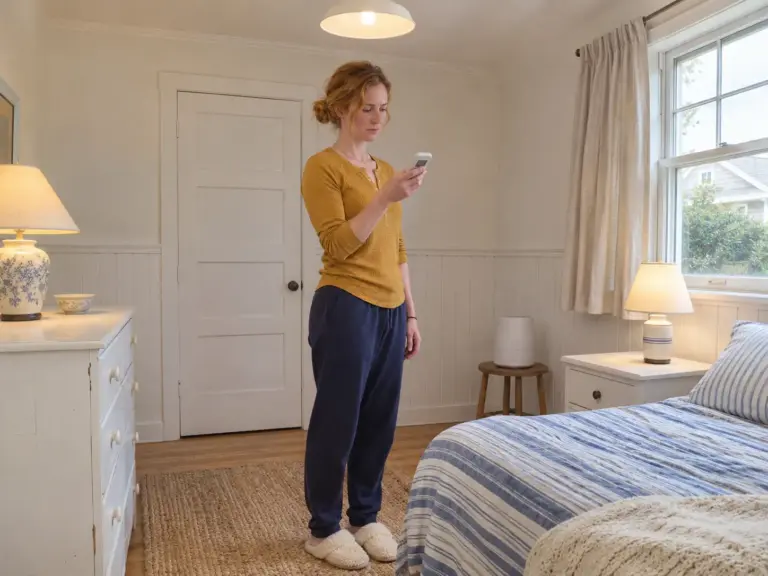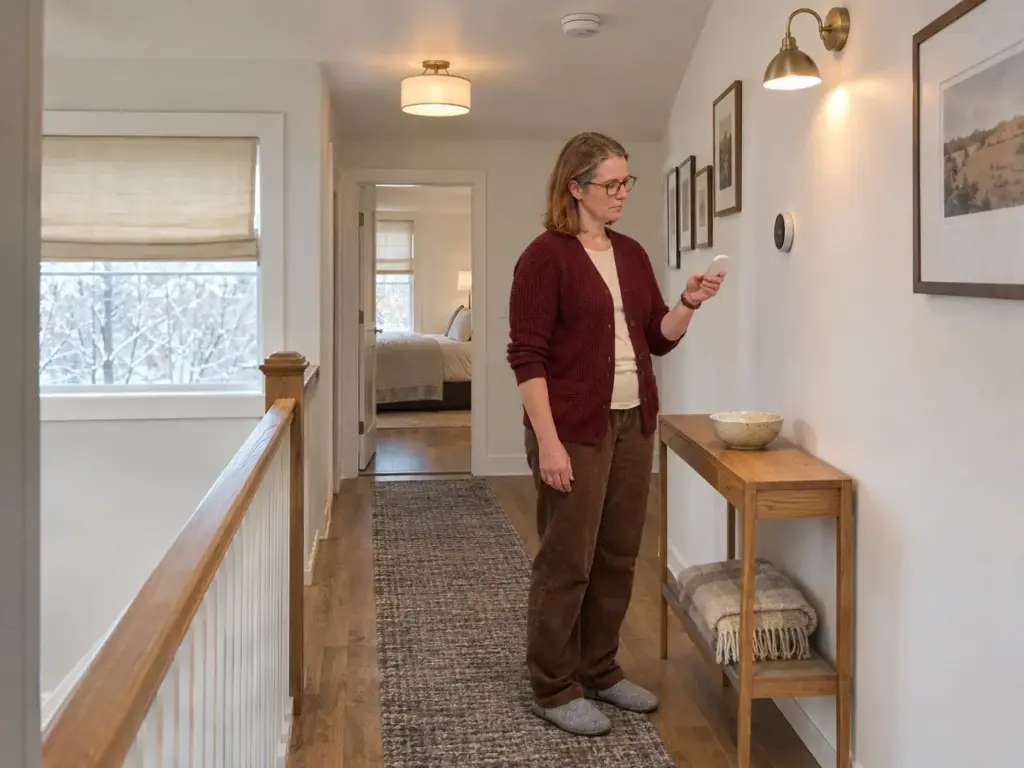
The kitchen feels fine, the hall feels fine, and the bedroom is the driest room in the house after dark, with a door handle that snaps at your fingers with static electricity and floorboards that tick as the wood shrinks. That is the moment the room humidifier vs whole house humidifier question starts, and it usually gets answered before anyone has read a single number. A whole-house unit rides on the furnace blower and the ducts, so it reaches only the rooms the blower reaches; a room unit sits on a table, runs off one outlet and wants a hand every day or two. The order that saves the most money is the reading first, then what each kind asks of the house, then what the months do to them, and the table puts the two side by side.
The table sets the two kinds against the four things that decide between them.
| Unit | What it covers | What it needs from the house | Upkeep | The first check |
|---|---|---|---|---|
| Room unit | One room or open area; common 6-liter tanks are rated for about 505 to 550 square feet | One outlet and a place to stand; no furnace, no ducts | Tank refilled every day to every third day, cleaned about weekly | A second reading in the room that bothers you |
| Whole-house unit | The rooms the furnace blower reaches; makers print up to roughly 5,000 square feet | A furnace blower, ducts and a water line | Water panel changed at least once a heating season; a steam canister serviced about every 500 hours | A reading in the middle of the house |
The Reading That Decides Between a Room and a Whole-House Humidifier
The table lists what each kind needs, but it cannot say which one this house calls for. Only two numbers can, and both are free to take before anything goes in a cart. One comes from the middle of the house, the other from the room that bothers you.
One reading in the middle of the house
A reading means nothing without a target, so start there. According to the EPA’s guidance on biological contaminants and indoor humidity, “Keep indoor relative humidity below 60 percent indoors, and ideally between 30-50 percent.”
The 60 is the ceiling that keeps cold surfaces from sweating; the 30 to 50 is the humidity band to aim for. A room at 22 percent is dry. A room at 48 percent with fog on the window already holds enough, and a humidifier would be the wrong purchase.
The EPA adds that a humidity meter is sold at many hardware stores, and the first measurement costs less than any unit. A small wireless meter like the AcuRite 00613 Wireless Digital Indoor Thermometer and Hygrometer does the job: it shows temperature and humidity and keeps the daily high and low of each, which tells you more than the live number, because a house swings between the afternoon and the end of the evening. Stand it at chest height in a hall or living room, away from the kitchen and the bathroom, and leave it for an evening. The method for taking three readings, one meter is short, and it keeps you from reading the one spot that flatters the house.
Cheap meters have a flaw worth writing down: some read inconsistently, and some stop working within days. So put it beside a second meter for ten minutes, or move the same one between rooms and see whether it agrees with itself. For the error to expect from a cheap humidity checker and how far to trust it, that page goes through the numbers.
Keep the meter off the windowsill and off the bathroom wall. Both spots read the worst minute of the room, not the air you sit in.
The same reading in the room that bothers you
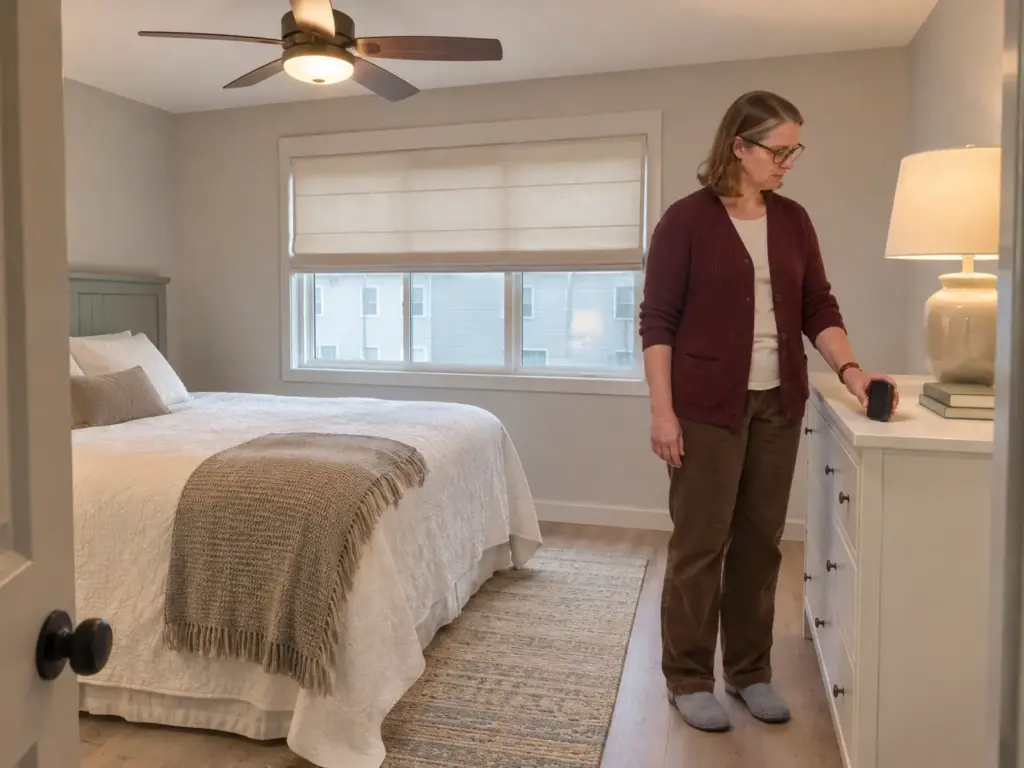
Carry the meter into the driest room, shut the door, and read it late in the evening, after the room has sat closed for a few hours. Then compare it with the reading from the hall at lunch. The gap between them is the answer, more than either number: a hall in the high 30s and a bedroom that has slid to the low 20s describes a house that is fine and a room that is not. Two meters standing in two rooms for one evening settle what a month of guessing cannot.
The reverse case is just as clear. When the hall is low too, and the kitchen, and the living room, the whole house is the dry one, and the machine drying it is the furnace.
What the two readings say together
The direction decides the unit. Dry in every room points at the whole house, because heating air without adding water lowers its relative humidity everywhere the heat goes. Dry in one room points at a leak, a door open to a dry hall, an exterior wall or a window, and at a room unit.
Leaks come first. Air sealing, and a blower-door test when the house is leaky enough to justify one, shows where the air escapes, and a leaking house empties whatever moisture is added to it.
Buying a whole-house unit so there is never a tank to fill sounds like the tidy answer, and in a house that leaks it sends the water out through the walls. Seal the draft under the door, read the room again the next evening, and only then decide whether the remaining gap needs a machine. Without ducts, the question is already half answered. For how far a reading can climb before you stop, what 50 percent is and is not draws the line.
What Each Kind of Humidifier Asks of Your House
One unit borrows the furnace and the other borrows a table. What each takes from the house rules a choice in or out before taste does, and in a rental the furnace question often ends the comparison in one sentence.
The whole-house unit rides on the furnace
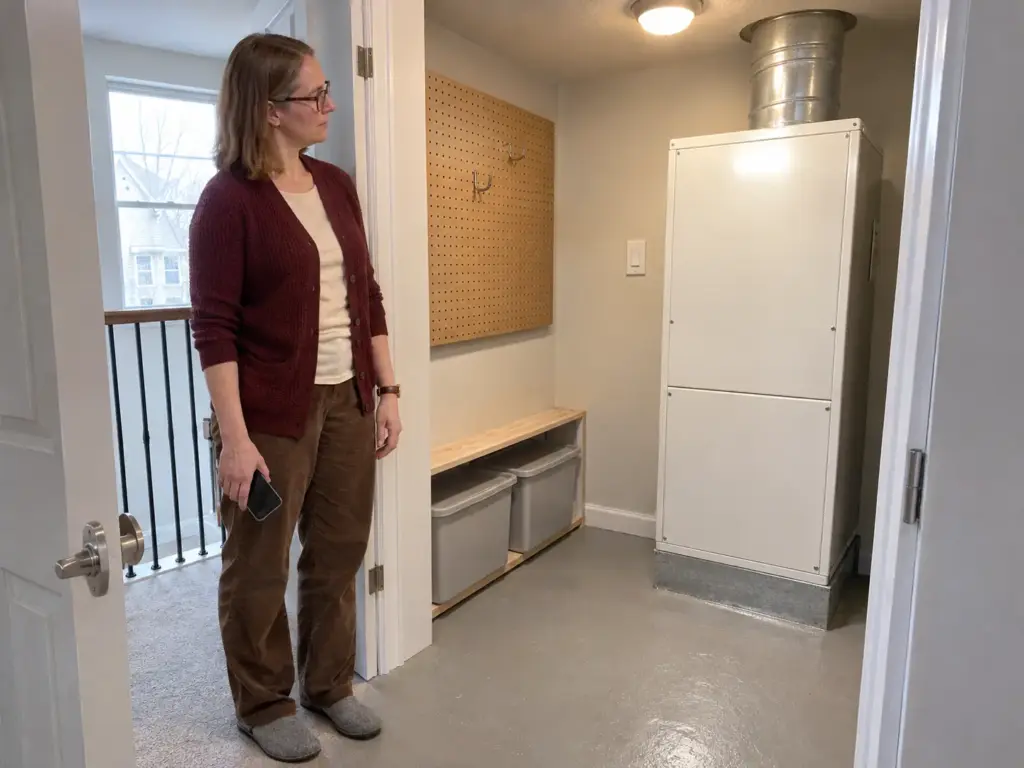
A bypass humidifier or a fan-powered humidifier uses the furnace blower and the ductwork to carry moisture through the house, and a steam humidifier feeds a tube into the duct. The AprilAire 600M is the bypass unit most often named when this comes up, built around the furnace blower and a water panel; its flaws are mixed build quality (some units crack) and a good deal of water used. If the house has no furnace blower and no ducts (a rental, a window unit, one bedroom), a whole-house unit is not an option, whatever the budget.
The blower is also the unit’s engine. Some whole-house units need a control setup to run when the furnace is not heating or cooling, so the furnace’s schedule becomes the humidifier’s schedule.
The humidistat that tells the unit when to stop sits in the duct or on the wall, reading a different place from the one you are standing in. The two numbers disagree, and neither is wrong. For a house with a furnace humidifier in mind, matching the fix to the heating system lays out the full set of ways to add moisture.
The room unit needs an outlet and a hand
A room unit, the portable humidifier of the pair, needs one outlet and a place to stand. It needs neither the furnace nor any ducts, which is why it is the only choice in many houses. The price of that freedom is a daily hand, and the months count it later in this guide.
How much water each can actually move
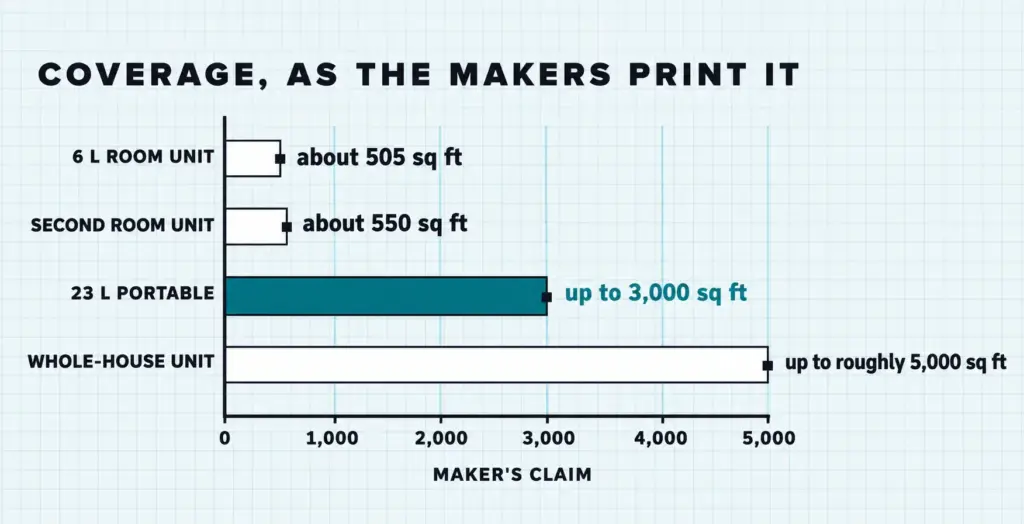
The claims differ by a long way. A common 6-liter tank unit is rated by its maker for about 505 square feet, another for about 550, a large 23-liter portable for up to 3,000, and a whole-house unit for up to roughly 5,000. These are the makers’ figures, and they are the numbers to hold your room’s area against.
Output is the other half. Carrier rates its whole-house models at about 12 to 34 gallons per day, by model. Twelve gallons is about 45 liters, which is seven or eight 6-liter tanks a day, and nobody carries that. A small whole-house unit on a large house repeats the mistake of a room unit on a whole house: the output has to match the space it is asked to fill.
When the House Has No Ducts, the Room Unit Does the Job
Most readers end up here: a rental, one window, a bedroom of ordinary size and no furnace connection to speak of. So the question is no longer room versus house but which room unit, and how it behaves once the first week is over.
Close the leak before you fill a tank
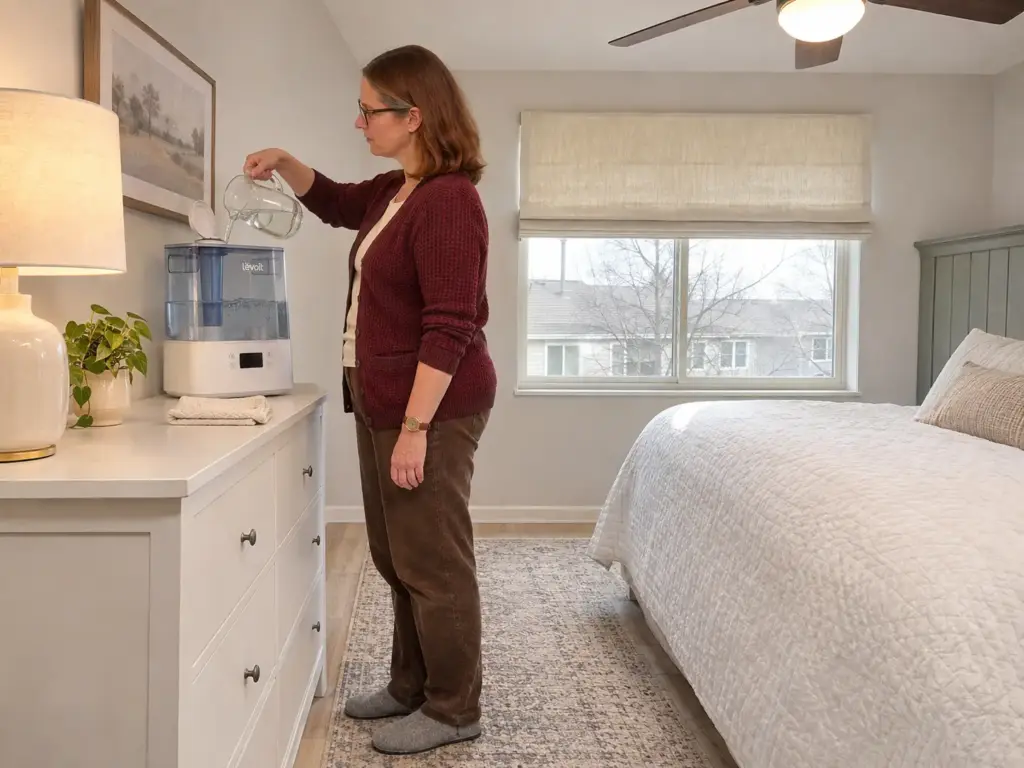
Free fixes first, because a tank can only add as fast as the room loses. The draft under the door pulls the room’s air toward a dry hall; a window that leaks does the same on a cold night; a door left open to the rest of the house lets the added moisture walk away. Shut the door and put a rolled towel at its foot, then read the room the next evening. If the number rose, the leak was the cause, and a smaller unit may be enough.
A room unit asks for a daily hand: the tank is refilled every day to every third day and cleaned about weekly, which is Trane’s guidance for its portable line. A tank refilled less often than that leaves the room dry again before the next fill. For a reader whose dry air shows up as a snap at the door handle, whether a room humidifier stops the snap at the door handle is the next page.
A top-fill unit for a mid-size room
The Levoit Classic 300S is the one-room answer before any whole-house talk: an ultrasonic unit with a 6-liter top-fill tank, a built-in humidity sensor with an auto mode, a sleep mode and a rated 505 square feet. Where a bedroom should settle at night is covered in what a bedroom should read at night, and the unit’s sensor is handy but never a stand-in for a meter in the room.

An ultrasonic or evaporative unit leaves the tap water’s minerals behind as mineral deposits: a film in the tank by the end of the third week and a fine white dust on the dresser beside it. The powder is the water, a hard-water house meets it first, and distilled or demineralized water cuts it. Coverage claims also drift between sites for the same unit, with the DREO printed at 550 square feet in one place and 400 in another, so the catalog figure is the one to check the room against.
Switch to distilled water for one tank and look at the dresser after a week. If the dust stops, the unit was never the problem, and the water is the only thing left to change.
Warm mist for a cold bedroom
The DREO 6L Smart Humidifier is the budget warm-mist choice: a 6-liter tank, both warm and cool mist, up to 500 mL per hour and a catalog coverage of 550 square feet. It is the unit to look at for a room that runs cold, since warm mist spends watts heating the water that a cool-mist setting never touches, and humidity added to a cold room still lands on the glass first. The DREO 6L Smart Humidifier has its own flaws: some units break after a month, the mist is weak or absent for some, and some leak. A sound unit still needs the dial set for the outdoor temperature.
The Setting Follows the Cold Outside
A setting chosen in October and never touched again is the setting that fogs the glass in January. First confirm there is a reason to add water at all: whether the room is actually too low is a one-reading check.
The humidity setting that suits the room depends on the outdoor temperature. Trane’s owner-manual table runs from about 45 percent at 40°F outside (4°C) down to about 15 percent at minus 20°F (−29°C), a maker’s rule of thumb and never a standard. For the whole range, see the numbers by outdoor temperature.
The mechanism is the coldest surface. Warm air carries moisture to it first. The dew point of air at 72°F (22°C) and 30 percent relative humidity is about 38°F (3°C), a temperature a pane can reach on a cold night, so the lower edge of the pane is where an overshoot shows.
The EPA’s ceiling and ideal still apply, and the meter in the middle of the house tells you which side of the band the room is on. A whole-house unit follows the blower and often has a humidistat that does the adjusting; a room unit follows whoever turns the dial.
When a bead line shows on the pane, lower the setting five points and read the room again the next morning. Moving it by five and not twenty tells you which step fixed it and where the overshoot began.
The film along the bottom edge of the pane at six in the morning fades by ten as the sun warms the glass, and a reader who only looks at midday never sees it. Why winter readings drift with the cold explains the pattern for the whole season.
The Big Portable That Says “Whole House” on the Label
The listing title of one large portable carries the words “Whole House”, and a reader takes that to mean a furnace connection. The label is the first thing to check against the spec, because the unit it names is a room machine at a large scale.
What the label means and what it does not
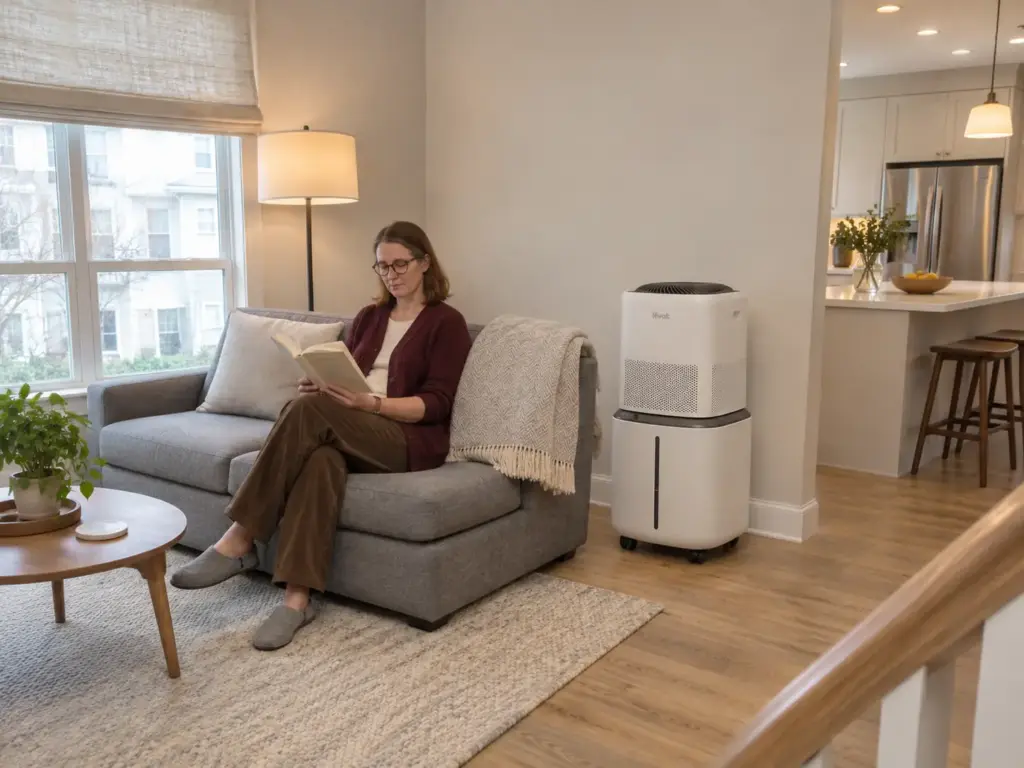
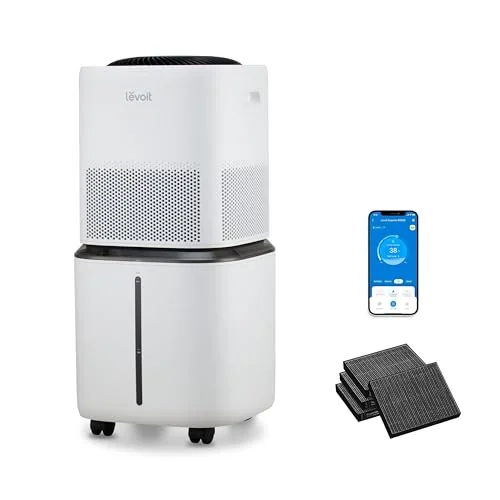
The Levoit Superior 6000S is a 23-liter (about 6-gallon) evaporative tank unit with a fan. It is not wired to the furnace and needs no ducts. The maker’s claims are up to 3,000 square feet, 1,500 mL per hour and up to 72 hours at low fan speed.
The arithmetic is worth running, because the label does not. Twenty-three liters at 1,500 mL per hour is a bit over 15 hours at full output. The 72 hours is the low-fan figure, about a fifth of that output, so a tank that lasts three days is a tank doing a fifth of the work.
Where a big portable fits and where it does not
It fits an open plan on one floor, the living room with the kitchen on one side and the stairs on the other, where no wall or door stops the air. It does not reach a second floor through walls and a closed door: the second-floor hallway stays at its old reading while the living room climbs. It is the unit in this guide built for the open plan, and it is still a portable, so the tank is refilled and the pump is cleaned.
Where the Added Moisture Ends Up
Water leaves the unit and goes to the coldest surface it can reach. In a room that is the window; in a whole-house system it can be the inside of a duct nobody looks at.
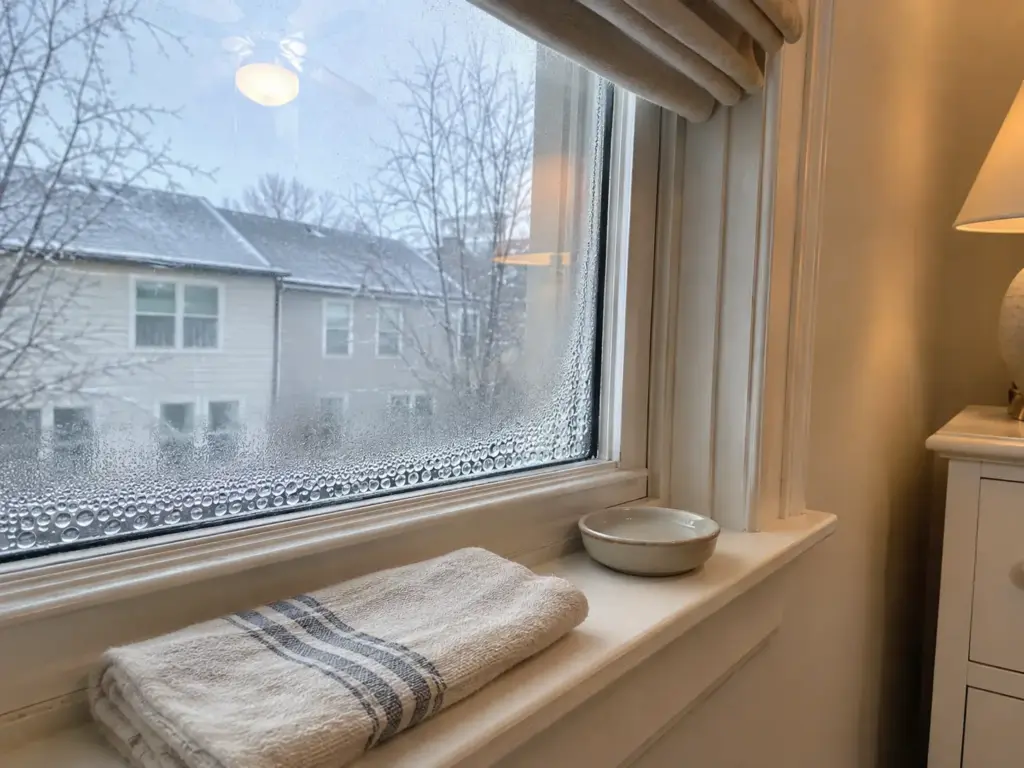
Humidity condenses on cold surfaces: the window glass first, then cold wall corners. Ducts that run through an attic or another unconditioned space can collect moisture on their cold inside surface, which is how mold in ducts starts in a whole-house system, out of sight. The EPA’s brief guide to mold, moisture and your home keeps the 60 percent ceiling as the line, and fog on the glass near 50 percent says the unit is already adding too much. A bead line along the lower corner of one pane that returns every cold morning is the house telling you which surface is coldest; reading the pane first turns that into a method.
Sometimes the cause is the building. Moisture behind drywall, in a crawlspace or from a leak is a professional’s job, and no setting repairs it.
A blower-door test or air sealing shows where the house leaks before a unit adds to the problem. And if the house reads high already, the free fixes for a room that reads too high come before any device. The other side of the same numbers lives at what to look for in a dehumidifier.
The Second Season, When the Maintenance Gets Skipped
The first month feels like the product, and the second heating season is where the product shows what it asks. Week-one impressions describe the box; the months describe the chore.
The tank in month three
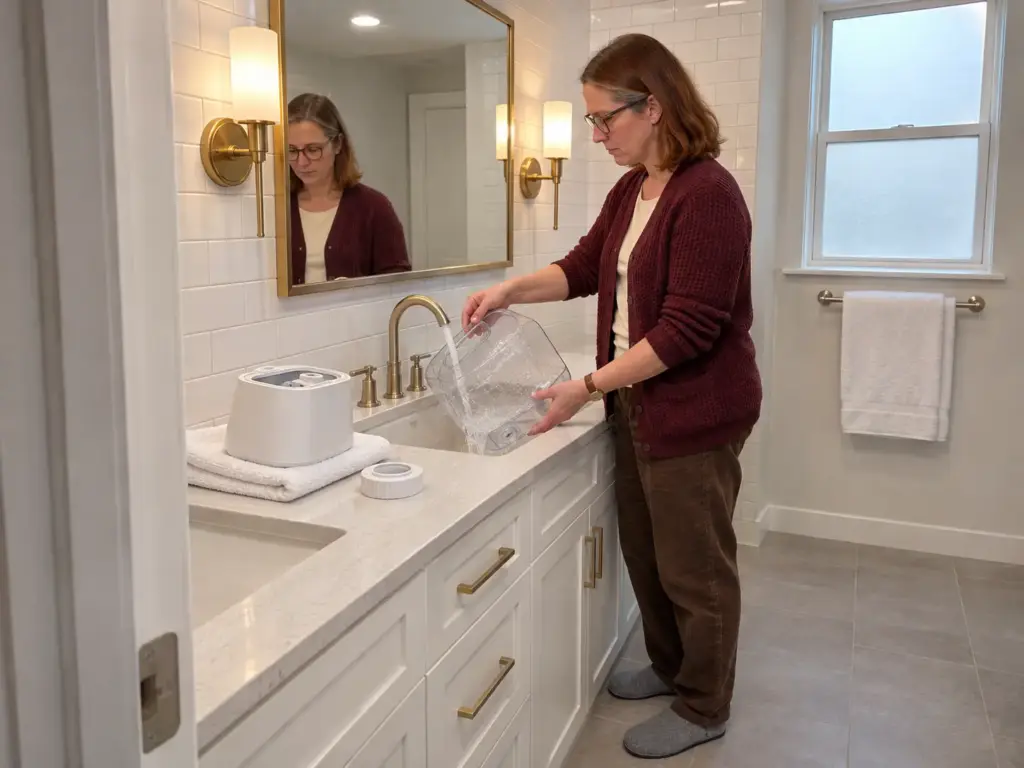
A portable tank is refilled every day to every third day, and tank cleaning comes about weekly. With hard water the film appears in the third week and has thickened by month three. The white dust the unit sends into the room lands on the dresser, the windowsill and the lid of the unit itself. Distilled water cuts both the dust and the scale.
The units themselves show a pattern. The Classic 300S and the DREO 6L both have units that break about a month in, and the Superior 6000S reservoir cracks after a few weeks for some. Failures that arrive in the second month are easy to blame on the routine, so the routine should be in place from the first day.
Write the day you first filled the tank on a piece of tape under the base. A unit that stops at day thirty and one that stops at day ninety are different complaints, and the date is the only record you will have.
The water panel in the second season
A whole-house water panel or humidifier pad is changed at least once a heating season, and more often in hard water, with an annual inspection of the unit alongside it. A steam unit has a canister instead, serviced about every 500 hours. The arithmetic is plain: a steam unit that runs ten hours a day in the coldest months reaches 500 hours in about seven weeks. The panel is the cost that comes after the purchase, and the second season is where it gets skipped.
A panel that has gone from white to a brittle brown crust by the second spring is a panel moving less water than it did in October, and the pad nobody replaced does the same. The humidistat still reads the same number and the room still sits low, and the reader blames the setting.
Which unit stays on schedule
The room unit asks for a daily hand, and the whole-house unit asks for a yearly visit that gets forgotten. The daily chore gets done because skipping it has an immediate result, a dry room the next morning. The yearly one has no feedback until the panel has already failed. Neither is better; they fail in different ways, and a reader who knows their own habits can pick the one that will actually get looked after.
A Season of Running One, in Arithmetic
A whole-house unit costs more up front and a room unit costs more hands, and both sums can be done with today’s figures. A 6-liter tank at the DREO’s 500 mL per hour maximum lasts 12 hours; the catalog’s 60-hour figure is the lowest setting, about 100 mL per hour. A day at full output is two tank fills, and the number of times the tank is carried to the sink in a week is the real cost of the room unit.
For electricity, multiply watts by hours and divide by 1,000 to get kilowatt-hours, then multiply by the rate on the household’s bill. The unit’s watt figure is on its label. A whole-house unit adds the water panel once a season and the water line, and it uses furnace blower time the household already pays for.
The energy argument is weaker than the sales pages suggest. Carrier itself says the saving on heating bills is not guaranteed: warmer-feeling air at a lower thermostat setting is a possibility and nothing more. A lower thermostat with the right humidity can feel the same, but the reading, not the guess, decides.
Two Readings Tonight, One Unit Tomorrow
The reading in the middle of the house chooses the unit, and a house with no ducts is a room-unit house whatever the catalog says. The label on the big portable is not a furnace connection, the setting falls as the outdoor temperature falls, and the glass shows the first sign of an overshoot. What the second season measures is the maintenance, not the purchase.
Look again after one heating season: the water panel, or the film in the tank. Whatever has crusted over tells you whether the routine was real.
Tomorrow, stand the meter in the middle of the house; tonight, read it again in the driest room, with the door shut. Then decide. For a reader whose dry air already shows up as a snap at the door handle, what the dry air does at the door handle is where it goes next.
Frequently Asked Questions
01Do you really need a whole-house humidifier?
Only if the whole house reads dry and has a furnace blower and ducts to carry the moisture. A meter reading in the middle of the house settles it; one dry room usually points at a leak or a room unit.
02Can a room humidifier replace a whole-house humidifier?
In one room, yes; across a whole house, no. A tank unit covers the floor area its maker rates and no more, and a closed door ends its reach.
03What size humidifier do I need for a 2,000 square foot house?
A room unit’s rating covers one room, roughly 500 square feet for the common 6-liter tanks. A house of 2,000 square feet is a whole-house unit’s job, or several room units.
04What humidity should I aim for with a humidifier running?
The EPA’s ideal is 30 to 50 percent relative humidity, kept below 60 percent. Fog on the window near 50 percent means the unit is already adding too much.
05How often does each type need attention?
A room unit needs its tank refilled every day to every third day and cleaned about weekly. A whole-house unit needs its water panel changed at least once a heating season.