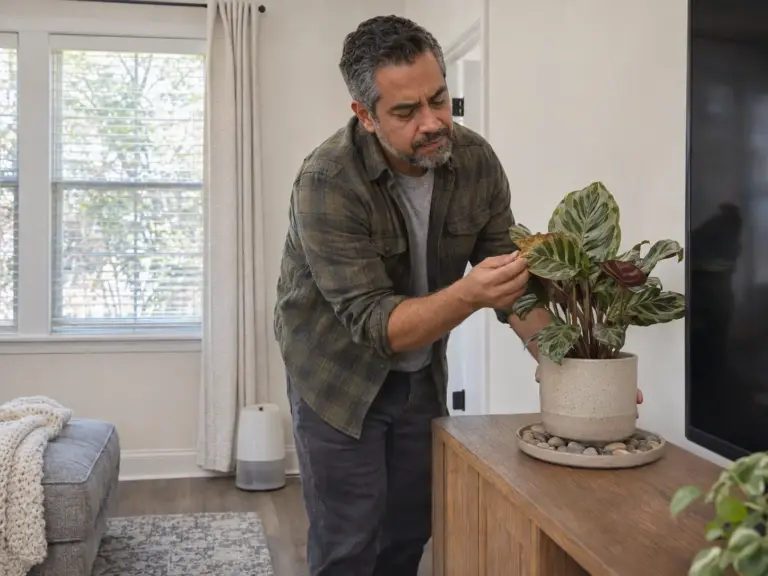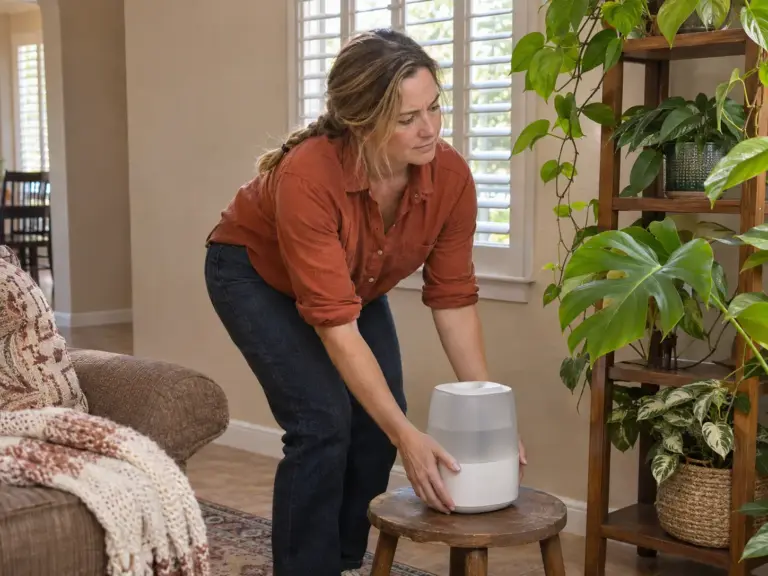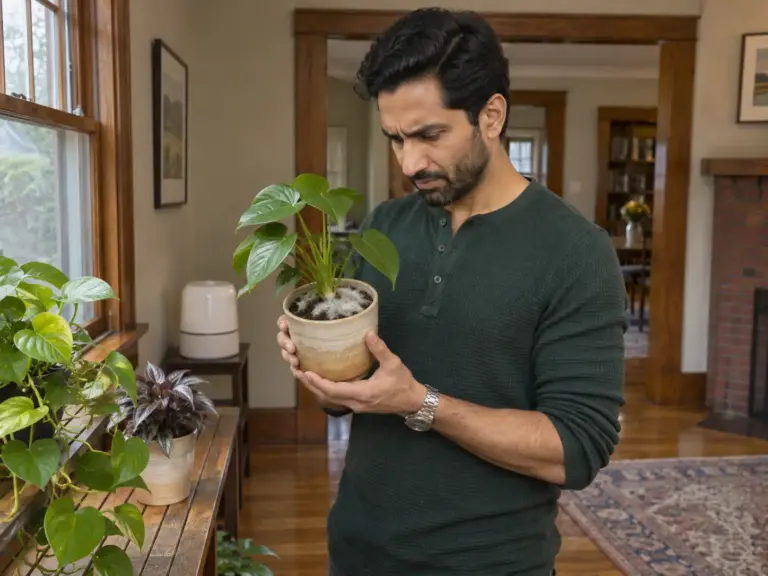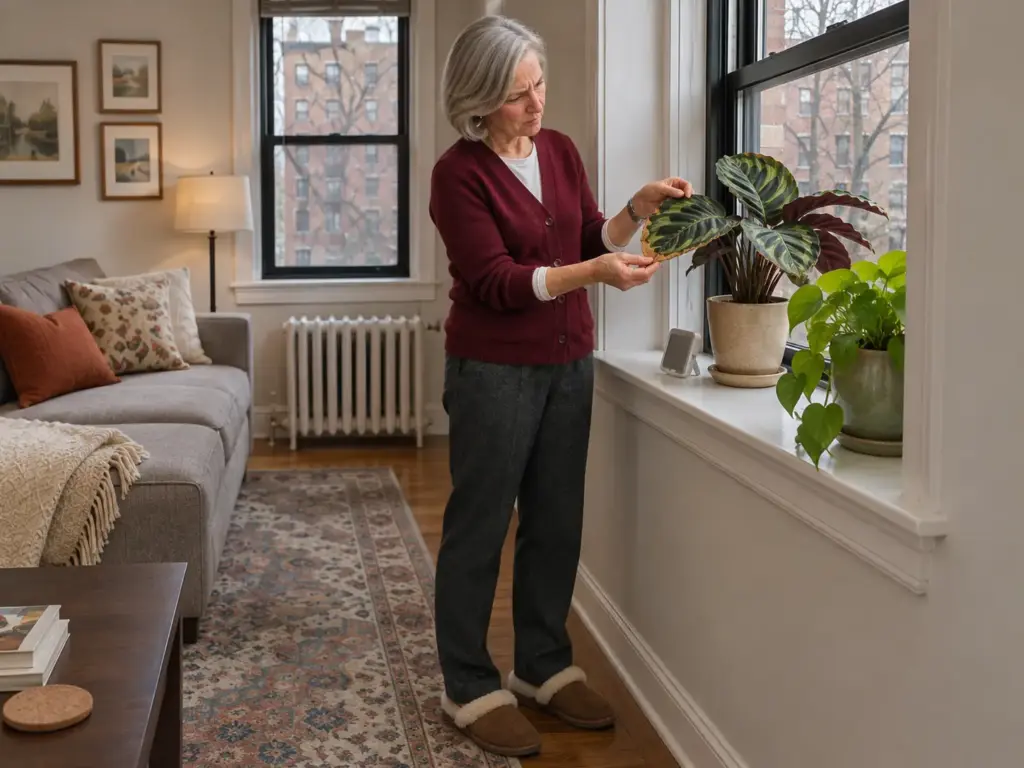
The heat came on this week, the little meter on the shelf dropped ten points overnight and the calathea’s edges have started to curl, with the thermostat the only thing in the room that changed. Whether a humidifier is good for plants in winter depends on what that meter reads at leaf height, which plants share the room and where the house itself says stop.
Heating does not dry the air so much as lower the percentage of the same water, and a plant that has barely grown since October asks for far less than the same plant in July. One unit can rescue a shelf of ferns and overshoot the shelf next to it. Tropical houseplants ask for humidity because how dry air pulls water out of a thin leaf shows first at the edge, as brown tips. What follows takes the reading first, then which plants gain, what else browns a tip in January, the free ways to raise the number, what a unit leaves behind by week three and the ceiling the house sets.
Quick Answer
Yes for tropical plants, ferns and calatheas when a meter at leaf height reads under about 40 percent, and no for cacti, succulents, ZZ and snake plants, which gain nothing from extra moisture. The house sets the ceiling: stop at 50 percent on the dial, or at the first fog on the glass, whichever comes first.
Read the Number at Leaf Height Before Anything Else
The gap between a heated room and the range a plant likes is a number, and the room has to be read to get it. A hygrometer standing among the leaves settles it within a day, and every decision after it, including whether any unit is needed at all, hangs on that reading.
Why the Percentage Falls When the Furnace Starts
The explanation of why indoor air gets drier in winter starts with one line from UNH Extension: “In winter, indoor air tends to be drier for two reasons.” Cold air holds less moisture, and heating it raises how much water the air could hold without adding any, so the relative humidity drops the week the furnace starts although the water in the room has not changed. Illinois Extension puts the winter result under 30 percent for most homes, which leaves a heated room below the range most houseplants prefer before a single leaf shows anything. Heated indoor air is dry air in this sense, and the room’s number falls further the colder the week outside gets.
Where the Meter Goes and When to Read It
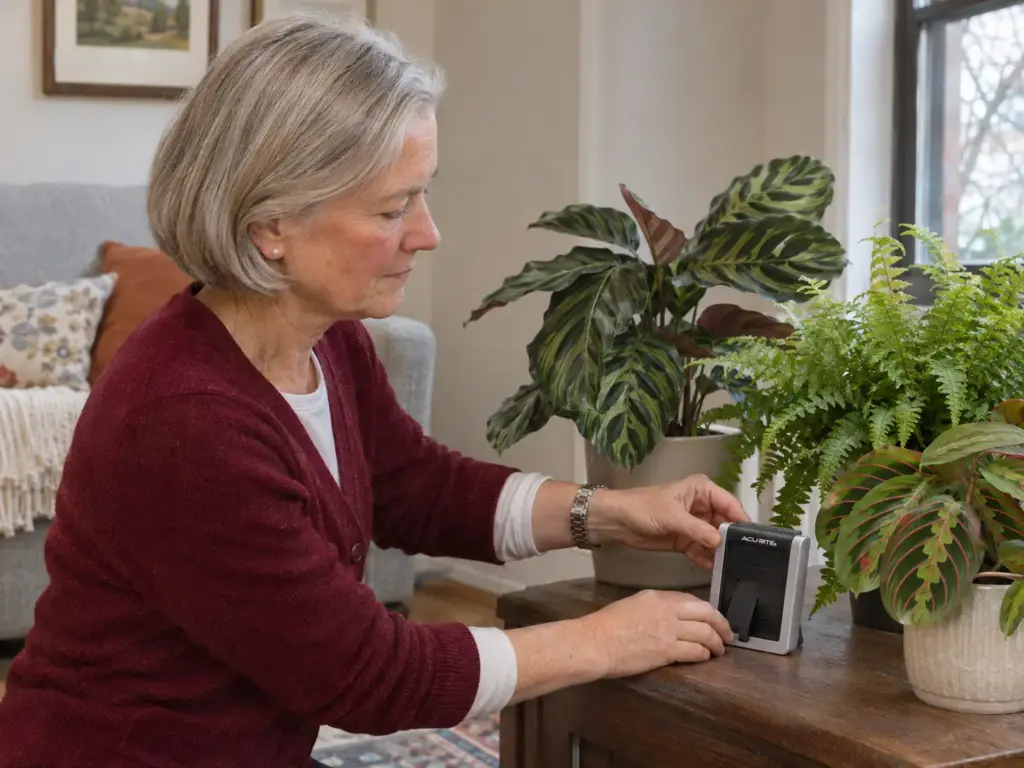
The meter stands at leaf height among the pots, out of the draft off the glass and away from the radiator, because the air at the thermostat is not the air the plants live in. Read it twice: in the morning, and at the lowest point of the day, which the stored minimum shows. The overnight low is the number that tells the truth, since the day’s high belongs to a room already warmed by people, cooking and sun.
The AcuRite 00613 Wireless Digital Indoor Thermometer and Hygrometer fits the job: a small single unit that keeps the day’s high and low, so the overnight dip is waiting in the morning. It is a cheap sensor and it behaves like one. Two units in the same room do not always agree, and some stop working within days, so a reading that looks wrong gets checked against a second meter before it moves a decision. A few points of error is normal for this class of humidity monitor, so it is good for telling 25 from 45 and poor at telling 44 from 46.
What the Reading Tells You to Do
The number sends the room one of three ways:
- Over about 40 percent: the plant is not short of air, and the crispy tip has another cause, covered further down.
- Under about 40 percent with tropicals in the room: the free changes first, then a unit if the number stays low.
- Over 50 percent: no unit at all, and a look at why the room is already that damp.
Tape an index card by the shelf and write the morning number and the stored low on it for a week. The week shows whether the dip is a one-night swing or the room’s new level, and every free change further down gets something to be measured against.
Which Plants Want the Extra Humidity and Which Do Not
Nearly everything on a plant shelf gains from more humidity nearby, and a few things on it gain nothing at all. The useful question is how much each kind gains, and whether the plants in the room are the ones a unit would be running for.
Tropicals, Ferns and Calatheas Gain the Most
UNH Extension puts most houseplants (excluding cacti, succulents and a few others) at 40 to 60 percent relative humidity, with tropical species thriving at 70 to 80. That range is extension guidance; no standard sets it, and how the plant’s band meets the house’s ceiling is where it gets tested.
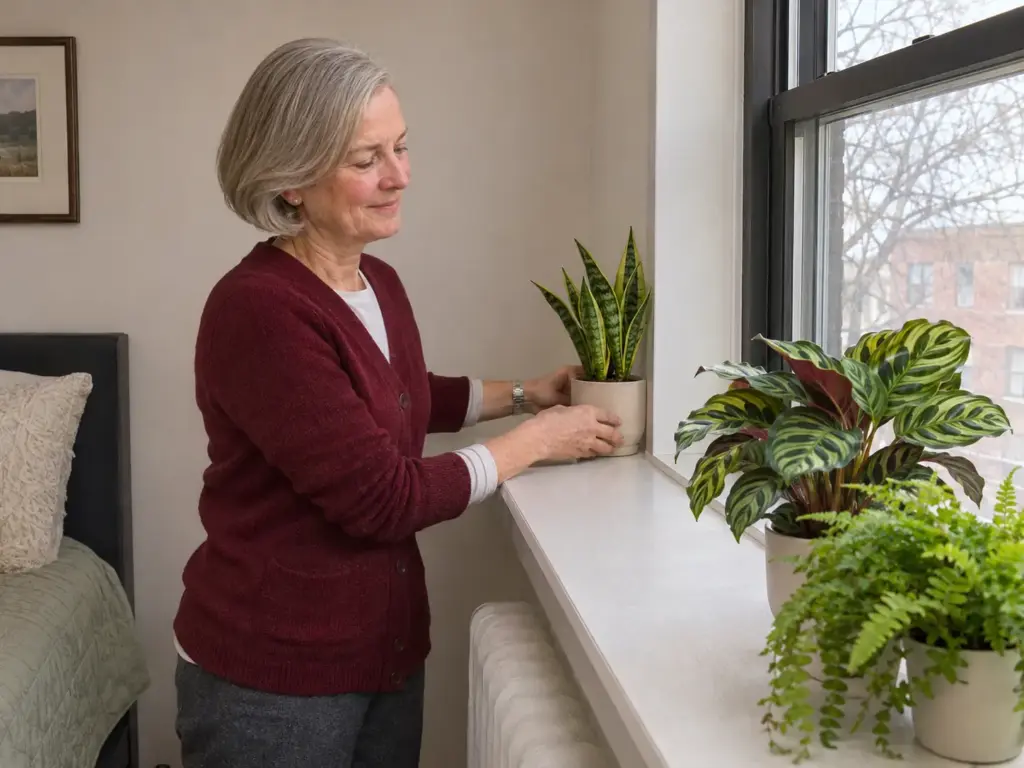
Calatheas, prayer plants, ferns, orchids, begonias and peace lilies are the ones whose thin leaf margins show a shortfall first, so they are the plants the rest of this article is written for. A mixed collection in one room is the usual case, which means the aim is the band the tropicals can live with. One number will never suit every pot.
Cacti, Succulents, ZZ and Snake Plants Gain Nothing
The exception sits with the plants that do not need extra humidity: UMD Extension excludes cacti and succulents, and the ZZ plant and the snake plant sit on the same arid side by habit, holding water in thick leaves and roots the way those do. More water in the room’s air gives them nothing to use, and it does not change how often the pot needs water. On a shelf with a calathea at one end and a snake plant at the other, a unit serves only the calathea. And a calm snake plant proves nothing about the room, because a thick leaf shows no shortfall for weeks while a thin one shows it at the edge first.
Root Rot Is the Soil’s Doing, Not the Air’s
Root rot gets blamed on a humid room, and the cause is a pot that stays wet. UNH Extension, quoting UMD, ties it to overwatering and wet soil, which is why a plant that wants less water does not want a unit either. The white film on a pot’s surface follows the same logic: it is a soil problem, and a wetter room is rarely its cause.
When the Crispy Tip Is the Cold Pane, the Short Day or the Wet Pot
In January a plant has lower light levels, a colder window and a pot that dries slowly, and any of the three can brown the leaf tips while the air sits at a fair number. Each has a check that costs nothing, and the checks come before a purchase.
A Plant That Barely Grows Barely Drinks
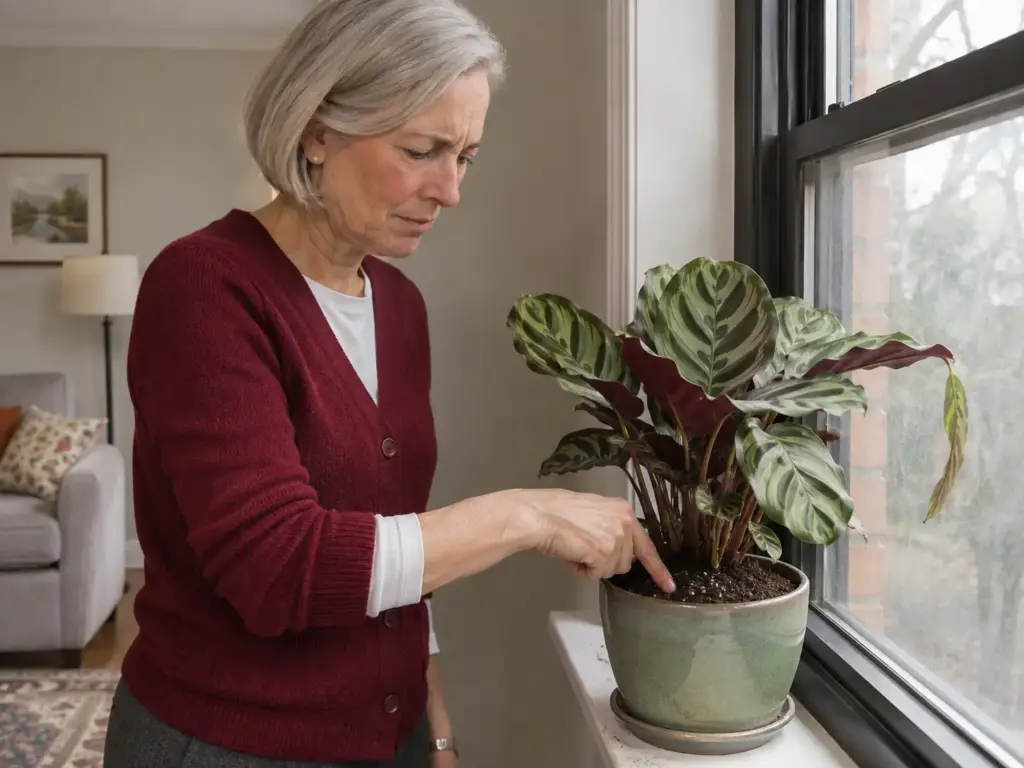
Illinois Extension describes winter as a rest period: plants need very little or no fertilizer and take in less water, a slow-growth dormancy of sorts. A calathea that has not pushed a new leaf since October is moving a fraction of the water it moved in July, so the same room number that looked thin in summer is generous in January, because the demand fell with the light. If the edge is browning while the meter reads 40 or more, the air is probably not the answer. (Probably, because one cold snap can still drag the room under the line, so the meter gets read again after the weather turns.)
The case a unit does fix is the other one. The heat comes on, the number drops ten points in a night, the thin leaves curl, and nothing else about the plant’s week changed. That is the minority case, and the meter is what confirms it.
The Leaf That Touches the Glass
Window glass is the coldest surface in the room, and a leaf resting against it browns from the cold, whatever the air is doing. The tell is the side: a tip that browns on the face toward the window and stays green on the face toward the room is the glass. The leaf in the middle of the room is the one that says whether the air is short, so read that leaf and ignore the one on the sill. A hand’s width off the pane is the whole check, and new leaves that come in clean point to the glass.
The Pot That Is Still Wet From Last Week
A pot still dark from the last watering is a pot that is not drying, and the air takes the blame for a soil problem. A pot that is still wet at the end of the week has not used its water, so more water in the air cannot be what the plant in it is short of. UNH Extension, quoting UMD, ties root rot to overwatering and wet soil, and a plant in its winter rest uses less water than the calendar says it should.
The check runs in order. Read the meter first, then move the plant off the glass. Press a fingertip into the soil before any watering, and water only when the soil says so. Only then decide whether the air is short, because drooping or curling leaves in a wet pot are a watering problem first.
Push a wooden skewer to the bottom of the pot and pull it out. A skewer that comes up dark and cool means the lower soil is still wet even when the top inch has dried, and in a January pot the surface is the first part to dry and the last part to tell the truth.
Raise the Number Without a Machine First
The free changes come before the purchase. They are small and they work on the air around the pots while the room as a whole barely notices, but they show how much a machine would still have to do.
Group the Pots and Keep Them Off the Radiator
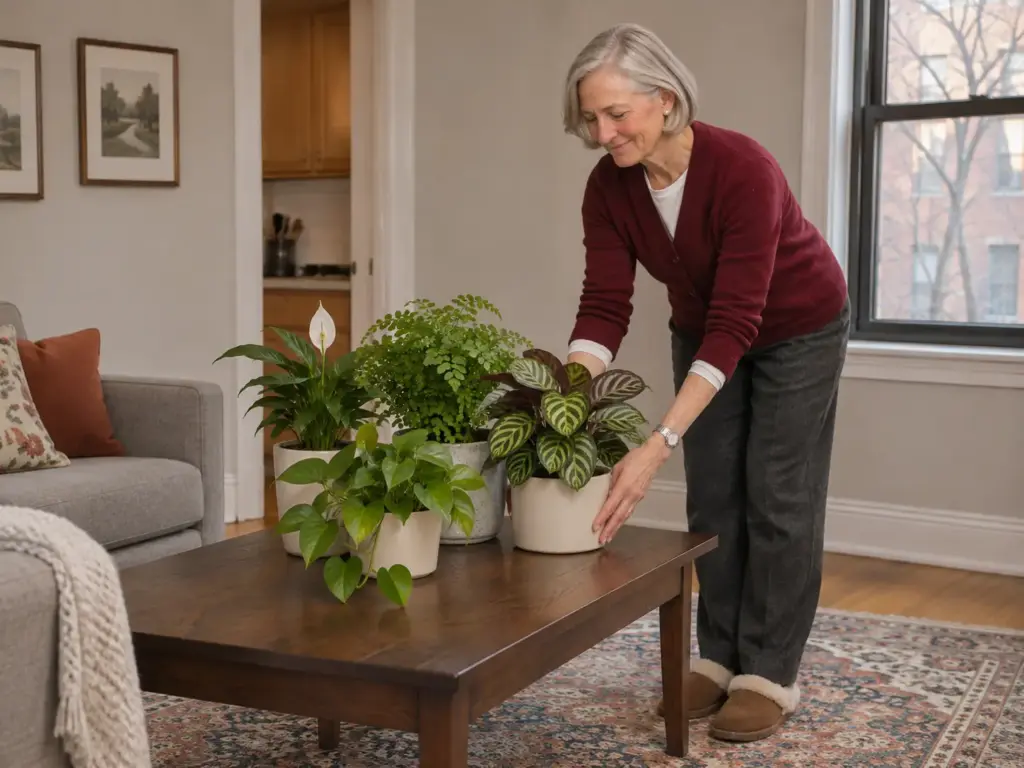
Grouping plants works through the water the pots and leaves give off by transpiration, and it helps most with several plants in a small room with slow air. UNH Extension adds the limit: keep the group away from heat vents, radiators and outside doors, where moving air carries the gain away. Expect a small, local gain, and read the meter at leaf height after the move.
Why Misting Does Not Change the Room
A spray bottle wets the leaf, and the room’s air stays where it was. Illinois Extension says misting does not always work well and that the effect on humidity lasts only a short time. UMD Extension goes further in the extension note on misting: it is questionable whether misting plants raises the humidity at all.
Too much misting may increase disease on the plant. If you mist anyway, do it early so the leaves dry before night, and never on fuzzy leaves.
Read the meter at leaf height before a week of daily misting and again at the end of it. If the number has not moved, the water went onto the leaves and never into the room’s air.
Pebble Tray, Bathroom or Kitchen: What They Add
A pebble tray gives a small local gain, largest in a low-airflow corner with several plants, and the pots stay on the stones above the waterline. The tray is worth the setup in some rooms and a waste in others, and when a tray of stones is worth the setup sorts which. A bathroom or a kitchen is wetter, and a plant belongs there only if the light reaches it, since moisture does not make up for a dark room. After each change, read the meter again at leaf height; if the number has moved into the band, the machine is not needed.
What a Humidifier Leaves Behind by Week Three
The box prints what a humidifier gives the room, and what it takes back never makes the box. By week three the room holds the proof: a film on the shelf, a tank that needs more than a refill and a pane that fogs earlier than it did. All of it is predictable, and all of it runs on a clock.
The White Dust and the Water That Makes It
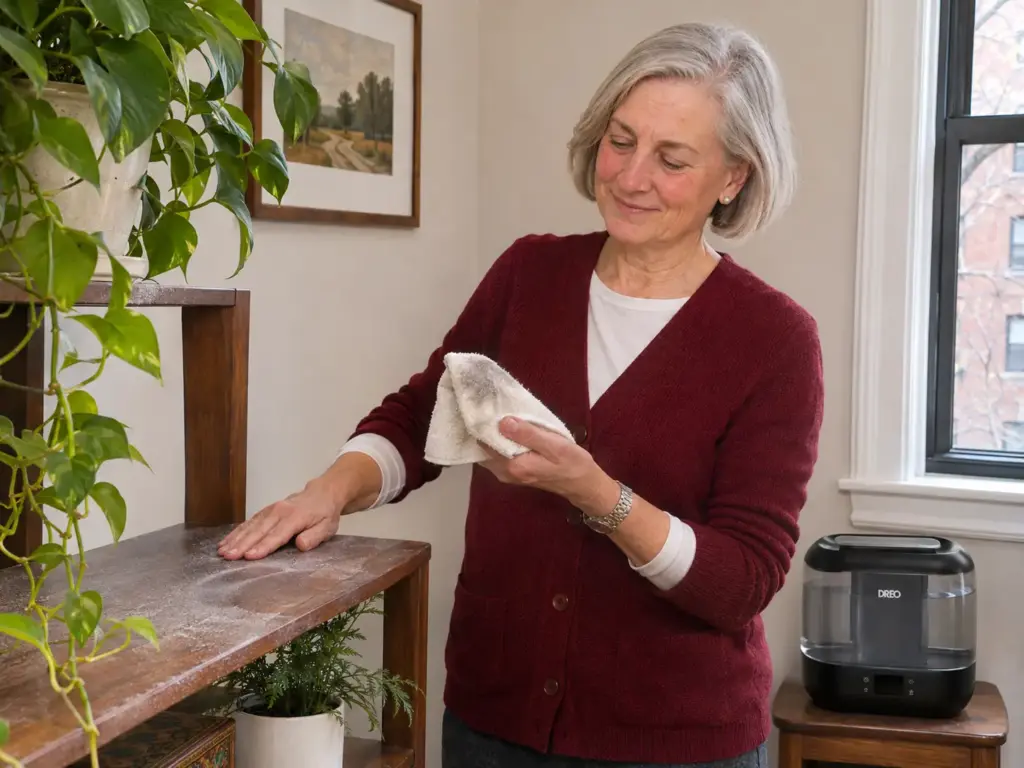
An ultrasonic humidifier or an impeller unit throws the minerals in the tank water into the room along with the mist. The EPA’s rules for running and cleaning a humidifier call for low-mineral or distilled water and name white dust on the furniture as the sign the minerals are not being removed. A quick test tells which kind of house this is: simmer a little tap water in a pan until it is gone. A white residue on the bottom is hard water, and an ultrasonic unit will lay that residue over the shelf, daily in a hard-water house and barely at all with distilled water in the tank.
A warm mist humidifier swaps the dust for scale in the tank, and an evaporative humidifier keeps its minerals in a wick filter that crusts over instead. How white dust and scale differ between cool and warm mist sorts which one lands where.
The DREO Smart Humidifier 4L (DR-HHM001S) prints the numbers a plant room needs: a 4-liter tank, 28 dB on its low setting and up to 36 hours of run time on low, which works out to about 110 milliliters an hour. It also takes an optional demineralization cartridge, the maker’s answer to the white dust, and the distilled-water rule still applies on top of it.
The Cleaning Clock: Day Three, Week Three
The EPA says to clean portable humidifiers every third day: remove the scale and film from the tank and wipe it dry. The clock after that runs on the part that makes the mist. A transducer scales and a wick crusts over a heating season, the tank needs a rinse before the film turns into a crust, and the unit cleaned only when it looked dirty is the one that dusts the room and fogs the glass first.
By the second season the appliance itself is the weak point. Units stop making mist, leak at the base or fail inside two months, and the DREO 4 L sits in that group: its durability is mixed, and the cartridge cuts the dust without cutting the cleaning. Count it as a unit that needs the day-three rinse for as long as it lives. Where the unit goes and how far from the leaves is the other half of running it well.
Stick a strip of tape on the base of the unit and write the date of the last cleaning on it. A schedule of every third day survives the first busy week only when the date is on the machine, and the tape also tells you how long the tank sat before the film showed.
The Pane That Fogs First
The first sign that the setting went past what the room can hold shows on the glass. It tends to arrive at the first hard cold snap, because the same dial setting that was fine in a mild week now meets a colder pane.
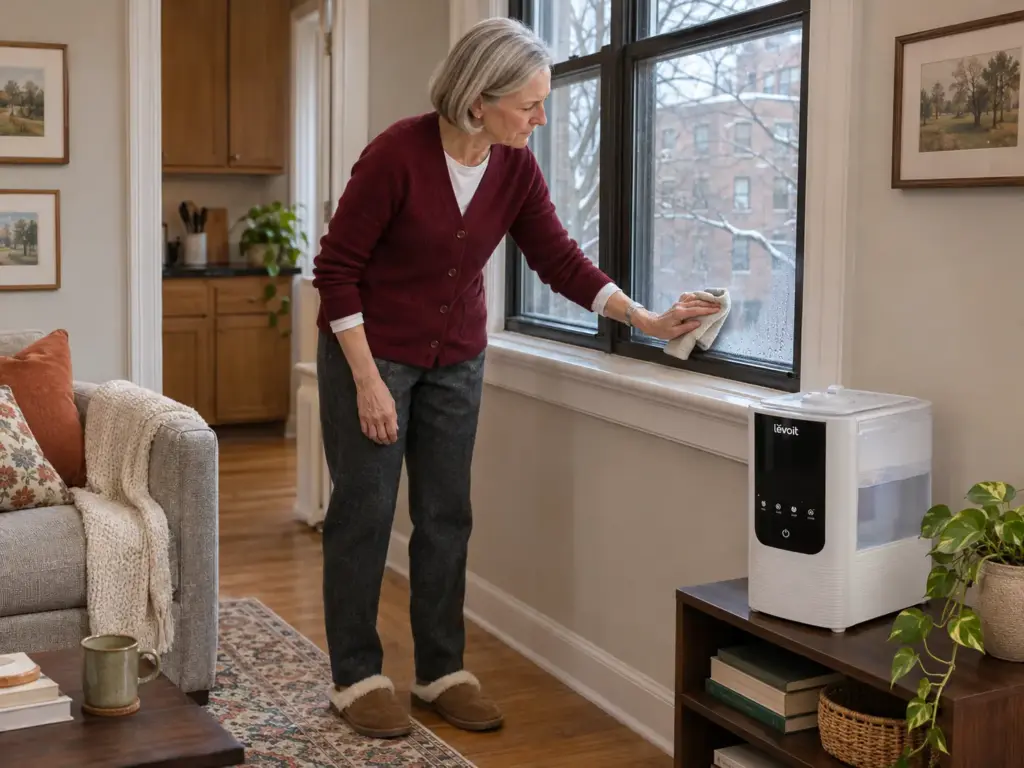
The lowest corner of the window clouds before anything else in the room. The EPA gives three ways out: relocate the humidifier, lower its humidistat setting or run it less. Any of them works. Waiting for the plants to complain is the slow route, since the pane answers sooner than a leaf does.
The Plant Wants 70 Percent, the House Stops at 50
A calathea asks for more than the house can give in January. The plant’s band and the house’s ceiling come from two different sources, and the window glass is where they meet. Neither number bends for the other, so the job is to hold the stretch where they overlap.
Two Bands That Cannot Both Be Met
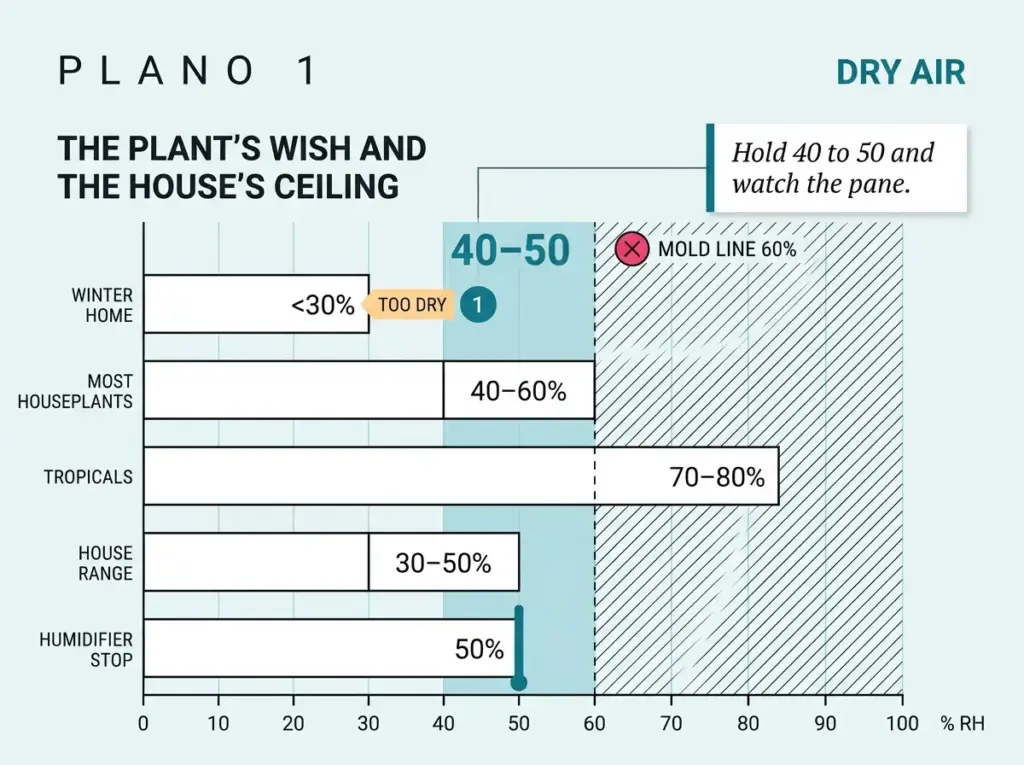
On the plant’s side, UNH Extension puts most houseplants at 40 to 60% and tropical species at 70% to 80%.
On the house’s side, the EPA’s mold guide states the humidity band the EPA gives a home in one line: “If possible, keep indoor humidity below 60 percent (ideally between 30 and 50 percent) relative humidity.” For the unit that does the humidifying the EPA is tighter still: do not humidify above 50 percent. The two sets of numbers overlap between about 40 and 50, and a tropical’s wish for 70 sits well past the house’s line, with glass in the wall to prove it. In a heated room with windows, a reading of 70 percent means condensation waiting for a cold night.
The Pane Is the Stop Signal
The EPA’s resolution is a physical one: if water condenses on windows, walls or pictures, relocate the humidifier, lower its setting or run it less. The glass stops the process before a number does, and it fogs at the lower corner first because that is the coldest spot in the room. What the glass is telling you when it fogs reads the pattern in more detail.
A cheap unit’s dial reports the air at its own base, so the meter at leaf height stays in place after the unit arrives, and when the dial and the meter disagree, the meter wins.
The Units That Hold the Band
For an aim of 40 to 50 percent, the unit needs a humidistat that holds the number, and a tank that only runs does not do that.
The Levoit OasisMist 450S Smart Humidifier is documented by its maker to hold 40 to 60 percent in auto mode, makes cool or warm mist from a 4.5-liter tank, runs at 26 dB and goes up to 45 hours on low. In a heated room with glass in it, the lower half of that band is the part to use, and the pane decides when to stop. Cleaning is where it splits: the wide opening helps, and the large tank is slow to descale. The dial and the room will disagree at some point, and which setting to use when the dial and the room disagree covers what to do then.
A larger room changes the sum. The DREO 6L Smart Humidifier (DR-HHM003S) makes warm mist at 133 °F (56 °C), with an automatic mode from 30 to 90 percent and an output of 500 milliliters an hour, about 3 gallons a day at full output (12 liters). That output is the figure that decides a large room, since the tank size only says how often it needs a refill, and how many gallons a day a large plant room needs does the sizing in full. Some units break in the first month, give little mist or drip from the base, so the first weeks are the test period.
The Rest of a January Plant Room
The air is one chore of several in a winter plant room, and the others decide as many leaves: less water, no feeding, the light and the cold.
Less Water and No Fertilizer
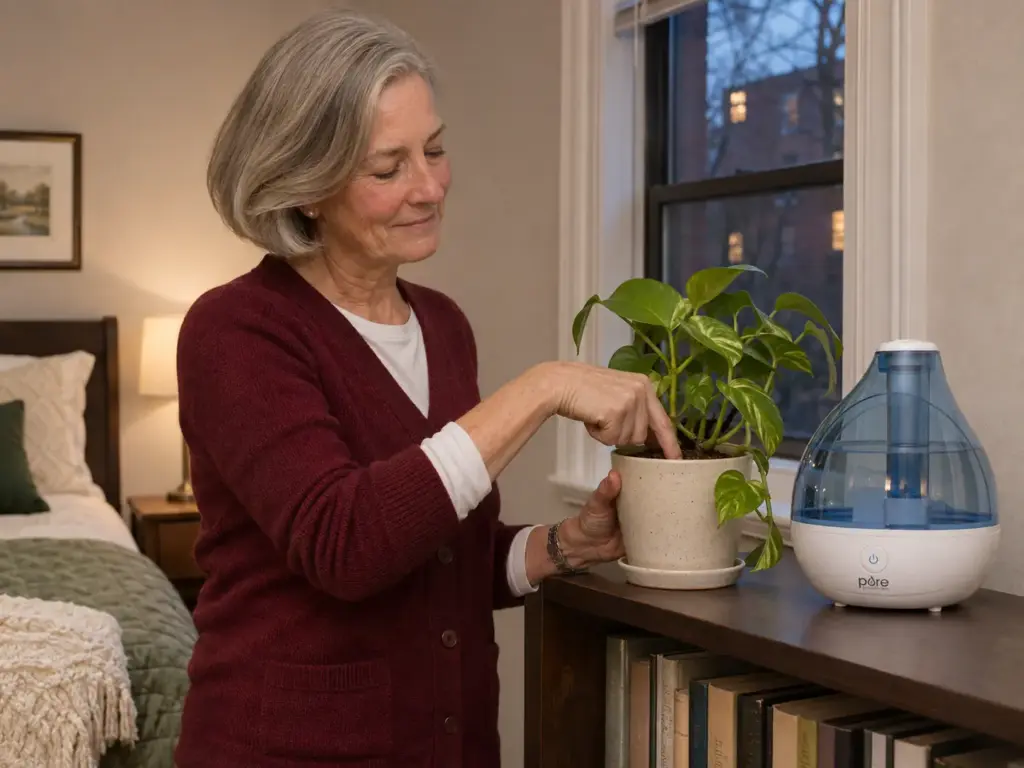
Illinois Extension’s guidance on what winter does to a house’s humidity and its plants says plants take in less water in winter and need very little or no fertilizer. Water when the soil says so and not when the calendar does, and leave the feeding until growth restarts.
The Cold Glass and the Radiator Draft
UMD Extension gives the plant’s rhythm as a night temperature 10 to 15 °F (about 6 to 8 °C) below the day’s. The extremes to move a pot away from are the cold draft off the glass on one side and the radiator on the other. A south-facing window gives the most light in a low-sun month, and a grow light covers the shelf the sun does not reach.
A Small Shelf Gets a Small Unit
A single shelf or a small bedroom collection does not need a large unit.
The Pure Enrichment MistAire Ultrasonic Cool Mist Humidifier, 1.7 L is the small version: 250 square feet on the label, two speeds, a 360-degree nozzle, auto shut-off and up to 25 hours, which is about 70 milliliters an hour at its slowest against 500 for the DREO 6L. Some units stop on their own, and the tank is hard to clean, so the third-day rinse decides how long it lasts.
A tank that is empty by the second morning is the sign that the room is bigger than the unit, and in a larger room a small unit holds the number for a short while before the room drops back under 40 percent, the swing thin-leaved plants react to. With two speeds to choose from, the meter at leaf height does the job a humidistat would, and the pane stays the stop signal.
The Meter First, the Glass Second, the Tank Third
Tomorrow’s job is a reading.
Stand the meter at leaf height, read it at the lowest point of the day, and do that before touching the thermostat, the pots or a shopping cart. The second reading comes after the first free change. A meter above about 40 percent says the crispy tip has another cause: the cold pane, the short day or the wet pot. Under about 40 with tropicals in the room, the free changes come first, then a unit that stops at 50 percent and at the first fog on the glass.
After that the room says when to look again. The glass is the check at the next hard cold snap, tank cleaning is the check on day three and again at week three, and a white film on the shelf means the tank water needs changing. If the reading says a unit is needed, room size, in gallons per day of output, is what picks it.
Frequently Asked Questions
01Is a humidifier good for plants in winter?
Yes for tropical plants, ferns and calatheas when a meter at leaf height reads under about 40 percent; no for cacti, succulents, ZZ and snake plants. Stop at 50 percent or at the first fog on the glass.
02What plants should you not mist?
Fuzzy-leaved plants should never be misted, and no plant should be misted as a way to raise the room’s humidity, since the effect lasts only a short time. Too much misting may increase disease, so if you mist, do it early enough for the leaves to dry before night.
03Can I use tap water in my humidifier?
A cool-mist ultrasonic unit throws the minerals in tap water into the air as white dust, and the EPA says to use low-mineral or distilled water instead. Simmer a little tap water in a pan until it is gone: a white residue on the bottom says the water is hard.
04Where should I place a humidifier for plants?
Put it in open air a few feet from the nearest leaf, off the floor and out of any draft, with the mist aimed across the group. The distance and the height matter more than the brand.
05How often should I clean a humidifier in winter?
The EPA says to clean a portable humidifier every third day: remove the scale and film from the tank and wipe it dry. A unit cleaned less often is the one that dusts the room and fogs the glass first.