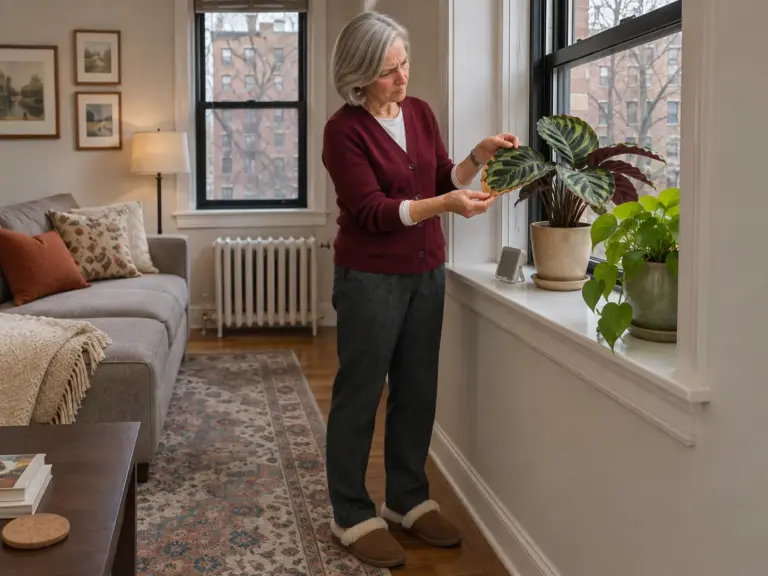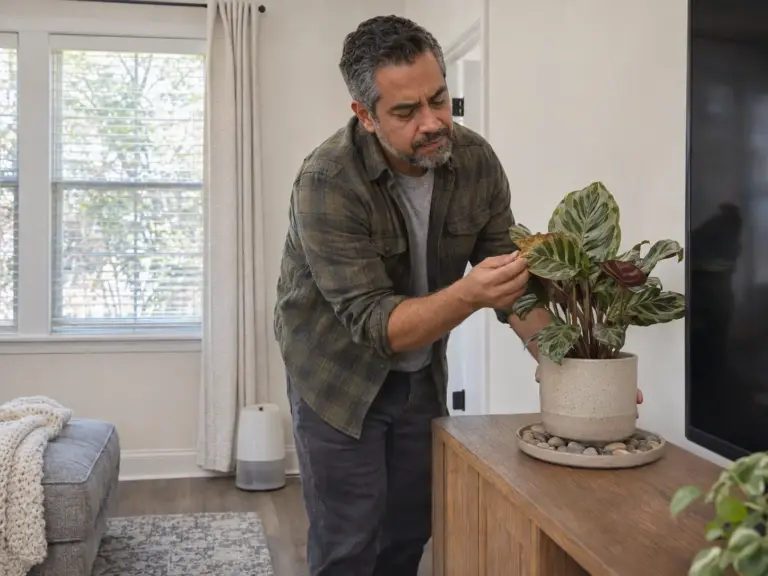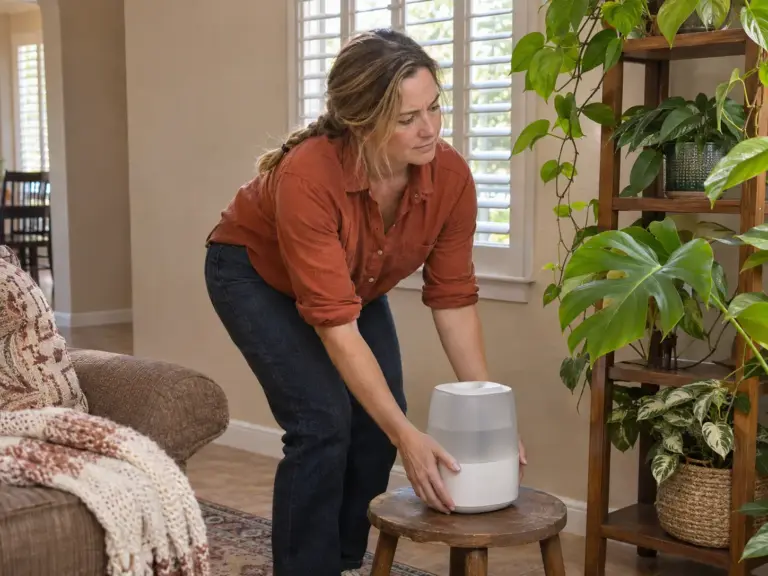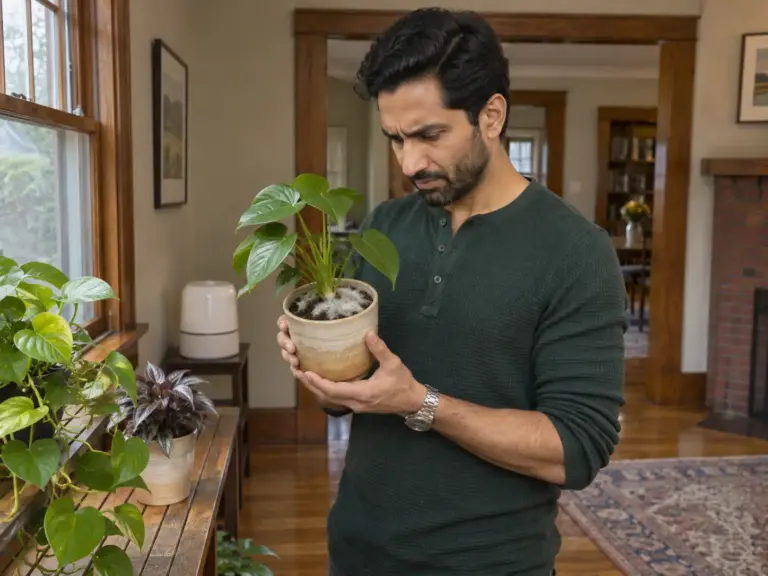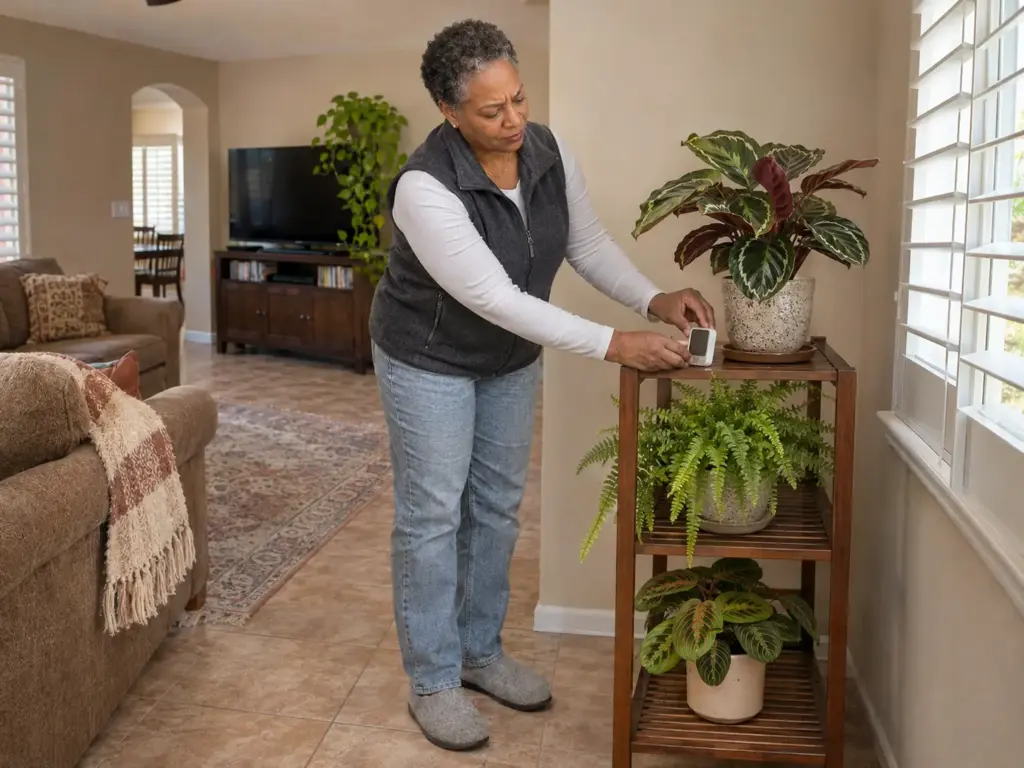
The calathea on the shelf three feet from the heat vent has crisped at the edges again, a small meter beside it reads 28 percent while the hall table reads 40, and the quick conclusion is to order a plant humidifier. If you are typing do I need a humidifier for plants, or do houseplants need humidity at all, with a brown leaf in your hand, the answer is usually no, and yes only when the gauge at leaf height stays low all season. A brown edge has four documented causes and three of them live in the pot, so the cheap checks come before any device, and the number that protects the calathea is the same ceiling that keeps water off the coldest window. Heated air pulls water out through the stomata on the leaf surface faster than the roots can send it, which is how a leaf gives up water into dry air in detail.
Whether a room full of plants is a good place to sleep is a question for a doctor, not for a gauge or a humidifier, so what follows stays with the plant, the air and the device: the pot and the vent first, then the gauge, the plants that really suffer, the free moves, the one number for plant and room, and what a unit costs to keep running in month two.
Quick Answer
For most homes, no. The room already sits in the 40 to 60 percent a houseplant works in, and a humidifier earns its place only when a gauge at leaf height stays below 35 percent through the heating season. Then you run it to that reading, aimed at the air beside the plants and never at the canopy.
Rule Out the Pot, the Vent and the Water First
The brown tip that started the question has four documented causes, and the instinct goes straight to the air. Iowa State Extension on brown leaf tips lists low humidity, a potting mix left dry too long, excess fertilizer salts, and chlorine or fluoride in tap water, and it says plainly: “The most likely cause is low humidity.” So the air stays a serious suspect. It is only the one of the four that costs money to test, and three of the four live in the pot or the pitcher, two of them free to fix, which puts them first in line.
A White Crust at the Soil Line Is Salt, and a Flush Removes It
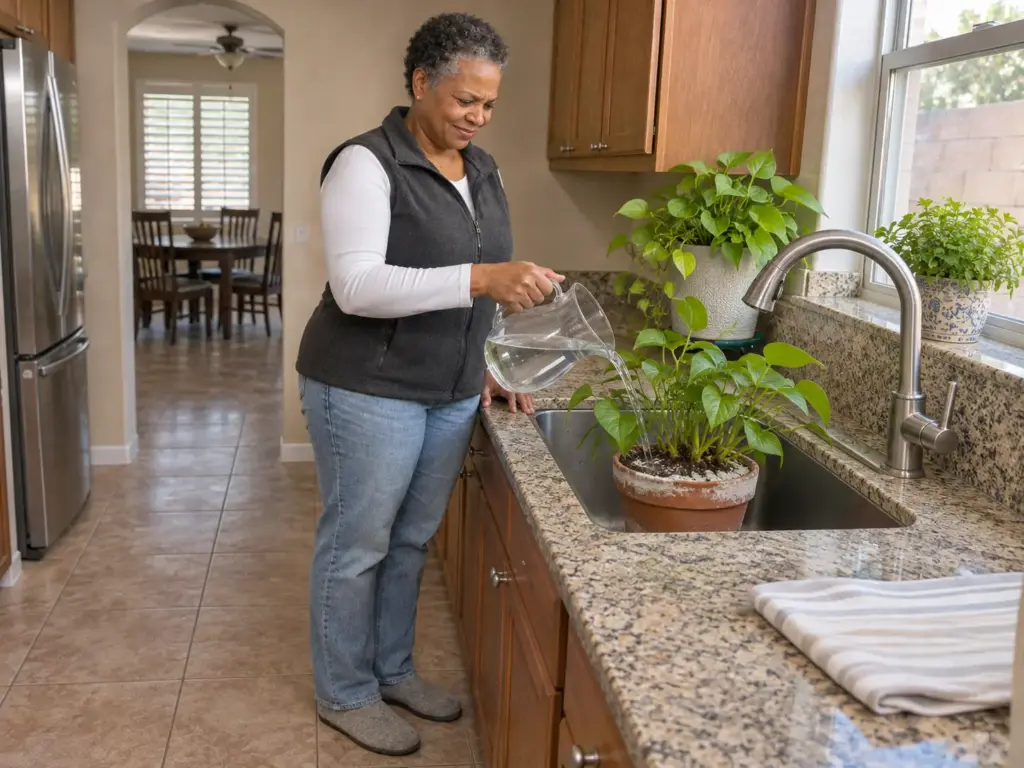
Look at the rim of the pot and the soil surface before you look at the air. Excess fertilizer salts show up as brown tips and margins together with a white crust, the salt build-up, at the soil line or on the pot itself, and the University of Maryland Extension on soluble salts in houseplants gives the remedy: flush the pot with clear water, at least twice the pot’s volume, and repeat the leach every four to six months. Flushing the soil costs nothing and takes a sink. A flushed pot drains for a minute, and then the crust stops coming back; if it returns within weeks, the feeding schedule, not the air, is the next thing to look at.
Judge a flush by the next leaf, never the old one. A brown tip stays brown after its cause is gone, so tie a twist tie around the newest leaf before you start and check whether it unfolds with its edge intact. If it does, the pot was the story and the air gets a pass.
The Shelf Three Feet From the Heat Vent
Colorado State Extension notes that plants near heating or cooling vents lose more water and develop brown tips, so the shelf beside the grille is a hot spot for a reason that has little to do with the room’s reading. A draft from the grille, warm air streaming past the leaf, dries it faster than the roots can supply it, and it does that at close range. Moving the pot a few feet away is a free test, and it changes the plant’s air before it changes the room’s. A plant with a radiator directly under the sunniest window can go from green to crisp, and most of that is the heat on the leaf, with the dryness of the room taking the smaller share.
What Tap Water Leaves at the Edge of a Leaf
Chlorine and fluoride in tap water hit the spider plant, dracaena, ti plant, prayer plant and calathea hardest, according to Iowa State Extension. Letting the water stand or filtering it are the cheap answers for chlorine; fluoride and the other tap water minerals do not leave by standing, so distilled or reverse osmosis water is the fix there, and water from a softener is the one to avoid.
Put the three checks in order of cost and the first step is plain: flush the pot, move the plant off the vent, change the water. Then wait, because brown tips never turn green again and the result shows on the next leaf that opens. If the new growth comes in with its edge whole, the pot or the pitcher was the story. If the new leaf crisps in its turn, the gauge is the next cheapest check.
The Gauge at Leaf Height Gives the Real Answer
With the pot and the vent ruled out, the question left is whether the room sits under what the plant needs, and a leaf cannot answer that by turning brown. A small meter placed where the leaf is answers it within a few days.
Where the Meter Goes and How Long It Stays
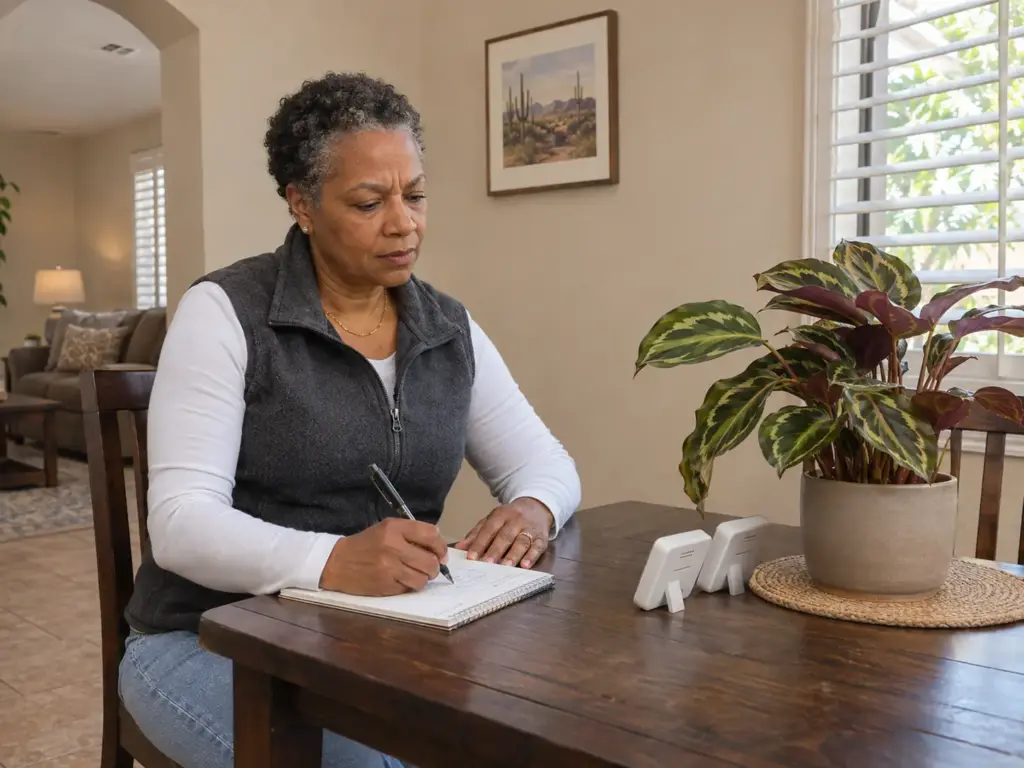
Put a hygrometer at leaf height in the corner the plants actually live in and leave it for several days, reading it morning and evening; the routine is the one in three readings from one small meter. A single reading at the wrong time of day is no answer. Cheap meters can be off by several points, so set a second one beside the first: when they disagree, you know which to distrust, and how to trust a cheap humidity checker covers the check. A pair of meters costs less than one wrong purchase.
Keep the meter out of the vent’s direct stream. In the stream it reads the grille’s dry air, and the plant two feet to the side lives in something wetter. Lean it against a pot at foliage height, an arm’s length off the airflow, and write the lowest reading of each day on a sticky note.
Why the Shelf Reads 30 Percent in February
University of New Hampshire Extension’s houseplant humidity guide explains the drop: cold outdoor air warmed by the heating adds no water, so the room’s relative humidity falls as the outdoor temperature falls, and central heating turns that into dry winter air; why the heating season empties the room goes through the mechanism. The 30 percent on the shelf is the furnace at work, with a drier climate playing no part. And the reading moves from day to day: the one taken after a cold night sits lower than the one on the first warm afternoon, so the lowest figure of the week is the number that counts.
What Under 35 and 40 to 50 Each Mean for the Decision
Under about 35 percent through the heating season, the room is the problem and a unit can be justified. At 40 to 50 percent the room already holds the band most houseplants work in, and a unit adds nothing but a tank to empty. The 35 line is a rule of thumb, a working threshold for the point where the room starts to matter, and the band itself, along with where each kind of plant sits in it, belongs to which humidity each kind of plant works in. Between 35 and 40, spend the free moves first and read the gauge again.
Which Plants Suffer and Which Are Fine Without One
A low reading is no verdict on the whole shelf. The gauge says how dry the room is, and the collection says how much that matters, because a few plants speak up and most stay silent.
Calathea, Ferns, Prayer Plant and Anthurium
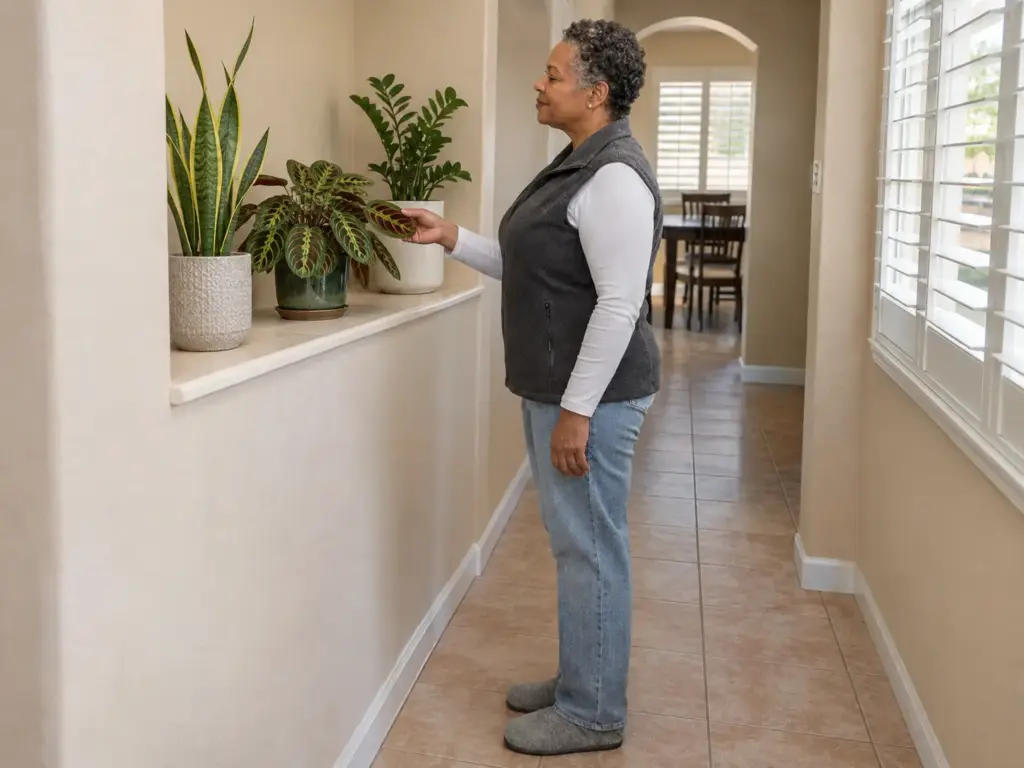
These are the ones that show it first. UNH Extension puts most houseplants at 40 to 60 percent and the tropical species at 70 to 80, and calathea, ferns, prayer plant and anthurium belong to that tropical group.
In one house, with the same water, a calathea can stay fine for a year while another gets crispy edges within weeks, and the difference is the pocket of damp air around the pot and the vent beside it, with the care routine playing little part. A prayer plant that closes its leaves earlier than usual in the heating season is telling you the corner reads low before the meter has been read.
Snake Plant, ZZ Plant, Succulents and Cacti
Iowa State Extension lists the snake plant as preferring low humidity and the ZZ plant as very tolerant of it, and Clemson says the ZZ thrives at regular indoor humidity. Succulents and cacti adapt to whatever the home reads; the UNH band leaves them out, so no band is printed for them here. A humidifier run for the snake plant’s sake solves nothing and raises the odds of a wet wall in the room, which makes these plants the best argument for skipping a unit when they fill most of the shelf.
A Mixed Shelf and the One Plant That Decides
On a mixed shelf, one fussy plant decides. If a single calathea is the only one asking, the answer is a pocket for that pot (a plant zone made by grouping and a tote, below) and the room gets no humidifier. The gauge sets how much that plant matters, and when a low reading is a problem and when it is not covers the floor of the band. If three or four tropicals share the corner and the lowest reading of the week stays under 35, the case for a unit gets real.
What Grouping, Trays and Misting Actually Move
The free moves come before any purchase, and each one has an honest number attached: minutes, or a few points, never a season.
Grouping the Pots and the Pocket It Makes
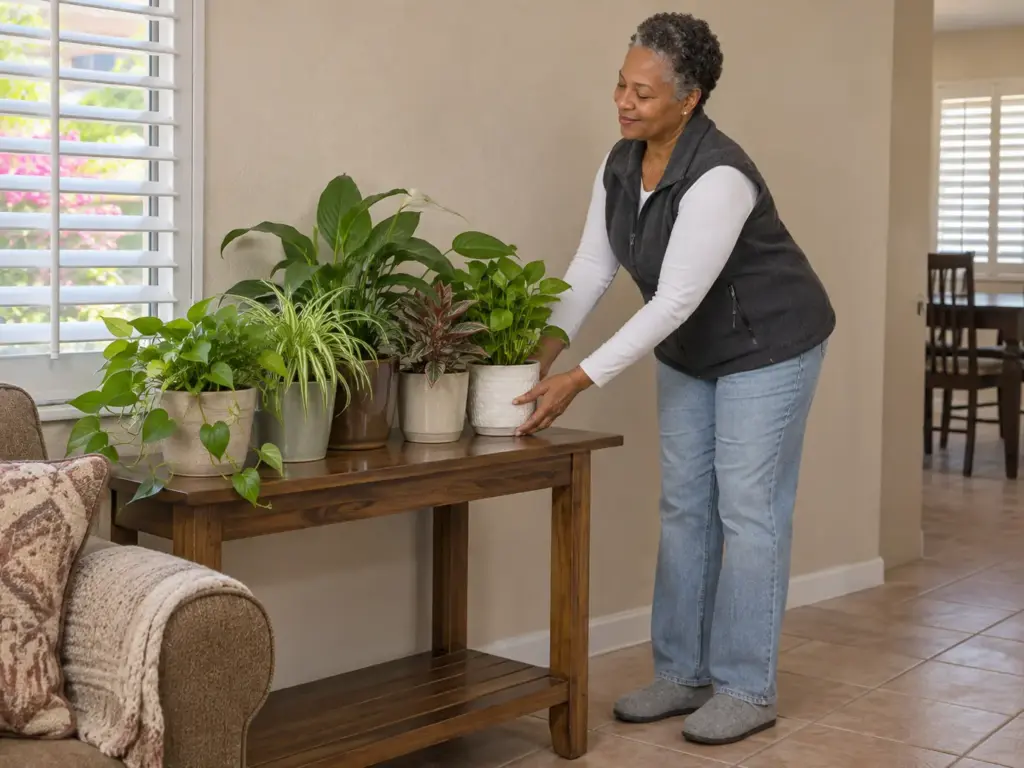
Grouping plants, pots set tight together, makes a damper microclimate around them, because the transpiration of each pot feeds the air the next one sits in. It is the free move that keeps working. A plastic storage tote with the lid off, or a small grow tent, does it harder for the plants that ask for more. The pocket is real but local: it reads higher at the pots than the hall meter does, and it ends at the edge of the group.
Stand the one fussy pot inside a plastic storage tote with the lid off and drop the meter in beside it for a day. The walls hold the damp pocket in, the open top keeps the circulation going, and if the reading climbs past 50 you lift the tote away and the pocket is gone in minutes.
Misting and the Pebble Tray Move Minutes, Not Hours
Misting wets the leaf and the air beside it only until the water evaporates, a matter of minutes, and it has to be repeated often to do anything at all. Colorado State adds that wet leaves may promote some fungal leaf spots, and UF/IFAS says never to mist velvety leaves. A pebble tray behaves differently: its vapor spreads into the whole room and does very little for the pot standing above it. Moving the pot off the vent, grouped with its neighbors and away from the coldest glass, changes more than either.
A small unit in an open apartment moves the gauge only a few points, far short of what the box implies, because the room’s air exchange eats the mist faster than the tank makes it. The shut door decides more than the dial.
Grouping can overshoot in a small, shut room, so when the corner reads over the ceiling, what to do when the plant corner is already over the ceiling takes the opposite direction.
One Band Serves the Plant and the Room
The decision so far has been about the plant, and the plant’s band and the house’s ceiling turn out to be one number read on one gauge. The ceiling that protects the calathea is the same one that keeps water off the coldest glass.
Where 40 to 60 Meets the EPA’s 50
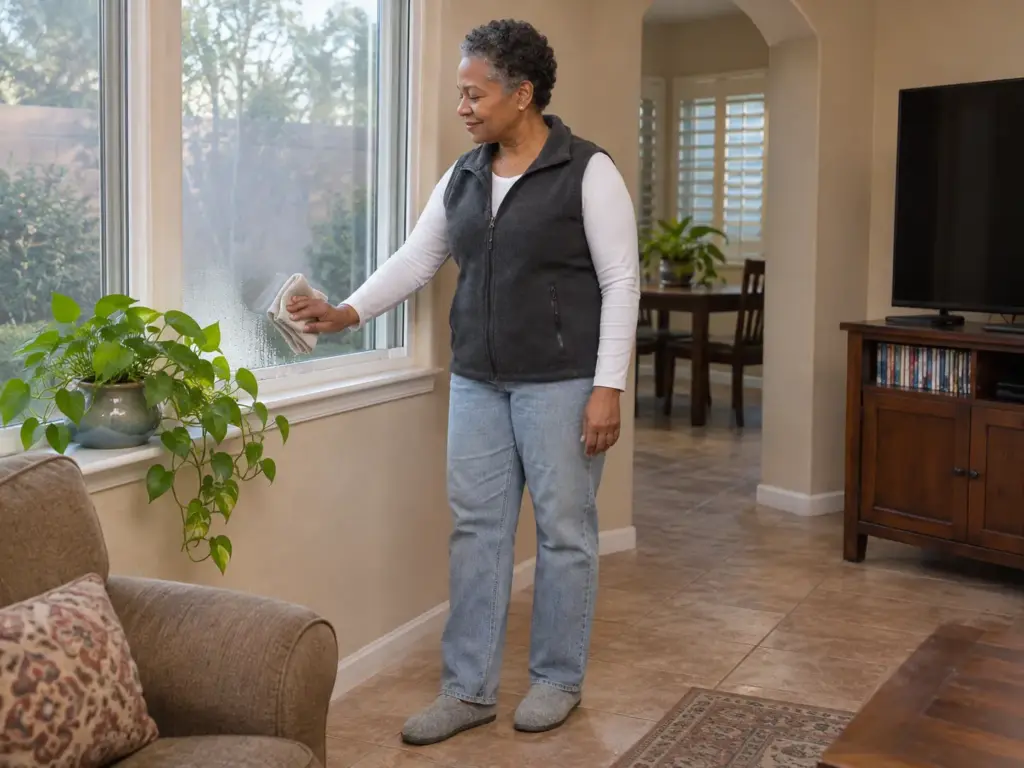
UNH Extension puts most houseplants at 40 to 60 percent relative humidity. For the house, the EPA’s indoor humidity guidance says: “If possible, keep indoor humidity below 60 percent (ideally between 30 and 50 percent) relative humidity.” The EPA’s humidifier sheet draws the line tighter for a device: do not humidify above 50 percent.
Lay the three on one scale and the overlap is 40 to 50 percent, and that stretch is the whole answer. The 50 line is the ceiling for a device, and it was never a floor for the plant.
The Glass and the Cold Wall Show the Ceiling
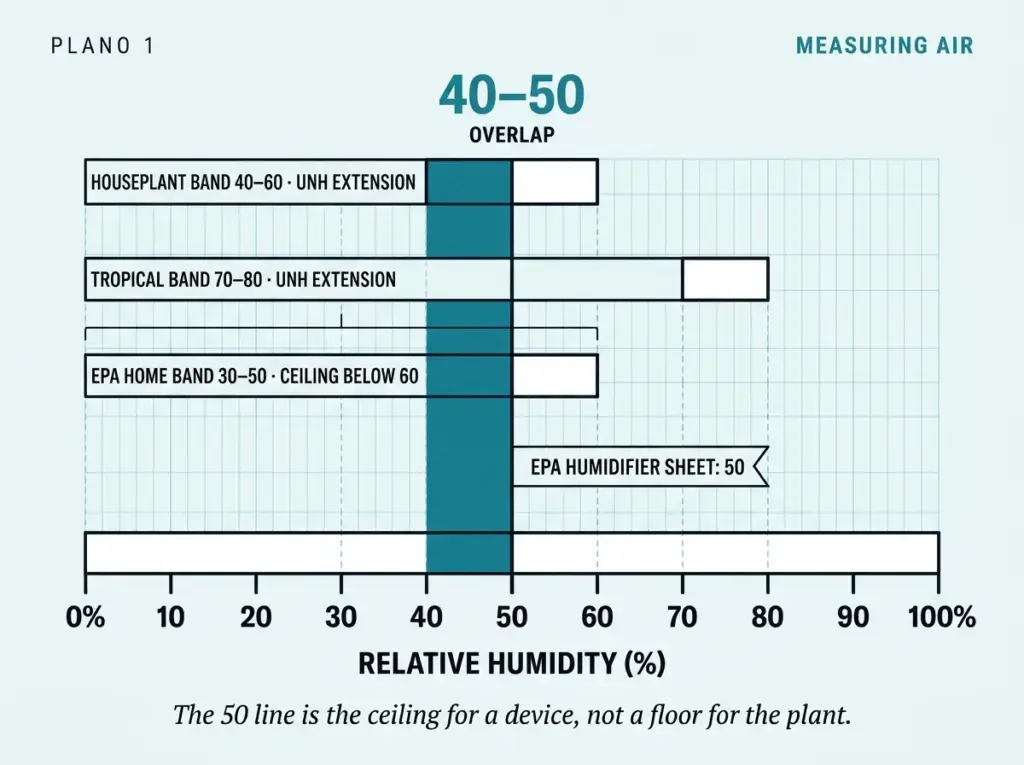
The room reports the ceiling itself. Condensation on windows, the kind on the room side of the glass, or beads on the coldest wall, is the EPA’s sign of high humidity, and when it appears the unit goes down or off, never up; why the fog on the room side of a window is normal and when it is not sorts the harmless fog from the kind that matters.
A room held past the 60 percent ceiling starts a mold and mildew clock, and the plant corner is not exempt: the EPA says a wet area dried within 24 to 48 hours stops mold in most cases, and keeping a bedroom wall under 60 percent shows the same line from the wall’s side. The glass speaks first. A fog at the lower corner at breakfast that is gone by noon says the setting is a point or two high.
When the Moisture Is the Building
Some moisture belongs to the building, and a humidifier makes it worse. A leak, a cold exterior wall that sweats, a damp crawlspace: none of them is fixed by a unit, and each is a professional’s call. Condensation that keeps returning with the unit off points the same way. And an unattended unit running all winter is worse than no unit, a point that the question of mold for a unit that runs all winter follows into the duct side.
When a Unit Earns Its Place, and What Month Two Costs
The decision narrows here. If the gauge at leaf height stays below 35 percent through the heating season and the free moves changed nothing, a unit is justified, and buying it is only the start of the cost, because the tank and the filter decide how the purchase ages.
A Single Shelf Wants a Small Unit and Arm’s Length
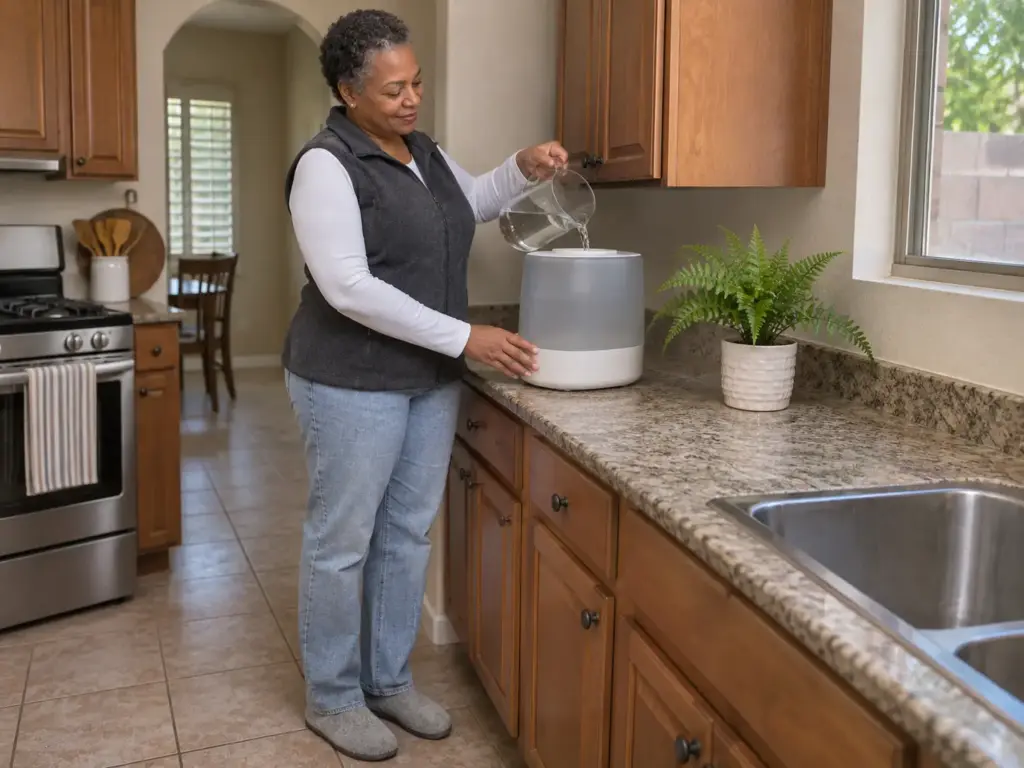
For one shelf or a small shut corner a small unit is enough, and at any distance it does nothing, because a small unit only changes the gauge within arm’s length of its nozzle.
The Levoit Dual 150 is a 3-liter cool mist unit that Levoit rates at about 25 hours on its lowest setting and 25 W, with a knob and no humidistat, so the meter beside it does the controlling; its limit is that distance, with no meaningful change in the reading more than a few feet from the nozzle. The nozzle points at the air beside the plants and never at the leaves, since wet leaves invite fungal leaf spots and a cool mist at the canopy chills the soil and lower leaves in winter.
For the reader who only wants the corner at 40 percent, the Pure Enrichment MistAire has a tank capacity of 1.5 to 1.7 liters, is rated for a room size of 250 square feet, runs up to 25 hours and draws 12 W, again with no humidistat. Its front-fill tank gets hard to clean once film sets, and units that quit within the first weeks are the usual way it ends.
Run It to a Reading, Not a Timer
A unit with a humidity sensor holds a number; a knob only runs until you switch it off. The Levoit Classic 300S is the one on this list whose sheet prints tank, run time, area, wattage and a set point: a 6-liter top-fill tank, about 60 hours on low, 505 square feet, a built-in humidity sensor, 26 W and an auto mode with a 40 to 60 percent target. Set the target at or below 50 for the house’s sake.
The arithmetic of those figures is plain: 6 liters over 60 hours is about 100 milliliters an hour, which in a shut 10 by 12 ft room with an 8 ft ceiling is about 3.7 grams of water per cubic meter an hour, a double-digit rise in the reading on paper if nothing leaked out, and the room’s air exchange eats most of that. In an open room the unit runs constantly and never reaches the number. Where it falls down: leaks at the tank are its usual failure, the humidity output varies from unit to unit, and some units quit inside a month.
White Dust, Steam and the Water in the Tank
The EPA’s humidifier care sheet sorts it by mist type: an ultrasonic humidifier or an impeller humidifier disperses the water’s minerals into the air, and an evaporative humidifier or a steam unit is not expected to. That is the white mineral dust on the shelf and the leaves, and it comes from the tank’s water, never from a defect. Distilled or low-mineral water cuts it, and so does a demineralization cartridge; dust that comes back means the cartridge is spent, and even then it reduces the dust without eliminating it. The same sheet asks for tank cleaning on a schedule: the tank emptied and refilled daily and the unit cleaned every third day.
The Vicks Warm Mist V745 is the no-dust option for a hard-water house that will not buy distilled water: a 1-gallon tank, filter-free, about 12 hours a fill, auto shut-off, no humidistat. It draws 248 W against the Classic 300S’s 26, about ten times as much, and it warms the room it stands in, with noise and leaks coming up as well. Run flat out for a day, 26 W is about 0.6 kWh, the 12 W MistAire about 0.3 kWh and the Vicks about 6 kWh, so a heating season of warm mist adds up to a different bill from the cool mist unit.
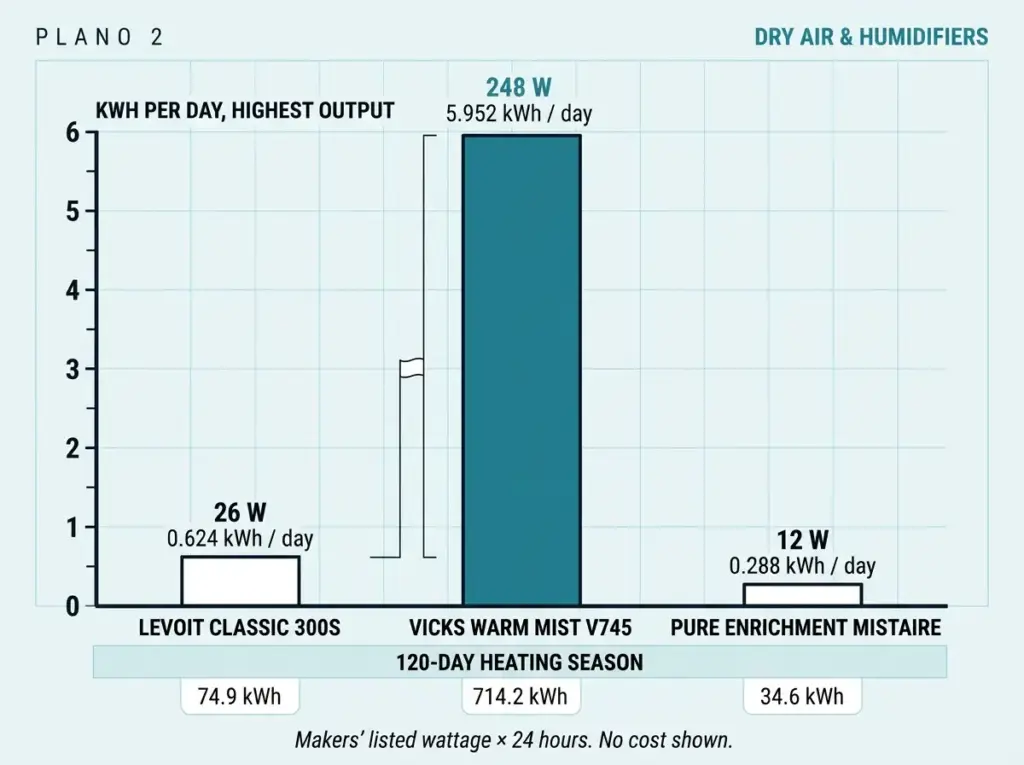
Read the shelf before you read the meter. By the second month, the white film on the wood under the nozzle tells you what the tank’s water is doing, and a film that shows up within days of a refill is the signal to change the water or the cartridge. Judge the setting by the reading at the foliage, never by one taken in the mist.
The Step Up and the Bill Nobody Prints
The Levoit OasisMist 450S is the step up: a 4.5-liter tank, cool or warm mist, 430 square feet, 45 hours a fill, and an auto mode with a 40 to 60 percent target. It is the only unit here that both holds a number and offers warm mist. The cost sits in the upkeep: its two filters are a two-to-four-week consumable, so filter replacement is a standing chore, and descaling is a 30-to-40-minute soak; the running cost is the flaw, and the output is fine.
Distilled water stops being practical by the second month for a big tank; a pitcher filter or a cartridge on hard water is what keeps a 6-liter unit going. Tanks that grow a pink film within a week are the other usual ending, and an unattended tank is worse than no unit at all. If a unit is the answer, the next question is size, and a room unit against a whole-house one is where that goes.
Flush the Pot, Move the Plant, Read the Gauge
For most homes the answer stays no. The order is the pot, the vent and the water first, then the gauge at leaf height, then the free moves, and a unit only when the lowest reading of the week sits under about 35 percent through the heating season. If it does, a unit with a sensor holds the number and a knob does not, the nozzle aims at the air beside the plants, and the target stays at or below the EPA’s 50. The tank decides how the purchase ages.
After a few weeks of running, look again at the film on the shelf under the nozzle and at the reading in the plant corner after a cold night; after a season, look at the soil line for the crust.
Tomorrow, flush the pot that has the white crust, move the plant off the vent, and lean a meter at leaf height for a few days. The lowest morning reading is the number that settles it.
Frequently Asked Questions
01Can I use tap water in a humidifier for plants?
Low-mineral water is the safer fill. Ultrasonic and impeller units disperse a tap’s minerals as white dust on shelves and leaves. Distilled water or a demineralization cartridge cuts it, and the EPA says dust coming back means the cartridge is spent.
02Does misting replace a humidifier for plants?
No. Misting wets the leaf and the air near it only until the water evaporates, a matter of minutes, and wet leaves can invite fungal leaf spots. It is a short fix and cannot hold a reading.
03Will a humidifier fix brown leaf tips?
Only when the gauge at leaf height stays low. Brown tips also come from salt in the soil, a pot left dry too long, tap water and a nearby vent, and those are free to check first.
04How close should a humidifier sit to my plants?
Within arm’s length for a small unit, because it only changes the gauge near its nozzle, with the mist aimed at the air beside the plants and never at the leaves. A cool mist blown at the canopy chills the soil in winter.
05Do snake plants and ZZ plants need a humidifier?
No. Iowa State Extension lists the snake plant as preferring low humidity and the ZZ plant as very tolerant of it, and Clemson says the ZZ does fine at regular indoor humidity. Ferns and calatheas are the plants that ask.