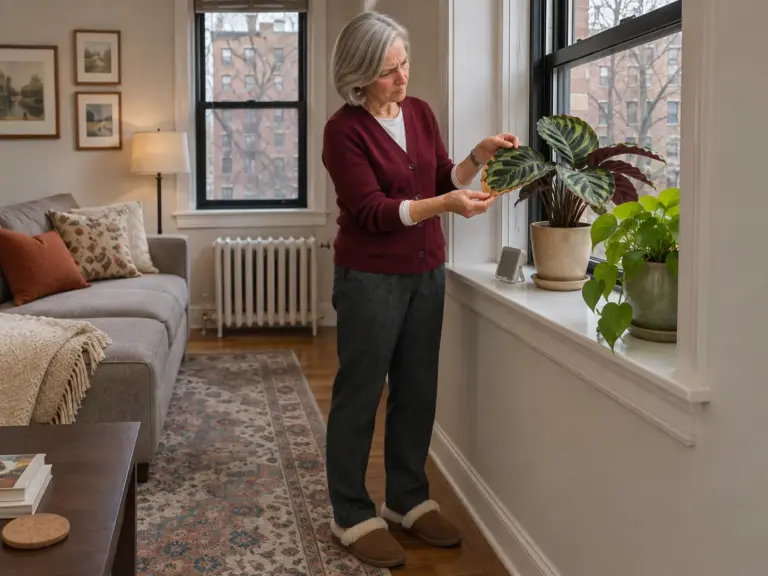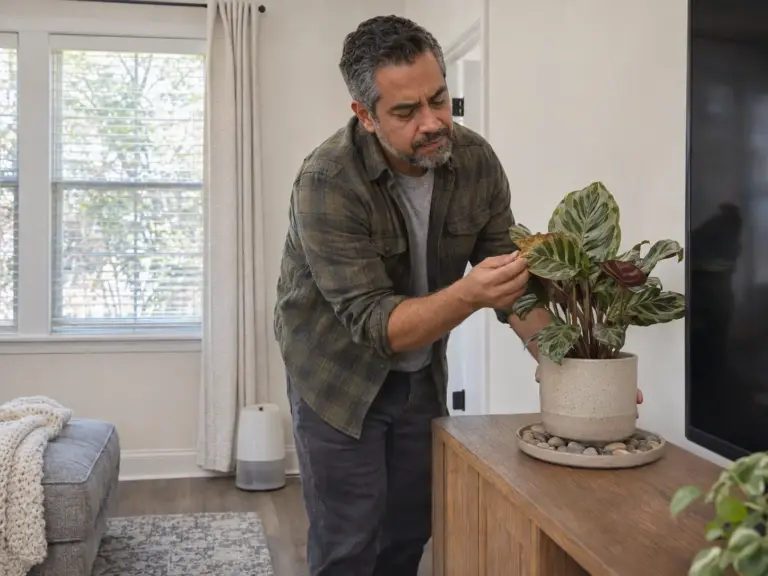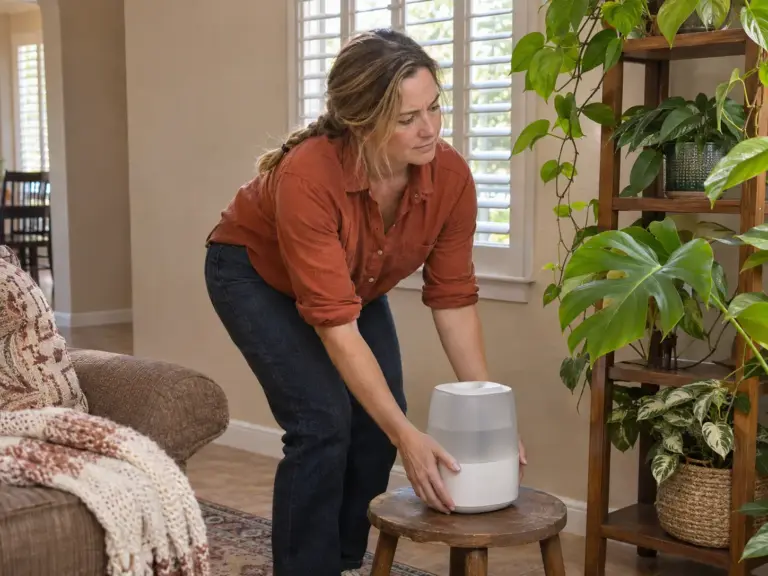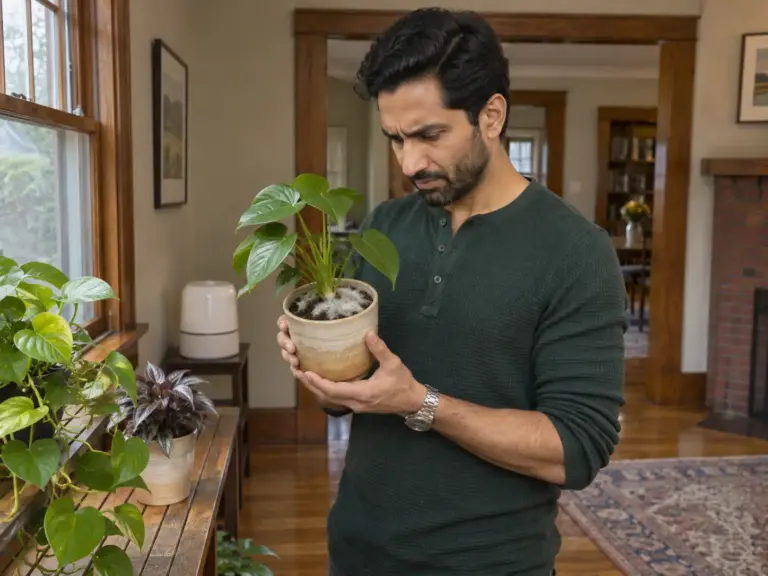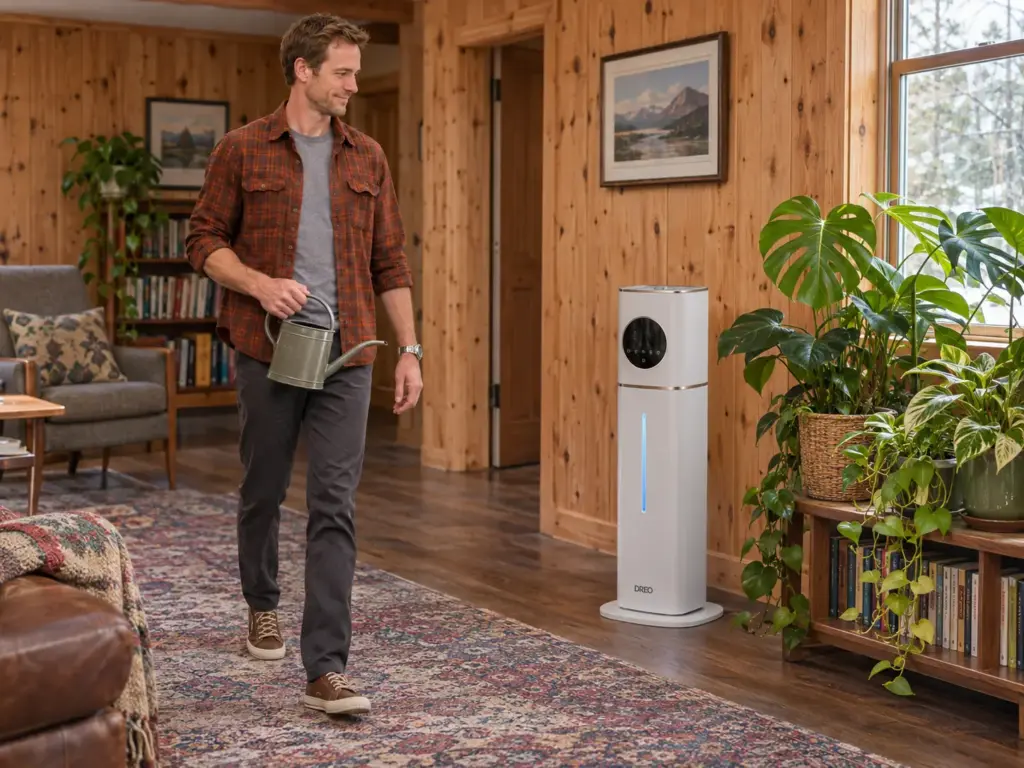
The display on the humidifier reads 50 percent, and a second meter stood in the leaves of the monstera six feet away reads 38. Same room, same hour, two numbers, and only one of them is where the plants live. The best humidifier for plants in a large room is the one whose water output matches the room, not the one with the biggest tank printed on the box, and a tank that was full at bedtime and is dry and warm by morning is a big room meeting a small tank, with nothing broken.
A unit’s humidistat only knows the air at its own base, and why a leaf loses water faster in dry air is the reason crispy leaf edges are where the gap shows first, so the two numbers that decide the purchase are the reading at the leaves and the gallons the room drinks in a day. The reading comes first, then the gallons, then the machines that can keep up, what 60 percent does to the glass, the water and the wick, the cases where no machine is the answer, and the two smaller units for a small collection.
Quick Answer
Match the machine to the room’s water. A 700 square foot room asks for about 3 to 6.4 gallons a day, so a large evaporative unit fits, the 11-liter tower fits only a tight house, and a 4-liter ultrasonic cannot keep up. Aim for 40 to 50 percent, read at the leaves.
Read the Leaves, Not the Machine’s Display
A big room holds two humidities. One is at the machine, where its own sensor reports it; the other is at the plants, where it has not been measured yet. The whole purchase hangs on the gap between them, so the reading comes before any model.
A Humidistat Only Knows the Air at Its Own Base
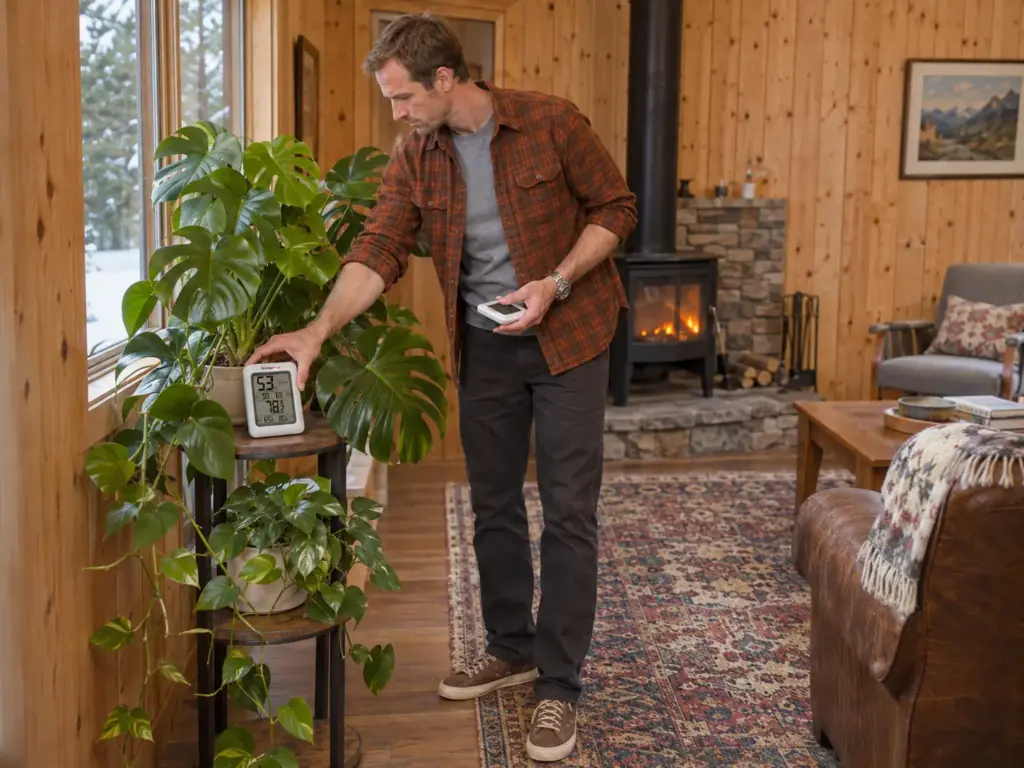
The sensor sits inside the housing and samples the air that reaches the base of the unit. In a small room that air and the air at the plants are close relatives. In an open-plan apartment or a living room of 700 square feet the mist rises, drifts, gets soaked up by pots, soil and upholstery, and the canopy six feet away can sit about ten points lower than the number on the display.
The sensor is answering the only question it can see. The DREO HM735S prints its humidistat accuracy as ±5 percent, which makes the display a reading with a margin, taken at the base.
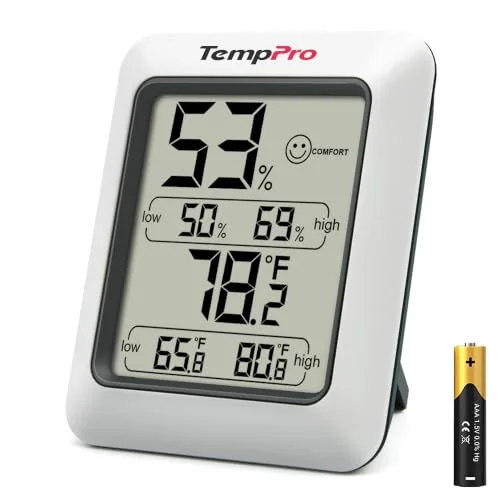
The second number comes from a separate hygrometer stood among the leaves at leaf height, out of the path of the mist and away from the cold glass of the window. Where to stand a meter so the number means something covers the placement in detail. The extension service at the University of New Hampshire gives the same advice for larger rooms: pair the humidifier with a digital thermometer and hygrometer. One meter in the leaves and one beside the machine, read on the same day, put the gap in this room into numbers.
A cheap meter is trusted only after it has been checked against a second one. Stand both on the same shelf for an hour before either goes anywhere. If they agree within their printed margin, move one into the leaves and the difference between the two readings from then on belongs to the room. If they disagree by five points or more before they have moved, the disagreement is the meters’, and that reading cannot be used to size a machine.
That makes the meter the one purchase here that can cancel all the others, and its accuracy sets what a reading can prove. What a cheap meter can and cannot read is a short read on drift and on the two-meter check, and the TempPro TP50 below is the kind of instrument the job asks for.
What the Reading at the Leaves Tells You to Do
The target is the overlap of two bands. The University of New Hampshire extension’s humidity range for houseplants fits in one line: “Most houseplants (excluding cacti, succulents and a few others) prefer a relative humidity range of 40-60%, although tropical species thrive at higher ranges of 70-80%.” The EPA keeps a house at 30 to 50 percent and stops a portable humidifier at 50, so the machine aims for 40 to 50 and is set to stop there. The tropical plants that want 70 to 80 are the ones a room cannot serve, and a later section says what to do for them.
Three readings sort the decision. A canopy reading already inside 40 to 50 means no machine at all, and whether this room needs a machine at all settles that before a tank is bought. A reading well under 40 through the heating season is the case this article serves. Between the two, the room is borderline and a few days of readings will say which way it leans.
Picture the three cases in a real living room. A meter in the leaves that reads 46 in the afternoon and 41 at the overnight low is a room that needs nothing, and a tank would only buy condensation. A meter that reads 36 in the afternoon and 29 at the low, with the furnace running, is the room this article is for. A meter that reads 44 in the group and 31 at the far window is a local problem, a pot or two in the wrong place, and the fix is a move.
Temperature enters the sum too, because DREO’s own manual notes that the same amount of water gives a lower relative humidity in warmer air, so a room that runs a few degrees warmer reads drier with no change in the water.
Clear the meter’s memory each evening and read the high and the low the next day. The low is the number the leaves live with after the heat has cycled down, and it is the figure to judge the machine by, since a display glanced at in the afternoon flatters it.
One reading proves little. Heating cycles, a door left open and sun on the south window all move the number, and the morning and afternoon figures can sit several points apart. Read it across a handful of days before deciding anything.
Group the Pots Before You Buy Anything
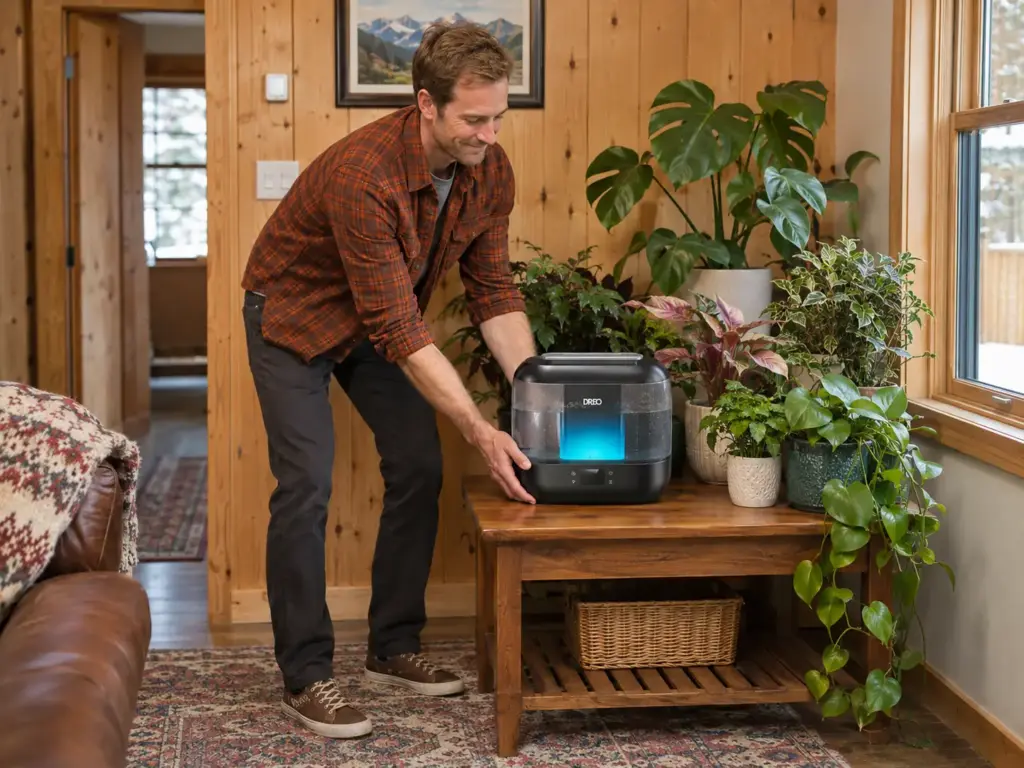
The free move comes first. The extension service points out that grouping plants makes a small microclimate, since they share the moisture they release, and it advises keeping them away from heat vents, radiators and outside doors. A pebble tray gets a small benefit from the same source, and like grouping it works best with several plants in a room with low air circulation, so it does little in a big one.
Move the pots off the radiator and the door, and read the meter again a few days later. If the group’s number climbs, the room’s dryness was partly local and the machine can be smaller, or unnecessary. If it does not climb, the reading is the real one, and the arithmetic that follows is what the purchase is sized by.
A Big Room Drinks Gallons a Day, and the Tank Label Hides It
A box prints tank liters and square feet; the room is paid in gallons a day, and the two never meet on a label. The first job is to convert the room into the unit a machine can be held to.
The Sum for a 700 Square Foot Room
The sizing method comes from AHRI Guideline F: the volume of the room in cubic feet times a leakage factor K, divided by 33,000, gives gallons per day. K runs 17.5 for a tight house, 27 for an average one and 38 for a loose one with leaky windows and doors.
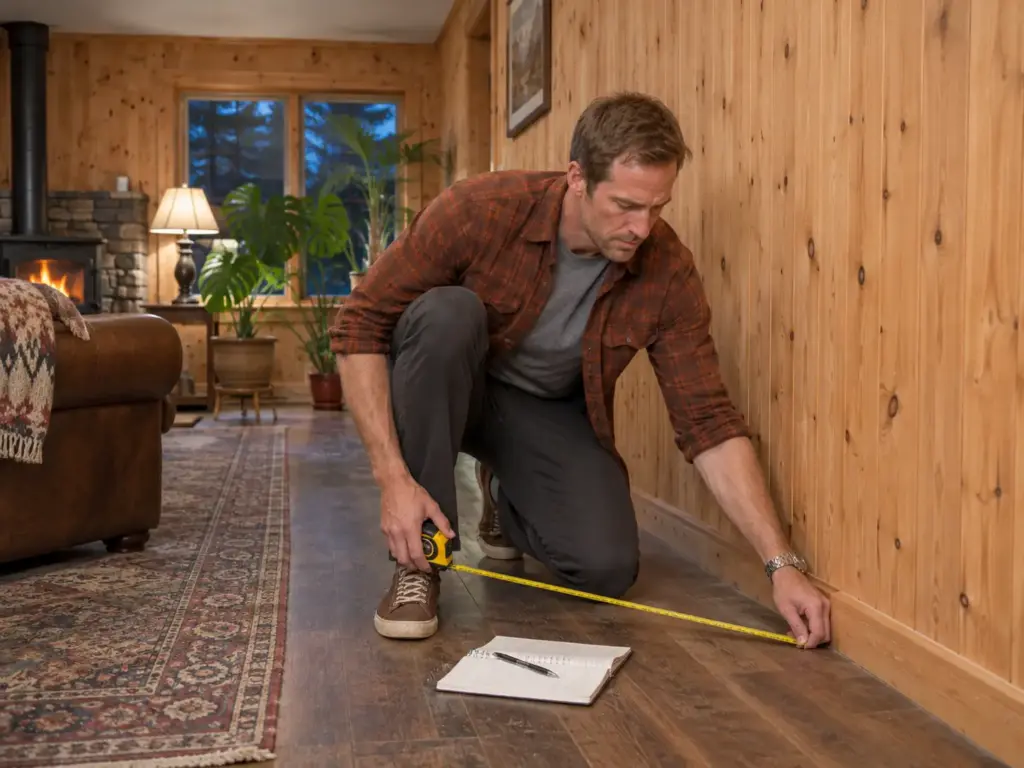
Count the volume of the space the air really moves through. An open-plan room runs into a hallway or a kitchen, and a door left open all day makes the humidified space bigger than the floor plan shows. A room of 700 square feet at an 8-foot ceiling holds 5,600 cubic feet (a 9-foot ceiling adds about an eighth to every figure below), and the sum gives about 3.0 gallons a day in the tight house, 4.6 in the average one and 6.4 in the loose one.
Read these as sizing figures for a cold week; a mild week asks for less. The gallons-a-day rule for any room carries the same method for a bedroom or a whole floor, and a plant room is that arithmetic with a longer reach.
Why the Tank Is Empty by Morning
The water goes out through the walls as air. The ventilation rate ASHRAE sets for a home in Standard 62.2 is 7.5 cubic feet per minute per person plus 3 for every 100 square feet, so the house’s air is replaced with outside air all winter, which is why dry air in winter costs the most water. Where the water in a winter room goes follows from that: the replacement air arrives cold and nearly empty of water, gets heated, and drinks from the tank until the reading falls back, however the unit was chosen.
Now the labels can be turned into the same unit. A top output of 400 ml/h is 9.6 L over 24 hours, about 2.5 gallons. A top output of 1,500 mL/h is 36 L, about 9.5 gallons. A 4-liter tank that lasts 36 hours makes 2.7 L in a day, about 0.7 gallons.
An 11-liter tank running at 400 ml/h empties in about 27 hours, and the 100 hours printed on the box is the other end of the same dial, 110 ml/h. The same unit can honestly print both figures, and only one of them is a room’s worth of water.
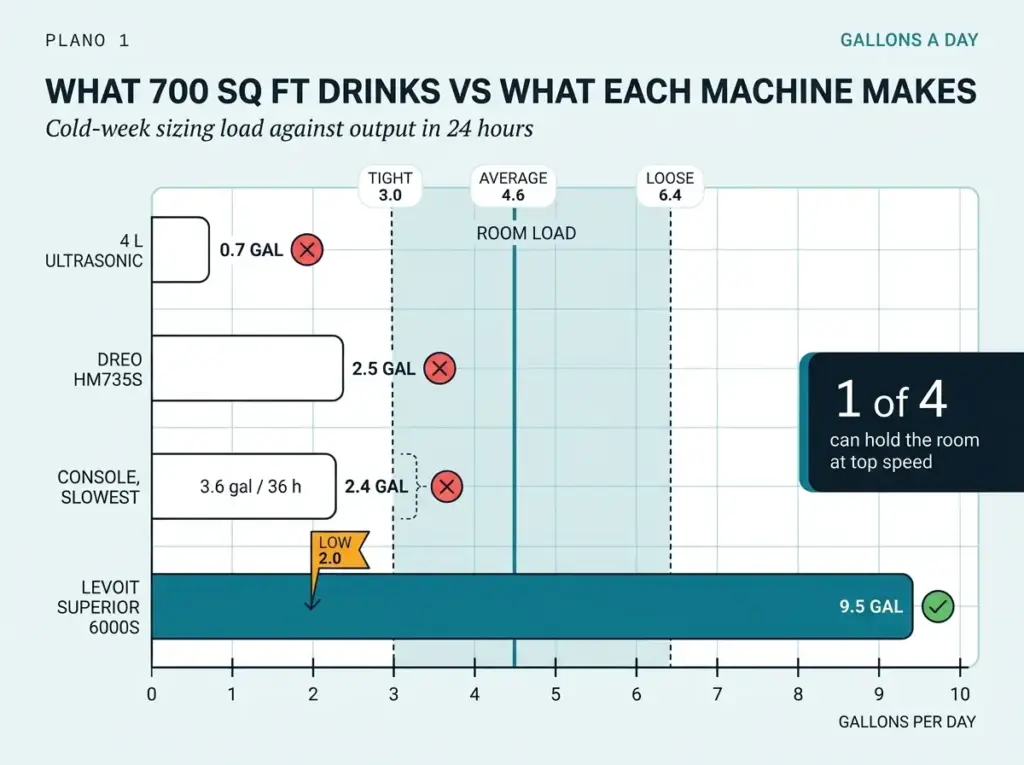
At the load, a 4-liter tank is a fill every few hours of the waking day, and that cost arrives in week two, when the novelty of a gauge is gone. Why the reading drops as the cold deepens explains why the same room asks for more water in January than in November.
Output in Milliliters an Hour Is the Number to Compare
A humidifier for a large room is judged on two numbers.
The tank capacity says how much the machine can carry; the output, in milliliters an hour, says how fast it can work, and a room is held by the second. Compare milliliters an hour at the setting the room will actually need, then divide the tank by it for the hours between fills. A big tank with a small output is a long wait for a small result, and a modest tank with a big output is a short wait for a real one. The obvious pick, the biggest tank, loses to a smaller one that makes water faster.
Turn the same figures into trips to the sink. A 4-liter tank holds about 1.06 gallons, so at the tight-house load of 3.0 gallons a day it is dry in a little over 8 hours, and at the loose-house load of 6.4 it is dry in about 4. An 11-liter tower at its 400 ml/h top speed lasts about 27 hours, and a 6-gallon tank at 4.6 gallons a day lasts about 31 hours. Refill frequency is the number that tells whether a household will keep the machine running in month two, since a unit that goes dry on a Wednesday is a unit that has stopped being a humidifier.
Coverage claims need the same arithmetic. A listing that pairs 1,000 ml an hour with 2,000 square feet and a 5.3-gallon tank is making two promises that cannot both hold for a day: 1,000 ml an hour is 24 L, about 6.3 gallons, drawn from a tank that holds 5.3 and empties in about 20 hours. The coverage area in square feet describes the floor the mist might reach. They say nothing about how much water must be found to keep that floor at 45 percent.
Fill the tank from one-gallon jugs for the first week and count them. The jugs poured between one fill and the next are the room’s real daily rate for this house, and they will land somewhere between the tight and loose figures above.
The Machines That Can Keep Up With a Big Room
With the room’s number in hand the field of plant humidifiers narrows fast. A few machines make enough water, a few make it in a form that does not coat the leaves, and one of the three that follow sits closer to the line than its label says.
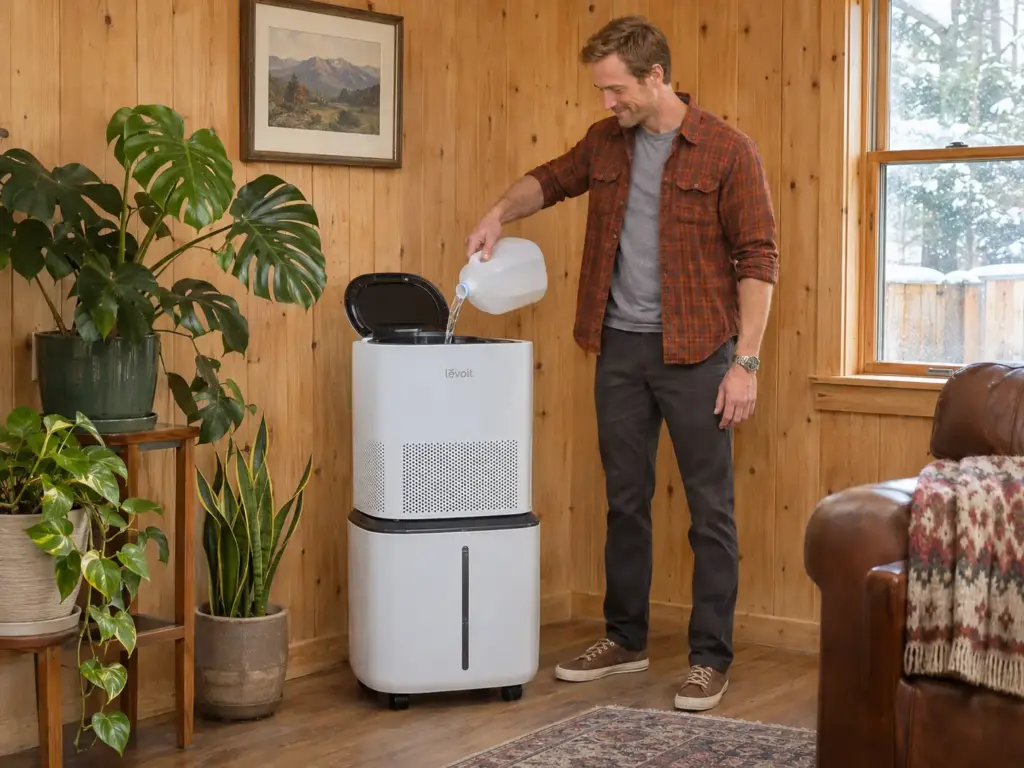
DREO HM735S, the Tower That Reaches the Canopy
The DREO HM735S is a tall cool-mist ultrasonic tower with an 11 L (2.9 gal) tank, rated by the maker for up to 700 square feet. It runs at 26 dB in night mode, holds a humidistat accurate to ±5 percent and sends its mist out above 6 feet, which matters when the canopy is across the room. App and remote control come with it.
The arithmetic places it just under the line. Its 400 ml/h is about 2.5 gallons a day at full speed, below the 3.0 of the tight-house load, so the 700 square foot claim holds in a tight house and for a modest rise, and falls behind in a loose one. It is the smallest machine of this set that comes close. It is an ultrasonic humidifier, so low-mineral water is what the tank should hold, as a later section explains.
The ±5 percent humidistat matters at the dial. A target typed in as 45 can stop the unit anywhere between 40 and 50, which is the whole band the plants and the room share. In a cold week, set it toward the low end and let the window decide whether it can move up.
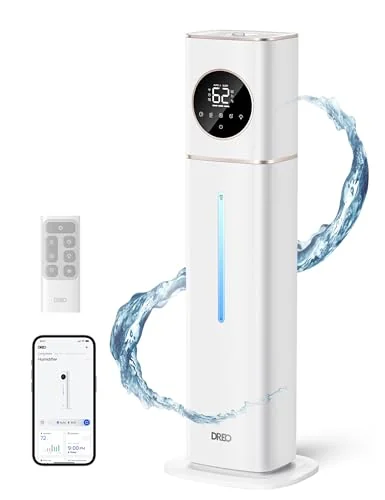
Levoit Superior 6000S, the Tank That Spares the Refill
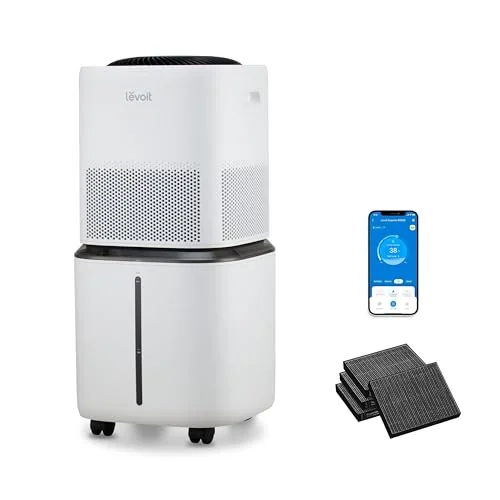
The Levoit Superior 6000S is an evaporative console with the largest tank in this set, 6 gallons (23 L), a printed output of 1,500 mL/h and a rating of up to 3,000 square feet. It runs on tap water, and because it evaporates water from a wick, no mineral dust leaves it for the leaves to collect.
Run flat out it would make 36 L in a day, about 9.5 gallons, and empty its tank in about 15 hours. The 3.0 to 6.4 gallon load is a third to two-thirds of that, so the humidistat cycles the unit on and off and it rarely runs flat out. At the tight and average loads the tank wants a refill about every 1.3 to 2 days, and at the loose-house figure it is nearly a daily chore. The printed 72 hours on low works out to about 320 ml/h, roughly 2 gallons a day: a three-day tank, but a trickle smaller than the tight-house load, so low stretches the fill without holding the room.
Its flaws are physical. It weighs 13.2 lb empty and stands 26.7 in tall, and the replacement wick set for its wicking filter is a yearly purchase, which is a cost to plan around and a line to leave in the weekly routine.
AIRCARE MA1201, a Coverage Claim to Take Apart
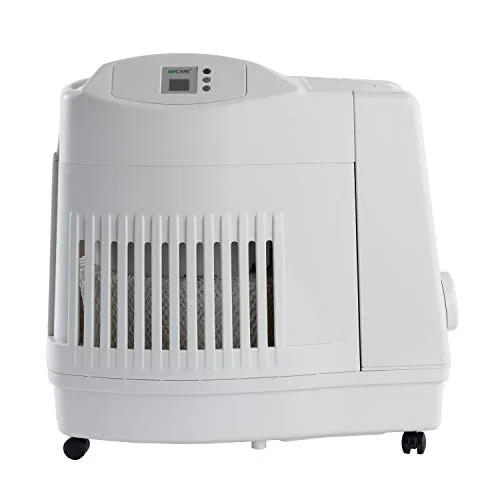
The AIRCARE MA1201 is the console humidifier with the biggest coverage claim of the set: an evaporative unit with a wick, a 3.6-gallon tank, a rating of up to 3,600 square feet and up to 36 hours of runtime. A digital humidistat shuts it off at the set point or when the tank runs dry, it has four fan speeds, and casters let it roll to the plants and back, which a tower cannot do. Nothing lands on the leaves, since the water leaves as vapor from the wick.
The maker prints the tank and the runtime, and the daily rate is one division away: 3.6 gallons over 1.5 days is about 2.4 gallons a day at the slowest run. At the 3.0 to 4.6 gallon load the tank is dry in about 19 to 29 hours. So the 3,600 square foot claim rests on a tank that empties in a day and a bit, and it is a claim about floor area that says nothing about how often a person carries water to it.
Its stated flaw is wear. The filters are reported to fall apart within a week in some units, and some units stop working around the third week. That is a reason to treat the first month as a trial and to keep the receipt.
All the Machines Against the Room’s Number
Here is the whole set against the 3.0 to 6.4 gallons a day a 700 square foot room asks for. Every figure in the water column comes from a printed output or run time, converted the way the earlier section did. The same shut-door sizing applies one room smaller, and the same shut-door sizing in a bedroom is worked out for the units that suit it.
| Machine | Type | Tank and coverage as printed | Water in a day, full speed or longest run | On the leaves, and the flaw |
|---|---|---|---|---|
| DREO HM735S | Ultrasonic, cool mist | 11 L (2.9 gal), up to 700 sq ft | About 2.5 gal at full speed | White dust with hard water; value is the mixed part |
| Levoit Superior 6000S | Evaporative console | 6 gal (23 L), up to 3,000 sq ft | About 9.5 gal flat out, about 2 on low | No dust; 13.2 lb, yearly wick set |
| AIRCARE MA1201 | Evaporative console | 3.6 gal, up to 3,600 sq ft | About 2.4 gal at its slowest run | No dust; filters that fall apart, units that stop |
| Levoit LV600S | Warm and cool mist | 6 L, up to 753 sq ft | 1.6 gal a fill | Warm setting avoids dust; output is the mixed part |
| Venta LW25 | Evaporative, washable discs | 2 gal, up to 430 sq ft | 2 gal a fill | No dust, no wick; some units stop inside a year |
| BLUEAIR InvisibleMist H35i | Evaporative, invisible mist | 3.5 L, up to 500 sq ft | About 0.5 gal in night mode | Nothing lands; cost against the coverage |
| Levoit Classic 300S | Ultrasonic, cool mist | 6 L, up to 505 sq ft | About 0.6 gal at its 60-hour run | White dust with hard water; mixed output, early failures |
| DREO HM311S | Ultrasonic, cool mist | 4 L | About 0.7 gal at its 36-hour run | White dust with hard water; some break inside two months |
Three machines can approach the room’s number: the tower in a tight house, the console on casters and the big-tank evaporative unit. The other five make a fraction of it, and what they are good for is the second half of this guide.
Which of the three depends on the house more than on the plants. A tight house with the plants clustered across the room from the machine suits the tower, because its mist travels and its output is close to the load. A loose house, with an older window and a door that leaks, needs the water the big-tank unit can make, and the console’s casters let it be moved to wherever the meter in the leaves reads lowest. The tower’s reach and the console’s output do not come in one machine, and the room decides which of the two it needs.
What 60 Percent Does to the Glass and the Soil
The plants would take more than this room should give, and the last ten points are paid for on the coldest glass and the soil surface, not on the leaves. This is where the band stops, and the machine is set to stop with it.
The Cold Glass Is the First Meter
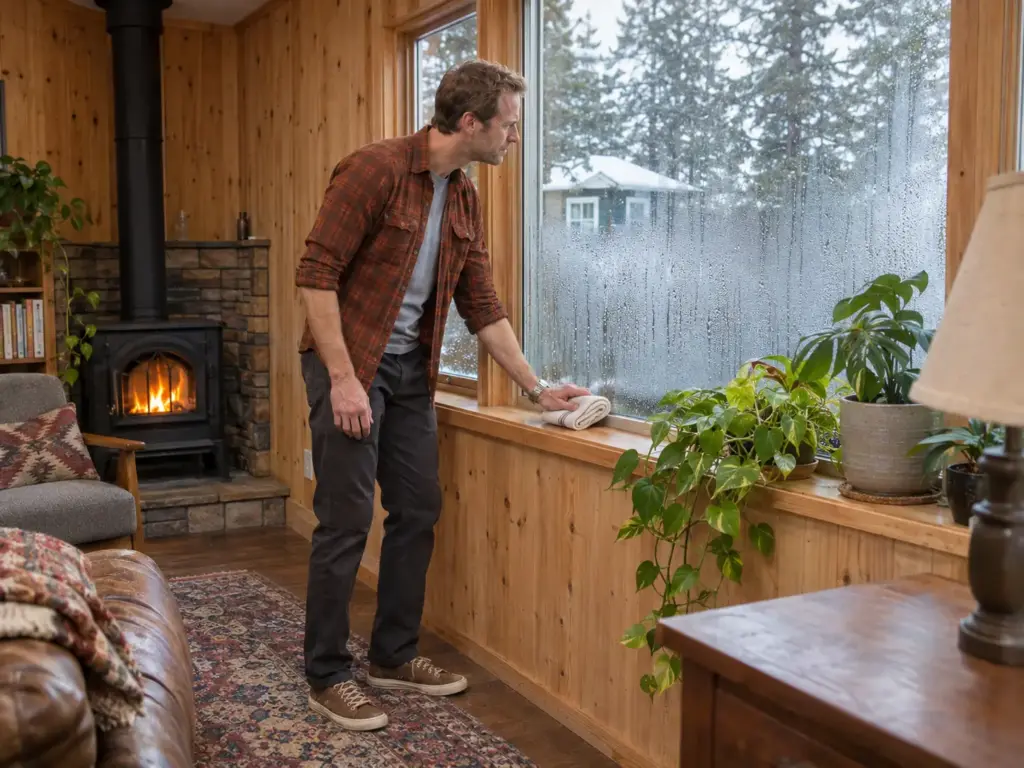
The window beside the plants fogs before any meter at the machine shows a problem, because glass is the coldest surface in the room and warm moist air leaves its water there first. According to the EPA’s use-and-care sheet for a portable humidifier, “Do not humidify to indoor relative humidity levels exceeding 50 percent.” The same sheet says that if water condenses on windows, walls or pictures, the unit should be moved, turned down or used less. Condensation on windows is the stop signal, and it arrives before the display agrees.
Set that against the house band. The EPA’s own humidity band for a home is below 60 percent and ideally 30 to 50, and the plants’ 40 to 60 overlaps it only in the lower half.
Between 40 and 50 the plants get most of what they want and the room pays little. Above 50 the room starts to pay, in beads on the pane, a film on the sill and, over a season, a damp patch on a shared wall. What the wet glass is telling you is a longer read on why that ceiling moves with the outdoor temperature.
The glass has a rhythm that the meter does not show. It clears an hour or so after the sun reaches it and fogs again as the evening cools, and the bottom edge of a double pane fogs first. Read the window and the meter together for a week, then set the stop where the glass stays dry. Why the dial and the window disagree explains why the window should overrule a number typed into the app.
Wipe one lower corner of the window dry in the evening and look at it first thing the next morning. A pane that has fogged again overnight is telling the machine’s target to come down a few points, whatever the meter in the leaves reports.
A Wet Soil Surface Grows Its Own Problems
Humid air slows how fast the top of the soil dries, and a surface that stays damp invites algae and fungus gnats long before the leaves look wrong. The adjustment is free: let the surface dry between waterings and stop raising the target, and leave the fan out of it, since a fan across the pots only moves the damp from one place to another. A greenish film on the soil or a cloud of small flies is a reading, and it says the room is carrying more water than the pots can use.
Check the top inch of soil in the pots nearest the unit, since those sit in the dampest air and are the first to hold water a day longer than the ones across the room. If the near pots stay wet while the far ones dry normally, the unit is too close or aimed too low, and the fix is to move the unit while the watering can stays as it was.
That is also where the band the room allows comes back. The overlap of 40 to 50 percent is the setting at which the plants are served and the glass, the wall and the soil stay quiet. The wish of the plant, 60 and above, can be met in one pot or one cabinet, but a whole room held there tends to pay for it in places that are hard to dry.
Where to Stand the Unit and Where to Aim the Nozzle
The extension service’s advice is to put the unit close to the plants in a larger room, since distance from the plants is what the mist pays for. Lifting it so the mist passes the foliage and does not fall to the floor, and aiming it across the group and away from any single leaf, is how the mist is made to arrive. A tower with mist delivered above 6 feet does the lifting itself; a short unit on the floor wants a stand or a table. A door shut keeps the moisture in the room where it was paid for.
Keep the nozzle off the window wall. Mist aimed at the cold glass is water delivered to the first place that will turn it into condensation. The same goes for the corner of a shared wall, which stays damp longer than any other surface in a large room and is the place the EPA’s moisture guidance warns about first. A patch that stays damp after the humidifier has been turned down is a building question, whatever the setting says: water is coming from somewhere, a leaking window seal or a cold exterior wall, and a larger machine would only add to it.
Tap Water, White Dust and the Wick You Will Buy
A machine for a big room runs every day, so what it leaves on the leaves and what it asks of you each week set its real cost. The mist type and the water decide both, and three of the machines here handle hard water in three different ways.
Why an Ultrasonic Unit Leaves a White Film
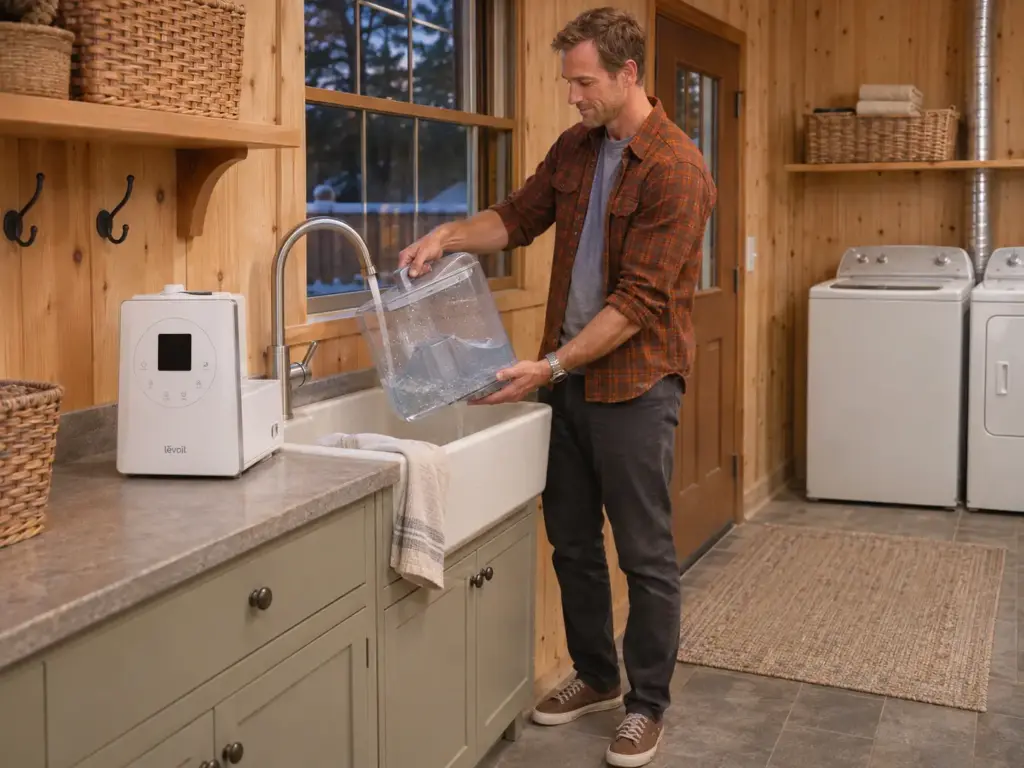
An ultrasonic unit breaks water into a fine mist with a vibrating plate, and every mineral in the tank goes into the air with it. The EPA’s sheet says that ultrasonic and impeller humidifiers disperse the minerals in tap water as white mineral dust, and that evaporative and steam units are not expected to disperse substantial minerals; low-mineral water is the remedy. The dust belongs to the mist type and the water, and the plant is just where it lands. On a leaf it settles as a film over the surface, and a film can be wiped.
The first sign is almost never on the plants. A haze across a television screen, a dull bloom on dark furniture and a chalky edge on the glass show up days before a leaf does, so those surfaces are the early reading. Cool mist against warm mist, in water and in watts lays out the type split behind it, including what a warm-mist unit costs to run.
Lay a clean dark cloth or a sheet of black paper a few feet from the unit and look at it after a day on tap water. A pale dusting there is the same mineral load that will be on the leaves in a week, seen early and on a surface that wipes clean.
The Weekly Calendar Nobody Budgets For
The EPA’s care sheet sets the cadence: empty the tank and refill it daily, clean a portable humidifier every third day, and keep the water low in minerals. That is a schedule, and a tank of standing water in a warm room keeps it whether or not anyone does. The units that skip it are the ones that smell by February, and standing water is where mold in the tank starts.
The wicking filter of an evaporative unit goes stiff and stops absorbing within a few months in hard water, so the cost that arrives in month two is a replacement wick, while the machine itself is still fine. Mineral buildup as scale on the plate and on the tank walls is where an ultrasonic unit starts losing output. The mineral load sets how long a unit lives more than the model name does, and a demineralization pad that has caked into a crust is the same dust, caught in one place instead of spread across a room. Descaling and cleaning follow the maker’s manual for each unit, and this guide leaves the procedure to it.
Low-mineral water has an arithmetic of its own as well. A unit making 2.5 gallons a day uses about 17 or 18 gallons a week, and every one of those gallons has to be bought or made and carried to the tank. That weekly haul is the quiet cost of running an ultrasonic unit in a big room on hard water, and it is the reason an evaporative console or a warm mist humidifier, which can take the tap, earns a second look.
Lay the calendar over the room and it comes out as a short list:
- Every day: empty the tank, rinse it and refill it with fresh water, as the EPA’s sheet says.
- Every third day: clean the tank and the parts that touch the water, following the maker’s manual.
- Every week: look at the dark cloth, the television screen and the sill for the first film of dust.
- Every month: read the canopy meter beside a second one, and press the wick to see whether it still takes water.
- Every year, or sooner in hard water: a new wick set for the evaporative units.
A console that is filled every day or two and wiped on that schedule is a routine. The same console with a skipped week is where the smell and the stiff wick begin.
Three Ways to Live With Hard Water
How hard the tap water is can be read off the house without a test: a white crust on the faucet, a chalky ring in the kettle and spots that stay on a glass after the dishwasher all point to a water high in minerals, and the more of them there are, the more the choice below matters.
Hard water can be met three ways, and each has a machine behind it. The first is a warm mist humidifier, where the water is heated and leaves as steam, which the EPA does not expect to carry substantial minerals. The second is a unit with nothing to replace, so hard water cannot turn into a wick line. The third is mist that cannot be seen, so nothing lands on anything.
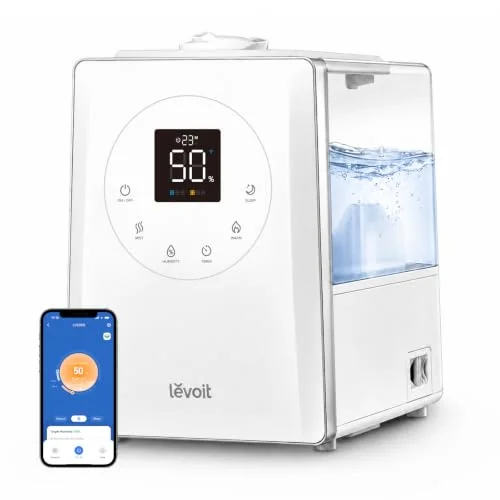
The Levoit LV600S is the warm-mist route. It is a 6 L hybrid humidifier that makes warm or cool mist, with a smart sensor and auto mode, under 28 dB in sleep mode and a rating of up to 753 square feet. Run on warm, it settles the dust question without distilled water. Output is the mixed part: in a big room the humidity it adds can be small enough that the meter hardly moves, and a few units quit inside a month and leak.
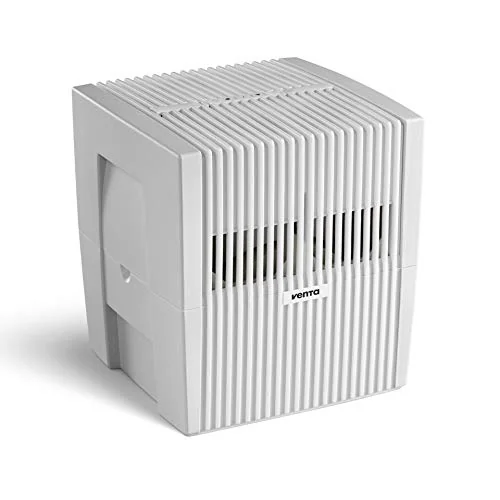
The Venta LW25 is the route with nothing to replace. It is an evaporative unit with washable discs in place of a wick, a 2-gallon tank, a rating of up to 430 square feet and a weight of 8.5 lb, and it runs on tap water. In a hard-water house there is no wick line to budget. Its weak point is the price against that coverage, and some units stop working inside a year.
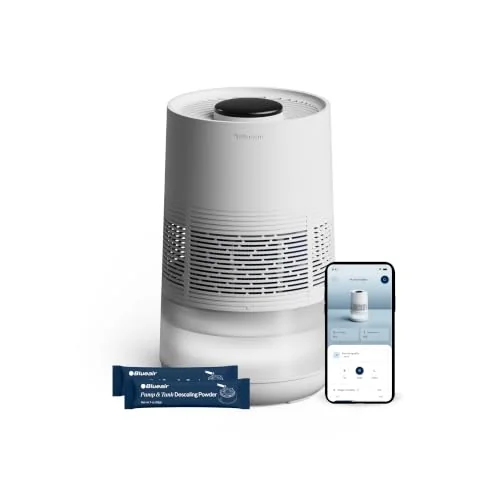
The BLUEAIR InvisibleMist H35i is the route where nothing lands on the leaves at all. It is an evaporative unit with an invisible mist, a 3.5 L tank, a rating of up to 500 square feet, a UV pump, a humidity sensor with AutoHydrate and up to 48 hours in night mode. The weak point is the cost against the 500 square feet it covers, and its daily water in night mode, about 0.5 gallon, puts it among the small units and not the big ones.
When No Machine Is the Answer
Some leaf edges dry out for reasons that are not a humidity number at all, and one group of plants wants more than any room in a house should give. Before a second tank is bought, these are the cases where the machine is the wrong tool.
The Draft and the Radiator Beat Any Tank
A plant beside a heat source or an outside door loses more water than any room average shows. Hot air from a radiator or a vent dries a leaf in a stream, and a draft under a door does the same in the other direction, so a calathea or a philodendron parked beside a radiator, or a fern at the front door, can crisp in a room that reads 45 percent. The extension service’s advice on grouping and moving plants comes down to relocation: move the pot off the heat and away from the door, and nothing needs to be bought.
A supply vent aimed at a leaf, an exterior door that opens a dozen times a day and a window with a cold draft each make a local dry zone that the room’s average hides. Plants that sit in one of those zones can brown in a room whose meter reads well, and a humidifier turned up to fix them only raises the rest of the room toward the glass.
A fair test is cheap. Move one affected pot into the group and leave a twin where it stood, then read the meter at each spot for a week. If the moved plant stops browning and the twin does not, the draft or the heat was the cause and the humidifier was never part of it.
The meter in the leaves shows the difference within days, and the plant shows it a little later. What drives a room dry in the first place is the longer read on heated air and a cold-weather room, and it explains why moving a pot a few feet can matter more than adding a tank.
The Plant That Wants 80 Percent Belongs Under a Cloche
The tropical plants at 70 to 80 percent want a small pocket of humid air that a whole room cannot give. A cloche or a terrarium gives that without a second machine and without putting the glass at risk, because the humid air stays in a few cubic feet around the leaves and the rest of the room can sit at 40 to 50. One species that wants more than the room should give is a reason to move that one pot and leave the house where it is.
A small collection in a big room is the third case. Grouped pots and one small unit do the job a console would be bought for, and a large machine is justified by the volume of the room only when the collection is spread across all of it. A plant that recovers after a move, when a purchase had changed nothing, is the sign that the machine was never the cause.
A Large Room With a Small Collection
A big room does not always need a big machine. When the plants stand together in one corner, a tank of four to six liters with a humidistat can hold the band where it matters, and two models are the honest answer in that case.
Levoit Classic 300S, the Default Answer and Its Catch
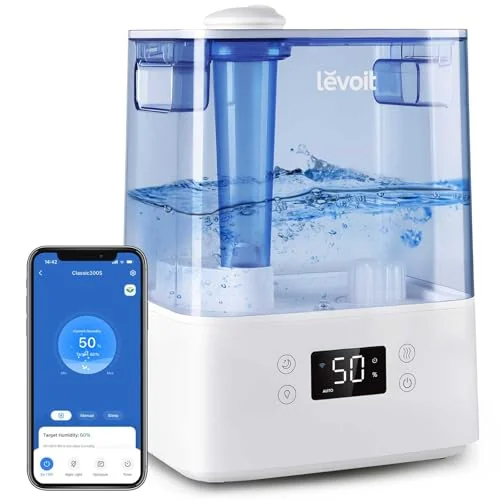
The Levoit Classic 300S is a 6 L cool-mist ultrasonic unit with a plant mode, app and voice control, under 28 dB in sleep mode and a rating of up to 505 square feet. Its 60 hours on a fill works out to about 0.6 gallons a day, roughly a tenth of the loose-house load, so it serves the group and leaves the room’s number where it was. It is ultrasonic, so hard tap water gives it a white dust that low-mineral water avoids. Output is the mixed part, and some units quit inside a month and leak.
DREO HM311S, One Corner With the Door Shut
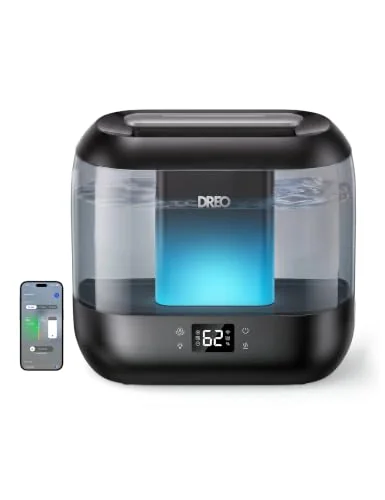
The DREO HM311S is the smallest machine in the set, a 4 L cool-mist ultrasonic unit with a top fill, 28 dB at night, app and voice control and 36 hours on a fill. Its longest run makes about 0.7 gallons a day, a quarter of the tight-house load and a ninth of the loose one. That is the point of it. It is the cheapest of the group, and the honest answer when the room is large and the collection is not: one corner of plants, the door shut, a unit close enough that its mist reaches the leaves.
The arithmetic for a corner is gentler than the room’s. A pocket of air 4 feet by 6 feet and 8 feet high holds 192 cubic feet, and the same sizing method gives about 0.2 gallons a day for it if it were sealed. A corner open to the room is not sealed, so the true figure lands between that and the whole room’s, and where it lands depends on the door, the distance and the house. That is why the reading at the leaves decides and the coverage on the box does not.
Durability is the mixed aspect, and some units break inside two months. For a single shelf a smaller tank than either of these may be enough, and the reading at the leaves decides it: if a second meter says the corner holds 40 to 50 with the small unit running, the small unit is enough. The corner’s number within a few feet of the unit is not the room’s, so carry the meter across the room once and learn where the band ends.
If the plants turn out to be spread through the whole house, the purchase is a different one, and a room unit against a whole-house one is where that comparison is made.
Stand a Meter in the Leaves Tomorrow, and Size the Tank to the Room
Read the leaves with a second meter and treat the display on the machine as a reading at the base. Convert the room into gallons a day before looking at tank liters: 3.0 to 6.4 for 700 square feet in a cold week. Choose the output and the mist type before the tank, and let hard water decide whether the answer is evaporative, warm mist, a unit with discs or low-mineral water in an ultrasonic one. Set the stop at 40 to 50 percent, and move it down when the glass fogs.
When the trouble is one corner, a small unit or a move away from the radiator beats a console.
The things that drift are the wick, the plate and the meter. A wick that was fine in the first weeks goes stiff somewhere in the second or third month on hard water, scale builds on the plate in the same stretch, and a meter that ran fine in week one may read differently after a few weeks. Put the canopy meter beside a second one for an afternoon every month or so, and swap the wick when it first goes stiff, whatever the calendar says.
After a unit sized to the load has run for a day or two, the canopy meter is the judge. If it has climbed toward 40 to 50, the sizing was right. If the unit has made its daily gallons and the reading in the leaves has barely moved, the room is leakier than the K value assumed, or the unit is smaller than its label, and the next step is a larger output, since a longer run time will not help.
Tomorrow the first move is free: stand a meter in the leaves at leaf height, write down the reading in the morning and again in the evening, and keep it up for three days. If the number sits low, whether the meter reads low at all is the check before anything is ordered, and the arithmetic above sizes whatever comes next, a room unit or a whole-house one.
Frequently Asked Questions
01What type of humidifier is best for plants?
Evaporative or warm mist, because the EPA says ultrasonic units throw the minerals in tap water into the air as white dust while evaporative and steam units are not expected to. An ultrasonic unit needs low-mineral water.
02Are humidifiers good for plants?
Yes, when the reading at the leaves sits under about 40 percent. Most houseplants prefer 40 to 60 and the EPA stops a portable unit at 50, so it runs to that reading and no further. Checking whether a machine is needed comes first.
03How many hours a day should I run a humidifier for my plants?
Go by the reading, since the clock is a poor guide: set the humidistat to stop at 40 to 50 percent and let it cycle. The EPA says to empty and refill the tank daily and clean it every third day.
04Does a humidifier put white dust on plant leaves?
An ultrasonic one does when it is filled with hard tap water. Evaporative and warm-mist units and low-mineral water avoid it, and the film shows on dark furniture and glass before it shows on a leaf.
05How big a tank does a large room full of plants need?
Think in gallons a day first and liters second. A 700 square foot room asks for about 3 to 6.4 gallons a day in a cold week, so a 4-liter tank is a fill every few hours and a 6-gallon one about every 1.3 to 2 days.