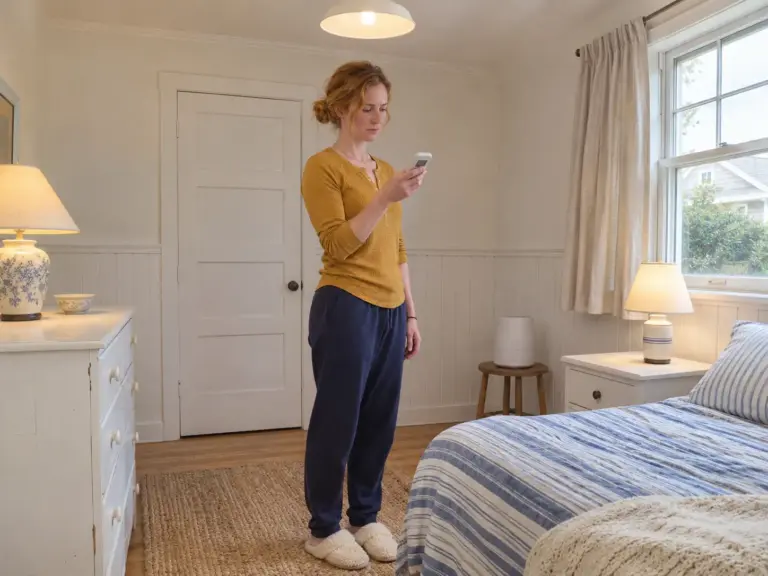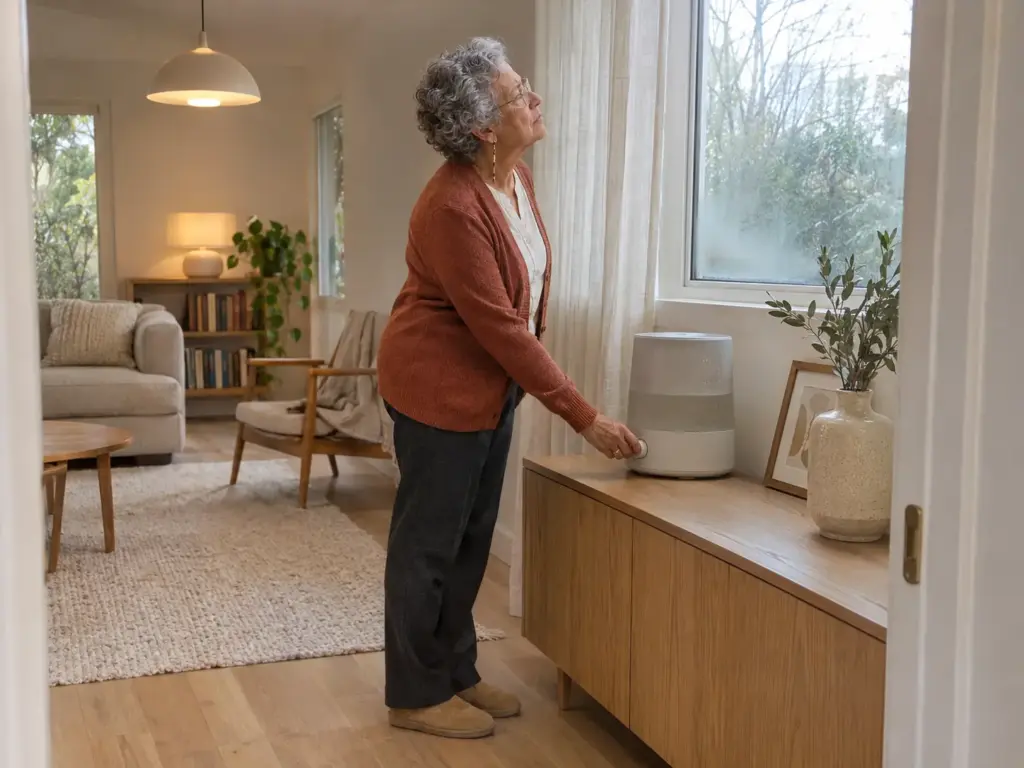
The first real cold snap arrives, the control in the hall still shows the number you typed in October, and by morning the lower pane of the bedroom window is beaded with water while the living room feels drier than it did last week. That is usually when the question arrives: what humidifier setting to use in winter, when the dial is plainly not telling you the truth? A humidistat measures the air at its own address, and a window is the coldest wall in the room, which makes the glass the first place a setting that is too high shows itself. Below, the number comes first, then what the control is really asking for, the reading that overrules it, and the short list of reasons a setting stops being delivered.
Quick Answer
Enter about 35% relative humidity in mild weather, and drop toward 20 to 30% once the outside falls under 20°F (-7°C). Then let the window decide: the moment the lower pane fogs, step the setting down one notch. The glass is the real ceiling, and the chart is only where you start.
The Number You Type Is a Ceiling, Not a Target
You want one figure, and every source hands you a band. The band is a range a house can carry, and on a cold night the top of it belongs to a warmer house than yours. In winter the useful reading is the lower half, and what follows says how far down it goes.

Start in the lower half of the band
The EPA keeps the home band at 30 to 50 percent relative humidity. The Department of Energy’s Building America program sits a little higher at the bottom: according to the Building America guidance on winter humidity, “The ideal relative humidity in homes is between 35% and 50%.” Both bands are a baseline, so winter reads them from the bottom: about 35% on a mild day and lower as the temperature drops.
The same page names the warning sign you will learn to watch, visible condensation or frost on windows and cold walls (fog on the glass is the plain version). The reasoning behind that shift is laid out in a guide on why the winter band sits lower than the summer one.
Turn it down before the cold snap, not after
The upper limit moves with the weather. The EPA’s moisture-control guidance prints the ASHRAE-recommended maximum by outdoor temperature: 35% at 20°F (-7°C), 30% at 10°F (-12°C), 25% at 0°F (-18°C), 20% at -10°F (-23°C) and 15% at -20°F (-29°C). Those figures are the standard. The ladders that HVAC companies print beside them (roughly 35 to 45% above 40°F, sliding to 20 to 25% near zero) are a rule of thumb, and every company rounds the steps a little differently, so read them as a sketch of the same slope.
Picture a house with the control at the bottom of its range, 10°F below zero outside, and the glass still fogged. The control is satisfied and the house is too wet for the weather. The October number and the January number are the same digit on the control and two different amounts of water in the walls, so turn the setting down when the weather turns, before the sills tell you. If you want every step of that ladder in one place, the full chart of targets by outdoor temperature has it.
Stick a strip of tape beside the control with two numbers on it: the lower-half figure for ordinary winter days, and a lower one for the week the outside drops under 10°F (-12°C). The tape stops you from retyping October’s digit in January, and the second number is the one to try first.
What the Control Is Actually Asking For
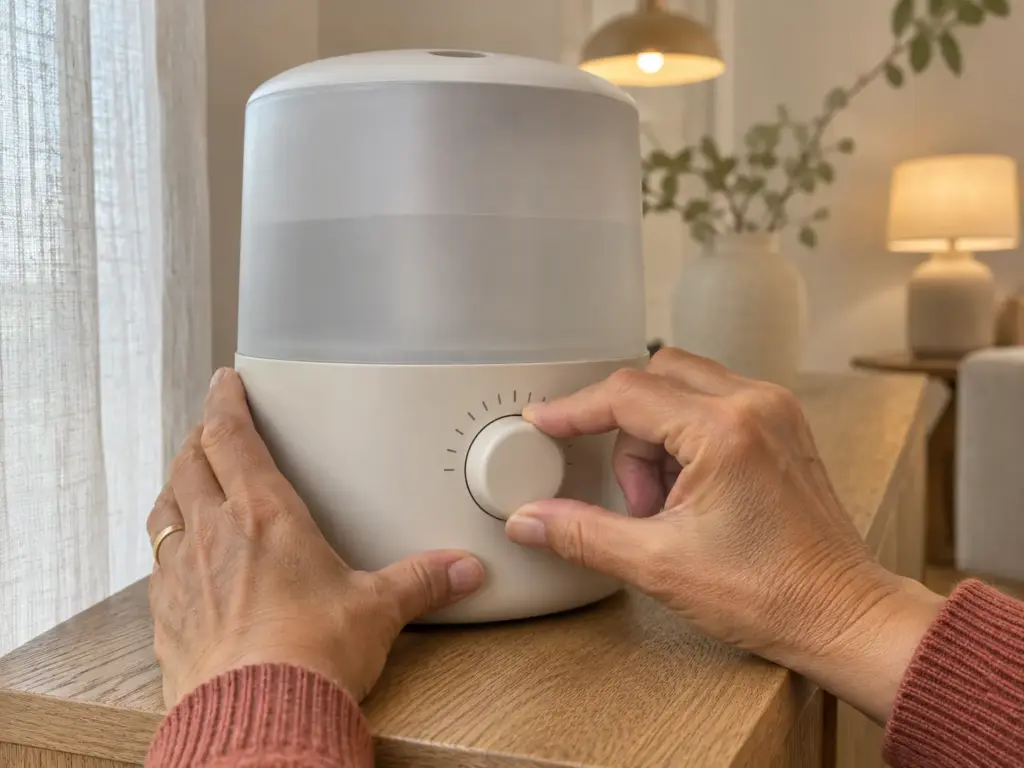
Typing a number only works if the control takes a number. A numbered dial, a Low/Medium/High knob and an Auto mode with a built-in sensor put three different questions to the house, and which one you face depends partly on whether you own a room unit or the one on the furnace. Work out which of the three is on your wall or your floor before deciding what to enter.
A whole-house control reads the house and the weather
A digital whole-house control reads the indoor humidity and the outdoor temperature, then trims its set point as the weather drops. That is the by-hand advice from the section above, done automatically, and the AprilAire 600 is the unit that does it: a bypass evaporative humidifier rated at 17 gallons a day for tight homes up to 5,000 square feet, with a Model 35 water panel that changes every year.
The limit sits right next to the strength. Like every bypass unit, it humidifies only while the furnace blower runs, so short heat cycles deliver less than the rating, and the automatic control has a mixed record. A plain analog dial asks for a number or a position and does nothing else, while a digital humidistat on the wall at least shows the percentage it is chasing.
Another layer hides here. A thermostat with a frost-control feature quietly lowers the humidity set point during a cold snap. You turn the number up, the number never arrives, and nothing connects the two. The figure on the control in March is not the figure it was working to in the coldest week.
A knob has no percentage in it
A knob marked Low, Medium and High describes how hard the unit runs and names no humidity at all. The room ends up wherever the room ends up, and a “1” on a numbered dial in a cold snap is only a position with no percentage behind it. Nothing in a knob reads the air, so nothing stops it from running past the number you meant. If this is your control, the meter in the room and the window do the controlling, and the sections after this one set that up.
Auto mode on a portable
Auto mode is the one portable control that takes a percentage. The DREO HM713S accepts a target between 30% and 90%, and its maker claims a 5% tolerance on a 6 L tank rated for 500 mL/h and 550 square feet. Treat the tolerance as the maker’s claim. The sensor sits close to where the mist leaves, and Forbes found its readings not always precise.
Add the unit’s other recurring weak points, little or no mist from some units and leaks, with durability becoming the question around the one-month mark, and you have a portable that asks for a number it cannot always read well. Auto means it cycles on the sensor in its housing. It does not mean the bedroom reads that number.
The Dial Reads a Different Room Than the One You Sleep In
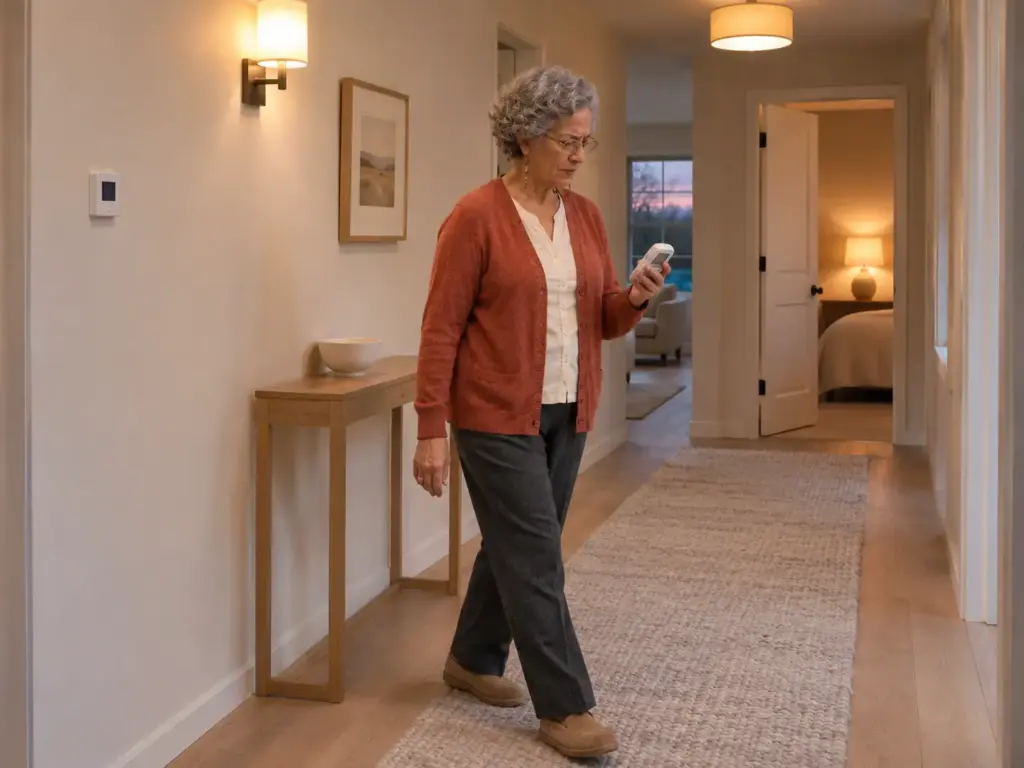
The set point is only a request. The sensor sits on a wall or inside a duct and reports the air at its own address, and that address is not your bedroom. This section walks from what you typed to what the room is doing.
Where the sensor sits decides what it reads
AprilAire’s engineers, speaking to the trade magazine ACHR News, call it a common mistake to mount the humidifier control on the return plenum downstream of the humidifier, or close to it. The control then measures the air coming out of the unit rather than the air of the house, and it controls inaccurately. Their install sheet puts a return-duct control at least 6 inches (15 cm) upstream.
A duct-mounted control also senses only while air is moving past it, so with the blower off it holds a stalled sample, and a wall control or thermostat sensor can be pushed the other way by the draft coming through the hole in the wall behind it. How the humidifier is triggered changes the answer again. Nothing here means the control is broken. It means the control reports one address, and you do not sleep there.
One cheap meter in the room you sleep in
The free fix is a second reading, taken before any new device goes in the cart. A cheap digital hygrometer in the sleeping room shows what that room is doing, and the TempPro TP50 prints an accuracy of ±2 to 3% RH and ±1°F (the maker’s claim), runs on one AAA and keeps a high and low memory.
That accuracy is enough to catch a five-point offset and too loose to argue over one point. Reliability is its soft spot: some units stop working after about a month, so set it up early enough to find out whether yours is one of them. The method for reading it, and what to do with the number, is in three readings from one meter.
Set the meter at head height on an inside wall, away from the window and from the humidifier’s mist, and give it a few hours to settle before the first reading. A meter dropped on a sill reads the pane’s cold air, and one beside a portable reads the mist.
A five-point gap is real, a one-point gap is noise
Leave the meter on the dresser for a week. After that the control in the hall and the meter settle into a steady difference, and that difference, more than either number alone, is the information.
If the meter reads five points under the control, the bedroom is five points drier than the hall believes, and five is the sensor offset you enter. If the difference is a point, it sits inside the meter’s error and nothing needs changing. If it swings by several points from one day to the next, the duct or the furnace schedule is moving the control’s reading, and the place to look is where the control is mounted.
Take the morning with water on the room side of the bedroom glass, the hall control showing its set point, and the dresser meter five points under it. Both numbers can be correct. A meter in the middle of a room reads the room’s average, and the window reads the coldest surface in the house, which condenses at an average reading the meter calls fine.
The Glass Overrules the Chart and the Dial
Once the dial and the room agree, the window has the last word. The coldest surface in the room reports a setting that is too high before any meter does, and it reports in water you can wipe off with a hand.
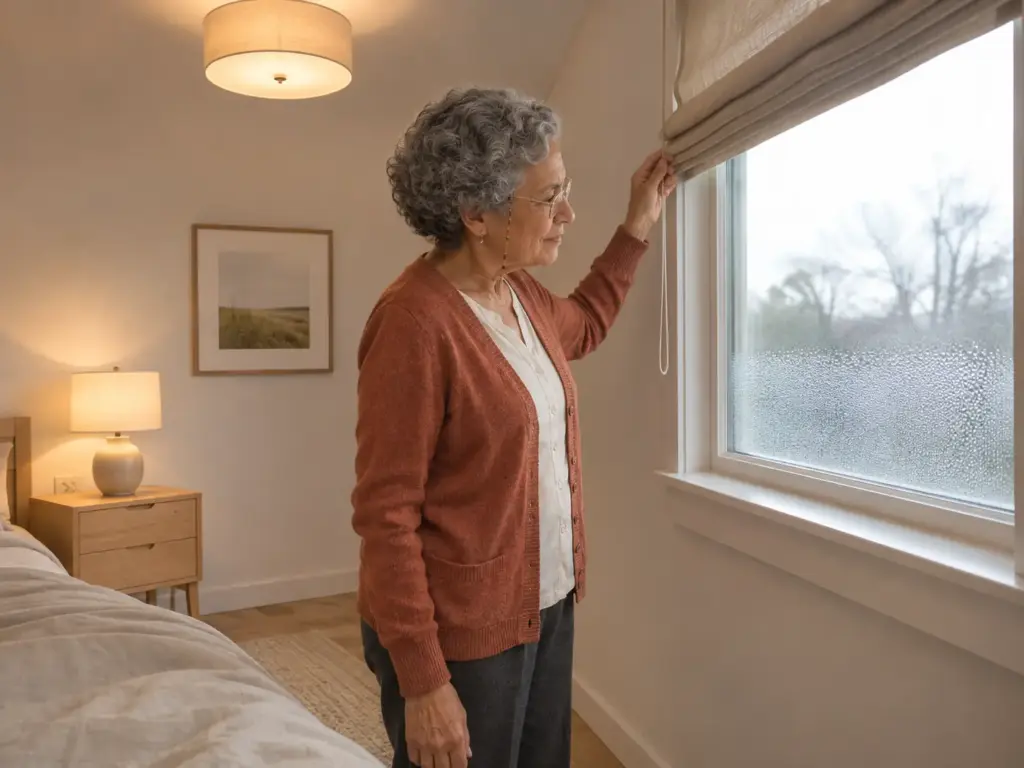
Fog on the lower pane means one notch down
The EPA’s own moisture page is blunt about it. According to the EPA’s page on controlling moisture in the home, “Your humidistat is set too high if excessive moisture collects on windows and other cold surfaces.” Fog on the lower pane is the first stage. Step the setting down one notch, often about five points on the control, and read the glass the next morning.
Open the blinds and curtains over a wet window as part of that reading: coverings kept shut all night trap cold air against the glass, and the sills under them are wet by morning while the hall control still shows the set point. A sill that dries during the day is a setting to nudge, while a sill that never dries is another problem, and when condensation on the room side is normal and when it is not separates the two.
Frost at the corner means two
Frost or ice at the corner of the window is the second stage and earns two notches. The Building America guidance calls visible condensation or frost on windows or cold walls the obvious sign of high humidity, and it states the cost of ignoring it: ongoing condensation can rot window sills and frames, and frost buildup can freeze windows shut or stick them open.
One fogged pane at 7 a.m. that is dry again once the sun reaches it is harmless. A wet sill every morning is damage on a schedule. For the whole sequence on a bad night, see what the glass does overnight, hour by hour.
Why a higher number is the wrong move
Twenty percent feels dry, so the instinct in a cold snap is to raise the winter humidifier setting. Condensation on windows is the house saying the air already holds more water than the cold glass can take, and the dew point is the temperature at which that happens.
At 10°F (-12°C) outside, though, 45% is what fogs the glass, and the glass is right: the house has nowhere to put that much water. A higher digit buys damage, while sealing the leak and warming the cold panel buys comfort.
The EPA adds a caution that covers the whole subject. Humidifiers are not recommended in buildings without proper vapor barriers, and its guidance sends the owner to a building contractor. A house that cannot dry itself is a house where a higher number makes the damage and none of the comfort.
Run the morning check in a fixed order: open the blinds over the wettest window, wipe the sill, then read the meter before touching the control. If the wiped sill is dry the next morning, the last step down was enough. If it is wet again, take one more notch and wait a day.
Why the Setting Stops Being Delivered by Midwinter
The control keeps showing the number after the unit has stopped delivering it. The display tells you what you asked for, and nothing on a basic control tells you whether the room received it. What follows is the usual list of reasons, in the order worth checking, each with the reading that proves it.

A spent water panel
Start with the part that quietly ends the setting. A bypass evaporative unit moves warm air across a wet pad, and a pad filled with minerals stops wetting evenly. The edge of a spent panel is stiff and mineral-gray, and that mineral buildup is what stops the pad from taking water.
A new panel, a 38% set point and a 29% house usually mean the pad is not fully wet, the fan is not confirmed running, or the heat cycles are too short to wet it. The Model 35 panel on the AprilAire 600 is a yearly swap, and how often the panel needs changing covers the interval; a filter change halfway through the season is a normal answer in hard water.
The Alocs 35 water panel fits the Model 35 (also sold as P110-3545, X2661 and A35) in a pack of 2, which covers two swaps if your water is hard. Its quality runs mixed against the OEM pad, so the third-party pack is a trade you accept, and the OEM panel costs more for the same fit. One more feed detail costs output silently: AprilAire’s install sheet recommends hot water, 140°F (60°C) at most, for full evaporative capacity, and a cold feed leaves part of the panel’s capacity unused.
A furnace that is not running
Mild weather is the trap. A bypass evaporative unit is rated with the heat running all the time, and its output falls when heat cycles are short or when only the blower runs. ACHR News, quoting AprilAire’s engineering staff, adds that a blower-activation control can force the fan to run for humidity. If your control allows it, run the humidifier with the blower during fan calls instead of waiting for a heat call.
The rest of the short list goes in order of cost, cheapest first. Look at the thermostat fan setting: left on Auto, the fan runs only with a heat call, so the furnace humidifier is idle between cycles.
Look at the bypass damper, the flap that routes air from the return duct through the humidifier, and check that it is open for the season. Then the water valve, then a failed solenoid.
Each check has a reading. With the furnace running and the fan on, the bedroom meter should climb toward the set point over the next day. If it stays flat, move to the next item on the list.
Write the install month on the humidifier’s housing in marker. If the old panel comes out stiff and gray at the edge before the season is half over, the water is harder than the yearly interval assumes, and the second swap belongs in midwinter instead of next fall.
Hard water, scale and a calcified wick
Scale is the same story on a slower clock. A pad or wick in hard water calcifies over a season, and its output sags long before the display shows anything.
The Honeywell TrueEASE HE200A1000 is the ducted pick built around that problem: a flow-through bypass humidifier with a built-in humidistat, rated for up to 18,000 cubic feet and fitted with an HC26P pad, where the water passes through the pad instead of sitting in it. Its limits are in writing too. The Spruce’s testing put its humidity accuracy as the loosest of the bypass units it tried, and the pad still needs replacing. The swap, step by step is a short job.
The portable half of the same story is a fine white powder. An ultrasonic humidifier run on tap water coats furniture, electronics and clothes with the minerals the water carried. Distilled water stops it (so does reverse osmosis water), and a softener does not, because a softener swaps calcium for sodium, which still dries to a solid. The film on an oak console is the portable’s version of the spent panel’s gray edge.
A Rental With One Portable and No Ducts
A furnace and a duct are not on everyone’s floor plan. In a rental apartment with one window the equipment is a floor unit, that window and a thermostat you may not control, and the same number applies. The control is simply your hand.
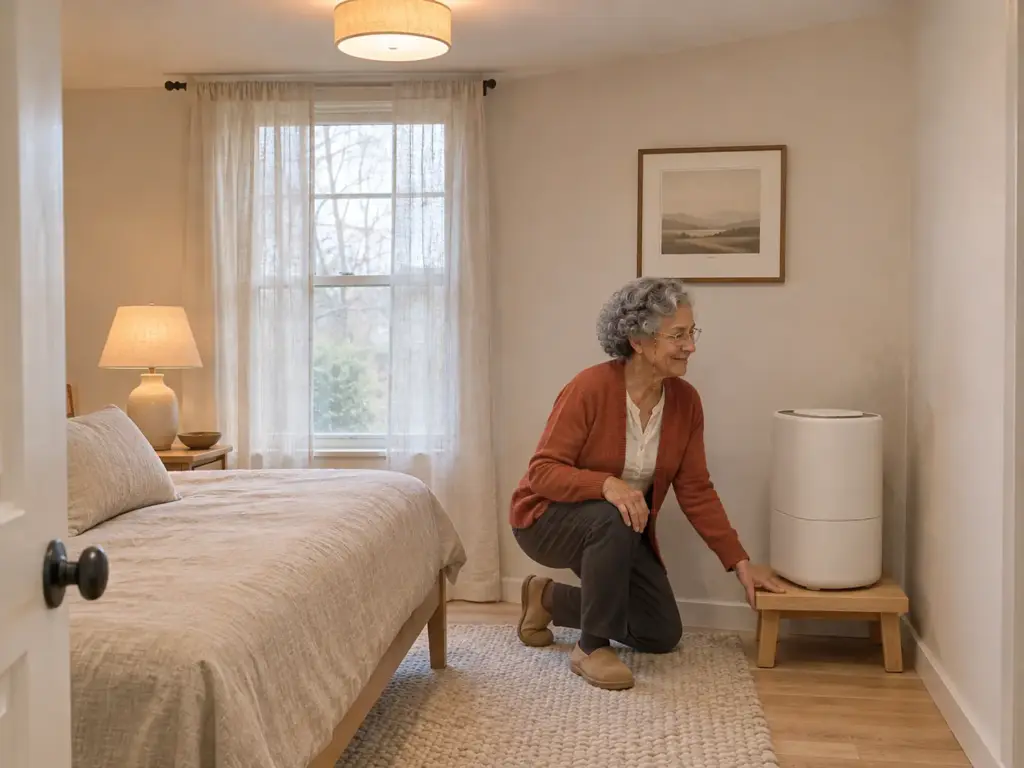
A portable without a humidistat
A knob cannot hold a percentage. Run the portable by the meter and the glass: leave it going until the room reads the top of the band for that day’s outdoor temperature, switch it off, and look at the lower pane in the morning before changing anything. Dry air is not always cured by a higher number either, and why the band has a bottom explains the floor.
The Levoit Classic 300S is the portable that takes a percentage in place of a notch. Its maker rates it for 505 square feet and 300 mL/h from a 6 L top-fill tank, with an Auto mode driven by a built-in humidity sensor (maker’s claims). Its output is the soft spot: some units do not raise the room at all, and some shut down or break within a month. Auto mode is the closest a portable gets to the humidistat the apartment never had, and the meter still checks it.
Where the unit goes and what goes in the tank
Move the unit out of the corner and away from the wall it wets. A wall that is wet behind a portable on a cold day says the unit is in the wrong place before any meter does. Keep the room’s door open so the moisture spreads through a larger volume of air, and use distilled water in an ultrasonic unit for the white-powder reason above. Sometimes the answer is to lower the number or seal the leak, because dry air often arrives with a house that exchanges its air too fast.
In a rental, buy the meter before any device. Two days of readings in the room you actually use will tell you whether you need a humidifier at all, a lower number, or a landlord’s attention to a leaking window.
What the whole-house route costs you in flaws
The whole-house route fixes the control problem and brings flaws in writing. A cold duct gives the moisture a surface to condense on, a duct-mounted pad that stays wet can grow mold (what a damp duct pad can grow covers it), the pad scales, and a control mounted at the wrong address reads the wrong air. Add the EPA’s vapor-barrier caution from earlier, and a ducted unit is a decision to weigh, and the whole-house humidifier is the one with the longest list of conditions. If the house passes that test, which whole-house units fit which houses sorts the options by house size and duct.
Whichever device ends up in the house, it has to deliver the number first. That is the order: a unit that can hold a setting, then the setting.
Tomorrow’s Order Is Meter, Glass, Then the Dial
The number you type is a ceiling that drops with the weather. The control reads one address, and the address may not be your bedroom. The glass overrules the dial, a setting that is not being delivered has a short list of causes that starts with the panel, and a portable in a rental runs by a meter and a window.
For later, watch the sill and the meter after the first hard cold snap, and pull the water panel when the season is half over to look at its edge. A stiff, gray edge means the pad has stopped wetting and the next swap should not wait for spring.
Tomorrow, put the meter in the room you sleep in and look at the lower pane before you touch the number. Give it a week, enter the steady difference as the offset, and read the glass again. If the sill is dry and the offset holds, leave the setting where it is. If the reading says the room is low, the order to raise a reading, meter first is the sequence to follow, and if the real problem is static electricity at the door handle, whether a humidifier stops static shocks at the 30 percent floor answers it.
Frequently Asked Questions
01What humidifier setting should I use in winter?
Use the lower half of the EPA’s 30 to 50% band: about 35% in mild weather and 20 to 30% once the outside drops below 20°F (-7°C). Step down one notch whenever the lower pane of a window fogs, because the glass sets the real ceiling.
02Is 70 percent humidity too high in a house in winter?
Yes, 70% sits far above the EPA’s 30 to 50% band, and in winter it condenses on the window glass and wets the sills. The maximum the EPA prints falls to 35% at 20°F (-7°C), so lower the set point and find the leak feeding the room.
03Should I run my humidifier every night?
A unit with a humidistat or an Auto mode cycles itself to the number you set, so it can stay on every night, while a knob unit runs by the meter and the glass. Empty and rinse the tank on a routine so the water never sits.
04Why does my humidifier say 35 percent while my meter says 29?
The control reads the air at its wall or duct, while the meter reads the bedroom, and the two can sit several points apart. Leave the meter for a week and enter the steady gap as the offset. A one-point difference is inside the meter’s error. See three readings from one meter.
05Do I need a humidistat on a portable humidifier?
No, but without one your hygrometer and the window glass do the controlling, and an Auto mode with a built-in sensor is the closest substitute. Keep the unit away from any wall it could wet.