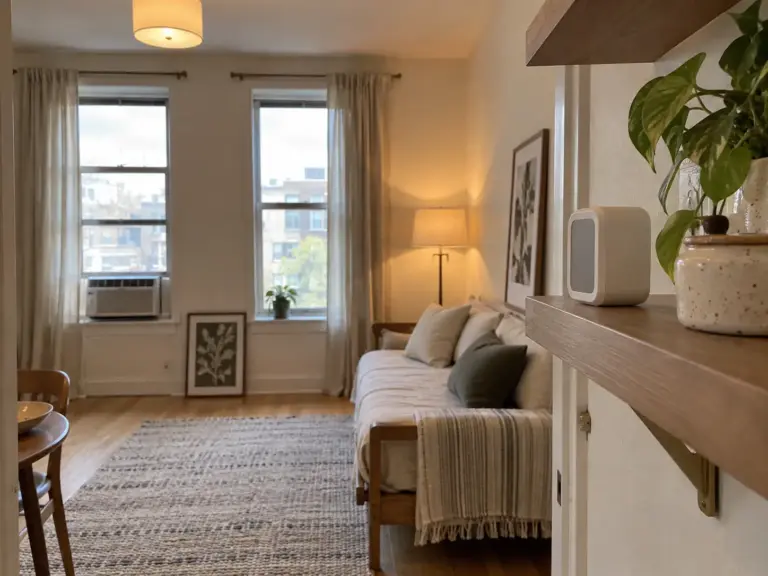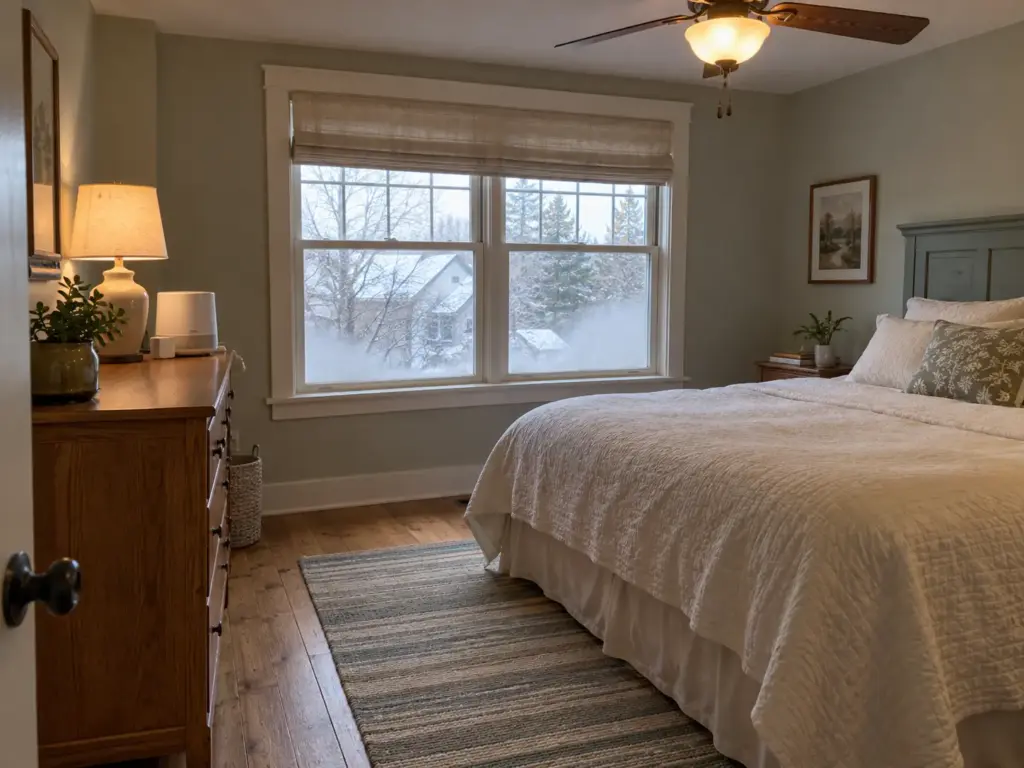
The humidifier setting that held all through October is exactly where you left it on the first hard-cold morning, and now the lower corners of the bedroom window are beaded. The glass is the coldest surface in the room, so the air that touches it cools first, and the colder it is outside, the less moisture that air can carry before it lands as water. That is why indoor humidity levels by outdoor temperature come as a table: the number a room can hold falls as the thermometer outside does. What follows is the cap for each band of outdoor temperature, what that cap rests on, why the window has the last word, and the one change to make tomorrow, with the year-round band left to the ideal humidity pillar.
As a rule of thumb printed by an energy nonprofit and an HVAC company, and not as a published standard, this is the highest indoor relative humidity to hold at each outdoor temperature. The window glass is the check.
| Outdoor temperature | Highest indoor relative humidity | What it means for the glass |
|---|---|---|
| 20 to 40°F (−7 to 4°C) | Under 40% | The loosest cap in the table; a haze on the lower pane means go lower anyway |
| 10 to 20°F (−12 to −7°C) | Under 35% | One notch down; look at the lower corners of the glass first |
| 0 to 10°F (−18 to −12°C) | Under 30% | The cap meets the floor of the 30 to 50 percent target |
| −10 to 0°F (−23 to −18°C) | Under 25% | Below the target’s floor; frost on the inside of the lower sash means go lower |
| −20 to −10°F (−29 to −23°C) | Under 20% | Further under the floor of the target; a clear pane is the only proof the number works |
| −20°F (−29°C) and colder | Under 15% | The tightest cap; the glass, not the chart, sets the number |
Why Cold Weather Lowers the Humidity a Room Can Hold
The table above is a cap that follows the outdoor thermometer: the colder it gets outside, the lower the number goes. The reason sits at the window and the exterior wall, not in the air in the middle of the room, and one mechanism explains every row.
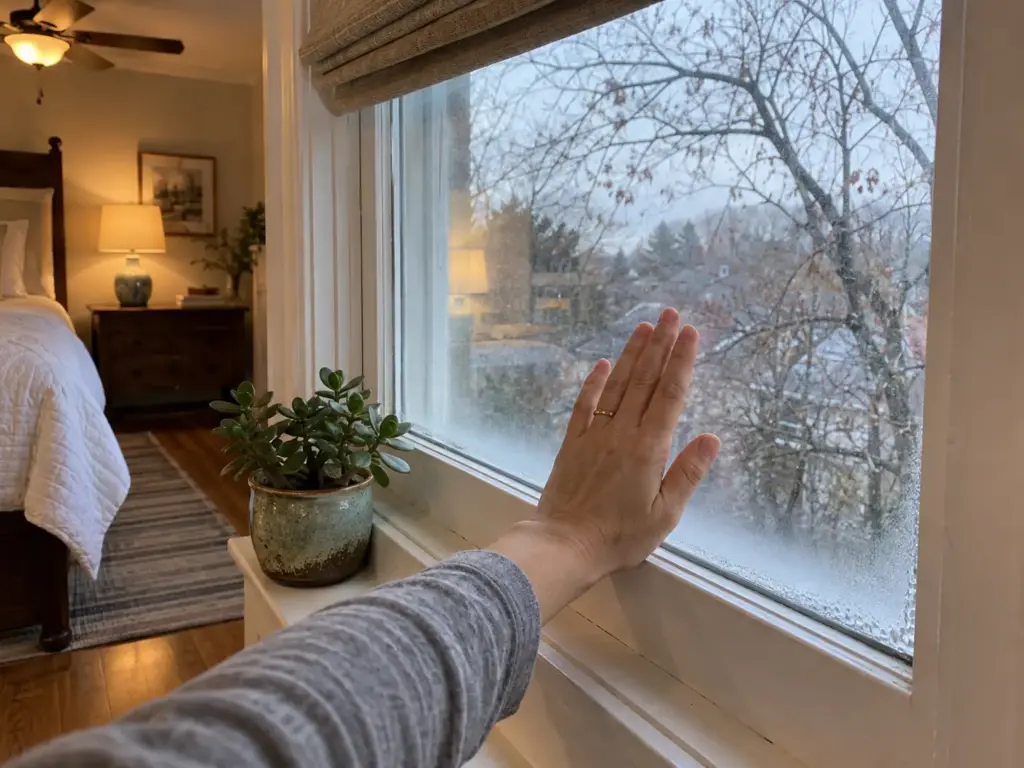
Cold glass is where the moisture lands first
Cold air holds less moisture than warm air, and the window glass and the exterior wall are the coldest surfaces a room has. Air at the room’s humidity reaches saturation there first, and the water that cannot stay in the air ends up as a film on the pane. The Center for Energy and Environment, a Minnesota nonprofit that prints the same table, puts the deep-cold case plainly: “When it is extremely cold out, 40% RH may still lead to problematic condensation on windows and wall surfaces.”
The whole problem is a differential: the gap between the outdoor and indoor temperatures. The bigger the gap between the warm room and the cold glass, the sooner the glass gets wet, and the table is just that gap turned into a ceiling.
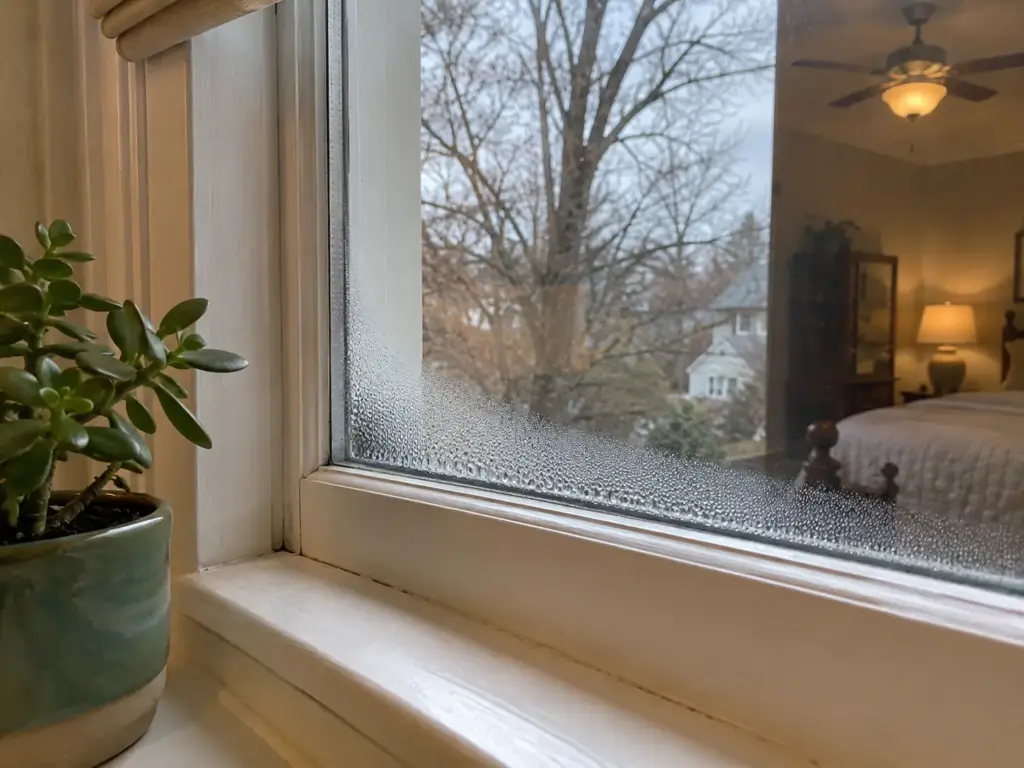
Drag a dry fingertip along the bottom edge of the lower pane before anything else. The lower edge of the lower sash is the coldest strip of glass in the room, and a smear shows there well before a single bead forms, which makes it the earliest warning that the cap is set too high.
Relative humidity depends on temperature, so one reading hides two things
Relative humidity is a percentage of what the air can hold at its current temperature, not a fixed amount of water. That is why one reading hides two facts: how much moisture is in the room, and how warm the room is.
Air at 68°F (20°C) and 35% relative humidity turns to water on any surface colder than about 39°F (4°C), and a pane on a below-freezing night is far colder than that. The hygrometer on the dresser reads the warm air in the middle of the room. The glass sits in a different climate a few feet away.
Why the same setting sweats in January and not in October
The setting did not change between the two months; the glass did. In October the pane is only a little colder than the room, and 35% in the room stays well short of saturating against it. In January the same pane can be far colder than the room, and the same 35% reaches it with room to spare. A setting of 35 percent can give no trouble for years, until the outdoor temperature drops far enough and condensation shows up on the older windows.
That is the situation the table was built for, and the reason a single setting chosen in autumn cannot be a setting for the year. How winter shifts the number covers the winter humidifier setting and the fog check in full; this article only adds the layer that comes from the outdoor temperature.
The Outdoor Temperature Table Is a Rule of Thumb, Not a Standard
Before you lean on the table, know what it is: the same six bands printed by an energy nonprofit and by an HVAC company, and neither of them traces the bands to a standard. That does not make them useless, but it changes how much weight they can carry.
Two pages, one set of numbers
The Minnesota nonprofit presents its table as “a general guide to recommended relative humidity levels in winter.” Pacific Heating & Cooling, an HVAC company, prints the same six bands in prose, from “not more than 40 percent” at 20 to 40 degrees down to 15 percent below minus 20, and credits them to the Star Tribune: “The Star Tribune breaks down how indoor humidity levels correspond to outdoor temperature.” Neither page gives a basis for the numbers beyond that.
Two pages with one origin are one source, and that is the table’s single point of failure. If the newspaper’s original numbers were a rounded rule of thumb, both pages inherit the rounding, and nothing in either checks the bands against a published standard. The nonprofit offers a home-visit service and the company sells HVAC work, which is worth knowing when you decide how hard to lean on the figures. Both are cited here by name, without a link, for exactly that reason.
What the EPA page does say, and what it leaves out
The nearest public source is the EPA’s mold course, and what it says is narrower than people tend to remember. Indoor relative humidity, it says, “should be kept below 60 percent”, “ideally between 30 percent and 50 percent, if possible.” That is a ceiling and a target for keeping mold in check across a whole year, written for a course on moisture control. It is not a home guideline for winter, and it has no outdoor-temperature table: the word outdoor does not appear on the page, and neither does a temperature in degrees.
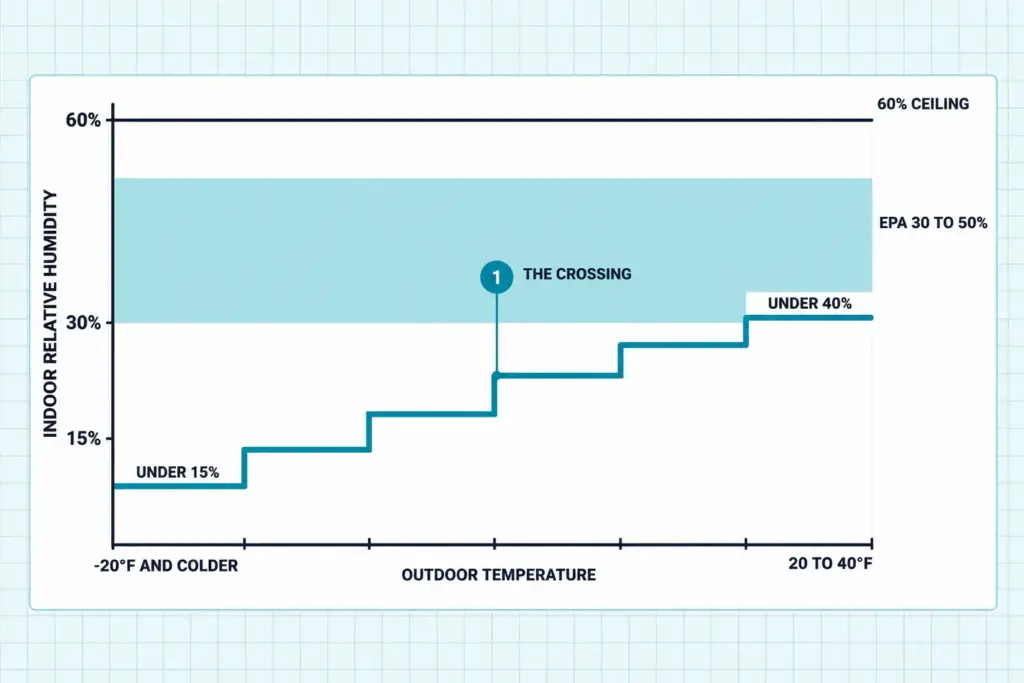
The comfort figure lives somewhere else entirely. The Minnesota nonprofit gives 40 to 60 percent relative humidity as the comfortable band, which makes it a comfort range and not a mold limit. Put the three figures side by side and the picture is plain: 60 percent is the ceiling for mold, 30 to 50 percent is the target, and the outdoor table only drags the ceiling lower when the weather does.
How to use a rule of thumb without treating it as a limit
Look at how tidy the table is. It steps down in 5-point increments across 10°F bands, which is a sign of arithmetic and not of measurement, because no window has 10°F steps built into it. A pane that beads at 29 percent when it is 12°F outside does not care that the chart switches rows at 10.
The 30 to 50 percent target is also the wrong number on the coldest nights. A reading of 40 percent sits comfortably inside the 30 to 50 percent target and still beads the glass at 0°F (−18°C), where the table says under 30. So treat the bands as a cap for the glass in deep cold, hold the year-round target the rest of the time, and keep in mind that the other end of the year has its own limit: the 60 percent summer ceiling is the number the room should stay under when the weather turns warm and wet.
Let the Window Glass Overrule the Chart
When the chart and the glass disagree, the glass wins. Window condensation is the evidence: the chart is a guess about glass, and the glass is the thing itself.
Read the glass in the morning, not in the afternoon
Glass is coldest at the end of the night, so that is when the evidence is plainest. Look at the lower corners of the lower pane first: a film shows before the beads do, and a film that returns every morning at the same corners is the sign the room is above what that window can take. By afternoon the sun on the pane, or a few hours of the furnace running, can warm the glass enough to erase the proof.
Take the meter reading and look at the glass in the same minute, before anyone opens the blinds. A meter number with no glass beside it is half a reading, and a glass looked at in the afternoon is no reading at all.
Old glass sweats at numbers the chart allows
When it is very cold outside, condensation on windows other than the most modern ones is normal. If the chart says 30 percent is fine and an older window shows a film at 28, the chart is not being broken by your house; it is being outrun by your glass. The tidy bands cannot know how old or how well sealed any particular pane is.
A damp pane is not harmless if it repeats. Frost forms, melts in the afternoon sun, refreezes on the bottom of the window, and sits as a puddle on the woodwork, where it can wreck the window trim. One wet morning is a note to self. One wet morning is a note to self. A wet pane every morning for a week is the trim taking the water.
So when the chart allows a number the glass will not, hold the number the glass needs. The chart is the opening bid; the pane gets the final say.
The lower limit is real too
Pushing the cap down is not free.
Wood, flooring in particular, can be damaged when the air runs very dry. The last three rows of the table ask for very dry air, and that is the part the chart hides. The dry end of the dial has its own costs, and a lower cap is a trade, not a gift. If a room has to sit well under 25 percent to keep one stubborn window clear, the window is the problem to fix, not the number to chase.
What the Chart Cannot See About Outdoor Air
The chart reads the thermometer outside. The glass reacts to the moisture in the room, and that moisture depends on the outdoor air that leaks in and on what the house adds, so the chart’s input is a stand-in for the thing that matters.
Outdoor temperature is a stand-in for outdoor moisture
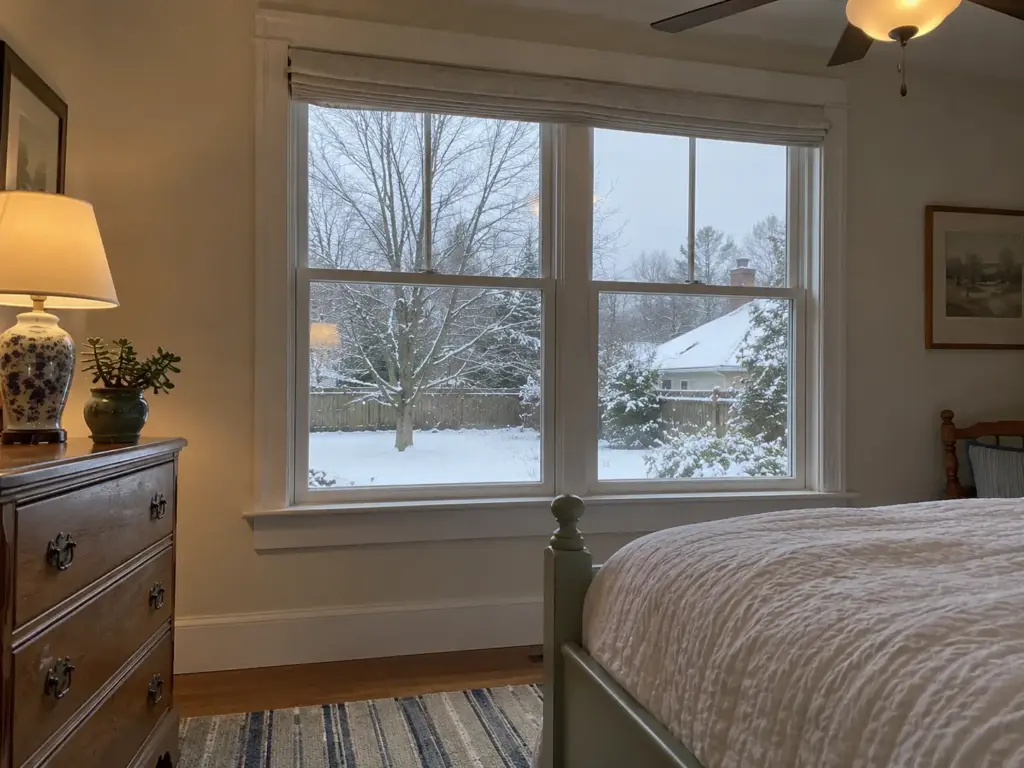
Think of two mornings at the same 15°F (−9°C). One is still and wet, with low cloud and nothing moving. The other is dry and windy, with air pushing through every gap in the walls.
On the windy morning the house is exchanging air with a dry outdoors, so the indoor humidity runs lower on the same humidifier setting. On the still morning the room keeps what the house produces, and the same setting lands higher. The table gives both mornings the same cap.
The problem is a differential, plus some other factors, and the chart bakes in only one of them. Showers, cooking, drying laundry and the number of people in the house all add to the other side of that equation.
What the 2015 study found, and what it cannot tell you
A 2015 study of eight locations in the International Journal of Biometeorology measured indoor temperature and humidity at eight locations, from the equatorial region (10°N) to the Arctic (64°N), for one calendar year. Its finding on relative humidity is the one that matters here: “There was large variation in indoor relative humidity between seasons and between locations which was independent of outdoor, airport measurements.” The measure that did follow the outdoors was specific humidity, the actual amount of water in the air, and dew point to a lesser degree.
The study has limits that belong in the same breath. The authors call it “a convenience sample of eight diverse locations,” so it is a sample and not a survey of houses. The outdoor figures came from the nearest airport weather station, not from the reader’s yard. And it does not prove the table wrong: it shows that the outdoor temperature on its own does not set the indoor relative humidity, which is a smaller and more useful claim.
What this changes about the number you hold
Use the table to set a ceiling, then let the glass and the meter move you off it. Do not build a rule out of a single row such as “at −5°F (−21°C) the room must read 25 percent,” because the reading that keeps one house clear can sit five points either side in the next. Reading the outside before changing the inside is the same move as the same read-subtract-change method used for carbon dioxide: find the outside figure, compare it with the room, change one thing, then read again.
Lower the Humidifier One Step, Then Read the Room
The order matters more than the device. The free change comes first, which is the setting itself, then one morning of reading, and only then, if the glass still beads, the next step. One change at a time, so you know which one worked.
Step one: lower the setting by one notch, not five
The Minnesota nonprofit gives the closest thing to an order: “It is important that you turn off your humidifier and lower your RH set point before turning it back on.” Pacific only says “You will need to adjust your humidifier accordingly,” which names the task and not the sequence. The sequence that works is shorter than either: lower the setting one notch, leave it a night, read the glass in the morning, repeat only if it is still wet.
The nonprofit also suggests humidifier settings of 30 to 40 percent for a home that feels dry in winter, and that range collides with its own table once the outside drops under 20°F (−7°C). A setting of 35 percent is fine at 25°F and a good bit too high at 5°F. That is the contradiction a one-notch change resolves without anyone needing to choose between the page and the pane.
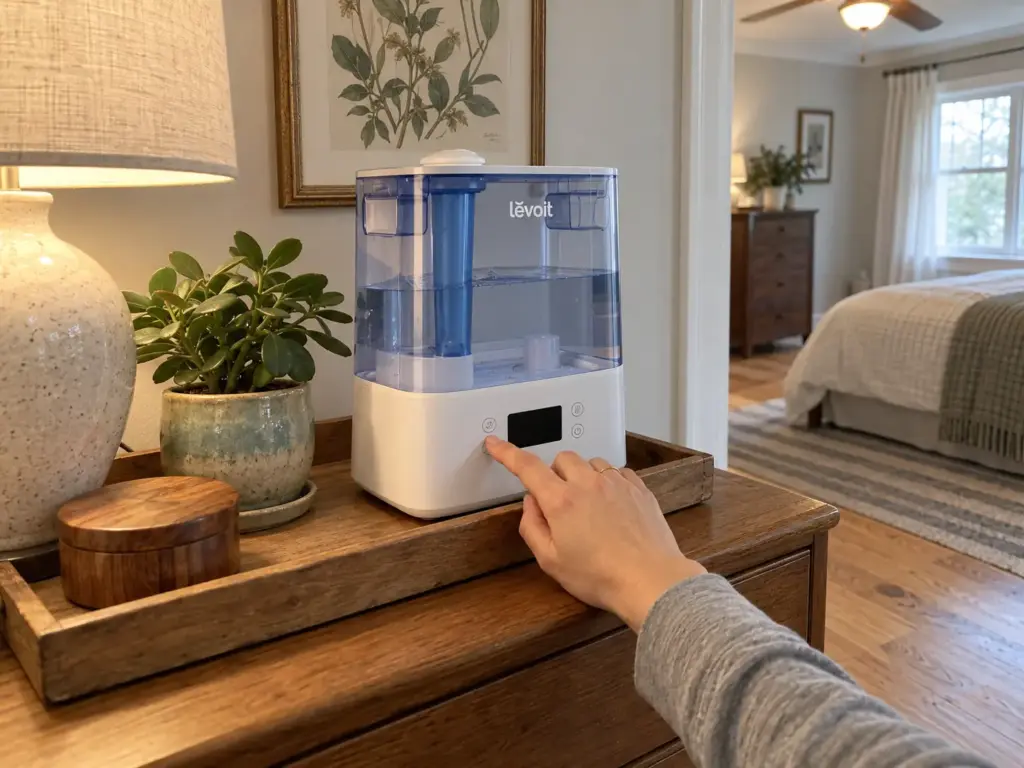
If your humidifier holds a target, lower it one notch. A smart top-fill ultrasonic model such as the Levoit Classic 300S, with a 6-liter tank, is the kind of unit that may let you step a target up or down, so check how yours sets it. Whatever the model, a humidifier only follows the number you give it; it cannot see the window, so a setting that suited a mild day will keep running on a cold one until you change it. If your unit has no target, run it for fewer hours.
Step two: wait for the morning and read the glass and the meter
The glass is slower than the meter by about a night. A setting lowered in the evening shows on the glass the next morning, not that night, so lowering it twice before bed overshoots and leaves two changes you cannot tell apart.
Write three things next to each morning’s reading: the setting, the outdoor temperature and whether the lower pane was clear. After a few cold mornings you hold a table for this one window, and when it disagrees with the printed bands, yours wins.
For the reading itself, a plain gauge is enough. The AcuRite 00613, with its 3-inch display, puts one number where you can see it from the bed. The gauge reads the air where it sits, on a shelf, while the pane is colder than that air, so a reading the gauge calls fine can still come with a wet window.
If you want the morning numbers to stay put so two steps can be compared side by side, the Govee H5075 sends its readings to an app over Bluetooth and keeps the history. The AcuRite is the cheaper no-app option, and it shares the same limit: it reads at the shelf, not at the glass. How far to trust either one is covered in a cheap indoor humidity checker you can trust.
Step three: only then take the next step
If the glass still beads after a notch and a night, lower one notch more and read again. If two notches in a row change nothing, stop adjusting the humidifier and turn to the free fixes of the pillar: a door opened, the exhaust fan run longer, a closet door left ajar. Those come in order there, and they are not repeated here.
If you rent or have one portable humidifier
The ordinary version of this is one portable unit on a dresser in a rented apartment, with no whole-house humidifier to reprogram. The Minnesota nonprofit’s energy auditors typically recommend individual humidifiers over whole-house ones, and this is the case that favors them: the setting is on the unit, nobody needs a technician, and a notch down is a thumb press. Move the unit off the sill, away from the coldest glass, and if the unit has no target at all, shorten its run time by an hour a night and read the pane the next morning.
Re-Check It at Every Cold Snap, and Know When It Is the House
A setting drifts out of range as the weather changes, and when the glass beads even at a low number, the cause may be the house, not the humidifier.
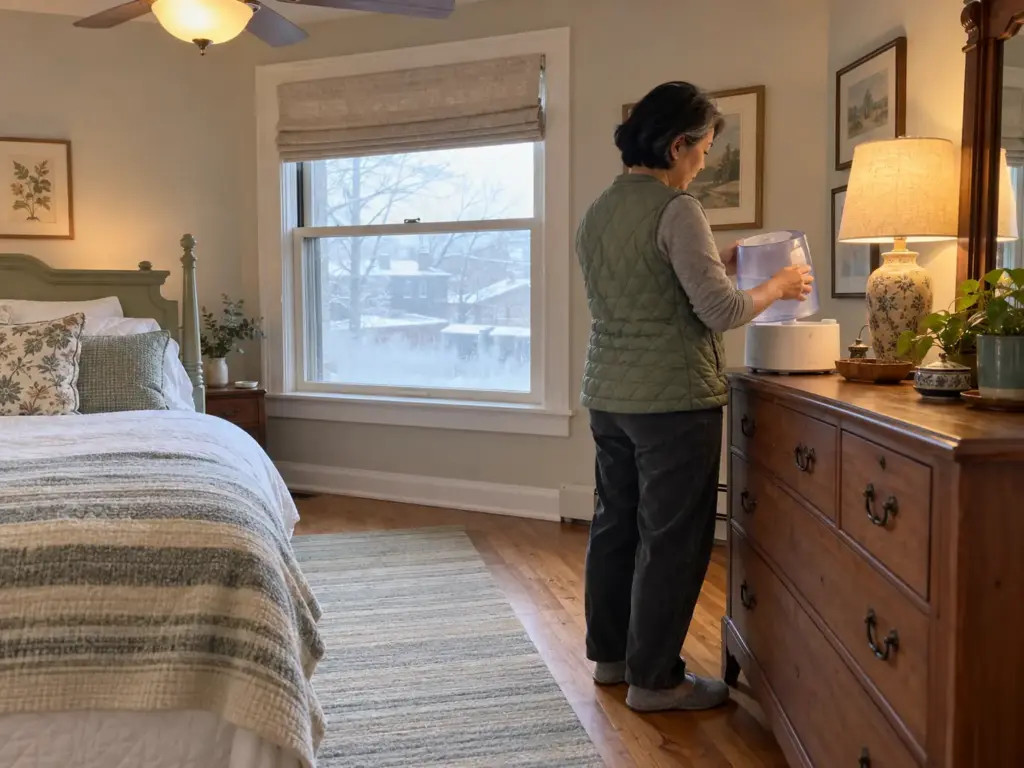
Why a set-and-forget setting drifts
A whole-house humidifier set point is easy to forget, and a forgotten one can lead to a rapid increase of too much moisture in the home. The Minnesota nonprofit makes the same warning. Some people wire a relay to a formula that follows the outdoor temperature, which suits a home-automation hobby more than an ordinary house, but the reason behind it is the point. The Minnesota nonprofit warns about the same thing: whole-house humidifier set points “can be easy to forget about,” and a forgotten one “can lead to a rapid increase of too much moisture to your home.”
Pacific’s advice for a whole-house unit is “set it and forget it.” A cold snap breaks that advice, because a setting that suited a 30°F week is the wrong setting at 5°F. Re-read the setting at each cold snap, not once in October.
Treat the outdoor low dropping into the next band of the table as the trigger. Lower the setting that evening, not whenever the glass complains, so the pane never has to be the one to tell you.
When the glass beads at a low number
A glass that stays wet at 30 percent points away from the humidifier. The house is adding moisture or leaking cold, and the usual sources are few: cooking with the pots uncovered, long showers with the bathroom fan off, laundry dried on racks indoors, a dryer that vents into the room instead of outside, and a crawlspace that sends ground moisture up through the floor. Where the extra moisture comes from has the full list and what each one adds.
If none of those fits, the glass or the wall is the thing at fault. The Minnesota nonprofit’s answer to steady condensation with no humidifier running is air sealing and insulation of the windows and walls, because a warmer surface is one the moisture cannot condense on. The worse version is condensation in the attic and in wall voids, which can do serious damage. That is a building problem and it belongs to a professional, not to a setting.
For a place to look, check the sill and the paint under the lower sash. A drifted setting shows on the trim first.
A dehumidifier is the last step, not the first
A dehumidifier belongs at the end of the order, and only if the glass still fogs after the setting change. It removes moisture from the air; it does not fix a leak or a cold wall. ENERGY STAR adds a limit for cold rooms: below 65°F (18°C), frost can form on the coils, and the compressor can cycle on and off without removing moisture.
If you do size one, ENERGY STAR’s dehumidifier criteria give a capacity table in pints per day by how damp the room is and its square footage, and note that capacity is “usually measured in pints per 24 hours.” Efficiency is measured by “its integrated energy factor, in liters of water removed per kilowatt-hour,” and a higher figure means a more efficient unit. Running cost follows from watts times hours divided by 1,000, which gives kilowatt-hours; the division with your own rate is the number to run. After it is running, how long a high reading takes to fall tells you what to expect, and in what order.
Hold the Number the Glass Needs, One Notch at a Time
Three things carry over from the table. The cap falls with the outdoor temperature, and it is a rule of thumb from two pages that share an origin, not a standard. The glass has the last word, so the number to hold is the one the pane can take. And the way to find it is a notch, a night and a morning reading, repeated until the lower corners stay clear.
The check for later is the strip of paint along the lower sash: look at it a month from now, and at the next hard-cold snap read the glass in the morning before touching the setting. Paint that bubbles or darkens there means the water has been arriving longer than one cold morning.
Tomorrow evening, lower the humidifier by one notch and take the first reading of the glass and the meter the morning after. If the pane still beads, the next question is where the moisture comes from, and the sources article answers it. If it stays clear, the next number is the summer ceiling, on the other side of the year.
Frequently Asked Questions
01What should indoor humidity be based on outside temperature?
As a rule of thumb, the cap falls from under 40 percent at 20 to 40°F to under 15 percent at −20°F and colder. The window glass is the check, not the chart.
02Is 63% humidity in a house a good level?
No, not as a steady reading. It sits above the below-60-percent ceiling in the EPA mold course and far above every winter cap in the table. Read the glass first.
03Is an indoor humidity of 80% considered too high?
Yes, as a lasting reading in any season. It is well above the 60 percent ceiling and would bead the glass at almost any outdoor temperature. Where the extra moisture comes from is the next thing to trace.
04Is 50 indoor humidity too high in winter?
Yes, by the table: it is above the cap at every outdoor temperature, which tops out at under 40 percent for 20 to 40°F. In deep cold it will bead the glass, and in mild weather the glass decides.
05How often should I change my humidifier setting?
Re-read it at each cold snap, not once in October. Check the glass in the morning, and lower the setting by one notch at a time so you never overshoot.