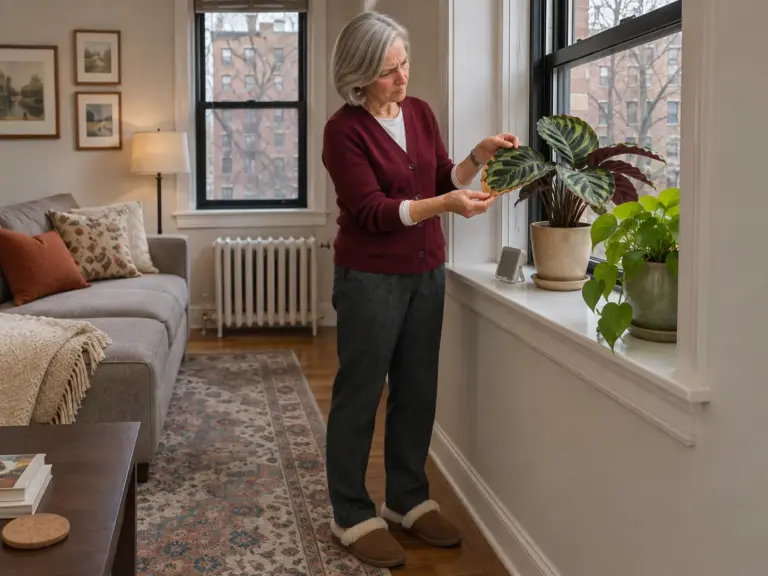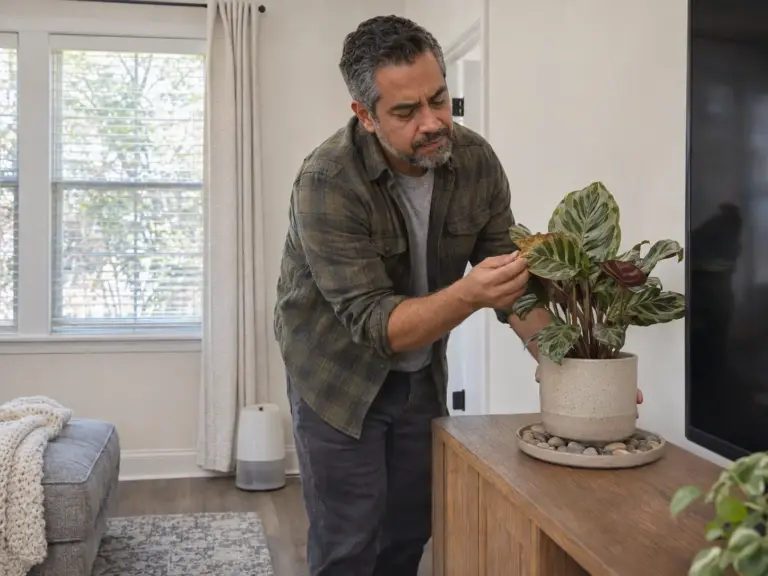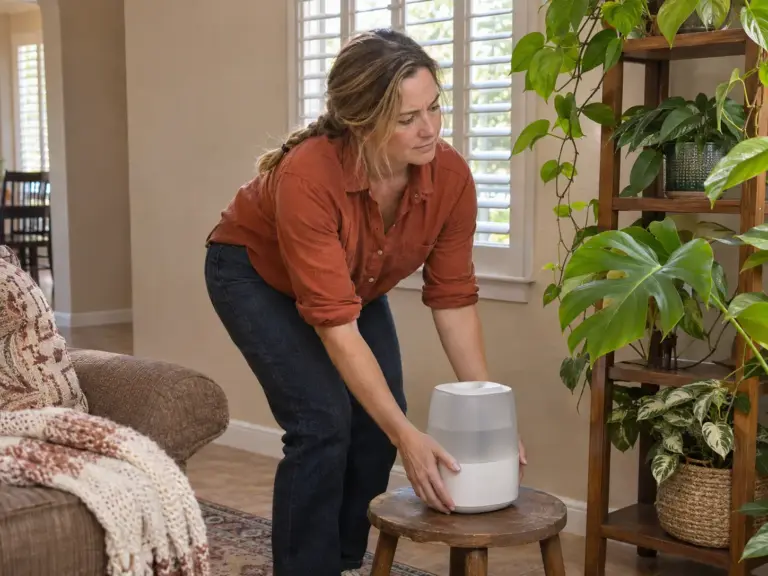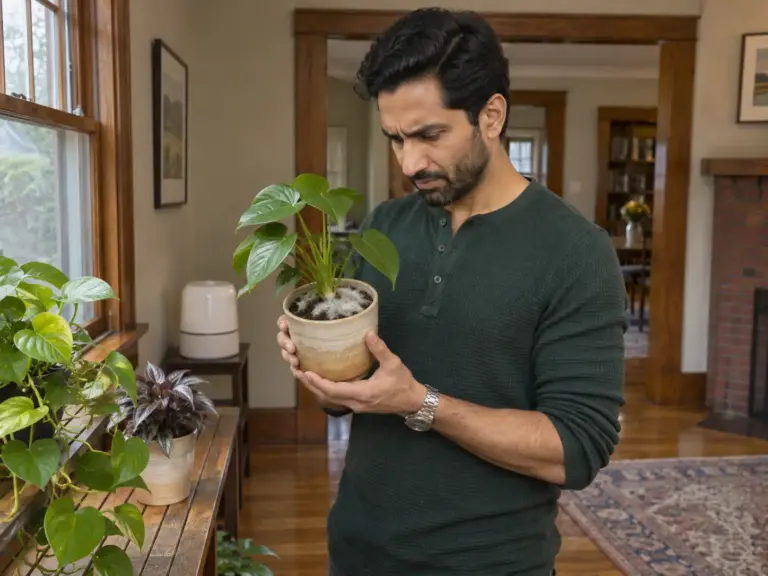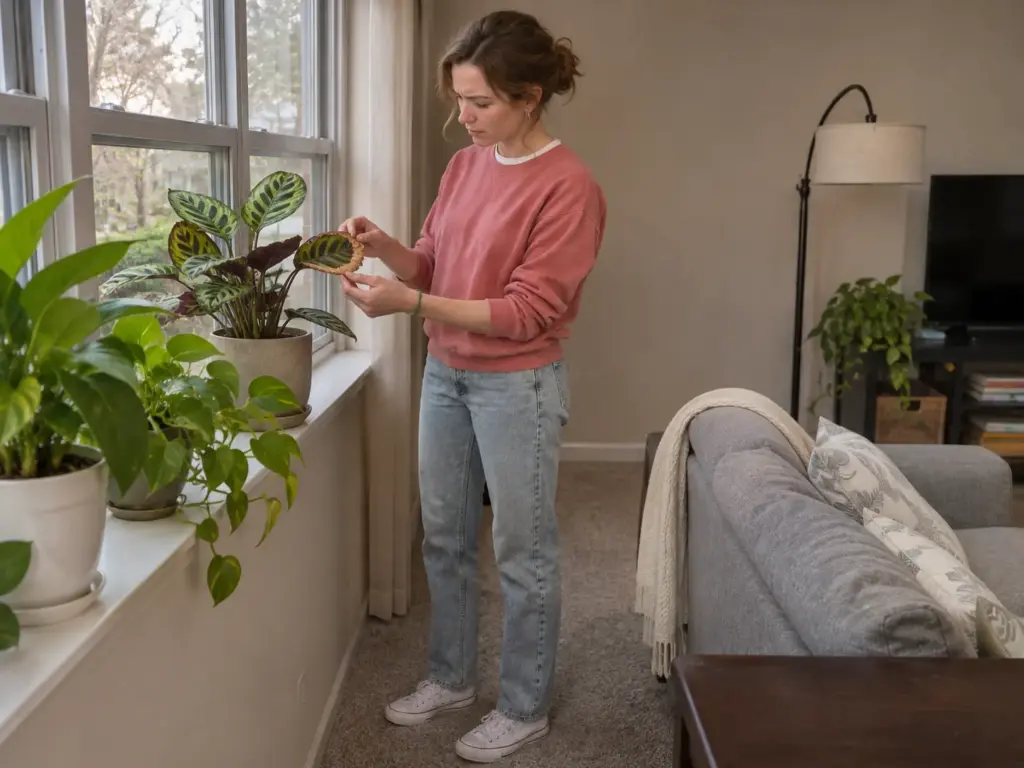
A calathea on the sill has crisp, brown edges, and the meter on the bookshelf across the room reads a comfortable number in the 40s. Both are telling the truth: the meter hangs at chest height in the room’s air, and the leaves sit in the dry air that falls off a cold window. If you typed why does humidity help plants grow with a browning leaf in your hand, the answer is that dry air pulls water out of a leaf faster than the roots can replace it, the plant closes its pores to save water, and with them closed it takes in less of the CO2 it grows on. The number that settles it is the one at the height of the leaves, and the plant wants wetter air than a winter window can take, so this guide says how far to go and where to stop.
Quick Answer
Dry air pulls water out of a leaf faster than the roots refill it, so the plant partly closes its pores and takes in less CO2 to grow on. Read the humidity at leaf height; most houseplants want more than the EPA’s room band, so aim at the air around the pots.
Why Dry Air Stalls a Houseplant Before It Wilts
The brown tip is the last thing a leaf shows, and on a monstera or any other indoor plant it is the crispy tips that people notice first. Long before them, the plant slows down, and the reason is a water budget that the air controls. A green plant on a January sill that has put out no new leaf since autumn, with the same pot and the same watering as in September, is often overspending that budget.
How a Leaf Loses Water Through Its Pores
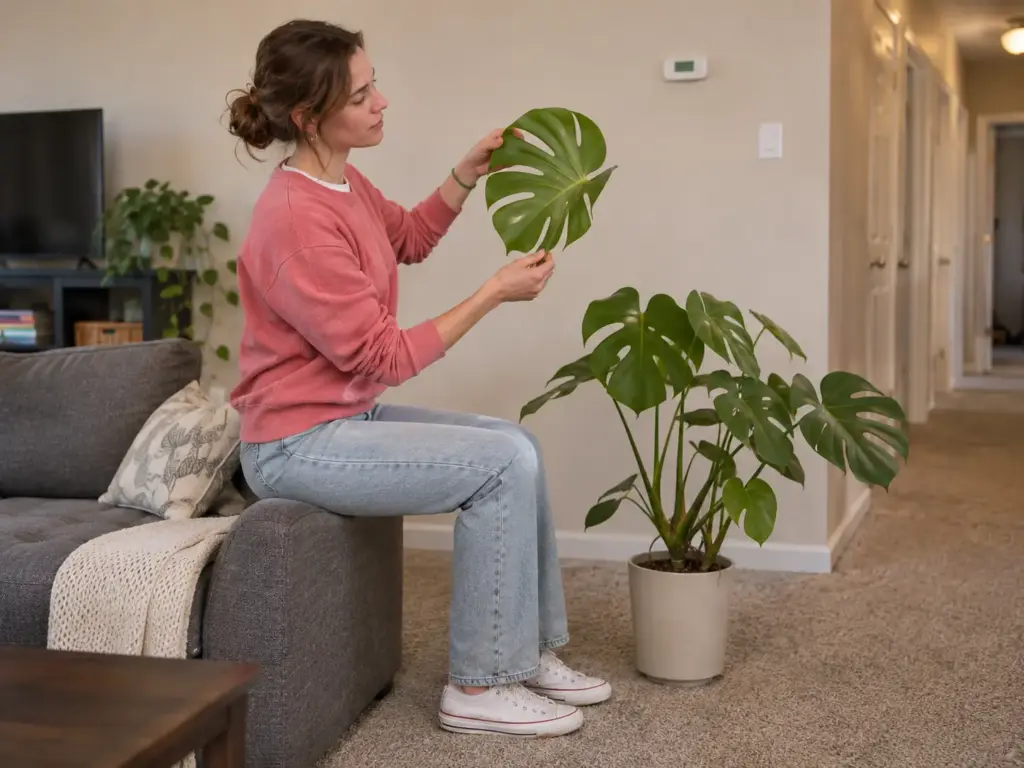
A plant is a one-way water line. The roots take water in, and it rises through the vascular system as one unbroken water column, pulled from above by the leaves far more than pushed by root pressure. It leaves through tiny openings in the leaf surface called stomata, in a process called transpiration.
Nebraska Extension notes that the loss speeds up when temperatures are high, the sunlight is intense, drafts are present or humidity is low. Colorado State Extension adds that plants in low humidity or in a draft lose more water this way, so their roots have to supply more.
Put that in a room and the effect is easy to see. The same plant in the same pot drinks more in a dry, warm room than in a cold, damp one, with nothing else changed. The soil moisture drops on a different schedule, and that shift is the first sign that the air changed while the watering can stayed the same.
When the Roots Cannot Keep Up, the Pores Close
A leaf cannot simply stop losing water, because those same pores are its doorway for carbon dioxide. When the air pulls moisture out faster than the roots can send it up, the plant partly closes the pores to save water. With the doorway narrowed, CO2 uptake drops, photosynthesis slows, and growth slows with it.
All of that happens while the leaves still look fine. A plant can stall for weeks, and the crisp edge arrives at the end of the story.
The Number Behind the Percentage
Relative humidity is a percentage of what the air could hold at its current temperature. The leaf feels the difference between that and what the air actually holds: the air’s demand for water. The term for it is vapor pressure deficit, or VPD. A percentage alone misleads.
The same 60 percent at 60 °F (16 °C) and 60 percent at 85 °F (29 °C) put different demands on the same leaf, because warm air could hold far more. Dew point, the temperature at which the air’s water starts to condense, tells the same story from the other side. The University of Arizona’s explanation of vapor pressure deficit puts the consequence this way: “when VPD becomes excessively high, plants often respond by partially closing their stomata to reduce water loss”. You do not need to calculate it, only to know the percentage is an approximation of the demand.
The same page runs the other direction too. Extremely low VPD, air near saturation, also suppresses transpiration and reduces the movement of nutrients inside the plant. So more is not better. The plant wants air moist enough that it does not pull hard on the leaf, and not so damp that water and dissolved food barely move.
Why a Heated House Is the Hard Case
The same sill that was fine in July is hard in January, and the cause sits in the heating. Central heating warms the air and adds no water, so the plant’s air is at its driest just when the glass beside it is coldest.
The Furnace Warms the Air and Adds No Water
Cold outdoor air holds very little water, and warming it to 70 °F (21 °C) adds none, which is the whole story behind why the furnace takes no water out of the air and adds none. The reading falls because the same moisture now sits in warmer air. It is also the reason the same room reads far higher in June, with a window open and the air soft, than in January with the heat on.
A drop like that has a short list of usual suspects: exhaust fans, leaks around the house and the heating itself. The usual causes of a low winter reading are worth a look if the meter surprises you.
Stand at the sill with the back of a hand: the air feels cooler there, while the room air feels warm and dry. Each sill is its own microclimate, set by the window glass, the pot’s height and whatever draft leaks past the frame. A meter shows the same thing, with a number that changes with the height it is held at, and the difference is largest on the coldest days.
The Climate the Plant Evolved In, Against Your Sill
According to Colorado State Extension on houseplant temperature and humidity, most tropical houseplants come from climates at 70 to 90 percent relative humidity, while a heated winter house can sit under 10 percent. That is a tenth of the air the plant evolved in. It describes the distance between the two, and it does not diagnose a sick plant from a number.
The EPA’s band for a home is the room’s number, and it is lower than the plant’s, so the two do not meet; the cold glass decides which one wins, and that comes up shortly. Dry winter air is not even across a room, and where the plant’s air is driest is easier to say: on the sill, in the cold air that falls off the window, and over a heat source. Nebraska Extension tells growers to keep plants off radiators, heat vents and ducts, and the reading at the wall or in the middle of the room describes none of those places.
The Number to Read, and the Height to Read It At
Winter explains why the air is dry. A number taken where the plant is not cannot help the plant, so the first move costs nothing: put the meter where the leaves are.
What Each Kind of Plant Asks For
According to Nebraska Extension’s guide to humidity for houseplants, “For plants, humidity requirements vary by species, but generally 70-80% is best.” The same page sorts the species: many ferns, Rex begonias, prayer plants and calatheas need high humidity to do well, while cacti, succulents, cast iron plant, Chinese evergreen, pothos, philodendrons and dracaenas tolerate low humidity. Orchids, English ivy and the aroids vary by species, so the plant’s own label is worth a minute. The tropicals sit at the high end of what a house can give them, and the cacti and succulents do fine at the room’s own reading.
The reference for the room is lower. The EPA’s band tops out well under the plant’s number, and treating both as one target gives a room that sweats or a plant that browns. Whether a room reading can run too low is a room-side question, and whether a room reading can be too low is answered there with no floor under the EPA band. The plant’s number, higher than the EPA’s, belongs to the air at the pots.
Read It at the Pots, Not at the Wall
A room can read in the comfortable 40s at chest height and far lower on a sill: same air, different place.
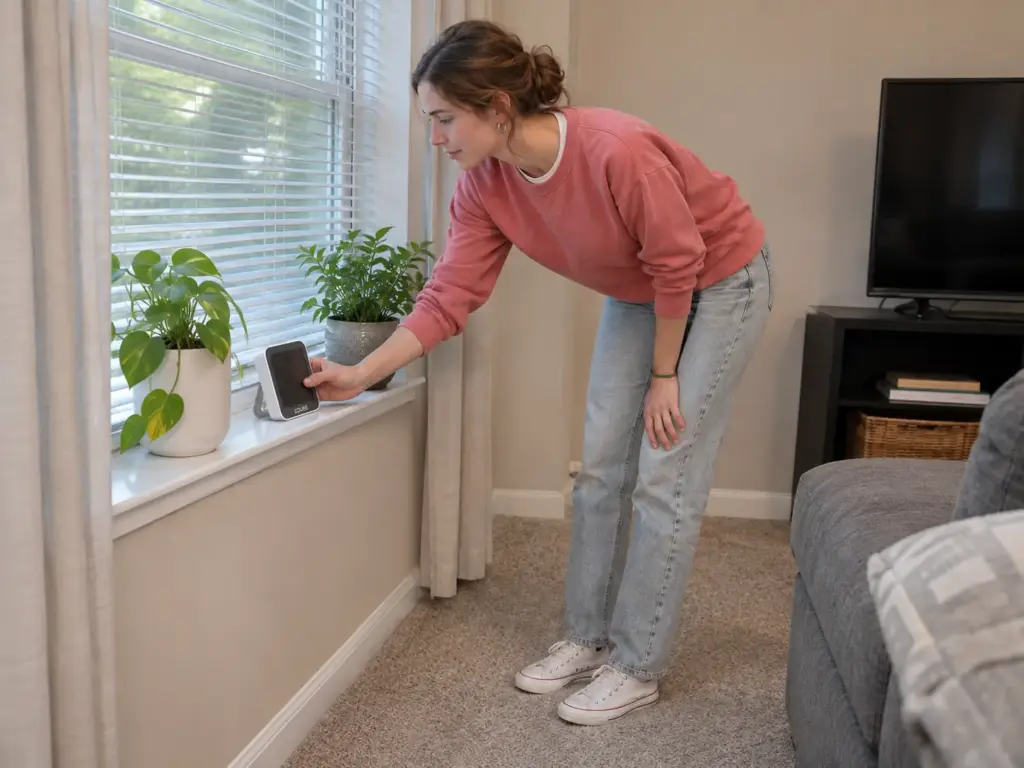
So the meter goes beside the pots, with its sensor in the open air an inch or two above the soil, and the wall gets nothing. The Govee H5075 states ±3 %RH and ±0.54 °F (±0.3 °C) and refreshes every 2 seconds, enough for a plant decision, and the Govee H5075 hygrometer is the cheap way to get a reading with an error bar printed on it. Connectivity is its weak point: some units pair with the Bluetooth app easily, others drop it, and a few stop working inside six months, so run it beside the old reading for a day before trusting it. A humidity meter with no stated margin is a decoration.
The same meter moved from the shelf to an inch above the soil of a sill pot reads lower by several points on a cold morning. The difference closes by afternoon, when the sun has warmed the glass.
Leave the meter at the pot of the plant you worry about for a full day and note the lowest reading, which lands in the early hours when the glass is coldest. That minimum is the air the leaf lives in, and the daytime average hides it.
Read, Change One Thing, Read Again
The method is a loop with a rule: read, make a single move, then read again at the same spot and the same height before touching anything else. Every fix further down comes with the reading it should move, so you can tell which move worked and which one did nothing. A pot beside the meter reads the pot’s air, and a meter on the far wall reads the wall’s.
The anti-sell is simple. A day of readings in the right place changes more decisions than any device, and it costs nothing.
What Low Humidity Looks Like, and What Only Looks Like It
A reading in hand, the plant gives the second opinion. A brown tip has four owners and the air is only the most likely one, so any device comes last.
Brown Tips, Curled Leaves and Slow Growth
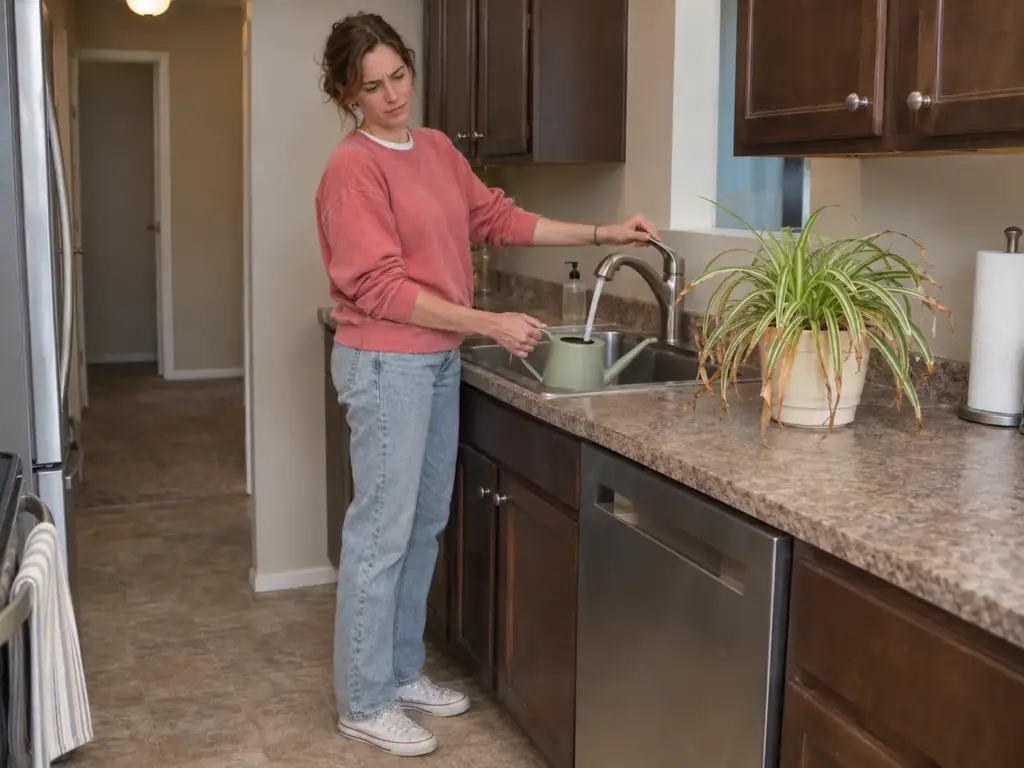
Iowa State Extension on brown leaf tips and what causes them names low humidity as the most likely cause. Inconsistent watering, fertilizer salts building up in the soil, and fluoride or chlorine in tap water produce the same thing. Dry air shows its signs in an order: slow growth with no new leaf comes first, then crisp edges, then leaves that curl or cup, then leaf drop. The tips come last, which is why the plant has usually been dry a long time by the time you see one.
Tap Water and Fertilizer Salts Burn the Same Tips
Some species tip-burn on treated water first: spider plant, dracaena, ti plant, prayer plant and calathea. They are the plants that make people blame the air when the water is the problem. A white crust on the soil surface is the salt build-up, from fertilizer or hard water. The tip that browns again at the same place after every new leaf, whatever the humidity does, points at the water.
Ruling the tap out takes one watering cycle. Switch to distilled or filtered water for that cycle and watch the next leaf. (Letting tap water stand overnight is the habit everyone tries first, and it does not remove fluoride, so skip it.) A plant on treated city water that tips brown no matter what the humidifier does is the classic case.
If you have two of the same species, water one with distilled water and leave the other on tap. Whichever one keeps the next leaf green has told you whether the water or the air was responsible, and it cost you a jug.
When the Plant Drops Leaves and the Meter Reads Fine
Say the meter reads 55 percent at the pots and the plant still drops leaves. Overwatering and root rot are soil-water problems, and the humidity has no part in them. A draft from a door, a sill over a radiator (warm, dry air rising past the pots all evening) and dim light also drop leaves. In each case the cause sits at the source, and adding humidity does nothing for any of them.
So the order is: rule out the tap and the watering first, both free, then read at the pots, and leave the humidifier for after both.
The Plant Wants More Than the Window Can Take
Once the air is the cause, the instinct is to push the number up. The plant and the cold glass want opposite numbers in the same room, so the question becomes how far to go and where to stop.
Two Targets in One Room
The EPA’s indoor humidity guidance for a home says to keep indoor humidity below 60 percent, ideally 30 to 50, and treats condensation on windows, walls or pipes as the sign a room has gone too far. Nebraska Extension puts the plant at 70 to 80 percent. In winter the room cannot meet both, because the glass sweats long before the room reaches the plant’s number.
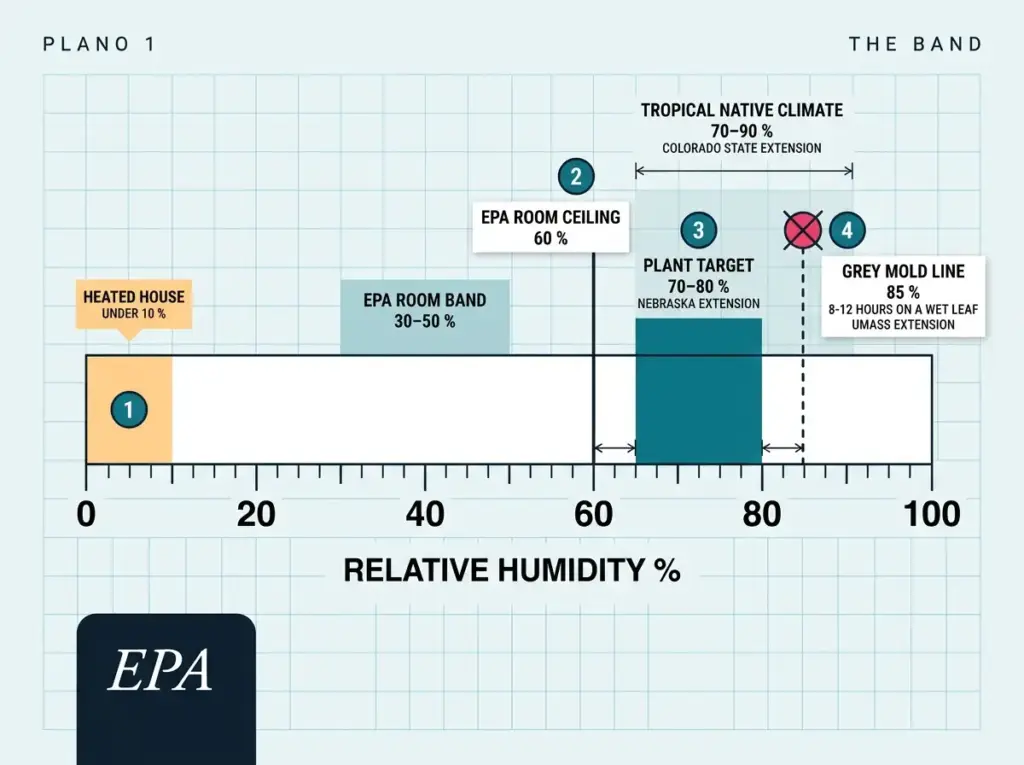
So the aim moves from the room to the air around the pots. The room stays under the EPA’s ceiling, and the glass says when it has gone too far. Why the safe indoor number falls as the outdoors gets colder is the reason the ceiling you hold in January is lower than the one in October.
Let the Glass Set the Limit
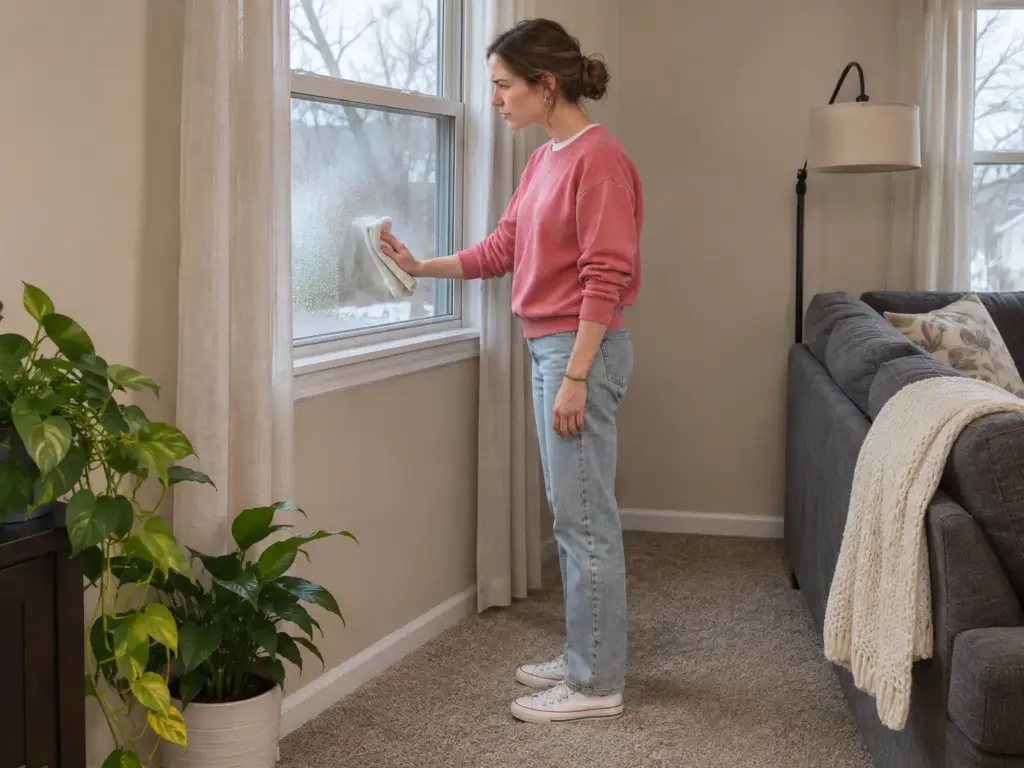
The glass is the first place a room tells you it is too damp. A film or beads on the lower pane, or a damp patch on the wall behind a plant corner, shows up before the plant does anything. That film is the earliest sign that the setting has overshot what the glass will take. The reading the room can hold without sweating changes with the weather: what the room can hold before the glass sweats at each outdoor temperature falls as the outdoor temperature falls.
The humidifier’s setting falls as the outdoor temperature falls. Which humidifier setting to use when the dial and the window disagree has the details, and the short form is that the glass overrules the dial. A dehumidifier is the opposite tool and has no place in a plant corner unless the glass keeps sweating. If beads have already formed, what to do when the windows sweat comes first.
Where Too Much Starts on the Leaf
The disease line is not the number people quote. UMass Extension’s conditions for gray mold put its infection at 85 percent relative humidity or greater with a film of moisture on the leaf for 8 to 12 hours. A misted leaf in a still, cold corner is the real risk, and the room reading is not. Powdery mildew, also a fungal disease, needs no free water, and Penn State Extension on powdery mildew and humidity says it needs high humidity around the plant to spread and is worst in crowded, shady, poorly ventilated spots.
That is the flaw of grouping: it raises the humidity and builds the canopy the mildew likes. The remedy is moving air, a small fan on low, and less grouping is not the answer. Root rot is a soil-water problem and belongs to the watering can. And when the setting overshoots, when the humidifier itself is where the mold starts is the page that follows where the water lands.
Raise It Around the Plant First, Then in the Room
The glass sets the room’s limit, and the plant does not need the whole room. The fixes come in order, nearest to the leaf first, and each stays only for the reading it moves.
Group the Pots and Put the Fussy Ones in the Middle
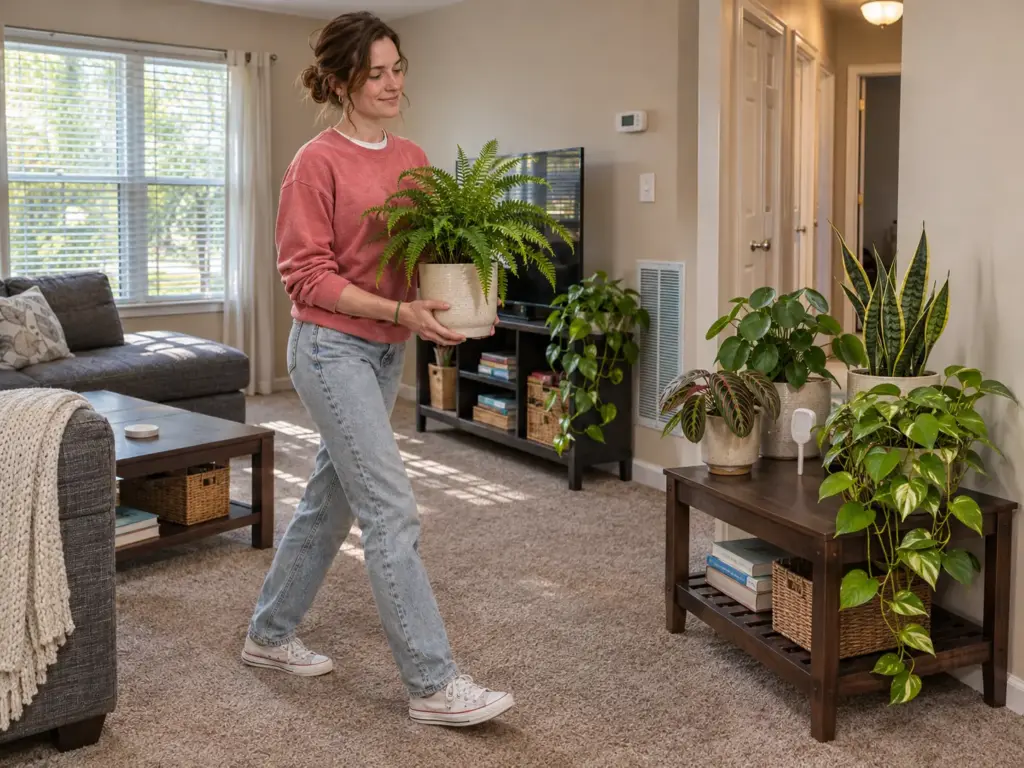
The order is: group the pots, which is free; move the plants that need it to the kitchen or a bathroom with a window, also free; then a tray or a dome for the one or two plants that need it; then the room’s humidifier. A reading at the pots follows every step, and the next step waits for it. Grouping plants is the cheapest of them, and gentle airflow around the group keeps the pocket from turning into stagnant air. The same order of fixes at the scale of a whole room is laid out for the room’s whole air.
Grouping works because plants release water from their leaves and a canopy holds a small pocket of slightly higher humidity, as Nebraska Extension notes. The fussy plants go in the middle. Pushing the pots into one corner is an easy Sunday job, and the meter two inches above them, not across the room, says whether it worked. The canopy is also the flaw, since it builds the still, shady air that powdery mildew spreads in, so a small fan on low, never pointed at the leaves, keeps it moving.
The Humid Room You Already Have
A bathroom with a window, or a kitchen that shares an opening with the plant room, reads higher every time a shower runs or a pot boils, and a laundry room on a drying day does the same. That is a humid room for free, and Nebraska Extension lists both as rooms normally more humid than the rest of the house. The cost is light, which is usually worse there, and the reading drops again when the door is open. A plant that needs both bright light and humid air has to give one up, and it is worth deciding which.
The Tray, the Mister and the Dome, Each With Its Limit
A pebble tray moves the air an inch or two above the dish and no further, and good drainage under the pot is still the first rule. At plant height it is a rounding error. The pot has to stand above the water, since wet feet are the shortcut to root rot, and a saucer left full goes green with algae and gives fungus gnats a nursery. A plant that sat in a tray all winter and still browned is the usual story: the tray’s reach is those two inches, and the meter at the same height says so.
Read the meter on the rim of the tray and again at leaf height. If the two numbers match, the tray is doing nothing for the leaf, and the water in the dish is just a place for algae to grow.
Misting barely moves the room’s reading and wets the leaf. Nebraska Extension calls misting not an effective solution, since you would have to mist every few minutes to make a real difference. On a still leaf in a cold corner it builds the wet-leaf conditions of the previous section. For the one or two plants that need real humidity, a cloche, a terrarium, a clear container or double potting does the work without conditioning the room.
Why a Rooting Cutting Sits Under a Dome
A rootless cutting cannot refill the water it loses. The University of Florida’s propagation note on vapor pressure deficit explains that misting a cutting puts a film of water on the leaf, and that the film evaporates and so prevents water loss by the leaf. A propagation dome keeps that film in place until the cutting can drink for itself, and a seedling tray under a lid follows the same logic for germination.
The dome is for the cutting, and the room’s reading has nothing to do with it. The free steps do more than any gadget when the plants are few, and the humidifier is for the room that will not hold a number at all.
When the Room Itself Needs a Humidifier
Grouping, a humid room and a dome do the job for a few plants. A room that will not hold a number at all is where a humidifier is the answer, and its size is the decision.
Size It to the Room, Not to the Shelf
The test is short.
After the free steps, if the reading at the pots stays under the plant’s number and the glass is dry, a room humidifier is justified. If the glass sweats first, the room is already at its limit and the unit stays off. A tank tells you how often to refill; how to size a humidifier to the room it runs in turns on square feet and hourly output, which say whether the air at the leaves moves at all. The figures below are the makers’ own.
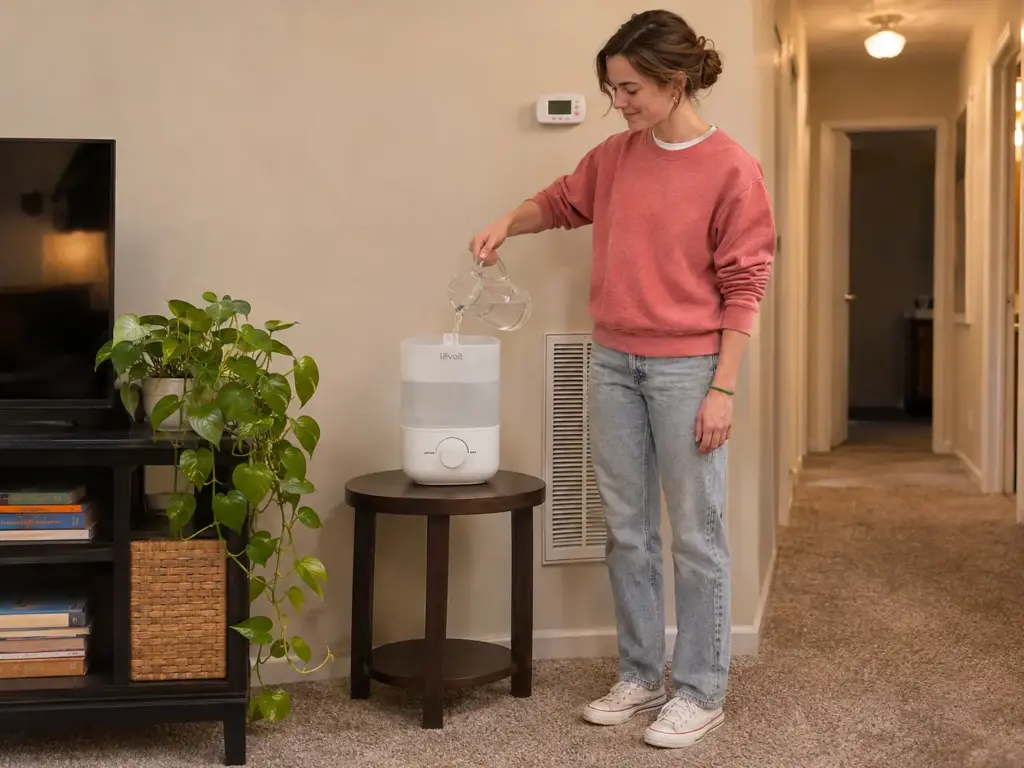
For one shelf or a small bedroom, the Levoit Top Fill 2.5 L (Classic 160) is the realistic size: top fill, up to 25 hours on low and 25 dB. The Levoit Classic 160 is easy to fill, but cleaning is mixed: the wide opening helps and the inside is still hard to clean thoroughly.
An open living room asks more of a unit. A plant corner there stays low whatever the pots do, because the room’s air keeps replacing the pocket you built.
The Levoit Classic 300S states 6 L, up to 60 hours and coverage up to 505 sq ft, and its sensor acts as a humidity controller, holding a reading, so it can be set and left. Its humidity output is mixed: in some rooms the reading at the pots barely moves, and the Levoit Classic 300S can shut itself off without warning or leak.
The largest hourly output in this group comes from the DREO 6 L (HM524), at 300 ml per hour, up to 500 sq ft and 28 dB. Mist output and reliability are mixed there: some units stop putting out mist, and a few fail within about three weeks, with the fan still running and the reading at the pots unchanged. The DREO HM524 has a digital readout that works as a second opinion, and the separate meter’s number is the one to act on.
For a bedroom-sized claim, the Pure Enrichment MistAire states up to 25 hours on low, up to 4 oz per hour on high and 250 sq ft, an honest figure for a bedroom and a stretch for a living room. Durability and cleaning are mixed: some units break within a month, and the tank is hard to clean. The Pure Enrichment MistAire is the smallest claim here, so read it as a bedroom unit.
Where It Goes, and What a Shut Door Does
A humidifier in a closed bedroom raises that bedroom, so the plants in the living room feel nothing. A bedroom with its door shut holds moisture the living room never will, and which units suit a bedroom with the door shut is a different question from the plant corner’s. The unit goes in the room the plants are in, on a stand, aimed along the room and not at the leaves.
The glass stays the check, and the setting falls as it gets colder outside. If the whole house reads dry, one room’s unit starts to look small, and a room unit against a whole-house one is the choice that comes next. A whole-house humidifier raises every room at once, which a plant corner rarely needs.
What Month Two Leaves on the Leaves and in the Tank
The unit worked the first week, and week one is the only week a humidifier looks clean. What it leaves behind decides whether the plants are better or just wetter.
The White Dust and the Scale
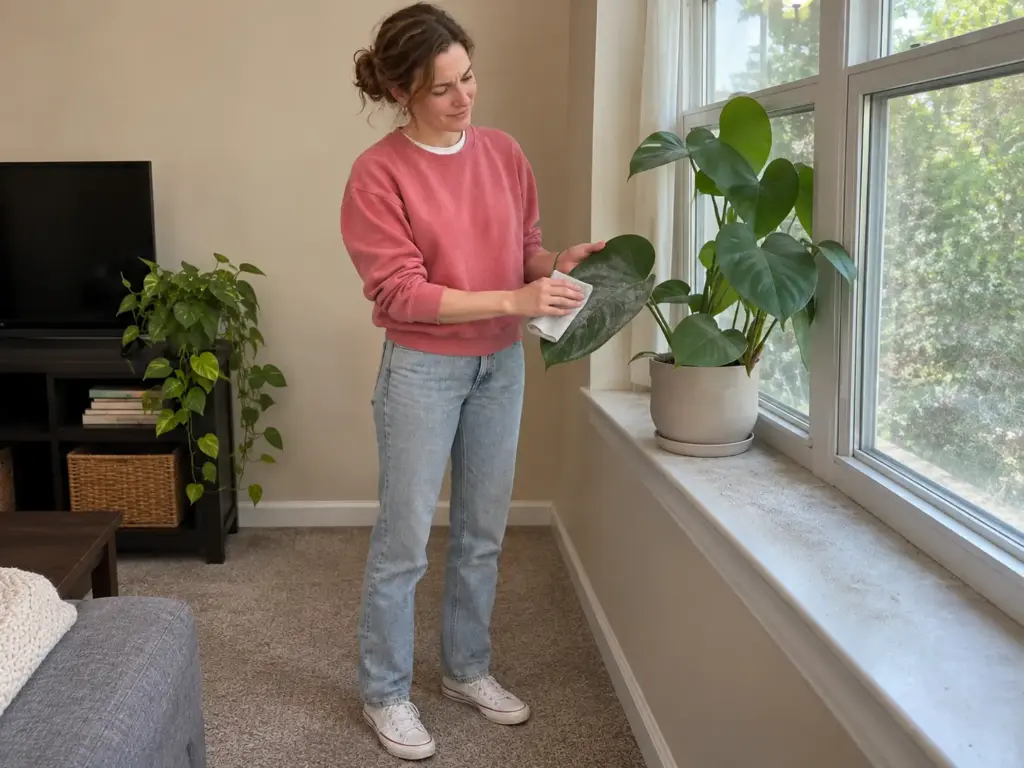
An ultrasonic humidifier on hard tap water coats the leaves, the sill and the furniture in a fine white mineral dust within days. The same minerals scale the disk until the mist stops. The dust is the tap water minerals, and it comes back the week after the wipe until the water changes.
Spider mites, which like dry air, and mold spores, which like damp, still need their own checks on the underside of a leaf, so the wipe doubles as an inspection. White dust against scale, cool mist against warm is the trade-off behind the choice.
The remedy is distilled or filtered water, with a jug filter as the cheap middle step.
An evaporative humidifier is the answer when distilled water by the gallon is not workable, because a mineral filter cartridge does the demineralization inside the unit, so the minerals stay in the cartridge and off the leaves. The tank also grows mildew in corners the brush cannot reach, and after a couple of seasons the unit moves air with no moisture in it. Empty it, rinse it and let it dry between fills. A unit that ran all winter and starts shutting itself off with a full tank is the same model that ran with no complaint in week one.
Tray Water and Fungus Gnats
The tray water goes green and the saucer breeds fungus gnats. Change the tray water on a schedule or drop the tray, because the reach is two inches either way.
The Soil That Stays Wet
Colorado State Extension notes that plants in low humidity lose more water and need more from the roots. The reverse is true in a damper room: the plant loses less, and the soil stays wet longer. How fast it dries also depends on the pot: dense potting mix in a glazed ceramic pot stays wet far longer than a loose mix in terracotta. The plant that was underwatered in January is overwatered by March if the watering does not change with the air.
After the unit goes in, push a finger two knuckles into the pot before every watering. If the soil is still damp down there, wait; the schedule that suited the dry room is too generous for the damp one.
Start With the Reading at the Pots, Then Watch the Glass
Dry air empties the leaf faster than the roots refill it, so the plant closes its pores and takes in less CO2. The number that matters is the one at the pots. The plant wants more than the EPA’s room band and the cold glass sets the limit, brown tips have four owners and the water gets checked first, and the real disease line sits far above the number people fear. The fixes come nearest first, each one read, and a humidifier comes last, sized to the room the plants live in.
For later, look again in the first cold fortnight and in the second month of a unit: the white dust on the leaves and the sill, any film on the lower pane, how dry the soil is at the next watering, and the reading at the pots with the door shut. If any of them has drifted, the setting is the first thing to turn down.
Tomorrow, put a meter at the pots and read it before touching anything. After the first move, whether that is grouping the plants or changing the water, read again at the same spot and the same height. And if the readings say the room will not hold a number, the question left is whether a room unit is needed at all and what size it should be, which the humidifier section above works through.
Frequently Asked Questions
01Does more humidity make houseplants grow faster?
Up to a point: moist air lets the leaf keep its pores open and take in CO2, while dry air makes the plant close them. Very damp air slows the water moving through the plant too, so the aim is a range.
02Do plants make your home more humid?
A little, right around the pots. Plants release water vapor through their leaves, but a handful of pots will not lift a heated room’s reading. Read a meter at the plants, not across the room.
03Does misting raise humidity for plants?
Barely. A spray wets the leaf and fades within minutes, and Nebraska Extension calls misting not an effective solution. On a still leaf in a cold corner it can invite gray mold.
04Why do the leaf tips still turn brown with a humidifier running?
Humidity is only the most likely cause. Fluoride or chlorine in tap water, fertilizer salts and uneven watering burn the same tips, so change the water for a watering cycle and watch the next leaf.
05How humid is too humid for houseplants?
For the room, the EPA keeps a home under 60 percent, and a window that sweats means it is too much. On a leaf, gray mold needs about 85 percent held for hours on a wet surface.