The best humidifier for a bedroom is the one that still holds the air between 30 and 50% with the door shut for eight hours, and that is a different test from the one printed on the box. A shut door turns the room into its own small volume of air: two sleepers add moisture, the room cools overnight, and the percentage on a nightstand meter climbs with nothing running at all. The same unit that read right at bedtime can sit past the band by dawn, so the meter on the nightstand, not the brand or the square-foot claim, decides which unit belongs in the room. What follows reads the room first, then sorts ten units by what they do to tap water and by the room they fit, with the flaw of each one written down, and ends at the point where the wall, and not the air, is the reason to put the humidifier away.
For a bedroom of about 150 to 250 square feet, an evaporative unit with a humidistat set inside 30 to 50% is the safer pick. An ultrasonic one holds up in that room only on distilled water, washed on schedule and small enough that it cannot over-humidify, and the room’s own reading decides the size.
| Unit | Type and tank | Best for | Main flaw |
|---|---|---|---|
| BLUEAIR InvisibleMist H35i | Evaporative, 3.5 L | Hard tap water with no white film | About eleven hours a tank, and it costs more than two 6 L ultrasonics |
| BLUEAIR DreamWell H38i | Evaporative, 3.8 L | A tank and a wick you can actually wash | Humidity control is mixed, and some units stop working after a couple of months |
| DREO HM524S | Ultrasonic cool mist, 6 L | An ordinary bedroom, run on distilled water | No fan, so the 500 sq ft claim behaves like about 350 |
| Levoit LV600S | Ultrasonic hybrid, warm and cool, 6 L | A cold bedroom that needs more output | The onboard sensor can read far from the room, and 753 sq ft is a best case |
| DREO HM311S | Ultrasonic cool mist, 4 L | A room under about 200 sq ft | Cannot hold the band in 220 sq ft with the heat running hard |
A Shut Door, One Night and One Cheap Meter
Shopping for a humidifier starts with a feeling and a list of models, and neither one contains a single number from your room. That number is cheap to get and it decides every choice below it, so the first job is a night of readings with the door shut, judged against the band the rest of this page measures against.
The Band the EPA Gives, and the Meter That Reads It
According to the EPA’s own humidity guidance for a home, “Keep indoor humidity low. If possible, keep indoor humidity below 60 percent (ideally between 30 and 50 percent) relative humidity.” The bedroom has no separate band; what a good bedroom humidity level looks like is the same 30 to 50 percent with the bedroom’s quirks on top, and the EPA adds that a humidifier should not push a room above 50%. So the target is a ceiling as much as a floor, and a unit that can overshoot it needs something watching it.
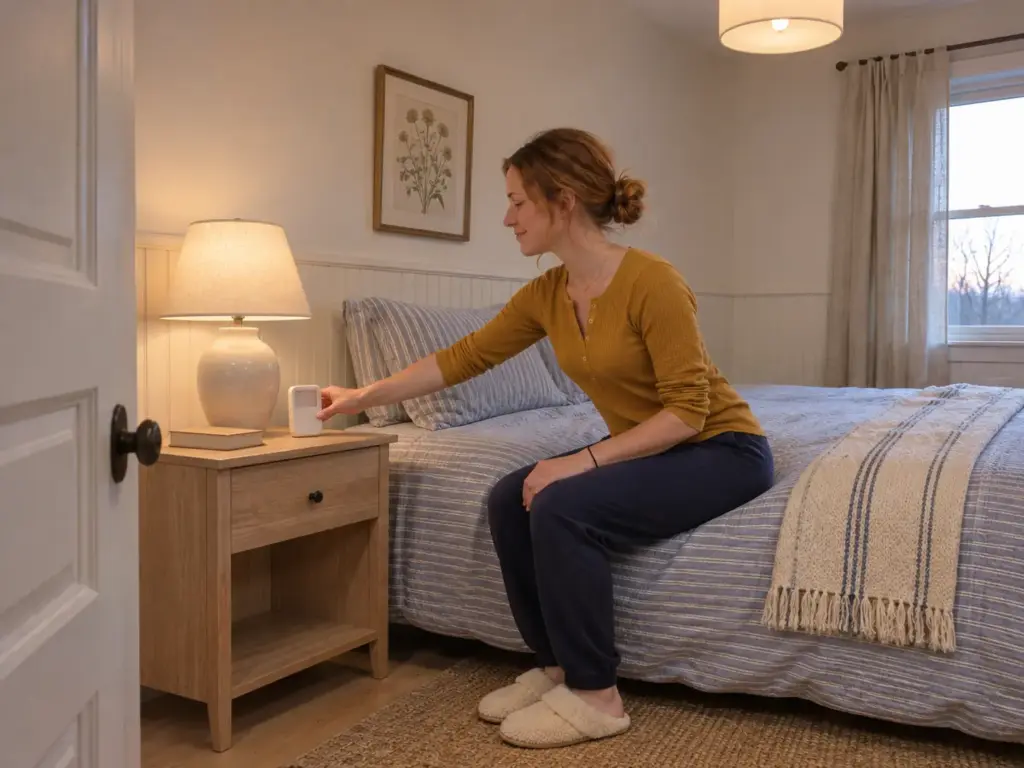
That something is a hygrometer, a small meter that costs a fraction of any unit in this article, and it is the first purchase. A cheap meter you can trust goes on the nightstand at pillow height, away from the mist and the unit’s own display. A separate meter matters because a humidifier’s built-in display and a meter two feet away can disagree by many points, and the separate one is the reading you can believe, since it is not the thing being controlled.
If the reason for wanting a unit is how someone in the house feels, or the room belongs to a child or a baby, whether a humidifier suits that person is a question for a doctor. This page covers the room, the water and the machine.
Give a new meter ten minutes on the nightstand before trusting its first number, then write the reading down with the time of day. A reading with no note about the door, the heat or the weather is hard to compare with the next one.
Bedtime Against Dawn With the Door Shut
Take two readings: one at bedtime, one at dawn, door shut in between. They are two different numbers and the unit has to be judged against both.
Say the meter reads 34% at bedtime and 47% at dawn with nothing running. That room is climbing by itself, and a unit with no humidistat could carry it past 60% before morning. Say it reads 24% at bedtime and 27% at dawn. That room is off on the dry side and stays there, and a unit sized for the room has real work to do.
Two things move the number overnight. Sleepers add moisture with every breath, and the room cools, which raises the percentage even when the water in the air has not changed. The glass is the third reading and it costs nothing: water on the room side of the window at dawn is the EPA’s own sign of high humidity, which means the room already passed the band and the next move is less output, not more.
Two signs are worth knowing apart. The pale line of mineral dust along the back edge of a dark nightstand is the first sign a unit is wrong for the water. The meter on the same nightstand says whether it is wrong for the room. They can fail separately, and an ultrasonic unit in a hard-water house can hold a perfect 40% while it paints the furniture white.
Three nights of the two readings tell more than one. A single night can be a mild one outside or a cold one, and the room follows the weather through the wall and the glass. Write the pair down for three nights in a row and look at the spread: if bedtime and dawn differ by two or three points every night, the room is steady and a small unit with a humidistat will hold it. If they swing by fifteen points, the room is leaking moisture somewhere, or taking it in, and a larger unit will only make the swing bigger.
The 30 to 50% target everybody quotes also depends on the weather. In a mild week 45% is comfortable. When the outside drops well below freezing, the inside of a single-pane window is cold enough that 45% room air sweats on it, and the same number that was right in October becomes the glass’s problem in January. The band is a ceiling the cold side of the house sets, and the meter at the window end of the room is a different reading from the meter at the pillow.
The Free Changes That Come Before a Unit
Free changes come first, in order, likeliest first, with a reading after each. The first is the thermostat: a degree or two lower in the bedroom (1 to 2°F, about 1°C) or a closed register, because the same moisture reads a point or so higher in cooler air and with forced air heat a closed register sends less hot, dry air into the room. Read the meter at dawn after one night. If it moved up a few points, the change worked; if the glass sweats, you went too far and the register comes back open.
The second is the humidistat on a furnace humidifier, if the house has one. Raising the humidity before buying anything covers that dial and the other free sources of moisture in a house. Turn it up one step, wait a night, read again, and stop when the bedroom reads inside the band. Only after both changes have been read does a portable unit make sense.
The static spark at the lamp switch is the other complaint of the same dry bedroom, and the static at the lamp switch that goes with the same reading is a handy second check: when the number climbs toward 30%, the sparks usually fade first.
When the Number Is Fine and the Room Is Still Stale
A reading of 35 to 45% with a room that still feels wrong means the room is stale, not dry. A shut bedroom holds in the CO2 two people breathe out, and why a shut room goes stale overnight is a ventilation question, which a humidifier does nothing about. A humidifier is not an air purifier either: it adds water and filters nothing. Adding moisture to an air problem that is not about moisture is the most common wrong purchase in this category.
A CO2 reading and a door left open a hand’s width answer that question in a night, and the humidifier shopping can stop right there.
What Each Type Does to Your Tap Water
Once the reading says dry, the next question is what leaves the machine along with the water: a fine mist, a wick-filtered vapor or a warm one. The type decides what lands on the nightstand, so it comes before the model.
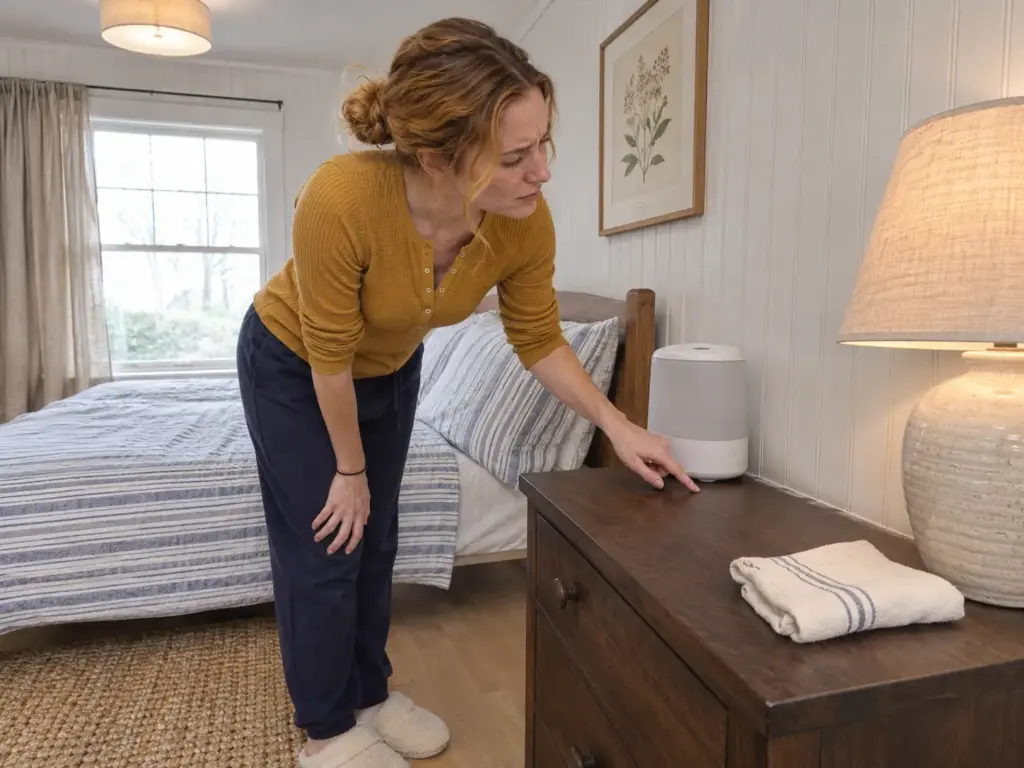
Ultrasonic: Fine Mist and a White Film
An ultrasonic humidifier shakes water into a fine mist with a vibrating disc. The EPA’s page on care instructions for a home humidifier says several studies show ultrasonic and impeller cool-mist units can disperse minerals and microorganisms from their tanks into indoor air. In a hard-water house that means the minerals in the tank become white dust, a fine film that settles on every flat surface within weeks, furniture, shelves, the black top of a monitor. The film is the mineral content of the water, which is why the same unit on distilled water leaves none.
The usual end for an ultrasonic unit in a hard-water house is the closet, because gallons of distilled water turn into a chore. The cheaper answer is a gallon jug from the grocery aisle before a new machine is considered, or a demineralization cartridge where the unit takes one.
Run an ultrasonic unit for one week on a gallon of distilled water and wipe the nightstand with a dark cloth at the end. If the film stops, the water was the cause and the machine is fine. If it keeps coming, the unit is too big for the room.
The width of the pale line on the nightstand matches the width of the mist plume. The film shows where the mist falls, so a unit pointed at a wall leaves its mark on the wall and a unit on a nightstand leaves a stripe on the nightstand.
Evaporative: The Wick Keeps the Minerals
An evaporative humidifier pulls room air across a wet wick with a fan, and the water leaves the wick as invisible vapor. The EPA says evaporative and steam types are not expected to disperse substantial amounts of minerals, because the minerals stay behind in the wick instead of leaving with the mist. That is the whole reason a hard-water bedroom is steered toward the second type.
It also limits itself. As the air near the wick approaches saturation, evaporation slows, so an evaporative unit has a harder time over-humidifying a small shut room than an ultrasonic one does. The price of that is a fan you can hear in a quiet bedroom and a wick that loads with scale, and a wick is something you buy again.
The wick tells the story of the water. In soft water it stays pale and stiff for months. In hard water it turns crusty and gray within weeks, gets heavier, passes less air, and the unit’s output drops without any warning light, because the unit keeps running at the same fan speed while the wick does less. That is why a wick’s quoted life is a ceiling, and a hard-water house sits at the short end of it.
The wick is also the part you can inspect: lift it out, hold it to the window and look at it. A wick that no longer lets light through is done, whatever the calendar says.
Warm Mist and Hybrids: Heat Without a Boil
A warm mist humidifier heats the water before it leaves, and the EPA warns that steam vaporizers can scald and belong out of reach of children. The warm-mist units in this article heat the water and blend it back down instead of boiling it, which is what makes them defensible beside a bed. The type is a mechanism, and the one to avoid is the boiling-element kettle.
Warm mist costs power, and energy use is the line most listings skip. The Levoit LV600S is rated at 280 watts. Run for eight hours with the heater on the whole time, that is 2.24 kilowatt-hours (kWh) a night, and you can multiply by your own rate to see it.
The disk-stack unit later in this article is rated at 8 watts, which is about a thirty-fifth of the draw. The heater is a choice, not a default: it earns its watts in a cold room that needs more output and wastes them in a room that does not.
Room Unit or the Furnace One
A furnace humidifier already on the duct changes the question, because the whole house gets the moisture and the bedroom is only one of the rooms the number depends on. Whether a room unit or a furnace unit is the right size of fix is a separate page, and this one stays with the bedroom unit that lives on a nightstand.
Three Units That Fit Most Bedrooms
With the number and the type settled, these three are the common ground for a closed, forced-air bedroom of ordinary size, and each carries the flaw written under its name, not tucked into the prose.
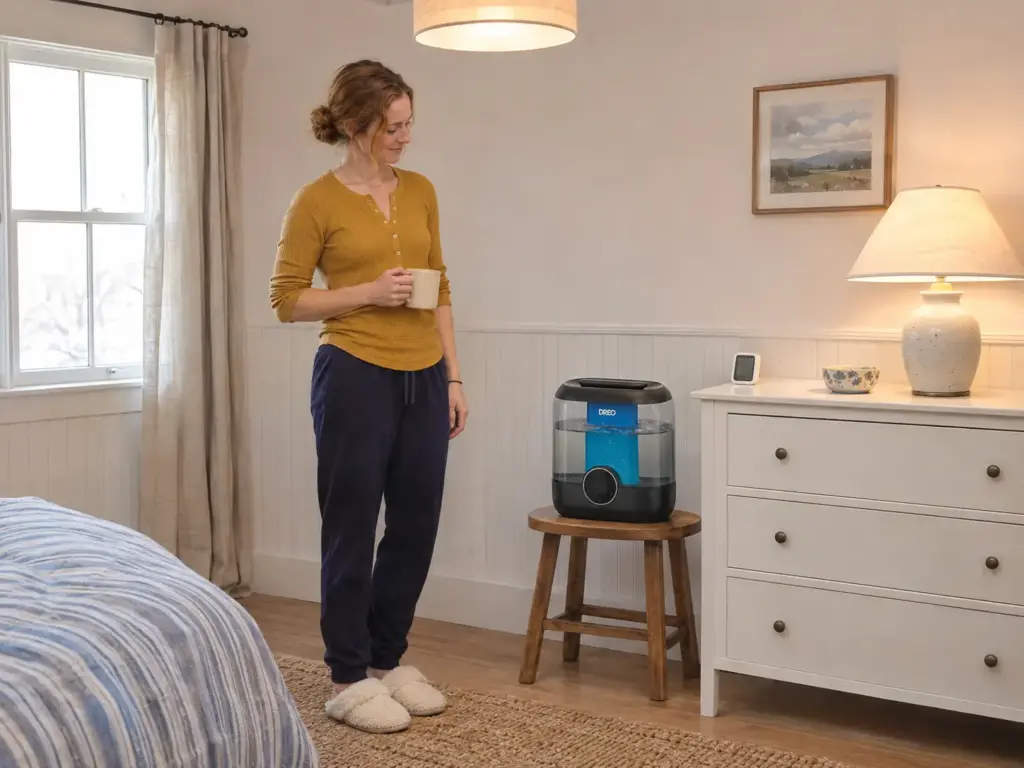
The Six-Liter Unit With a Humidistat and Two Nights a Fill
A 6 L tank run only at night and switched off by day lasts two nights, and that is the figure a person actually plans around. The DREO Smart Humidifier HM524S is the cheapest 6 L unit with a humidistat and an app, which makes it the one a bedroom shortlist usually starts with: ultrasonic cool mist with a top fill tank, 300 ml/h, 28 dB at its lowest setting and a humidistat rated at ±5%.
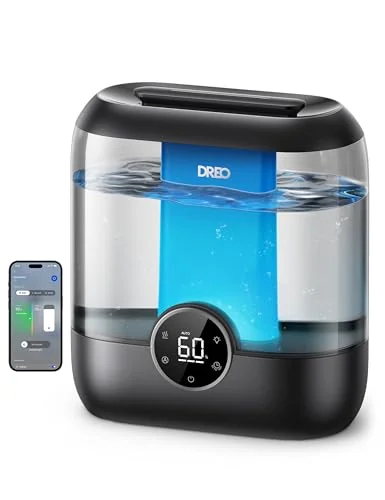
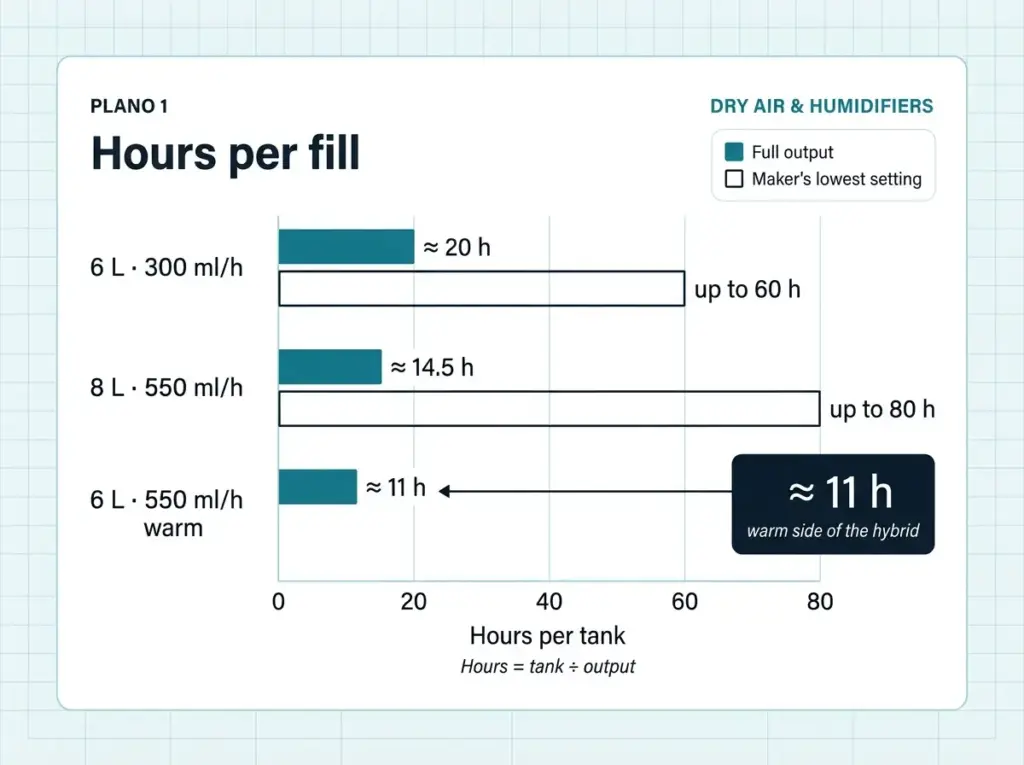
The arithmetic behind that runtime is worth a minute. 6 L at 300 ml/h is about 20 hours at full output; the 60-hour figure on the box belongs to the lowest setting, the only one a closed bedroom lives with on a cold night. Its weak point is the one in the card: with no fan, the mist stays near the unit, and a six-liter unit that was a good humidifier for two months and then began to drip from the base, on parts washed on schedule, is a pattern of the type. The humidistat is judged by the meter on the nightstand, never by the number on the unit’s display.
The common advice for a unit like this is to leave it in auto mode all night and forget it, and that advice breaks in exactly this room. A small closed bedroom with a sensor that reads a few points high gives the unit a target the room reaches early, and then a ±5% tolerance decides whether the unit idles or keeps going. The better call for the first week is to set the target at the low end of the band, 35 to 40%, read the meter at dawn, and move the target up a step only if the room sits below 30% and the glass stays dry. Auto is a setting to arrive at, with a meter in hand, and a poor place to start.
The Familiar Unit, and Where It Slips
The Levoit Classic 300S is the unit most people already know: 6 L top-fill, 300 ml/h, 30 dB or less, a humidistat and Wi-Fi, so the setting can be changed from bed. The maker claims 505 sq ft, which behaves like the HM524S: best treated as a claim, not a measurement.
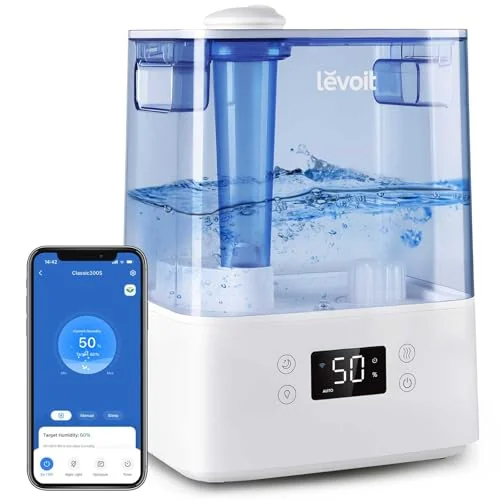
What the card says in four lines needs a paragraph in a bedroom. Mixed humidity output means some units do not raise the room as far as the spec suggests, and a unit that fails near the one-month mark does it after the return window feels like a long time ago. The wash is the part people feel every week, because a tank with corners hides the film in the places a brush does not reach. Pick this one if the app matters, and keep the meter next to it.
A Hybrid That Stops Itself, and the Number It Reports
The Levoit LV600S is a hybrid humidifier, warm and cool ultrasonic, with 300 ml/h on cool and 550 ml/h on warm, a 28 dB sleep mode, a humidistat, an app and a 280-watt rating. Wirecutter’s lab picked it first, and the warm side gives a cold bedroom the output of a much bigger unit. A hybrid that stops itself at a target is the opposite of the haze machine, so it suits the shut door better than the cheap cool-mist unit does.
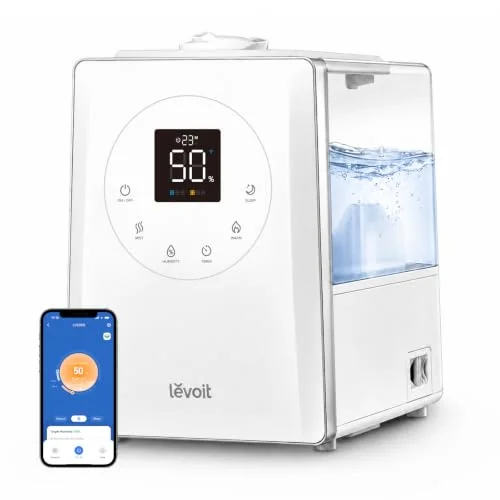
The sensor is the weak spot, and it is a real one. The onboard sensor on this unit can sit far enough from the room’s reading that it has run twenty hours toward a 55% target while a separate meter in the room still said 20%. People who live with that stop trusting the onboard number and automate from a second sensor.
And the 753 sq ft is the best case a maker can print, so in a 150 sq ft bedroom the unit is already oversized and the humidistat is doing a lot of the thinking. Decide from the meter, set the target low (a point or two inside the band) and let it stop.
On the first night with any unit that has a humidistat, set it a few points under the target you want, then read the meter at dawn. A unit that runs all night toward a number the room never reaches is the sensor, not the room, and the glass will tell you before the meter does.
Tank Hours, Decibels and the Square Feet on the Box
Three numbers on the box decide whether a unit survives a night, and the room rewrites all three: the hours per tank, the square feet claimed and the decibels quoted. The arithmetic behind each takes less time than reading the listing.
Hours per Tank: Do the Division
Divide the tank capacity in milliliters by the output in milliliters per hour. Six liters at 300 ml/h is about 20 hours at full output. Eight liters at 550 ml/h is about 14.5 hours. A 6 L tank at the 550 ml/h warm setting is about 11.
The 60- and 80-hour figures on the boxes belong to the lowest settings, and a bedroom on a cold night rarely lives there.
Run the unit at night only and switch it off by day, and one tank turns into two nights between refills. A tank that barely lasts a night on high is a design flaw, usually in a unit that turns water to vapor faster than the tank was sized for. Fine for a living room. In a bedroom it means a refill at the worst time of the day, and a reservoir that sits empty and wet.
The Square Feet on the Box Against a 150 Square Foot Room
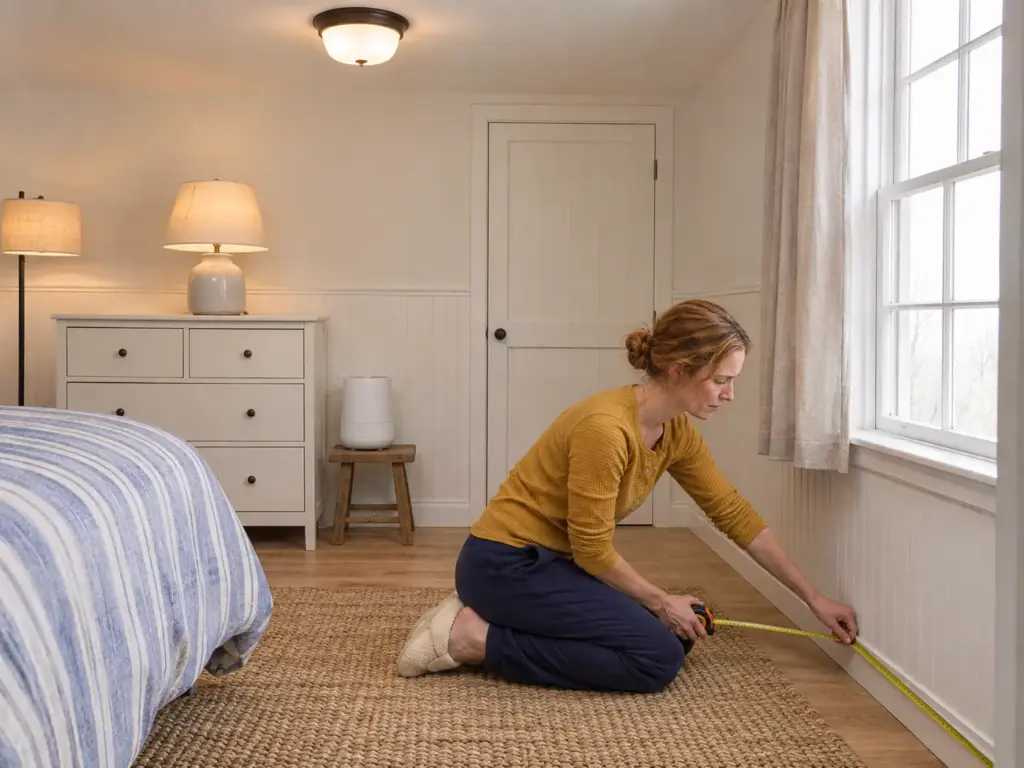
Every coverage figure is the maker’s claim, and room size is where it goes wrong. Units that claim 500 sq ft keep behaving like 350 in open rooms, and units that claim 300 sq ft fail in a 220 sq ft room once the heat runs hard. The box overstates in one direction only, so buying smaller than the label is the safer error: a unit that is a little small runs longer and holds the band, and a unit that is too big holds the band and then overshoots it.
The overshoot is the part of a shut room that hurts. Two sleepers add their own moisture, a big unit adds more on top, and the room can pass 50% by morning with a humidistat that thinks it is doing its job. A sensor reading five points high holds the room five points high. For a closed 120 to 200 sq ft bedroom, a tank of about 4 to 6 L with a humidistat is enough, and the meter on the nightstand is what confirms it.
A worked example makes the sizing concrete. A 150 sq ft bedroom with an 8-foot ceiling holds 1,200 cubic feet of air. The unit that claims 500 sq ft is built for about 4,000 cubic feet, more than three times the volume of the room, and even if it behaves like 350 sq ft in an open room it is still more than double what this room needs.
In a shut room that gap goes into the air with nowhere to leave, so the unit either idles on its humidistat or overshoots it. The smaller unit runs longer at a lower output and lets the number settle, which is the behavior a shut door rewards. The same arithmetic runs backward for a 250 sq ft room with a cold outside wall, where a 4 L unit will run flat out all night and never reach the band.
The Sound Floor at Two in the Morning
Decibels are quoted by the maker, from 20 to 30 dB across the units in this article, and they are quoted at the quietest setting. The fan on an evaporative unit becomes audible on high, the warm setting on a hybrid adds a heater and a fan to the sound, and the display light is a second noise in a dark room, so a dimmable display counts for as much as a night light mode you can switch off. A unit that is quiet at the setting on the box and audible one step up is the one the owner turns down and then stops trusting, because the setting that was quiet no longer moves the number.
Judge sound at the setting the room needs, not the setting on the box. Put the unit on its night mode, close the door and listen for a minute; then turn it up one step and listen again. If the second setting is the one you will end up using, that is the decibel figure that counts.
Smaller Rooms, Bigger Rooms and the Cold One
The first three suit an ordinary bedroom. A small bedroom of 110 sq ft and a large bedroom of 250 sq ft on the cold side of the house ask different things of the same tank, and four more units cover the edges.
The Smallest Rooms and the Cheapest Way In
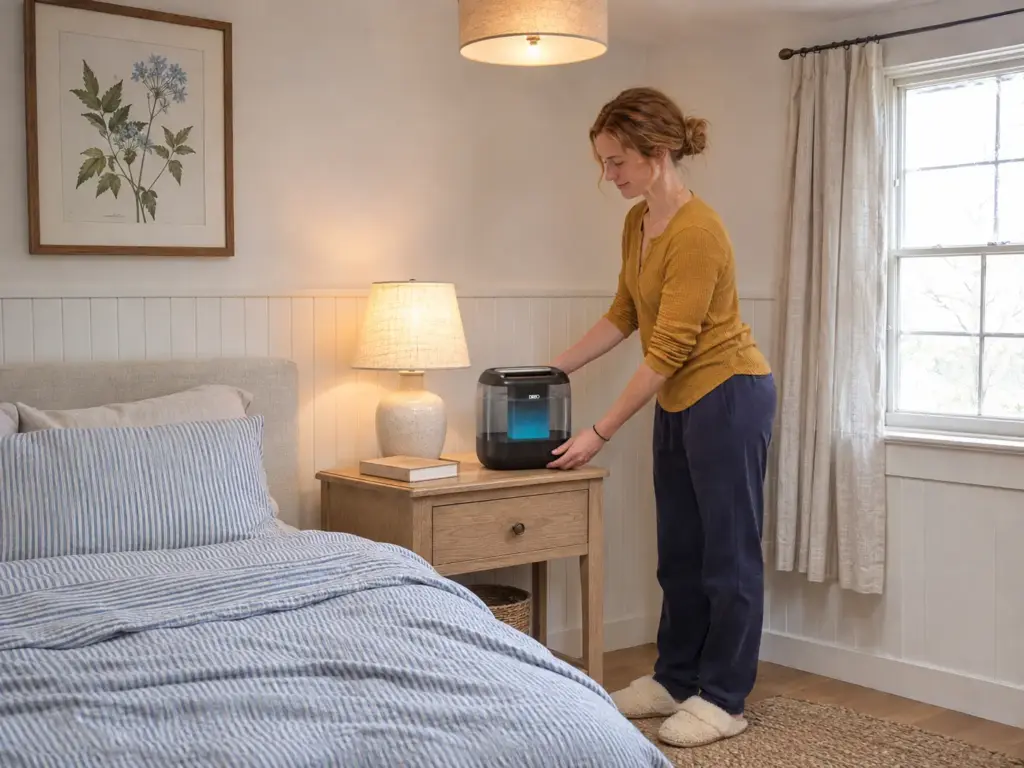
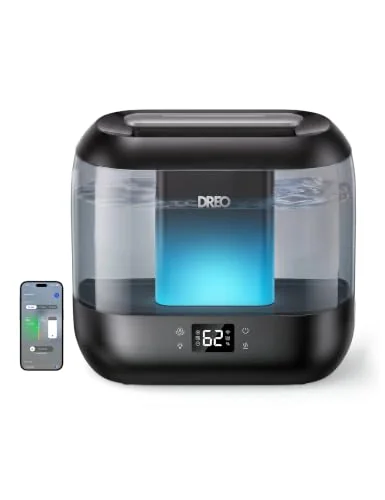
The DREO HM311S is toaster-sized: 4 L, top-fill, ultrasonic cool mist, quoted at 36 hours and 28 dB, with a humidistat and an app. The maker claims 300 sq ft, and that claim is true only in a room under about 200. In a 220 sq ft bedroom with the heat running hard it cannot hold the band, and the durability summary is mixed, with units that break inside two months.
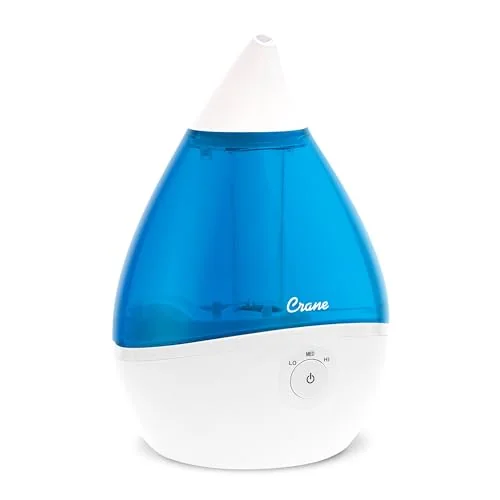
The Crane Droplet is the floor of the group: 0.5 gal (1.9 L), about 24 hours of run time, no humidistat and no app. It is the cheapest thing that actually moves the number in a tiny room, and it takes about half again as long as a 6 L unit to humidify the same space. With no humidistat the meter on the nightstand is the only thing that stops it, which is the best reason to own a meter. Units that break after a week or a month are a loud complaint about the type, and the narrow tank is awkward to scrub.
The Big Bedroom and the Cold One
A tall, cold, 250 sq ft bedroom is where the cool-mist 6 L units run out of reach. The DREO HM717S holds 8 L at 550 ml/h with a cool and a warm setting, 28 dB, a humidistat rated at ±5% and a claim of 600 sq ft, and its tank is two or three nights between fills. The warm setting is what moves a big, high-ceilinged room.
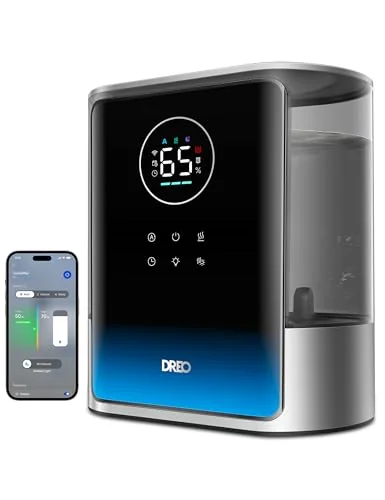
Those three flaws arrive in the order a big-room buyer meets them. The mineral film shows up in the first month in a hard-water house, the fan on the warm setting is audible the first night anyone uses it, and the app drops later, when the humidistat is the thing you most want to reach from bed. The person who bought this unit for the big room discovers the noise at the setting that moves the air, and only then learns that the warm side is where the fan becomes audible.
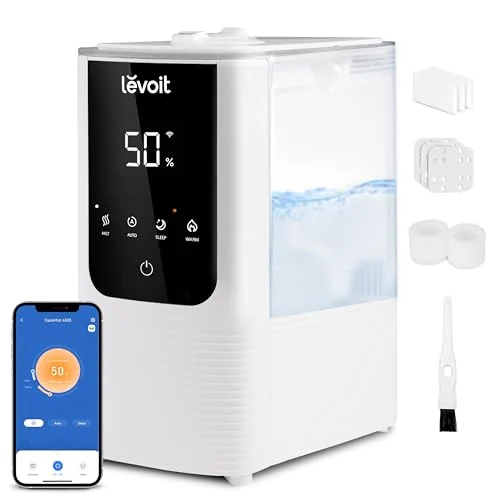
The Levoit OasisMist 450S takes the warm side at a smaller size: 4.5 L, 45 hours, 26 dB, cool and warm, and a humidistat with an auto band of 40 to 60%. It heats the water and blends it down instead of boiling it, so the burn question the EPA raises for steam vaporizers does not describe it.
Two cautions go with it. The wash is the weak point, because opinions on cleaning are split and a real share call it hard to clean properly. And the auto band reaches 60%, past the 50% ceiling the EPA sets for humidifier use, so a separate meter matters more here than on most units.
When the Humidistat Reads Higher Than the Room
Every pick above carries a humidistat that is supposed to stop the unit at the band. What a pick looks like after a season depends on whether that sensor still tells the truth and whether the tank has turned into a cleaning project.
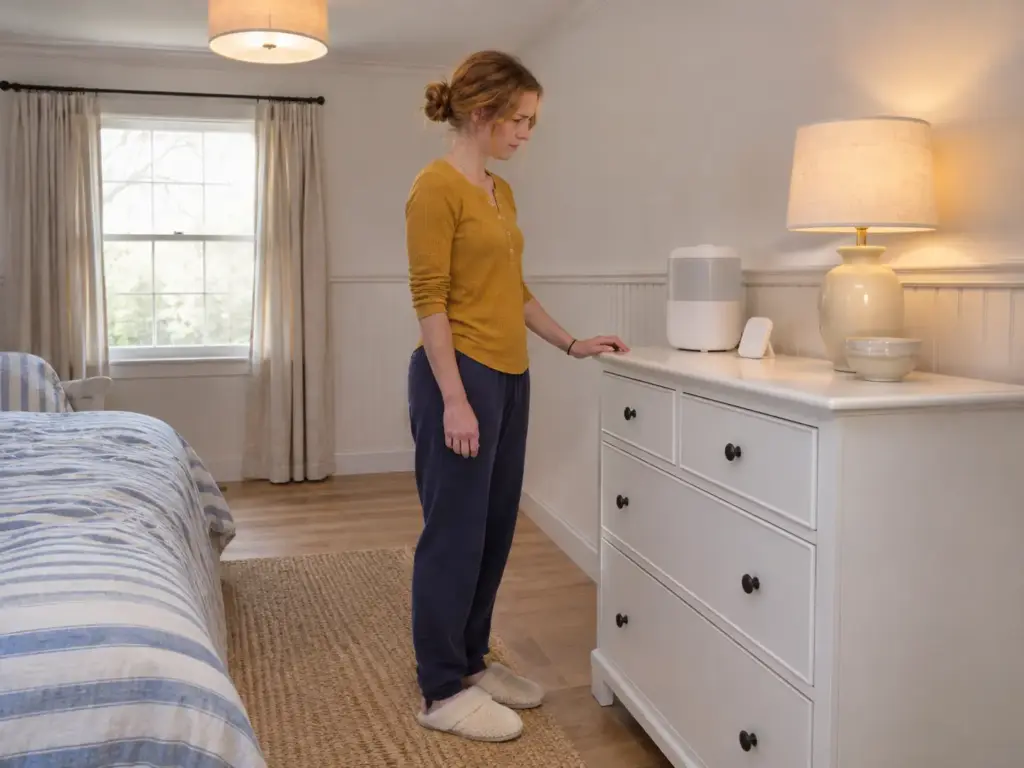
A Sensor Five Points Off, or Twenty
The EPA says that if water condenses on windows, walls or pictures, the humidistat setting should be lowered or the unit relocated. A sensor five points high holds the room five points high, and the glass is the check that the unit stopped.
Humidistats are specified at ±5% (the HM524S and the HM717S both quote it), and one maker’s own support reply concedes sensors can vary by five points or more. Twenty points optimistic has been measured on premium evaporative units against a small meter on the same dresser. The display says 45% while the meter two feet away says 25, and the argument about which one to believe has a clear answer: the meter, because the humidistat is the thing being tested.
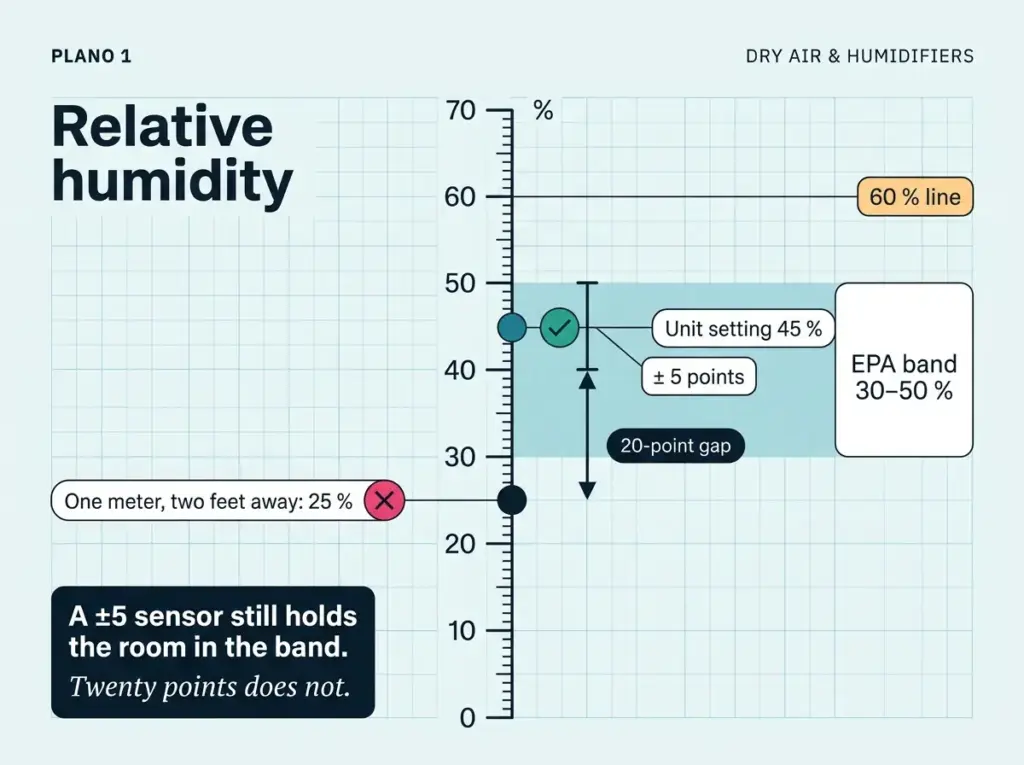
A separate meter and a reset settle it. Why the dial’s number is not the room’s number in winter covers a humidistat that is asked for one thing and delivers another, and the way to take a second reading in the room is the method for the independent number. If the two disagree by more than five points, trust the meter, set the unit’s target lower by the difference, and read again after a night.
A drift is easiest to catch in the first fortnight, before the tank and the wick add their own variables. Put the meter within arm’s reach of the unit’s display, not beside the mist outlet, and compare the two at the same hour for a week.
A sensor that agrees at 30% and disagrees at 45% is telling you it is accurate near the bottom of its range and loose near the top, which is the half of the range where a shut room is at risk. That is a unit worth keeping with a lower setting. A sensor that is off by the same amount at every point can simply be offset by the difference.
The Wick, the Scale and the Tank
The wick loads. The Blueair units quote 6 and 12 months for it, and a hard-water house sits at the short end. Scale cuts output, and scale is a surface microorganisms grow on, which is the EPA’s reason to descale rather than to buy a bigger unit. A unit that was fine in the first fortnight and drifts in the second month is usually carrying scale on the part that makes the mist or on the wick that holds the minerals.
The routine of the subject is plain. A vinegar soak handles scale in an ultrasonic base, citric acid handles the wick and pump of an evaporative unit, and descaling a wick extends its life even though it loses some bite. The maker’s manual decides which acid a given part tolerates, so check it before soaking anything with a seal.
Wash the tank in the morning and let every part air-dry through the day, then refill at night. That gives the roughly six hours of drying the reservoir needs, so it never goes back on the base closed up wet, and the schedule costs no extra time.
The Washing Schedule Nobody Plans For
According to the EPA’s care instructions for a home humidifier, “Clean portable humidifiers every third day to reduce the buildup of scale and microorganisms.” That means empty the tank, brush it and wipe it dry, and it is a bigger job than most boxes admit. A tank run on tap water films in two to three days even at that interval, so weekly is already behind.
A routine that holds up has three parts: wipe the base with a wet towel every other day, make weekly cleaning a deep one instead of a single heroic monthly scrub, and let every part air-dry before it goes back together. The pale film that returns two days after the monthly scrub is the sign the interval was too long. The tank is what a unit is judged on after the first few months, long after the sensor has been forgiven.
Three Built for Tap Water and a Washable Tank
The weekly job and the white film are the two reasons a bedroom humidifier ends up unplugged, and three units are designed around removing both. They cost more, and the cost shows up in their flaws as much as in their features.
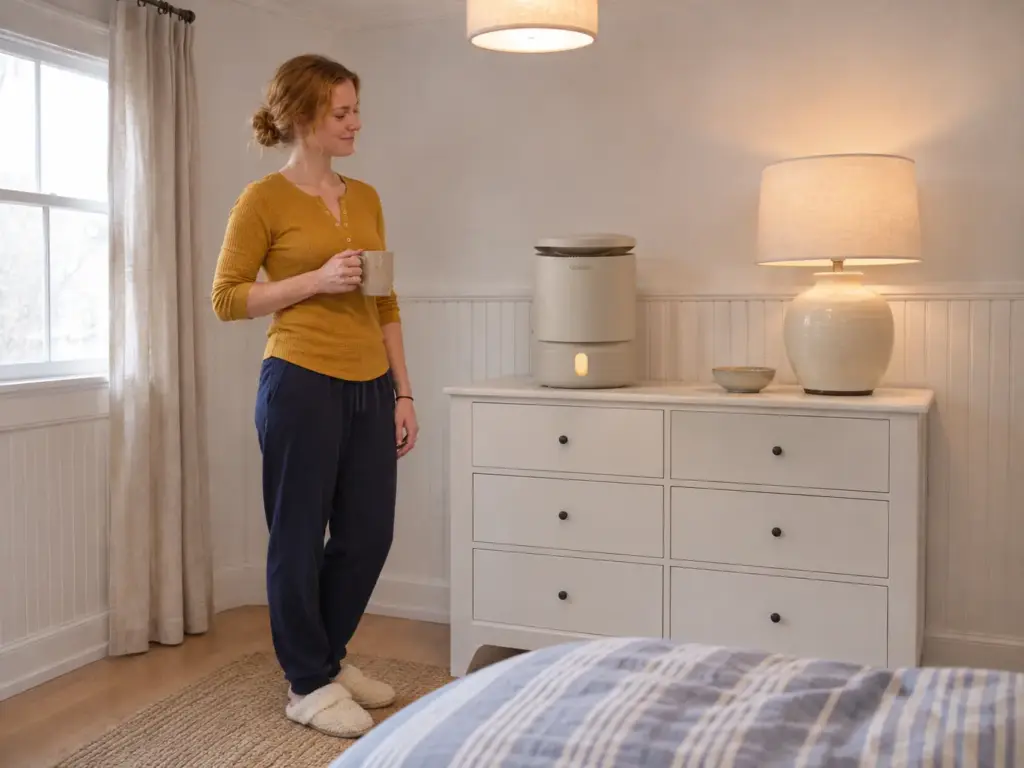
No White Film, Tap Water Allowed
The BLUEAIR InvisibleMist H35i is evaporative and mist-free, with a 3.5 L top-fill tank, an antimicrobial wick with a 6-month life, an AutoHydrate humidistat, a 20 dB night mode and an app. Tap water is allowed, and the wick holds the minerals in place of the furniture, so the pale line on the nightstand does not appear. It claims 596 sq ft. Its weak points are the price and the runtime: it costs more than two 6 L ultrasonics, RTINGS measured about eleven hours from a tank, and the listing is young enough that the track record is thin.
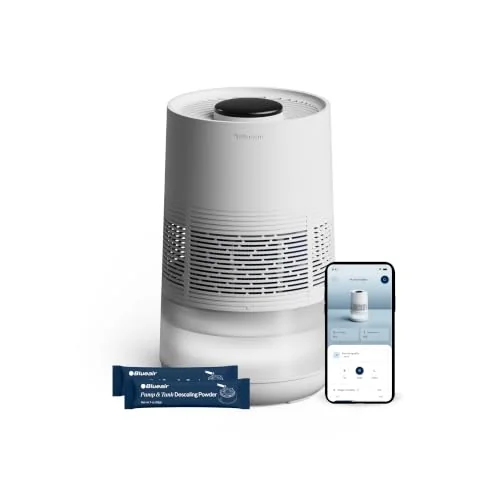
The VENTA LW25 answers the wick problem differently: a stack of disks turning in the water, so there is no filter to buy and no mineral dust to wipe. It holds 2 gallons, claims 430 sq ft, draws 8 watts and takes tap water. At eight hours a night that is 0.064 kilowatt-hours, against the 2.24 for the 280-watt hybrid, which is roughly a thirty-fifth of the running load.
It is the one unit here a hard-water house can feed from the tap for years. The trade is output: humidity results are mixed, some units do not raise a room as far as hoped, some fail within months, and the price buys three ultrasonics.
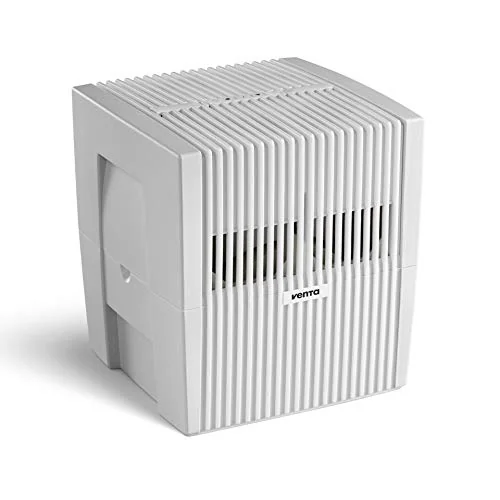
A unit this expensive is not always worth it. Distilled water by the gallon in a 6 L ultrasonic does the same job for a fraction of the cost, and a bigger tank is not a cleaner tank. The evaporative wick quotes 6 or 12 months, so wick replacement is a recurring item, while the unit with no filter has no recurring item, and the person who bought it for that discovers what it does to the number.
Run the cost of a clean nightstand as a comparison, not a figure. A wick every six months on the H35i is two wicks a year; a 12-month wick on the H38i is one; the Venta has none.
Add the distilled water a 6 L ultrasonic drinks: at 300 ml/h and eight hours a night, that is 2.4 L a night, about 17 L a week, so a gallon jug lasts a little over a day and a half. Put the two side by side with the unit’s price and the break-even arrives later than it feels at checkout. For a house with soft or moderately hard water, the cheaper route to a clean nightstand is distilled water in the cheap unit, and the premium units are for the house where the gallons stopped being a habit.
The One Whose Tank Goes in a Dishwasher
The BLUEAIR DreamWell H38i is the one you can actually wash: a 3.8 L (1 gal) tank that is dishwasher safe, filled through a funnel, and a wick that goes in the washing machine and carries a 12-month life. It is evaporative and mist-free, 20 dB, with a humidistat and an app, and it takes tap water. That is the difference between a week-three biofilm and a clean reservoir.
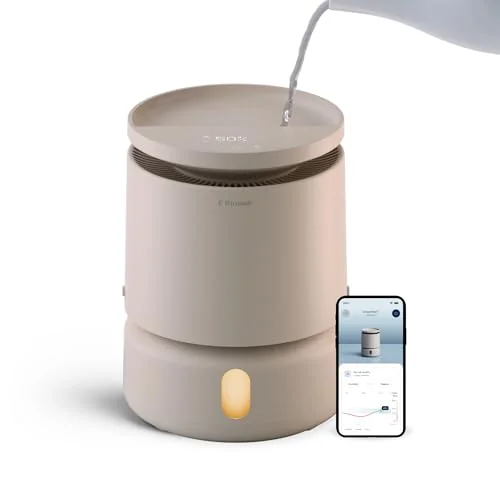
The weak point is what it does for the number. Humidity control is mixed: some units struggle to raise the room, and some stop working after a couple of months. Two premium evaporative units optimistic by about twenty points against a small meter is the reason all three of these still need the meter beside them. The easy wash buys back the weekly job, and it does not buy back the reading.
When the Wall Is Wet, the Fix Is Not a Humidifier
Every section above assumes the room is dry. This one is for the reading, the glass or the frame that says the opposite, because a humidifier in a damp room makes the building’s problem worse.
The Glass Says You Already Passed the Band
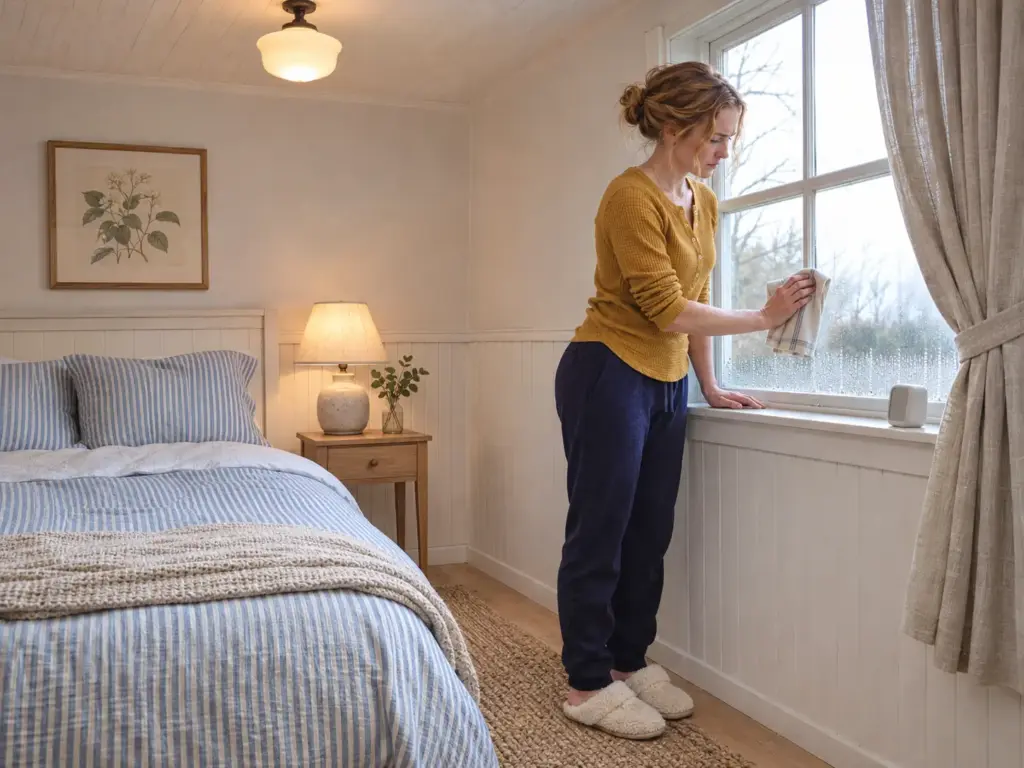
The EPA’s advice on condensation and the sources of moisture says condensation or moisture collecting on windows, walls or pipes is a sign of high humidity. The surface gets dried and the source reduced, so the answer is less output, not more water. To prevent condensation, reduce humidity and increase ventilation or air movement.
Which side of the glass the water is on matters, because the room side is the humidifier’s side. How a window sweats hour by hour overnight is the same shut bedroom the article opened on, seen through the night.
A window that sweats a little on its coldest pane shows the overshoot before the wall shows anything. It is a reading before it is mold, which makes it the best early warning a shut room gives, and the cheapest.
A Wet Frame, a Damp Wall or a Reading Above 60%
Three things say the moisture is the building’s. The wall behind the bed is damp. The window frame is wet on the inside of the frame and not only the glass. The room reads above 60% with no unit running.
In each case the cause is a leak or a cold wall, a humidifier is the wrong purchase, and a building problem goes to a contractor, not a filter. Keeping mold off a bedroom wall below 60% shows what an oversized unit in a shut room risks, and where the 60% line comes from is the mold ceiling the EPA draws.
Cold walls are the usual suspect. An exterior wall corner behind a headboard or a wardrobe, with no air moving across it, is the coldest surface in a bedroom, and moist room air touching it condenses first. The sign is rarely a puddle: it is a darkening in the paint, a smell that is stronger with the wardrobe shut, or wallpaper that lifts at the seam. If that is the pattern, moving the furniture a few inches off the wall and leaving the door ajar costs nothing and gives the wall air, but a wall that stays damp after both is a contractor’s problem and no machine on a nightstand fixes it.
A unit sized for a bigger room, or a sensor reading five points high, can over-humidify a shut room without any building problem at all. The glass is the check. When it sweats, lower the setting, move the unit, or switch it off for a night, and read the meter again.
The Next Machine Is the Dehumidifier
If dawn reads high instead of low, the answer is on the damp side of the same bedroom, with pints, decibels and a bucket to empty. A dehumidifier sized for a bedroom takes the reading the other way. The meter is what tells you which page you are on.
Read It at Bedtime, Read It at Dawn, Then Choose
The number comes from the bedroom, taken at bedtime and again at dawn with the door shut. Everything else follows from those two readings:
- The free changes come before any unit: a degree or two on the thermostat, a register, the furnace humidistat.
- The type decides what lands on the nightstand, and a hard-water house leans evaporative.
- Buy smaller than the label and judge the sound at the setting the room needs.
- Every unit carries a flaw, written on its card, and the humidistat gets checked against a separate meter.
- A damp wall is not a humidifier problem.
The target is not the same all winter. What a reading that is too low actually means is worth reading before the first purchase, and the figure that is safe in October is too high in January, because glass gets colder as the outside does. Why the right setting falls as the outside gets colder explains the drift. Compare the unit’s display with the meter after the first fortnight, look at the film in the tank after the third wash, and check the wick at the six or twelve months the maker quotes.
Tonight, put the meter on the nightstand and read it at bedtime. Read it again at dawn. Tomorrow decide the type and the size from those two numbers. If both are fine and the room is still stale, the answer is a ventilation question, and not a humidifier one.
Frequently Asked Questions
01What size humidifier do I need for a bedroom?
Buy smaller than the box says: for a closed 120 to 200 sq ft bedroom, a tank of about 4 to 6 L with a humidistat is enough, because coverage claims are the maker’s best case. The room’s own reading decides.
02What humidity level should a bedroom be at?
The EPA says below 60%, ideally 30 to 50%, read with a separate meter, because a unit’s own display can drift. Water on the glass at dawn means the room is already past the band.
03What is the best type of humidifier for a bedroom with hard water?
An evaporative or filter-free unit, because the wick or the disks keep the minerals instead of throwing them into the room. An ultrasonic unit needs distilled water or a demineralization cartridge to avoid the white film.
04How often should you clean a bedroom humidifier?
The EPA says every third day: empty the tank, brush it and wipe it dry. A tank on tap water films within two to three days, so weekly is already behind.
05Should a bedroom humidifier run all night?
Only with a humidistat that stops it at the band and a second meter to check the humidistat. If water beads on the glass in the morning, the setting is too high or the room is too small for the unit.