
The meter on your shelf reads 27 percent in the coldest week of the year, the door handle gives you a small snap when you touch it, and a humidifier is one click away. Can indoor humidity be too low? Yes, but the number alone rarely settles it: air that comes in on a freezing day carries very little water, and heating it to 70°F (21°C) drops its relative humidity before anything in the house has gone wrong. Whether dry air is bothering your eyes, skin, throat or sleep is a question for a doctor, so this article stays with the house: the floor and what the EPA says about it, the meter check, what the building shows, and the one change to make before a humidifier.
Quick Answer
Yes. Below about 30 percent relative humidity a house starts to show it, but the EPA publishes no lower limit: its ideal band is 30 to 50 percent, with 60 as the ceiling. So 30 is the floor of an ideal range, not a failure line. Check the meter against a second one before you act.
Where the Floor Sits and What the EPA Leaves Open
Somebody says 25, somebody else says 40, and a heating vendor says 45 to 55. All of them sound like a floor, and only one number in that pile comes from a published standard. This section sorts the published band from the rules of thumb, because every later step is measured against it.
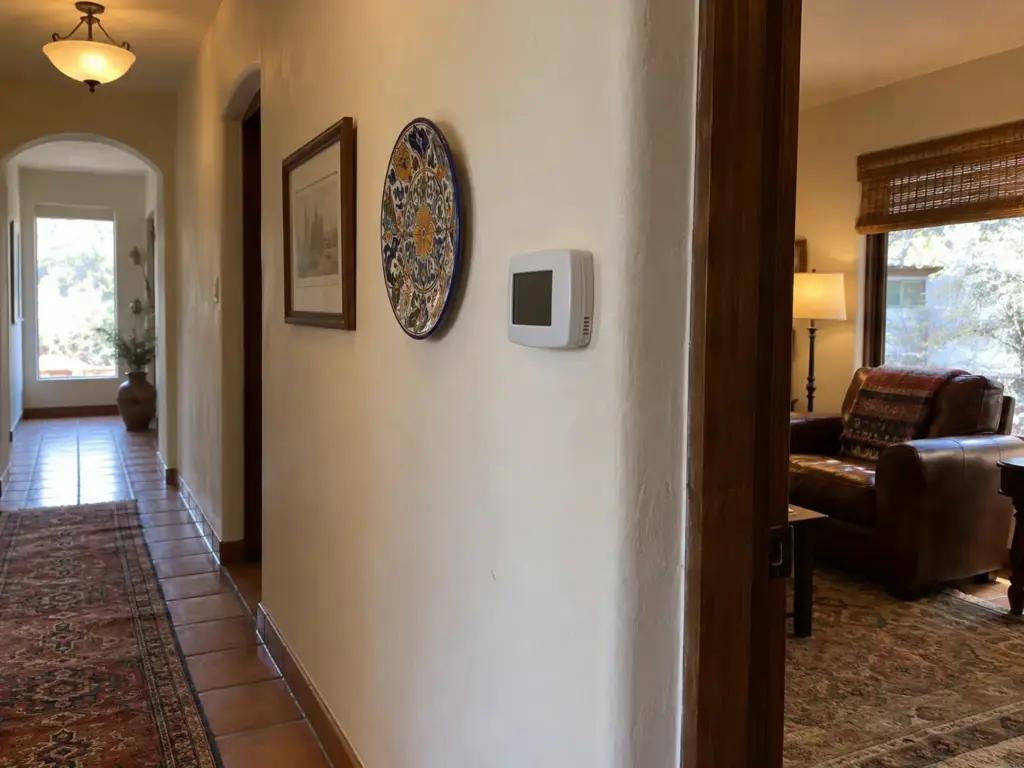
What the EPA band actually covers
According to the EPA’s guide to mold, moisture and your home, “If possible, keep indoor humidity below 60 percent (ideally between 30 and 50 percent) relative humidity.” Read what that sentence asks for. It sits inside a mold guide, so its first job is the ceiling: 60 percent is the number to stay under, and 30 to 50 percent is what it calls ideal. The same page says a humidity meter is the way to measure it, which puts the meter ahead of any purchase in this article too.
The band is also a target for the house over a season, not a pass-or-fail mark for one reading on one cold morning. The range by month and by room is laid out in the full ideal-humidity band.
Why 30 is a rule of thumb, not a rule
Thirty is the bottom of the EPA’s ideal band, which is a different thing from the line where a house fails. A reading of 27 or 28 sits just outside the ideal and inside what many houses show in a cold week, so it is a prompt to check, not a verdict. The EPA page sets no lower limit at all, and any other floor you are handed (25, 40, 45 to 55) comes with no published source.
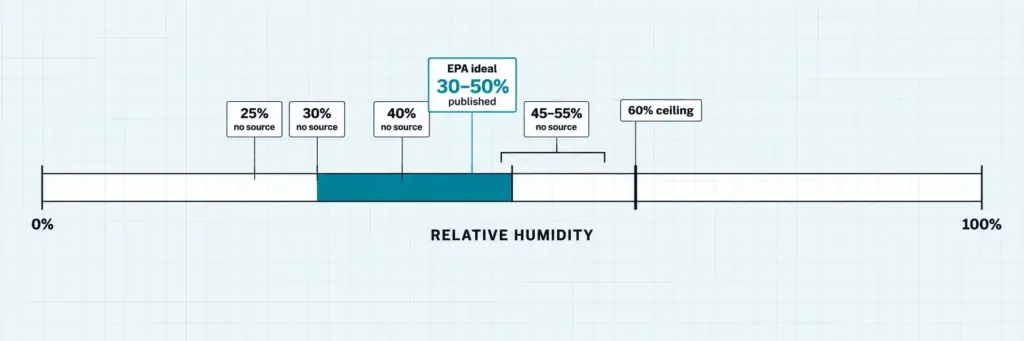
The building gives its own reason to hold a floor. Aiming for 55 to 58 percent in winter runs into a limit: a thermostat humidistat may not go that high, and warm, moist air that leaks out in cold weather condenses once it touches a cold surface. Low humidity can shrink wood trim and floors. Around 30 percent is where the EPA’s recommended band starts, and a house begins to ask for something.
Why the same house reads 30 in one week and 15 in the next
The number follows the weather outside. Heating cold outdoor air drops its relative humidity sharply: air at 24 °F (-4 °C) and 49 percent, once heated to 70 °F, ends up far drier. The water in it does not leave. The air got warmer, warm air can hold much more, and the same water became a smaller share of what it could hold.
So one morning is a data point. Read it again in a milder week before deciding anything is wrong with the house, and see what the outdoor temperature does to the target for the full set of pairs.
Write the outdoor temperature next to every indoor reading, even on a scrap of paper. A 27 percent with 15°F (-9°C) outside and a 27 percent with 40°F (4°C) outside are different findings, and after a week of pairs you can see whether the house tracks the weather or sits low whatever the weather does.
Trust the Reading Before You Act on It
A cheap meter can sit several points off, and the same room reads differently depending on where the meter stands. So the number gets checked before anything is bought. It is the free step that comes ahead of every purchase on this page.
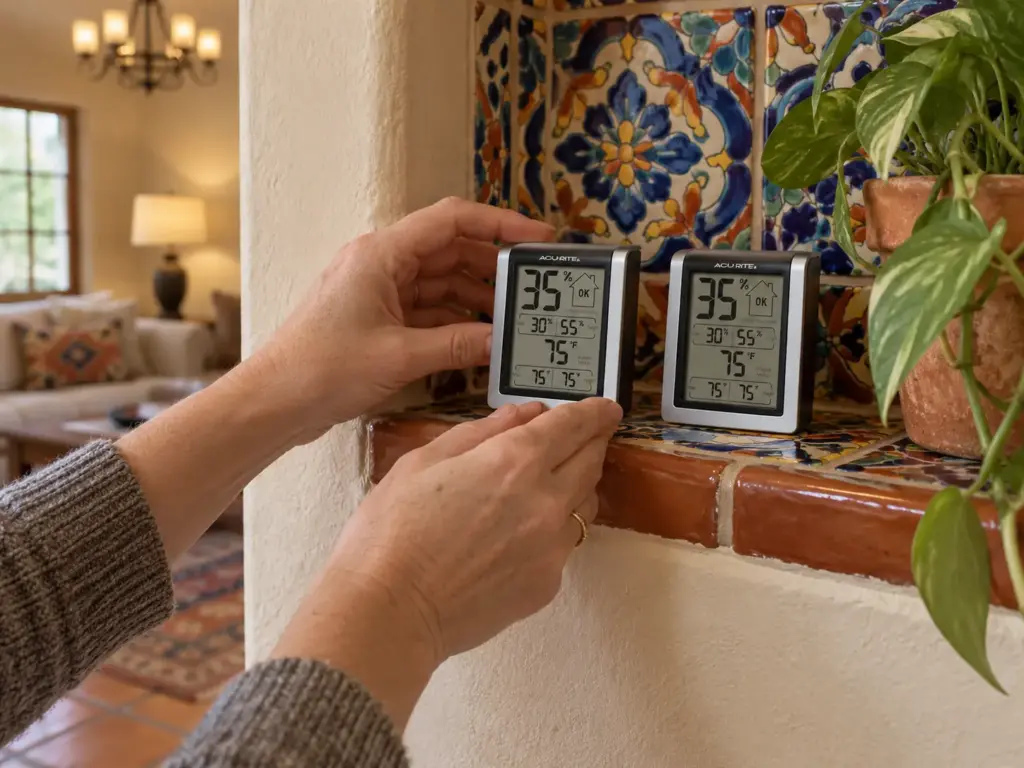
Two meters on the same shelf
The method is the comparison, not either meter. A low reading is worth checking before you trust it. Two digital meters placed beside two analog ones is a simple way to double check, and a sensor that is off is the first suspect.
If two meters agree within a few points, believe them. If they differ by ten, the meter is the story, and no humidifier setting will fix a wrong number. The routine for three readings with one meter is its own article; this is the short form.
The AcuRite 00613 Indoor Thermometer & Hygrometer is a low-cost way to get the second reading: a tabletop digital unit on one AA battery, with an operating range of 16 to 98 percent relative humidity on its listing. The listing does not print an accuracy figure, which is the reason to use it as a check against the meter you already own. Two unknowns that agree are evidence; one unknown alone is not. The 16 percent floor of its range also matters: a reading in the teens is at the edge of what it reports, so treat it as very dry and not as a precise figure.
Once both meters agree, the house becomes the question. Two houses on the same forced-air heat can sit far apart in humidity, so a reading from one house says little about another. After two meters agree, a gap like that belongs to the house.
Wait for the reading to settle
A meter carried in from another room is still reporting where it was. Leave it in its new spot until the number stops moving, and do not read it right after a shower, a pot on the stove or a window opened to air the room out. Each of those leaves a short bump or dip that is the room’s last event, not its level.
A meter that logs takes the guesswork out of the timing. The Govee H5075 Bluetooth Hygrometer Thermometer keeps its readings in a phone app, so a week can be judged against the band instead of one minute. A single night at 27 that is back at 33 the next afternoon is a blip; a week that never leaves the 20s is a pattern. Its accuracy is not printed on the listing either, and it needs a phone to show you anything, so think of it as a second opinion that happens to keep notes.
Put both meters side by side, wait until neither number moves, and write both down. Then carry the pair to a second room and compare again. A gap that stays the same is the meters’ own difference; a gap that changes means one of them drifts, and that one is not the number to buy a humidifier for.
Put it at sitting height, in the room that feels dry
A meter on a windowsill reads the window’s own pocket of air: colder by the glass, or hot and dry if a heater sits underneath. Neither is the room. Move it to a shelf at sitting height, away from the window, the heater and the stove, in the room where the dry reading was a concern, and the number changes before anything else does. The same day can show one value on the shelf and another on the table by the window, and both are true for their spot.
The no-cost version needs only one meter: carry it between two rooms, or borrow a second one, before spending anything. If you do end up buying, a cheap humidity checker you can trust covers what to look for, and the instrument costs a fraction of any humidifier.
What a Dry House Shows and Where the Dry Air Comes From
A meter gives a number, and the house says whether the number matters. This section keeps to three signs the building gives and the causes behind them, then says where a humidifier stops being the answer.
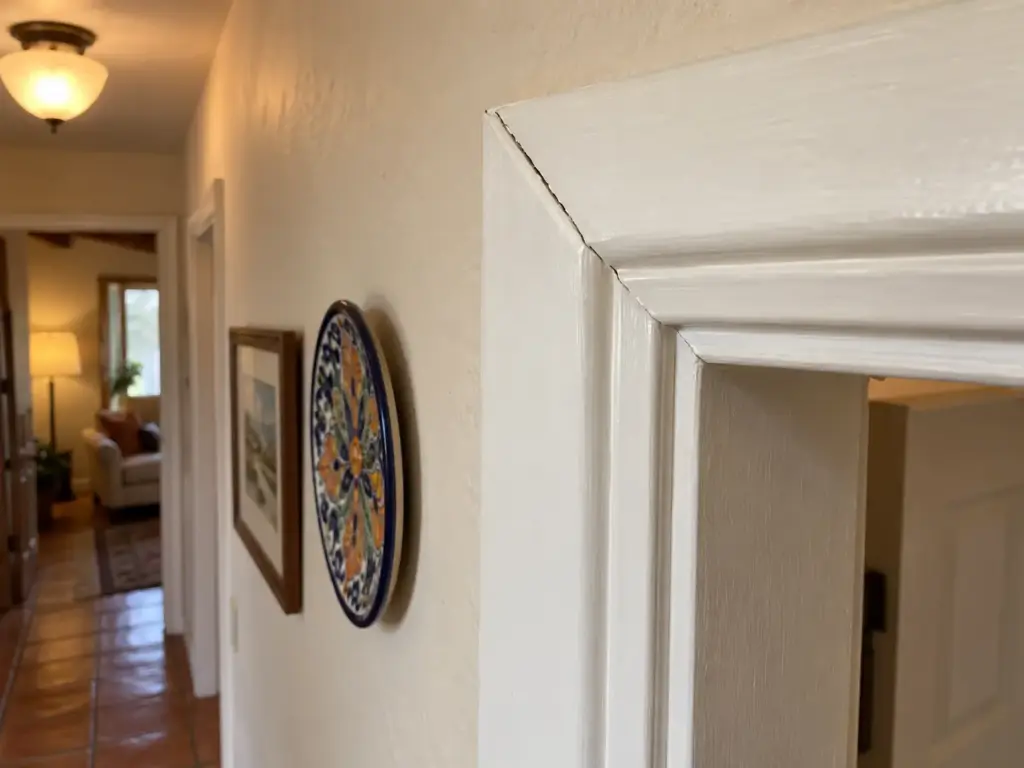
Three signs the house gives
Three, used as a check: a static shock from a doorknob or a stair rail; a hairline gap opening between boards, in wood trim or a floor; and window fog that used to appear on the coldest mornings and has stopped. If the meter reads low and none of the three shows up, the meter or the week’s weather is the likelier story. But if all three show, the reading is real. The trim gap is the same warning about wood shrinking, seen from inside the room.
Cold air heated is the usual source
Winter dry air starts outside, because cold outdoor air carries little water. Bring it in and heat it, and the same water is a small share of what warm air could hold: the 10 to 15 percent arithmetic from the first section. Each time the house swaps its air for outdoor air it swaps moist for dry, so the leakier the house, the faster the reading falls and the harder it is to bring back. Two houses on the same heat can sit 15 points apart for this reason alone.
A drafty, poorly insulated house drops much lower in cold, dry stretches than a better-insulated one does. Humidifiers in two rooms of the old house ran around the clock and did “not seem to make much of a difference.” The full chain of causes is in why indoor humidity can drop so low, and the winter band is in how indoor humidity shifts with the cold.
The opposite house exists. Normal household activities generate a good deal of moisture, and in a very tight house that can be enough to hold the number up without a humidifier. A blower-door test, which measures how much a house leaks, is a better answer than a guess.
Other sources of dry air get one line each: a furnace that runs hard and pulls in outdoor air, an overventilated house, and a wrong meter, which sends you back to the previous section. When the structure itself is the leak, the professional to call is an HVAC or air-sealing contractor.
On a windy cold day, hold the back of your hand near outlets on exterior walls, around window frames and along the gap under the door. A draft you can feel is a leak a humidifier will be fighting all winter. Mark each one with a piece of tape and deal with those before anything is plugged in.
When the house leaks, the humidifier loses
Here the test is the day after the unit stops. If the reading falls back to its floor within a day of switching a humidifier off, the leakage in the house, not the unit, is what sets the number. The humidifier is holding the house; it is not changing it.
There is an overshoot on the other side too. A unit that does hold the reading in a leaky house can push it past what the coldest glass tolerates, and window condensation on the room side shows where that line sits.
The First Fix, Its Flaw and the Point to Stop
Once the reading is real and the house confirms it, the free changes come first and a humidifier comes last, with its upkeep in writing. This section gives the order, what a portable unit can and cannot cover, and the place to stop turning it up.
Free first, one change at a time
Change one thing, then read the meter before the next. In this order, free and likeliest first:
- Put the meter right with the second meter from the previous section, so the number you are fixing is a real one. The next reading should simply agree with the second meter.
- Let the moisture the house already makes stay in it. Cooking, especially long simmering, and leaving the bathroom door open after a shower both raise the number. The reading should creep up while the pot simmers and fall back after; if it never moves, the house is outrunning the source.
- Add a few plants on a pebble tray. Houseplants add moisture, but slowly, over days rather than hours, so space the readings out.
- Seal the drafts you found with the back of your hand. Air sealing is a low-cost change that keeps working all winter, and drafts are the first place to look. With the same settings, the next cold night should hold a higher number than the last one.
For the whole raise path, how to raise indoor humidity picks up where this list ends. A furnace-mounted humidifier on a forced-air system is the whole-house option. Bypass models are one common type.
What a portable humidifier does and does not cover
A portable unit adds water at a fixed rate to one room, and a leaky house removes it at a rate that changes with the wind. When the leak is faster, the unit runs all winter and the meter barely moves. That is the case the free fixes above are meant to rule out, and a humidifier belongs after them, not instead of them.
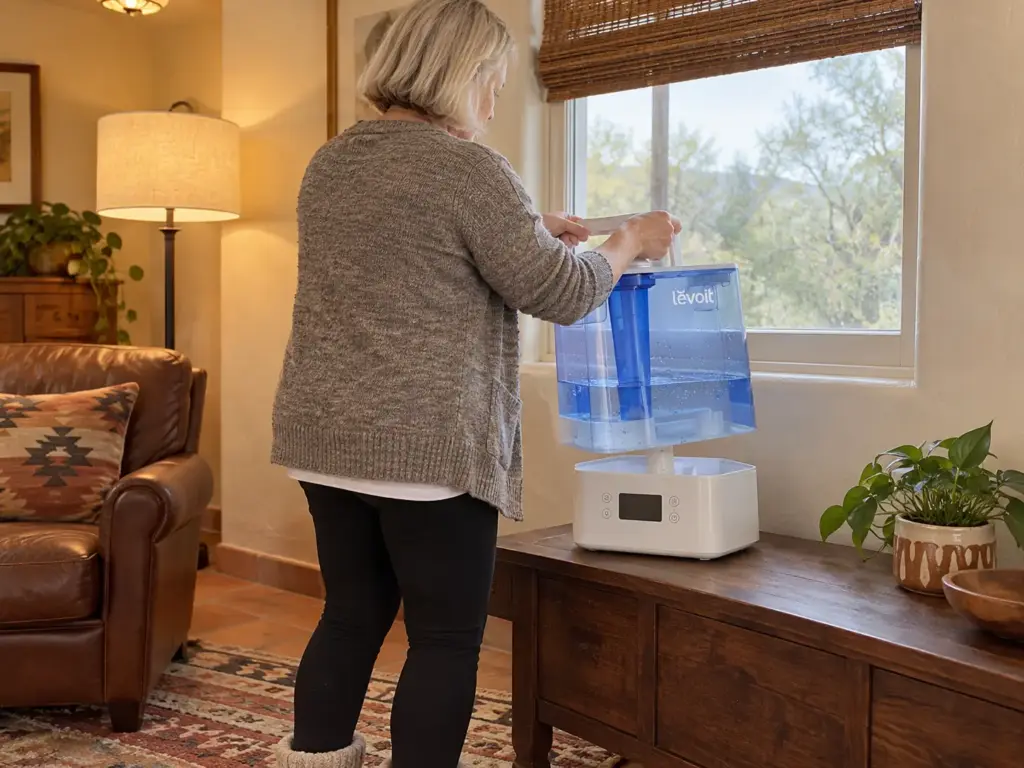
If the reading is real, the house is reasonably tight and one room still needs help, the Levoit Classic 300S Ultrasonic Smart Humidifier is a 6 L (about 1.6 gallon) top-fill model with a built-in humidity sensor and an auto mode. Its listing gives an effective range of 215 to 505 square feet, a run time of up to 60 hours on a tank, and a sound level of up to 30 dB. The top of that range is far short of a 1,200-square-foot house, so one unit holds a bedroom or a living room, not the whole place.
Its upkeep decides whether it is worth it. Buyers are split on how easy it is to clean, several report leaks, and the reports on mist output are mixed. The maker prefers distilled or purified water, which is a chore with every refill, and an ultrasonic unit sends whatever is dissolved in its water into the room, which in hard water means a fine white dust on nearby surfaces. After a few months the work is the tank and the scale, not the number, and in a leaky house the number may have moved little for all of it.
Fill the tank to the same line each time and note how many days it lasts at one setting. In a tight house a tank lasts and the number climbs. In a leaky one the tank empties early and the number stays put, which is the house telling you where the water went.
The stop rule
Set the auto mode at the bottom of the EPA band and read the meter, then move it up one step at a time. The coldest window is the check. Fog on that glass means the setting is higher than the house can hold that week. And in a very cold week the line sits lower than in the rest of the year.
No condensation on the windows does not prove the house is dry, because water can condense where nobody can see it, in walls and the attic. Glass is the part you can see, so stopping where it starts to fog keeps the setting where you can check it.
If the unit overshoots, the other direction, lowering it has the order for coming back down.
Two Meters, One Change, Then Read Again
The EPA band is 30 to 50 percent with a 60 percent ceiling and no published floor, so 30 is where you start looking, not where the house fails. Check any low number against a second meter before you act on it. Then read the house’s three signs, change one thing, read the meter again, and keep any humidifier at or below the bottom of the band.
A month from now, look at a week of logged readings against that band, and if a humidifier has been running, at its tank: the scale line, the number of days a tank lasts, and whether the reading is any higher than the week before it went on.
Tomorrow, put the two meters side by side on one shelf, let both settle, and write down the two numbers with the outdoor temperature beside them. The reading you are after is whether they agree within a few points. Once they do, what humidity suits a bedroom is the next question.
Frequently Asked Questions
01How low is too low for indoor humidity?
Below about 30 percent relative humidity a house starts to show it, with static, hairline gaps in trim and windows that stop fogging. The EPA publishes no lower limit, so 30 is a rule of thumb. Check the meter against a second one before acting on it.
02Is 30 percent humidity too low?
No, 30 percent is the bottom of the EPA’s ideal band of 30 to 50 percent, so it is the point to start checking rather than a failure line. Compare two meters and read the house’s signs first.
03Is 27 indoor humidity bad?
A reading of 27 sits just under the ideal band, and many houses show it in a cold week, so it is a prompt to check rather than a verdict. Put a second meter beside the first, then look for static, trim gaps and windows that have stopped fogging.
04Does AC work better with low humidity?
For the machine, yes: an air conditioner spends part of its work pulling water out of the air, so dry air leaves more of that work for lowering the temperature. That describes the unit, and it is no reason to let the house run dry.
05Should I run a humidifier all winter in a leaky house?
In a leaky house a humidifier running all winter barely moves the number, so seal the drafts first, read the meter again, and keep the setting at the band’s bottom. Fog on the coldest window is the sign to turn it down.