The bucket is full again, and the room it came from was dry a month ago. Emptying the bucket twice a day is the moment many owners start looking for a unit with a pump or a drain hose. The answer starts with the room, not the box: a dehumidifier can only remove the water the air is holding at that moment, and a damp wall or a slow leak puts it back as fast as the unit takes it out. What follows are the checks in the order that decides the purchase, and each section hands you to the page that goes deeper.
Quick Answer
The pints per day the room needs for how wet it is decide the purchase, then whether the drain and the noise fit the room. The biggest pint number on the box is not the answer. Check in this order:
- Read the room with a meter first: below 60 percent, ideally 30 to 50.
- Rule out the house: a leak, a dryer vent, a fan that vents indoors.
- Pick pints by how wet the room is, not the square feet printed.
- Match the drain to the room: bucket, gravity hose or pump.
- Check the noise at the speed that dries, and the kWh it draws.
- Test the built-in humidity reading against a separate meter, then set it.
What to Look For First: The Room’s Reading, Not the Box
The box lists nine specs, and none of them says whether the room needs a unit at all. The first thing to buy is a reading. A humidity meter on the wall tells you which way the room is off, and sometimes the answer is that it is not damp enough to justify a machine.
The band the room should sit in
The public number is a ceiling and a band. According to the EPA’s brief guide to mold and moisture, “If possible, keep indoor humidity below 60 percent (ideally between 30 and 50 percent) relative humidity.” ENERGY STAR lands on the same 30 to 50 percent as the optimum for a building, and in a cold climate it lowers the target to 30 to 40 percent for the heating season, because the window glass is the first place a room admits it is too wet.
A line drawn at 50 percent is a stricter choice than the EPA’s own, and it is the reason a room that reads 55 percent in July is a room to watch rather than a room to dry at any cost. Seasons move the target and so does the building, which is why the page on ideal indoor humidity levels breaks the band down by time of year.
Why a separate meter beats the number on the unit
A unit’s display reads a sensor inside the machine, in the machine’s own airflow, so until it has proved itself it is a number you cannot check. A separate hygrometer set beside the unit is the way to check the built-in reading. A built-in gauge can stick on a low reading while other gauges in the house read higher. Both are real, and the only way to know which one you have is a second reading.
So the meter is the first purchase and it lives on its own, not on the machine. If you have never taken a reading in a room, measure the humidity yourself walks through three readings with one meter, and a cheap humidity checker you can trust covers the meters themselves and how far to trust each kind.
The same room reads differently in different places. The corner by the window or the closet wall is cooler than the middle of the floor, and cool surfaces sit closer to the dew point and hold the wetter air, so the meter is moved around the room for a day rather than trusted at one spot.
Take one reading where the room feels worst and one in the middle of the floor. If they differ by several points, that gap is a finding about the room, not an error. The wetter spot is where trouble starts; the middle number is closer to what a unit’s own sensor will see.
What the first reading tells you to do next
Under 50 percent, the room does not need a dehumidifier, and the musty smell you noticed has another source. Between 50 and 60 percent, you are in the zone where free fixes are worth a week before any purchase. Above 60 percent for days at a stretch, the room is past the EPA’s ceiling and the question becomes where the water comes from, which is the next section.
A smell tells you something is wrong; a number tells you how wrong and in which direction. That is why the reading, not the nose, decides whether a unit is bought.
Rule Out the House Before You Rule In a Unit
A unit drying a room that keeps taking on water is a bucket you empty forever. The water has a source, and some sources cost nothing to fix. If the meter reads high, start with how to find the source of high humidity, then come back here with the answer.

The three checks that show the water is coming from the house
The first check is where the room is wet. A reading that is high everywhere points at the air; a damp patch on a wall or floor near the foundation, or a room that is worse after rain, points at water coming in from outside. What causes basement humidity sorts the three ways it gets in: liquid water, vapor through the concrete, or warm moist air meeting a cold surface.
The second check is what the house itself puts into the air. ENERGY STAR lists the usual suspects: a clothes dryer that is not vented to the outdoors, laundry hung to dry indoors, bathroom and kitchen fans that are missing or not used, a leaking outdoor faucet, gutters and downspouts that dump water at the foundation.
The third check is timing. A reading that jumps after showers, cooking or laundry and settles overnight is a moisture load you can cut at the source. A reading that stays high day and night, whatever the household did, points at the building.
A leak is a repair, not a humidity problem. The EPA’s own line on it is short: if wet materials are dried within 24 to 48 hours, in most cases mold will not grow. A dehumidifier does not replace drying the wet thing, and it does not fix a pipe.
The free fixes, in the order to try them
Try them one at a time and read the meter between each, so you know which one moved the number. The order is the likeliest and cheapest first. Free fixes first has the full list; for a purchase decision, four are enough.
- Run the bathroom and kitchen exhaust fans longer, and confirm they vent outside, not into the attic. Read the meter the next morning: the post-shower spike should be lower and gone sooner. If nothing changed, the fans were not the source.
- Check that the dryer vent actually exits the house and is not leaking lint and steam into the basement or a closet. The reading near the dryer should stop climbing on laundry days.
- Walk the outside: extend downspouts away from the foundation, clear the gutters, and look for soil that slopes toward the house. This one pays off over a rainy week, not overnight.
- Open a window, but only when the air outside is drier than the air inside. On a muggy day the open window carries water in, and the meter will show it going the wrong way within an hour.
The window advice is the most repeated and the least reliable of the four, which is why it comes last on this list. It works in a dry spring and fails in a wet July, and the meter is how you tell the difference.
Change one thing, read the meter the next morning, then change the next. The reading that moved tells you which fix worked. Three changes at once give you a better room and no idea why.
When a unit is the answer after all
When the sources are checked and the meter still sits above the band, a unit is the right purchase. That is the case for a basement that stays wet through a humid season, a room where laundry has to dry indoors, or a space where the moisture is a function of the weather and not the household. Keeping basement humidity low makes the same argument from the basement side: the device comes last, after the water has been dealt with, because a unit working against an open source never finishes.
Once the room is drying, the bucket tells you how it is going. It tends to fill fast in the first two weeks, while the walls and contents give up stored moisture, and then every few days after a month. That slowing pace is the sign the room is drying, not a sign the unit is failing.
How Many Pints a Day the Room Actually Needs
A box that says it covers 4,500 square feet is quoting a room size, but the table that matters is picked by how wet the room is. That distinction is the whole sizing decision.
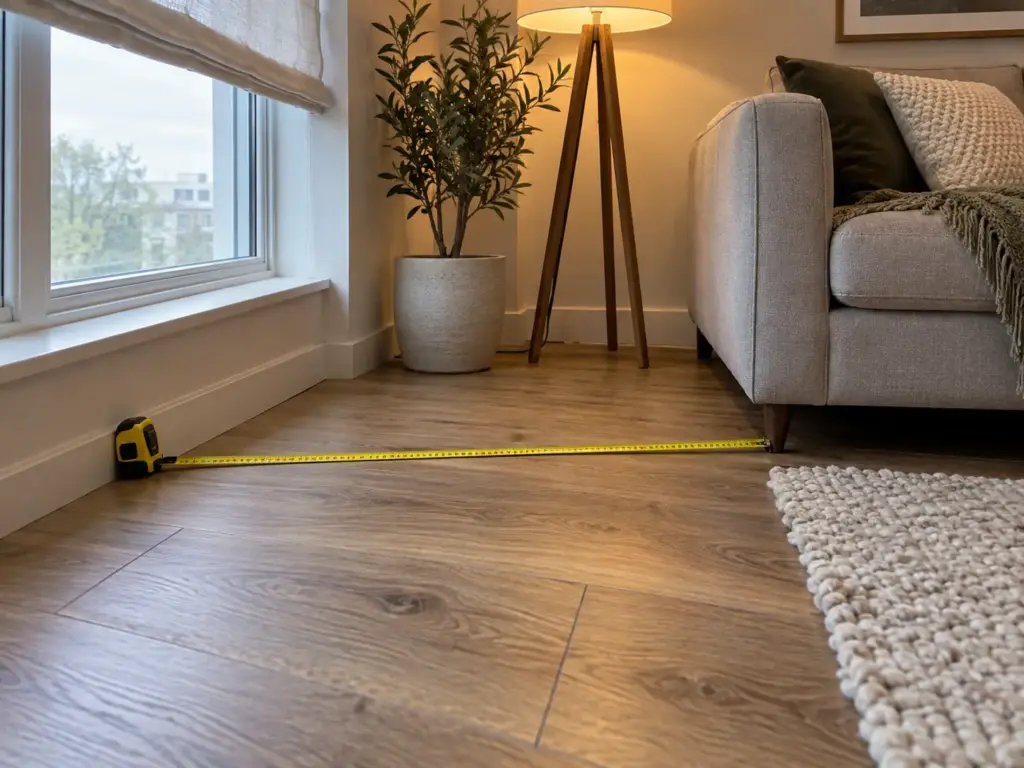
Read the row by wetness, not by the square feet on the box
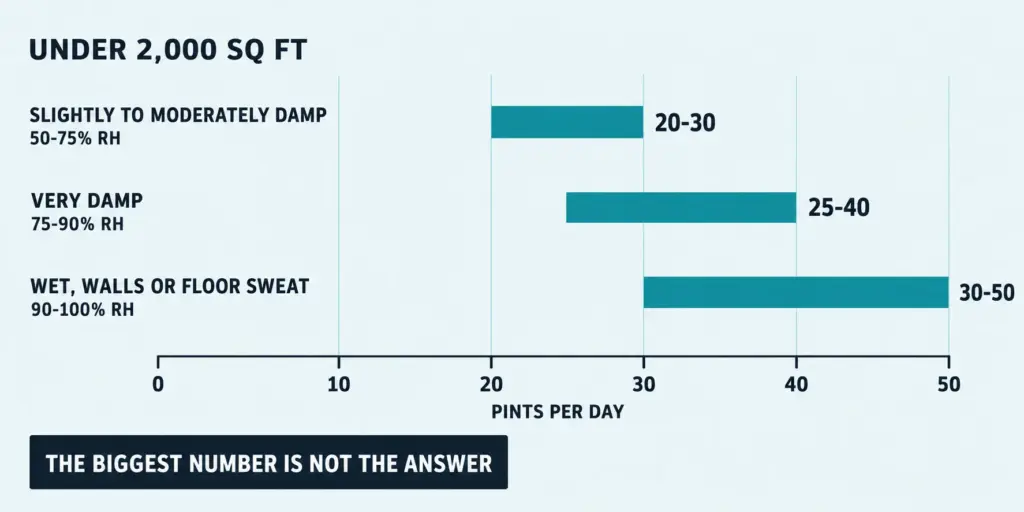
ENERGY STAR’s dehumidifier guide sizes a portable unit from two things: how big the space is and the conditions in it without a dehumidifier running. For a small to medium space under 2,000 square feet, the capacity range comes in three rows.
A room that is slightly to moderately damp, with an intermittent musty odor and a reading of 50 to 75 percent, needs 20 to 30 pints per day. A very damp room, consistently damp and smelling it, with damp spots on walls and floors at 75 to 90 percent, needs 25 to 40. A wet room, where walls or floor sweat or seep, or where laundry dries indoors, at 90 to 100 percent, needs 30 to 50. Over 2,000 square feet the same rows read 30+, 40+ and 50+.
If you are replacing a unit, there is a shortcut: judge by how much water you empty each day. The 50 on a badge and the water a room gives up in a day are different numbers. A unit’s rated area on the box is not a promise for a damp basement, and a large-capacity unit can still fill a bucket every day. That is 16 pints, a third of the badge, and he wondered himself whether the unit was too big for the space.
What oversized and undersized look like in the room
ENERGY STAR’s line is that it is better to oversize than undersize. That holds as long as the humidistat does its job: a unit with spare capacity reaches the set point sooner and shuts itself off, so it runs fewer hours, not more. It stops holding when the oversizing is paid for in other ways, a bucket that is a heavier carry and a purchase that is larger than the room can use. A sensible pick is one row up from the room’s reading, not the top row.
The check after the purchase is simple. A unit that shuts itself off once the room is in the band is the right size. A unit that never shuts off is too small, or the source is still there. And a unit that runs all day while the bucket barely moves is telling you about the source, not about the box: if the machine is working and the water is not coming out, the room is being refilled from somewhere.
Which table this page uses (and why it may differ from the window page)
This page uses the US ENERGY STAR table, in pints per day. A page on this site about window condensation reads a metric chart in liters per day, and its bands are close to these but not the same numbers, because the units and the source differ. If you read both, expect the two to land within a few pints of each other, not on the identical figure. For a basement, how big a dehumidifier a basement needs runs the sizing through floor area and moisture level; and once the size is settled, the best dehumidifiers for a basement, reviewed is where the models are compared.
Why a Pint Rating Isn’t One Standard
Two boxes can both say 50 pints and not mean the same thing, because the test changed in 2019. A buyer who ignores the date compares numbers taken at different temperatures.
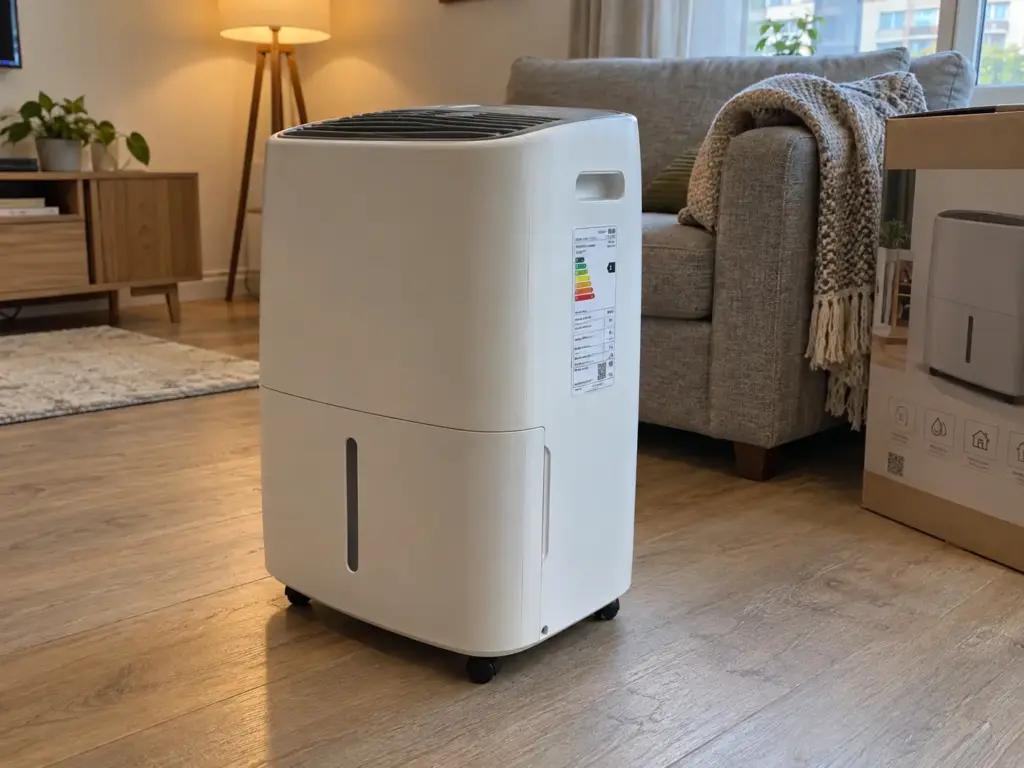
What the test moved from and to
The US Department of Energy finalized new standards for dehumidifiers that took effect in June 2019. They replaced the old efficiency metric with the Integrated Energy Factor, which counts the energy a unit uses even when it has cycled off, and they changed the test: portable dehumidifiers are now tested at 65°F (18°C) rather than 80°F (27°C), to reflect how a unit actually performs in a basement. Less water hangs in cooler air, so a unit tested at 65°F reports a smaller capacity than the same machine tested warm. Nothing about the hardware changed; the test did.
The reason is physics, not marketing. Warm air carries more water vapor than cool air at the same relative humidity, so a unit pulling air through its coil at 80°F has more moisture to take than the same unit at 65°F. ENERGY STAR describes the new conditions as cooler and more realistic, comparable to a basement. A bedroom at 70°F (21°C) sits between the two old and new test points, which is why neither rating predicts a bucket exactly, and why the room’s own reading matters more than either badge.
ENERGY STAR’s testing and capacity page says it plainly: “Starting in early 2020, you may see dehumidifiers that look comparable to previous models but have lower capacity ratings.” The label dropped; the water removed in your basement did not.
How to read a label from before and after 2020
ENERGY STAR publishes a rough correlation between the old and new ratings for portable units. A unit rated 30 pints through 2019 comes out around 20 under the new test, a 40 around 25, a 50 around 30, a 60 around 35, and a 70 around 40 to 45. The same page says the change for a specific model varies, and that the manufacturer can give a more reliable comparison.
The rule that follows: never compare a pre-2020 rating with a post-2020 one, and check which temperature a listing’s “up to” number was taken at. A maker is free to quote its own test point, and a number taken at 86°F (30°C) and 80 percent humidity is not a number you will meet in a cool bedroom. The sizing table in the previous section is the current one, so read a new unit’s label against it as printed, and convert an older unit’s label with the rough table above. Choosing by the biggest badge without asking which test produced it is choosing the biggest number, not the best dehumidifier.
New models sold today carry the post-2019 rating, so the old numbers surface in other places: a used unit’s listing, a review written years ago, the label on the unit you are replacing. That is where the mix-up happens, and where it costs money. If you are replacing an old unit, ENERGY STAR points out that the smaller capacity on a new label may still meet your needs, so a lower number on the new box is not a downgrade by itself. Ignore the old badge and use what the old bucket filled in a day to find the row of the table the room belongs in.
An efficiency figure has the same split. The old Energy Factor and the new Integrated Energy Factor are different metrics taken on different tests, so compare liters per kilowatt-hour only between units rated on the new one. Two numbers that look alike and come from different tests are how a bad comparison gets made.
Compressor, Semiconductor or Desiccant, and the Cold Limit
The type of machine decides where it can work, and the cold is where most buyers get caught.
Which type for which temperature
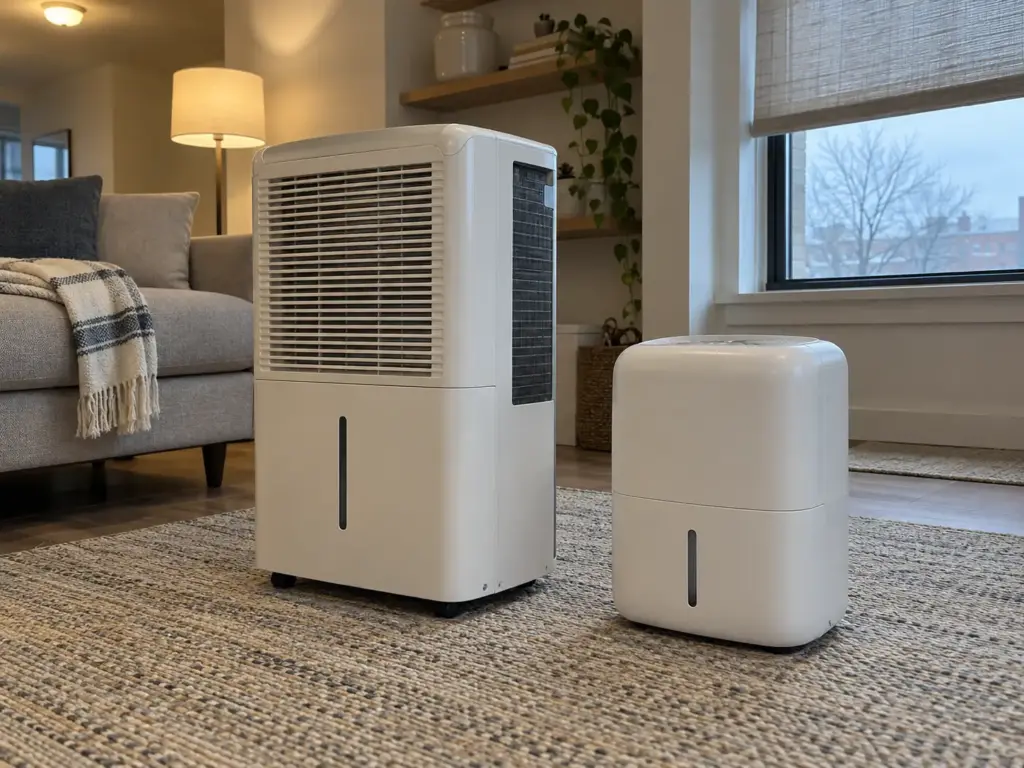
A compressor unit, which is most of what is sold, pulls room air across a cold coil so the moisture condenses and drips into the bucket. It is the type the pint table above and the 65°F test describe.
A semiconductor unit, also called thermo-electric, has no compressor; one small model’s listing says it “works differently from compressor units” and describes it as made for small spaces. A desiccant unit dries the air with a moisture-absorbing material rather than a cold coil, which is why it does not frost. It is named here as a type, and this page does not rank one.
The practical difference is where each earns its place. Compressor units cover most rooms and basements. A semiconductor unit is a small-space tool, and its numbers behave differently, which the ordinary-room section works through.
The frost limit and the winter basement
ENERGY STAR warns that frost can form on the condensing coils if the air temperature drops below 65°F (18°C). When it does, the compressor can cycle on and off repeatedly without removing any moisture, and the advice is to switch the unit off and let it defrost before running it again. Some units carry an anti-frost sensor that shuts the machine off below a set temperature, and some are specified for lower temperatures; if the space regularly falls below 65°F, that is a spec to look for before buying.
A cold basement in winter is a limit on the device, not a fault of the room. The same unit that dries a warm room in July can sit frosted and idle in a cool basement in January, and the meter will show the room unchanged. If winter is when the room is wet, read should you run a dehumidifier in winter before settling on a type.
When an air conditioner already does the job
An air conditioner removes moisture while it cools, and ENERGY STAR suggests that a home with central air can add an A/C vent in the humid space and use the system’s own dehumidifying, which also improves airflow between the humid parts of the house and the drier ones. Whether that beats a separate unit depends on the room and the season. A dehumidifier or an air conditioner for a basement works through that choice. For a room with a window unit already running in summer, the reading before and after a day of cooling is a free test of how much the air conditioner is already doing.
The Drain: Bucket, Hose or Pump
Before the pints, ask whether there is a floor drain or a sump within reach of a hose. That single yes or no sorts the whole market, because it decides how much of your week the machine takes.
A bucket you carry
ENERGY STAR describes the standard portable: a removable plastic bucket, warning lights, and an automatic shutoff when it fills so it never overflows. It needs nothing but a place to stand and a sink or tub to empty into. The cost is the carry and the cleaning. Buckets with many ridges and corners are hard to clean, and mold can form in them over a summer.
A bucket is the right choice when the unit sits in a bedroom or a rental with no drain, and the wrong one in a basement that fills it every day.
A hose that runs on gravity
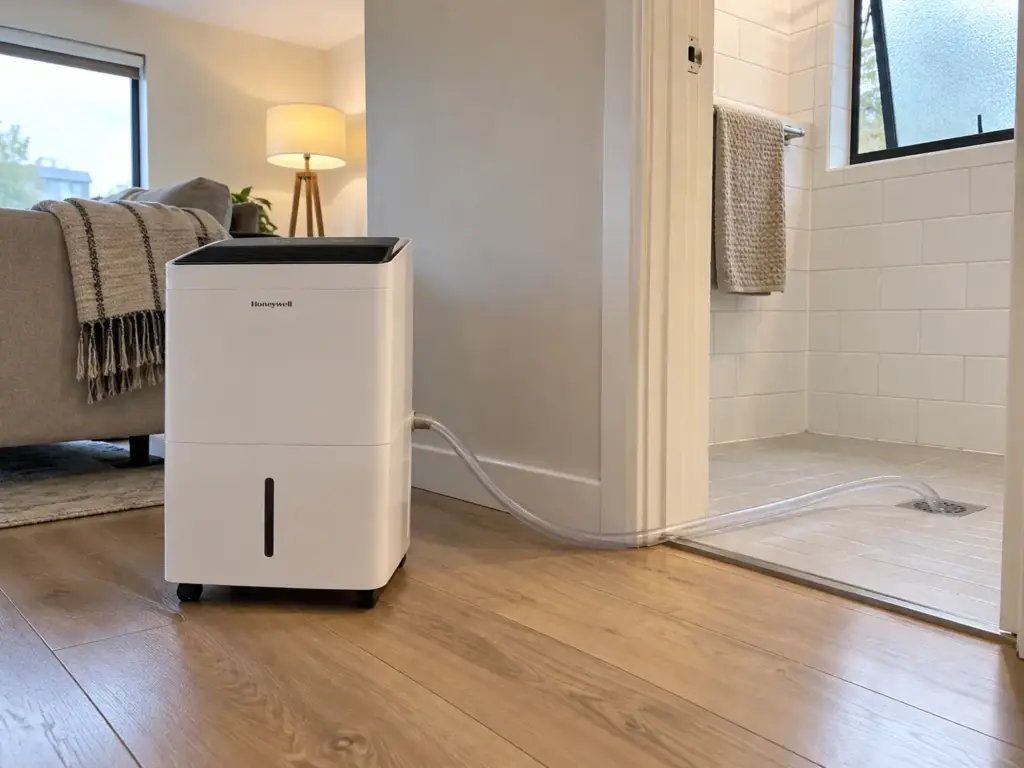
Some units give the bucket a fitting for a hose that runs to a floor drain or sump pump, so there is nothing to empty. ENERGY STAR’s practical notes: keep the unit close enough to the drain that the hose does not get long and unwieldy, do not create a tripping hazard, and keep drain hoses away from electrical cords and connections. A gravity drain only works if the drain is lower than the unit’s outlet.
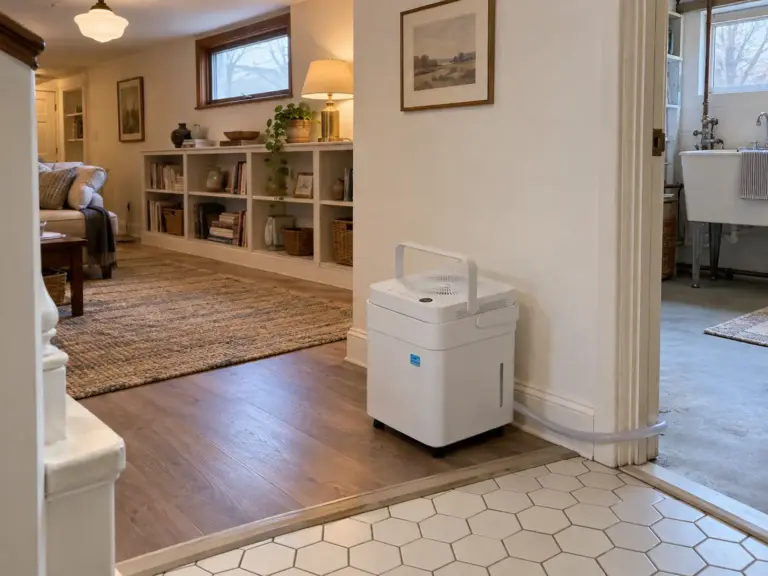
A unit set on a shelf beside a laundry tub can drain straight into it, but a constant drip into a slop sink can attract sewer flies. Where the water goes is a decision in itself, and where to drain a basement dehumidifier takes it room by room.
When a built-in pump fails, some owners connect a hose to the provided fitting and drain by gravity into a floor drain, if the layout allows it. When his unit finally gave out, the replacement he asked about had to have no internal pump and no custom hose, because custom hoses, in his words, are always too short. A standard garden hose reaches where a short proprietary one does not.
A built-in pump, and the month it quits
A pump lifts the water out of the room when the drain is above the unit, or far away, and this is the obvious pick for a room with no gravity route. It also adds a part that can fail. Whole-house units, which dry a full home through its ductwork, lean on a condensate pump or a floor drain for the same reason. The internal pump is the part to check, since it can fail early even on a unit under warranty.
His reading of the reviews was that none of these pumps last very long. For a pump you want to be sure about, dehumidifiers with a pump and drain hose is where the models are picked.
The Honeywell TPFIT50PWK shows the whole drain question in one machine. It is a 50-pint portable with a 7.1-liter tank and three fan speeds, and its listing says the pump “Drains condensation vertically or horizontally up to 15 feet,” enough to send water into a sink or out a window. A unit that pumps to a sink drain can run without trouble and with no bucket to carry.
The other half of the story is the refrigeration side: the manual ties error code E3 to the cooling system, and some units fail within a few months while others last just past a one-year limited warranty.
Reviews also claim the company behind the unit is out of business and the warranty cannot be honored, a claim that is not verified here. Notice what the codes say: the reports blame the whole unit, not the pump, so a pump on the spec sheet tells you nothing about whether the machine lives.
That is where the obvious pick stops being obvious. The pump suits a drain that sits above the unit and nothing else; with a floor drain below the outlet, a gravity hose does the same job without a part that is a common point of failure.
| Drain route (what it needs) | What you do | Where it fails |
|---|---|---|
| Bucket (a spot to stand, a sink to empty into) | Carry and empty it; the unit shuts off when it is full | A wet room stops drying while the bucket waits |
| Gravity hose (a drain lower than the outlet) | Run a hose from the bucket fitting to a floor drain or sump | No drain below the outlet, or a hose that is too long or a trip hazard |
| Built-in pump (a drain within its lift, in feet) | Run the discharge tube to a sink, a drain or out a window | One more part; owner reports of failures in the first months |
Measure the height from where the unit will sit to the drain before reading any pump’s number. If the drain is lower than the outlet, gravity does the work and no pump is needed. If it is higher, the lift printed on a listing is a maximum, so leave margin below it.
The Tank: How Often You’ll Be Carrying It
The bucket is the part you touch every day, and its size decides whether a unit becomes a chore.
Match the bucket to the pace the room fills it
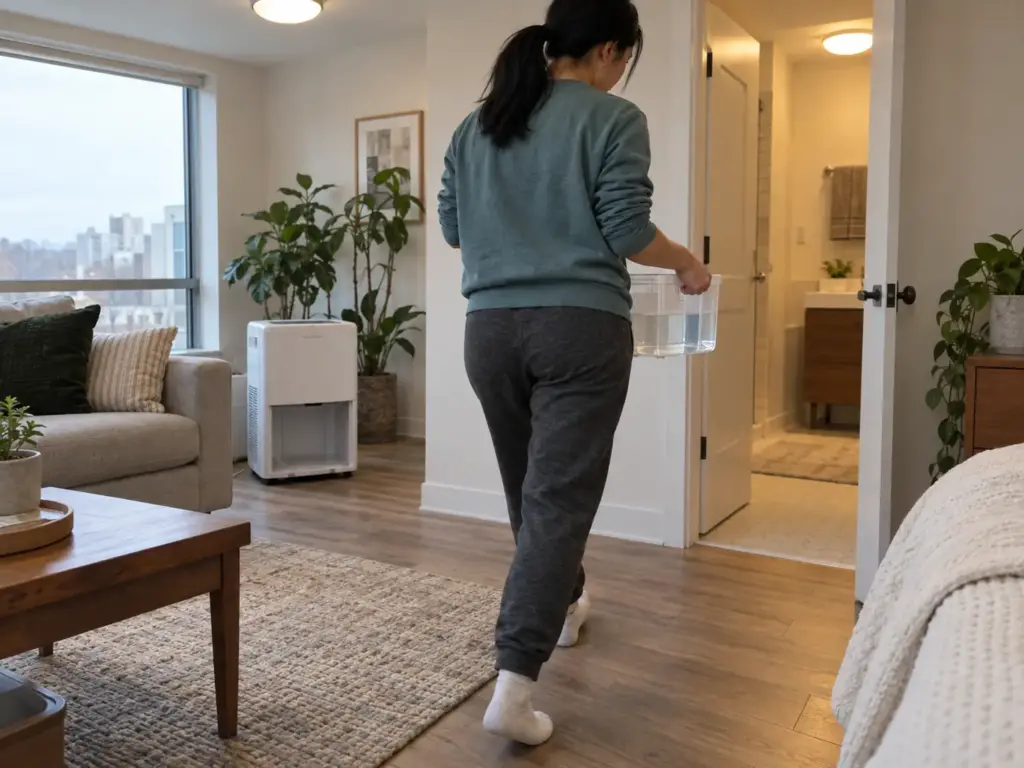
Tank size is the first spec to weigh against the room, and emptying the tank sets the daily routine. The pace comes from the room, not the unit. Without a hose, a bucket often needs emptying every day from late spring to early fall. Running a unit all day on the lowest setting does not stop the bucket from filling.
In each case the bucket is a reading of the room.
A bigger bucket means longer between trips and a heavier carry. Water weighs about 8.3 pounds a gallon, so a 4-gallon bucket is around 33 pounds of water before the plastic. A bucket that is full by the time you leave for work is not a bad unit; it is a room that is still wet.
What a full-bucket shutoff does and does not do
ENERGY STAR notes that bucket units shut off automatically when full, so they will not overflow. That protects the floor and nothing else.
A shutoff stops the drying, which means a room that fills the bucket overnight sits wet until you empty it. A small bucket in a wet room is a unit that is switched off for part of every day, and the meter shows it as a reading that climbs between your visits. If the bucket is the limit, a hose solves it, and a bigger promise on the box does not.
Noise at the Speed That Actually Dries
The decibel number on the box is for a speed, and the speed that dries a wet room is usually not the quiet one.
Ask which speed the number is for
A fan moves less air across the coil at its lowest setting, which is why that setting is the quietest, and it also removes less water per hour. A noise level on a listing, a decibel figure such as dBA, belongs to the lowest speed or a sleep mode unless it says otherwise, and a room that is still above the band asks for the high one. A decibel figure is only worth reading with its speed attached; the one that counts is the figure for the speed you will actually run, and a number that cannot say which speed it was taken at tells you little.
The sensible check is to hear the unit, or to read reviews that name the speed. A review that says only that a unit runs quietly, with no setting named, is the box talking in a different voice. Count the speeds too: a unit with two or three fan settings gives you a choice, and a unit with one gives you its noise at every hour.
A unit in the room you sleep in
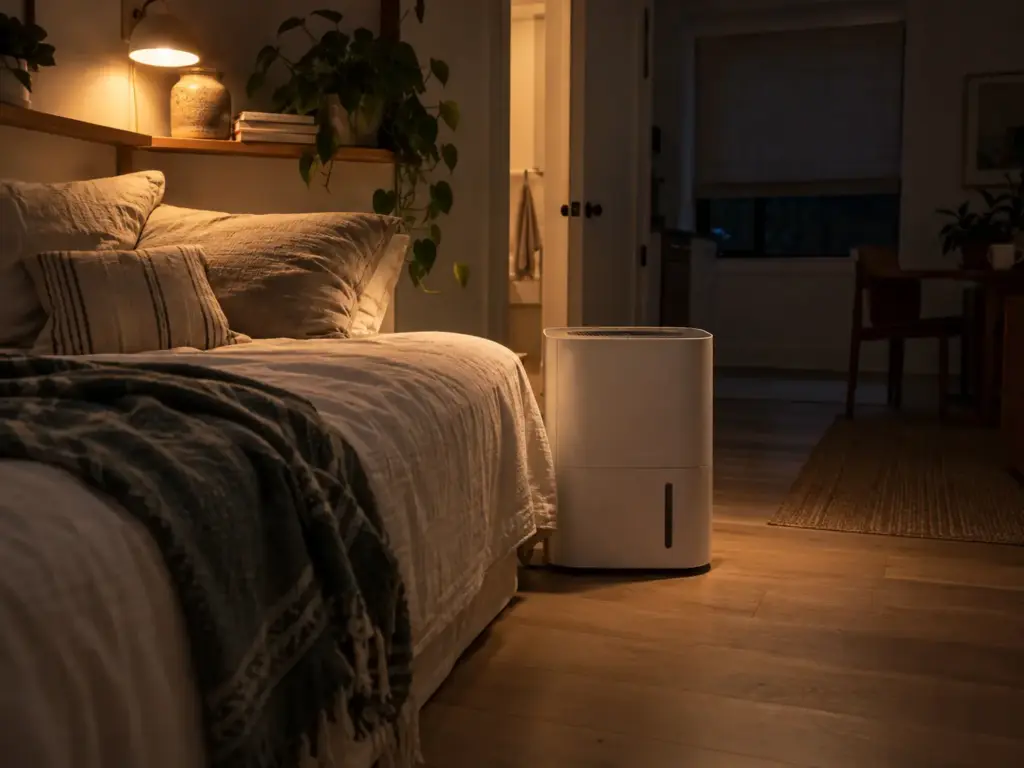
The hum that is fine at noon is the sound you hear at midnight with the door shut, and the door has to stay shut: ENERGY STAR says doors and windows to the space should be closed while the unit runs. A bedroom unit is therefore a unit in a closed room with you in it.
A reasonable pattern follows from how the thing works. Bringing a room down into the band takes the most work, so run the high speed during the day with the door shut, and once the meter holds inside the band, drop to the low speed or a sleep mode overnight, where holding a number takes less effort than getting there. The bedroom case gets its own section further down.
Watts, kWh and What It Costs to Run
Nobody can tell you the running cost in your room, but the sum is short and you can run it with your own price.
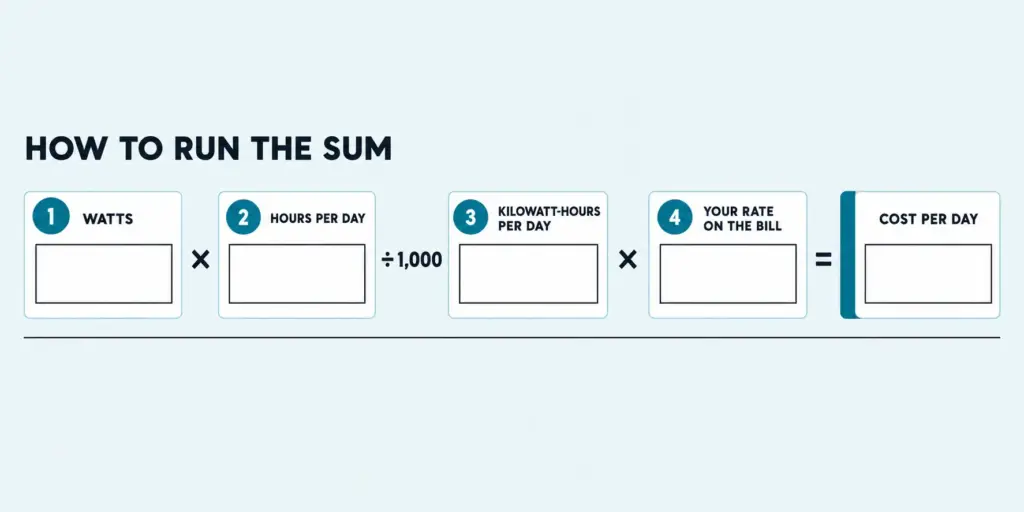
The sum: watts, hours, kWh, your rate
Take the watts printed on the unit’s label, multiply by the hours it actually runs in a day, and divide by 1,000. That gives kilowatt-hours per day. Multiply by the rate on your electricity bill and you have the daily cost, in your own number, which will be right on the day you read it. As an example of the arithmetic only, a unit drawing 400 watts for 8 hours uses 3,200 watt-hours, which is 3.2 kWh.
The hours that count are the hours the compressor is on, not the hours the unit is plugged in. A unit cycles: it runs until the room reaches the set point, rests, and comes back. A room close to the band needs few hours; a room that is wet or still taking on water needs many, which is why the run time swings so widely between houses. How long to run a basement dehumidifier gives the run-time side of the sum.
Multiply the daily kWh by the days of your damp season and you have a seasonal figure to set against the alternative: a hose that never needs emptying, or an air conditioner that is already running.
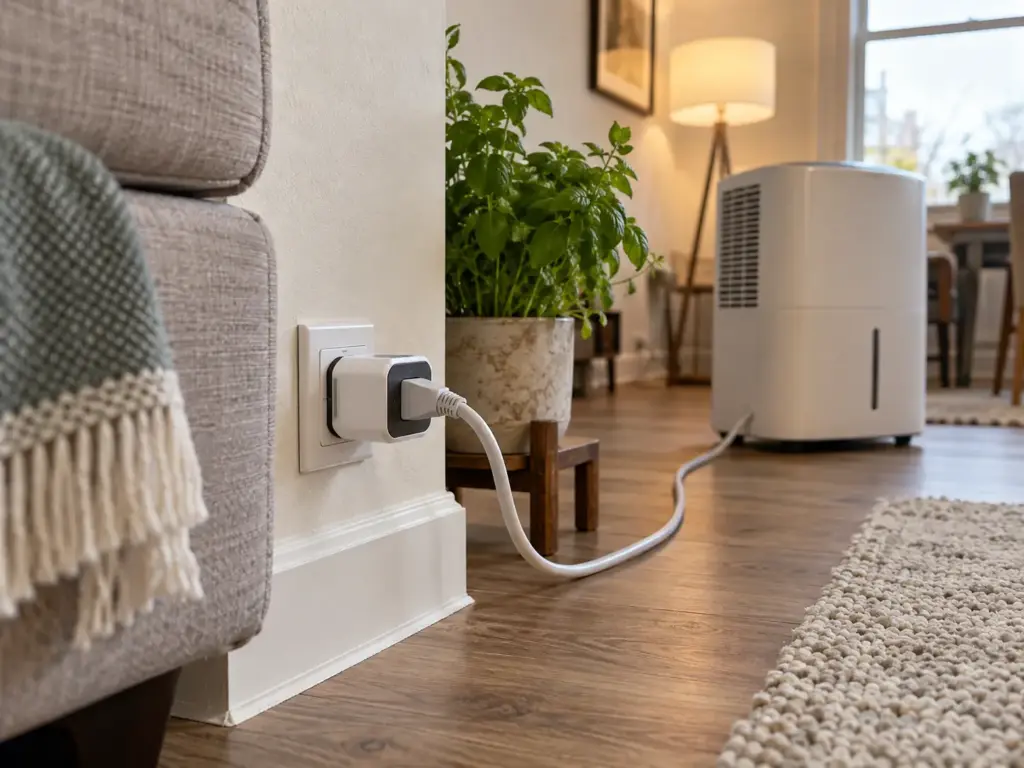
If you already own a unit, a plug-in energy monitor between the wall and the plug shows the kilowatt-hours it actually used over a week, which replaces the guess about hours with a reading. Without one, the label’s watts and a count of how long the unit runs each day will land close enough to compare two machines.
The hours are where the room speaks, and they outweigh almost everything else on the label. A unit that runs 12 hours a day costs three times what the same unit costs at 4, so fixing a source of water in the house cuts the bill more than the difference between two efficiency ratings. That is the same order as the rest of this page: the free fixes lower the hours, and the hours set the cost. A modest efficiency edge on a machine that runs all day while a leak refills the room is a small saving on a large number.
Liters per kilowatt-hour, the number to compare on
The pint badge says how much water a unit can remove. It says nothing about what each bucket costs. ENERGY STAR rates efficiency with the Integrated Energy Factor, in liters of water removed per kilowatt-hour (L/kWh); a higher number means a more efficient machine. ENERGY STAR says certified dehumidifiers are 20 percent more efficient than non-certified models, and since the 2019 rules the factor includes the energy used when the unit has cycled off.
That makes liters per kWh the number to compare two units on. Two 50-pint models can differ in what they draw: the one with twice the liters per kilowatt-hour uses half the electricity for the same water. A high badge with a poor efficiency number costs more per bucket, and the badge will never tell you. Look for the factor on the ENERGY STAR listing, and compare units on that before comparing them on size.
Liters are the unit on the efficiency number while the capacity is in pints, so keep the two apart. One US pint is about 0.47 liter, which puts a 50-pint rating near 24 liters of water at the rated test conditions. A real room rarely pulls the full rating, as the 16-pint basement earlier showed, so the kilowatt-hours that matter are the ones for the water your room gives up, and the efficiency figure tells you how many of them each liter costs.
The Built-In Humidistat and Where to Set It
The dial on the unit reads a sensor, and the sensor is the part you cannot see failing.
Where to set it
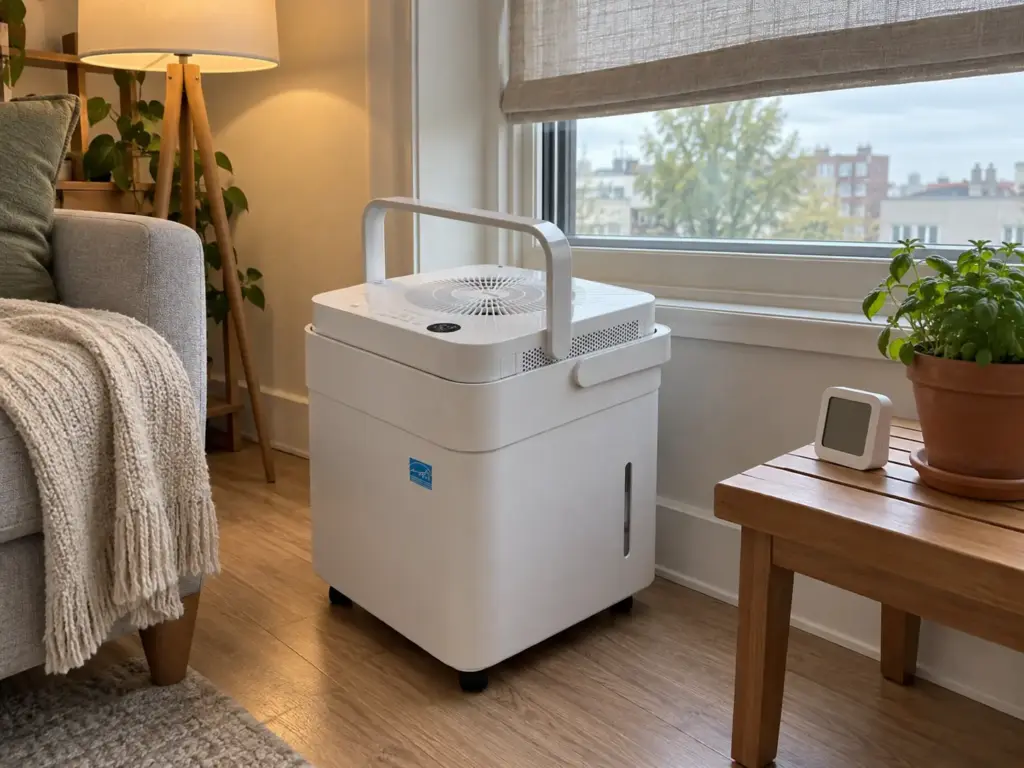
The ceiling is the EPA’s 60 percent, and the band is 30 to 50. ENERGY STAR says all its certified dehumidifiers include a built-in humidistat that cycles the unit on and off to hold the level you pick. The familiar 50 percent is the wrong number for a cold room in winter: ENERGY STAR gives 30 to 40 percent for the heating season to prevent window condensation.
The window is the test. If the glass is wet at 45, the set point goes down; if the glass is dry and the room reads low, it can go up.
Move it by five points at a time and read the meter after a day. A set point that is too high leaves the room above the band; one that is too low runs the unit longer than the room needs, and the electricity goes up with it. Both ends depend on the sensor telling the truth, and that is the check below.
Check the built-in reading against a separate meter
The sensor sits in the machine’s own airflow, near the filter and the coil, which are not where you live. That is why a built-in reading can differ from the room, and why it can switch the unit on or off at the wrong time.
ENERGY STAR recommends that if a unit has no humidistat, or one that does not display relative humidity, you hang a hygrometer near it. That is the right move even when it does have one. A humidity sensor for cold concrete walls shows where to put a meter in a basement so it reads the wall and not the unit.
The Midea Cube 50 is the unit that makes the point. It is a 50-pint model with a 4.2-gallon (15.9-liter) bucket, two fan speeds and a drain hose in the box, and no pump on this variant; its listing says the dial adjusts from 35 to 85 percent.
The build holds up well and the bucket is large, and a hose to an external pump that already serves the HVAC system keeps the bucket empty. The humidity sensor is the weak point in the reviews.
The humidity gauge is the weak point in the reviews: it can stick on a reading that other meters contradict.
A replacement can come back with the same problem, and some units arrive with a sensor that will not read in the upper range.
Against that, the built-in reading can be close to a separate meter when the two are compared side by side. Some units are fine and some are not, and a second meter is how you find out which one arrived.
A failed sensor can also fail the other way. The reading can fall well past the set point, and the unit stops running. A dial that stops reacting to the room is a reason to read the room yourself.
Placement and Care That Keep It Working
A unit placed badly and never cleaned will lose to the same unit placed well, which is why this is a purchase check and not an afterthought.
Doors and windows shut, unit off the wall
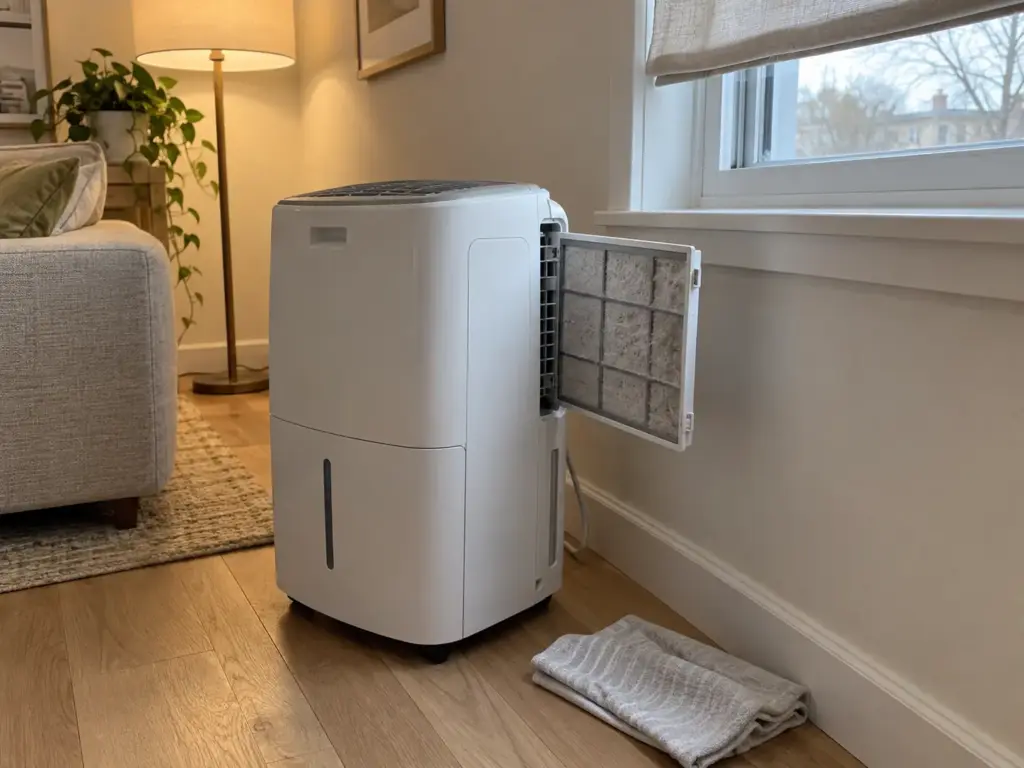
ENERGY STAR’s instruction is that doors and windows to the space being dehumidified stay closed while the unit runs, so that it dries the room as efficiently as it can. A unit working against an open window is working against the weather. Most portable units discharge air from the top and can sit against a wall; a unit without top discharge should stand away from walls and furniture so air can circulate, and every unit does better away from sources of dust like woodworking equipment, which clogs the coil and grille.
A unit that cannot pull air in runs longer and dries less, and the meter shows it as a reading that stays put. The unit also warms the air around it slightly as it works, and ENERGY STAR says not to be alarmed by that. If the window is the problem, not the room, that is a different fix, and how to prevent condensation on windows starts at the pane.
The filter and the tank, on a schedule you will keep
The filter and the tank get cleaned on a schedule, and the schedule that works is the one you will keep. The interval matters less than the habit, so tie it to something you already do on a regular day, such as laundry, and look at the filter for visible dust at the same time.
Keep drain hoses and the tank away from electrical cords and connections, and make sure the unit is plugged into a properly grounded outlet, as ENERGY STAR advises. A tank that stays wet between emptyings grows a film. Emptying it and leaving it damp is how mold returns, so rinse and dry it.
The Ordinary Room: A Bedroom, a Rental, a Bucket
A basement with a floor drain is the easy case. Most readers have a bedroom, one window, a door and a bucket.
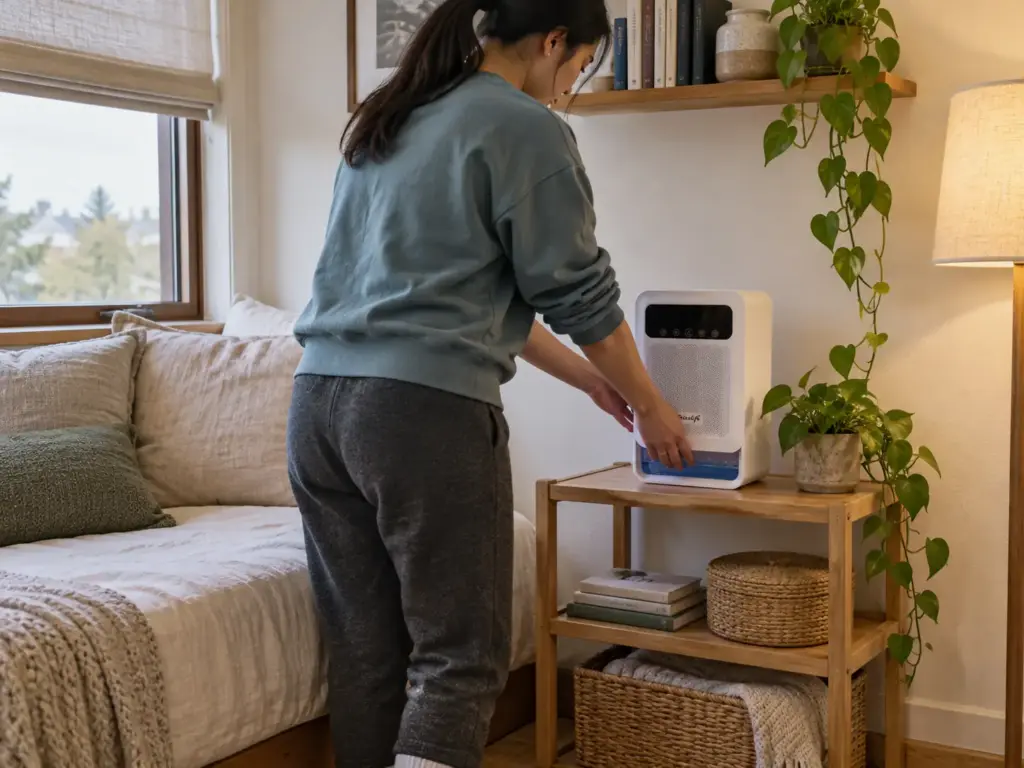
No floor drain, one window
Start with the reading for the room you sleep in: a good humidity level for a bedroom puts the band at 30 to 50 percent and says what to do when the room sits outside it. Then the free fixes, in order, with the meter between each: a door left open between rooms, a vent fan run longer, laundry dried somewhere that has an exit for the steam. On a muggy day, the window you open for air is the window that lets the water in.
Once a unit is the answer, a bedroom or a rental narrows the choice. There is no drain, so it is a bucket, and the bucket’s size against the pace the room fills it is the decision. The door and the window stay shut while it runs. The unit goes where air can reach it, and the cord and any hose stay out of the walking path.
ENERGY STAR’s table splits spaces at 2,000 square feet, so a small bedroom falls in the same column as a large damp basement, and its smallest row is 20 pints for a space that feels damp. That does not mean a bedroom needs 20 pints. It means the table does not resolve a room this size, and the room’s size sets how fast it dries while the source sets how much water arrives.
What a small unit’s number means at a hot test point
The Frizzlife DH80 is the example of what a small unit does to the room most people have. It is a semiconductor model with a 135-ounce (4.1-liter) tank, a 28 dB sleep mode that is the maker’s claim, and no manual set point: its listing says it balances humidity by itself and the level cannot be set.
The listing says it removes “up to 40oz” a day, tested at 86°F and 80 percent humidity. Forty fluid ounces is 2.5 pints, and the tank would take well over three days to fill at that rate. The test point is also far from a bedroom: ENERGY STAR explains that cooler air gives a unit less water to remove, which is the reason the whole pint scale dropped when the standard moved to 65°F.
Units of this kind are slow to show results, even in a humid stretch.
Because it is top heavy, a knock can tip it over and spill water onto the components. It weighs about 6.5 pounds empty and carries a tank that holds 135 ounces, so it is a unit to place on the floor where nobody walks. The pattern is a unit that works slowly, in a warm and wet room, and that is hard on a bedroom that is only a little over the band.
So a small semiconductor unit suits a slow source in a small space, and it does not suit a room that sweats. If the meter reads well over 60 percent and the water keeps coming, the cheaper small unit is not the cheaper fix; a compressor unit sized to the room’s row is.
When it is a closet and not a room
A closet is a sealed little box with a slow source: damp shoes, a wet coat, a wall that shares a bathroom. The door closes, the air volume is small and the source is modest, which is exactly where a small unit can hold the reading. Put a meter inside the closet, shut the door, and read it the next morning before deciding anything.
If it sits in the band with the door closed, the closet was the problem and a unit that small can keep it there; if it reads high with the door shut, the closet is wet for a reason, and the house checks in the second section are where to go. For the whole room, the best dehumidifiers for a bedroom has the picks.
What Breaks by Month Three, and How to Judge Reliability
Reviews are written in week one. The complaints that matter arrive between months two and nine.
The failures that repeat
Lifespans vary, and a unit can fail well before an earlier one from the same brand lasted. He wondered whether he had lost refrigerant, and whether running it on a timer, on and off, did it in. Built-in pumps can be a weak point, so an external pump or a gravity drain is a good backup plan. The reviews of the pump unit in the drain section run from error codes at two months to a unit that quit at 13, just past a one-year warranty.
None of these is a lab test. They are the people who write, and plenty of units run for years. But the same complaint from unrelated owners, at the same age, in the same part, is a design flaw, and here the repeats are the pump, the humidity sensor and the refrigeration side of the machine. A reliability check needs no brand name: read the warranty length against how soon the common failures show up, ask whether the unit has a pump you do not need, and ask whether its humidistat can be checked against a separate meter.
That is the answer to which brand lasts longest. It is not a brand. It is whether the weak points are on the unit, whether the warranty outlasts the failure months, and whether you can tell when the sensor lies.
Apply that same test to any model you consider. Skip the verdict and look for four facts: the month it failed, the error code or symptom, the place the unit ran, and what the seller or maker did next.
The place matters more than it looks. A unit that died after nine months in a crawl space was running in cold, damp air, the hard case for any compressor unit, and the frost limit from the machine-type section applies there; the same failure in a heated finished basement points at the machine. A review that gives all four is evidence. A review that gives none is a mood.
The same sources also hold the counterweight. A pump draining into a sink can run for years without trouble when it is set up well.
A simple humidistat has less to fail, which is the case for keeping it simple. That is not an argument for an old machine. It is a reminder that every added feature, the Wi-Fi, the pump, the sensor you cannot check, is another part that can be the one that quits, and each should earn its place against the room you have.
A short list for the second month
The first month is for the room settling. By the second month, read these in order, and change one thing if one is off.
- The pace of the bucket: is it filling more slowly than in week one? A unit that fills at the same rate for two months is working on a room with a source.
- The coils, if the room is below 65°F: frost on them means the unit is idling, not drying.
- The pump, if there is one: does it clear its lift, and does it start every time the bucket fills?
- The filter: look for visible dust and wash it if the unit has a washable one.
- The sensor against the meter: do the two agree within a point or two?
Change only the one that is off, then read the room again before touching the next. A bucket that is still filling fast at week eight with the humidity unchanged is a room with a source; a unit that runs but whose water has stopped is a unit with a problem; a sensor that disagrees with the meter is a reason to set the unit by the meter’s number from then on, or to return it while the return window is open.
Buy for the Water in the Room, Then Check It a Month Later
Three things decide the purchase. The room’s reading comes first, taken with a meter of your own, because it says whether a unit is needed and how wet the room is. The pints come second, picked from the row for how wet the room is and not the square feet printed on the box. The drain and the humidistat come last, and they decide whether the machine stays a tool or becomes a chore you do every morning.
A month from now, look at two things: how often the bucket fills, which should be slowing if the room is drying, and whether the built-in reading still agrees with the separate meter. A bucket that fills at the same pace as in week one, or a reading that has drifted from the meter, is the earliest warning you will get.
The one change to make tomorrow is to put a meter in the room, in two places, and write down both readings in the morning and again in the evening. That is the number you take to every other section of this page. Where it points depends on the room: the basement size, the bedroom picks and the winter-use pages above each take that reading further.
Frequently Asked Questions
01What is the most reliable brand of dehumidifier?
No brand name is safe to trust on its own, because reliability shows up in the pump, the humidity sensor and the point where failures usually start. Read the warranty length against the failure months in owner reviews, and prefer a bucket or a gravity hose over a built-in pump.
02What do I need to know before buying a dehumidifier?
Four things decide the purchase: the room’s humidity reading, the pints per day for how wet the room is, the drain route and the set point. Read the room with a separate meter first, because the cheapest fix may be a fan or a downspout.
03How much should a good dehumidifier cost to run?
Multiply the unit’s watts by the hours the compressor runs, divide by 1,000 to get kilowatt-hours, then multiply by the rate on your bill. Compare units by liters of water removed per kilowatt-hour: a higher number means less energy for the same bucket.
04How can I tell if a dehumidifier is good?
A good dehumidifier brings the room into the band, shuts itself off once it gets there, and reads within a point or two of a separate meter. If the bucket fills for weeks and the room never reaches the band, the unit is too small or the water still has a source.
05Do I need a dehumidifier with a pump?
You need a pump only when the drain sits higher than the unit’s outlet, or no drain is within a hose’s reach of where the unit has to run. A floor drain below the outlet lets a gravity hose do the job, with no pump to fail.