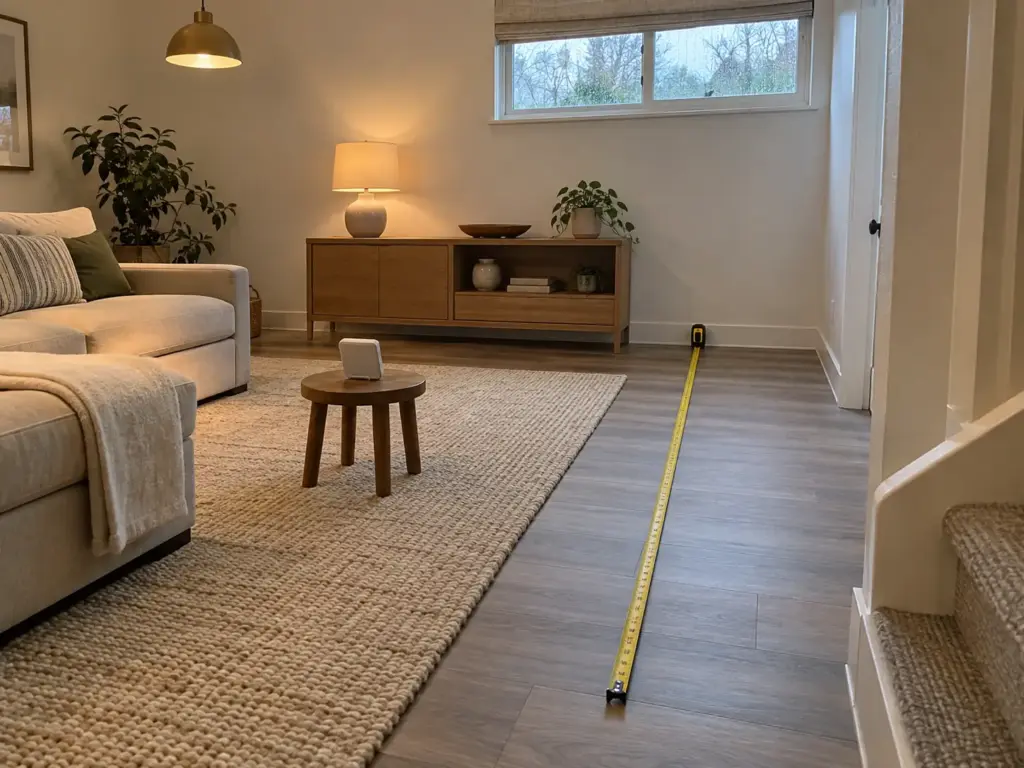
You are holding a box that says 50 pints per day and 4,500 square feet, and the basement at home has smelled damp since the last week of rain. Nothing on the carton says what room those pints were measured in.
A pint rating is a lab number taken in one fixed room at one temperature and one humidity, so it slides when your basement is colder or wetter than the lab. How big a dehumidifier you need for a basement comes down to three inputs you can get today, a reading, a floor area and a table, with the water source checked before any of them. Dehumidifier sizing follows that order here and ends with one check that proves the size; if you are still deciding between types of unit, what to look for in a dehumidifier before you buy comes first.
Quick Answer
The pint figure comes from the basement’s own reading and floor area; the square-foot rule is only a starting guess.
- Read a meter in the middle of the room for 24 hours, unit off.
- Stop outside water first: downspouts, grading, window wells.
- Match the day’s highest reading and your floor area to a pint row.
- Run the unit a full day on top; the room should read 50% or less.
Take a 24-Hour Reading Before You Pick a Size
The pint number cannot come from the box, and it cannot come from the smell either. It comes from a reading, because “damp” on a sizing chart is a humidity measured with the dehumidifier switched off, and a basement can feel one way and read another.
What the chart’s damp rows actually measure
ENERGY STAR sizes a portable dehumidifier by two things: the floor area and the humidity the room holds when no dehumidifier is running. Its damp rows are bands of relative humidity (50 to 75 percent, 75 to 90, 90 to 100), each paired with a sign you can notice, such as a musty smell that comes and goes, damp spots on walls and floors, or walls that sweat. The sign is the hint; the percentage is the measurement. And the measurement means something only with the unit off, because a reading taken after a unit has run for a day is a reading of the unit.
The finish line comes from a different source. According to the EPA’s mold course on indoor humidity, “Indoor relative humidity (RH) should be kept below 60 percent — ideally between 30 percent and 50 percent, if possible.” This article uses 50 percent as the number to reach, the top of that ideal band, so every size decision below is really a question of getting a room that reads 70 or 80 percent down to 50.
Where the meter goes, and why not on the unit
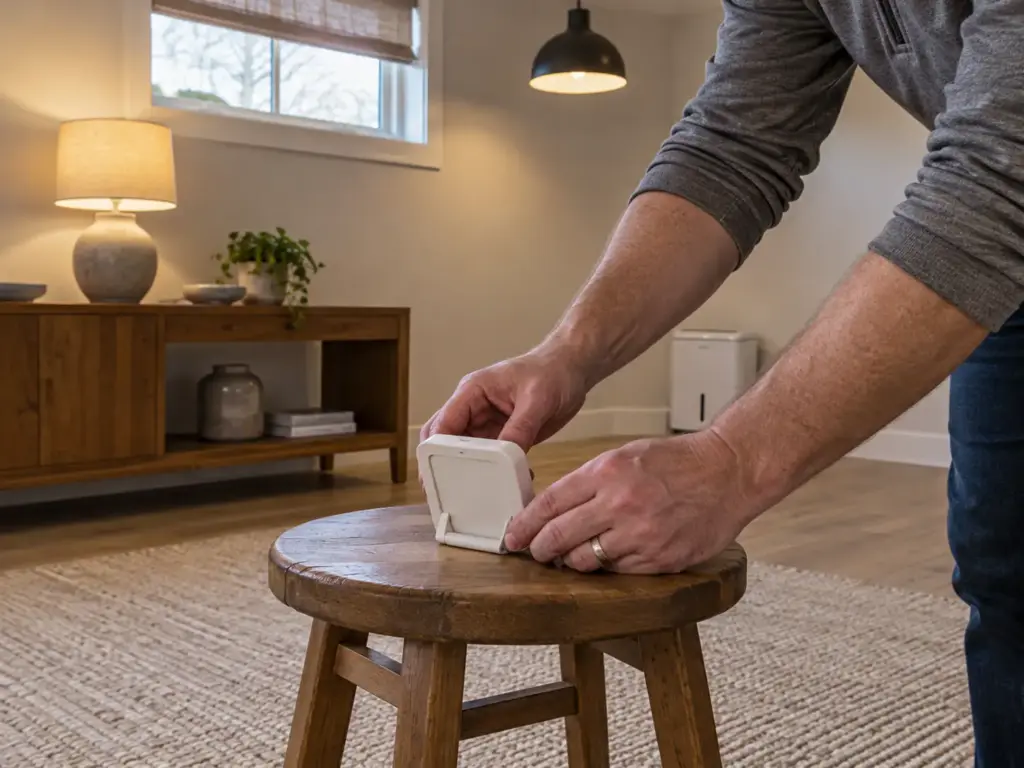
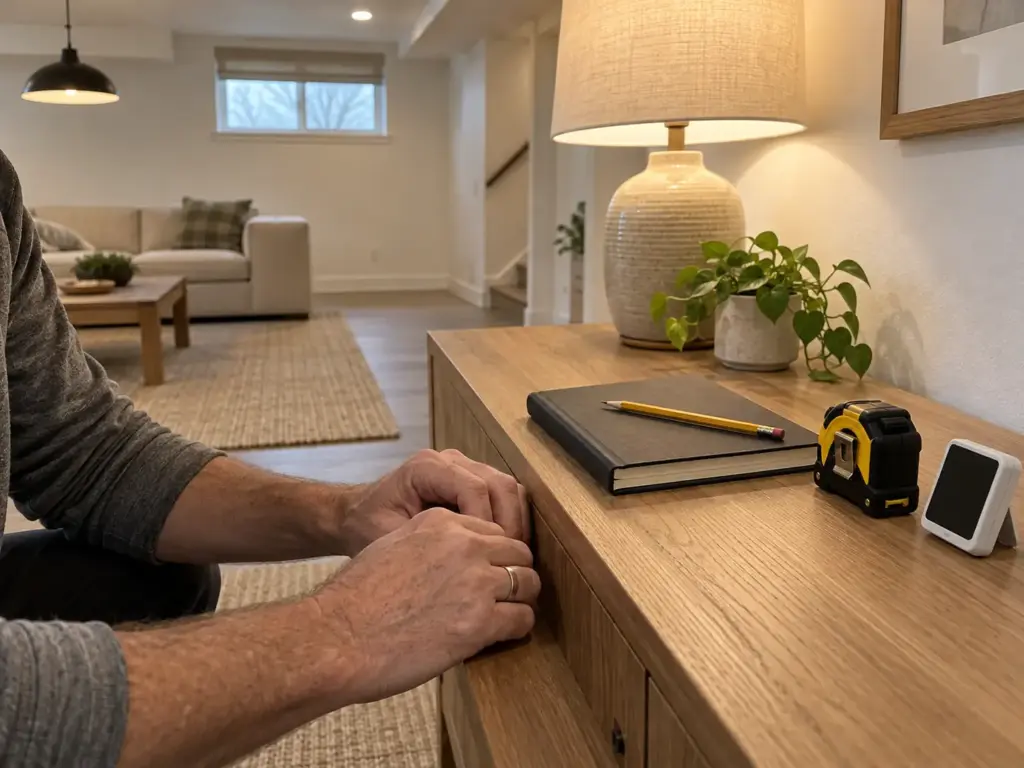
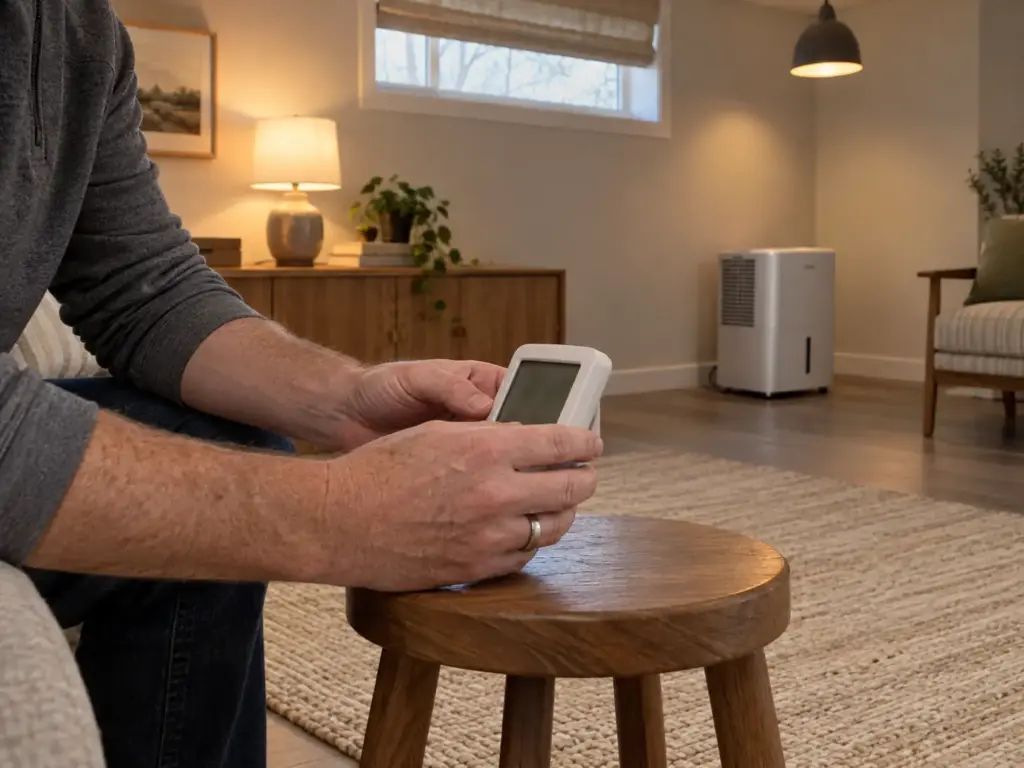
Put a hygrometer in the middle of the room, clear of the walls, on a stool or a shelf-height perch. A cheap meter is enough for this job, and a basement humidity sensor for cold concrete walls is the kind to look for, since the air touching a cold wall runs damper than the air in the middle of the floor.
The meter on the unit’s own panel is the wrong one to trust. A built-in sensor reads the air right at the unit, so its number can differ from the rest of the room. That number says where the sensor sits, not where the room is; a hygrometer reading from the middle of the floor is the one that counts.
Let the meter sit in the basement for a while before you trust its first number. A sensor carried in from a warm kitchen reads the kitchen at first, and one propped against the concrete reads the wall.
The reading that picks the row
Take two numbers from the day, the 24-hour low and high. Many meters store both; if yours does not, write the reading down each time you pass. The high picks the row: a basement that touches 78 percent at its worst is in the 75-to-90 row, whatever its average says.
Basements also drift with the weather and the season, so the first reading is a snapshot. After a week of rain I would read again before paying for a bigger row.
Until that number exists, the purchase is a guess. The method is three readings and one meter, laid out in how to measure indoor humidity.
Stop the Water First, Then Count Pints
A reading tells you how damp the room is. It does not tell you where the water comes from, and that matters more than the row. If water is coming in, the reading is a leak’s reading, and the pint row you pick next is a patch on top of it.
Check outside the wall before you check the chart
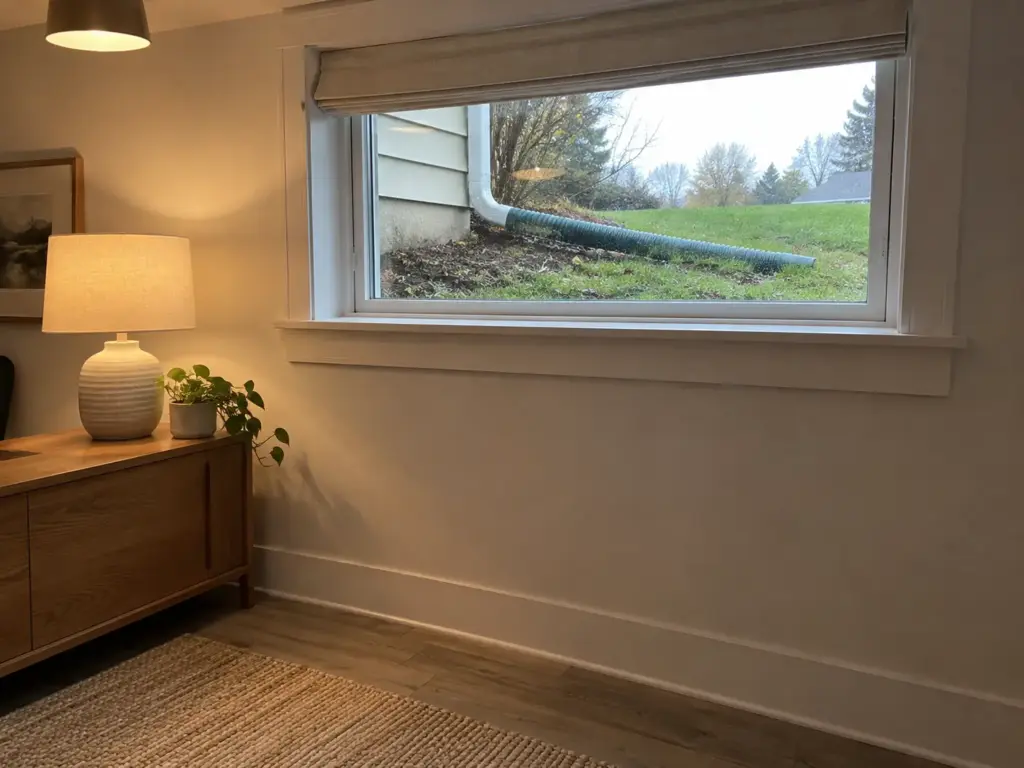
Look out the high window after the next rain. A downspout that ends beside the foundation and soil that slopes toward the house are two common ways water ends up at a basement wall, and both cost nothing to look at.
The EPA’s guidance on keeping the building dry puts the order plainly: “Don’t let foundations stay wet. Provide drainage and slope the ground away from the foundation.” It adds that seepage into a basement should be stopped quickly, and it names sump pumps among the measures.
Work through the checks in this order, and change one thing at a time:
- Extend any downspout that ends beside the wall so it empties well away from the foundation.
- Look at the ground along that wall; soil that slopes toward the house sends water down the wall instead of away from it.
- Follow the dryer vent. If it ends inside, every load of laundry goes into the room’s air.
- Check any window well for standing water.
After each change, read the meter again for a day. A reading that drops after the downspout moved tells you which fix worked, and one that does not drop tells you to go on to the next. The longer order of fixes is in how to keep basement humidity low, dehumidifier last.
What a dehumidifier cannot do about a wet wall
ENERGY STAR’s table does size for seepage: its wet row, 30 to 50 pints, lists sweating walls and seepage by name, so a unit can be bought for a wet basement. What no unit can do is finish the job while water keeps arriving. It runs without stopping, the bucket fills or the hose runs, and the meter never gets to 50 percent.
The EPA’s other rule belongs here too: repair leaks and ventilate when the outdoor air is cold and dry, and dehumidify when it is warm and humid. A unit answers the air in the room, not the water in the wall.
The reading tells the two apart. One that spikes after rain and settles within two dry days is outside water. One that stays high through a dry week is the air the room keeps, and that is the reading a unit is sized for. And if the wall keeps seeping after the gutters and the grade are fixed, the next call is a waterproofing professional, not a bigger unit.
Match the Reading and the Floor to a Pint Row
You now have two inputs, the high reading and the floor area, and dehumidifier size is a row of a table, not a formula. Each row is a range, so most of the work is deciding where in the range to land.
Measure the floor, not the house
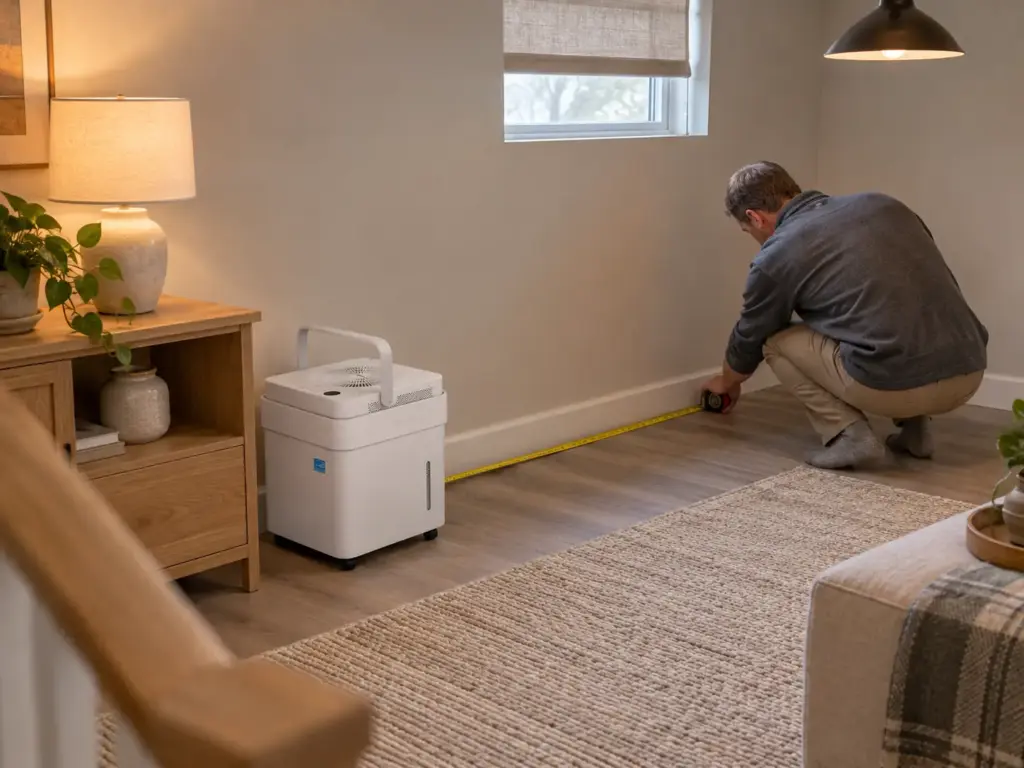
Run a tape along the damp space and multiply length by width. The square footage of the house is not the number; the basement floor is, and a laundry corner counts if a washer dryer pair puts moisture into it.
ENERGY STAR splits its table at 2,000 square feet, so nearly every basement lands in the first column, and inside that column a 600-square-foot room and a 1,500-square-foot one share the same rows. The floor area decides the column. The reading, the room’s dampness level, decides the row.
The rows by reading, under and over 2,000 square feet
ENERGY STAR’s dehumidifier capacity table gives three rows, each keyed to the room’s humidity without a dehumidifier running, with a pint range for each column:
| Reading with the unit off | What the room shows | Pints a day under 2,000 sq ft | Pints a day over 2,000 sq ft |
|---|---|---|---|
| 50 to 75% RH | Feels damp, with a musty odor that may come and go | 20 to 30 | 30 or more |
| 75 to 90% RH | Smells and feels damp all the time, with damp spots on walls and floor | 25 to 40 | 40 or more |
| 90 to 100% RH | Walls or floor sweat, seepage, or heavy loads such as laundry drying | 30 to 50 | 50 or more |
Where in the range to land
ENERGY STAR’s own advice for the choice is that it is “better to oversize than undersize.” What pushes a basement toward the top of its range is easy to count. One big retailer’s sizing guide adds pints for the things that load a room with moisture: 10 for a humid climate, and 5 each for several occupants, several windows and doors, and a washer dryer pair in the room.
Treat that list as a checklist of what applies to your basement, not as a formula to add up. The more of it you recognize, the higher in the row you shop.
A 20-pint unit covers one row and only that row. The Midea Cube 20 Pint Dehumidifier for Basement is rated for 1,500 square feet, which sits in ENERGY STAR’s under-2,000 column, and its 20 pints are the bottom of the slightly damp row, so it suits a basement whose high reading stays under 75 percent. On the lowest fan speed some owners would rather run the unit more slowly so it runs longer, but that is a preference, not a rule.
What limits it is the row itself. If the 24-hour high reaches the next row, the 20-pint rating stops answering the question, and the 30-pint class, the common middle, is where to look. The buying guide prints the same damp rows by room, so you can compare them side by side: pints by room in the dehumidifier buying guide.
When the low and the high land in different rows, shop by the high, and inside that row take the top figure. A basement that runs 52 percent at its best and 78 at its worst is a very damp basement, so the number to shop for is 40, not 25.
Why the Sizing Charts Give Different Numbers
You have probably seen a smaller number somewhere else, and it probably looked just as official. The two sources are not wrong about each other; they are answering different questions about the same room.
One basement, two answers
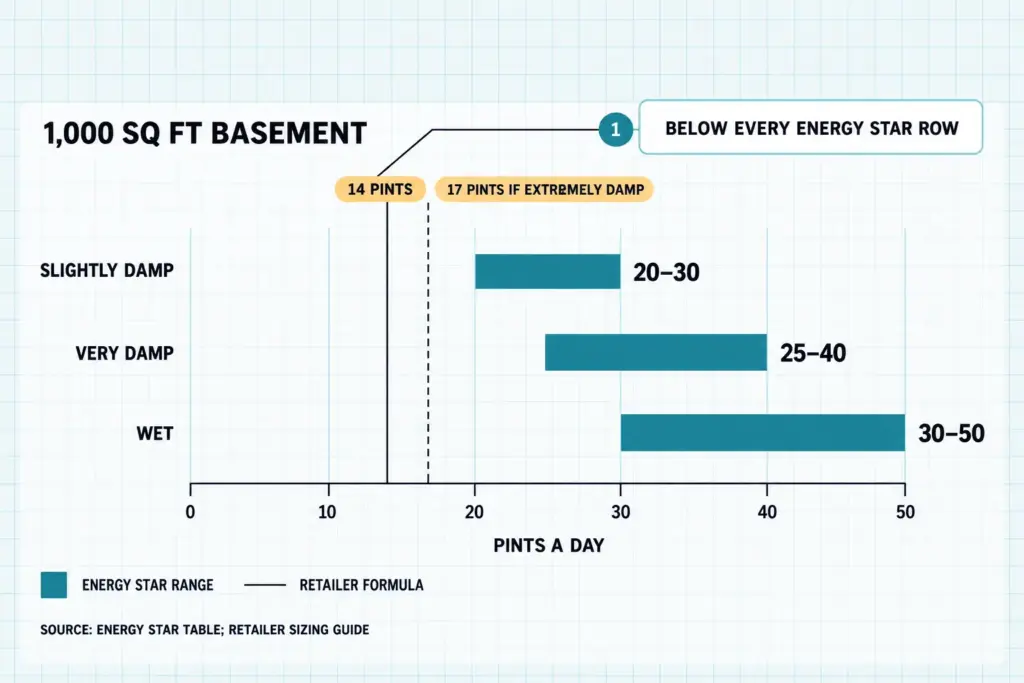
Take a 1,000-square-foot basement. ENERGY STAR gives 20 to 30 pints a day if it is slightly damp, 25 to 40 if it is very damp and 30 to 50 if it is wet. One big retailer’s sizing guide gives 14, or 17 if the space is extremely damp, from a formula of 10 pints up to 500 square feet plus 4 for each extra 500. Two tabs open, two answers, and a gap of at least 6 pints at the bottom.
Why the formula runs lower
The formula asks for a floor area and a few signs: a musty smell, damp, condensation. The table asks for a humidity reading. They are different inputs, and apart from its extremely damp step the formula is a floor-area rule, so two basements of the same size get the same number whether one reads 55 percent and the other 85. The reading is what separates them, and no chart prints that.
Both numbers also sit on top of a label that is itself a lab figure. The Department of Energy defines capacity in its final rule on dehumidifier test procedures as “pints collected per 24 hours of operation under the specified ambient conditions,” so a rating of 20 pints per 24 hours means 20 pints collected in a day of lab operation, and for portable units those conditions are a room at 65 °F (18 °C) and 60 percent humidity.
The older standard tested at 80 °F (27 °C). DOE says in the same rule that a unit extracts less at 65 °F, “which will result in a lower measured capacity.” So a pint label from the old test and one from the new test are not the same number, even on the same unit, and labels are comparable only when they come from the same test.
The retailer’s guide dates the change in pint labels to 2019; that date is the retailer’s claim. The pints-per-room question also comes up from the window side, and pints by room size for window condensation works it from there.
The reference this article uses
ENERGY STAR’s rows are the reference here because they are keyed to a reading you can take yourself, which is something a floor-area formula cannot say. Where the retailer’s number runs lower, that is worth knowing, and it is not wrong for every room: a basement that reads 52 percent with one musty corner may be well served by the low end of the first row. But for a basement that reads above the first band, the higher row is the safer one, and that is the row this article keeps.
What a Cold Basement Does to the Pint Label
A pint label is a number at one temperature. A winter basement is colder than that, and the colder it runs, the more of the label you should expect to give up. Cold is a size decision, not a comfort detail.
Frost on the coils and a compressor that cycles
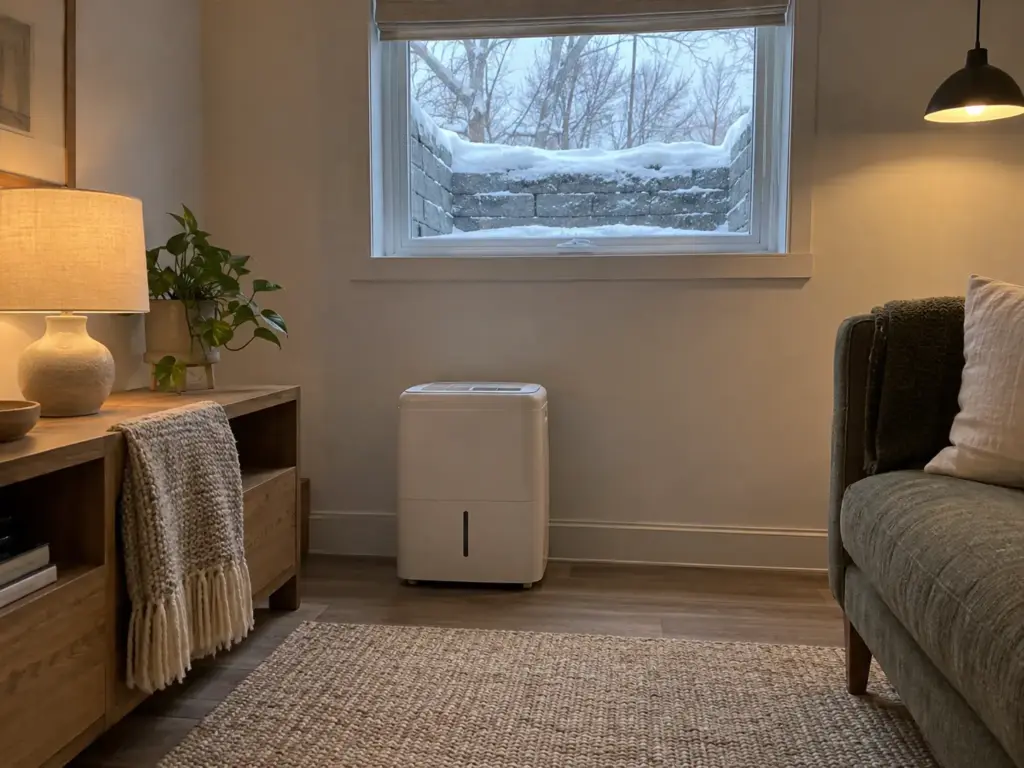
ENERGY STAR names the threshold for the usual compressor dehumidifier: “Frost can form on the condensing coils if the air temperature drops below 65 degrees.” The compressor then cycles on and off without removing moisture, the instruction is to switch the unit off and let it defrost, and some units are specified for lower temperatures or carry an anti-frost sensor that shuts them off at a set air temperature.
The test behind the label sits at that same temperature. DOE’s rating room is 65 °F (18 °C) and 60 percent humidity, and the agency expected basement ground temperature to be “close to 65 °F” through the dehumidifying season, so a basement that runs colder is outside the label’s test. The further below 65 °F it runs, the further under the label a unit can fall.
Efficiency ratings are measured at warmer temperatures than most basements, so the label is a ceiling, not a daily figure. A unit’s real output in a cool, damp basement runs lower.
Picture the February version: the unit runs, the bucket holds half what it held in August, and the meter has not moved. The bucket is the first place the cold shows. Whether to run a unit at all in that weather is its own question, covered in whether to run a dehumidifier in winter.
What to find on the unit’s spec before you trust the number
Look for two lines on the unit’s own spec page: a rated operating temperature and an anti-frost or defrost feature. If a unit lists a range that reaches your basement’s winter temperature, the pint number holds closer to its label there. If it lists none, expect the label to be a warm-weather figure.
The label is also the unit working flat out, since DOE’s test runs on the continuous setting, or the lowest humidity setting with the fan on its top speed. A unit set to 50 percent in a real basement stops earlier, so the bucket will always look smaller than the label promises.
Then make the one change: read the spec before you choose the row, and take the top of the range for a basement that stays under 65 °F. The winter target you are aiming at is its own number, covered in what basement humidity should be in winter. A bucket that fills more slowly in February is the temperature, not a failed unit.
On a listing the pint number sits in the title, and the operating temperature sits three screens down in the spec table. Scroll to the table first. A unit that stops below a temperature is a smaller unit in January.
The Cost of Going Big Is a Bucket, a Hose or a Pump
ENERGY STAR says oversize. What it does not say is what oversizing costs, and the bill is paid in water you have to move: every pint of rating is a pint that has to leave the room by bucket, hose or pump.
How much water a day’s rating is
Run the arithmetic once. Eight pints make a gallon, so a rating of 50 pints per day is a little over 6 gallons of water. DOE’s test text puts the weight of water at 1.04 pounds per pint, which makes a full day at a 50-pint rating about 52 pounds of water, and a 20-pint rating about 21.
Even so, a bucket holds a fraction of it. A 22-pint unit with a 1.7-gallon bucket stops when the bucket is full, until someone empties it.
The Midea Cube 50 Pint Dehumidifier for Basement is the top of ENERGY STAR’s wet range, and its listing rates it for 4,500 square feet. It is the no-pump variant, so every pint leaves by the bucket or by a hose, and the figure to plan around is the 52 pounds, not the square footage.
Bucket, hose to a drain, or built-in pump
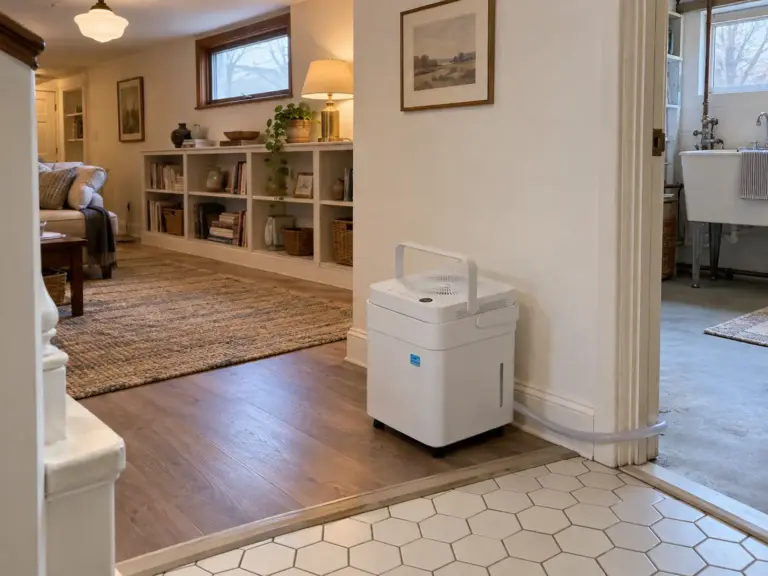
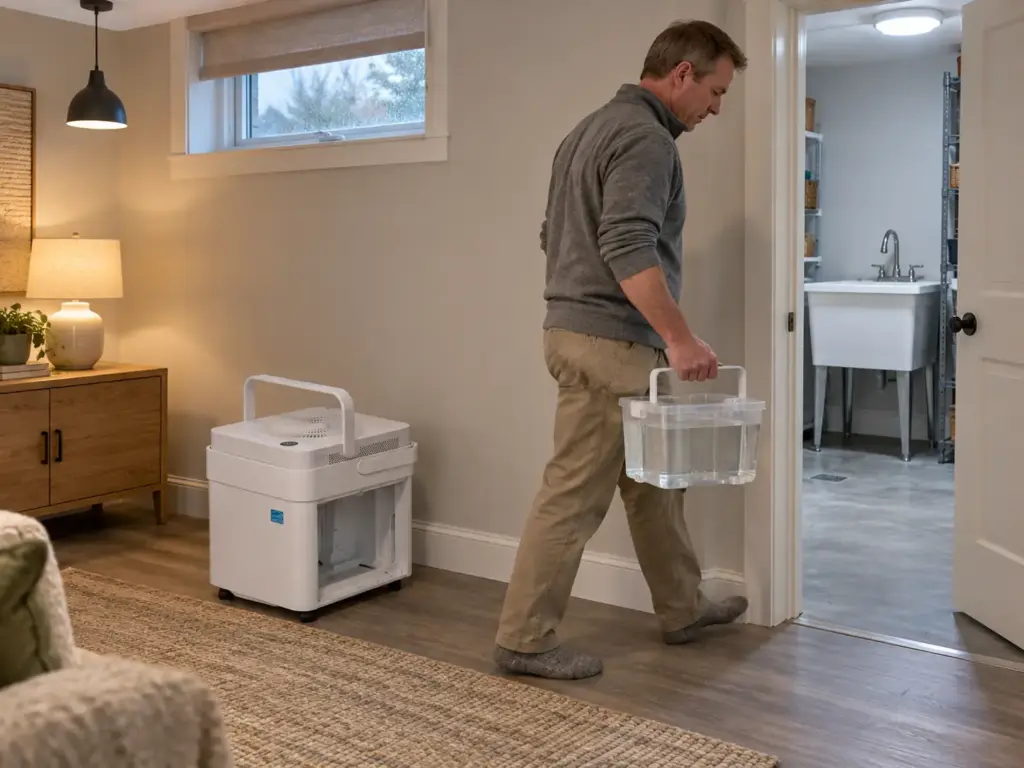
There are three ways out. A bucket carried to a sink is the simplest and the first to wear you out. A hose with a fall to a floor drain gives a continuous drain and removes the carrying, but it needs a drain lower than the unit. A built-in pump sends the water up and out, and it is for a drain higher than the unit.
Before buying anything, move the unit next to the drain or run the hose to a lower sink, because that costs nothing and often removes the need for a pump. The routes are compared in where to drain a basement dehumidifier.
The Honeywell 50-Pint ENERGY STAR Dehumidifier with Built-In Pump (TPFIT50PWK) is the pump model: 50 pints a day with the pump inside the unit, which lets you keep it in the main room and run a line to a drain above it.
The catch is general rather than specific. A built-in pump is one more part that can wear out. A separate condensate pump behind a plain unit is another way to handle the water. The pump decision has its own page, a basement dehumidifier with a pump and drain hose.
What to expect after the first season
The failures that week-one reviews miss show up later. The bucket of one 50-pint unit was awkward to wash out, and mold formed in it several times a summer. A hose that dripped into a slop sink brought sewer flies. A unit can also wear out sooner than expected, and the cause is not always clear.
And the label overshot the room. A unit rated for 4,500 square feet in a 600-square-foot basement was judged too large by its owner, who replaced it with a 22-pint unit that held about 43 percent in humid weather on a 40 percent setting.
The label said big; the room needed small.
For a basement that really is large, two smaller units on staggered humidistat settings can work, so the second only runs when the first cannot keep up. For most basements, one unit is enough.
Check the Size by the Reading It Leaves
A size is only a guess until the room answers. The check takes a day, and it tells you what to do when the room does not answer.
One day at full power, then read
Run the unit at its top setting for a full day with the doors shut as usual, then read the meter in the middle of the room. Fifty percent or less, the top of the EPA’s band, means the size is right. The reading also drifts with the season, so run the same check again after the first week of rain. How long to keep the unit running once it works is covered in how long to run a basement dehumidifier.
When the number does not come down
If the room still reads above 50 after a full day of the unit running without stopping, the next questions are the size row and the water, in that order. Read the meter again, go back to the outside checks, and only then think about size. Do not add a second unit on the first day. The two-unit workaround and the staggered settings are for a basement too big for one unit, not for a unit one row too small.
The setting after the size
A setting is a target, not a size. The owner of the 22-pint unit set it to 40 percent and held about 43 in humid weather, so a lower setting would not have changed the output of a unit already running flat out. Which number to set is its own decision, in what humidity to set your dehumidifier to. And once the size is settled, the next question is which model carries that pint number: which dehumidifier is best for a basement.
A Meter on the Basement Floor Decides the Size
Three things carry the whole article:
- The reading picks the row: 24 hours, unit off, meter in the middle of the room, and the high decides.
- The water goes first, and the cold takes pints off the label.
- The size is right only when the room reads 50 percent or less after a day at full power.
A month from now, look at the reading after a week of rain, the line left in the bucket where it sits and whether the hose end still drips. Tomorrow, put a meter on a stool in the middle of the basement floor, leave the dehumidifier off and read it until the same time the next day. The highest number is the row you shop for, and the reading after the new unit’s first full day is the one that tells you whether you were right.
Frequently Asked Questions
01What size dehumidifier do I need for a 1000 sq ft basement?
A 1,000 square foot basement needs 20 to 30 pints a day if slightly damp, 25 to 40 if very damp and 30 to 50 if wet, by ENERGY STAR’s table. The 24-hour reading, taken with the unit off, tells you which row the room is in.
02What size dehumidifier do I need for a 1500 sq ft basement?
A 1,500 square foot basement uses the same three rows as a 1,000 square foot one, because ENERGY STAR’s table changes columns only at 2,000 square feet. The reading picks the row, and a unit rated for 1,500 square feet covers only the lowest one.
03How big a dehumidifier do I need for a basement calculator?
You do not need a calculator, only two inputs and a table: the highest 24-hour reading with the unit off, and the basement’s floor area. Formulas that start from floor area alone run lower, because they skip the reading.
04What size dehumidifier do I need for a 3 bedroom house?
Size the damp space, not the house, because a portable unit dries the room it stands in and the basement’s reading and floor area decide the pints. A whole-house dehumidifier is ducted into the system and is a different product.
05How do I know if my dehumidifier is too small?
A unit is too small if, after a full day at its top setting without stopping, the middle of the room still reads above 50 percent. Check the water coming in first and the size row second, before buying a second unit.