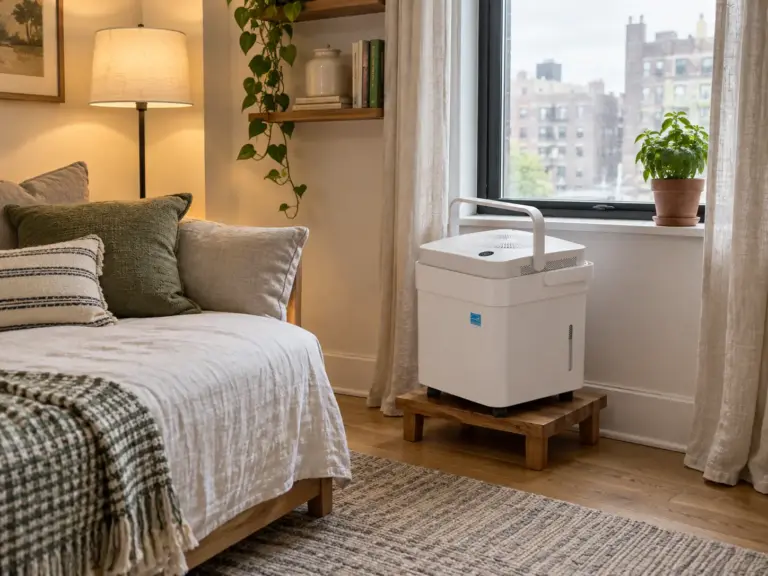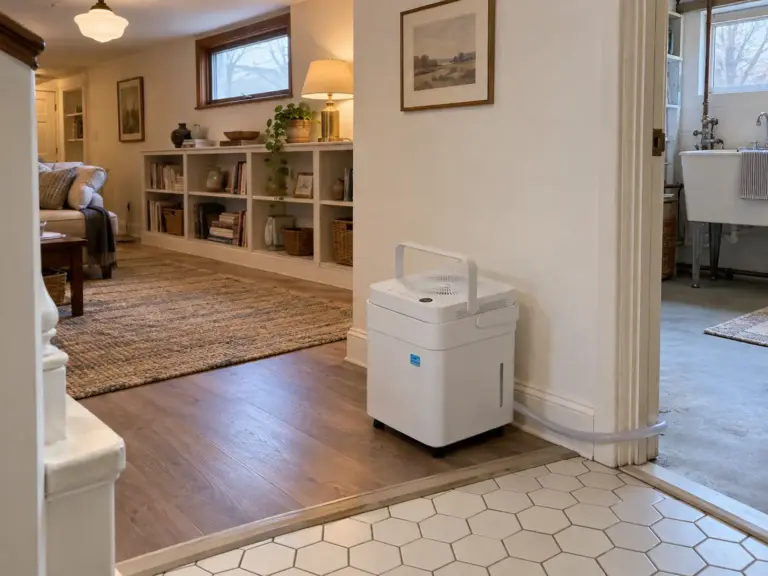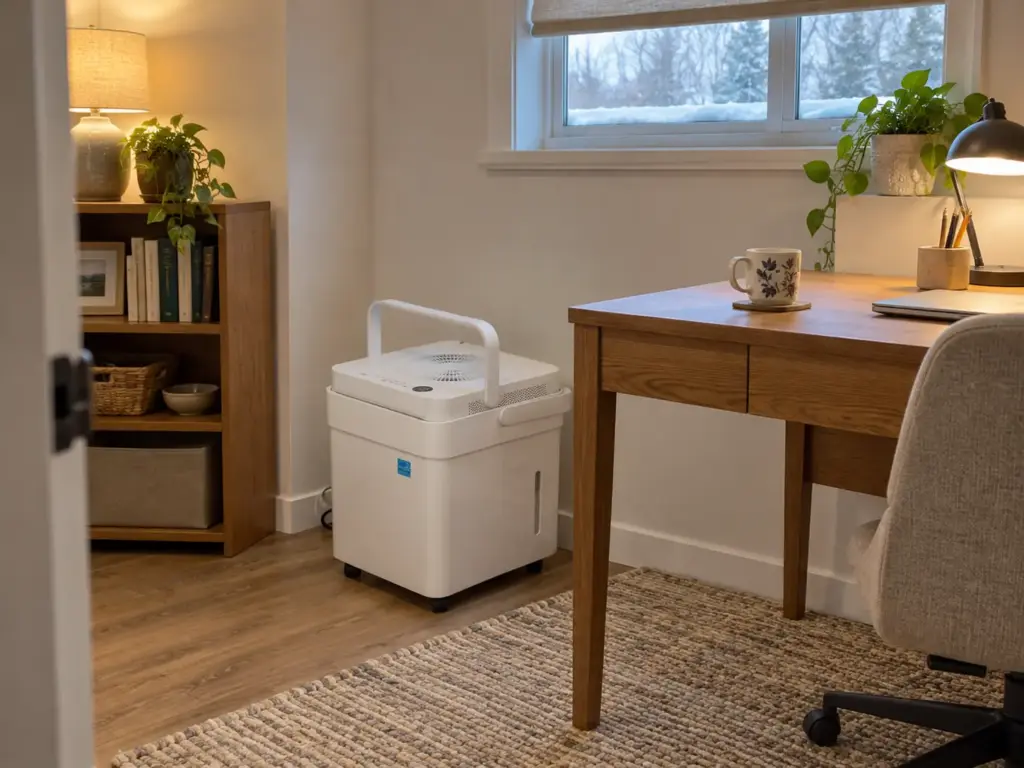
The dehumidifier ran every day from June through September, and now the first cold week has arrived: the basement feels cooler, the air feels drier on your hands, and the bucket is emptier every morning. So should I use a dehumidifier in the basement in winter, or is it time to switch it off for the season? The calendar can’t answer that, because the cooling coil that pulls the water out can frost over in a cold room, and then the machine keeps cycling without drying anything. What decides it is a reading taken with the unit off, the room’s temperature against the 65°F (18°C) line, and the sheet of your own unit, in that order.
Quick Answer
Run it through winter only while the basement reads above its setting with the unit off and the room stays above 65°F (18°C). Under the setting, switch it off. Wet but colder than 65°F, it needs a unit specified for lower temperatures, a warmer room or the water fixed first, not a longer run.
Check the Reading With the Unit Switched Off
The calendar can’t settle the winter question, because the answer is a number the dehumidifier cannot give you. A unit on its own humidistat shapes the very air it is supposed to be judged by, so the first thing to learn is what the basement reads when the machine is not the one doing the shaping. Everything after this section hangs on that one reading.
Why the reading comes before the decision
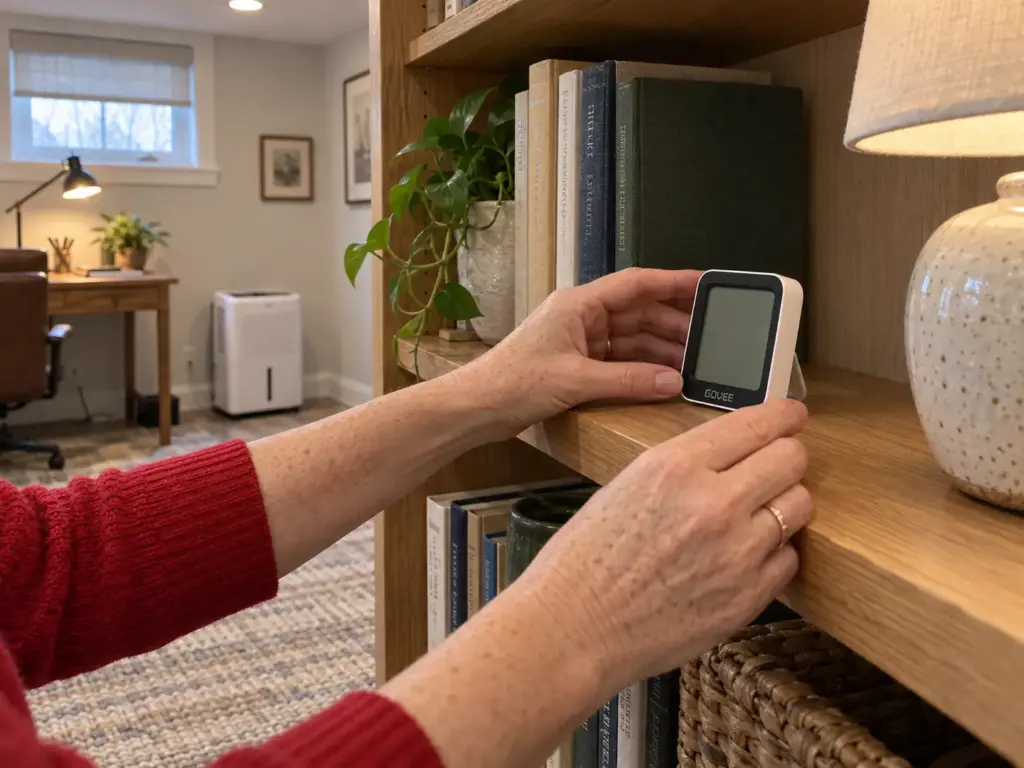
A meter sitting beside a running dehumidifier reads air the machine has already dried, which is how a basement can look fine on the display and still be wet two steps away. Switch the unit off, give the room time to settle until the number stops moving, and read it then. That figure belongs to the basement alone, and it is the only one that says whether the unit has anything left to do.
Winter humidity shifts the starting point in two directions at once. The outside air carries less moisture in January than in July, yet the basement’s cold walls and pipes still sweat, so winter basement humidity can read dry or wet depending on the walls, the soil and the thaw. The free version comes first: get a cheap monitor, because if the reading is already low there is no need to keep the unit running. Write the number down once a day for a week before you move any switch.
Where the number sits against the EPA band
A reading needs a standard behind it. According to the EPA’s guidance on keeping indoor humidity in a band, the advice is to “keep indoor humidity below 60 percent (ideally between 30 and 50 percent) relative humidity.” That is a ceiling and a band, with no floor, and what basement humidity should be in winter is worked out in its own article, so this one only needs the ceiling and the band as yardsticks for your target humidity.
ENERGY STAR gives the wet end its vocabulary. A space at 50 to 75 percent relative humidity is “slightly to moderately damp”, with a musty odor that may come and go; 75 to 90 percent is very damp, and 90 to 100 percent is wet. Those words say how wet wet is. The target stays the EPA band.
Where the meter goes
Mid-room, at shelf height, off the cold wall and a few steps from the unit. Air against a cold surface sits closer to saturation than the air in the middle of the room, so a meter taped to the foundation wall reads wetter than the room is. The same physics explains condensation on cold walls: once a wall’s surface is colder than the air’s dew point, water forms on it even while the room’s own reading looks fine. The reasoning for placing a sensor in a basement lives in a humidity sensor that survives cold concrete walls, which argues for the same spot.
The Govee H5075 is the pick if you want the week on a screen: it pairs with a phone app, keeps two years of readings for export and lists a humidity accuracy of plus or minus 3 percent. Its record is mixed. Amazon’s summary of the reviews says some units quit working within 6 months and that the Bluetooth connection splits the reviewers, though the listing sits at 4.5 out of 5 across 48,585 ratings.
Which hygrometer matters less than where it stands. For a reader who only needs to know whether the room is above or below the band, the AcuRite 00613 puts a thermometer and a humidity gauge on its face; nothing in the listing mentions a log, so the week goes on paper. And a cheap sensor can sit a few points off, which means a 52 is “near the band”, not exactly 52.
Mark rain days and thaw days next to each reading. A basement that sits at the setting all week and jumps on the day the snow melts needs the unit for those days, not for the whole season, and a plain notebook shows that pattern better than any single number.
The same shelf also reads differently in January than it did in September, even though the unit has not moved. The room changed, so last season’s number is not this season’s answer.
Leave It Off, Run It or Move It, Depending on the Reading
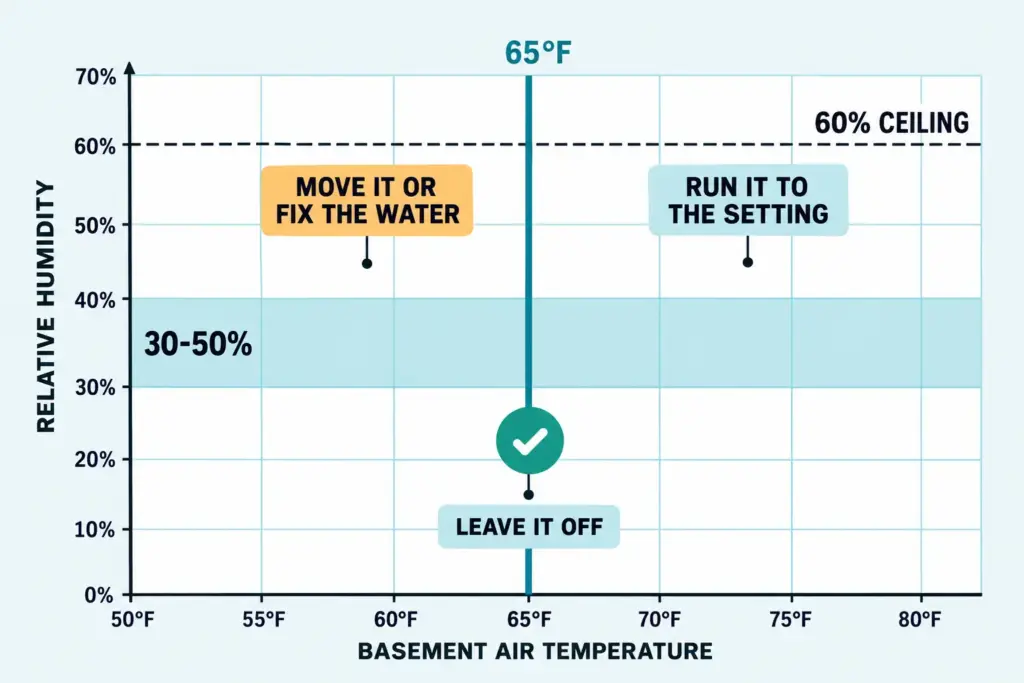
The reading is in hand, and it points to one of three places: leave the unit off, run it to its setting, or accept that this room is the wrong place for it. The month is not one of the inputs, so whether to run a dehumidifier in winter comes down to that reading. Whether basement humidity is worse in summer or winter depends on the walls more than on the date, and that is why the same unit can have nothing to do in one basement in February and a full bucket in another.
Dry and under the setting with the unit off: leave it off
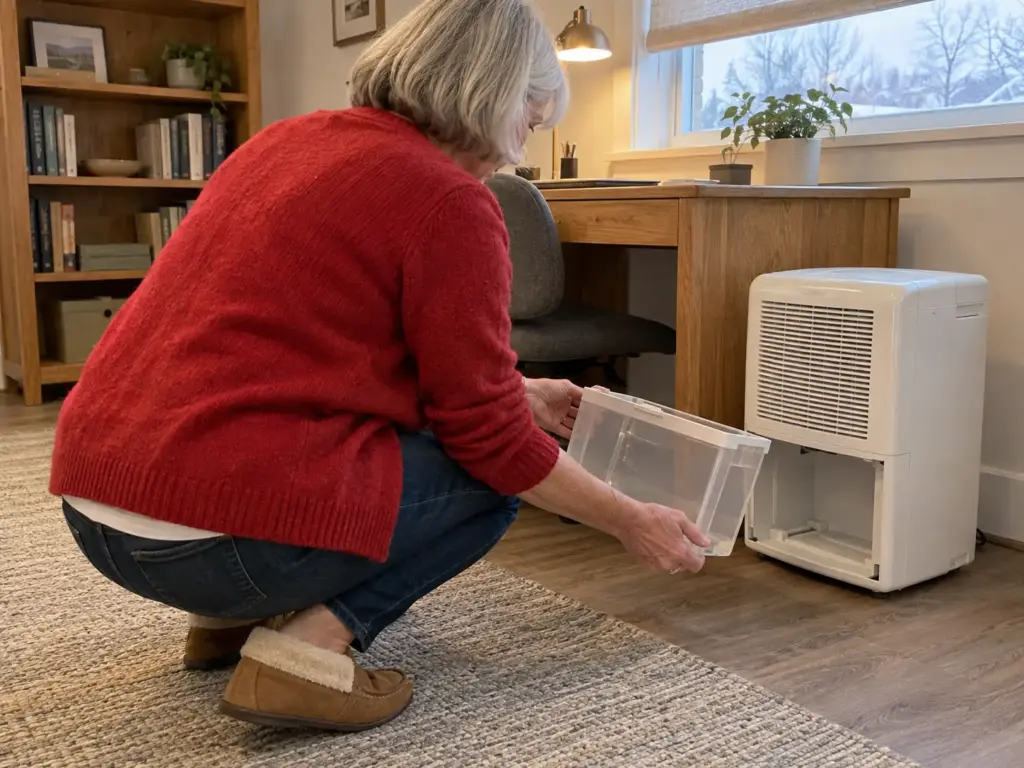
If the meter reads under the setting with the unit off, the unit has nothing to remove, and the only thing left for it to do is over-dry the air, a real risk in dry winter air. This is the case behind the people who switch their basement unit off for the cold months: the basement is dry already, and a running machine is cycling for nothing. When indoor humidity runs too low has its own article, and the first step there is the same as here, which is to read the meter before touching anything.
The bucket tells the same story from the other side. A unit that filled it every morning in August and now holds a thin film of water is not broken. It is saying the air has run out of moisture to give.
Wet and warm enough: run it to the setting
Two readings decide this branch: the room’s humidity with the unit off, and the room’s temperature. If the basement still reads above the setting and the air at the unit stays above 65°F (18°C), run it. The humidistat does the cycling, so the useful question is the setting, not a clock, and the setting is covered in what humidity to set a dehumidifier to.
How many hours that adds up to is the subject of how long a basement dehumidifier should run. The wet season also has a trigger worth stealing. Some people turn the unit off in autumn unless rain is coming, and run it again when the snow starts melting. Blanket advice to switch it off for winter works for some basements and fails for a basement where the thaw pushes water against the wall.
Wet and cold: the unit is the wrong tool for this room
The third case is the one most winter advice skips: the basement reads wet, and the air around the unit sits under 65°F (18°C). A machine run longer in that room does not dry it more. The coil frosts, the compressor cycles, and the water stays where it was.
ENERGY STAR’s wording is that, for a space which typically falls under 65 degrees, you may want to consider a product that is specified for use at lower temperatures, so the options are that kind of unit, a warmer spot, or fixing the water first. That is the whole case against a basement dehumidifier in winter when the room is cold. The next two sections take the cold line and the water one at a time.
Why 65°F Matters and What the Spec Sheet Has to Say
Too cold for the machine needs a number, and the number is a property of the room’s air rather than the month on the wall. A basement can sit at 62°F (17°C) in October, and the unit will treat it the way it treats January. This section covers what happens inside the unit in that air, where on the sheet the maker says what it can take, and what a winter run adds to the meter.
What the coil does below 65°F
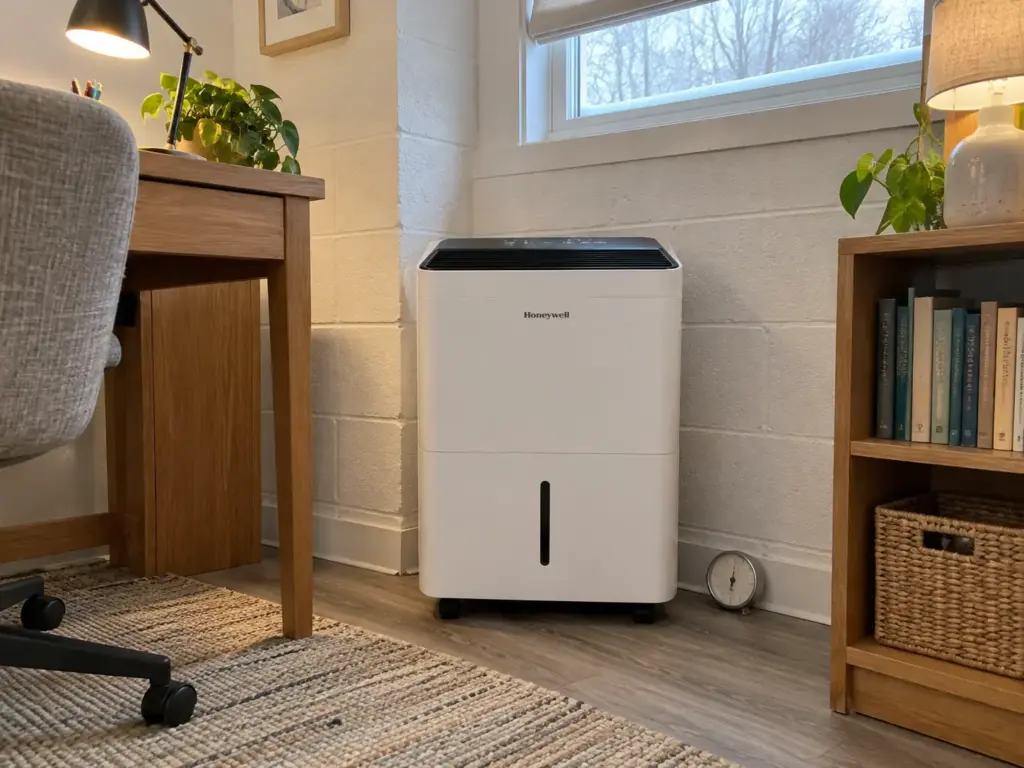
According to ENERGY STAR’s dehumidifier guidance on cold rooms, “Frost can form on the condensing coils if the air temperature drops below 65 degrees,” and the compressor then cycles on and off repeatedly without removing moisture from the air. If that happens, the unit should be switched off and left to defrost before it is turned back on. A rest, then, not a higher setting.
Some units carry an anti-frost sensor that switches them off when the air falls under a set temperature. ENERGY STAR prints no number for it, which means the cut-off lives on your unit’s sheet and nowhere else. Running a unit in a cold basement can end with ice over the air intake and the control panel, and nothing works afterward. It is what frost looks like when nothing switches the machine off. One report, not a trend, but it is what frost looks like when nothing switches the machine off.
A unit that has frosted over and one that is idling happily look the same from the foot of the stairs: both hum, both have a lit panel. Look at the bucket. If it has gained nothing since yesterday while the compressor is still running, the unit is cycling without drying, and the step is the one above: switch it off and let it defrost.
What to look for on the spec sheet
The sheet of your own unit is where the maker says more than the box does, and two lines matter: the lowest air temperature the unit is rated to run in, and whether it has an anti-frost sensor. Until the sheet says otherwise, 65°F (18°C) is the line to keep. And a warmer spot in the house, or the unit moved off the coldest wall, costs nothing and comes before any shopping.
A listing can name the feature and still leave the number out, which is the lesson of the Honeywell TPFIT50PWK, a unit rated for 50 pints per day with a built-in drain pump. Its feature list names Low Temp Operation and prints no temperature beside it. The listing sits at 2.5 out of 5 across 115 ratings, and Amazon’s summary of the reviews reports mixed reliability, with some units malfunctioning after 6 months and E3 error codes turning up. So the one listing here that names a low-temperature feature still sends you to the manual for the number.
If the unit already in your basement is the 50-pint Midea Cube (4,500 square feet and ENERGY STAR on its title, a humidity control range of 35 to 85 percent on the listing), the sheet check matters more than a purchase. Its page does not print a minimum temperature either, and Amazon’s summary says the built-in humidity sensor gets negative feedback, with reviewers reporting inaccurate readings (3.5 out of 5 across 332 ratings). That is one more reason the reading in this article comes from a separate meter.
Neither listing gives a minimum operating temperature, so there is none to quote for either model, and reading the sheet is the job. If the sheet says the unit stops short of what your basement does, which dehumidifier is best for a basement starts from the same 65°F line, and what to look for in a dehumidifier before you buy covers the other lines of a sheet.
What a winter run adds, as arithmetic
Watts times hours run, divided by 1,000, gives kilowatt-hours for the day. Take a round figure, say 500 watts for 12 hours of running: 500 times 12 is 6,000, and divided by 1,000 that is 6 kilowatt-hours. Multiply that by the rate printed on your own bill and you have a winter day’s running cost without a guess in it. The 500 is an invented round number to show the steps; your unit’s real figure comes from the meter.
That is where the P3 P4400 Kill A Watt earns its place. As a plug-in watt meter it sits between the wall and the unit and reads watts and kilowatt-hours, so a humidistat that cycles all day still ends up as one number after 24 hours. It reads the plug, not the room. The ratings are strong at 4.6 out of 5 across 9,752 of them, but a meter that fails quietly is worth a second look at the display.
ENERGY STAR measures efficiency as liters of water removed per kilowatt-hour, and a higher number is better. It gives no winter figure. And whether a winter run saves any heating is not something a published source settles, so the arithmetic stops at kilowatt-hours.
On the day you read the kilowatt-hours, empty the bucket and divide the liters by them (a pint is about 0.47 liter). That is ENERGY STAR’s efficiency unit for your own basement, and a number that slides as the weather turns says the unit is working in air too cold, or too dry, to do much.
When the Basement Is Wet in Winter and the Unit Is Not the Fix
If the unit cannot work in this room, the water is still there, and a wet cold surface is a water problem before it is an air problem. The useful question is where the water comes from, and which of the free fixes comes first. A dehumidifier treats the air, not the source.
Wet cold surfaces are a water problem first
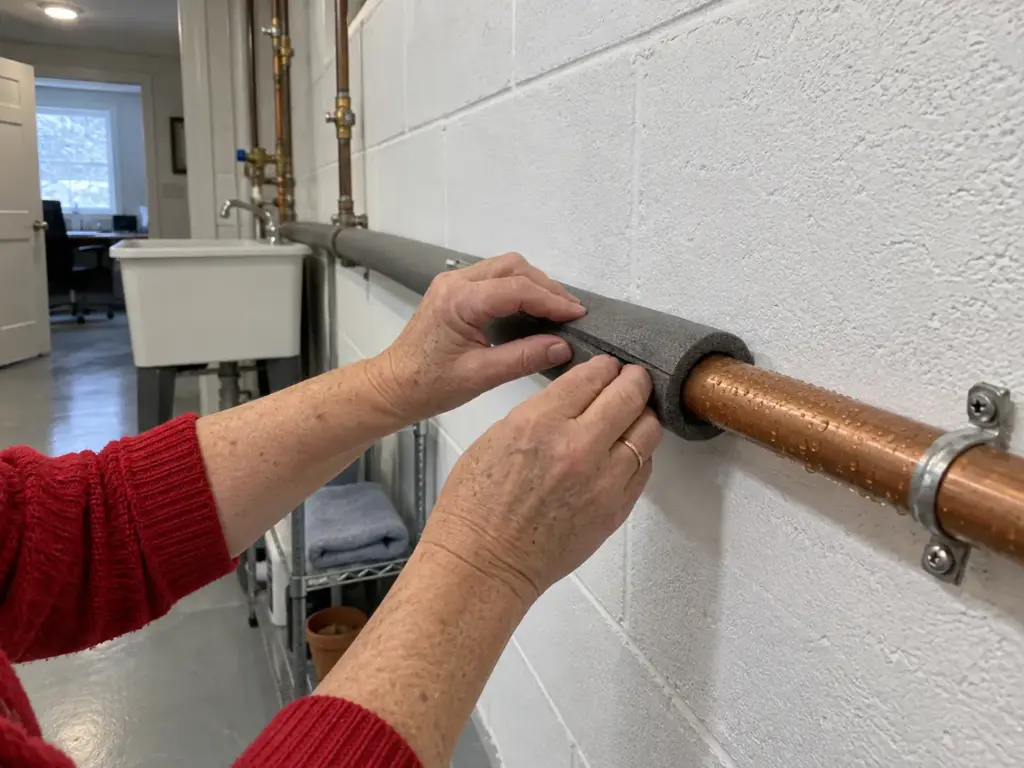
The EPA’s advice to dry wet surfaces and insulate cold pipes starts with the surface: if condensation or moisture collects on windows, walls or pipes, dry the wet surface quickly and reduce the moisture or water source. Winter has its own routes for that water: snowmelt against the foundation, rain, wet soil, ground that slopes toward the house, a foundation crack or a gap at the rim joist. The cause-by-cause argument is in what causes basement humidity, and it is worth reading before deciding the unit is the answer.
Cover the cold pipes and read again
The same EPA guide says to cover cold surfaces, such as cold water pipes, with insulation. The cold surface is the cause; cover it and the sweat stops without a device. One change at a time, in order: dry the wet surface, insulate the pipe, read the meter, and only then decide about the unit.
After the first change the surface should stay dry between readings; after the second, the pipe should stop beading by evening. If the meter has not moved at all, the water is arriving from somewhere else, and the last step of this section is for that.
A cold-water pipe that beads by the end of the day while the room reads fine is the building telling you where the cold surface is. It is a better guide than the display. Wet glass says the same from the room side, and condensation on windows, basement window condensation included, usually points to the same cold surface.
When a professional is the answer
A unit that frosts again and again, even in a room above 65°F, goes to an HVAC technician rather than to a higher setting. A wall that stays wet after the surface is dried and the pipes are covered points to water coming in from outside, which is a job for someone who works on foundations and drainage, whether that means sealing a crack or regrading the soil. Whether the wet air stays down there is a separate question, covered in whether basement humidity affects the rest of the house.
Switch It Off for One Reading, Then Choose
Three things carry over. The reading with the unit off decides, not the month. The line for the room is 65°F (18°C), and the sheet of your own unit is where the maker says more. And a wet, cold surface is a water problem first, with the unit reserved for the air that is left.
A month from now, read the bucket window and the meter at the same hour you read them today; if the bucket has gone from a film to a few inches, or the meter has climbed past the band, the choice you made this week needs another look. Tomorrow, switch the unit off, wait until the meter stops moving, and read it once, then follow the branch it points to. For the next question, the season itself, read how indoor humidity shifts with the cold.
Frequently Asked Questions
01Do you need to run a dehumidifier in the winter in the basement?
Only while the basement still reads above your setting with the unit off and the air at the unit stays above 65°F (18°C). A dry basement or a cold one does not need it running.
02When should you not use a dehumidifier in winter?
When the basement already reads under your setting with the unit off, or when the room sits under 65°F (18°C) and the coil can frost. In either case the unit has no drying left to do.
03Should I leave my basement dehumidifier on all the time?
Leaving it plugged in is fine, because it runs on its humidistat and cycles only while the room is above the setting. The hours that adds up to are in how long a basement dehumidifier should run.
04What month should you run a dehumidifier in your basement?
The reading decides, not the calendar. A basement that reads above the band with the unit off needs it in any month.
05Can a basement dehumidifier freeze up in the cold?
Yes. ENERGY STAR says frost can form on the coils when the air drops below 65°F (18°C), and the unit should then be switched off and left to defrost before it runs again.