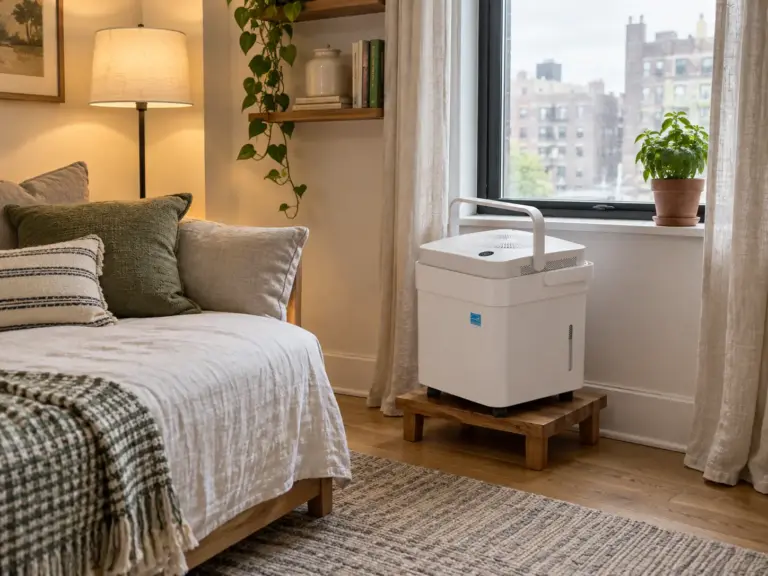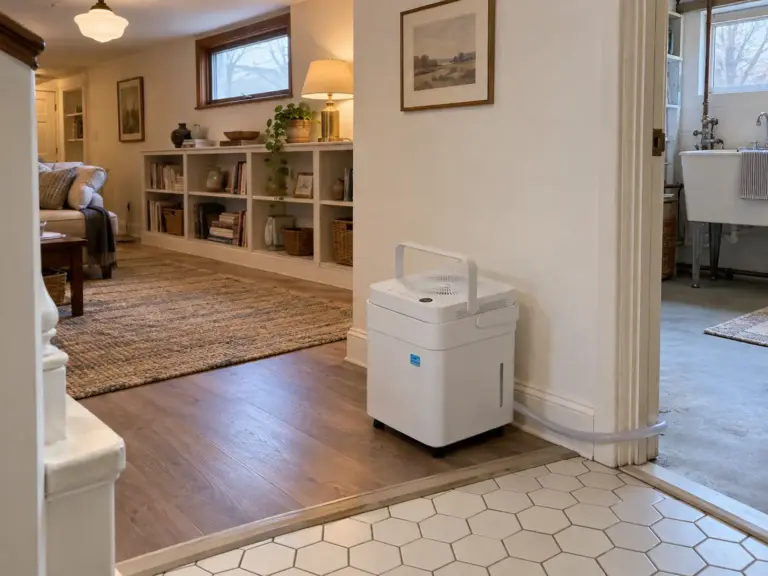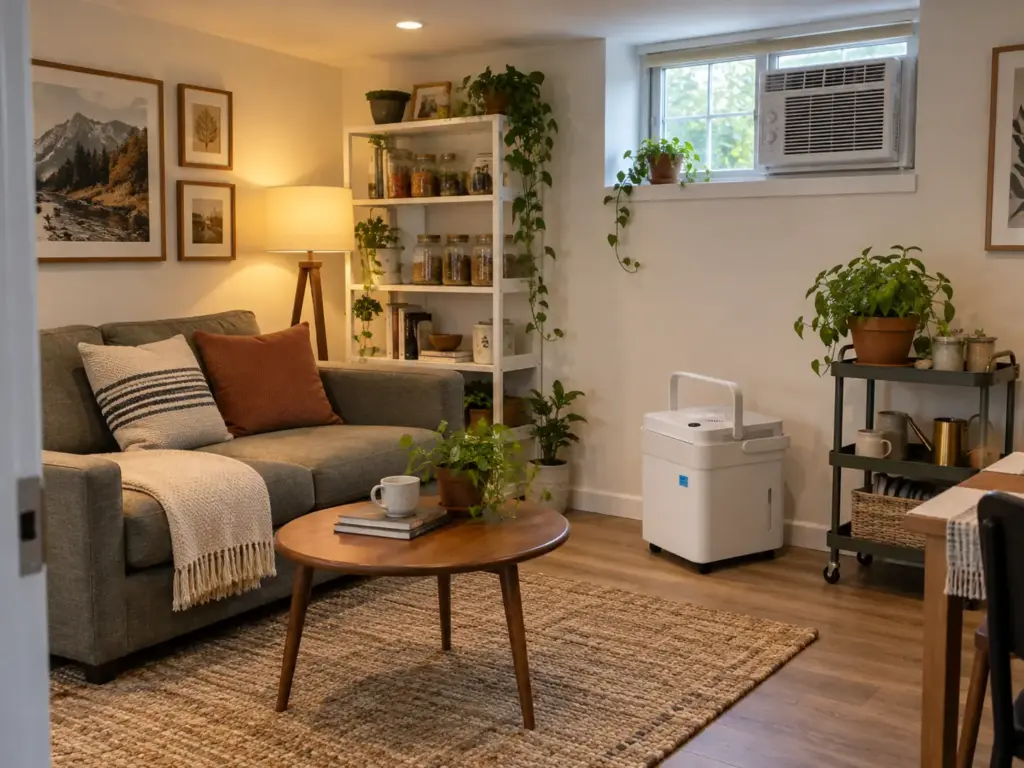
Your basement is hot, it smells damp, and its one small window already holds an air conditioner that hums along as though it were handling the problem. Is it, or is the machine you already own missing the point? The dehumidifier vs air conditioner for a basement question has a short mechanical answer: a dehumidifier removes water on purpose, while an air conditioner removes some only as a side effect of cooling, and a side effect ends when the room reaches the number on the dial.
The table below settles who does what, the basement’s temperature decides which one can work, and a one-day test needs no purchase at all. After that come what each needs from the window and the drain, the running cost as arithmetic, and the case where the water, not the air, is the real problem.
Where a source publishes a figure, the table uses it; where none does, the cell says so.
| In a damp basement | Dehumidifier | Window air conditioner |
|---|---|---|
| What it does to the water | Removes it on purpose; that is the whole job | Removes some, only as a side effect of cooling |
| When it stops | When the room reaches the humidity you set | When the room reaches the temperature you set, even if the air is still damp |
| What it does to the room’s temperature | Warms the space slightly | Cools it |
| In a cool basement | Frost can form on the coils below 65°F (18°C), and the unit stops removing water | No published figure |
| What it needs, and its catch | A bucket or a drain, and closed windows; it returns its heat to the room | A window that fits and a level unit; an oversized one cools but removes only some of the humidity |
An Air Conditioner Dries a Basement Only as a Side Effect
The window unit you already own does pull some water out of the air, so “it does nothing” is the wrong answer. The better question is what it does once the room reaches the number on its dial, because that is the moment its drying stops.

Why cooling removes some water
An air conditioner chills air across a cold coil, and water condenses on that coil the way it beads on a cold glass. The water leaves through the drain and the room’s air comes back a little drier. That is the entire mechanism, and it is a by-product: the machine was built to lower a temperature, and the drying is whatever the cooling happens to produce. In short, a dehumidifier is an air conditioner with its condensing coil indoors, one that keeps running until it reaches its humidity setpoint.
What happens when the air conditioner reaches its set point
Cooling is the job, so the unit quits when the cooling is done. An air conditioner can reach its set point and switch off while the air is still humid, depending on the size of the space and the capacity of the unit. ENERGY STAR says the same about sizing: according to ENERGY STAR’s room air conditioner factsheet, an oversized unit will cool the room but remove only some of the humidity. A bigger unit reaches its set point sooner and stops sooner, so a basement can end up cool and still musty while the dial says the work is finished.
The same factsheet has a free setting worth trying before anything is bought: on humid days, run the fan on low, because slower air movement removes more moisture. Some owners lower the set point so the unit keeps running longer, which can help with humidity but costs more to run. It keeps the unit running, but without a meter reading nothing shows it is helping, and the electricity it uses comes up again below.
On the day you try the low fan, leave the set point where it is. Change both at once and the next reading cannot say which one moved the number.
Why the window glass sweats when the AC is on
The unit adds no water to the room. It chills the glass, and the glass collects moisture the way a cold can does on a porch, which says nothing about whether the machine is making the air wetter. The glass has its own article on why condensation on windows shows up when the AC is on; the only question that matters here is whether the room’s number is going down.
A Dehumidifier Removes Water on Purpose, and Gives the Heat Back
The dehumidifier is the one machine in this comparison whose entire job is the water. The price of that job is written on ENERGY STAR’s own page: it warms the room it dries.
How a dehumidifier decides when to stop
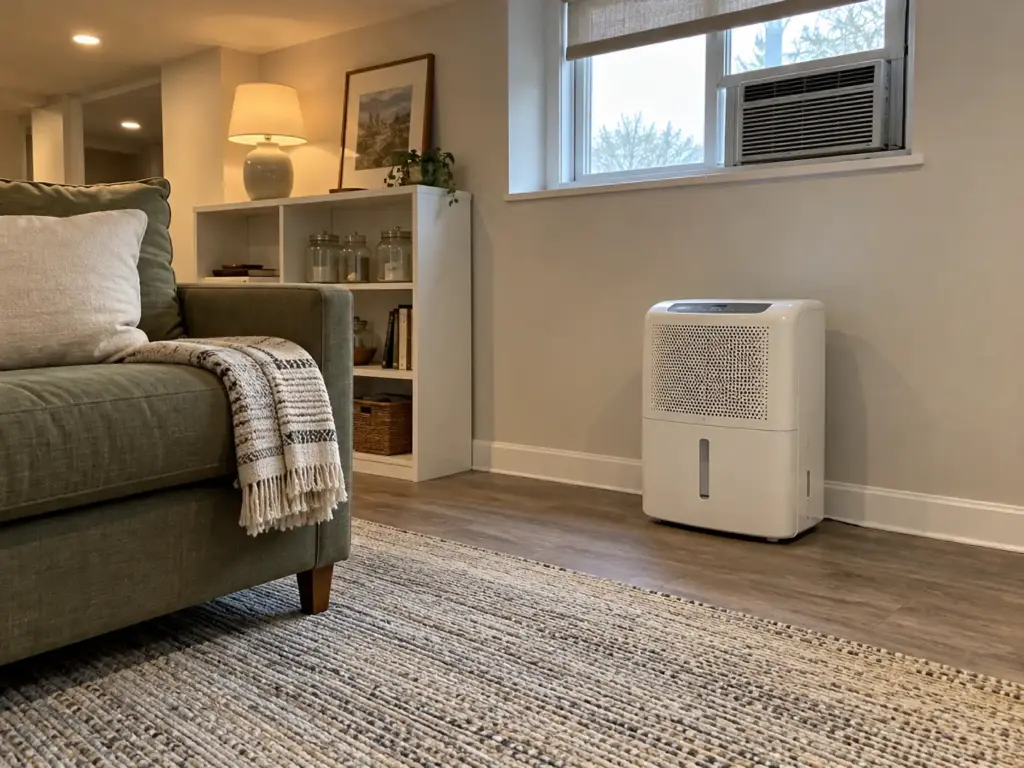
Every ENERGY STAR dehumidifier has a built-in humidistat, a control that lets you set the relative humidity you want, and once the room reaches it, the unit cycles on and off to hold the level. That is in ENERGY STAR’s dehumidifier guidance, and it is the opposite of the air conditioner’s logic: the dehumidifier stops when the air is dry enough, not when the room is cold enough.
The target both ENERGY STAR and the EPA name is 30 to 50 percent relative humidity, with 60 percent as the ceiling, and ENERGY STAR adds that anything above that range may promote mold growth. The setting therefore matters as much as the size, and it has its own piece on what humidity to set your dehumidifier to.
The heat it returns to the room
Water does not leave the air for free. ENERGY STAR says a dehumidifier slightly warms the space around it as it works. That makes it a poor fix for a room that is too hot: if heat is what bothers you, a dehumidifier will not solve that problem. They are right, and it is the dehumidifier’s real flaw in this comparison.
The heat the compressor and fan make stays in the basement, so a room that was already warm drifts warmer over an afternoon of running. The only evidence that the unit is earning that heat is the bucket.
The windows must stay closed
ENERGY STAR says the doors and windows of the space being dehumidified should be closed while the unit runs. A window left open lets in the very moisture the unit is pulling out, and it will run all day without getting anywhere. Hold on to that, because an air conditioner needs the opposite, and section five returns to it.
How much machine the room needs comes from the same ENERGY STAR page. For a space under 2,000 square feet, a slightly to moderately damp room (50 to 75 percent relative humidity, musty smell, possibly intermittent) calls for 20 to 30 pints a day; a very damp room (75 to 90 percent) calls for 25 to 40; a wet one (90 to 100 percent, where walls or floor sweat or seepage is present) calls for 30 to 50. A musty basement sits in the first row and sweating walls sit in the last. The arithmetic of fitting a unit to a room lives in how big a dehumidifier a basement needs, so it is not repeated here.
The Basement’s Temperature Decides Which One Can Work
The two mechanisms are in hand, and the room’s temperature is what chooses between them. One question settles it: which of the two has a number it cannot work below? The answer has a published half and an unpublished half, and this section keeps them apart. The same basement behaves differently in July and October, which is the curve in whether basement humidity is worse in summer or winter.

Below 65°F the dehumidifier stalls
The published half is the dehumidifier’s. ENERGY STAR puts it this way: “Frost can form on the condensing coils if the air temperature drops below 65 degrees.” When it does, the compressor cycles on and off without removing moisture, and the instruction is to switch the unit off and let it defrost. Some models have an anti-frost sensor, though the sources print no temperature for it.
In a basement that sits under 65°F (18°C), a plain dehumidifier is the wrong machine, and a reading of the room’s temperature, taken once with the unit off, costs nothing. The cold-room consequence has its own article: whether to run a dehumidifier in a basement in winter.
What a window AC does in a cool basement
The unpublished half is the air conditioner’s, and it is worth saying out loud: no institution gives a temperature below which a window AC stops dehumidifying, so this article does not print one. What the sources do say is narrower. A unit cycles off at its set point, so an oversized one cools without removing much of the humidity. In a cool basement the set point is reached early, which suggests the AC has little to do, but that is a reading of the mechanism and not a measured figure.
The table’s cell for that row says “no published figure” for the same reason.
When cooling is the job
The dehumidifier is the obvious answer for a damp basement, and in a basement that is also hot and occupied it stops being the whole answer. A finished basement that gets hot and humid in summer, with one window unit as the only cooling, is a common setup where mold can follow. A dehumidifier gives off heat, so in a hot room it does not fix the heat. Where cooling is the job, the air conditioner’s drying comes along with it. Three cases cover most basements:
| The basement | Dehumidifier | Window air conditioner |
|---|---|---|
| Warm and damp | Has the work to do, and removes water until the humidity setting is reached | Also removes some water while it cools, then stops at its set point |
| Cool and damp | Frost can form below 65°F (18°C), and the compressor cycles without removing moisture | No published figure |
| Hot and occupied | Removes the water but warms the space slightly | Cooling is the job; some drying comes with it |
A unit that has frosted and shut off and a unit that is cycling normally look identical from the stairs. Check the bucket: a meter that is still high and a bucket that stayed empty overnight say the unit stalled.
Test One Day Before You Buy Anything
The table says what each device can do in a room of a given temperature, but only the room’s own reading says whether the unit already there is enough. That reading costs a meter and a day, and a meter is the one purchase this test may need if you do not own one.
Where the meter goes
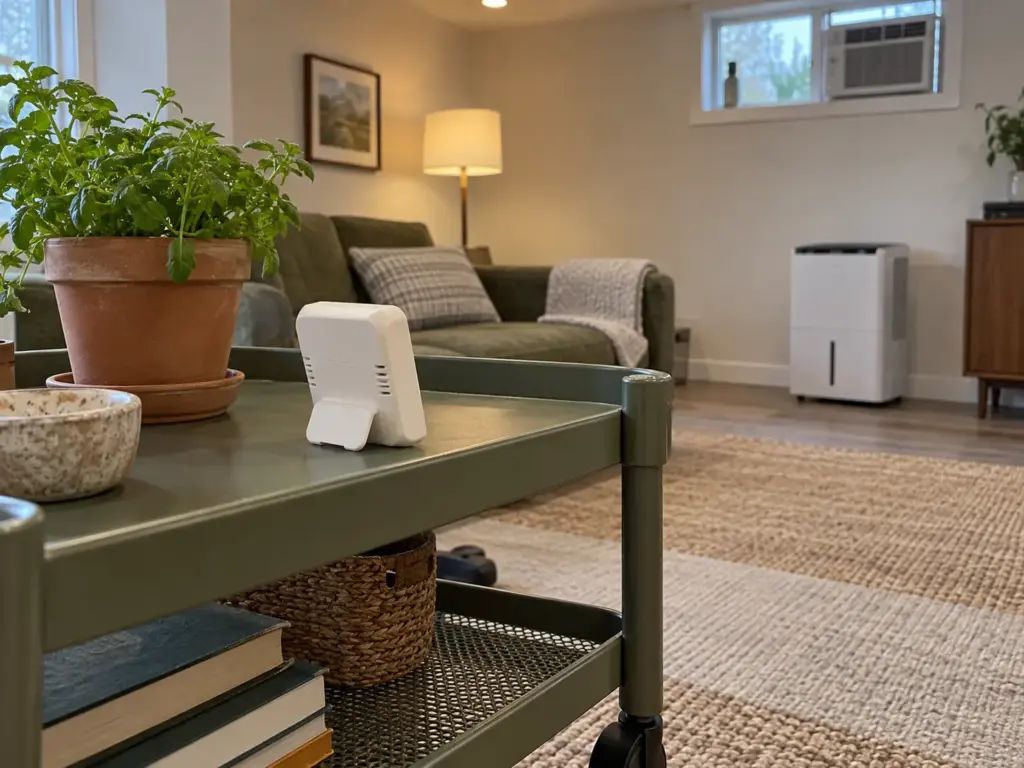
The EPA says relative humidity can be measured with a moisture or humidity meter, and that indoor humidity should stay below 60 percent, ideally between 30 and 50. ENERGY STAR, for its part, tells you to hang the hygrometer near the dehumidifier. For this test I would put it in the middle of the room instead, away from the unit, because a meter beside a running dehumidifier reads the air the unit has just dried. That is a judgment, not a standard, and it is the right one for this question: you are testing the room’s number, not the machine’s.
A sensor suited to cold concrete walls is covered in a humidity sensor that survives cold concrete walls, and the method for trusting what it shows is three readings with one meter.
Off, then on: the one-day reading
Change one thing at a time, and read between changes. In order:
- Read the room with everything off. This is the baseline.
- Run only the air conditioner, fan on low, for a day, and read again.
- Switch it off, run only the dehumidifier with the windows closed, and read again.
Never run both at once, or you will not know which one did the work. ENERGY STAR names the low fan for the air conditioner and the closed windows for the dehumidifier, and those are the only settings that change in their steps. The full protocol for step three is in how long to run a basement dehumidifier in a 24-hour test, so link there instead of repeating it. If you have no dehumidifier yet, steps one and two still answer the first question, whether the unit you already own is enough.
What the reading says
There is no invented threshold here. The device that brings the room into the band and holds it is the one that fits. If the room stays above the band with both machines running, it is not short of a device, it is a water problem, and the last section deals with that. The reading at the end of the first day is worth more than the one at the end of the first hour, because the walls and the floor keep giving moisture back to the room.
Write the time, the setting and the percent on the same card at every reading. A number without its setting cannot be compared with the next one.
What Each One Needs From the Window and the Drain
Whichever device wins the day, it needs a place: a window that fits, or a drain. The two needs are opposites, because ENERGY STAR wants the dehumidifier’s windows shut and an air conditioner needs one open to hold it.

A window unit needs a window that fits
The air conditioner’s drain is the window. A window unit drains its water outside on its own, as long as it is mounted properly, and the mounting is where basements often go wrong. ENERGY STAR says an improperly installed room air conditioner leaks as much air as a 6-square-inch hole, and its factsheet also says to make sure the unit is level so the drainage system works.
A basement window that does not fit the unit loses the benefit of the machine. It also costs the renter the window: in a one-window basement, the choice between devices also decides how that window is used, because the AC takes the window and the dehumidifier wants it closed.
A dehumidifier needs a bucket or a drain
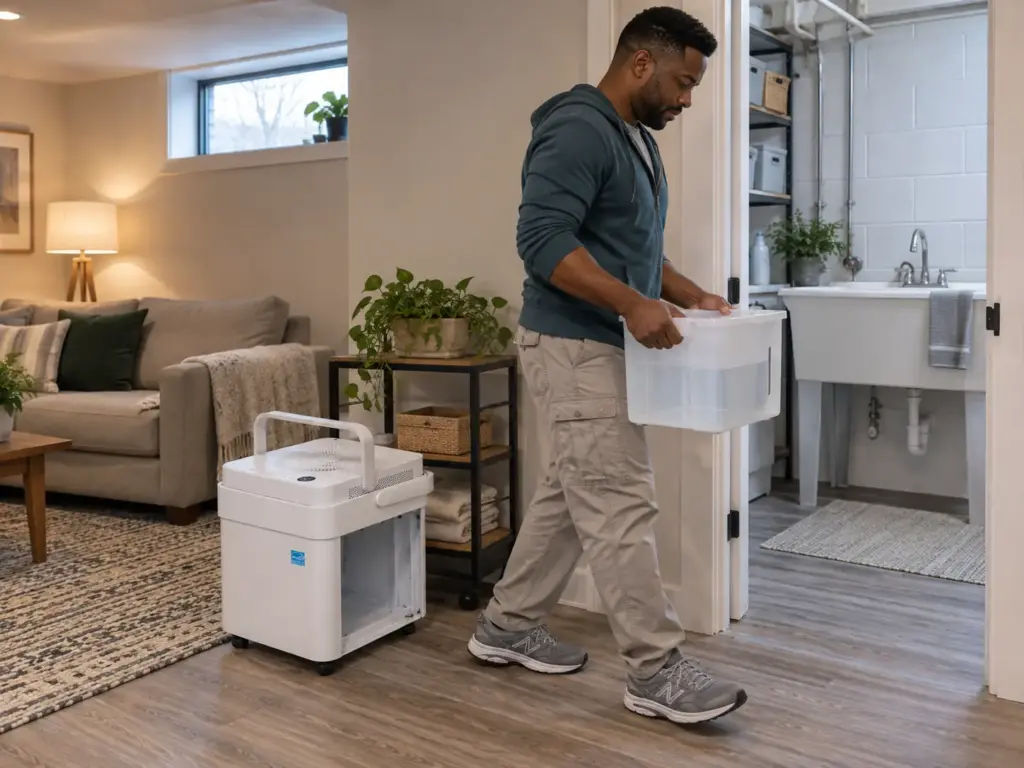
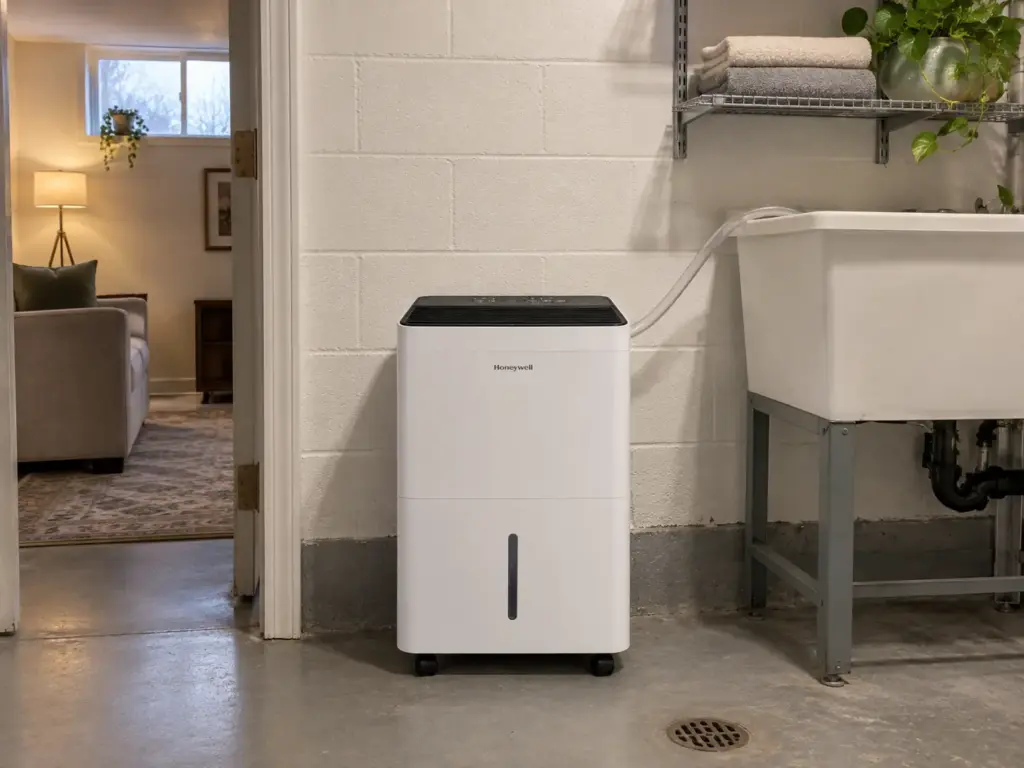
A dehumidifier with no pump fills a tank that is emptied by hand, or sends its water down a hose to a floor drain or into a pump. Where the hose goes is covered in where to drain a basement dehumidifier, and the model with a built-in pump has its own page, a basement dehumidifier with a pump and drain hose. The bucket that has to be carried to the sink every day is the part of a dehumidifier that decides whether it is still running in month two.
What Each One Costs to Run, as Arithmetic
The next question is the electricity. No page in the sources gives a current figure for a basement, so the section does the arithmetic with the one number your own bill holds.
The formula, and what each unit’s own rating says
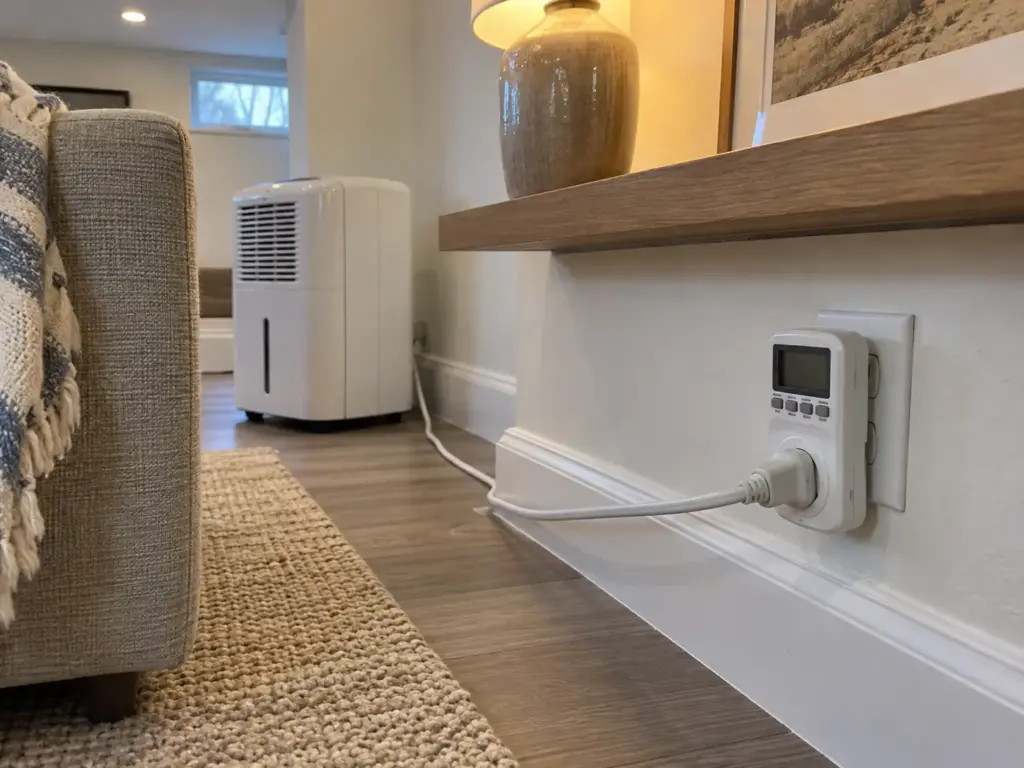
Watts times hours, divided by 1,000, gives kilowatt-hours; multiply by the rate on your bill. ENERGY STAR’s product listings put an 8,000 Btu/h window air conditioner at 400 kilowatt-hours a year and the Honeywell 50-pint dehumidifier at 516 kilowatt-hours a year (record 4572937).
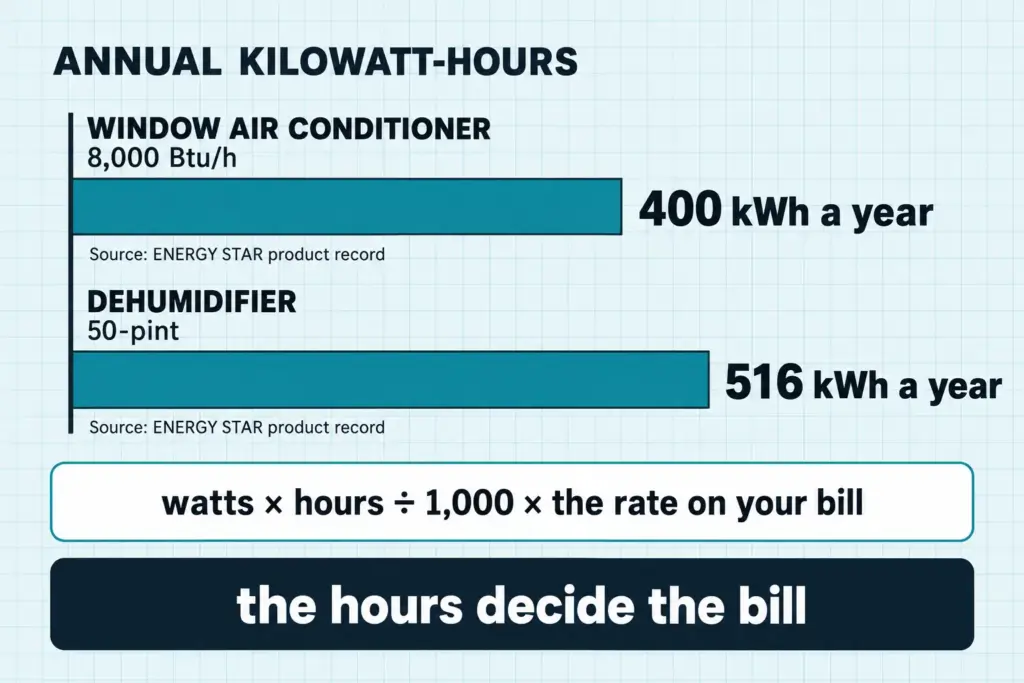
The gap is 116 kilowatt-hours a year, about 30 percent more for the dehumidifier on paper, and the number to run is 116 times your rate. But it is on paper only. Each figure is ENERGY STAR’s for that unit on its own test basis, and the air conditioner’s is the listing of a window unit, not a measurement in your basement.
ENERGY STAR also says certified dehumidifiers are 20 percent more efficient than non-certified models. Its efficiency measure is liters of water removed per kilowatt-hour, where higher is better, and the Honeywell’s record shows 2.01. One more direction, with no dollar claim behind it: the dehumidifier heats the room and the AC cools it, so in a hot basement the cooling bill and the drying bill are not the same bill.
Why the hours decide the bill
A dehumidifier’s humidistat turns it off when the room reaches the setting, and an air conditioner’s thermostat turns it off at the set point, so neither runs flat out for a year. Running the AC around the clock through a summer can prevent mold, but it feels wasteful. That is the hours column of the arithmetic, and it is the one a listing cannot fill in. A plug-in watt meter on the cord reads the real watts, and the days you leave it running supply the hours.
Month Two: What Each One Does When It Runs All Summer
The arithmetic assumes a unit that keeps running, and the first week lies about that. This section counts the months the way a real summer does.
The window unit left on all summer
An AC that runs for months asks for upkeep that week one never does: the EPA’s guide says to keep air conditioning drip pans clean and the drain lines unobstructed and flowing. And a unit that cycles off at its set point is doing what it was built for, so nonstop is a setting the owner chose, not something the machine does on its own.
The bucket that fills every day
In ENERGY STAR’s wet row a unit is pulling 30 to 50 pints a day, so the drain decides month two, not the machine. The Midea Cube 50 Pint Dehumidifier is the 50-pint class, with an ENERGY STAR mark, a stated coverage of 4,500 square feet and a humidity sensor with a Wi-Fi app.
This version has no pump, so a hose has to run downhill to a floor drain or the tank gets emptied by hand. Amazon’s summary of its customer reviews, at 3.5 stars, says “The humidity sensor receives negative feedback, with customers reporting inaccurate readings,” which matters because the unit’s own sensor is what the humidistat reads. A separate meter in the middle of the room settles it.
What the owners of the 20- and 50-pint units report
The smaller class suits the first row of ENERGY STAR’s table and comes up short in a wet basement. The Midea Cube 20 Pint Dehumidifier is rated for 1,500 square feet and 20 pints a day, which makes it the budget choice for a musty basement that is not sweating.
Amazon’s summary, at 4.0 stars, reports “units working for only a few hours before dying” and a bucket that gets heavy to empty. A 12-liter bucket holds about 25 pints, so a unit pulling its full 20 a day is most of the way to full every day.
Neither the sensor complaint nor the early failures is a week-two story. The Honeywell with the built-in pump, which gets its card in the last section, draws a third kind: at 2.5 stars, Amazon’s summary says others mention it malfunctioning after 6 months. Three units, three different failures, and none of them appears on a spec sheet.
Empty the bucket at the same time every day and write down how full it was. A bucket that is already full when you arrive means the drain, not the unit, is what will decide month two.
When It Is the Water, Not the Air, and What to Buy Then
A basement that stays above the band with every device running is not short of a device. This section says what to fix first, when the air conditioner and the dehumidifier together make sense, and gives the verdict.
Fix the water before you pick a device
The EPA’s brief guide to mold, moisture and your home says the key to mold control is controlling moisture, and ENERGY STAR says reducing sources of moisture reduces the need for dehumidification. Both agree on the band: below 60 percent, ideally 30 to 50.
ENERGY STAR’s own vocabulary for the worst case is a floor or wall that sweats, or seepage that is present, and that is a water problem first and a device problem second. The routes in are covered in what causes basement humidity, and ENERGY STAR’s own tips for reducing the moisture are to extend downspouts away from the foundation, keep gutters clear and slope the soil away from the house. Fix one, read the meter, and then decide.
The order in which the dehumidifier comes last is in how to keep basement humidity low with the dehumidifier last, and the free fixes sit in free fixes for lowering indoor humidity.
A wall that stays wet after all that is a building problem, and a professional’s.
The verdict, by basement
Damp and cool: the dehumidifier, in a version that handles the cold, or the water fixed first. Damp, hot and occupied: the air conditioner takes the heat and the dehumidifier takes the water, tested one at a time as in the one-day reading. Damp, one window, a rental: the test decides, because it shows whether the window unit already there is enough. And the test catches what the table cannot: a room where both machines are running and the number still will not move, because the water is still coming in.
The one unit worth a card
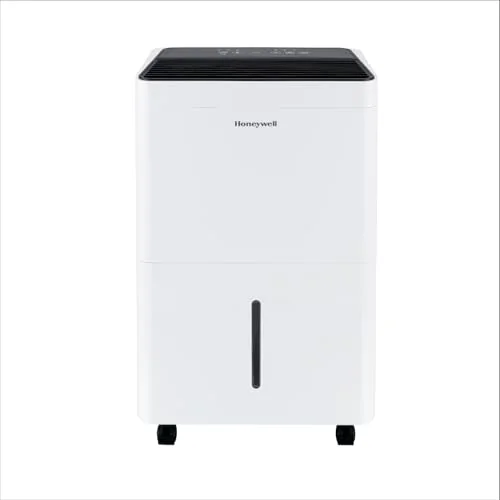
For the wet basement, the 50-pint class matters, and a pump matters when the drain is across the room. The Honeywell TPFIT50PWK is the one unit here with an ENERGY STAR record opened for this article, and its numbers come from that record. The unit’s flaws are in the reviews and in the listing, and both come before the card. For a shortlist, there is which dehumidifier is best for a basement, and for a reader with no unit at all, what to look for in a dehumidifier before you buy.
Tomorrow’s Reading, and the One to Take a Month From Now
Three things carry this article. A dehumidifier removes water on purpose and an air conditioner only as a side effect, so a damp basement points to the dehumidifier unless the room is also hot and occupied. The room’s temperature decides: 65°F (18°C) is the dehumidifier’s published line, and the air conditioner has no published one. And a one-day test, one change at a time, beats a purchase made on a guess, with the water fixed before either.
A month from now, the bucket and the meter, read at the same hour and the same spot, will say whether the choice held: a bucket that fills faster than it used to, or a number that crept back above the band, means the water source moved or the unit slipped.
Tomorrow, put a meter in the middle of the room, run only the unit you already have on its low fan for a day, and read it at the end. If the room settles inside 30 to 50 percent, you have your answer for free. If it sits above 60, the next question is size and drain, and how big a dehumidifier a basement needs is the place to start.
Frequently Asked Questions
01Is it better to use a dehumidifier instead of an air conditioner in a basement?
For a damp basement, usually yes, because a dehumidifier removes water on purpose while an air conditioner removes it only while it cools and stops at its set point. If the room is also hot, cooling is the job.
02Does a dehumidifier run up your electric bill?
It adds its watts times the hours it runs, divided by 1,000, times your rate, so the hours decide more than the label does. ENERGY STAR lists the Honeywell at 516 kilowatt-hours a year on its own test basis.
03What is the downside of a dehumidifier?
It slightly warms the room, fills a bucket that needs emptying or a drain, and below 65°F the coils can frost and the unit stops removing water. The rest depends on how well it is sized to the room.
04What month should you run a dehumidifier in your basement?
The reading decides, not the calendar: run it when the basement reads above your setting with the unit off. In winter, check the 65°F line first.
05Can a window air conditioner dry a basement?
Only as a side effect: it removes water while it cools and stops at its set point, and ENERGY STAR says an oversized unit removes only some of the humidity. Running the fan on low on humid days helps.