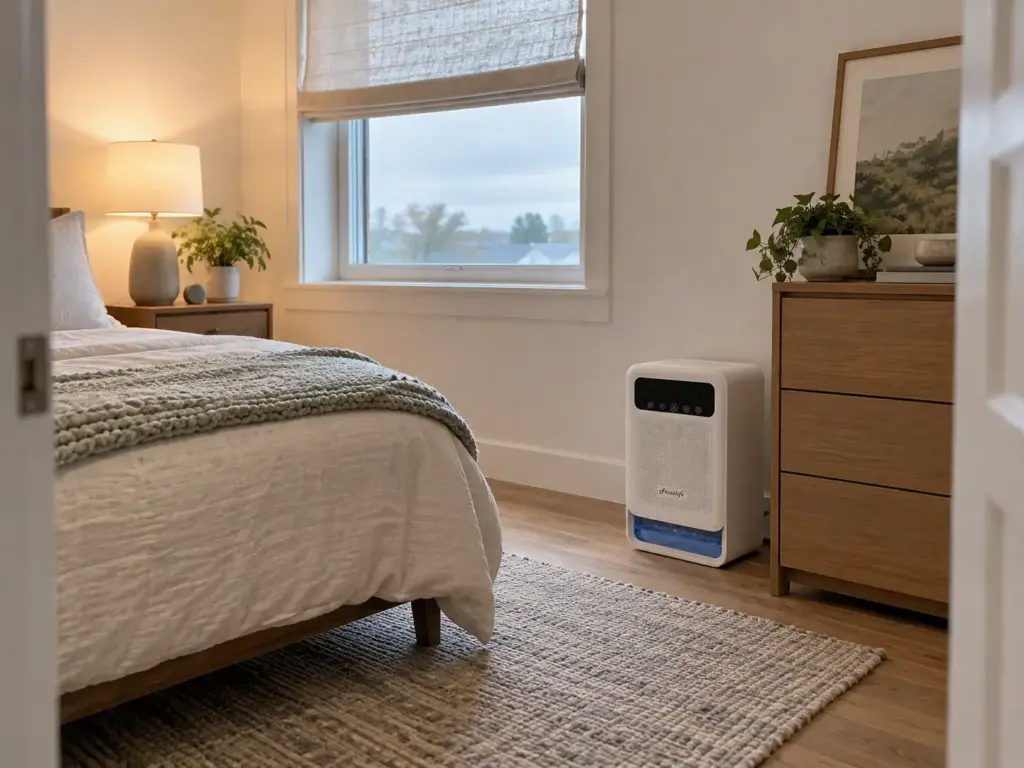
You shut the bedroom door for the night, and by morning the air in there feels muggy and clammy, the shade at the window edge looks damp, and the search on your phone is for the best dehumidifier for a bedroom. A closed room collects the moisture of a night of breathing and has nowhere to send it, so the reading at the bed, not the name on the box, says whether a unit is needed at all. This guide takes that reading first, then the three figures on a spec sheet that decide a bedroom unit: pints a day at the speed you will run, decibels at that same speed, and the hours the bucket takes to fill. After those come the heat a unit leaves in a shut room, two real listings with the flaw written beside each, and what a bedroom should refuse to take home.
Here are the two listings set against those three figures, and the blank in the noise column belongs to the listing, not to a typo.
| Unit | Rated moisture a day and bucket | Sleep noise on the listing | Flaw |
|---|---|---|---|
| Frizzlife DH80 semiconductor type | Up to 40 oz (about 2.5 pints) at 86°F (30°C) and 80% RH, the maker’s test. Tank 135 oz (about 8.4 pints). | 28 dB in sleep mode. The maker’s figure, with no distance given. | Small pace, humidity level cannot be set, and the pace is a warm-room figure. |
| Midea Cube 50 50-pint unit with a hose option | 50 pints a day (the maker’s rating), 4,500 sq ft. Tank 4.2 gal (15.9 L). | None printed on the listing. | Far more pace than most bedrooms collect, a heavy bucket, and no decibel figure. |
Read the Bedroom Before You Shop for a Dehumidifier
The shopping question comes second. First the room has to show that it is damp, because a room that is only stuffy (the carbon dioxide count after a night behind a shut door) does not need a dehumidifier, and neither does a room that reads 45%.
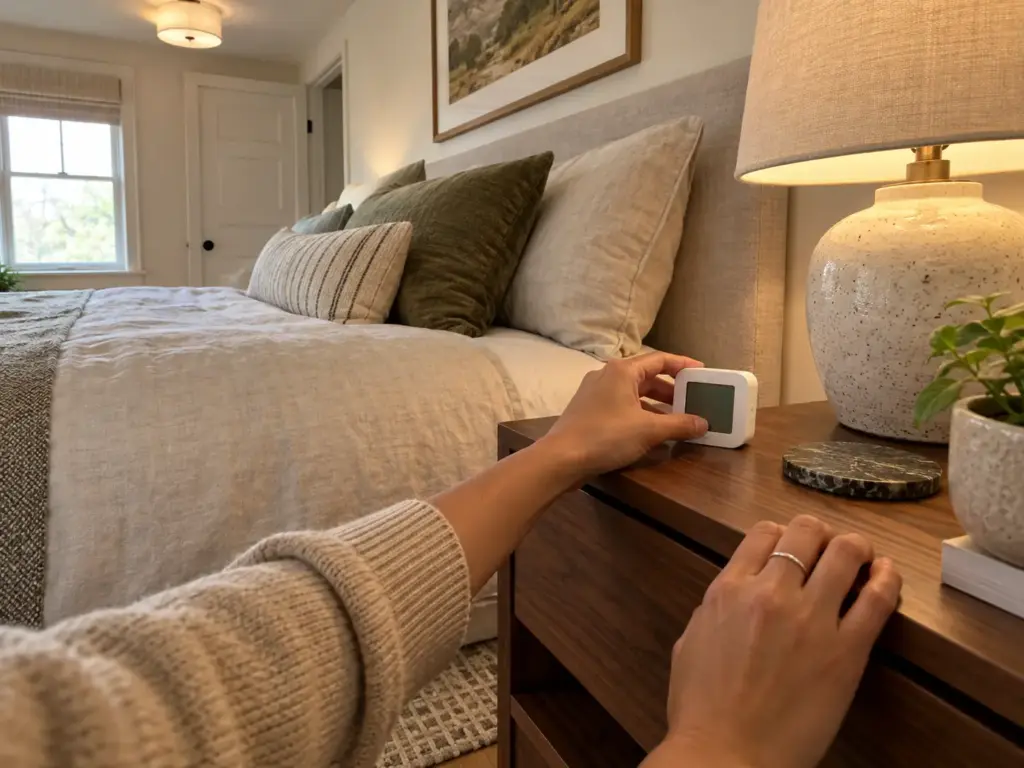
The line to read against comes from EPA’s guidance on mold and moisture, which recommends keeping indoor humidity “below 60% relative humidity (RH), ideally 30-50%”. The long version for this one room lives in what a good humidity level for a bedroom is. The working rule here is shorter: a bedroom that sits above 60% with the door shut is the case for a unit, and a bedroom at 50% is not.
Get the number from a cheap humidity meter on the nightstand rather than from the thermostat in the hall. The meter reads the room that needs the answer, and a unit’s box reads nothing. A cheap one can be off by a few points, so check it against the same spot twice, and trust a reading that repeats over one that looks dramatic once.
Put the meter where the sleeper’s head is, not on the dresser beside the window, and write down the wake-up number for three mornings in a row. One number is a mood. Three in the same spot are a reading.
Take one reading at wake-up with the door still shut and another by mid-afternoon. A room that reads high in the morning and ordinary by afternoon has the night as its source: a closed room’s own moisture with nowhere to go. That is the job a bedroom unit would have, and it shapes every choice below.
The 60% line needs one caveat, and it is a judgment call, not a rule. A meter on the nightstand reads the middle of the room, while the corner behind the wardrobe or the wall that faces the outdoors is cooler than the room’s air, so the air touching that cold wall reaches its dew point sooner than the air at the bed does. A room can read 55% at the bed and still have a corner that feels clammy or a patch of paint that looks darker than the rest. When the corner and the meter disagree, believe the corner, and put the meter in that spot for a few mornings.
Then change one thing at a time, free and likeliest first, and read the meter again between changes. Open the door for an hour after waking and read at the next wake-up; if the number now sits under 60%, the shopping is over.
If it does not, run the bathroom exhaust fan during the shower and for a while after it, so the steam leaves through the duct instead of drifting under the bedroom door, and expect the morning number to drop a few points if the bathroom was feeding the room. Only after those two, go looking for a source: a wet baseboard, a stained ceiling, a sill that keeps pooling water. Three changes on the same night tell you nothing about which one worked.
A wall that is wet or spotted with mold is a building problem, and no device in this article fixes it. Mold on a bedroom wall has its own guide, and a professional is the right call when a patch keeps coming back after the source has been dealt with.
For a single problem bedroom, the first check is the roof and the plumbing for leaks, and then the room for mold. Another says that unless the room has a significant moisture problem (walls wet with condensation, mold growing), a dehumidifier “will fight with your AC and will simply be a waste of money.” Both send the reader back to the reading.
How many pints a day a room needs, sorted by how wet it is, is laid out in what to look for in a dehumidifier, and this guide does not repeat it. What follows is for the sleeping room, where the noise and the bucket you carry at wake-up count as much as the pace.
Decibels at the Speed You Will Actually Run
A unit that is right on paper still fails if its hum keeps the room awake, and a decibel figure only means something once a speed and a distance stand beside it. Two listings go through that test below, and one of them has nothing to test.
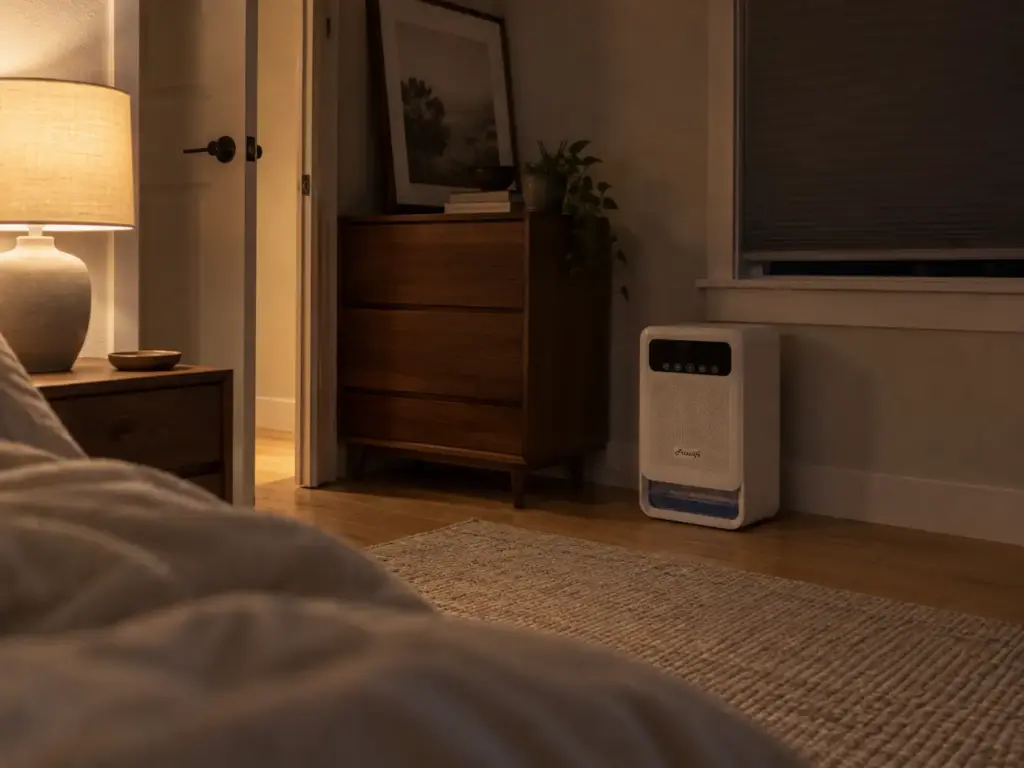
Ask which speed the number is for
A decibel figure with no speed and no distance is a sales line. Loudness depends on both Hz and dB, but Hz is often not listed, and dB figures often come with no conditions attached.
Three questions turn a figure into a spec. Which fan speed was it measured at? How far from the unit did the meter stand? And is the number the maker’s claim or a measurement somebody took?
Neither listing here answers all three, which is how the form works and not a verdict on the units. A phone’s sound-meter app is crude, but it is good enough to compare two nights in the same room at the same distance from the unit, which is the comparison that matters once the box is open. Until then, treat each figure as the maker’s best case for its quietest mode, and nothing more. For a bedroom the best-case speed is the one that matters least, because the speed that runs all night is also the speed that decides how many pints leave the room.
What the two listings print (and what they leave out)
The Frizzlife DH80 listing prints 28 dB for sleep mode. It is the maker’s figure, it names a mode and gives no distance, and it is the only decibel number either listing offers. The same listing describes a built-in 7-color light and a digital display; whether the light switches off is not stated on the page, so that is a question for the maker before the unit goes on a nightstand. (A light that stays on in a dark bedroom is its own kind of noise.)
The 50-pint listing sits at the other end. Its title promises “Quiet Operation” for the bedroom, yet the page prints no decibel figure at any speed, and quiet with no number and no fan speed beside it is the box talking. For the unit a bedroom shopper is most tempted by, the figure to compare is simply not there. Ask the maker, or leave that one on the shelf.
Why the quiet unit and the unit that dries are not always the same
A quiet figure belongs to a mode, and dehumidifier noise drops when a sleep mode runs the fan, or the cooling part, at its low fan speed. A unit that runs low dries less.
So the advice to drop to the low speed at night is only half a rule: the quiet speed and the pints per day at that speed have to be read together, and the second number is the one a listing leaves out. Noise at the speed that actually dries carries the general rule. Here it comes down to the Frizzlife’s 40 oz a day, which the listing ties to a test room at 86°F (30°C) and 80% RH and does not tie to sleep mode.
The reason the DH80 is quiet sits in the listing itself. It is built on “dual semiconductor technology” (the thermo-electric kind), and the listing says it “works differently from compressor units” and “is designed for small spaces”.
The same choice that removes a compressor’s hum caps the pace, so quiet and small arrive as a pair. That suits a closet-sized problem, the job a small, quiet dehumidifier for a bedroom is really good at. It is a mistake for a bedroom that reads over 60% with the door shut.
A hum that is easy to ignore at noon is judged from the pillow, with the lamp off and nothing else making sound in the house. The first night is the test, and a purchase with a return window long enough to cover it is the fix.
How Many Hours Until the Bucket Is Full
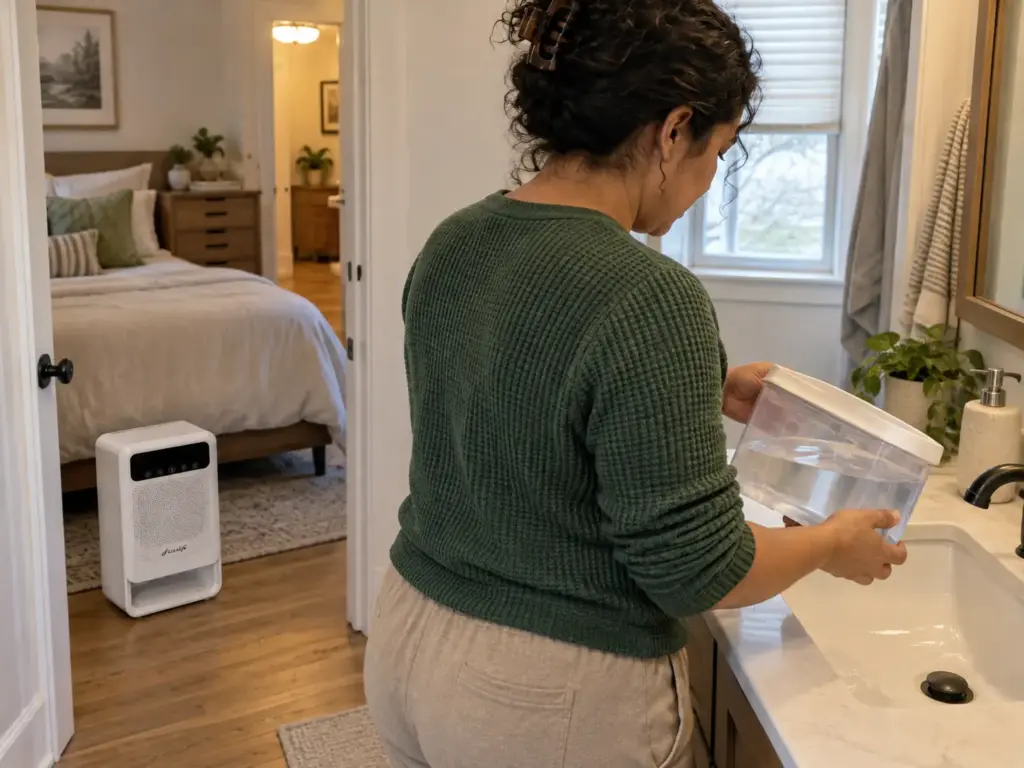
A bedroom has no floor drain, so the bucket is the decision, and the bucket sets how often somebody carries water to the bathroom before the day starts. The sum is short enough to run on your own, and it is arithmetic on the makers’ rated figures, not a measured fill time.
The sum: bucket divided by pace
Start with the small unit. The Frizzlife’s tank holds 135 oz (about 8.4 pints) and its rated pace is 40 oz (about 2.5 pints) a day, so at the maker’s pace the tank fills in about 3.4 days. For the large unit, the Midea Cube 50’s tank holds 4.2 gal (15.9 L, about 538 oz) and its rated pace is 50 pints (800 oz) a day, so at the maker’s pace the tank fills in about 16 hours. Same method, opposite results: one bucket outlasts the week, the other fills in the span of a night and a morning.
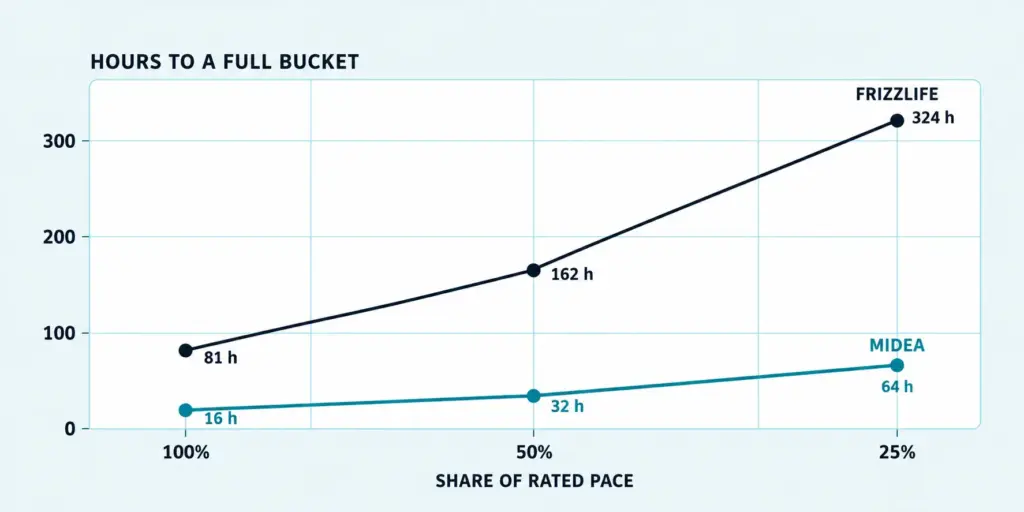
The big bucket is a trade, not a feature. The Midea Cube 50 listing sells its tank as letting the unit “operate up to 3X longer than a conventional dehumidifier”, and that is true as far as it goes. But 15.9 L of water weighs about 35 pounds (a liter is roughly 2.2 pounds), and it gets carried with both hands from the bedroom to the bathroom sink. The listing also prints no decibel figure, so the bucket is not the only number missing from that page.
Why the real pace is lower than the rated one
A rated pace is a test in a warm, wet room. The Frizzlife’s is 86°F (30°C) at 80% RH, and its own listing admits that the actual amount depends on “the current humidity and temperature of the environment”. A bedroom at 68°F (20°C) and 55% gives the unit far less to collect.
So the buckets last longer than the sums say, and how much longer is the open part. At a quarter of the rated capacity the Frizzlife’s tank would take about 13.5 days to fill and the Midea’s about 64 hours; at half the pace, about 6.8 days and 32 hours. These are scenarios, not forecasts.
The room’s real pace is whatever your own bucket says after the first week, and how pints a day map to a room explains why that number moves with the wetness of the space. In a closed bedroom the bucket tends to fill in one go during the first damp spell and barely move in a dry one, so a single week can mislead in either direction. Count two if the weather changed in between.
Pour the first full day of water into a measuring jug before you tip it out, and write the ounces on the same note as the meter readings. After seven days you have the room’s real pace in your own units, and the sum above can be rerun with it.
A full bucket and the shut-off
A unit that shuts off when the bucket is full has stopped drying, whatever the display still says. The Frizzlife does exactly that, and its listing says a red light flashes when the tank is full or out of place. A unit that quits at 3 a.m. with a full tank leaves the room undried for the rest of the night, which is the one stretch the unit was bought for.
The Midea lists automatic shutoff too, plus a continuous-drain option: the tank comes out, the included hose goes in, and the unit sits above the sink or over a floor drain. (Models with a built-in pump exist; the one linked here is the no-pump variant.) A bedroom that shares a wall with a bathroom can use a gravity drain hose running downhill into a tub, since a drain hose only works when the outlet sits lower than the unit. Where to drain a dehumidifier with no floor drain covers the options, so this guide leaves the details there.
On the small unit, the 1-24 hour timer is the lever. A timer set to cover only the hours the door is shut shortens the run, so the same tank lasts longer, and a timer that ends before wake-up means the unit is not still humming when the room is awake. The trade is that a shorter run collects fewer ounces, so the meter at wake-up decides whether the window was long enough. Change the timer by an hour or two, not by half the night, and read again.
Weight deserves a word, because it is the reason a small bucket keeps coming up. A small tank is a sensible wish when it has to be carried out every morning. Neither listing here is that small. The Frizzlife’s 135 oz is about 4 L (roughly 9 pounds of water), and the Midea’s is the 15.9 L above.
The Heat a Dehumidifier Leaves in a Closed Room
A unit that dries the air gives something back, and a bedroom with the door shut is the room that cannot send it away. This section says what the one federal source says, turns a label’s watts into a night, and covers the room that already has an air conditioner running.
What ENERGY STAR says about the warmth
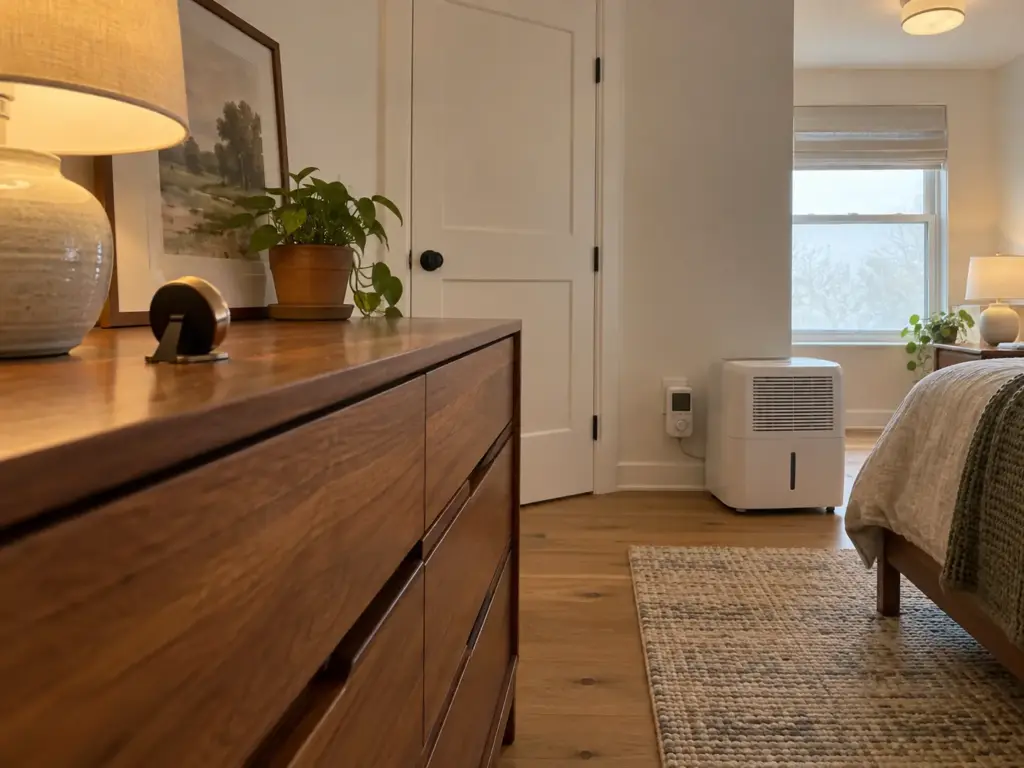
ENERGY STAR’s dehumidifier page puts it in a sentence: “As a dehumidifier removes moisture from the air, it slightly warms the space around it.” In an open basement that disappears. In a bedroom with the door shut it stays, because the room has no second place to put it.
The same effect shows up in day-to-day use. Dehumidifiers also give off heat, so they act partly as space heaters. The size of the effect depends on the unit and on the room. What the room can do is measure it, which is what the thermometer further down is for.
Turning the label’s watts into a night
The sum is watts times hours, divided by 1,000, which gives kilowatt-hours. A unit drawing 300 watts for 8 hours uses 2.4 kWh a night. That figure is a round example for the arithmetic and not the draw of either unit here.
Multiply by the nights in a month (2.4 kWh over 30 nights is 72 kWh), then by your own electricity rate, and the result is what running costs, with no price printed anywhere in this article to go stale. The same sum run with a unit that is on for 4 hours instead of 8 halves the answer, which is another reason the wake-up reading should choose the run time and not the other way round.
Neither listing prints a watts figure, so the number has to come from the rating label, and the watts on it set the heat output to expect. The easiest time to read the label is before the unit goes into the room.
Compare the two labels, not an assumption about which type draws less. A small semiconductor unit might use less than a larger unit, or might not, and the label settles it faster than a guess does. The watts are the size of the effect to look for; the thermometer reads the effect itself.
Plug the unit into a plug-in power meter for one night and read the kilowatt-hours the next morning. It tests the label’s watts against what the unit really drew, and it turns the arithmetic above into one real number for your room.
The temperature at wake-up is a number worth reading too. Park a small dial thermometer at the same spot beside the bed for three nights with the unit running and three without it, and the gap between the two sets of mornings is the heat this room takes from this unit. Anything under a degree or two (°F) is noise in the reading; a larger gap is the number to plan around.
When the air conditioner is already doing the job
An air conditioner removes moisture as it cools, which is why a dehumidifier running beside one often does little. Whether a unit warms a room at night depends on the room and on the air conditioning. The air conditioner already dehumidifies the air, so a unit that runs alongside it can make the air conditioner work overdrive. A dehumidifier or an air conditioner works through the trade in a basement, and the principle carries up the stairs.
For a bedroom the free option comes first again. Open the door in the morning, run the bathroom fan after the shower, and try a setpoint one or two degrees lower on the air conditioner with the dehumidifier left off. Then read the meter at the next wake-up. If the number drops under 60% that way, the dehumidifier would have added noise, heat and a bucket for nothing.
Two Units for a Bedroom, With the Flaw Beside Each
With the reading, the noise, the bucket and the heat in hand, two real listings can be set against them. Two is a short list, and it stays short on purpose: a third candidate was left out because the figures printed for it did not agree with each other, and a comparison built on figures that disagree is worse than a short one.
The small unit, for a room that is only a little damp
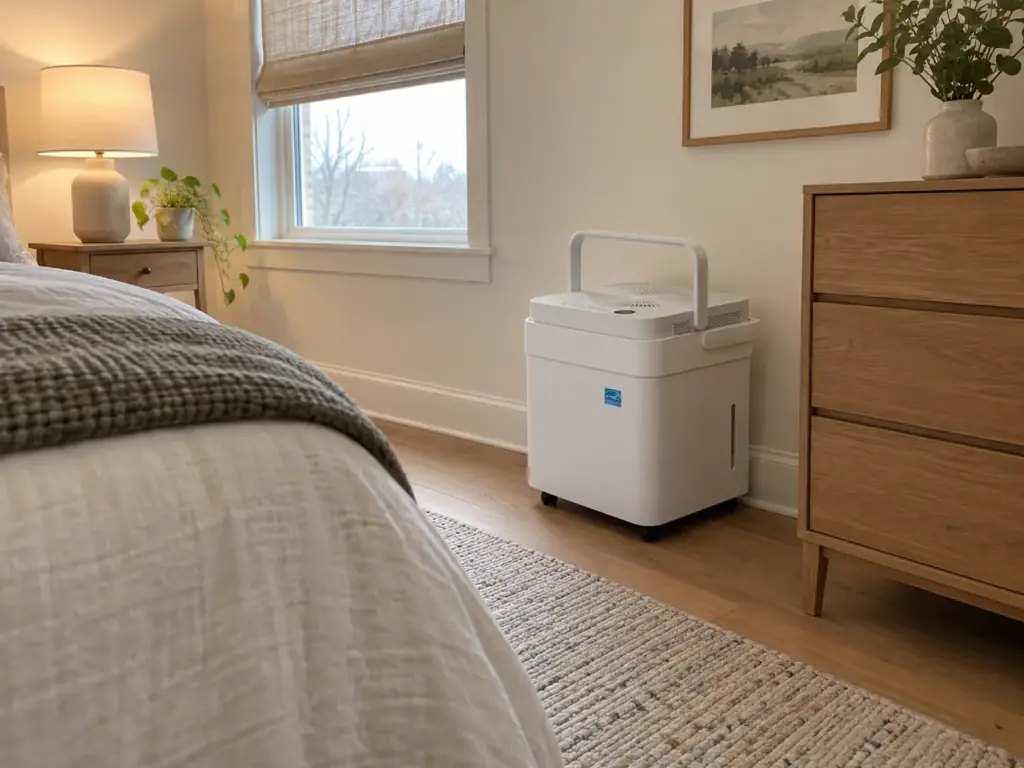
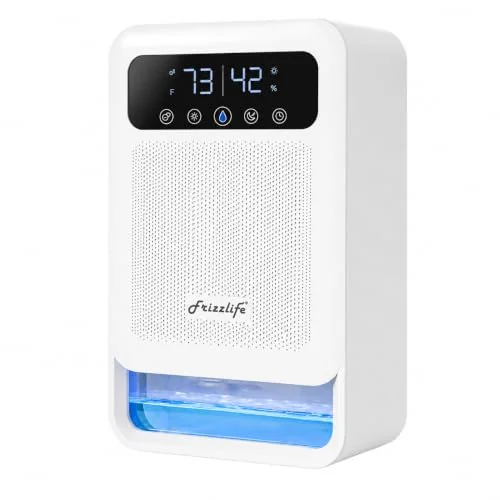
The Frizzlife DH80 is a semiconductor unit with a rated 40 oz (about 2.5 pints) a day at 86°F (30°C) and 80% RH, a 135 oz tank, auto shut-off when the tank is full, a 1-24 hour timer and a 28 dB sleep mode (the maker’s figure). That reads as a small, quiet, patient unit, and it is one. It suits a bedroom that sits just above the band and only climbs in the night, where the job is a few points of humidity and not a flooded room.
Its flaws are in the listing’s own words. The pace is small, and the listing states “Humidity level cannot be manually set” for this model, so the unit decides on its own how much to pull and a bedroom reader cannot hold a target like 50%. The pace is also a warm-room figure, so a cool bedroom gets less than 40 oz. And the 28 dB number comes with a mode but no distance.
The small unit’s chore is the bucket, so watch that first: if the tank is full in days, the room is wetter than a small unit should be asked to handle, and the next step is the reading and the source, not a second small unit.
The 50-pint unit, for a room that stays high with the door shut
The Midea Cube 50 is the opposite answer: 50 pints a day by the maker’s rating, coverage listed at 4,500 sq ft, a 4.2 gal (15.9 L) tank, a continuous-drain hose option, humidity adjustable from 35% to 85% (a real humidistat, where the Frizzlife has no set point), and Wi-Fi. That is built for a wet basement, and the listing title says as much. For a bedroom it is the unit to justify, not the default.
The flaws pile up in a sleeping room. Its rated pace is far more than most bedrooms ever collect, the bucket is a heavy carry, and the listing prints no decibel figure at all. A unit can work well in a bedroom, but one good result with no length of time attached is not a test. The case for it is narrow: a room that reads over 60% with the door shut all day long, where a smaller unit would be full in hours and the hose can send the water somewhere useful.
Which one the reading points to
The meter picks. A room that sits just above the band and climbs only at night points to the small unit. A room that stays above 60% with the door shut all day, or one with a wall that keeps taking in water, points to the large unit and, before either, to fixing the source. Between the two readings sits the whole range of bedrooms, and most of them land closer to the small end than the box sizes suggest.
If the glass is part of the picture, a dehumidifier sized by room for window condensation sizes the bedroom for the pane, which is a different question from the one the night asks here.
What a Bedroom Should Not Take Home
The picks above are about what to buy, and this section is about what to refuse and what to check before anything plugs in for eight hours. It covers the recall check, the unit that is quiet because it moves little moisture, and the wall that no unit can dry.
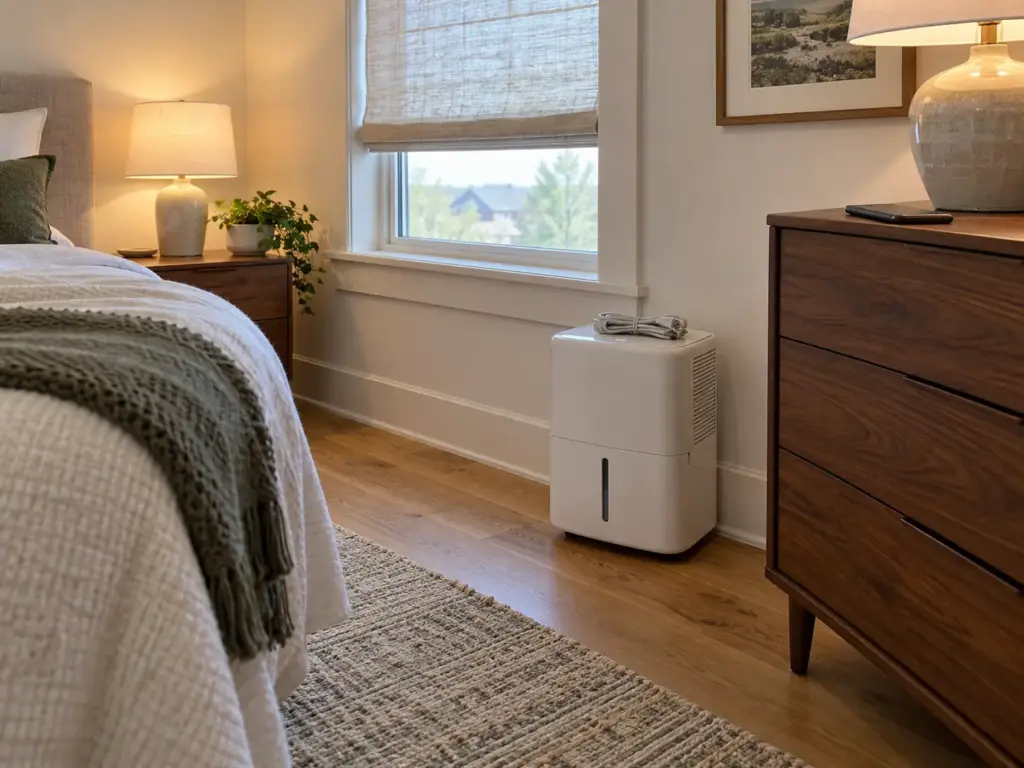
Check the model before it runs all night
A unit that runs while the whole house sleeps is the case where a fire hazard matters most, so the model gets checked before the first overnight run.
The U.S. Consumer Product Safety Commission keeps the CPSC’s dehumidifier recall page, which covers dehumidifiers made by Gree Electric Appliances across a run of recalls from 2013 on, the most recent announced August 16, 2023, for 1.56 million units. Of the earlier recalled units it says: “CPSC evaluated the recalled dehumidifiers and found that they can overheat, smoke, and catch fire, which can lead to serious injury or death.” The page counts more than 2,000 reported overheating incidents.
The check takes a couple of minutes. The page lists the recalled brands, pint capacities, model numbers and date code ranges, so note the brand, the capacity, the model number and the date code on your unit and match them against it.
If the unit is listed, the page says to turn it off, unplug it and contact Gree about a refund. A unit handed down from a relative, or bought used, is worth checking first, because nobody remembers when it was made.
Photograph the rating label with your phone before the unit goes behind the nightstand. The recall page asks for the model number and the date code, and a sticker against a wall is hard to read once the cord is plugged in.
The other label worth reading is the warranty, because these units often fail on a timescale of a couple of years. A unit can work for a couple of years and then quit, and once the warranty ends, troubleshooting help from the maker may not come.
How long the maker stands behind the unit is on the listing page you open, and it is worth finding before the unit is plugged in.
The quiet unit that cannot do the job
A very small semiconductor unit, the closet dehumidifier class, is quiet because it moves little moisture, and that is the trap in a bedroom search. The Frizzlife’s own listing says it “maintains humidity within a suitable range and does not simply lower it”, which is an honest description of a unit designed to hold a small space, not to rescue a wet one. The word “bedroom” in a product title is a marketing label and not a rating: both listings in this article carry it, and the 40 oz a day and the 50 pints a day differ by a factor of about 20.
Size by how wet the room is, not by how it is labeled. A single-room unit does not always need a 20-pint capacity; the right size depends on how much moisture the room gathers. The number depends on the room, which is why the reading comes before the box.
When it is the wall, not the air
A wet wall or a patch that returns is a building problem. A dehumidifier moves the water that the room’s air holds, and it does nothing about the water that a wall keeps taking in from a leak at the roof, a leak in the plumbing, or a cold outside wall. The first step is to check the roof and the plumbing for leaks: fix the water, then dry the room.
How to prevent mold on bedroom walls covers the cold-wall case from the humidity side, and a professional is the answer when the patch keeps returning after the source is found. Once the room reads under 60% with a dry wall behind it, the next question is the set point, and what humidity to set a dehumidifier to takes it from here.
Read the Meter at Wake-Up, Then Pick by Three Numbers
Three things carry from here. The reading comes before the unit: above 60% with the door shut is the case for one, and 50% is not. Three figures on the sheet decide the choice, pints a day at the speed you will run, decibels at that same speed, and hours to fill the bucket, and when a listing leaves one blank (the Midea’s decibels), ask before buying. And the heat and the recall check come before anything runs for eight hours: the label’s watts become kilowatt-hours by the sum above, and the model number goes to the CPSC page.
After the first week, the bucket count gives you the room’s real pace in ounces, and the same meter read at the same spot says whether the room moved. If it has not moved by month three, look at the wall and the source of the water, not at a bigger unit.
Tomorrow, set the meter at the head of the bed, close the door, and read it at wake-up before anything opens. Write the number down. If it is over 60%, open the door for an hour each morning for a week and read it again, then take that number into the set point to start from. On a night that runs hot as well as damp, the air conditioner question is the other branch, and it is worth answering before a second device comes into the room.
Frequently Asked Questions
01Is a dehumidifier good for a bedroom?
A dehumidifier is good for a bedroom only when the room reads above 60% relative humidity with the door shut and stays there. At 50% or less a unit adds noise, heat and a bucket to carry for no gain.
02Is it okay to sleep with a dehumidifier in your bedroom?
It is fine for the room when the model is not on a recall list, its sleep-mode noise is a figure you can sleep beside, and the heat has somewhere to go. Check your model on the CPSC recall page first, and read the rating label for its watts.
03What is the best size dehumidifier for a bedroom?
Size by how wet the room is, not by square feet: the pints a day at the speed you will run decide it. A bedroom that runs only a little high takes a small-pace unit, and one that stays high takes a larger one. The dehumidifier buying guide sizes by wetness.
04Do I need a dehumidifier if my bedroom is not damp?
No. Without condensation, a wet wall, or a reading above 60 percent, a dehumidifier is usually a waste of money and can fight your air conditioner. Read the room with a meter first, and free fixes before any purchase.
05How often do you empty a bedroom dehumidifier?
Divide the bucket by the room’s real pace. At the makers’ rated pace the Frizzlife tank takes about 3.4 days and the Midea tank about 16 hours, but a bedroom collects less, so count the first week and use that number.