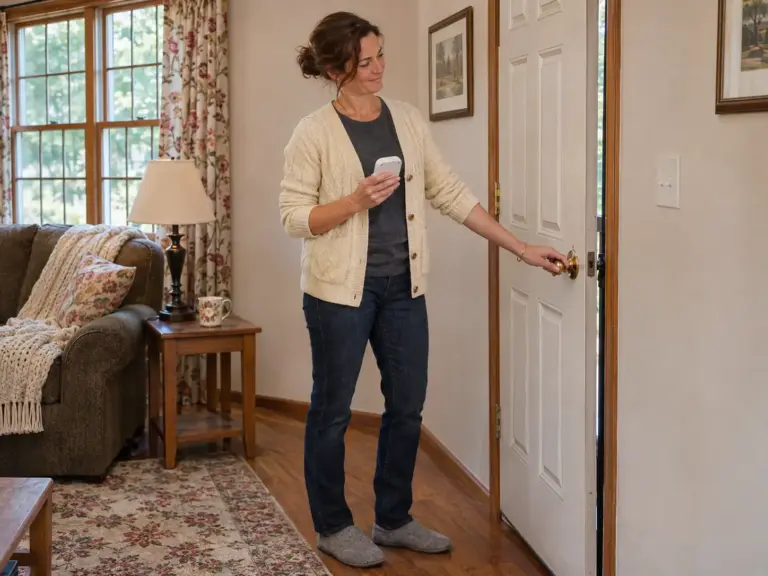
The meter on the nightstand says 19% at dawn, the weather app says the air outside is at 85%, and nobody touched the thermostat. Both numbers are true, which is the whole answer to what causes dry air in winter: cold air carries very little water, and warming that same air to room temperature leaves the water where it was while the percentage collapses.
The furnace is not pulling moisture out of the house; it is heating air that never had much to give. What dry air does to a person is a question for a doctor, and this guide stays with the house: the numbers, the glass, the leaks and the device. It starts with two readings, then the free changes in order, then the ceiling your windows set, and only after that the water.
Quick Answer
Winter air outdoors holds very little water, and heating it to 68 °F (20 °C) lowers its relative humidity to roughly 15 to 25% without removing any. Before touching a dial or buying a humidifier, read a hygrometer in the room where you sleep and the outdoor dew point.
The Two Numbers to Read Before Changing Anything
You arrive with a feeling that the house is dry and, probably, a shopping cart. Two numbers already exist that settle more than the cart does: one is on a meter in your bedroom, the other is on your phone. Together they say which way the air is off and whether any unit is needed.

The Reading in the Room Where You Sleep
The ruler is the EPA’s 30 to 50 percent band for indoor humidity: “Indoor relative humidity (RH) should be kept below 60 percent — ideally between 30 percent and 50 percent, if possible.” Thirty to fifty is the target and sixty is the ceiling. Compare the bedroom against that band, not against a feeling.
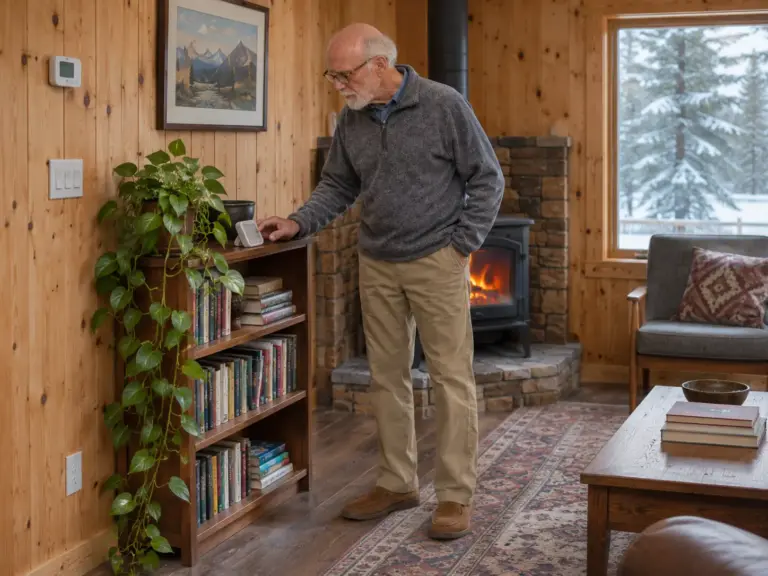
Put the hygrometer on the nightstand or a shelf, away from the radiator and the supply register, and read it at dawn and again at bedtime. A TempPro TP50 (hygrometer on Amazon) reads relative humidity to about ±2 to 3% and temperature to ±1 °F, and its min/max memory shows how far the room swung overnight.
Its weak spot is the part itself: a cheap meter can sit a few points off, and several units of this model stop working within about a month, leaving a dead number on the shelf. A reading that is identical at dawn and at bedtime for a week is stuck, not stable, because a healthy meter moves with the weather and the day. That is the reason to keep a second meter of another brand in the room for a day, and how far to trust a cheap humidity checker has the comparison. When the two disagree by several points, a low reading deserves a second meter before it deserves a purchase.
Write the dawn reading and the outdoor dew point on the same line of a notepad for three mornings. The pair, not either number alone, tells you whether the house is dry because of the weather or in spite of it.
The Dew Point Outside, From Any Weather App
The outdoor number that matters is the dew point, not the humidity percentage. The National Weather Service defines it as the temperature the air must cool to for relative humidity to reach 100 percent, and in its words, “The higher the dew point rises, the greater the amount of moisture in the air.” Read the National Weather Service’s explanation of dew point once and the percentage on the weather app stops mattering. The dew point is the number that does not move when the heat comes on.
Put the two readings against each other and they point a direction. A bedroom in the teens on a morning when the outdoor dew point is also in the teens or twenties is reading what the weather handed the house, and nothing is wrong with the house. A bedroom far below what that outside air gives once warmed means a meter that reads low, or something pulling water out of the house, such as a fan or a dehumidifier left running. Lived-in houses normally read a few points above the weather’s baseline, because people, cooking and showers add water.
What the House Itself Is Showing
The building keeps its own record of dry air: a spark on the doorknob (the shock on the doorknob has its own page), a gap opening along a wood floor, a door that stopped latching in January. None of them is proof by itself. Each one says the same thing the meter says, and each one is worth a glance before the first cold snap and again after it.
Why Cold Air Turns Dry Once the Heat Comes On
With the two readings in hand, the obvious question is how the same air can be wet at the door and dry at the thermostat. One idea and a little arithmetic settle it.

The Water Never Left, the Room for It Grew
Warm air can hold far more water than cold air. When cold outdoor air is heated, its capacity rises and the amount of water per cubic meter stays exactly where it was, so the relative humidity falls. The dew point is the part that stays fixed, which is why it is the number to watch. A cold snap that drops the meter five points with the thermostat untouched is the same rule: colder outside means less water per cubic meter to start with.
Three Cold Days, Worked Through
Take indoor air at 68 °F (20 °C) and three outdoor cases. Air at 32 °F (0 °C) and 70% humidity carries about 3.4 grams of water per cubic meter and reads about 20% once heated. The same 32 °F air at 100%, in fog or drizzle on a damp gray day, reads about 28%. Air at 20 °F (-7 °C) and 80% reads about 13%.
Their outdoor dew points are 23, 32 and 15 °F. Even saturated freezing air lands under the band.

On a raw, drizzly 33 °F afternoon the glass of an open window looks wet, and the bedroom meter still says low. The percentage outside never entered the house. The same comparison from the dew point side, outdoor and indoor values on one page, is in two dew points on the same afternoon.
Why the Furnace Gets the Blame
“The furnace dries the air” is half true. A furnace changes the temperature and removes no water. What it does do, along with every other appliance that moves air, is set how much outside air the house swaps for inside air, and that is where the house adds its own share, which the next section works through. Treat the figures above as the baseline the weather hands the house, with the house’s habits moving the real reading up or down from it.
The Free Changes, in Order, and the Leaks Behind Them
The weather is not negotiable. How much of it your house trades for its own air is. These changes cost nothing, and they come in the order they usually pay off, each with a reading before the next.
The Dial, One Step Down
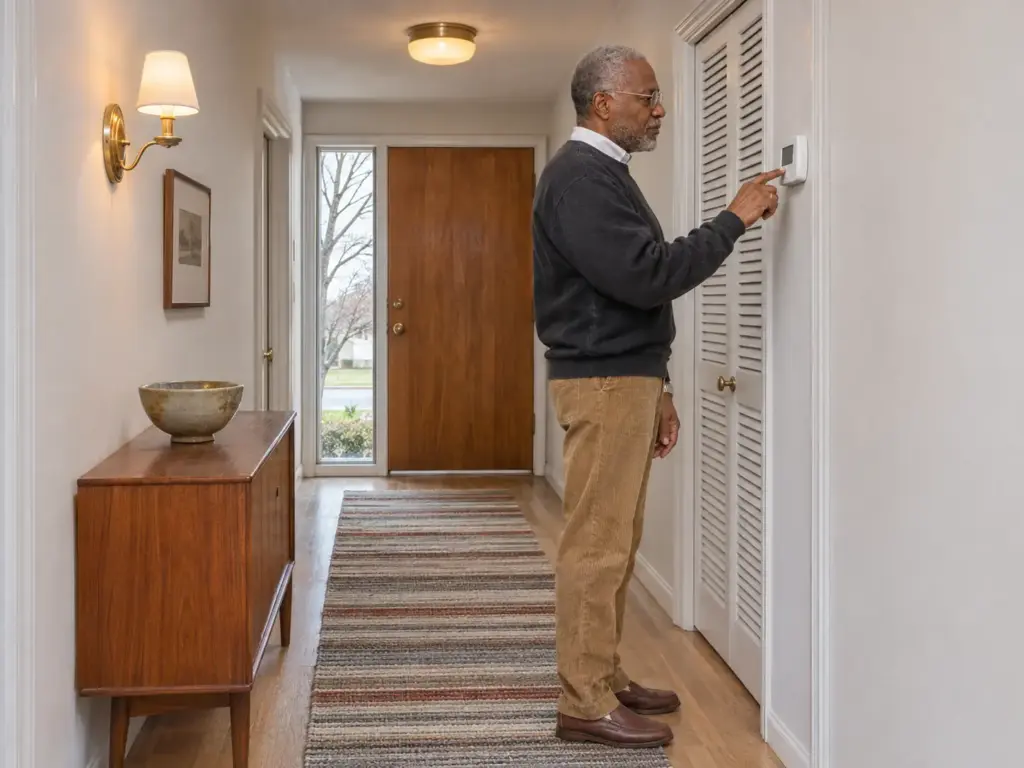
Start with the thermostat. Stepping it from 72 °F to 68 °F (22 to 20 °C) lifts a 20% reading by about 3 points, because cooler air holds less water and the same water makes a higher percentage.
It takes a minute. Read the meter the next morning, and expect a small rise rather than a jump. If it moved the way the arithmetic says, the next change is worth making; if it moved a great deal more, the meter was probably the problem.
Move the thermostat before you move anything else, then leave it alone for a full day. Changing the dial and the fan schedule together means the next reading cannot say which one worked.
The Fans That Trade Your Air for the Outside’s
A bath fan, a range hood or a dryer sends warm, slightly moist indoor air outside and pulls cold, very dry outdoor air in to replace it. The houses that dry out hardest are usually the ones where one of these runs far longer than its job needs. A dryer vented indoors goes the other way and dumps its moisture into the room, so that is a different problem.
Run each fan for as long as the shower or the pan asks, then switch it off. The usual advice is to open a window for a few minutes with the bathroom fan going, and that order is backwards for a dry house: a window opened briefly with the fans off trades a little air, while a window left open overnight trades a great deal. The full order of suspects, with the readings that point at each, is laid out in which fan or leak to look at first.
The Leaks Nobody Planned
Warm air leaves through the top of a house and cold air comes in at the bottom to replace it, which is the stack effect. The gaps that feed it are ordinary: the base of an exterior door, an attic hatch, recessed lights, a fireplace damper left open. A wood stove or fireplace with the damper open eats room air all night.
Weatherstripping and caulk are the cheap cure, and air sealing around the attic hatch and recessed lights is the bigger job when the first pass is not enough. The dry room is rarely the one with the draft; it is usually the one with the door shut and a supply register pushing heated air into it.
There is a free source of water too, and it is also a moisture load to manage: a wash hung inside, which puts water back into the room.
The Winter Ceiling Is Set by the Coldest Window
Once the meter says low and the free changes are made, the instinct is to push the number up. How high the house can go changes with the weather, and the answer is on the glass.

The Dew Point of a 70 °F Room
The humidity you can run is whatever keeps the coldest surface in the house above the dew point of the room air. For 70 °F (21 °C) room air, the dew point is 37 °F (3 °C) at 30% humidity, 41 °F (5 °C) at 35%, 45 °F (7 °C) at 40% and 50 °F (10 °C) at 50%. Any surface colder than that number collects water.
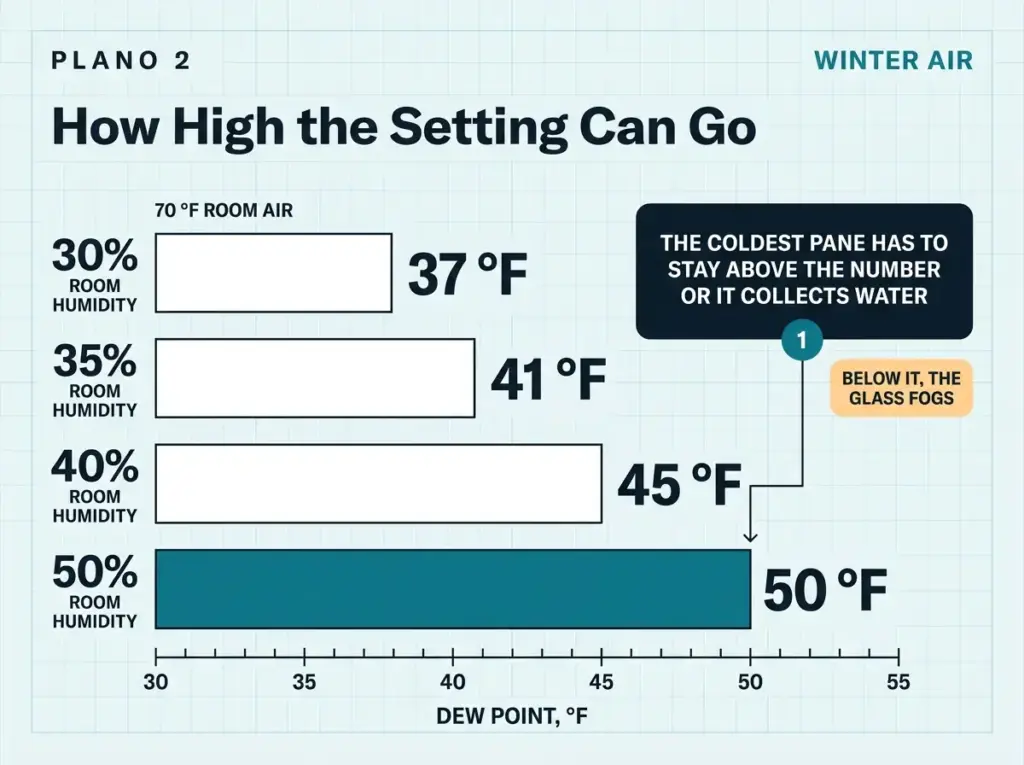
The coldest surface is the pane. On a 10 °F (-12 °C) night a single pane or a leaky window sits near 10 to 20 °F, far below even the 37 °F figure, so 30% can fog it. A good double pane has more room, and a storm window or a window film over a single pane buys back a few points of that room. The ceiling for each outdoor temperature is tabulated in the ceiling by outdoor temperature, row by row.
Why a November Setting Fogs the Glass in January
A setting that kept the glass clear in November fogs it in January with the dial untouched, because the outdoor temperature fell and the pane fell with it. The number the house can carry drops with every cold front. Why the safe setting slides as the weather turns is the measuring-side version of the same idea. A film that forms first along the bottom edge of the glass and the lower corner of the window is the pane’s own colder zone saying the setting is already over the line.
Once water runs onto a sill, the clock starts: the EPA says to dry water-damaged areas within 24 to 48 hours to prevent mold, a matter for the sill, the frame and the wall.
The Glass Is the Free Instrument
When water condenses on windows, walls or pictures, the EPA’s direction is to relocate the humidifier, lower its humidistat or reduce its use. The CDC puts the ceiling at no higher than 50 percent all day long, which in November is a cap and not a target (the CDC’s cap on home humidity).
The glass overrules the dial. And the dial can mislead in a second way: a humidistat reads the room where the unit stands, not the room that matters, so the check is the glass in the room that matters and a meter across the room. If the film is already there, what to do about the film on the glass covers the pane first and the setting second.
Check the bottom corner of the bedroom window on the first morning of a sharp cold snap. If that corner is wet, take the setting down a few points before the room reads dry again, and recheck when the next cold front passes.
Adding Water in the Room Where You Sleep
A reading below the band, the dial down, the fans trimmed and a ceiling the windows allow: only now does water earn a place, and only in the room where you sleep.
The Free Water Sources, and How Little They Add
A tray of water on a register, a bowl on a radiator, a damp cloth over the back of a fan, wet towels, the bathroom door left open after a shower, a fish tank and a few houseplants each add a little water. None of them holds a bedroom through a cold week, because the evaporating surface is small and the water has to go somewhere. Stove-top boiling is not a method.
The upper limit is the same for every source and every unit: the EPA says do not humidify above 50 percent (the EPA’s advice on running and cleaning a humidifier). A dial parked at the 60% a box prints is already over the line. Once the meter says low, the order of fixes once the meter says low puts the free sources and the unit in sequence.
A 3-Liter Room Unit With a Humidistat
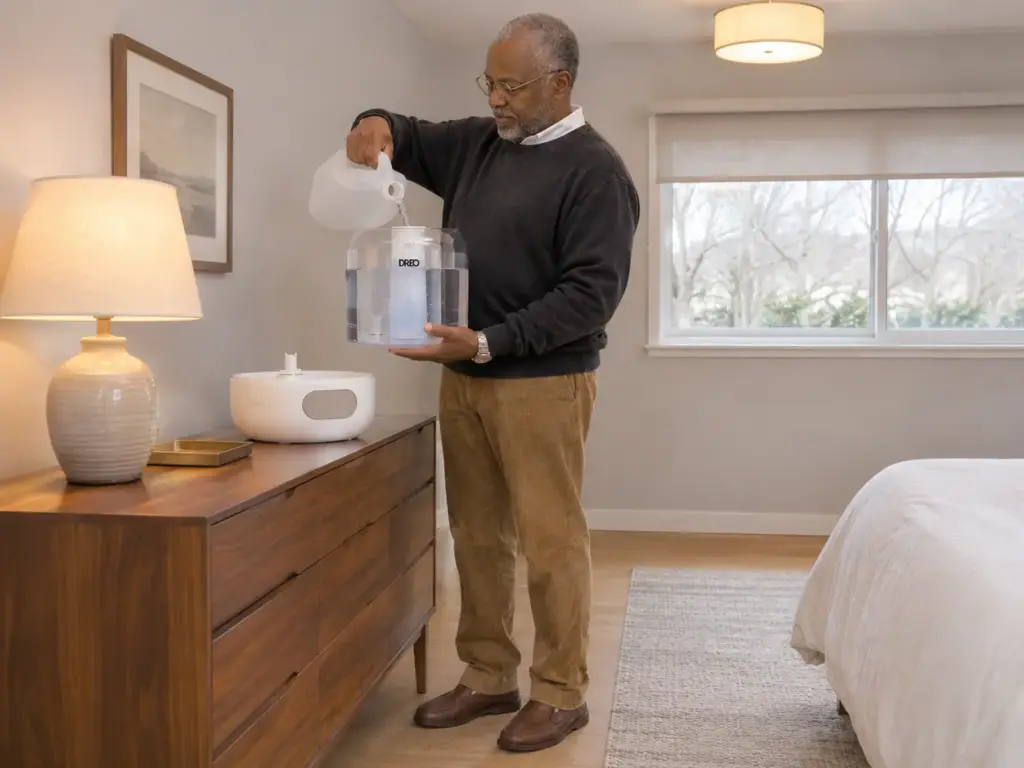
What to ask of a unit is a tank of real size and a humidistat that stops it at the number the room can carry. The DREO 3L DR-HHM006 (humidifier on Amazon) has a 3-liter top-fill tank, a digital humidistat, about 26 dB on its night mode and up to 30 hours on low. It makes cool mist only, and the demineralization cartridge is extra upkeep to hold white dust down. The number to hold it at is a separate question, and what to set it to when the dial and the glass disagree answers it.
The Same Tank, a Knob and a Separate Meter
The Levoit Dual 150 (3-liter humidifier on Amazon) holds the same 3 liters, runs about 25 hours on low at under 28 dB and draws about 25 W, but it has a rotary knob and no humidistat. That makes it the honest choice for a reader who already owns a meter and will read it. Cleaning splits the verdict on this unit, easy for some tanks and awkward for others.
When the Room Is Big
An open floor or a large room is the one case where tank size matters. The Everlasting Comfort 6L (humidifier on Amazon) is an ultrasonic cool-mist unit with a 6-liter tank, up to 50 hours of run time, about 500 square feet of coverage, 28 dB and no filter. Its durability is uneven: some units stop working by about the third month, and the mist output splits between good and none, so put it on a hard surface and read the meter closely in the first weeks. Output, not tank size, decides how much room a unit can handle, and how big a unit a given room needs, in gallons a day works it out.
Wherever the unit goes, put it on a hard surface off the floor, away from the bed and not under the window, at a height where the mist does not fall on a wall. Then read the meter across the room, not the unit’s own dial, to see what it actually changed.
A unit that lights up and hums can still be putting out far less water than it did in week one. Write the meter reading across the room on the day you start it and again a week later; if the number slid while the tank level did not, the wick or the water is the problem, not the weather.
A Rental With Baseboard Heat and One Room That Matters
Everything above assumes someone who can choose. This section is for the reader who cannot: no ducts, no permission to touch the heating, a bedroom and a door.

Why a Whole-House Unit Is Off the Table
In a rental with baseboard heat, a radiator or a window unit there is no duct to mount a whole-house humidifier on and no right to cut one. The answer collapses to a single room unit where you sleep, sized by output rather than tank, and a meter to hold it under the ceiling the glass sets. If the meter still sits under the band after the free changes and that one room unit, the real decision is room unit or whole-house unit, measured first.
Where a Bypass Unit Goes, in a House That Has the Ducts
A house with ducts can take a bypass unit. It belongs on the return, with a flex run from the heat duct, and never mounted above the blower, because a leak there reaches the furnace motor and its electronics. That is the building’s side of the job: have an HVAC technician place it instead of working it out from a diagram.
The Door Shut and One Meter
The room you sleep in is the room that matters. Shut its door, run the unit there, and read the meter on the nightstand after a week. A unit chosen for a rental is judged by that reading and not by the size of its tank. If one bedroom is the whole job, a bedroom unit for the room with the door shut is the narrower comparison.
What a Humidifier Does by Month Two
Most “it stopped working” stories trace back to the water, the wick or the meter, and by the second month the unit has either been maintained on a schedule or it has not.
The Wick, the Tank and the Clock
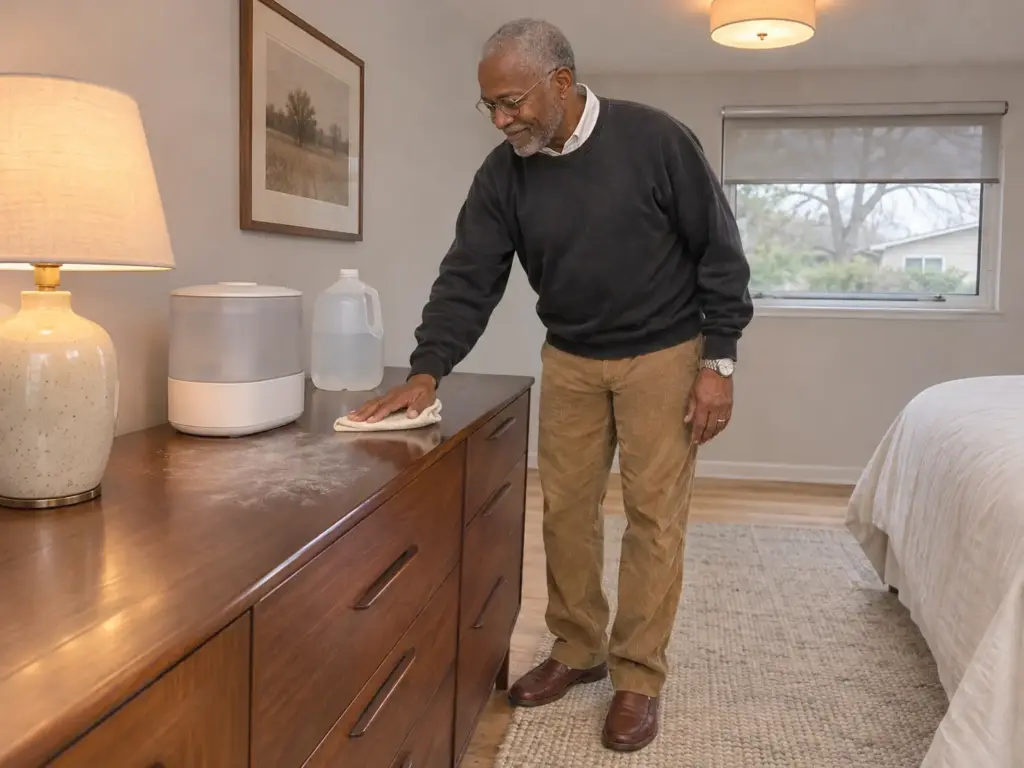
The EPA’s clock for a portable unit is simple: empty the tank, wipe it dry and refill it daily, and clean the unit every third day. A tank left full is a container of standing water, and a wick left damp is where mold starts. The wick of an evaporative unit also crusts with scale, which quietly cuts its output while the unit still hums, and a whole-house pad can channel water the same way. The day the bedroom reads lower than it did in the first week, with a tank as full as yesterday, is the day to look at the wick or the water before blaming the weather.
White Dust Is the Tap Water
White dust on the dresser is the mineral load of the tap water, dispersed by ultrasonic and impeller units.
Distilled or demineralized water reduces it, and it keeps coming for as long as the unit runs on tap water, so the cure is the water or a cartridge and not a new machine. A steam unit disperses less of it: the Vicks Warm Mist V745 (warm-mist humidifier on Amazon) boils its water, holds one gallon for about 12 hours, covers a room up to about 600 square feet and has no filter.
It draws 248 W, roughly ten times what a 25 W ultrasonic unit draws, so a tank’s 12 hours is about 3 kWh against about 0.3 kWh. Noise and durability are uneven, some units break within a month and leak, and it is a heat source: set it on a hard, flat surface out of reach, never on the floor. Cool mist against warm mist, by water and watts does that sum in full.
The Meter That Quietly Dies
The meter fails in the same quiet way. It reads fine out of the box and stops within a month, or it reads a few points low from the start. A second meter, or the same meter held against the glass reading, is the check, and a number that never moves for a week is stuck.
Add the other failures of room units to the list: mist that stops, a tank that is awkward to fill and wash, leaks and unexpected shut-offs. A tank on a hard surface and a cleaning schedule head most of them off.
When the Cause Is the House and Not the Weather
Everything so far treats dry air as the weather’s work. Here are the times it is the building’s, and where your job ends and a professional’s begins.
A Blocked Core, a Leaky Return and the Ducts You Cannot See
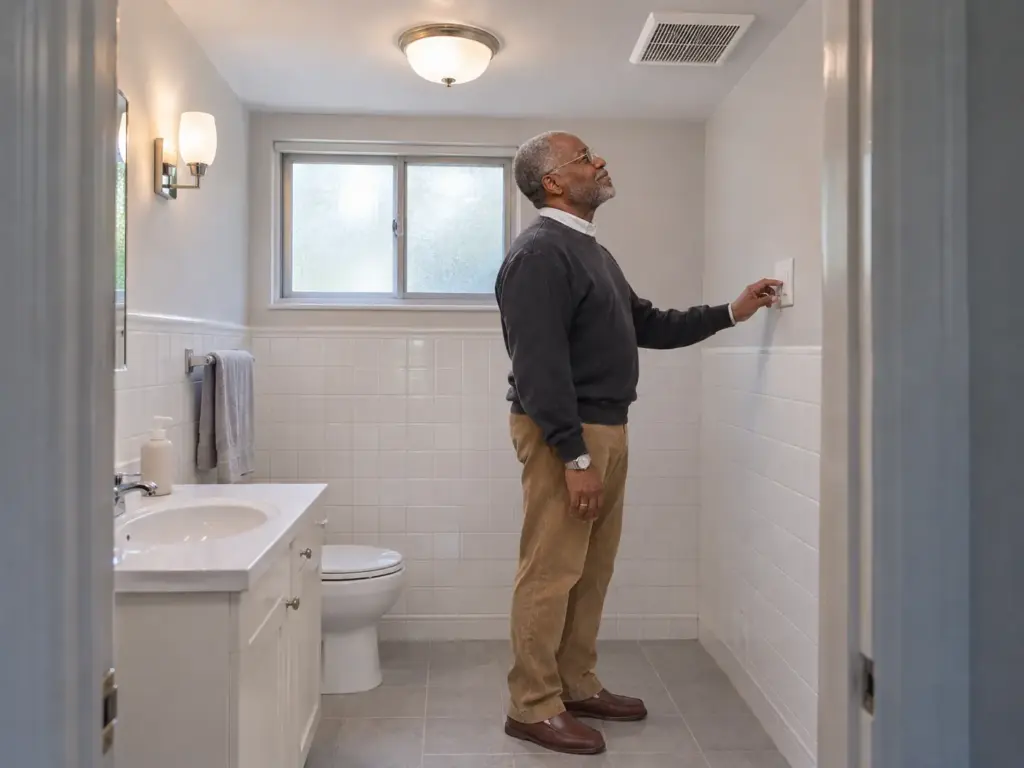
A blocked core in a heat- or energy-recovery ventilator, a supply or return duct that leaks in a crawlspace or attic, or an oversized and leaky duct system can swap far more of the house’s air than you would see from the living room. The reading that stays in the single digits in the first week of a mild spell, with the bath fan off, is the sign the weather was never the cause. The fix is an HVAC technician’s, and the readings are what you hand them.
When an Appliance Draws Air It Should Not
A fireplace or wood stove drawing room air all night, a bath fan running for hours and a range hood on its top speed come first, as covered above. A gas or other combustion appliance that backdrafts is a safety matter. Keep a carbon monoxide alarm working near the bedrooms, and if it sounds, leave the house and call the emergency number. The appliance itself is a call to the gas or electric utility.
A Meter That Lies
A cheap meter that reads many points low, or two meters that disagree by ten points, is the cheapest cause to rule out. A reading that never moves is not a reading. And a whole-house unit that is installed and still reads dry is a heat, wiring or setting question before it is a device question, and when the unit is installed and the house still reads dry goes through the checks. When the readings stay low after the free changes, one room unit and a meter that has been checked, the next call is to a technician and not to a bigger unit.
Read the Pair at Dawn, Then Move the Dial
The cause is heated outdoor air, not water the furnace takes out. Two readings decide the next move: the meter where you sleep and the outdoor dew point. The free changes come in order with a reading after each, the glass sets the ceiling and it falls with the weather, and water goes into the bedroom only if the meter keeps asking for it. Every unit brings a chore with it, and a few houses are dry for a reason no unit reaches.
What to look at again depends on the thing. The bottom edge of the bedroom glass wants a look on the first hard cold snap. The meter beside the bed wants a look after a week of the unit running, and the tank and the wick want one when the second month comes around.
Tomorrow at dawn, read the meter in the room where you sleep and the dew point outside, write both down, and set the dial from the pair. If the number is still low after the free changes, the comparison that follows is room unit against whole-house unit, and the setting that holds when the glass disagrees is on its own page.
Frequently Asked Questions
01Why is the air in a house so dry in winter?
Cold outdoor air carries very little water, and heating it to room temperature lowers its relative humidity without removing any water. The same outside air that feels damp can read under 20 percent inside.
02How do you fix dry air in the house in winter?
Read the meter first, then lower the thermostat a step, trim the fans that pull outside air in and seal the leaks. Add water in the bedroom only if the reading stays under 30 percent.
03What humidity should a house be in winter?
The EPA says below 60 percent, ideally 30 to 50. In a hard freeze the glass sets a lower ceiling: when water shows on the windows, the setting is already too high.
04Does a furnace dry out the air?
Not by removing water. A furnace heats the air, which lowers its relative humidity, and a house with many leaks or long-running fans swaps more outside air in, which dries it further.
05Will an air purifier fix dry air?
No. A purifier filters particles and adds no moisture, so the meter will not move. Water comes from a humidifier or from another source of water.