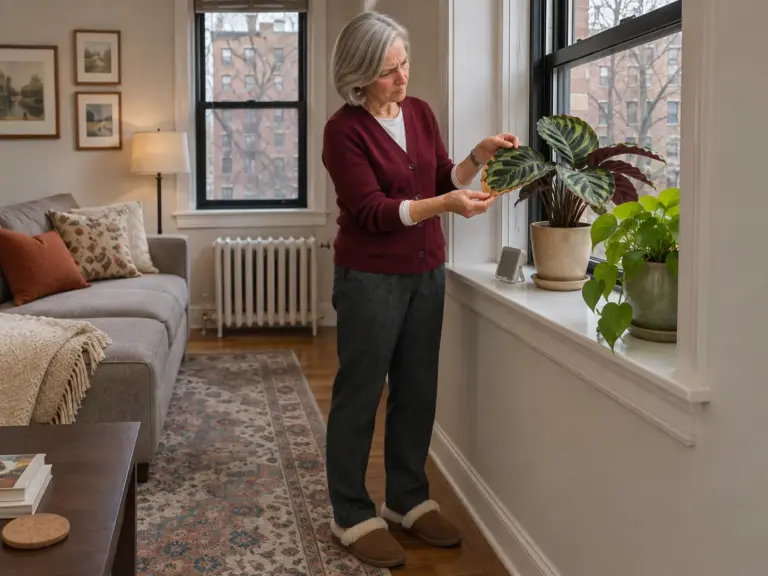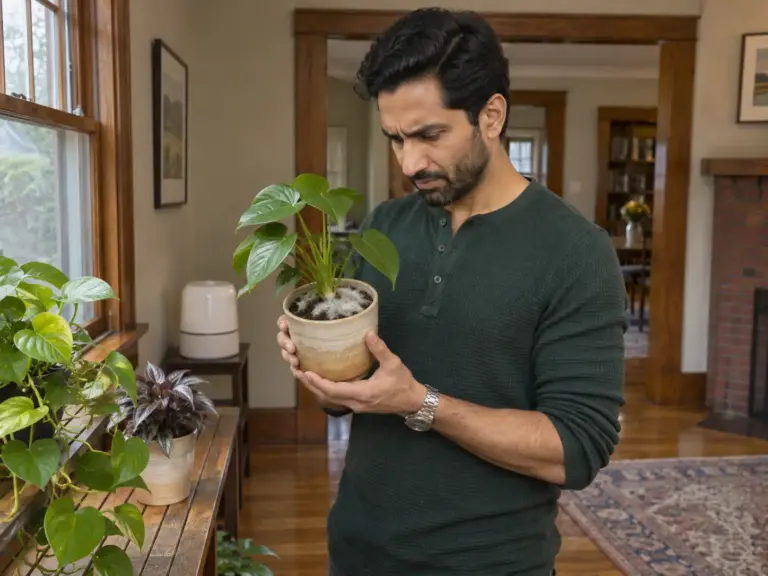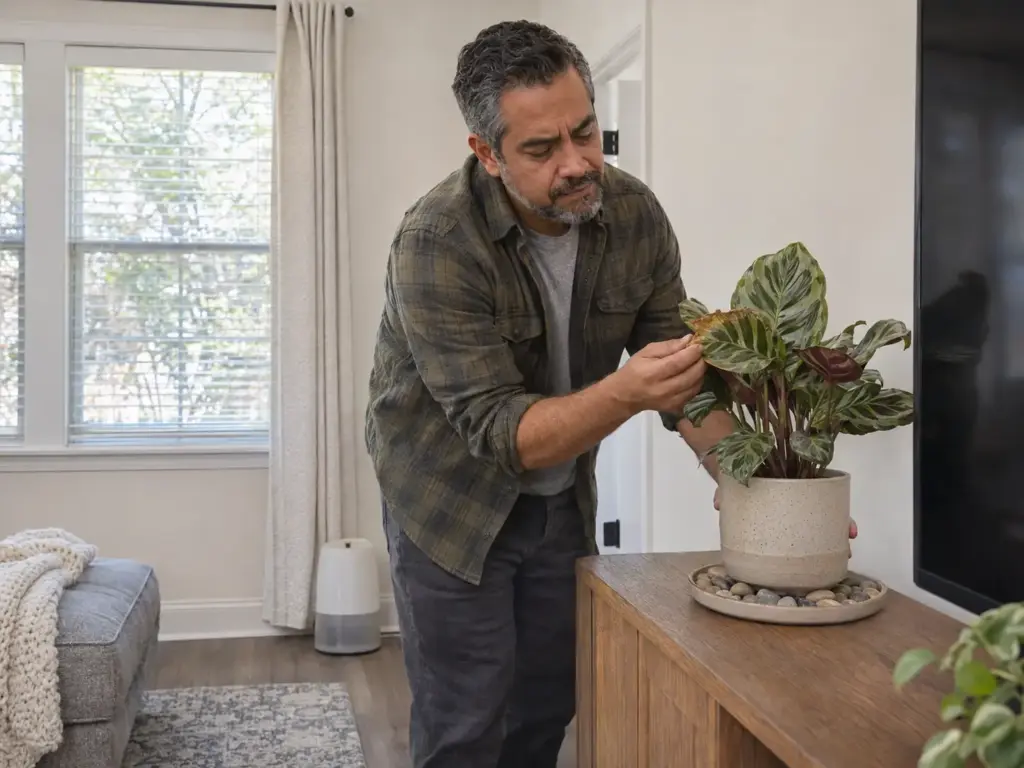
The calathea (a prayer plant, now filed under Goeppertia, like its cousin the maranta) on the shelf has gone crisp at the edges, a bag of river stones is already on the counter, and a humidifier is already sitting in a cart. Edges brown when a leaf gives up water through transpiration faster than it can replace it, and dry air is one way that happens, which is the subject of why dry air closes the pores of a leaf. Pebble tray vs humidifier for plants comes down to how far each one reaches, and a tray reaches about as far as the water it holds: a few square inches of exposed surface area, against a machine whose output is counted in liters a day. The room’s own reading, taken at the leaves, decides which of the two is worth the trouble, so what follows is that reading, the tray from the stones up, the arithmetic of its ceiling and the shelf where it wins, what a humidifier changes in a room, what each one asks of you, and what each leaves behind by week six.
The two differ most in how far they reach, and the table puts that next to what each one asks of you.
| What matters | The pebble tray | A humidifier |
|---|---|---|
| How far the humidity reaches | The air at the pot and a short distance above the stones | The air of the whole room, up to the maker’s coverage and the EPA’s 50 percent limit |
| What it needs from the room | Warm air to evaporate into, and a pot held above the waterline | Water low in minerals, a daily refill and a scrub every third day |
| What it cannot do | Lift the humidity of a room, or work in a cold one | Stay under the ceiling when nothing is watching it, if it has no humidistat |
| What week six asks of you | Emptying and scrubbing the tray and rinsing the stones, weekly | Fresh water daily, a white film or a loaded wick to deal with |
| Where it wins outright | A shelf or a glass cabinet, where the same water sits in very little air | A room or an open floor, where the whole volume of air needs to move |
Pebble Tray vs Humidifier Starts With the Reading at Leaf Height
The comparison usually runs on reputation: a tropical plant wants a tropical room, so something has to be bought. Neither device can be judged until a meter says what the air at the leaves already is, and sometimes the reading says the answer is neither. This section takes the reading first, then the free fixes, then the plant that wants more than a house can give.
What the Meter Has to Say Before Either Is Bought
Start with the house’s own limit, because the plant’s wish does not move it.
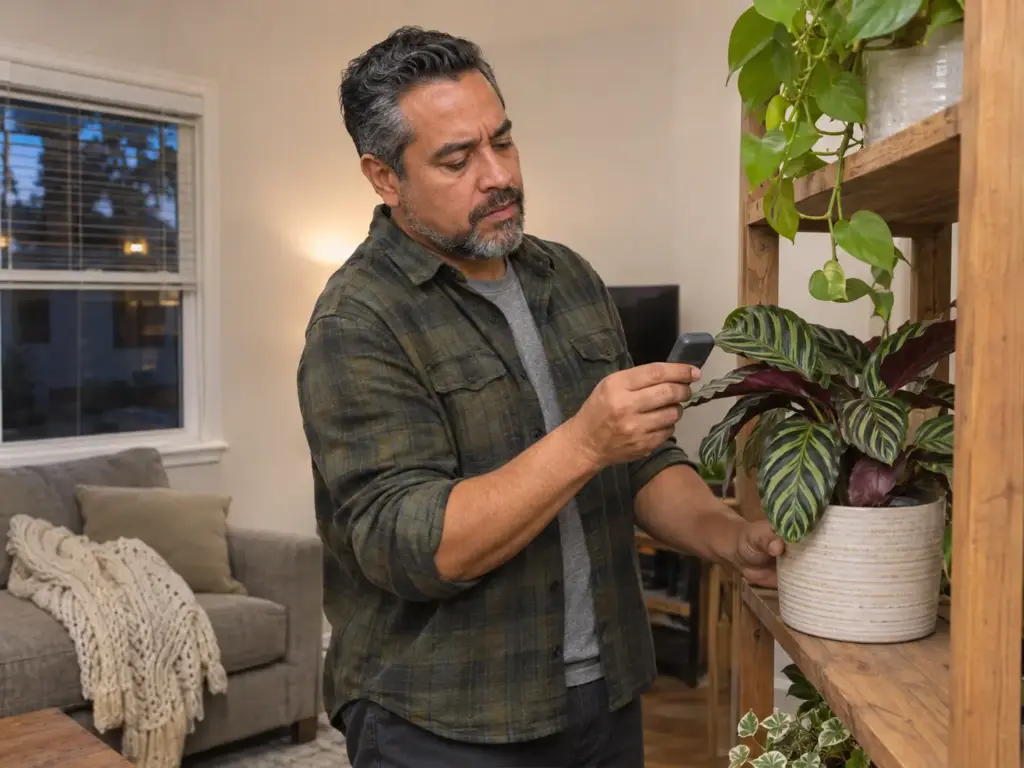
The EPA keeps indoor humidity below 60 percent relative humidity (RH), ideally between 30 and 50, and says an inexpensive meter is enough to read it; that is in the EPA guide to mold, moisture and your home. That is the ambient humidity the whole house is held to, and it is the first number to know.
Orchids are the plant group with the best-documented range, and the American Orchid Society puts virtually all of them at 40 to 70 percent, phalaenopsis at 50 to 80. Laid on one line, the plant’s wish runs past the house’s ceiling at the top, and the strip where a houseplant and a house are both comfortable is narrow, roughly 40 to 50 percent.
That strip is this article’s own reading of the two sources, not a number either one prints, and it is the range the meter should show before a tray is worth setting up. “My plant is tropical” is a reputation. 40 percent at leaf height is a reading.
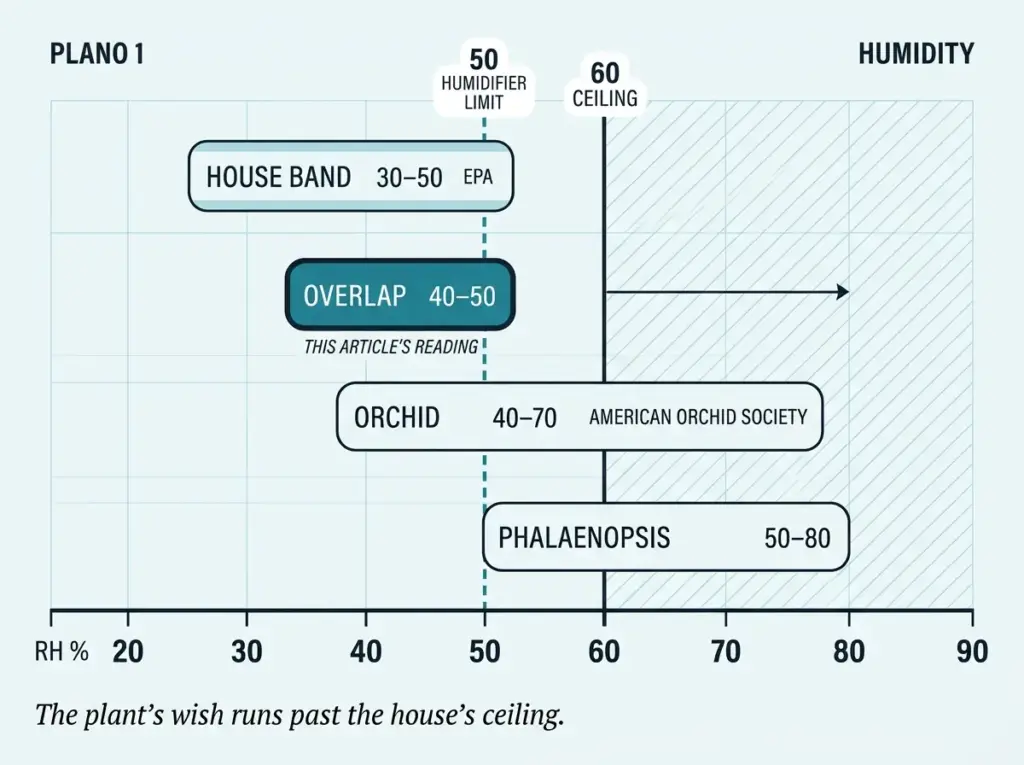
Where the meter stands matters as much as owning one: at leaf height, out of the draft from a door or a vent, and away from the plume of any machine bought later, as laid out in how to take the reading at the leaves with one meter. The TempPro TP50 Digital Hygrometer Indoor Thermometer does the job as a first purchase: it prints its accuracy as plus or minus 2 to 3 percent relative humidity and 1°F (0.6°C), keeps the day’s highs and lows in memory, and stands on a table or sticks to a shelf edge with a magnet. Reliability is where it is soft, since a share of units quit after about a month, and a band of 2 to 3 points is wide enough that a second reading from any other cheap gauge is the sensible check; the page on a cheap humidity gauge and how far to trust it goes through why a few points of error are normal at this level.
Read it twice a day for a few days.
The morning figure says little. The evening one, taken after the forced air heat has run all day, is the one that differs, and it is the one that picks the side. A reading that sits at the floor of the 30 to 50 band and stays there at night is the only result that puts a machine on the table; whether a reading that low even calls for one is a separate question about when a plant room needs a humidifier at all.
The opposite result is just as common: a calathea with brown edges on a shelf where the meter sits mid-band, and a second shelf two feet from a heat register where the same plant crisps in the same weeks. Same species, same room, two different problems, and only one of them is humidity.
A third result is a plant that wants none of this: succulents and cacti sit happily at the dry end of the house’s band, and brown leaf tips on one of them are a watering story.
Take the evening reading with the meter standing where the plant stands, then move it two feet into the open middle of the room and read again. If the two figures differ by more than the meter’s own 2 to 3 points, the shelf, the register or the window is setting the plant’s air, and that figure is the one the leaves live in.
The Cheaper Fixes That Come Before Both
Brown leaf tips, crispy edges and curling leaves have more than one source, and the free fixes are worth running in order, with a few days between them so the meter can say which one worked. First, the pots come off the heat register and out of the path of any draft, because a stream of dry heated air or a leaky window works a leaf harder than the room does. After a few days the room’s reading will not have moved, but the new leaves should stop crisping; if they keep crisping, the air was not the lever.
Second, shut the door of the room the plants live in, which keeps the room from trading its air with a drier hallway all day. The meter at the leaf should creep up a point or two.
Third, try grouping plants: the water they lose around the cluster raises the air there a little, and a reading a point or two higher inside the group than outside it is the expected result.
The overshoot is a cluster packed so tight that the air stops moving, which makes dead air, and a leaf that stays wet invites trouble of its kind. A plant mister belongs in none of these steps, since a spritz wets the leaf for a few minutes and leaves the air alone.
Fourth, look at the watering and at the crust on the soil. Brown tips are what too much water, too little water and salt buildup from fertilizer all do to a leaf, and a plant that is crisping at a reading in band is telling you to check the roots before the air.
When the Plant Wants More Than a House Can Give
Some plants want something close to a rainforest, and a house whose own ceiling is 60 percent cannot give it without the windows and walls paying for it. That ceiling exists to protect the building. The third option, after the tray and the machine, is an enclosure: a glass cabinet, a terrarium or even a small grow tent around the one fussy plant (the greenhouse cabinet is the furniture version) gives it a separate microclimate so the rest of the room never has to be pushed. The arithmetic of why that works comes later, in the section on where a tray wins.
The purchase made before the reading looks like a machine humming in an open-plan apartment living room whose air already reads 52 percent. The meter does not move, the edges stay brown, and the machine turns out to have been solving a problem the room did not have. A cheap meter costs less than the first filter or wick that machine will need, and it is the one purchase here that cannot be wrong.
What a Pebble Tray Does, From the Stones Up
A tray is a shallow dish of stones with water under the pot, and what it can do follows from the one number it has: the area of water open to the air. This section builds the tray from the bottom, shows where the setup goes wrong before humidity ever comes into it, and leaves the arithmetic of its ceiling for the section after.
Stones, Water and the Waterline
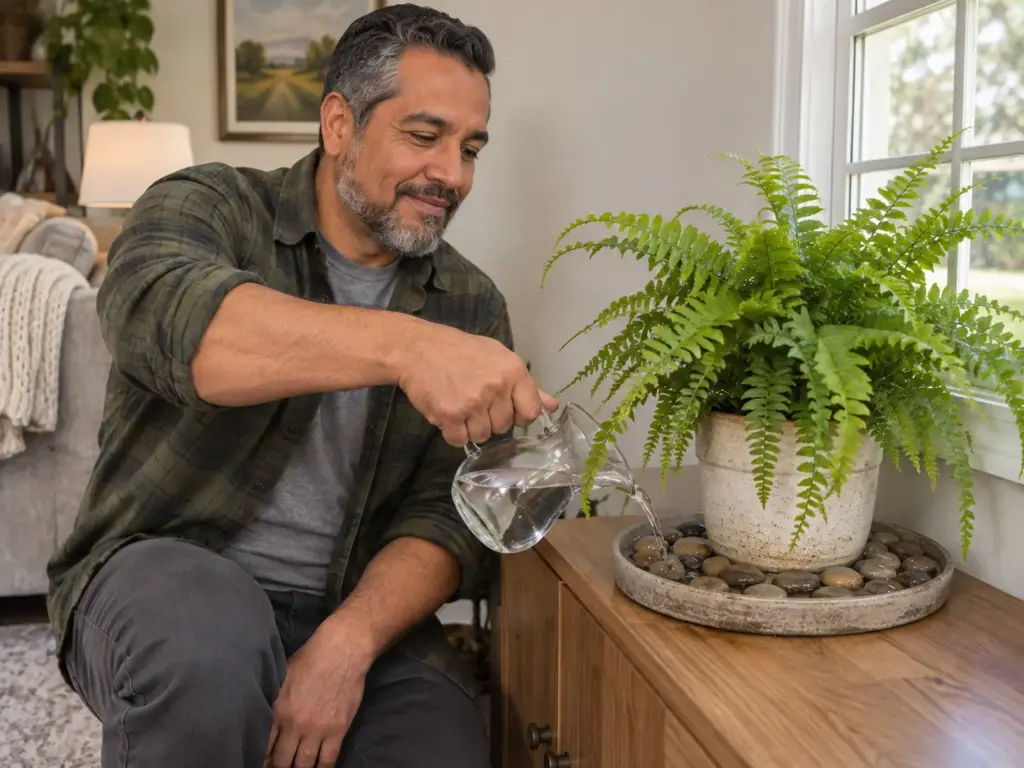
Take a shallow tray a couple of inches wider than the pot (a humidity saucer sold as such is the same object), spread a layer of river stones, aquarium gravel or LECA across it, and pour in water until the surface sits just under the top of the stones. The pot goes on the stones, with its drainage holes above the water; that is the whole rule of the pot above water. The water evaporates from the exposed surface between and around the stones, and that surface is the entire engine: no heater, no fan, nothing to turn up.
What the stones are for is easy to forget. They hold the pot up.
They are structure, so a tray of stones works the way a saucer full of water under a pot never can, and that is why the waterline matters more than how many stones there are. Pour to just under the top of the stones and the drainage holes stay in air. Pour past it and the stones have stopped doing their one job.
Why the Pot Stays Above the Water
A pot whose base touches the water pulls it up through the drainage holes, the soil stays saturated, and the roots sit in what growers call wet feet, which is how root rot and fungus gnats get started. The usual way it happens is a tray set up with care in the first week and then topped up too generously, with the level creeping up until the pot is standing in it and nobody notices until the leaves yellow. Refill to the line instead of letting the level rise, and look under the pot when the plant looks wrong.
A wet pot is a soil question before it is an air question. A tray is not a fix for brown tips that came from watering, salt crust or a draft, and the page on when the wet surface is the pot and not the air covers the soil side of damp that a high waterline can cause.
The Tray’s Size Is Its Output
A wider tray exposes more water, so tray diameter is the one dial a tray has. The effect is localized humidity, at the pot and in the small space above it.
In a cold room the water is cold and evaporates slowly, and the tray does nothing through the winter: it only works as well as the warmth of the air it evaporates into. Through the heating season, in a room that stays warm, the water line drops by about the same small amount each day, and that drop is the only output figure a tray ever gives its owner. A damp shelf under the tray is worth a look when the pot has been standing in spillover.
There is also a second job nobody planned. A tray that stands is a container of standing water in a warm room, and the CDC on standing water around the house asks that anything holding water be emptied and scrubbed every week, flowerpot saucers included. A tray is a saucer with more stones. The routine that follows from that, and what a tray looks like when it is skipped, belongs to the last section.
Why a Tray Stops Short of the Room and the Shelf Where It Wins
The American Orchid Society calls trays terribly ineffective and, a page later, still gives them a job, and the two statements are one fact seen from two sides: the same water is nothing in a room and a lot in a cabinet. The arithmetic below shows why, and where the tray earns its place.
The Area of Water Against the Air of a Room
Start with the water. An 8 inch pot sitting on a 9 inch tray leaves a ring of open water of about 13 square inches. On a 10 inch tray it is about 28, and on a 12 inch tray about 63, which is a little under half a square foot (0.44) at the very most, and the stones take part of that surface back. Those figures are geometry worked from the tray sizes; they do not measure any particular tray.
Against that surface sits the air. A bedroom of ten by twelve feet with eight foot ceilings has a room volume of 960 cubic feet.
That air is traded with the rest of the house all day, through the door, the vents and the gaps around the window, so the room’s air changes and its ventilation keep carrying any added moisture away. The ceiling for that air from the building’s side is covered in why 60 percent, not 50, is the ceiling from the house side. The tray has nothing to lift 960 cubic feet of air with. How much water any given tray loses is a number only that tray can give, which makes it a measurement worth taking.
Put a strip of tape on the inside of the tray at the water line, and read how far the water has dropped after 24 hours. Set that loss beside a machine’s output multiplied by its hours of running: the comparison is lopsided before either one is switched on, and it is the reader’s own tray and room that produce it.
Where the Effect Ends
According to the American Orchid Society on humidity indoors, “Humidity trays barely raise the humidity at all, and are terribly ineffective.” The reason is mechanical. Vapor leaves only from that small patch of water, and the room’s own airflow carries it away long before it reaches foliage height. In an open room the effect shows up only just above the stones and then diffuses, which is lower than the leaves of anything on a stand.
A fan blowing across the plants undoes even that, faster. This is why a tray’s reputation and its measured effect do not match: a few square inches of surface really do make the air at the pot a little wetter, and the wetness really does disappear into the room within a hand’s width.
The Cabinet and the Shelf, Where the Same Water Wins
The same page that dismisses trays for a room adds that “For small collections grown under lights or windowsills, humidity trays may be sufficient.”
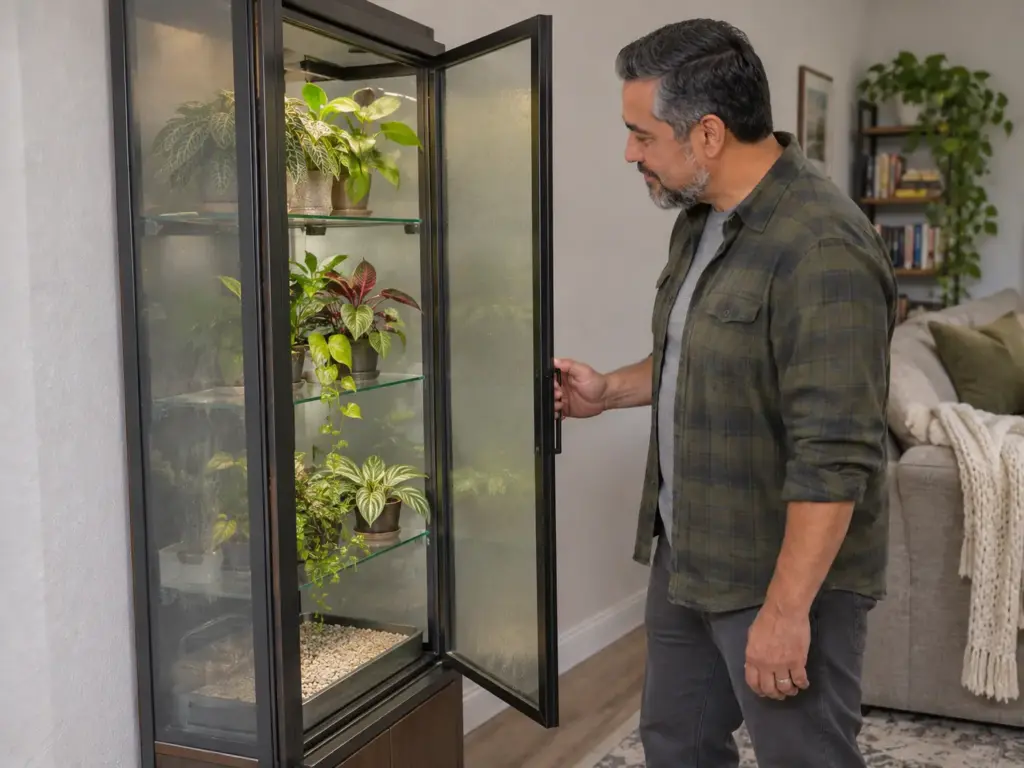
Both statements are correct, and the difference is volume. A glass cabinet of 3 by 1 by 5 feet holds 15 cubic feet, about 64 times less air than the 960 cubic feet of that bedroom (the sizes are an illustration, not a measurement). The same tray water, in 64 times less air, makes the cabinet a small microclimate that reads muggy the moment the door opens. A tray of gravel or LECA in the bottom of the cabinet, topped up about once a week, is the cabinet version of everything above.
The glass works as a hygrometer: when it fogs and stays fogged, the tray is too much water for that much air. Lift the lid or leave the door ajar now and then so the glass does not stay wet.
The same society names trays of gravel only partly filled with water as the home method for phalaenopsis, with the air kept moving, so even the narrowest case is a job and not a myth. The honest limit is that a tray never gets a house above the house’s ceiling, and giving one fussy plant a band the room cannot hold is the cabinet’s work; how much humidity a houseplant is allowed in a house that caps it covers the band itself.
What a Humidifier Changes in the Whole Room
Where the tray moves the air at the pot, an ultrasonic humidifier or any other type moves the air of the room, and the question stops being whether it works and becomes how much water a day the room needs and which type of machine delivers it without a side effect worse than the problem. Output, type and the ceiling a machine must respect come in that order.
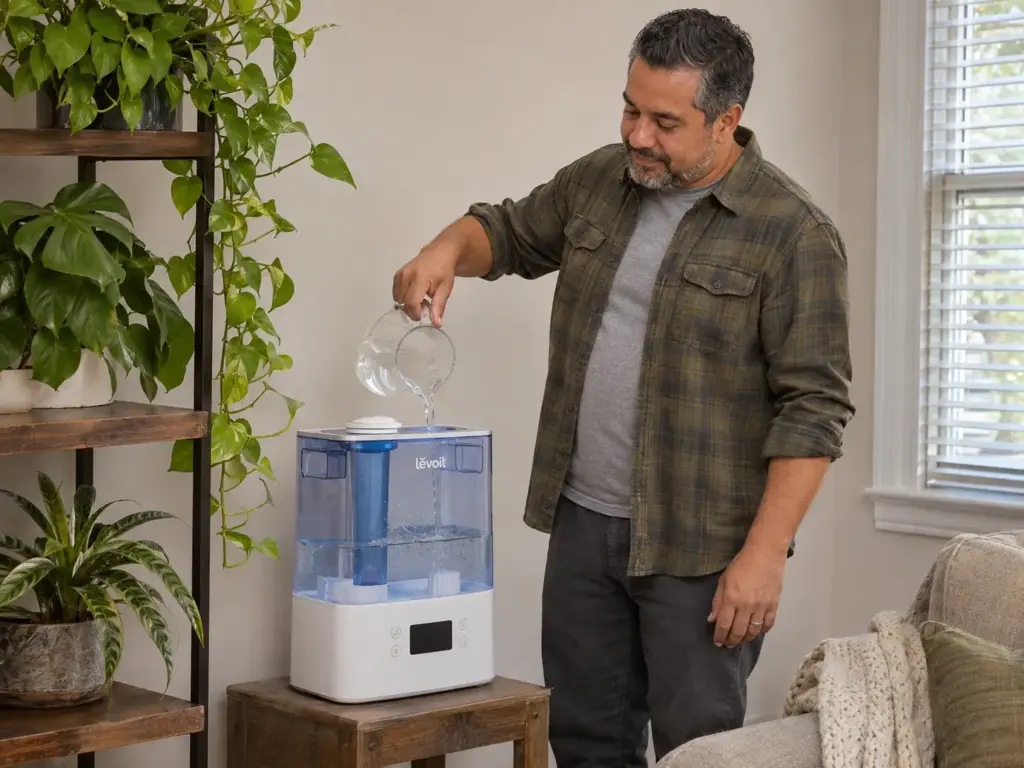
Output, Not Tank Size, Does the Work
A six liter tank sounds like a lot until it is on a shelf in a room with an open door. At full output it is empty in 20 hours, while the meter on the far side of the room has barely moved. Tank size says how long the unit runs between refills; output says how much water goes into the air, and output is the number that decides whether the room changes.
The Levoit Classic 300S prints 300 mL an hour at full output, about 7 liters over a day or close to 2 gallons, and the maker rates it for rooms up to 505 square feet. That coverage is the maker’s figure and has not been certified for plants. For a room the size of a living room, how many gallons a day a large plant room needs is the arithmetic worth running, and it is set out in how many gallons a day a large plant room needs.

Cool Mist, Warm Mist, Ultrasonic and Evaporative in a Plant Room
Ultrasonic units make cool mist, run quietly and draw few watts. Evaporative units pull air through a wet wick with a fan. Warm-mist units heat the water, and steam is a burn hazard on a low shelf where a child or a pet can reach, which the EPA flags for steam units. For a plant room the type matters less than the output and the water, but the choice does change what the shelf collects, as the next two sections show.
The Levoit LV600HH Warm and Cool Mist Humidifier is the one pick here that switches between warm and cool, and its output of up to 500 mL an hour, with coverage the maker puts at 753 square feet, is the honest size for a plant room whose door stays open. A 6 liter tank at that output is empty in 12 hours. Reliability is its soft spot, with units that die within days or refuse to start, and some are hard to clean.
Once a machine is running, the plume has a reach, and the leaf is better off beyond the point where the mist has thinned; where to stand the unit so the mist thins before the leaf covers the distances. A very small machine does not rescue a big room either: the American Orchid Society says the smaller humidifiers have a negligible impact on the humidity of a room, and the same small unit that does nothing on an open floor can hold a closed small room or a plant cabinet with ease.
For a bedroom shelf where a 6 liter tower is too much, the Levoit OasisMist 450S Warm and Cool Mist Humidifier takes a 4.5 liter tank, runs up to 45 hours, sits at 26 dB and has an Auto Mode that holds 40 to 60 percent. The top of that range sits above the EPA’s 50 percent limit for humidifiers, so the meter still gets the last word. Cleaning is the mixed point on its page, despite the wide opening.
The Ceiling a Machine Has to Respect
A tray fails quietly. A machine can overshoot, and that asymmetry is what separates the two at the wall. In the EPA’s use and care of home humidifiers, the instruction is not to humidify to indoor relative humidity levels above 50 percent, and if water condenses on windows, walls or pictures, to lower the setting. The area around the unit must not become damp or wet either, which is the line between a plant shelf and a rotting one.
A humidistat holds a level and a unit without one runs until somebody stops it. That is the reason the meter comes first: without a humidistat it is the only thing between the room and a wet windowsill.
The unit’s own display reads the air at the unit, and the meter at the leaf reads the air where the plant lives. The two disagree by a few points, and that gap is the part of the number that is plume. Trust the meter at the leaf: set the machine so that reading sits inside 40 to 50 percent, and let the glass tell you if the setting is too high for the cold outside.
What Each One Costs to Own, in Water and Upkeep
A tray costs the stones and a machine costs a routine, and neither bill is paid at the checkout. This section counts what each takes from a week: water, a refill, a scrub and, for one type, a consumable.
The Tray: Stones, Water and One Weekly Job
Free is not zero. The tray needs stones, water kept below the waterline, and the weekly empty-and-scrub that the CDC gives for anything holding water. That is a few minutes a week and no electricity, which is the whole running cost. It is the cheapest line in this article, and the only one that also asks you to remember it.
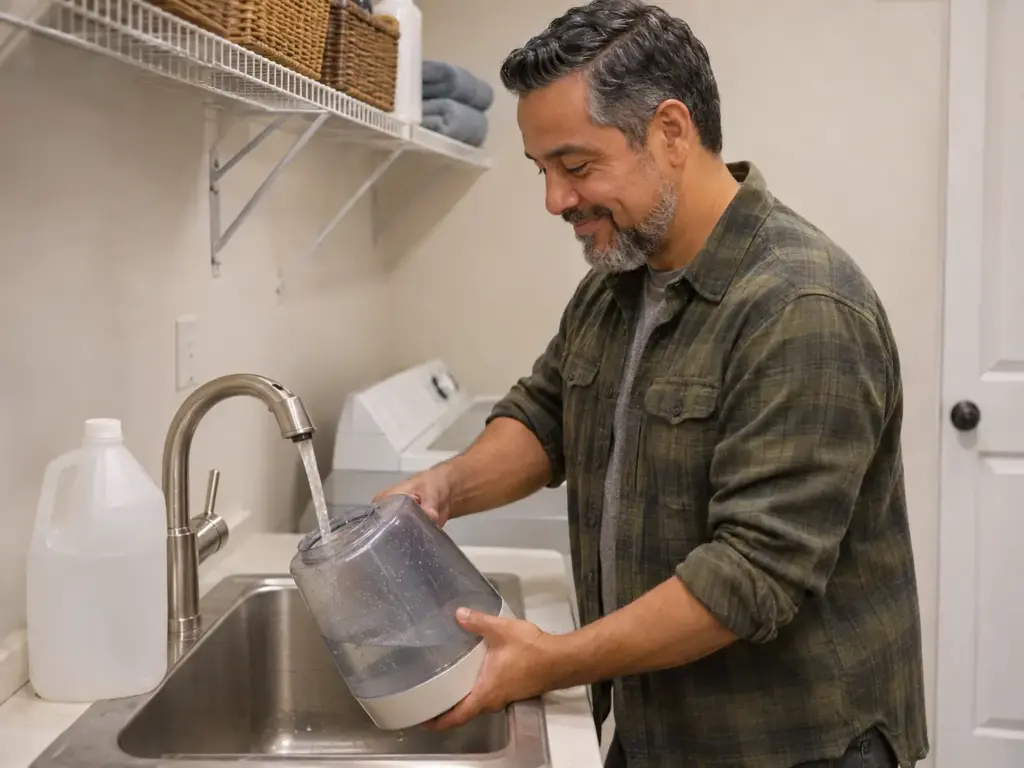
The Machine: Daily Water and a Scrub Every Third Day
The machine’s job is not monthly. The EPA’s routine for a portable unit is to empty the tank, wipe all surfaces dry and refill with fresh water daily, and to clean the unit every third day; the method is in the maker’s manual. A unit that cannot be cleaned in a minute or two is one that stops being cleaned, so the wide opening on the 450S and the top-fill tanks of the Levoit units are the practical answer. Tank cleaning on a narrow reservoir is the chore that gets skipped first, and descaling is the same chore a few weeks later; the maker’s manual says what a unit tolerates, vinegar included.
Running time is arithmetic, and the label gives the inputs. A 6 liter tank at 300 mL an hour is empty in 20 hours; the maker’s figure of up to 60 hours is the same tank on the lowest setting, which comes to about 100 mL an hour. Multiply the watts on the label by the hours the unit runs and divide by 1,000 to get kilowatt-hours; the maker’s consumption figure is the input, and the tray has no such line at all.
For one shelf, one small closed room or a plant cabinet, the Pure Enrichment MistAire Ultrasonic Cool Mist Humidifier is the honest size: 1.7 liters, up to 25 hours (about 68 mL an hour at its lowest) and 250 square feet of coverage from the maker, where a small output is no compromise. It has high and low settings and no humidistat, so it runs until someone stops it, which is why the meter comes first. Durability and cleaning are its mixed points, with units stopping within a week and tanks that are almost impossible to clean. Compared with the tray, the machine costs a tank, a cleaning routine and, for an evaporative unit, a wick, and a bigger machine does not buy a bigger win in an open room.
The Water Decides the Mess
Ultrasonic units disperse the minerals of tap water into the air, and the EPA says the white dust film that settles is those minerals, so water low in minerals is the advice. Evaporative and steam units are not expected to disperse substantial amounts of minerals; an evaporative wick traps them and becomes the consumable instead. Which of the two leaves the better trade depends on the tap, and what each mist type leaves behind, in water and watts goes through the dust-versus-scale split.
The jug of distilled water is the line on the grocery list that nobody counted when they priced the machine. Units that stop working early, after two days, a week or a month, and auto shut-offs that cycle on and off are the price of the cheaper end of the category, and a unit that short-cycles is not a reason to turn the setting up.
Week Six on Each Side
Week one judges a tray by the leaves and a machine by the number on its screen. By week six both of them leave a record: a mineral ring in a tray, a pale film on a shelf, a wick that has loaded. The two records ask for two different cleaning clocks.
The Ring, the Smell and the Water That Stood
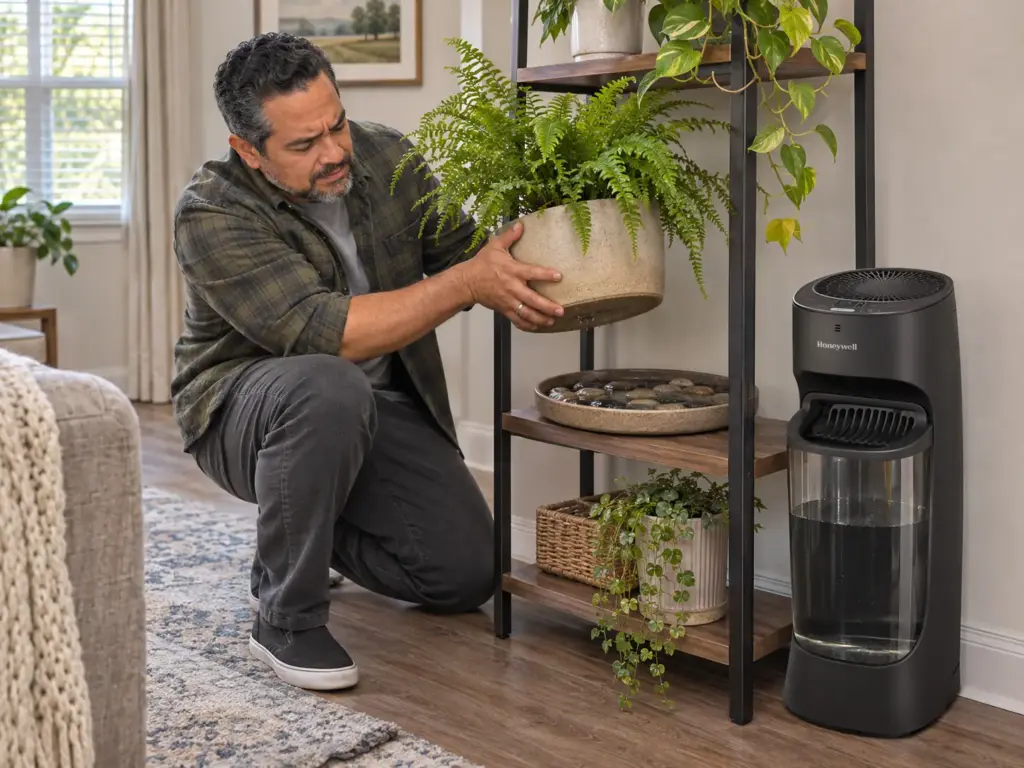
A tray set up in November and found in March shows a mineral ring where the water has evaporated down, a smell, and sometimes larvae in the water. That is the standing-water cycle the CDC’s weekly empty-and-scrub is written for. An algae film is the other common find, and it is one more reason the weekly clock matters.
The fix is the weekly clock and rinsed stones. Pests follow standing water, so the tray that is emptied and scrubbed weekly is the tray that stays what it was supposed to be.
The White Film and the Loaded Wick
On an ultrasonic unit running on tap water, a fine white film settles on leaves and sills within weeks. It is the water’s minerals, which makes it neither a plant ailment nor a filter problem, and the leaves get blamed for it. Scale in the tank is a place where microorganisms grow, according to the EPA, and a wipe-down does not stop it: distilled water or an evaporative unit does.
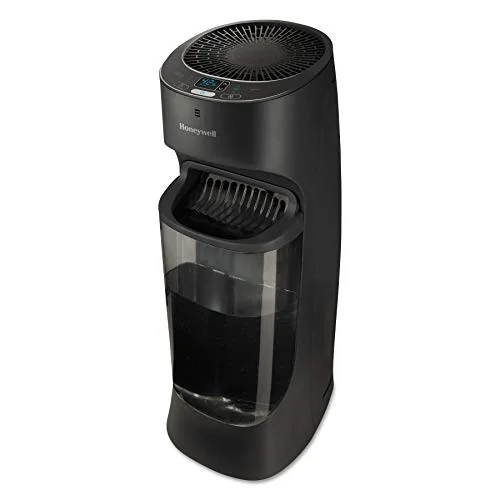
The evaporative answer trades the dust for a consumable. The wick loads on hard water, and the filter pads of the tower do not last for some units. The Honeywell HEV620B Top Fill Tower Evaporative Humidifier is the evaporative card here.
The window is the second meter at week six. If the glass beads when the machine runs, the setting was too high for the cold outside, and the setting that is safe falls as it freezes; how to read the glass as the ceiling check once a machine runs explains the reading. A wall or a window that sweats is the building telling the EPA’s story: condensation on windows, walls or pictures means lower the setting.
A humidifier that tops out short of its setting, or cycles on and off at month two, is showing the flaw of the evaporative tower, and a higher dial will not fix it.
The Two Cleaning Clocks
The tray gets emptied and scrubbed weekly, which is the CDC’s interval. The machine’s tank gets emptied, wiped dry and refilled daily, and the machine itself gets scrubbed every third day, which is the EPA’s. A wick or cartridge swaps on the maker’s schedule. A routine that does not exist by week six is the one that ends the experiment.
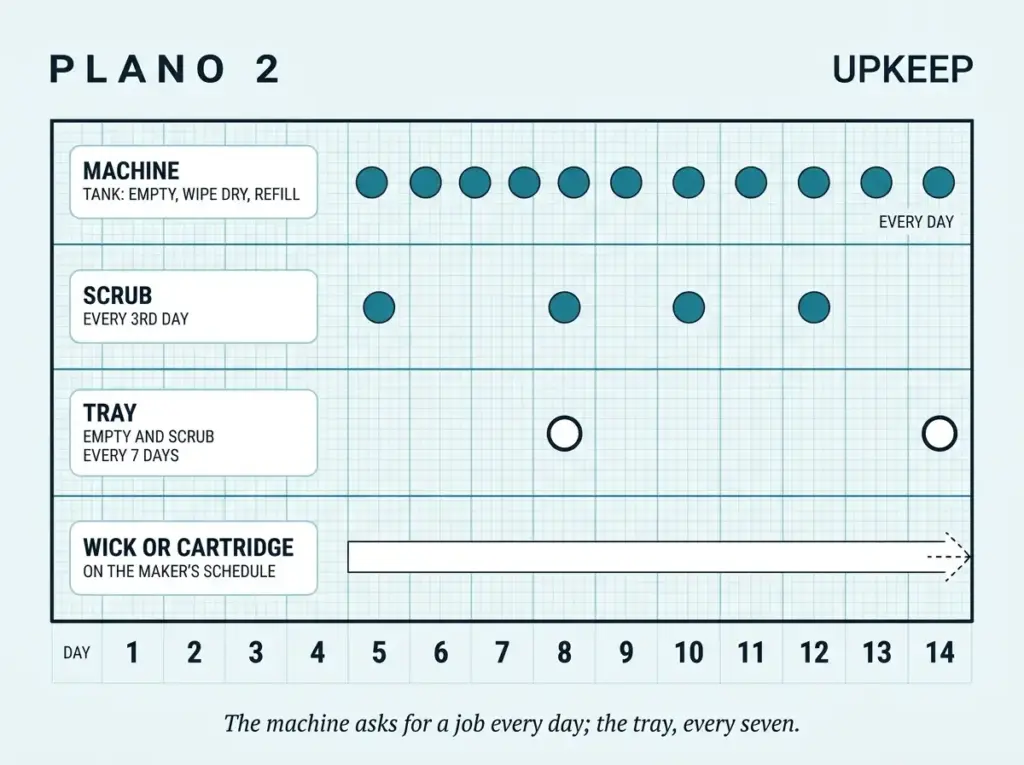
Before a second device is bought, the cases where it was never the air get checked.
Brown tips that persist at a reading in band, a shelf in the draft of a register, watering and salt crust: the roots and the watering come first, and the new machine comes last. In the check at the end of week six, free fixes lead (water, move, group), and the glass, the ring, the film and the wick are what get looked at again.
When the film shows up, run a finger across a leaf and across the shelf under the unit. If both streak white, it is the tap water, and the answer is distilled water or an evaporative unit; if only the leaf marks, look at the watering and the soil first.
Put the Meter at Leaf Height Tomorrow and Let It Pick
The reading at the leaves picks the side, and sometimes it picks neither: a meter mid-band over brown edges sends you to the register, the watering and the salts. A tray reaches about as far as the water it holds, and it wins only where that water sits in very little air, on a shelf or in a cabinet. A machine is the only one of the two that changes the air of a room, and it comes with a ceiling at 50 percent, a daily refill and a scrub every third day. By week six the two leave different records, a ring in the tray and a film or a loaded wick on the machine, and the clocks for them are different too.
For the check later on, look at the tray’s water and its mineral ring weekly, at the film and the wick across the first season of running, and at the glass on the coldest mornings of the winter, since that is when a setting that was fine in November turns out to be too high.
Tomorrow, stand the meter at leaf height, out of the draft and away from any machine, and read it morning and evening. If the evening reading is in band, the next step is a free fix and not a purchase. If the reading stays low after the pots are off the register and the door is shut, a unit is the next move, sized by output: why a humidifier is sized by gallons a day and not by tank size is where that starts.
Frequently Asked Questions
01Is a cool or warm mist humidifier better for plants?
For plants, the water and the output matter more than the mist type: ultrasonic units throw tap-water minerals into the room as white dust, while evaporative and steam units do not. Steam is also a burn risk on a low shelf, so keep a warm unit out of reach.
02Where should you not place a humidifier?
Keep it away from walls, windows and wood, and a few feet back from the leaves, because the EPA’s sign of too much is condensation on windows, walls or pictures. The placement guide on how far back to stand it gives the distances.
03How does a pebble tray increase humidity?
Water evaporates from the open surface between the stones, and the vapor stays close to the pot and a short distance above it, so the effect is local. A wider tray exposes more water, but the room’s airflow carries the vapor off quickly.
04Do pebble trays attract mosquitoes?
Standing water can, and the CDC advises emptying and scrubbing anything that holds water, flowerpot saucers included, every week. A tray emptied, scrubbed and refilled weekly follows that advice; one left to stand for months does not.
05Do pebble trays work for orchids?
The American Orchid Society calls trays barely effective for a room, yet names gravel trays only partly filled with water as the home method for phalaenopsis, with the air kept moving. The job is narrow: one genus, one shelf.