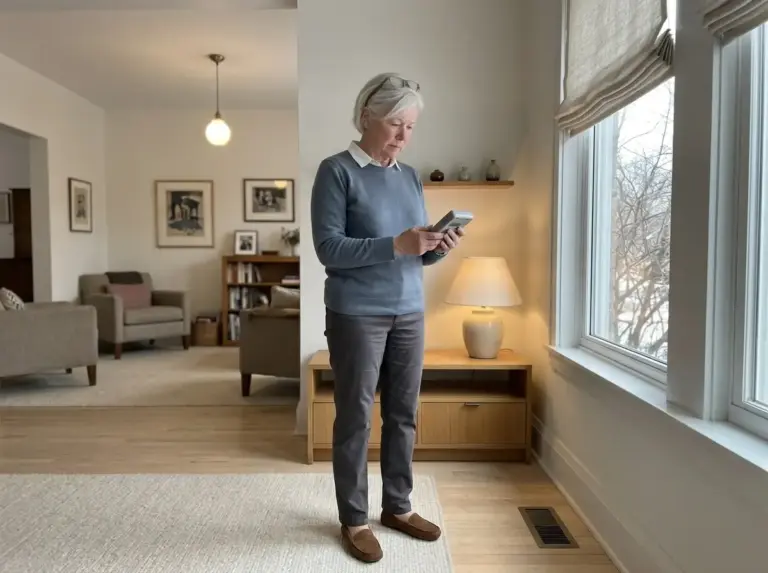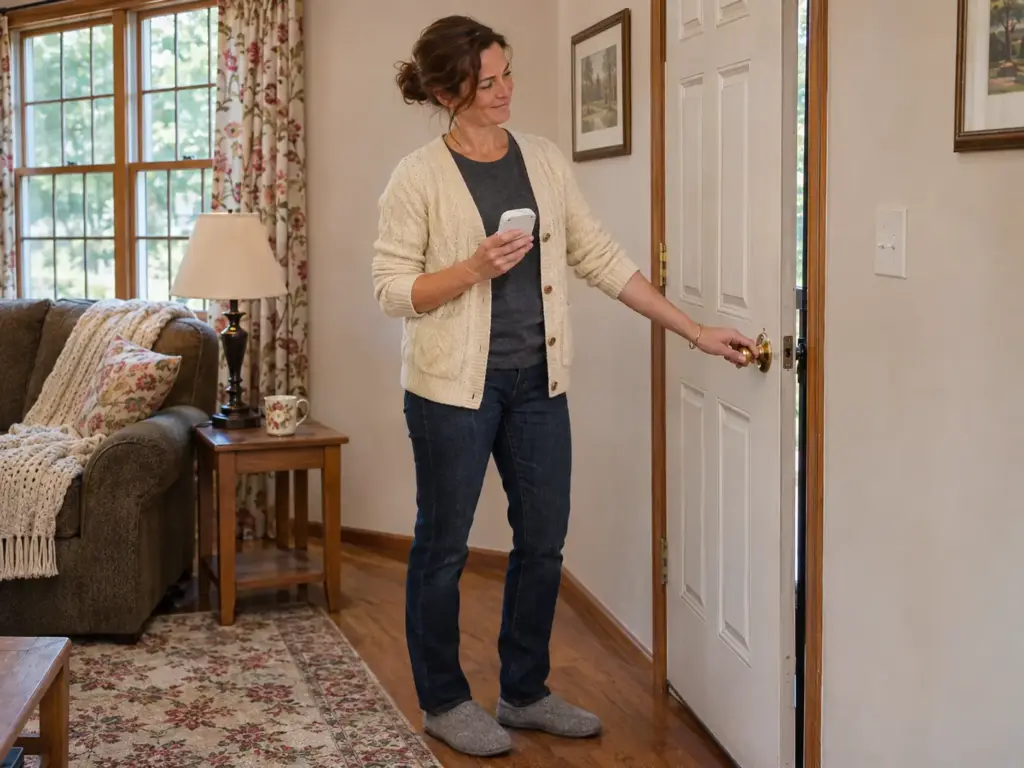
The first hard cold of the year arrives, the hallway door stops latching, and a spark jumps from the doorknob to your fingertip. If you typed winter dry air in house into your phone with that hand still stinging, here is the answer: those signs are readings of one number, and the number lives on a small hygrometer in the room, not on the thermostat. Heating cold outdoor air adds no water vapor, so the humidity percentage falls while the water stays the same, and wood follows the percentage, settling at about 4 percent moisture content in a heated house against 7.7 percent at 70°F (21°C) and 40 percent humidity, according to Penn State Extension.
How dry indoor air sits on a person is a doctor’s question and never a meter’s, so this article stays with the house, the number, the glass and the machine. Below, each sign is tied to a reading, then comes how to read a room without trusting a cheap display, the signs that are not the air at all, the band with its ceiling, the free changes in order, and last the humidifier sized in gallons.
Quick Answer
A heated house reads dry because the furnace warms cold outdoor air without adding any water, and the signs you notice all trace back to that one number.
- Why it reads dry: the percentage falls as the air warms, while the water in the house stays the same.
- Signs that belong to the air: the spark off the knob, the floor gap, the door that swings free, a seam that opens.
- The number to read: a meter in the room below about 30 percent. The EPA’s band is 30 to 50 percent, and below 60.
- The first change: stop the leaks and lower the thermostat a degree or two before any humidifier.
What the Doorknob, the Floor and the Door Are Telling You
Walk through the house on the first cold night and three odd things turn up that look unrelated: a spark, a gap and a door. They are one reading in several disguises, so the first job is to say which sign points to what, and which ones belong to the building instead. The full cause is laid out in what makes winter air dry in the first place, and what matters here is the chain from the sign to the room to the meter to the first change.
The Spark Off the Doorknob
The doorknob spark is the sign nearly everyone meets first and almost nobody measures. Cold air carries little water, and the furnace warms it without adding any, so the humidity percentage on the wall falls even though the water in the house, its absolute humidity, has not moved (why the furnace changes the percentage and not the water is written out in full there).
A static shock has no official threshold, so any single figure printed here would be invented. What can be said is that static electricity builds from sweaters, carpet and rubber soles, and a room with enough moisture in the air drains the charge away before it reaches your hand. Treat the spark as a reason to read the room with the EPA’s humidity guidance of 30 to 50 percent as the target, and leave the fix to the meter. The ordered fix for the shocks lives at what to do about the shocks themselves.
The Gap Between Two Boards
Wood follows the air like a sponge. Wood moisture content settles at 7.7 percent at 70°F and 40 percent humidity and drops to about 4 percent in a house with forced-air heat running, which are the wood moisture figures Penn State Extension works out for a heated house.
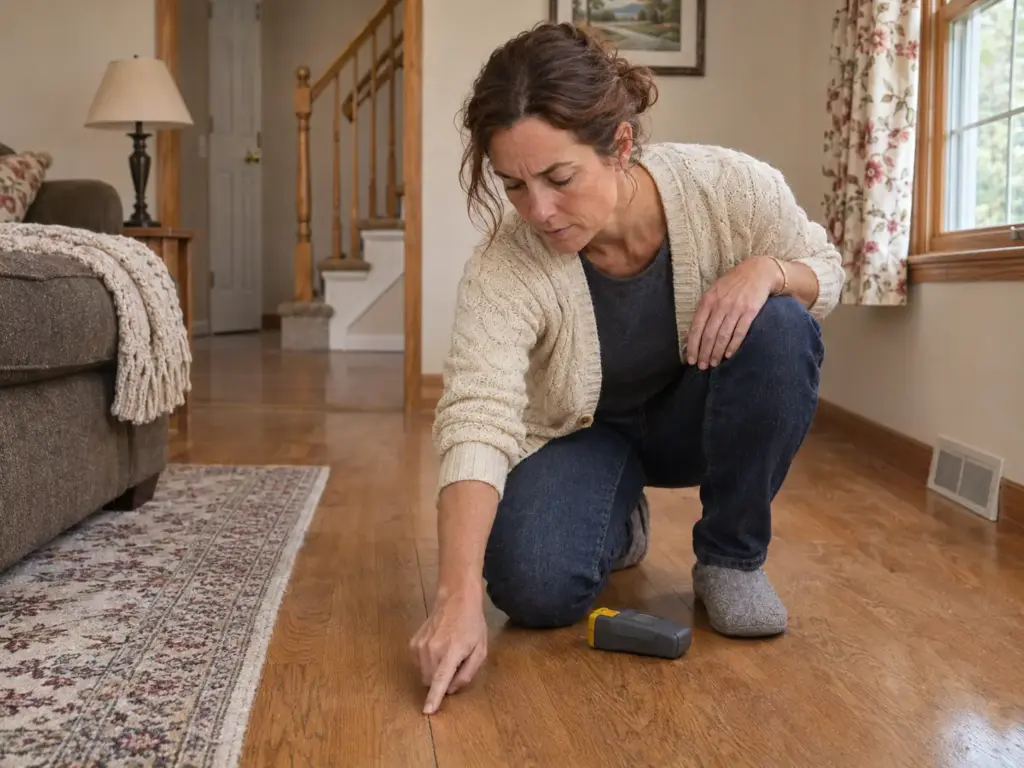
As boards lose that water they shrink across their width, and the shrinkage shows up as hardwood gaps, light between two planks, a floor that creaks like a much older floor and cracked furniture joints that start to talk. That seasonal wood movement is the whole mechanism: nothing is wrong with the board. In a house nobody has measured yet, that same floor is also the one that shocks off every knob.
A gap alone proves a reading, not a fault. According to the National Wood Flooring Association’s note on seasonal gapping, “Gaps and splits can vary in size and are considered to be normal if they appear and disappear during normal seasonal changes.” The same gap closes in July in a 90-year-old floor, which is why a gap seen in January is a reading and the same gap seen in July is the building.
The Door That Stopped Catching, and the Crack at the Seam
Doors, trim and drywall joints are wood and paper moving with the same percentage. A door that used to need a shove now swings free of its latch because the slab has shrunk a hair in width, and a hairline paint crack opens along a drywall seam or a mitered trim corner because the framing behind it has moved too.
In summer the same door sticks again, and a door that sticks in July and swings free in January is the clearest proof the movement follows the air and not a house settling. Three signs in three rooms tell you the direction, which is dry, and not the room. The room is the meter’s job.
Photograph the widest floor gap next to a coin on the first cold night, and again in July. A gap that has closed points to the air; a gap that is the same width in both photos points to the building.
Reading the Room Before You Touch a Dial
With the signs named, the number is what is left, and it is easy to get and easy to get wrong. A cheap display, a hallway reading and the thermostat’s own sensor can each be off by more than the whole distance between 30 and 40 percent, and the humidity percentage on any of them is relative humidity, a share of what the air could hold at that temperature.
Where the Meter Goes and When to Read It
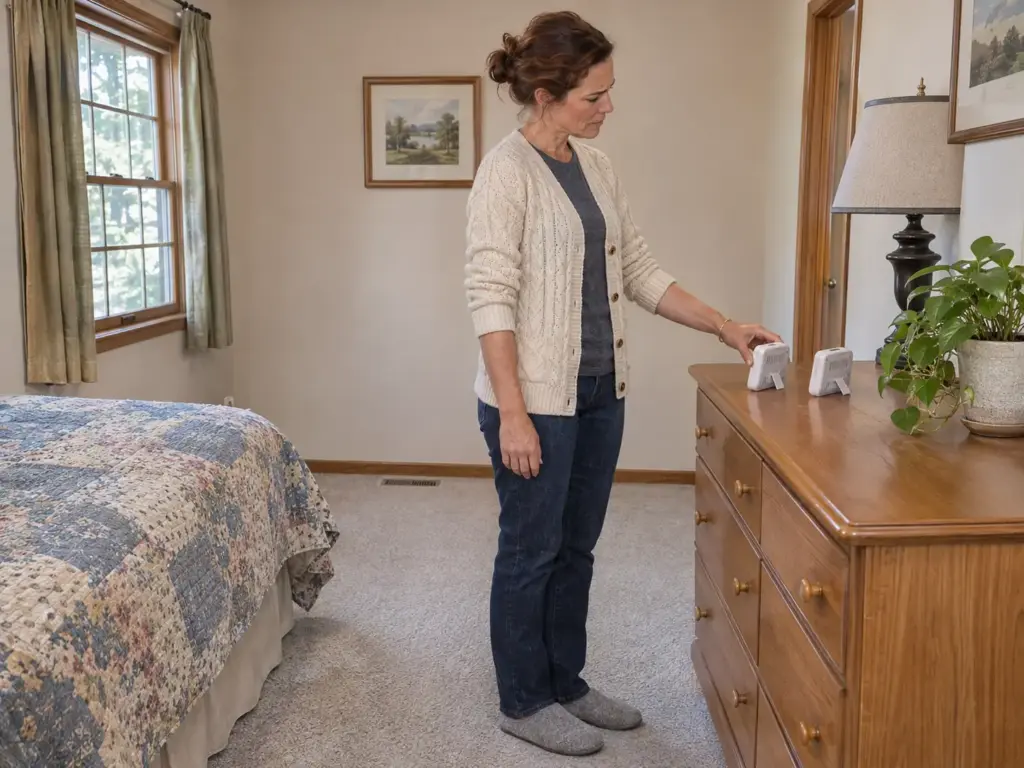
Read the room, not the hall. The bedroom at dawn and the kitchen at dinner can sit ten points apart in the same house, so a single number at noon in the hallway describes nobody’s room. A logging meter fixes that: the Govee H5051 keeps two years of readings and calibrates from its app, which turns one number into a pattern across the day. Its weak points sit in three places, with readings that can drift, batteries that can run flat in about a month and Wi-Fi that drops, so trust the curve it draws more than any single reading.
Placement matters as much as the model. A meter on a cold exterior wall or beside a register reads the draft, not the room, and the number settles only after the meter has sat in place for a while. For the full routine, see how to place and settle a meter.
Two Cheap Meters Can Disagree and Both Be in Spec
A meter’s accuracy is a band, and the bands are wide. The TempPro TP49 states ±2 to 3 percent, the Govee ±3 percent and a common wall-style meter ±3 to 5 percent, so two cheap meters can disagree by five points and both stay inside their own spec. Five points is more than the whole distance between 30 and 40 percent. In Bob Vila’s meter test, one sample read about 7 percent low and could not be calibrated, and another ran about 5 percent off with the same problem, which is how a display at 25 ends up in a room at 32.
The cheapest step in this article is therefore a second meter. The TempPro TP49 prints its accuracy band, takes one AAA battery and mounts on a shelf, a magnet or a hook. It has no backlight and it is not meant for a very humid enclosure, which does not matter on a bedroom shelf, and it is the meter to buy two of and compare.
Two other instruments also mislead: the thermostat’s humidity sensor and the humidistat dial on a furnace unit. A dial setting can end up far from what the room reads, and upstairs bedrooms in the same house can sit several points under the kitchen. The meter is the judge and the dial is a hint. A wider comparison of cheap meters sits at a cheap indoor humidity checker and how far to trust it.
The Salt Test, Overnight, in a Bag
A hygrometer that is going to decide a purchase deserves one overnight check, and it needs nothing from a store. The salt test North Dakota State University Extension gives seals the meter in a plastic bag with a cup holding half a cup of water and a quarter cup of table salt. After about twelve hours it should read about 75 percent.
Write down how far off it is, and apply that offset to every later reading. The test checks a single point on the scale, so a meter that passes at 75 can still wander in the 30s, and two meters that agree with each other there are better evidence than one that passed alone.
Put both cheap meters on the same shelf for a day before moving either. Within a point or two, hang one in the bedroom and one in the kitchen. More than three apart, run the bag test and keep the loser for trend lines only.
The Signs That Are Not the Air at All
Not every sign is a reading. Some come from the wood, the framing, the filter or a duct, and a humidifier bought for a doorway that has settled fixes nothing.
A Seasonal Gap Against a Wet Board
A gap that opens in January and closes by summer is the air. A large gap that stays open through the humid months is a professional’s call, which is the flooring association’s own line.
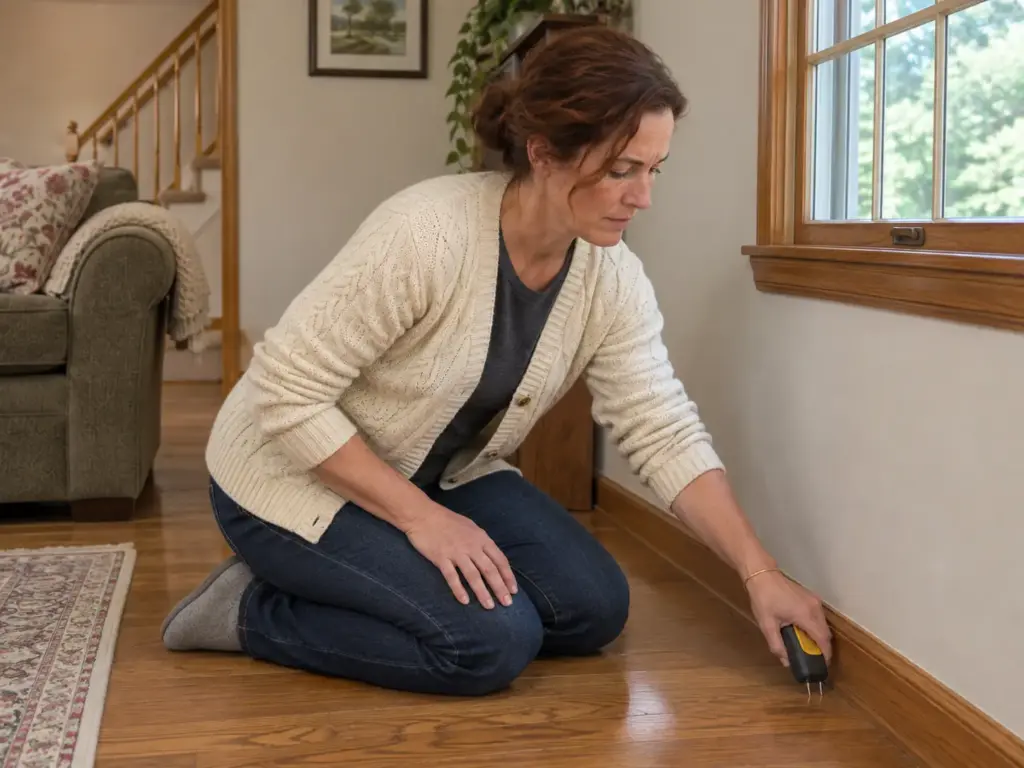
Between those two sits a question only an instrument answers: how much water is the board holding? The General Tools MMD4E is a pin-type moisture meter that reads the board’s own moisture content in percent, 5 to 50 percent on wood and 1.5 to 33 percent on building materials, and that number decides whether the gap is the air or the building. A board that reads far above what the room’s air could hold it at points to water, which is a question for the roof, the plumbing or the foundation.
Its flaw is mechanical. The pins bend after about 30 uses and its accuracy is contested, so a reading that suddenly drifts is the meter wearing out, not the floor.
The Crack Over a Doorway, the Dust and the Room Beside a Return
The rest of the false alarms are qualitative, and none of them gets a number here. A crack running up from a door or window corner is settlement, and it does not close in July. Dust that keeps coming back is a filter that has loaded and is passing air around the media.
A bedroom that stays dry beside a return duct may have a return pulling attic air through a duct leak, which makes that room the coldest and driest in the house. And a thermostat’s humidity readout is often off, so the first reading always comes from a meter in the room.
Air leakage and infiltration pull dry outdoor air in around doors, the attic hatch and the baseboards, and in a leaky house sealing alone can lift the reading with no new humidifier. No standard puts a number on how far, so the signs alone cannot show how much of the dryness is the leaks. What leaks and fans can do to a house’s reading covers the building side.
A wet board, a gap that stays open all summer and a return that draws from the attic are the building’s fix, a flooring or HVAC technician, and a humidifier is a poor answer to each of them. Duct sealing belongs to that same professional’s list, not to the humidifier aisle.
The Band, the Glass and the Free Changes First
Once the signs, the room’s number and the false alarms are separated, the question is how low is too low and how high is too high. The band has an owner, the window glass sets a ceiling, and the changes that cost nothing come before anything bought.
The 30 to 50 Percent Band and Who Owns It
The band everybody repeats belongs to somebody.
According to the EPA’s guidance on mold and moisture, “If possible, keep indoor humidity below 60 percent (ideally between 30 and 50 percent) relative humidity.” Winter pulls the top of that band down.
NDSU Extension gives 30 to 40 percent for the heating season and puts the start of window condensation at about 40 percent. The winter-to-summer range University of Minnesota Extension gives is less generous at the bottom, 25 percent in winter to 50 in summer. All three point the same way: in January the useful target is the lower half of the EPA band, and a reading near 25 in a hard freeze is what a heated Minnesota house is expected to show.
The Ceiling Is the Glass
The band says how low is too low. The glass says how high is too high.
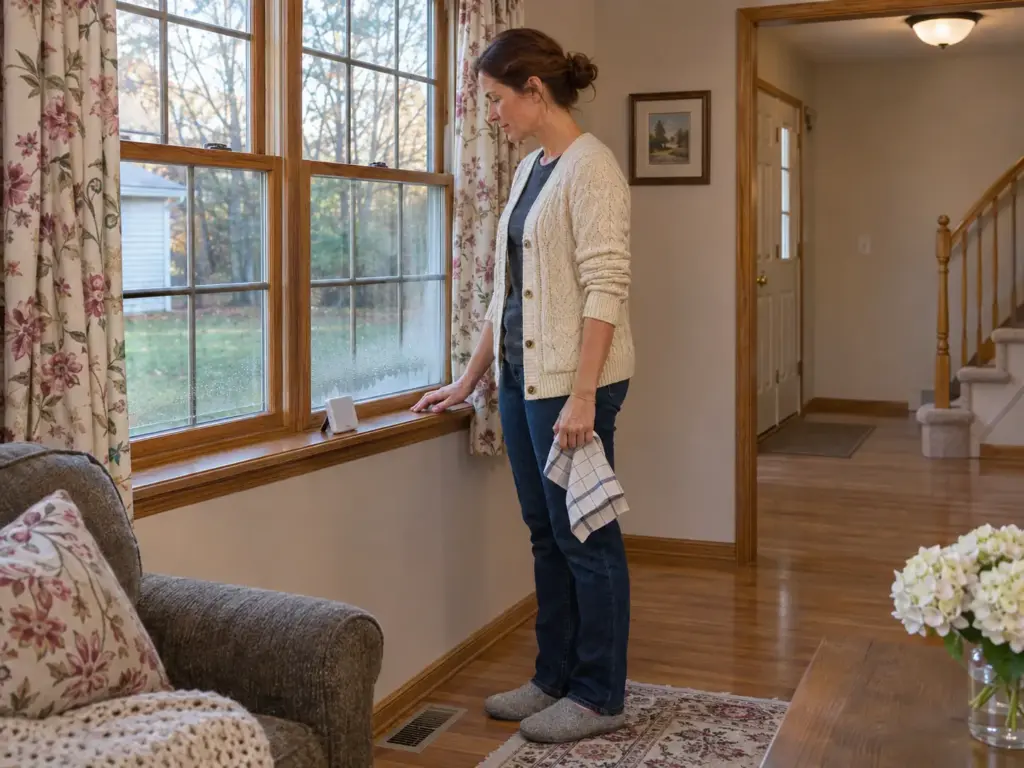
As the outdoor temperature falls, the pane gets colder, and the humidity ceiling a window can carry before it fogs falls with it, so the January ceiling sits below the EPA’s 50.
Window condensation is the dew point showing up on a cold surface: the room air meets glass colder than the temperature at which its water vapor turns to liquid. Condensation on the room side of a pane is a sign of high humidity for that night, and the number to lower is the room’s, not the thermostat’s. Treat this as a rule of thumb and no more: the figures by outdoor temperature live at the ceiling at each outdoor temperature. On the coldest night, a faint film on the lower corner of the pane shows before any water runs down the sash, and a film on the glass and what it says about the room is the earliest warning a humidifier owner gets for free.
Seal, Lower, Then Use the Moisture the House Already Makes
Work the free changes in this order, and read the meter in the same room after each one.
- Stop the leaks. Weatherstripping on the exterior doors, a sealed attic hatch and caulk along the baseboards come first. The reading should climb a few points over the next few days, and a film on the lower pane means you went far enough.
- Lower the thermostat a degree or two. Cooler air reads a higher percentage for the same water, so the meter should move up within a day. If it does not, put the dial back.
- Keep the moisture the house already makes. The EPA lists showers, cooking and laundry as sources. In a dry house that means shower steam kept in the house with the door left open, the lid off a simmering pot and a rack to air-dry laundry in the room, and how to dry clothes indoors and stay under 60 percent gives the ceiling. A reading above 40 with the glass fogging is a sign to stop.
What the house makes that it does not want, such as the steam from an unvented gas appliance, goes out by an exhaust fan or a vent, and an open window against dry winter air weighs venting against keeping moisture in.
The free tricks that fail are worth knowing before the shopping starts. A tray of water beside a floor register offers a small surface to a furnace that dries a whole house, and the meter rarely shows a change. A pot of water on top of a radiator suits a house with radiators and baseboard heat, and does little in a house with ducts and a heat pump or furnace. A simmer pot on the stove moves the meter a little.
All of the free changes together cannot fix a house far under the band. They can move a house a few points under it into the band.
Write the outdoor temperature beside every indoor reading. A house that read 28 percent in a mild week and 20 in the next hard freeze may not have changed at all; the weather did. Compare readings only at similar outdoor temperatures.
When the Free Changes Run Out, Size the Humidifier in Gallons
If the reading is still under the band after the free changes, a machine is the answer. The box prints a tank size, the room needs an output, and a house with ducts needs a different decision from a rental apartment with one window. A portable humidifier serves the second, a whole-house system the first.
A Bedroom Unit for the Rental With No Ducts
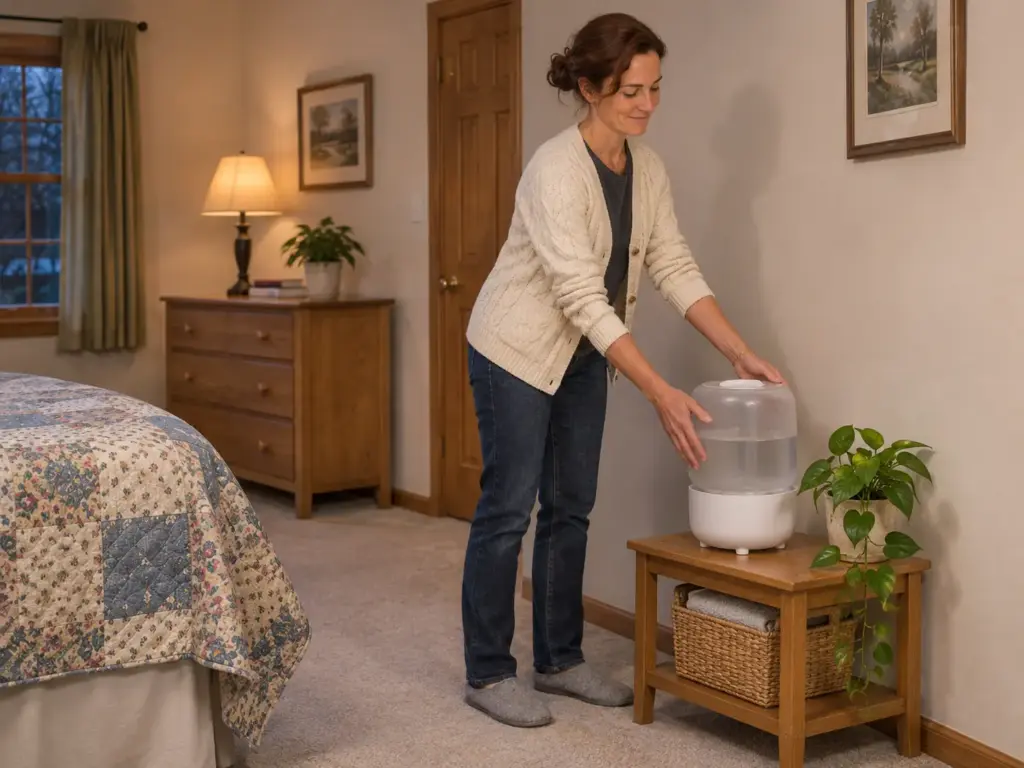
A bedroom unit is sized by the output it claims and the room it claims it for, not by the tank. A tank divided by the run time gives the output at that setting: a 6-liter tank that lasts 60 hours is moving about 100 milliliters an hour at the slowest setting, well under a gallon a day.
The Levoit Classic 300S is an ultrasonic humidifier with a 6 L tank, runs up to 60 hours and carries a maker’s claim of 505 square feet, and it has a real humidistat with an auto mode, so the sensor sets the target and the claim leaves room to spare. Its flaw sits in output, reliability and durability: a unit may not raise the humidity much, may shut off on its own, may leak, and a failure inside the first month is on record.
A 120-square-foot small bedroom does not need a claim of 505 square feet, and a lower output is the point of a smaller unit. The DREO HM311 holds 4 L, runs up to 36 hours, is rated for 300 square feet and 28 dB, and has no humidistat, so the meter on the dresser does the supervising. Its durability and reliability are mixed: a unit can break at five months or stop after two days.
A unit that ran all night and moved the meter one point is not broken. It is a bedroom claim set against a room it was never sized for, and the answer is a closed door on a smaller room or a second unit, and a higher dial fixes nothing. For the full arithmetic, see what size humidifier a room really needs, and for the closed-door case, bedroom humidifiers for a room with the door shut.
The Dial That Lies and the White Dust
The dial on a humidifier is another hint. It sets how hard the unit works, and the room’s reading is what the unit achieves, so the two can sit twenty points apart. Which setting to use when the dial reads wrong shows how to set it from the meter.
Month two brings the white dust. An ultrasonic humidifier on hard water leaves a mineral film on furniture, because the minerals in the water leave the tank in the mist. Mineral scale builds inside the unit as well, and a tank rinse every few days keeps it from starting to smell. Distilled water is the cheapest fix for the film.
Mold follows the room’s humidity and a cold surface, and the EPA ties it to moisture and condensation on cold surfaces; the temperature of the mist is not part of that, so a warm mist unit protects nothing by itself, and a cool mist unit adds no risk by itself either. What matters is the reading on the meter and the film on the glass.
The Furnace Unit and the Water Panel Every Season
A house with ducts makes a different decision. The AprilAire 500 is a bypass humidifier that mounts on the furnace, rated by the maker at 12 gallons per day for up to 3,600 square feet in a well-sealed house, and it is the one pick here whose output is printed in gallons per day against a house size. The furnace unit’s rating is a ceiling and the bedroom units’ figures sit at the slowest setting, but the gap in scale between them explains why a rental needs no furnace system. The maker’s larger fan-powered humidifier, the 720A, is rated at 21 gallons per day for up to 6,250 square feet and is named only to show where the scale ends.
“Maintenance-free” is the marketing. The maker’s own listing calls for the evaporative water panel to be changed typically once or twice per heating season, and pad replacement is the chore, because a panel that scales stops passing water. The flaw sits in installation and control: the wiring and the cut into the duct are hard for some, a house may never reach the set level, and a short life is on record. Water left in a furnace-mounted unit’s condensate drain can also go bad over the summer it was supposed to be off, so a failure can show up in the months the unit is not running.
After the reading and the free changes, the choice left, between an evaporative humidifier for a room and a whole-house system on the duct, is room against whole-house humidifiers, and the answer depends on whether the house has ducts and how many rooms need the water.
Two Readings Tomorrow, Then the Order of the Changes
The doorknob, the floor and the door are one reading in several places, and a meter set in the room and checked against a second one is the only number that decides. Some signs are the wood or the building, and a pin meter or a professional settles those. The band has an owner, the glass sets the ceiling, and the free changes come first, in order, with a reading between them. When a unit is finally needed, it is sized by the output it claims for the room, not by the size of its tank.
Plan a recheck for the weeks after the first change. Read the bedroom door with the unit running and again with it shut off, look at the lower corner of the window pane, and look for white dust on the dresser. If the house has a furnace unit, check the panel. The first cold week and the second cold snap rarely read alike, so compare each reading against the outdoor temperature before concluding anything moved.
Tomorrow, read the bedroom first thing in the morning and the kitchen after dinner, write both down, and make the first change from the free list. Read the same two spots a day later to see what moved.
Frequently Asked Questions
01What should you do if the air in a house is too dry?
Read the room’s humidity first with a meter, then work down the free changes in order: stop the leaks, lower the thermostat a degree, use the moisture the house already makes. Add a humidifier only if the reading is still low.
02What causes a house to have dry air in winter?
Cold outdoor air carries little water, and a furnace warms it without adding any, so the percentage falls. The same air that read high outside reads low once it is heated indoors.
03What is the ideal humidity level for a home in winter?
The EPA says keep indoor humidity below 60 percent, ideally between 30 and 50. NDSU Extension puts winter at 30 to 40, because above about 40 the cold windows start to fog.
04Why is the humidity in a house so low in winter?
Heating drops the percentage by itself, and a leaky house loses more through cracks and fans. A reading far below a neighbor’s points to the building, not the weather.
05Do trays of water and houseplants raise the humidity?
A tray beside a register offers little water surface against a house full of dry air, and the meter rarely shows a change. The moisture the house already makes (showers, cooking, laundry) does more, and a meter tells you.