You are standing in a dry living room in January with a tab open on a humidifier that says it covers 300 square feet, and the meter on the shelf still reads in the low 30s after a full night of it running. Two different numbers are in play and the box prints only one of them: the square footage on the sticker is a test condition, while what the room needs is water per day, the amount its air loses to the cold outside and to every leak. So the answer to what size humidifier do I need is a division you can run with a tape measure, in gallons a day.
Below, the sticker gets taken apart, the free moves come first, two rooms get worked out, and the same unit is checked again for February. If you are also weighing a room unit against a whole-house system, when a room unit is enough and when the whole house needs one covers that side.
Quick Answer
Size a humidifier by its output in gallons per day, not by the tank or the square-foot sticker. A typical leaky house in heating season needs roughly one gallon a day per 250 to 400 square feet, and the humidistat or a lower fan speed trims it from there. A 10 by 12 bedroom needs under half a gallon.
Why the Box Number Describes a Lab, Not Your Room
The figure on the box is true, but it was measured in a room that does not exist. It describes a warm chamber, a tight shell and a new wick, and your January room has none of the three.
What the Rating Assumes Before Your Room Gets a Say
Every coverage sticker descends from a test condition. According to Consumer Reports’ humidifier buying guide, “Our moisture output tests are conducted in a chamber set to 70° F and 30 percent relative humidity, an industry standard for testing humidifiers.” That is a warm room, a low starting humidity and one fan speed (usually the highest), with a new wick or a clean transducer doing the work. Change any of those and the number changes with it.
The sealed window in the test chamber is the other quiet assumption: in a rental apartment with a leaking sash the air leakage pushes the air changes per hour well above a new build’s, which is the same unit asked to fill a bigger hole.
A maker’s spec sheet can say the same thing out loud. AIRCARE rates its 831000 for 2,700 square feet at up to 9 gallons in 24 hours, but only for tight construction and an 8-foot ceiling, the conditions of the ANSI/AHAM HU-1-1997 test. Divide it out and you get 300 square feet per gallon, in a tight house, at one ceiling height. The sticker keeps the number and drops the conditions.
A unit that runs flat out for hours and never reaches its setpoint is the sticker meeting the room. The water in the tank went somewhere, and it did not go into the band.
The Same Unit in November and in a Cold Snap
Change the denominator and the same unit gives a different answer. A taller ceiling, a leaky sash or a 1940s rental all raise the water the room loses, and that loss grows as the outdoor temperature falls. A unit rated for 300 square feet can hold a bedroom at 40 percent in November and sit at 30 in a January cold snap with nothing wrong with the machine.
The target moves with the weather too. ENERGY STAR gives 30 to 50 percent in general and 30 to 40 percent for the heating season in a cold climate, the level that keeps window glass dry. At the cold end of the year the room is asked to hold a lower number against a bigger loss, and how the safe setting changes with the outdoor temperature is worth a look before you set the dial in a deep freeze.
Read the Room Before You Size Anything
With the sticker set aside, the first purchase is a reading. Which way the room is off, and by how much, decides whether anything needs buying at all.
The Meter Goes Across the Room, Not Beside the Unit
The EPA’s advice is to keep indoor humidity between 30 and 50 percent and to read it with a gauge, which is the point of the EPA’s guide to caring for the air in a home. Without a reading you cannot tell a dry room from an undersized unit. The humidifier’s built-in sensor sits in the plume it just made and reads high, so the number that counts comes from a separate meter on the far side of the room, away from the radiator and the vent. Take three readings around the room with one meter and you have the room’s real baseline, and a cheap checker worth trusting before any unit costs a fraction of the humidifier it can talk you out of.
Write the outdoor temperature next to each reading for three days running. A room that reads 38 percent with 45 °F (7 °C) outside and 30 percent with 15 °F (-9 °C) outside is following the weather, and that pattern tells you the loss is climbing before it tells you the unit is too small.
The Moves That Cost Nothing, in Order
Each of these gets a reading before the next one starts:
- Take 1 to 2 °F (about 0.5 to 1 °C) off the thermostat. Cooler air reads a few points higher on the same moisture, so read the meter again after a day.
- Pull the leaking sash shut or seal it. The reading should hold longer into the evening than it did.
- Decide the door. Open, a floor behaves as one room; shut, one room becomes two. The meter in the far room says which you have.
- Move the meter off the radiator or the vent, where it runs low and swings with the heat.
Meanwhile, think about which reading you trust: the unit’s own panel is one sensor in one corner of the plume, and a hygrometer across the room is the humidity reading that counts. Give the first move two or three days before judging it, because the reading that shows the room changed, and not only the afternoon, is the one from the third day. If the meter already sits in the band, the purchase disappears. And a room that “feels dry” at 38 percent is a reading with nothing left to size.
The Arithmetic: Gallons a Day for Your Square Footage
Now the number the box leaves out. A room’s need and a unit’s output can be compared in only one unit, water per day, so that is the unit used from here on.

One Gallon a Day for Every 250 to 400 Square Feet
As a rule of thumb, and only that, a typical leaky house in heating season takes about a gallon of water a day for every 250 to 400 square feet, and the humidistat or a lower fan speed cuts it back from there. The range comes from the makers who print an output figure: AIRCARE rates 9 gallons a day for 2,700 square feet (300 square feet per gallon), Vornado 4 gallons for 1,000 (250), Levoit about 9.5 gallons for 3,000 on its 6000S (about 315) and about 2.5 gallons for 600 on its 450S (240). Four makers land on one constant, and none of them prints it on the box.
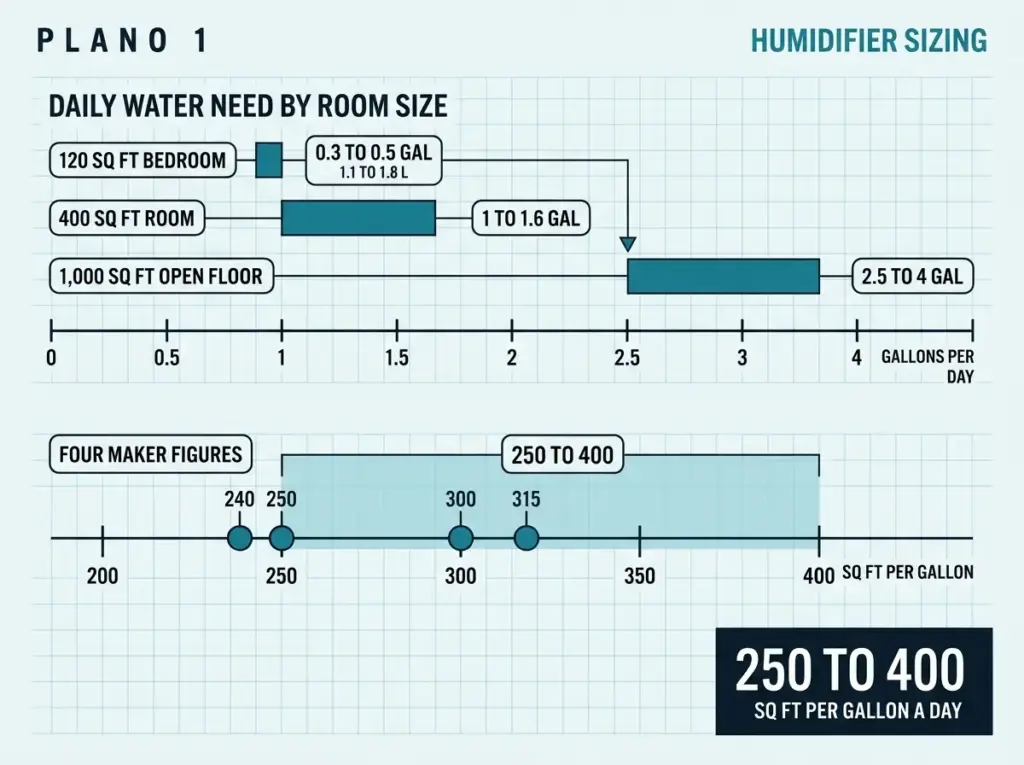
The unit that is right on paper for a tight new build is half a unit in a rental with a leaking sash, which is why the range runs from 250 to 400 and nothing narrower. Use 250 for a drafty place with old windows, 400 for a recent, well-sealed one, and 300 when you cannot tell.
Turning a Listing Into a Daily Number
Listings speak in milliliters per hour or in a tank and a runtime, and both convert in one step. One liter per hour is 24 liters a day. A listing of 1,500 mL per hour is 36 liters, about 9.5 gallons (a gallon is 3.8 liters), and 400 mL per hour is 9.6 liters, about 2.5 gallons. When the listing prints only a tank and hours, divide the tank by the hours and multiply by 24: 6 liters over 60 hours is 2.4 liters a day, about 0.63 gallon, and that is the output on the lowest setting.
A Size Chart in Gallons, Pints and Tank Capacity
Put the band into a chart and the classes of unit fall out of it. The output rating is the column that matters, and tank capacity is only what the class happens to carry:
- Up to 200 square feet (a bedroom or office): under 0.8 gallon a day, or 6 pints a day, from a tabletop humidifier with a 1 to 1.5 gallon tank.
- 200 to 500 square feet (a living room): 0.5 to 2 gallons a day, from a tower humidifier or a larger ultrasonic unit with a 1.5 to 2 gallon tank.
- 500 to 1,000 square feet (an open plan): 2 to 4 gallons a day, from an evaporative console with a 4 to 6 gallon tank.
- A whole floor and up: 5 gallons a day and beyond, from a large console or a bypass humidifier tied into the furnace.
Pints per day is the same number in the unit older spec sheets use: a gallon is 8 pints, so 0.5 gallon a day is 4 pints a day. A calculator on a maker’s site is this chart with the leaks guessed for you, and a humidifier size you worked out yourself beats one it guessed.
Ceiling Height and the Room You Actually Have
Coverage ratings assume an 8-foot ceiling. Add 10 to 15 percent to the figure for a taller ceiling, because the air being humidified grows with the height. Area turns into room volume only when the room is tall, and for a standard ceiling the square footage is enough.
If you do want cubic feet, multiply length by width by height: a 10 by 12 room at 8 feet is 960 cubic feet. If your dry room is actually a damp one somewhere else in the house, the same sizing question for a damp basement, counted in pints a day, runs the opposite way.
The 10 by 12 Bedroom, Worked Out
With the rule in hand, the first room to run it on is the one most readers have: a bedroom of about 120 square feet with the door shut. The arithmetic is short, and its answer is smaller than most boxes suggest.
120 Square Feet Is Under Half a Gallon a Day
A 10 by 12 room with an 8-foot ceiling is 120 square feet. At 250 to 400 square feet per gallon that is 0.3 to 0.5 gallon a day, about 1.1 to 1.8 liters, so a 4-liter tank lasts two to three and a half days at that rate. A unit rated for 300 square feet already has headroom on that number, and a unit rated for 600 has far more than the room can take.
That also explains the bedroom that reads 30 percent at bedtime and 26 at dawn with a unit running all night and the door shut. The output was already a bedroom’s output, and the number that fell was the outdoor temperature.
Two Units for That Room, and What Each Does Wrong
The Dreo HM311 4L is an ultrasonic cool-mist unit with a 4-liter tank, up to 36 hours of runtime, 28 dB and a 300-square-foot rating. Four liters over 36 hours is about 2.7 liters a day, roughly 0.7 gallon, so even its slowest pace is more than the 0.3 to 0.5 gallon the room computes to. With no sensor to throttle it, a shut door and the window as the only overflow, it asks to be watched.
It sits at the budget end of the class and prints tank, coverage and runtime, which makes it a clean example of the gallon-a-night class and of a tank that buys two to four nights. Durability runs uneven: some units broke after five months and others stopped after two days.
The Levoit Superior Studio Smart 450S is evaporative, with a 4.5-liter tank, 400 mL an hour (about 2.5 gallons a day), a 600-square-foot rating, 19 dB and a humidistat. Evaporation slows as the air nears the band, so a shut room tolerates a slightly generous evaporative unit and does not tolerate one that is ultrasonic. This maker also prints the output as well as the tank. Reliability is the worry, with units that quit after two days or would not turn on, and the value is uneven for the class.
Mist type is a separate decision, and the water and the watts behind cool mist and warm mist settles it. Placement takes one clause: off the wall, with the mist pointed away from the bed. Once the size is known, which model suits a bedroom with the door shut is the next page to read.
Give each notch of the mist dial a full night before moving it. A shut bedroom reacts slowly, and a reading taken an hour after a change describes the plume while the room is still catching up.
The Window Is the Overflow Alarm
Oversizing is a failure with a tell. Past 50 percent the glass sweats, and window condensation along the lower edge of the pane at dawn says the setting overshot while the room was shut. Glass is where a room first shows it, because the pane is the coldest surface and the air touching it falls below its dew point before any wall does.
The EPA’s care page for home humidifiers is plain about it: “Do not humidify to indoor relative humidity levels exceeding 50 percent.” The instruction when the windows sweat is to move the unit, lower the humidistat or run it less. It never says to buy a bigger one. The EPA’s own care page for home humidifiers has the full wording, and when condensation on the window is normal and when it is the alarm tells you which side of that line the pane is on.
A Bigger Tank Is a Longer Refill Interval, Not a Bigger Unit
The bedroom arithmetic raises the question every shopper asks next: what is a big tank for? The answer is one idea. A tank and an output are different numbers, and the tank only sets how often you walk to the sink.
Six Liters Over Sixty Hours
The Levoit Classic300S is ultrasonic, with a 6-liter tank, up to 60 hours on its low setting and a 505-square-foot rating. Six liters over 60 hours is 2.4 liters a day, about 0.63 gallon. The tank buys interval between refills and nothing else; a bigger tank on that output would only lengthen the walk. Output is uneven, since some units barely raise the humidity at all, and shut-offs, leaks and failures at about a month show up too.
Seven gallons of water a week poured into an apartment that still reads about 25 percent shows the other face of it. The volume going in belongs to the tank and the pace, and the room needs a different number.
Tank Divided by Output Gives the Refill Hours
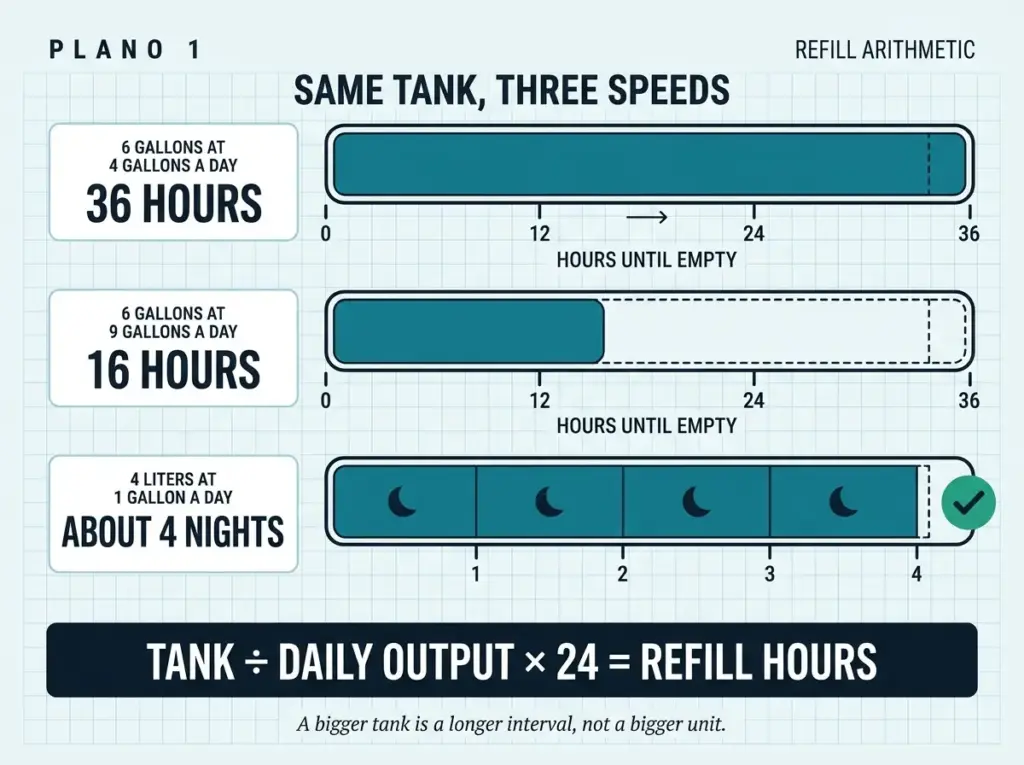
Refill time is the tank divided by the daily output, times 24. Six gallons at 4 gallons a day lasts 36 hours, the same 6 gallons at 9 gallons a day lasts 16, and a 4-liter tank (a little over a gallon) lasts about a day at 1 gallon a day and about two and a half days at 0.4 gallon a day.
A tank that is empty each morning with the meter unmoved is a unit sending its water somewhere other than the band. And a daily refill that appears by February is the output falling, since the tank did not shrink and the room did not grow. Month three takes that apart.
The Open Floor: the Arithmetic for 1,000 Square Feet
The bedroom was the small number. An open floor is the same rule on a larger room, and the difference between the two is a different class of machine.
1,000 Square Feet Is Three to Four Gallons a Day
At 250 to 400 square feet per gallon, 1,000 square feet takes 2.5 to 4 gallons a day, and 3.3 at the 300 constant. A tabletop unit’s output disappears into that. Several 3-liter units running around the clock in a big room can leave the meter where it was, and the money is spent before the buyer learns the difference between a tank and an output.
The Vornado Evap40 is evaporative with no visible mist, a dual tank holding 4 gallons in all, up to 4 gallons of output in 24 hours on high, a 1,000-square-foot rating, three speeds, a humidistat dial and a five-year warranty. That works out to 250 square feet per gallon, from a maker that prints the output as well as the coverage, and on high the unit moves its full 4 gallons in about a day. It is loud on high for a room where people sit, durability is uneven (some units broke after four months), and the tanks are hard to wash.
The free fix applies here as well. A door left open makes the floor one room, which is the premise of the arithmetic, and a shut door at one end makes it two.
What That Output Costs You in Noise
Vornado’s 4 gallons is the figure for the high setting, and high is the speed a living room tolerates least. Evaporative output is a fan pushing air across a wet wick, so the quieter speeds deliver less water, and a cold snap on a 1,000-square-foot floor may ask for high more often than the room’s tolerance for noise would like. That is the trade-off hiding inside the rating.
The dial itself is a wheel with no numbers on it, and a meter across the room is what says where it sits. For the set point worth asking the dial to hold, the winter setting the dial should hold has the figures by outdoor temperature.
Stick a strip of tape beside the dial and mark the position that held your target last week, with the meter reading and the outdoor temperature written next to it. When the weather turns, you move the dial a notch and add a new line, and by January the tape is the numbered dial the unit never had.
One Big Unit or Two Small: the Door Decides
The arithmetic sets the total. Whether one machine can deliver it depends on something the rating never mentions, which is whether the doors are open.

Doors Shut Means One Unit per Room
With the doors shut, one unit is one room’s unit. A unit that runs constantly across a whole floor with the door open goes to the room whose door closes and holds that room, and the same machine that lost an open plan wins a bedroom. With the doors open, the moisture spreads and one big unit can serve the floor.
Two small units are the answer when the floor has a door that stays shut, or when the plan is two small units now and a decision after January. The first winter tells you which rooms really lose the most.
The Nine-Gallon Class, and Its Noise
The AIRCARE Space Saver 831000 is an evaporative console of the 5 gallon console class, with a 6-gallon tank, up to 9 gallons in 24 hours, a 2,700-square-foot rating for tight construction and an 8-foot ceiling, a digital humidistat and auto shut-off when the tank runs dry. That is about 300 square feet per gallon, and the listing states the test condition behind that square footage. It is the single-unit answer for a floor with the doors open. It is loud, and reliability is uneven: units that stop after a few hours, and a fragile tank.
At its full 9 gallons a day it empties that tank in about 16 hours.
The Levoit Superior 6000S is the same class with a sensor that holds a set point. It is evaporative, with a 23-liter (6-gallon) tank, 1,500 mL an hour (about 9.5 gallons a day), a 3,000-square-foot rating, up to 72 hours on low, a humidity sensor good to ±5 percent, app control and a frame that folds for storage. Those 72 hours are a refill interval and say nothing about size. It is expensive for the class, and the wick is a part you replace every three to six months by the maker’s own estimate.
When One Floor Is Not Enough
A 2,000-square-foot house at 250 to 400 square feet per gallon needs 5 to 8 gallons a day. A nine-gallon console covers that in a tight house. Past it, a unit on the duct (a furnace or bypass humidifier) is the permanent version, and whole house humidifier units rated by the house they fit is where that class lives.
A larger floor is also where a ducted unit raises another question. The moisture goes where the air goes, so what a ducted unit does to the building when it overshoots belongs in the decision before it is installed.
Month Three: What the Same Unit Delivers by February
A size chosen in week one is a size chosen against the best output the unit will ever give. The number on the listing is the number for a new wick and a clean transducer.
The Wick Tells on the Unit Before the Meter Does
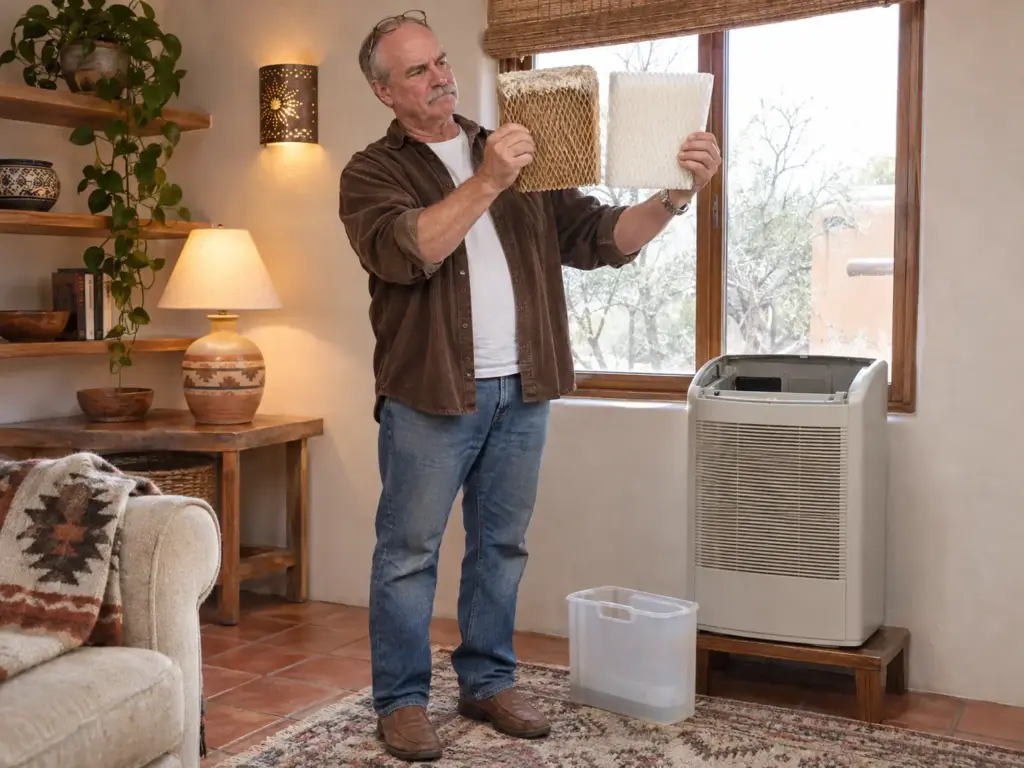
In an evaporative unit the minerals in the water stay in the wick. The wick stiffens, the wet surface collapses, and the fan runs at the same speed while moving far less water. That is why wick replacement, and not the tank, sets the real schedule of the unit.
The tell is a dry top third on a wick whose tank still empties once a day, which means the machine is running at a fraction of its rated output. How often the wick or pad should change depends on the water, and the maker’s estimate is a starting point: three to six months for the 6000S.
The arithmetic turns around here. A listing is the output of a new wick, so a unit rated exactly at the room’s need has no margin left once the wick has loaded. Makers print the output of the new wick, and the loaded one is left for the room to show.
Put the install date on a piece of tape on the unit, and add the day the tank first needs a second daily refill. The days between those two dates are how long that wick held its output in your house, and they are the number to plan the next change around.
The White Film and the Transducer
In an ultrasonic unit, scale builds on the transducer and tap water is atomized with its minerals in it. The result is white dust, a fine mineral dust on furniture, screens and electronics that a cloth does not lift. The white line along the top of the television, months after the unit went in for a dry bedroom, is the tap water, and the dust in the house has nothing to do with it.
Distilled water or a demineralization cartridge fixes it (descaling the transducer handles what already built up), at a running cost you can count in the same unit as everything else: a room that needs 0.4 gallon a day goes through about 12 gallons of distilled water a month. For a unit that is meant to run all winter, that figure belongs in the decision.
Choose the Size for February, Not for the First Week
Compute the need at 400 square feet per gallon for a tight house and 250 for a leaky one, then pick a unit whose published output sits at or a little over that number, a buffer of 20 to 30 percent at most, and let auto mode and the humidistat cut it back. Past that buffer you are buying the ability to over-humidify. A unit that kept up in autumn and falls behind once the outdoor temperature drops into single digits needs a second refill a day because the output fell while the room’s loss rose, and the room itself did not grow. What to check when a unit stops keeping up walks through that failure on the ducted side, and why the setting and the need move with the outdoor temperature explains why February asks more of the same machine.
Do the Division Tonight, Then Choose the Box
The number on the box was measured in a lab at 70 °F (21 °C). The room’s own need is water per day, about a gallon for every 250 to 400 square feet: under half a gallon for a 10 by 12 bedroom, three to four gallons for a 1,000-square-foot floor. A tank is a refill interval, the open or shut door decides between one big unit and two small ones, and the unit that fits in week one is smaller than it looks by February. All of it sits behind the free moves, which cost nothing and come first: a meter across the room, a degree off the thermostat, the sash and the door.
Come back to the room after a stretch chosen for each part: a few days for the white film, a few weeks for the dry top third of the wick, the first cold snap for the glass at dawn, and the turn of each season for the reading across the room against the unit’s panel. The humidity a bedroom should sit at is the target all of that is aimed at.
Tonight, put a meter across the room and read it at bedtime and again at dawn; what a low reading is really telling you says what to do with the number. Divide your square footage by 250 and by 400 for the two ends of your daily range. With that number in hand, the model pick on the bedroom page is the next stop, then mist type, then the cleaning the unit will demand.
Frequently Asked Questions
01What size humidifier do I need for my room?
Size by daily output, not by the tank: about one gallon a day for every 250 to 400 square feet in heating season. A 10 by 12 bedroom needs 0.3 to 0.5 gallon, and a 1,000 square foot open floor needs 2.5 to 4 gallons.
02What size humidifier for a 2000 sq ft house?
At 250 to 400 square feet per gallon, about 5 to 8 gallons a day. A nine-gallon evaporative console covers that in a tight house, and a duct-mounted whole-house unit is the permanent version for a floor beyond it.
03Can a humidifier be too big for a room?
Yes. Past 50 percent relative humidity the window glass starts to sweat, and the EPA’s instruction is to move the unit, turn the humidistat down or run it less.
04Is 70 percent humidity too high for a bedroom?
Yes, well above the band: the EPA says to keep indoor humidity under 60 percent, ideally 30 to 50. At 70 percent the glass beads and the coldest wall stays wet, which is a moisture problem for the house.
05How long does a humidifier tank last?
Tank divided by output, times 24. A 4 liter tank at about 0.7 gallon a day lasts a day and a half; 6 gallons at 9 gallons a day lasts about 16 hours, and at 4 gallons a day 36 hours.