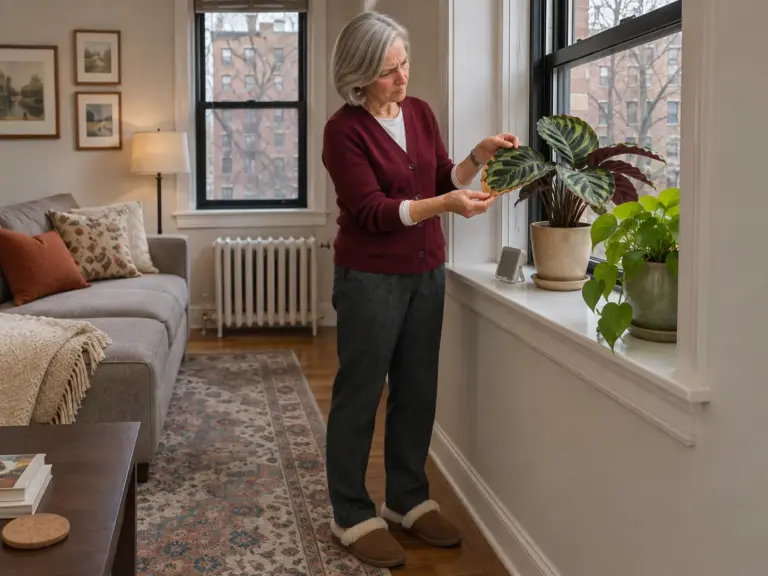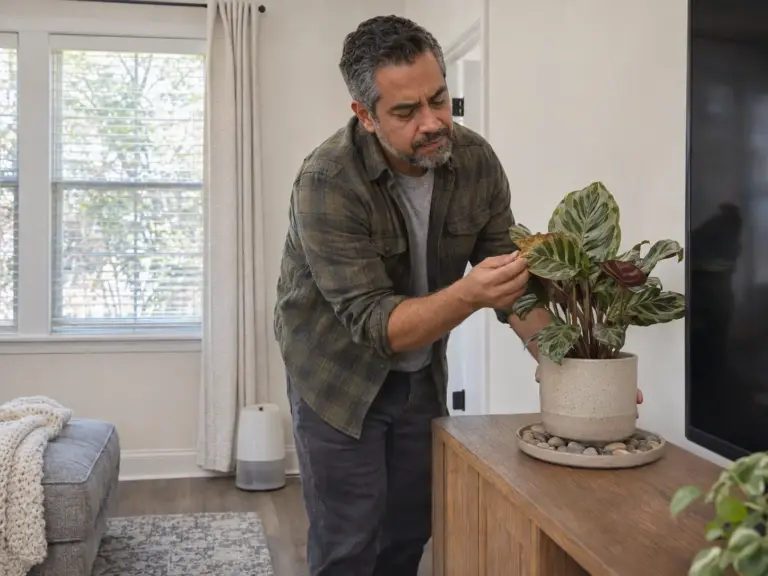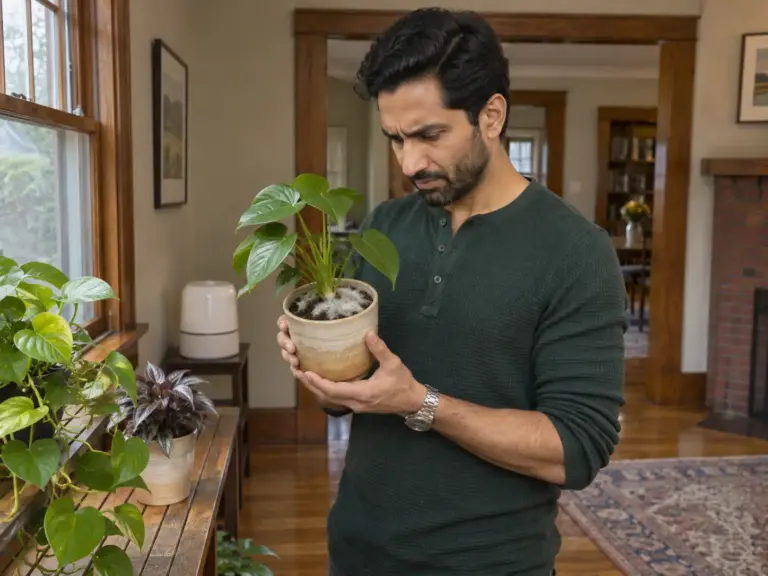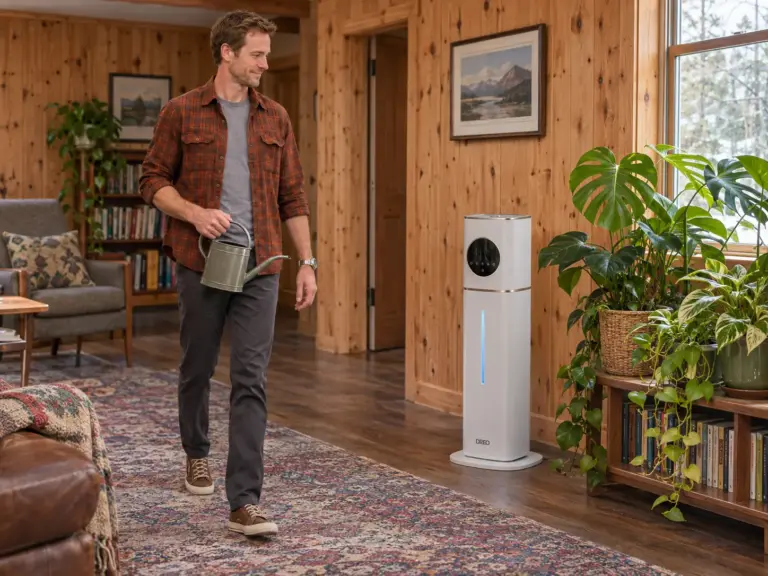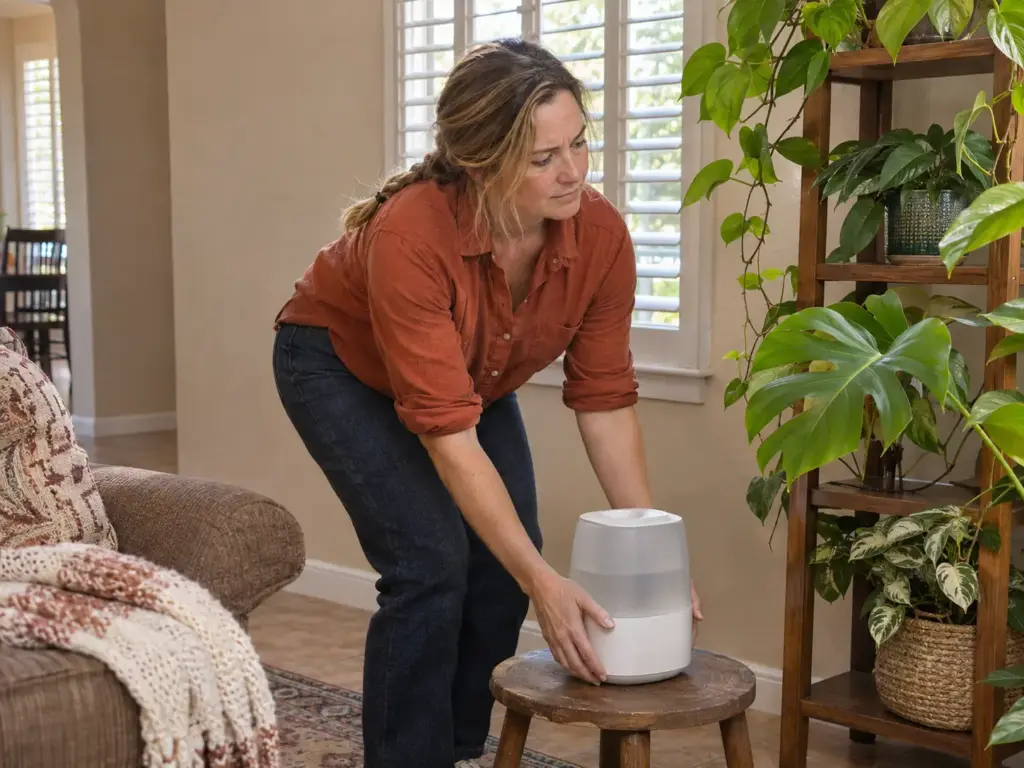
You bought the humidifier for the brown, papery edges on a calathea and a fern, and by now it has stood on the floor by the baseboard, in the corner behind the pots and at the end of the shelf, while the edges stay exactly as they were and the wall behind the last spot feels cool and a little damp.
Where to place a humidifier for plants indoors comes down to a distance, a height, a short list of spots to stay out of and one reading taken in the right place, because the mist is a plume with a reach, and what matters is whether it thins out in the air before it lands on a leaf. Humidifier placement for plants is mostly the job of keeping mist landing on leaves to zero while the dry air around them gets a little less dry, and where to put a humidifier follows from that. A meter parked inside that plume reports the plume, which is how a room sitting at 38 percent humidity ends up reading in the sixties on the shelf.
This guide places the machine for the plants; whether to run one in a baby’s or a child’s room is a question for a doctor. The machine is there at all because of why plants ask for more humidity than a heated room gives, and what follows tracks the water from the nozzle: the distance, the height, the spots to avoid, grouping and the band to aim for, the meter, the machine type and what the placement leaves behind by month two.
Quick Answer
Place the unit so the mist thins out in open air before it reaches a leaf, then check the result at the leaves, not at the unit.
- Set it 2 to 3 feet (60 to 90 cm) from the nearest leaf edge.
- Raise it onto a stand above pot height, off the floor.
- Keep it away from vents, drafts, cold glass and wood.
- Aim the nozzle across open air, never at a leaf.
- Read a second meter at leaf height, outside the mist, twice a day.
Where to Place a Humidifier Starts With the Distance to the Nearest Leaf
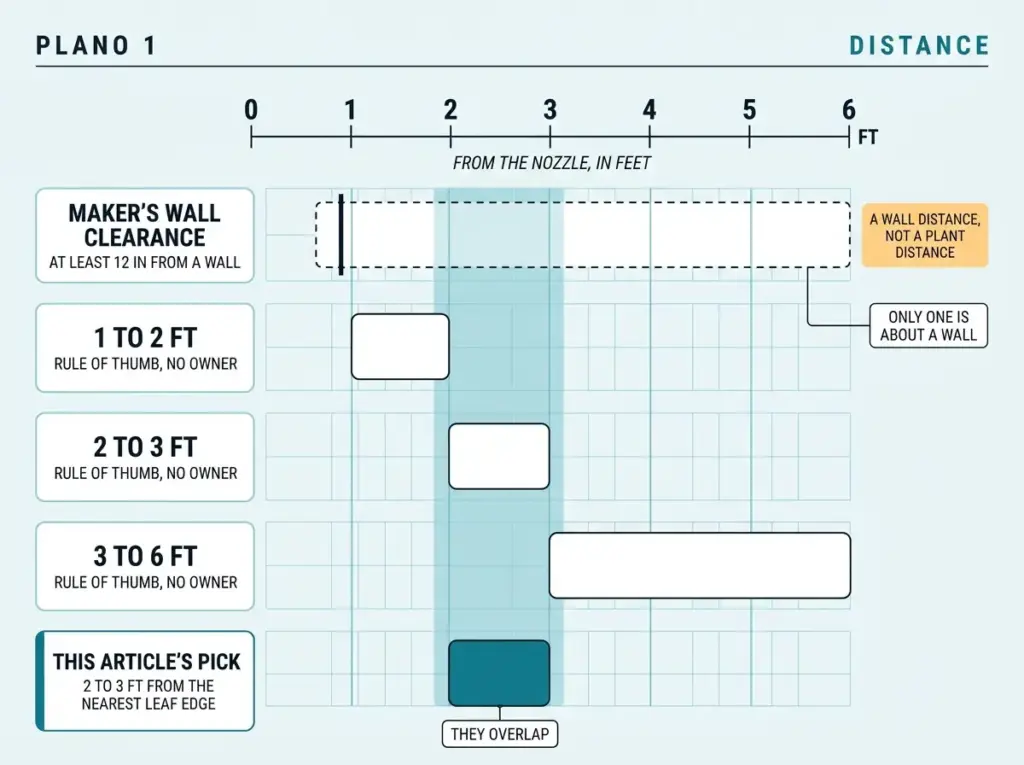
Three distances circulate for this, 1 to 2 feet, 2 to 3 and 3 to 6, and none of them has an owner. So the first job is to say which number is a working estimate, what the one distance a maker prints is really about, and why a few feet of air between the nozzle and the nearest leaf is what keeps a leaf dry.
Why the Published Distances Disagree
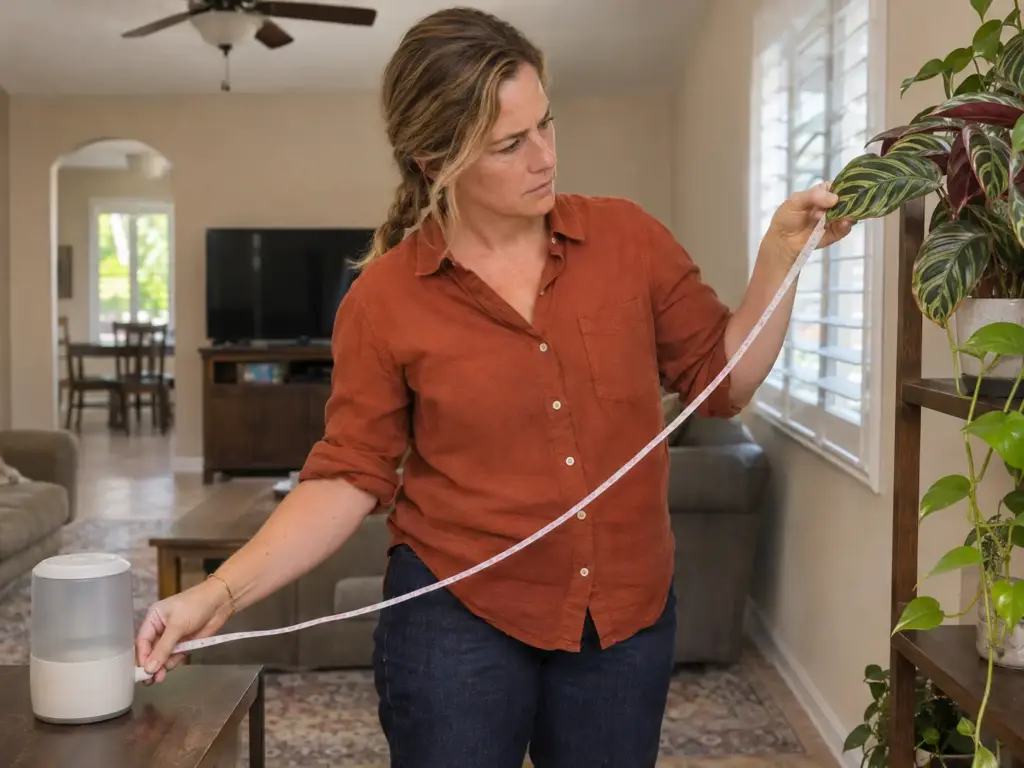
The three ranges (1 to 2 feet, 2 to 3 feet and 3 to 6 feet) overlap in the middle, and all three are working estimates with no standard, extension bulletin or maker’s spec sheet behind them. What they share is a physical idea about the distance from plants, and it is what makes 2 to 3 feet (60 to 90 cm) from the nearest leaf edge the one to act on, as a rule of thumb.
An ultrasonic nozzle throws a mist plume that is dense at the source and thins as it mixes into the room. Close to the nozzle that plume is still droplets, and droplets landing on a leaf leave wet foliage, which is a different thing from humid air. Two to three feet out, the droplets have evaporated into vapor and the leaf sits in air that is simply more humid than before.
The reason a leaf should not be the landing spot is spelled out by Nebraska Extension’s note on wet leaves and leaf spot: “Plus, continual leaf wetness makes plants more susceptible to leaf spot diseases.” The damage comes from a leaf that stays wet, not from humid air around it, and fungal growth on a leaf that never dries is the same story.
So the test is the leaf nearest the nozzle at the end of the day. If it is still glossy and wet while the leaves across the shelf are dry, the unit is too close. If it dries within the hour, the placement is working.
The Only Distance a Maker Prints Is About the Wall
The one distance a manufacturer does print is a clearance, and where to put a humidifier relative to a wall is a different question from where it goes relative to a plant. Levoit’s manuals ask for a hard, flat surface at least 12 inches (30 cm) from any wall, with the mist directed away from walls, furniture and appliances. That number protects the wall, the air inlet and the built-in sensor; it says nothing about foliage.
Levoit’s placement page for plants adds the part that bears on leaves: keep the unit near the plants, do not point the mist straight onto them, and leave a few feet of clearance around it. Put the two together and they agree with the 2 to 3 feet above, with a wall 12 inches behind the unit and a leaf a few feet in front of it.
Aim the Nozzle at Open Air, Not at a Leaf
Point the nozzle into open air or across the front of the cluster, never straight at one leaf and never at the wall behind. A plume aimed at a wall makes the wall the wettest surface in the room long before any leaf notices. With a cluster, rotate the unit around it (one side this week, the center the next) so no single plant takes the whole plume. And a unit on the floor at the base of a pot sends its mist up the trunk, which leaves the leaves a few feet higher dry and the pot and the rug damp: a placement that is too close and too low at once.
Off the Floor, Above the Pot, Below the Ceiling
Distance fixes the placement sideways; height is the other coordinate. A unit on the floor throws its plume at the bottom of a pot, where the leaves are not.
Why the Floor Is the Wrong Place
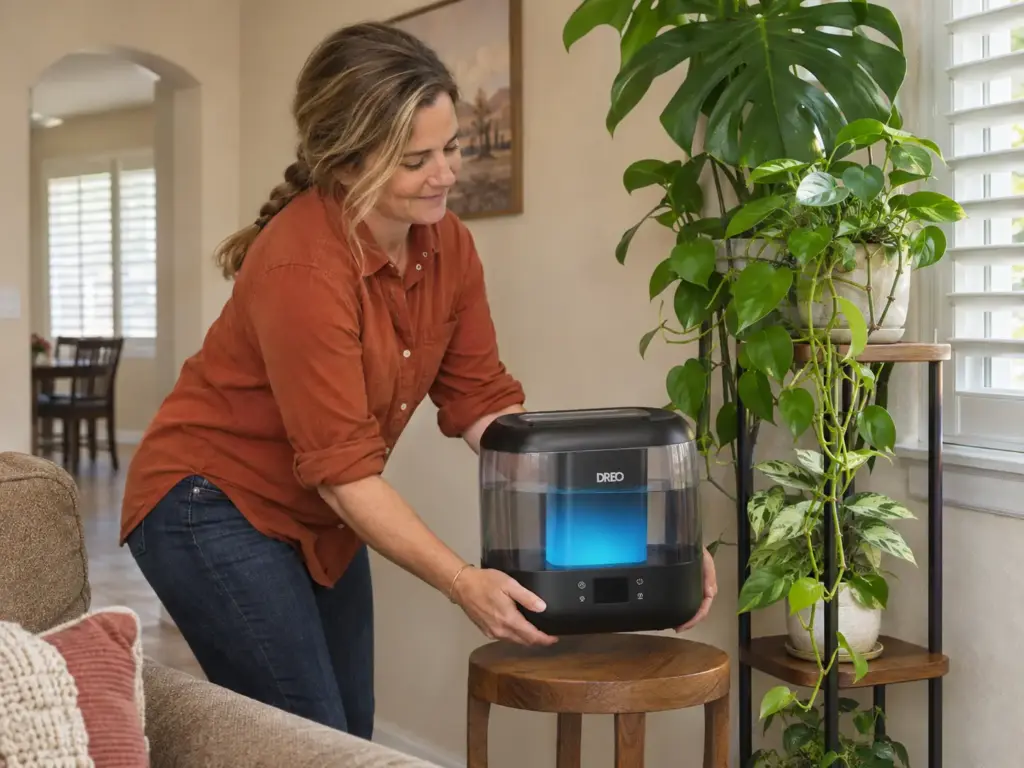
Levoit’s placement page says to stand the unit on a table, dresser or nightstand and not on the floor, because floors tend to be cooler and the moisture can condense there and damage carpet or hardwood. The working rule is the one the geometry gives: above the pot, below the ceiling and off the floor. In still air the plume needs a column of air to mix into before it reaches foliage. At pot height it lands on the pot and the soil instead.
The floor also keeps the earliest record of a bad height. A damp ring on the rug or the boards under the unit shows up well before any leaf shows a mark.
A Stand, a Shelf or a Cabinet Top
The free fix comes first: a sturdy box, a stool, a plant stand, a side table or a mid shelf above the plants costs nothing and gets tried before any new machine, and a unit raised off the floor is already most of the fix. If the unit already owned is too tall or too heavy for the shelf that works, the DREO Smart Humidifiers for Bedroom, 4L Cool Mist Humidifier is the size that fits one: a 4-liter top-fill tank and a small footprint, with a stated coverage of about 300 square feet. That is more than a single shelf needs, and the unit is for a shelf that wants one small plume. Durability is where it is uneven, with some units failing inside two months, so the stand already in the house is the cheaper way to get the same height.
The Tall Plant With No Stand High Enough
A six-foot bamboo palm and a unit on the floor at the base of its pot is the common version of this problem: the mist climbs the trunk, and the leaves a few feet up never see any of it.
The moves go in order, with a reading between them. First, bring the unit to the plant’s side or the plant closer to a shorter stand, never nearer than the 2 feet. Second, angle the nozzle across the open air in front of the leaves instead of up the trunk. Third, add an oscillating fan on low a couple of feet away to carry the vapor up.
If the floor under the unit is wood or carpet, give it a waterproof tray so the first sign of a bad height is not a stain.
Put the unit’s footprint on a strip of tape on the shelf once it sits where it should. Dusting and watering move a light unit a few inches at a time, and a unit that has crept toward the nearest leaf is the usual reason a placement that worked last week starts leaving wet leaves.
Vents, Cold Glass and Wood Ruin a Good Placement
A correct distance and a correct height still fail on the wrong spot, and the room says which spot is wrong by what gets wet, not by the number on the unit.
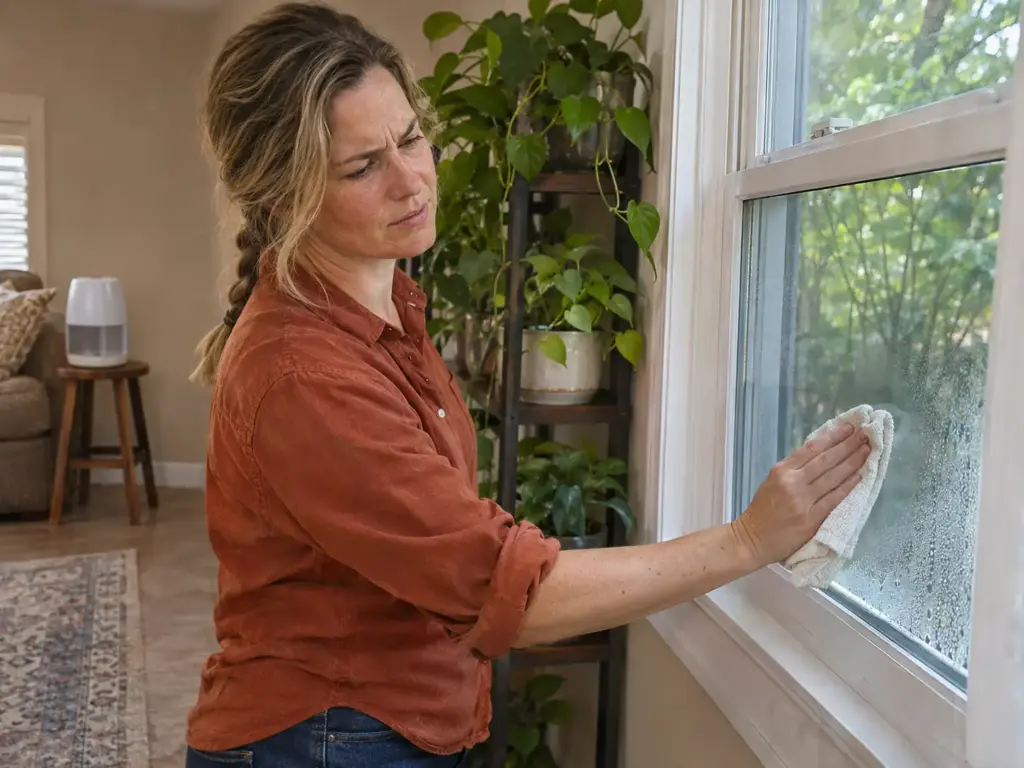
Heating Vents, Radiators and Drafty Doors
Keep both the plants and the plume away from heat vents, radiators, an AC vent and outside doors, as the University of New Hampshire’s extension advises, and University of Maryland Extension on drafts and heat sources near plants adds that plants are sensitive to drafts and to the heat that comes off registers. A vent does two things to a placement at once. It carries the plume away before it reaches the leaves, and it dries the pot it passes. A shelf above a floor register, or in the draft of an AC vent, can sit at the right distance and the right height and still never hold any moisture.
The Cold Pane and the Exterior Wall
The EPA’s test of a bad placement is not the hygrometer. It is water on a cold surface, and a cold window is where it shows first. The EPA’s own rules for running a portable humidifier say: “If water condenses on windows, walls, or pictures, relocate the humidifier, lower its humidistat setting, or reduce its use.” Window condensation behind the shelf, or water runoff along the sill, means the spot is wrong or the output is too high, and the glass tells you sooner than any meter does.
Reading a pane properly takes some practice, and it is covered in how to read a window that sweats before you change anything.
Move the unit first (it is free), then read the glass the next morning. Change one thing at a time, so you know which move worked. The wall behind a nozzle aimed at a corner feels cool and slightly damp to the back of a hand after a week, well before any stain shows, and in that corner the reading at the leaves will not have changed at all. The corner was never the problem.
Wood Furniture, Electronics and the Outlet
Moisture builds up on whatever stands close to the nozzle, so Levoit’s placement page asks for a few feet of clearance around the unit. The EPA puts the same idea as a rule: do not let the area around the humidifier become damp or wet.
That covers the shelf under the unit, the carpet or runner beside it, the drapes within reach and anything electrical on the same surface. Wood shows it first, as a pale ring or a swollen edge, and an outlet or a power strip within reach of the nozzle is a plain safety problem. If any surface near the unit feels damp to the touch, the unit moves, whatever the meter says.
Grouped Plants, a Slow Fan and the Band to Aim For
With the spot chosen, what is left is the air that moves through it and the number the room should settle at. Both are free, and both change how far a few feet of plume can carry.
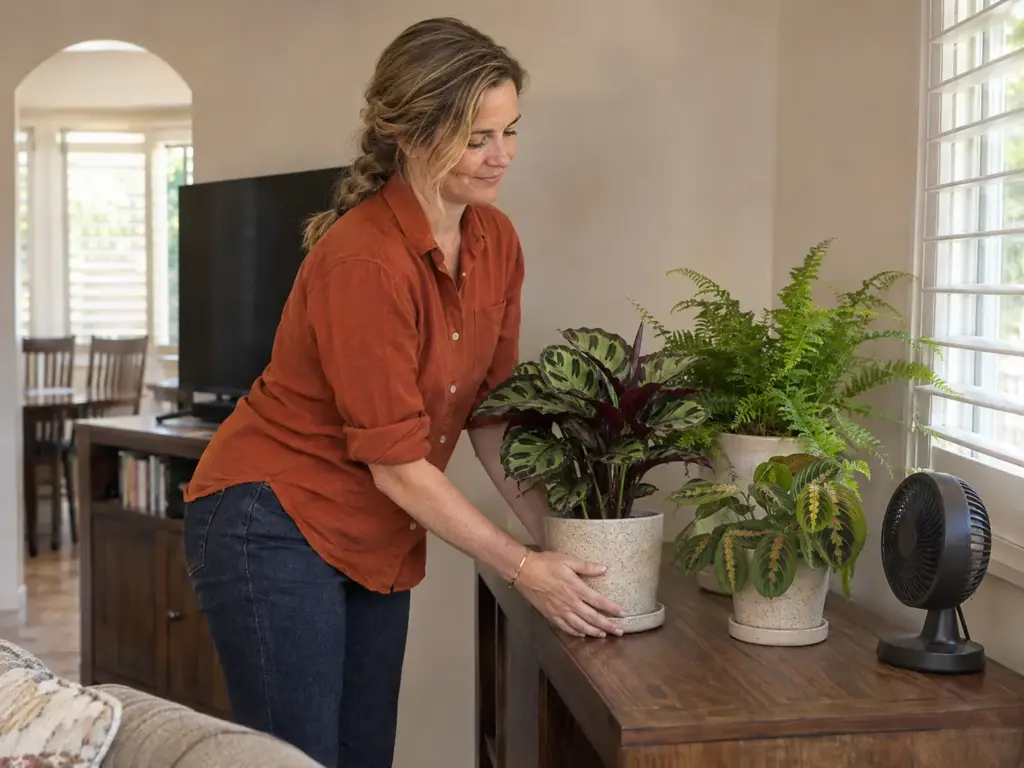
A Microclimate Is Not a Wet Corner
To group plants together is to let them humidify each other: water evaporating from the potting mix, plus water the leaves lose, raises the humidity around a cluster of plants. The University of New Hampshire Extension’s guide to raising humidity around houseplants says the effect works best with several plants in a small room with low airflow, because the moisture stays at the plants instead of spreading through the house. A shelf of calatheas, ferns and a prayer plant pulled into one corner reads a few points higher than the same plants spread around the room, with no machine running at all.
A cluster pushed into a stagnant corner is a different arrangement. There the plume lands on one surface, and what rises is the wall’s moisture while the number at the leaves stays where it was. A small room with the door shut also behaves more like a bedroom than a house, as how a humidifier behaves in a small room with the door shut shows, so the same unit reads higher in a closed plant room than in an open living room.
A Fan on Low Along the Shelf
An oscillating fan a couple of feet away on low moves air through the cluster and keeps the mist from settling on one crown. On high it undoes the grouping within the hour: the airflow carries the moisture out of the cluster and into the rest of the house. For one fussy plant, a terrarium, a cloche or a glass grow cabinet gives it a separate band, so the room never has to be pushed toward 70 percent; the lid comes up now and then to let it air. A pebble tray adds a little to a grouped shelf, and it gets no more space in this guide.
Take the meter reading at the leaves once with the fan off and once after an hour of it running on low. A drop of more than a few points means the fan is carrying the moisture out of the cluster: turn it away from the plants or move it farther back before touching the humidifier.
The Band the Plants Ask For and the Ceiling the House Sets
Each of the numbers that get quoted for a plant room has an owner, and the owners disagree. The University of New Hampshire’s extension puts most houseplants (cacti, succulents and a few others excluded) at 40 to 60 percent relative humidity, with tropical species thriving at 70 to 80, the monstera and philodendron kind of foliage included. Iowa State University Extension on dry winter air and houseplants lands lower, at 40 to 50 percent for many houseplants, and notes that winter homes often sit at 10 to 20. The EPA guidance on mold and moisture in a home is below 60 percent and ideally 30 to 50, and its humidifier sheet says never to humidify past 50.
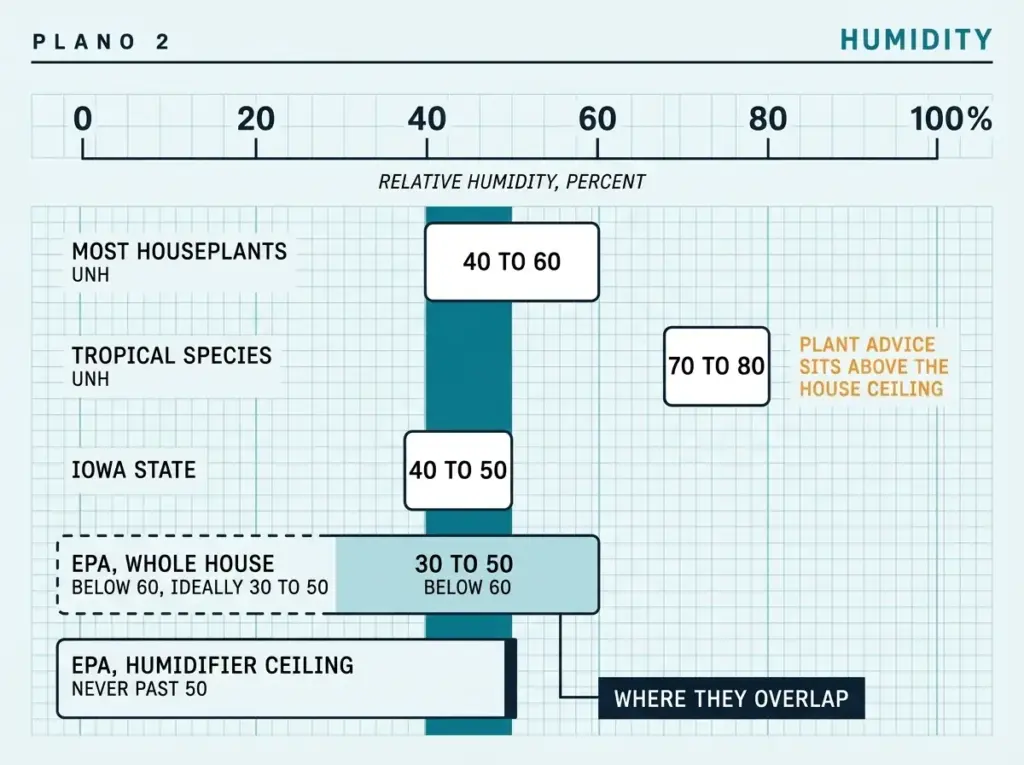
Two extensions that do not agree with each other, and plant advice that sits above the house ceiling: that is the whole difficulty. The strip where all of them overlap is 40 to 50 percent, and that is the band to aim for at leaf height. What the plants themselves ask of a room goes higher for a tropical plant, but 70 to 80 cannot be reached in a house without soaking the walls, because 60 percent is where the house’s walls start to pay for it. And the setting that is safe falls as it freezes outside, because the coldest pane hits its limit first; why the safe setting drops as the weather turns freezing explains the mechanism, and the glass remains the check.
The Meter Goes at Leaf Height, Outside the Mist
Once the unit is moved, the only honest question is whether the air at the leaves changed, and the display on the unit cannot answer it, because it reads the air at its own base.
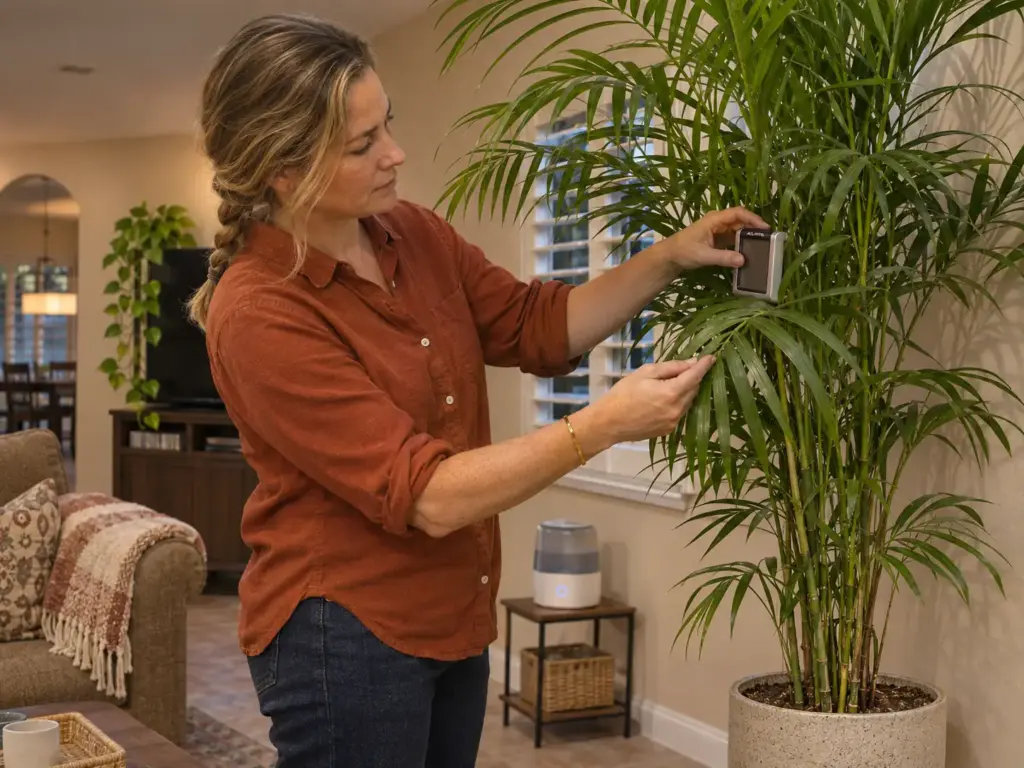
A Meter in the Plume Reads the Plume
Levoit’s manuals for several models say that a unit placed within 12 inches (30 cm) of a wall, or in a corner, cannot give a proper reading of the room’s relative humidity, because the sensor sits inside the machine. The maker is telling you the built-in number describes the machine’s own pocket of air. A separate meter six inches from the nozzle has the same problem for another reason: it reads the mist and not the room. A hygrometer wedged between two pots on a shelf, with the nozzle a hand’s width away, can read in the sixties while the room sits at 38 percent, and the owner trusts the number that flatters the placement.
Leaf Height, Twice a Day, Against the Unit’s Own Display
Stand a second meter at leaf height, on the far side of the cluster from the nozzle and outside the plume, and read it twice a day: in the morning before the winter heating runs hard, and in the evening after it has. Compare it with the unit’s display. The gap between the two says how much of the display’s number is plume. Where to stand the meter and how long it takes to settle covers the reading itself.
The AcuRite 00613 Indoor Thermometer and Hygrometer is the cheap way to get that second reading: a 3-inch display, a tabletop stand and a magnetic back, plus a daily high and low that shows what the heating cycle does to the room. Its accuracy is uneven, and some units stop working within days, so put two on the shelf for the first day and trust the pair.
Then read the direction. Over about 50 percent at leaf height, or glass that fogs, means the placement or the setting overshot: lower the setting or move the unit. A reading that sits low at the leaves with the unit running and the distance right means the output is not reaching the room, which is a question of room size and the unit’s output, and not of where it stands.
A meter that has just moved needs a while to settle in its new air. Stand it at leaf height, leave it for the rest of the day and take the first reading the next morning; a number taken a minute after placing it is still the number from the old spot.
What a Cheap Meter Cannot Tell You
A meter reads conditions and never whether anything is growing; it will say 45 percent at the leaves and say nothing about the pot’s soil. It can also be off by a few points, so a one-point gap between two meters means nothing and a ten-point gap means one of them is wrong. Some budget meters read inconsistently, which is why the second one earns its place, and how far to trust a cheap humidity checker goes through the two-unit check and the drift to expect.
The Type of Machine Changes the Distance
The 2 to 3 feet was worked out for a unit that throws a visible plume, and the machine in the room may not throw one. The type of unit decides how far it can reach and what it can wet.
The Ultrasonic Plume Reaches One Spot
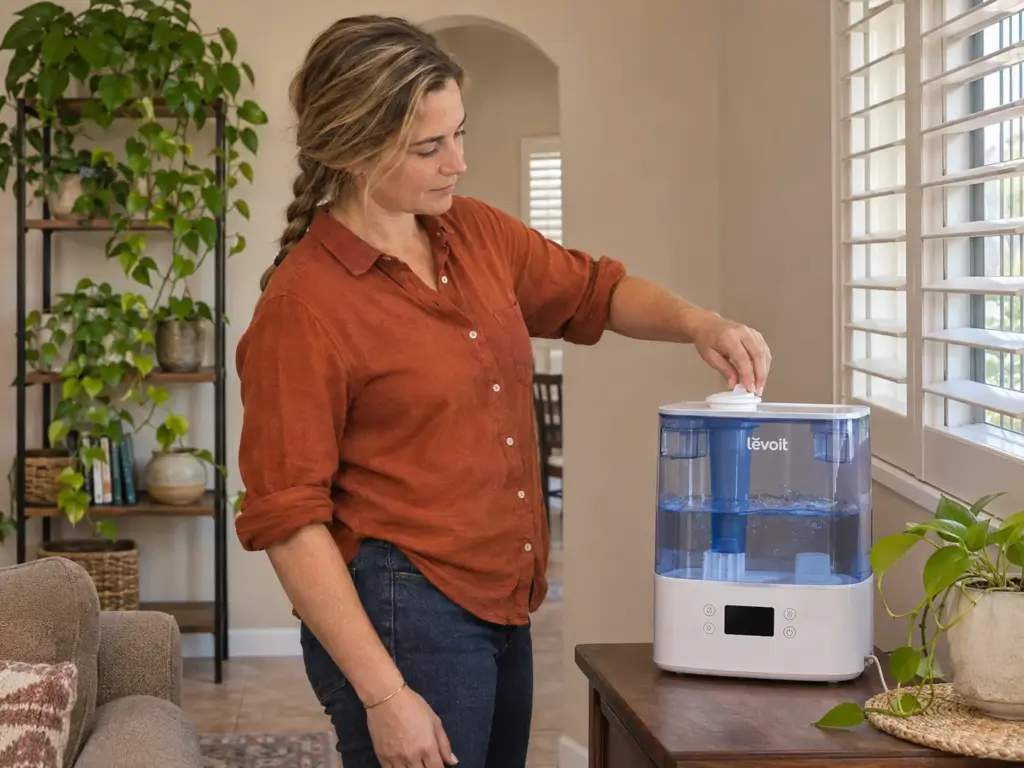
An ultrasonic unit throws a visible cone of mist at one spot, so distance, aim and the water in the tank all matter. An ultrasonic cool mist humidifier is the visible-plume type, and the Levoit Classic300S Ultrasonic Smart Top Fill Humidifier is the example this section is about: a 6-liter top-fill tank, a stated coverage of about 505 square feet, up to 60 hours on its lowest setting, and a built-in humidity sensor with Auto and Plant modes. That sensor sits inside the machine, so the reading at the leaves still has to come from a separate meter. The output is the uneven part: some units move a room’s number and others barely do, and reliability is mixed, with units that fail or leak inside the first month.
The EPA’s description of the types adds what the plume carries with it. The EPA’s note on which humidifier types disperse minerals says ultrasonic and impeller units put the minerals of the tap water into the air as white dust, while evaporative and steam units are not expected to disperse substantial amounts of minerals. A plume sized for the room also reaches further, and how big a unit the room really needs, in gallons a day is the buying decision that comes with that.
The Evaporative Unit Pushes Vapor With a Fan
An evaporative unit pushes invisible vapor through a wick with a fan, and it cannot wet a leaf the way a plume can. Distance matters far less, and airflow and the state of the wick matter more.
Its output never shows, so the only evidence it reached the leaves is the meter at leaf height. The Levoit Evaporative Humidifier (Sprout) builds that method into the product: a 3.8-liter tank, up to 36 hours of running, air and water filters, and a humidity sensor that is a separate puck reading where it is stood and not where the unit sits. Cleaning is the uneven part of living with it, and the wick is a consumable on hard water. The evaporative type also costs more than the ultrasonic one, so the free version of the same job is grouped plants and a fan on low.
The Warm-Mist Tank Is Hot and Sits Above a Pot
A warm mist humidifier or steam unit runs a hot reservoir, and the caution is heat and condensation, with no plume involved. Keep it off the shelf above the pots, where a hot tank drips on the plant you water by hand. What each mist type leaves in the room, in water and in watts covers the trade. With a unit you already own, the cheap fix is the move, the stand and the fan, and a second machine comes last.
What the Placement Leaves Behind by Month Two
Week one judges a placement by the leaves. By month two it is judged by the surfaces, and the surfaces keep a record that no meter does.
The Pale Film on the Leaves and the Shelf
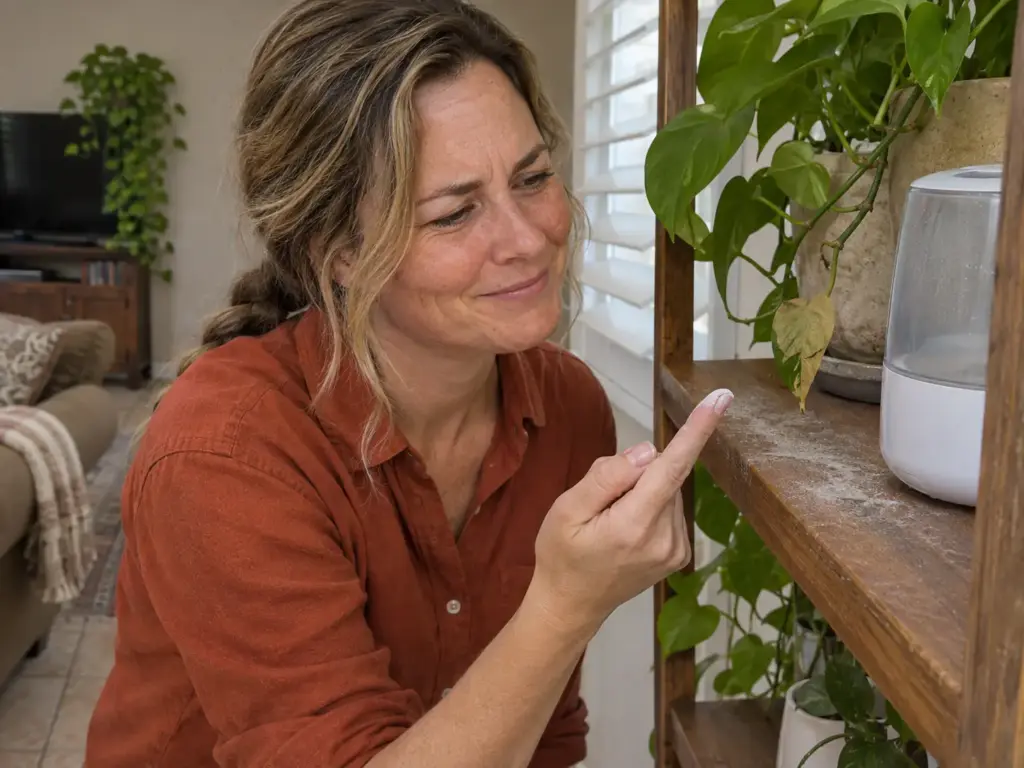
An ultrasonic unit running on tap water throws the minerals in the water along with the mist. They settle on the fuzzy hairs of a leaf, the shelf under the nozzle, the sill and anything statically charged, and a finger leaves a clean streak through the film. That mineral film comes off with a dry cloth; a rinse does not do it.
Moving the unit ten feet does not stop it either, because the minerals travel with the water. Distilled or reverse-osmosis water, a demineralization cartridge or an evaporative unit does stop it, and a gallon of distilled water is a smaller change than a new machine.
Once a week, wipe the shelf under the nozzle with a dry dark cloth and look at the cloth. A pale mark there means the film is already building, and it will be on the leaves above that shelf in the same pattern a little later.
The Wall and the Rug Behind the Unit
The wall behind a nozzle aimed at a corner is the cold surface the EPA’s test describes. A damp patch, a wall that feels cool to the back of the hand and a runner that stays soft are the placement failing, even when the room’s average reads fine. If the wall stays damp after the unit has moved, that is a question for the building and a professional, not for the dial, and how to tell a stain from a growing problem on a wall covers the wipe test that separates the two.
The Wick and the Tank That Stays Full
An evaporative wick loads on hard tap water within weeks. The trade is real: far less dust in the room, and a consumable to replace in exchange for it.
A tank left full and switched off is standing water, which is what the EPA’s care schedule is about. Tank cleaning means emptying the tank, wiping it dry and refilling it every day, and cleaning the unit every third day, with the method in the unit’s manual. A unit that runs all winter and sits full in a closed room in July is the version of this that gets forgotten.
What No Distance Fixes
Some brown leaf tips have nothing to do with the air. A pot in a draft, a pot with poor drainage that stays wet, and a plant whose edges brown from the water in its pot or a root problem will look the same as a dry-air plant, and no distance changes them.
A snake plant or a ZZ plant in the cluster is the other case: it tolerates a dry room, so it needs no plume at all. Check the watering and the roots before moving the unit again, and consider moving the plant more than the unit. When the wet surface turns out to be the pot, the soil side of damp is the page to read. One move, then a reading.
Tomorrow: Lift the Unit, Move the Meter, Read Both
The distance of 2 to 3 feet from the nearest leaf edge is a working estimate with a physical reason behind it. The unit goes up and off the floor, out of vents, drafts and cold glass. Grouped plants and a fan on low do the free half of the job, the meter goes at leaf height outside the plume, the machine type bends the number, and the surfaces tell the truth at month two.
The check for later is on a different clock for each part: the shelf, the wall behind the unit and the wick once a week for the first few weeks, and the tank on the EPA’s daily schedule. A pale mark on the cloth, a wall that stays cool to the hand or a wick that has gone gray each point at the same fault, which is a spot that needs a different move before it needs a different machine.
The first move for tomorrow is to lift the unit onto a stand and put the second meter at leaf height, outside the mist. Then read that meter in the morning and the evening against the unit’s own display. If the reading at the leaves stays low with the placement right, the unit is the wrong size for the room, and which unit reaches a large plant room, by gallons a day is where the sizing starts. If the room reads fine and the leaves do not improve, whether the room reads low enough to need a unit at all is the question to ask next.
Frequently Asked Questions
01Is a humidifier good for houseplants?
It helps tropical plants in a room that reads dry, but only when the mist evaporates into the air around the leaves and the leaf itself stays dry. Aim for 40 to 50 percent at leaf height, since the EPA says not to humidify a home past 50.
02How close is too close for a humidifier near plants?
Closer than about 2 feet (60 cm) from the nearest leaf is too close, and so is any distance at which a leaf is still wet at the end of the day. The 2 to 3 feet is a working estimate with no owner, and the leaf is the test.
03Should a humidifier sit on the floor or higher up?
Higher up, on a stand or shelf above pot height and below the ceiling, because floors run cooler and moisture condenses there. A damp ring on the rug under the unit is the first sign it sits too low.
04Which way should the humidifier point near plants?
Into open air or across the front of the cluster, never straight at one leaf and never at the wall behind it. Rotate the unit around a cluster now and then so no single plant takes the whole plume.
05Where should the hygrometer go when a humidifier runs by the plants?
At leaf height and outside the mist, read in the morning and the evening and compared with the unit’s own display. A meter sitting in the plume reads the plume, and the difference between the two readings shows how much of the number is mist.