
The window over the kitchen sink was clear all through November. On the first truly cold morning the lower third of the glass is fogged and the sill is beaded with water, even though nothing in the house has changed. That is how indoor humidity levels in the winter usually announce themselves: the glass is the coldest surface in the room, so it runs out of room for moisture before the air does.
This guide reads the house’s number and nothing else, so how dry or damp air sits on a baby, on skin, on a cold or on anyone who is ill is a question for a pediatrician or a doctor. What follows is the band, why it moves with the cold, how to tell which way your room is off, and the order of fixes, with a device at the end of the line.
Quick Answer
Winter has no single number. Keep indoor relative humidity inside the EPA’s 30 to 50 percent band, in its lower half, and lower the setting as the outside gets colder. Fog on the coldest glass is the first sign the room is past its limit.
What the EPA Band Says About Indoor Humidity Levels in the Winter
Anyone who types the question wants a number, and the first honest answer is a band with a ceiling on it. According to the EPA’s mold course on indoor humidity, “Indoor relative humidity (RH) should be kept below 60 percent — ideally between 30 percent and 50 percent, if possible.” The three parts below separate what that band is, why the figures people post around it disagree, and which of them are only rules of thumb.

The band and the line above it
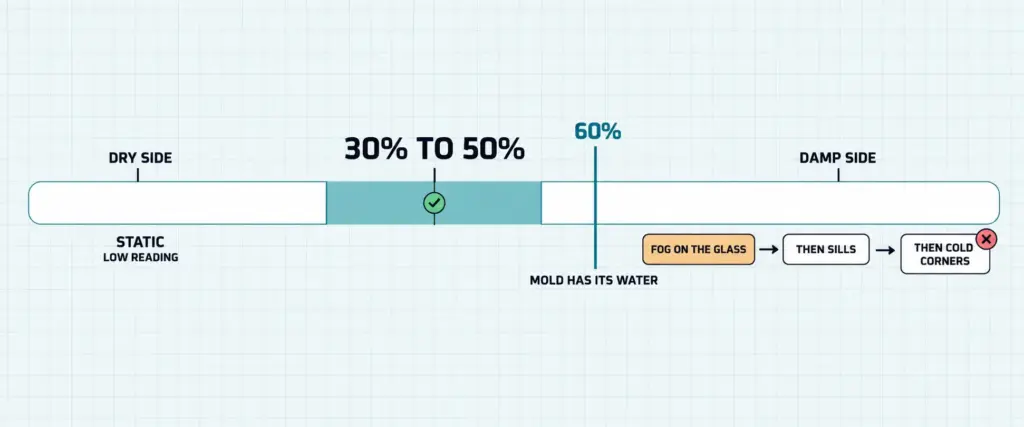
The EPA’s figure has two edges and a ceiling. Thirty to fifty percent is the target band, and sixty percent is the line above which mold has the moisture it needs. The EPA frames the band as the aim and the ceiling as the limit, so nothing the room does should push the reading past it.
Winter does not change the band. It changes where in the band a room can sit without paying for it somewhere else, and the next section explains why. For now the working rule of thumb is to aim for the lower half of the band, 30 to 40 percent, during the coldest weeks. That half is a habit of careful readers, not a figure the EPA prints.
Why the numbers people post do not agree
The usual targets run from 30 to 50 percent. Both can be right: a house with tight, well-insulated windows can hold a higher humidity number than one with single-pane glass and a drafty north wall. For winter, the EPA’s band of 30 to 50 percent is the usual target.
A setting that suits November can be too high once the coldest weather arrives, because the cold outside makes the same indoor moisture condense more easily.
A rule of thumb is not a standard
The EPA gives the band and the ceiling. It does not give a step for every outdoor temperature, and the stepped tables that tie a target to the weather outside are rules of thumb: useful, but not checked against a standard. This guide uses the principle behind them and leaves the table to the page that owns it.
If you want the target stripped of the winter question, the number to aim for in any season is where it lives in full.
Why the Right Number Moves Down as the Outside Gets Colder
The band stays put, but the room’s limit does not. A reading that kept the windows clear in November can fog them in January with the setting untouched, and the reason is not in the humidifier. The three parts below follow the water from the air to the glass and back out through the walls.
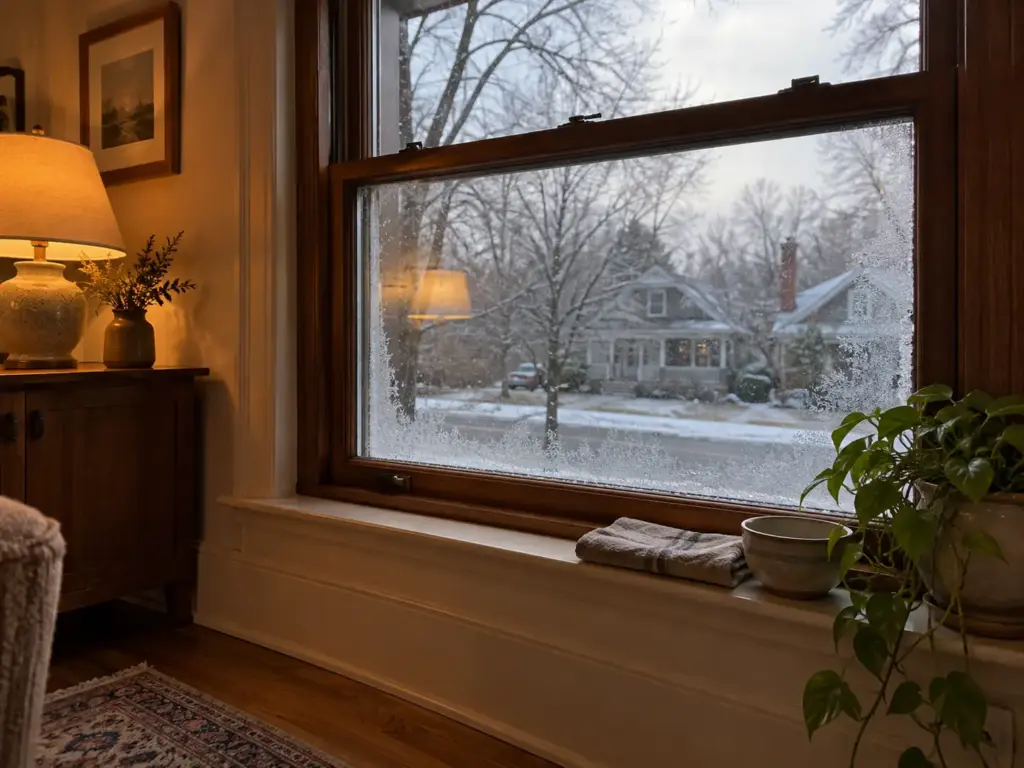
The glass reaches its limit before the room does
Air can carry only so much moisture, and the colder a surface is, the less it can take from the air touching it. The EPA puts the mechanism in two lines: when warm, humid air meets a cold surface, condensation may form, and “Condensation can be a sign of high humidity.” The window pane in January is one of the coldest surfaces in the house, so it is the first place the room’s moisture finds a reason to let go.
That is why the same reading on the wall gauge can mean two different things in two months. In November the glass was mild and the air was fine. In January the air has not changed, but the pane has dropped far enough that 45 percent is more than it can hold off.
Look at the glass at the coldest hour you are awake, not after lunch. A pane that is fogged at seven and clear by noon is telling you the room’s limit was passed overnight, and the afternoon reading on the gauge will never show it.
Cold air that leaks in arrives dry
Winter also dries a house from the other direction, and it is worth one paragraph. Cold outside air carries very little water, and it enters through every leak around doors, outlets and window frames, where it is warmed by the heat. The same small amount of moisture spread over warmer air reads as a lower percentage, so a leaky house can sit near the dry edge of the band while its coldest window still fogs. For the full mechanism, see why indoor humidity can drop so low.
Why November’s setting fails in January
The setting nobody has touched since October is the usual suspect. A humidifier or a whole-house unit set when the glass was mild holds that same target while the pane gets colder, so the room keeps adding moisture the glass can no longer shrug off. The fix is a schedule instead of a number: the target steps down as the outside gets colder and comes back up in the thaw.
The stepped values by outdoor temperature are not printed here. They sit on a chart of the target by outdoor temperature, which is the page to open when you want the numbers rather than the principle.
The Dry Side: What a Reading Below 30 Percent Looks Like
One edge of the band is done. This section covers the other: what a house gives off when the reading falls under the EPA’s lower figure, before it names any fix. The signs here are in the building and on the gauge, not on anyone.
The reading that says dry
The dry side starts under 30 percent relative humidity, and the number comes from a hygrometer, not from how the air feels. A dry house and a stuffy one can feel alike on a winter night, which is one more reason to read the gauge. How dry a room feels shifts with its temperature and with what you were doing a minute ago. The gauge does not care.
If you want the reading in full, when indoor humidity is too low covers it by the building’s own signs.
The signs in the house
Static is the sign people name. A shock off a doorknob or a metal rail is the familiar sign of dry air. Static electricity is the one in the quote; a spark off a sweater in a dry hallway is the same reading in a different material.
The reading is lowest in the coldest week, so the first measurement of the season is not the one to set a unit by. Wait until the cold has settled in and read again.
One caution belongs here, because it undoes the whole winter. Do not add water before the leaks are sealed. Dryness in a winter house comes from cold air entering, and a humidifier set high against a leaky wall is the setup for the fog described in the next section. Raising it the right way starts with the leaks and ends with the unit.
The Fog on the Glass Tells You Which Way the Room Is Off
The dry side is read from a number. The damp side is read from the window, and that makes the glass the one check anyone can do in ten seconds without buying a thing.
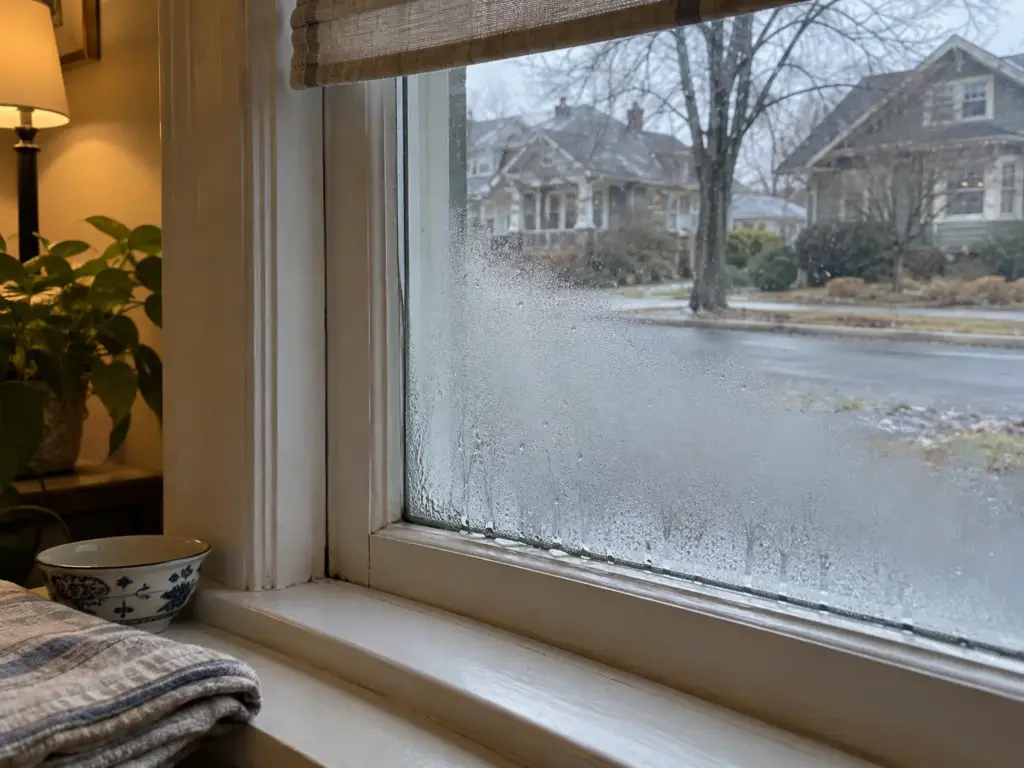
Fog means the room is past its limit at that spot
Fog on the inside of a window, or frost on windows in a hard freeze, means the surface has dropped below the temperature at which the room’s moisture starts to condense, so the room is past its limit at that spot. The glass is the coldest surface a reader can see, which is why it fogs first.
If it fogs, the room is too damp for the weather outside: fog on windows is how a damp house shows itself first. If it stays clear, the number is working for now. Whether condensation on your windows is normal goes deeper on the glass itself.
Not every fog is the same. A film that wipes away with a sleeve is a room that crossed its limit this morning. Beads that run down onto the sill mean a night of too much water, and that is a setting problem, not a bad morning.
One notch down, then read again
Here is the rule, written as a method and not as something anyone certifies: fog says the setting is too high, so lower it one notch and read the room again before changing anything else. One notch, not three. The glass takes a night to answer a change, so the reading to trust is the next morning’s, not the one ten minutes later.
If it still fogs, step down another notch and wait another night. If the pane clears and the gauge reads in the band, stop. The goal is not the lowest number; it is the highest one the glass will accept.
After a change, wipe one patch of the lowest pane and leave the rest alone. How fast that patch fogs again the next morning tells you more than the wall gauge does, and it needs no battery.
Where the water goes next: sills and cold corners
The order of damage runs glass, then sills, then walls. Condensation often shows on window sills and, in some cases, on walls. If the setting is still too high after the glass has fogged for a week, the moisture finds the next coldest place, and the sill is the one that stays wet. Why windows sweat overnight is the night version of the same pattern.
If there is no fog at all, look at the coldest corner behind the couch or the bed. The EPA notes, “Mold is frequently found on walls in cold corners behind furniture where condensation forms.” That is the house and the setting talking; what mold means for a person is a doctor’s question and not one this guide answers. Whether the fog on the glass means mold is the next page to open if the corner looks suspect.
Read the Room Before You Touch a Setting
Every fix so far starts from a number, so it helps to say where that number comes from. The EPA says humidity can be measured with a humidity gauge or meter, and a reading comes before any setting changes. The three parts below cover where to put one, how long to read it, and which of three devices suits which reader.
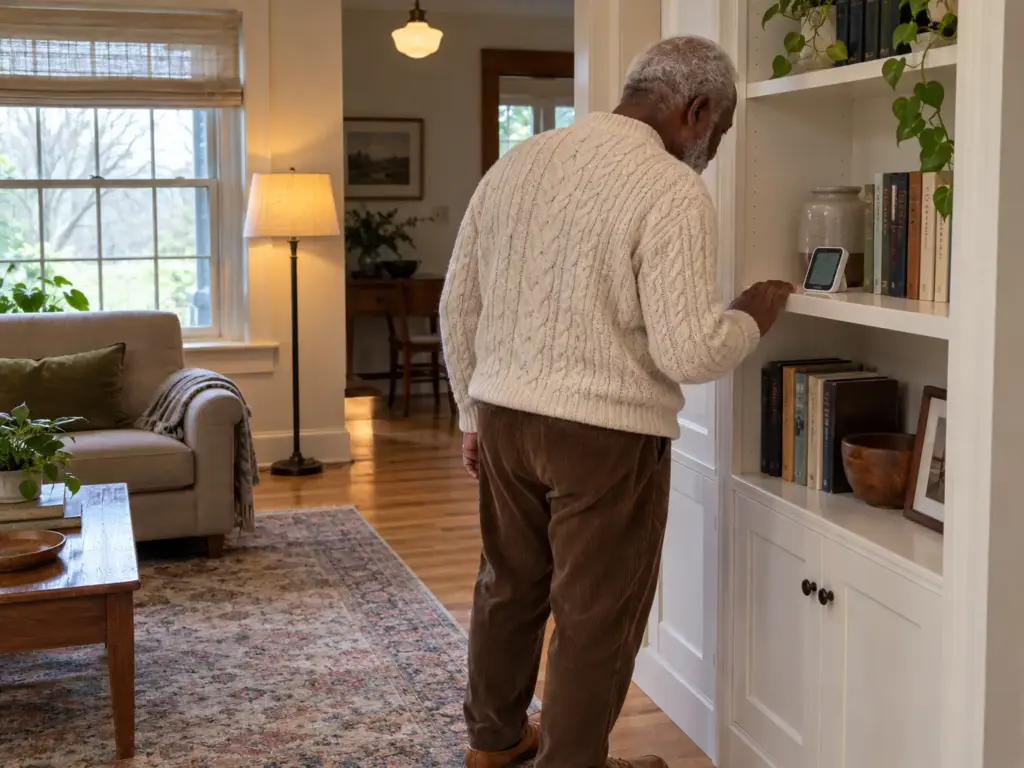
Where to put it, and where not to
Mid-room, away from the humidifier and the heat vent, at roughly chest height on an interior wall. A reading next to either one is the reading of that spot, not of the room. A gauge sitting beside a humidifier will confirm that the humidifier is working, and tell you nothing about the glass.
A gauge by the window reads the wrong way too, colder and damper than the room. For the longer version, how to measure indoor humidity at home covers placement room by room.
Read it over a night, not a minute
One reading tells you where the room is at that minute. The fog rule needs a number from the coldest hour and another from mid-afternoon, so the pair shows the swing. A gauge that logs does this for you; a plain dial means you check twice a day for a few days.
A hygrometer is also off by a few points, and that matters here. The Govee listing below states plus or minus 3 %RH, so two readings three points apart prove nothing: 44 on one gauge and 47 on another is the same room.
Before trusting a new gauge, set it on a shelf across the room from the heat vent for a day, then move it beside the vent for another. The gap between the two readings is how much a single spot can lie to you about the room.
Three ways to read the room
A gauge changes more decisions than a new unit, so this is the cheapest part of the whole article, and it comes first.
The Govee H5075 Bluetooth Hygrometer Thermometer has a 3-inch LCD, shows max and min readings, and keeps a graph of the last 20 days in its phone app, which is what the fog rule needs: the low in the coldest hour. The stated accuracy is the number to remember, plus or minus 3 %RH on the listing, and the history is read through that app, so no phone means no graph.
Not everyone wants an app. The AcuRite 00613 Indoor Thermometer Hygrometer is the plain display on the wall: a 3-inch screen, a stated humidity range of 16 to 98 percent, and an AA alkaline battery. The listing describes no app and no history, so the overnight low is yours to write down, twice a day.
For the reader who wants to see why the glass fogs, the SensorPush HTP.xw is the only one of the three that prints the dew point, the figure the cold pane follows. It logs 30 days on the sensor itself, but remote access needs a G1 gateway that is sold separately.
How far to trust any of these is covered in a cheap humidity checker and how far to trust it, and an all-in-one monitor against a separate hygrometer settles which reading to act on when two devices disagree.
Fix It in Order, With a Reading Between Each Step
This is the method of the whole site in one section: change one thing, read again, and start with what costs nothing. The setting is treated as something that moves through the season, not a number chosen once.
Lower the setting on the unit you already have
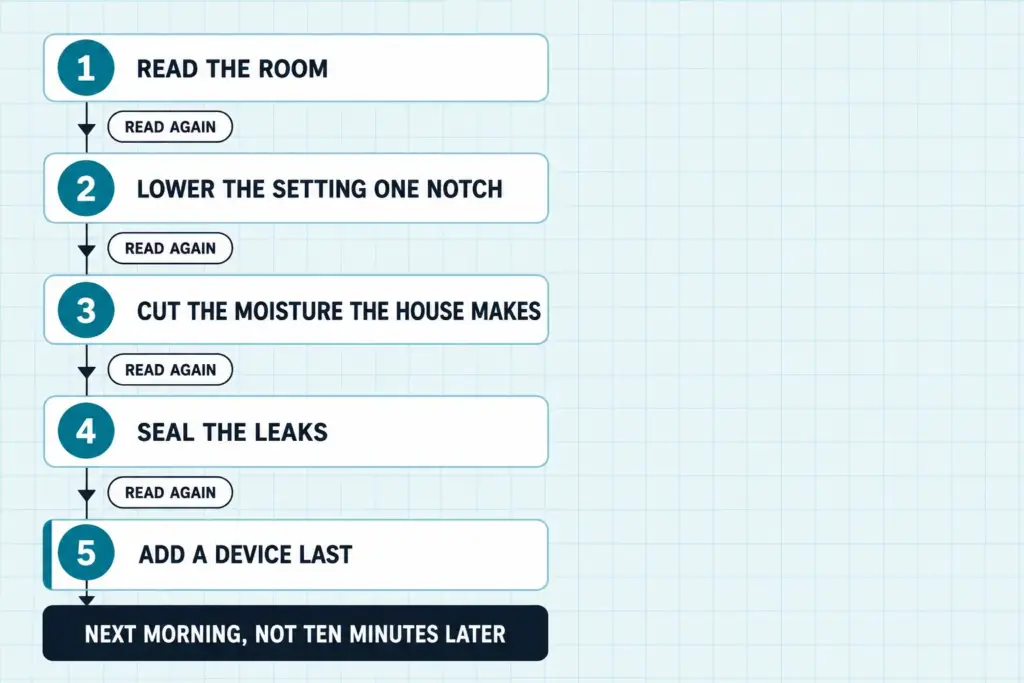
The ladder runs in five steps: read the room, lower the humidifier’s setting one notch, cut the moisture the house itself makes, seal the air leaks, and add a device last, if the reading still asks for one.
There is a reading between every step, and none of them gets skipped.
The first rung is the unit already in the house. Lower it one notch, wait for the next morning, and read the glass and the gauge. A unit with a humidistat holds a target on its own. That is the right idea, but the target itself still has to come down with the weather.
Stop adding water you did not mean to add
If the glass still fogs, the next source is the house. Shower steam and the stove both feed it, and the EPA is plain about it: “Cooking and showering also can add to indoor humidity.” So the bath exhaust fan runs through the shower and for a while after, the kitchen fan runs while the pot is on, and the dryer vents outside, not into the room. How to lower humidity at home lists the rest of the free fixes for the damp side.
It also helps to know where the moisture is coming from in the first place; why a house runs humid walks through the usual sources. And a shower’s moisture does not leave when the water stops, which is the subject of how long high humidity stays indoors.
Seal the leaks that let the cold air in
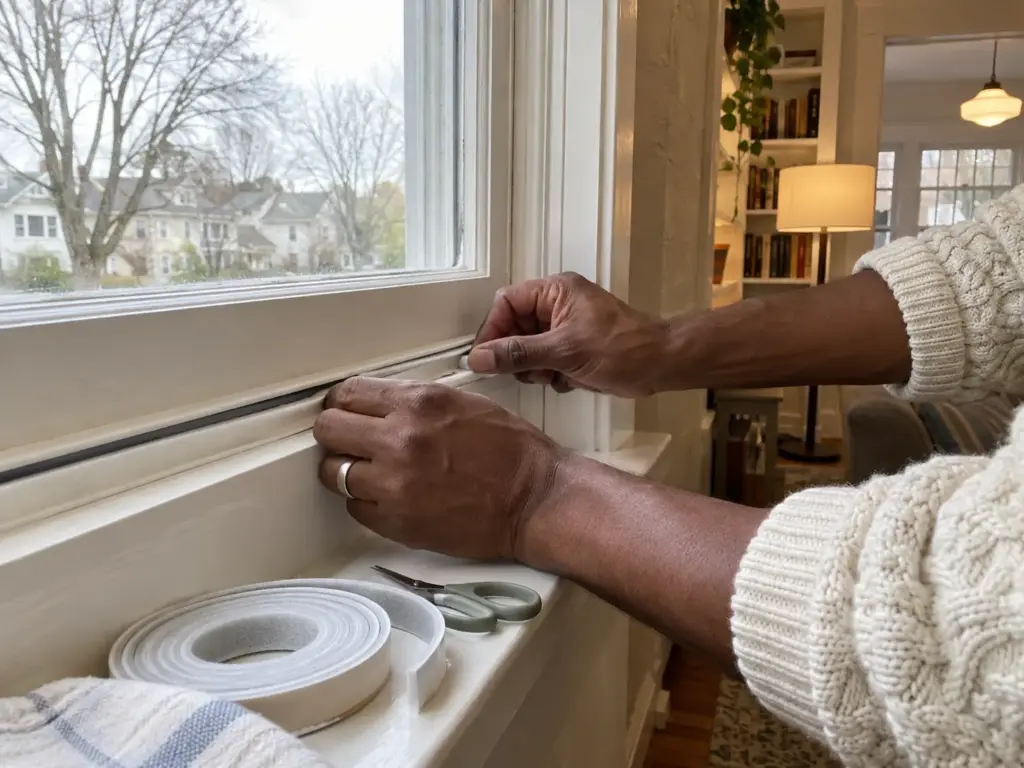
Air sealing is the unglamorous part: weatherstripping around doors, caulk at window frames, a gap sealed where a pipe goes through a wall, window insulation film over a drafty pane, or any other way to insulate windows that you already have the tools for. Leaks bring in cold, dry air and also give the humidifier a reason to run. Read after each one. Sealing the leaks is the step that lets the house hold a number at all, so a reading that was dry in the first week may sit comfortably in the band by the third.
Write the setting and the date on a strip of tape stuck to the humidifier. When the glass fogs a month from now, the first question will be what the setting was, and the tape answers it without a guess.
When none of the steps changes the fog, a clogged furnace filter is blamed more often than it is guilty. Whether a dirty furnace filter causes window condensation sorts out when the furnace is the suspect and when it is not.
Room Humidifier or Whole-House Unit, and Which Comes Last
The ladder ends in a device, and the open question is which kind: a room unit with a target you can read, or a unit on the furnace that works on every room at once. Neither fixes a house that is losing air through its walls, so both come after the earlier steps.
A room unit with a target
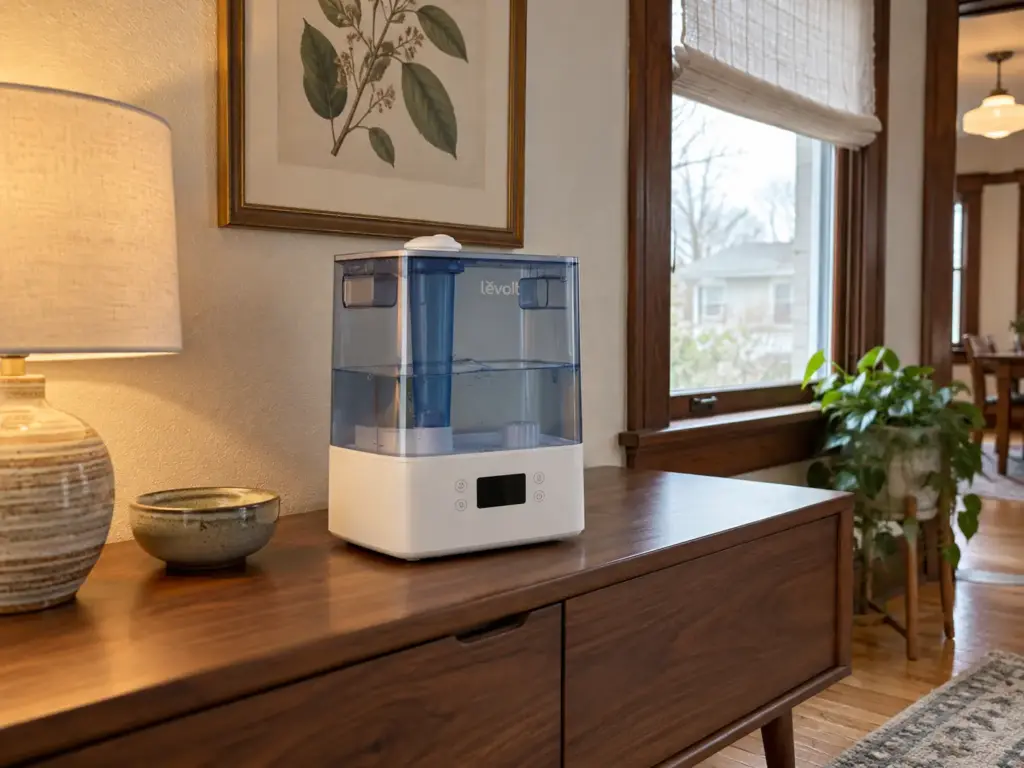
A room unit with a humidistat holds a target, which is exactly what the fog rule asks of a device. The Levoit Classic 300S Ultrasonic Smart Humidifier is a top-fill model with a 6-liter tank, and its auto mode holds 40 to 50 percent or a figure you set yourself, as the manufacturer states them, not as something checked in a room.
The flaw comes from the water, not the brand. A mist unit filled from the tap can leave a fine white dust over much of the house, and reverse-osmosis (RO) water is the usual fix. That is a general observation about an ultrasonic humidifier and its mineral buildup, not a verdict on this model, but it is the failure to plan for: the minerals in the tap water land on the sideboard a week after the tank is filled, so the water in the tank matters as much as the setting.
A unit on the furnace, as the last step
A whole-house humidifier works on the entire house through a gas furnace, a heat pump or any other ducted heat. That is its strength and its risk, because a forgotten setting then fogs every window at once. Steam humidifier and bypass humidifier types are the two that come up, and the choice between them is for the person installing it. The reason it comes last is simple: it adds water at the scale of the whole house, so the earlier steps have to be done first or it will add moisture to a house that is already leaking cold air.
What a humidifier cannot fix
A humidifier does not fix a leaky wall or a cold window. It adds the water that makes the fog. If the problem is a pane that sits at the temperature of the street, a bigger unit makes the fog worse, and the fix is the glass and the leak, not the setting.
Where a Whole-House Unit Goes Wrong by the Second Month
The previous section ended on the whole-house unit as the last step. Before anyone is sold on it, the month-two failures belong in writing, each tied to who reported it.
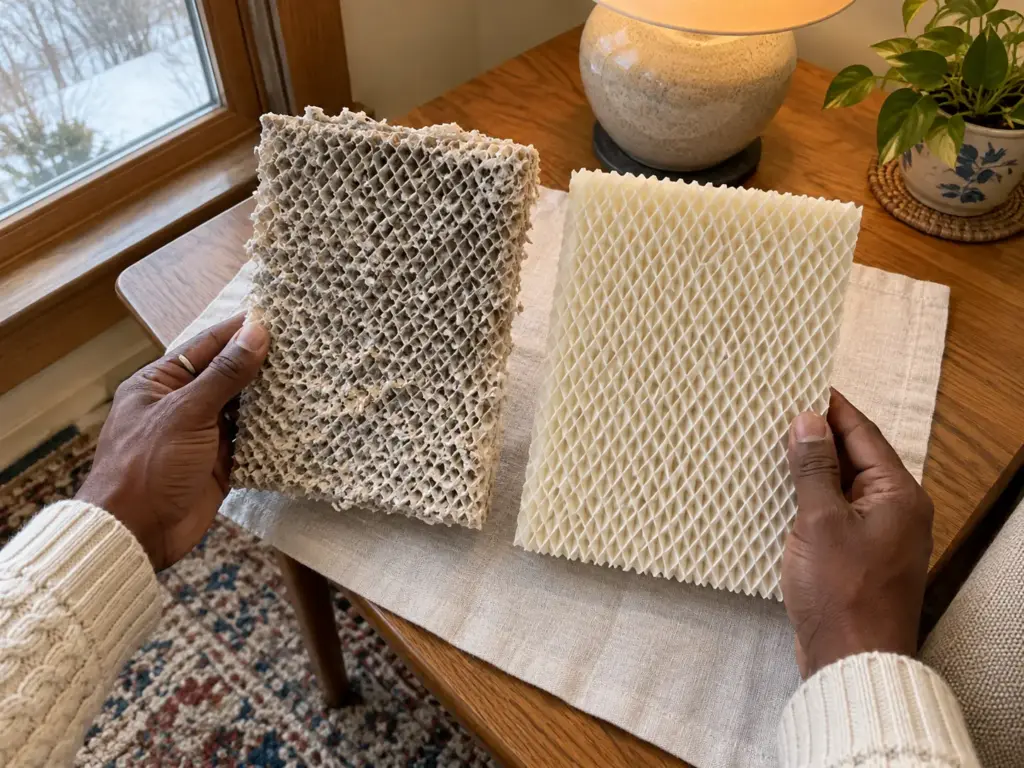
The wick that calcifies
The wick or water panel takes the water first, and mineral buildup from hard water turns it to stone, which is when a filter change stops being optional. Hard water can wear through an evaporative filter quickly. Hold the panel from a unit after one season of hard water beside a new one, and the difference is the maintenance schedule no brochure prints.
A setting left high against cold glass
The setting that is right in the first cold week is wrong in the coldest one. It is the same month-two shape as the fog on a single window, only now the setting sits in a closet by the furnace where no one sees it, and the windows of the whole house are the readout.
Cold surfaces, ducts and the attic
The mechanism is the same as at the window: warm, moist air meeting a cold surface, and that can happen in the ducts too. Too much moisture in an attic can freeze on the wood in cold weather and then thaw, soaking the framing and sometimes coming through a ceiling.
What it does show is where the professional belongs. The attic and the ducts are theirs; the setting is yours, and the setting is where the first fix lives.
One Room, One Portable Unit, No Ducts
Everything above assumes a furnace. Most readers have one room that matters tonight, and the method does not change: read, change one thing, read again.

The one-room house
An apartment or a rental with no ducts and one window unit is the ordinary case, and the same ladder applies with one extra reading. Put a gauge in the room where the portable unit runs and another in the next room. The far room’s number tells you whether the unit reaches past the door.
Free first: shut the door of the room the unit serves, so it works on one room’s air and not the hallway’s. A unit that cannot move the far room’s gauge in a week is not reaching it, and a second unit would not be the first thing to try.
A tall room that will not climb
Large open spaces on ducted gas heat can be hard to humidify in winter, because the house keeps losing moisture through air exchange. That is one house, not a standard, but it names a pattern: a big volume of air reads slowly, so give a change days, not hours. A setting on the unit and the reading in the room are two different numbers. A unit kept at 45 percent can still sit beside a room that reads far lower.
If the gauge in the far room still reads low a week after the unit started, the unit is working on its own corner. Move it toward the middle of the space and give it another week before judging it.
When the Problem Is the Building, Not the Setting
If the fog is still there with the unit off and the reading low, the question changes from the setting to the glass, the wall or the attic. The three parts below mark where to stop adjusting and who to call.

Fog that stays with the setting low
Persistent window fog at a low setting is a pane or a wall that is too cold, a cold spot in the house rather than a number problem. No notch on a dial fixes single-pane glass in a hard freeze. If the reading is already low and the glass still fogs, the damp side may be a different source entirely, and whether to run a dehumidifier in winter covers it.
Cold corners behind the furniture
The EPA’s line about cold corners behind furniture applies again here, because it describes the building and not a device. The corner where the paint holds a cold, damp handprint at the same hour every cold morning is a wall problem. A basement’s cold concrete walls take a lower target; what humidity a basement should be in winter gives that number.
Who to call, and for what
The professional is for the attic and the ducts, especially when a unit runs into a cold attic. The setting is yours to read and to lower. A contractor can fix a leak or insulate a wall, but only you can read the glass at seven in the morning for a month.
Tomorrow Morning: Read the Glass, Then the Gauge
Three things carry from this guide. The EPA band is 30 to 50 percent, and as the outside gets colder the lower half of it is the safer place to sit. Fog on the glass says the setting is too high, and the response is one notch down, then a fresh reading the next morning. The fixes run in order, free first, with a device last and a whole-house unit after everything else.
A month from now, look at the glass after the coldest week of the season, and check the gauge for the setting you wrote on the tape. When the thaw comes, walk the setting back up a notch at a time; what is too much when the season turns picks up where this one leaves off.
Tomorrow, before touching anything, read the glass and then the gauge, and write both down. Make the one change that the glass points to, lower the setting a notch or seal the leak you found, and take the same two readings the morning after. The reading that matters is the second one. When the window question is settled and you want the whole picture, how to prevent condensation on windows is the next page, and the year-round target is waiting on the ideal-levels page.
Frequently Asked Questions
01Is 50 percent too high for indoor humidity levels in the winter?
Fifty percent sits at the top edge of the EPA’s 30 to 50 percent band, so it is inside the range. The glass decides whether it is too high that week: if the lower pane fogs, step the setting down one notch and read again.
02Is 40% humidity too low in a house?
No. Forty percent is inside the EPA’s 30 to 50 percent band, so it is not low by that standard. The dry side starts under 30 percent on a hygrometer, with static and a low reading as the signs.
03How do you fix humidity in a house in winter?
Read which way the room is off first. Fog on the glass means too high, so lower the setting one notch. Static and a reading under 30 percent mean dry, so seal leaks before adding water. Read again between every step.
04Does opening a window in winter increase humidity?
Usually the opposite. Cold outside air carries very little water, so once it is warmed inside the same moisture reads as a lower percentage. Running the bath fan during a shower removes that moisture at the source instead.
05How do you reduce humidity in a house in winter?
Lower the humidifier’s setting one notch and read the room the next morning. Run the bath and kitchen fans during showers and cooking, then seal air leaks, reading again after each change before touching the next.