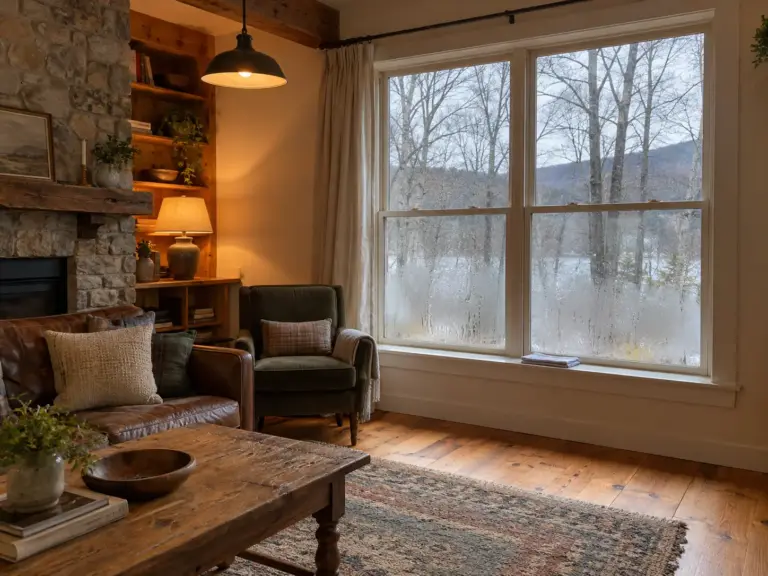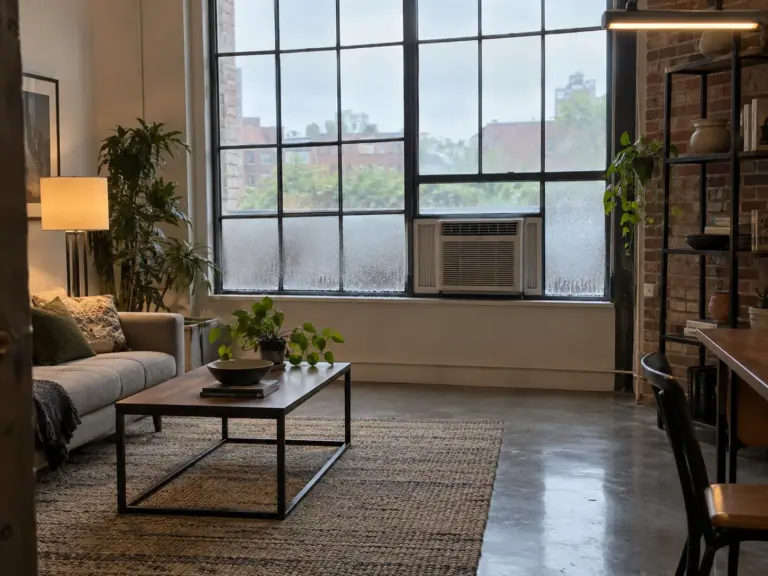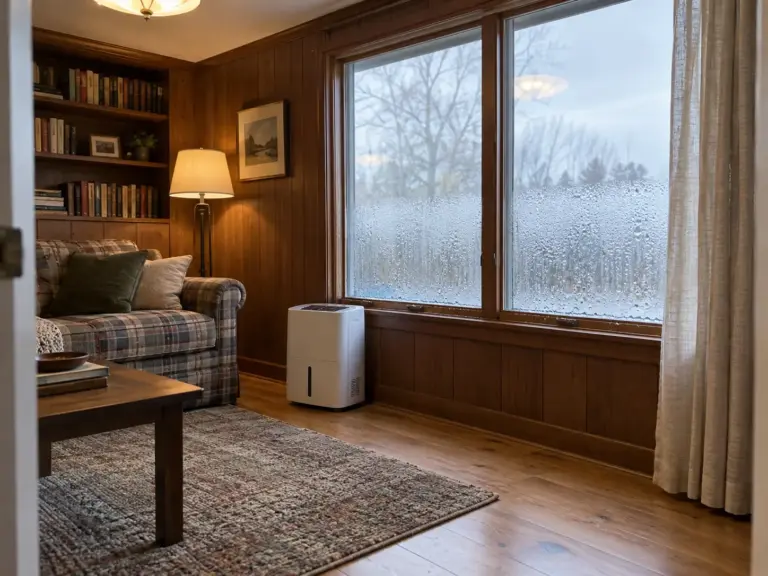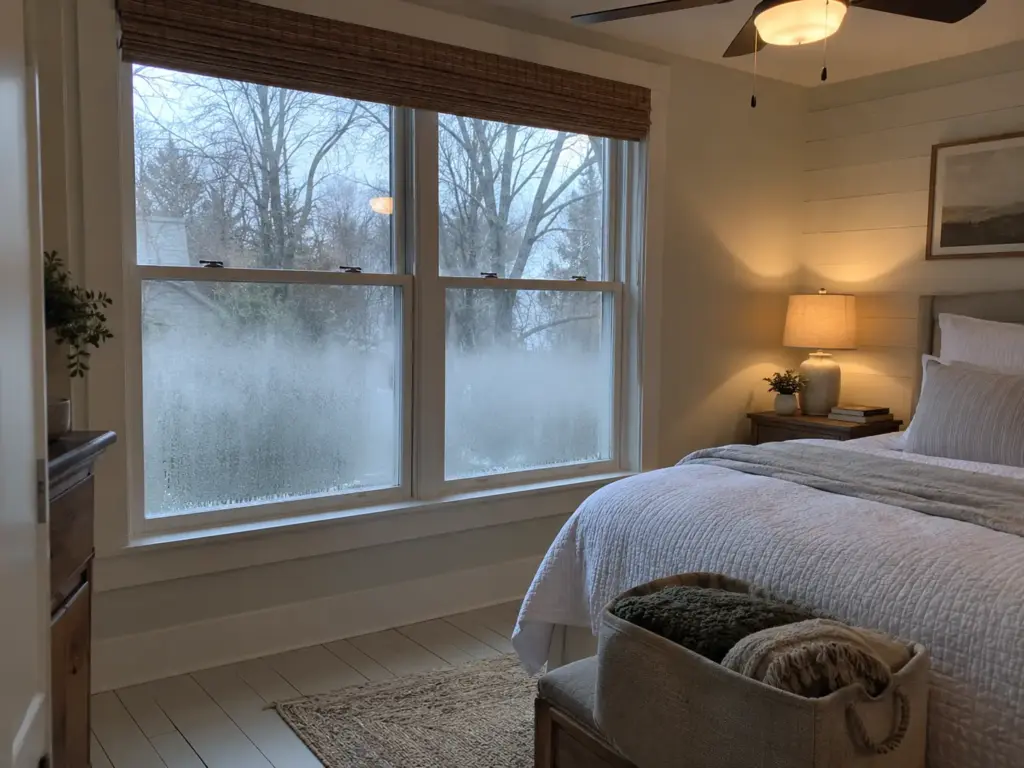
The glass is dry when you turn off the lamp and running with water by six, and the room felt comfortable the whole evening. Nothing about the window changed in between. The room’s temperature did, and the glass followed it down faster than the air did, which is what causes condensation on windows overnight. This article takes the night in order: what the glass does once the heat drops, what a shut room keeps making, the night hour by hour, and the one change to make at bedtime plus the one reading to take at dawn.
Quick Answer
Window glass sweats overnight because the heat drops and the glass, which touches the outside, cools below the dew point of the room’s air while sleepers and a shut door keep adding water. Change one thing at bedtime, the free one first, and read the room again at dawn.
What the Glass Does After the Room Cools
The window did not change in the night. The room’s heat did, and glass answers that kind of change before the air does. So the useful question is not whether the window is bad, but which surface in the room reaches the dew point first, and once the heat drops it is almost always the glass.
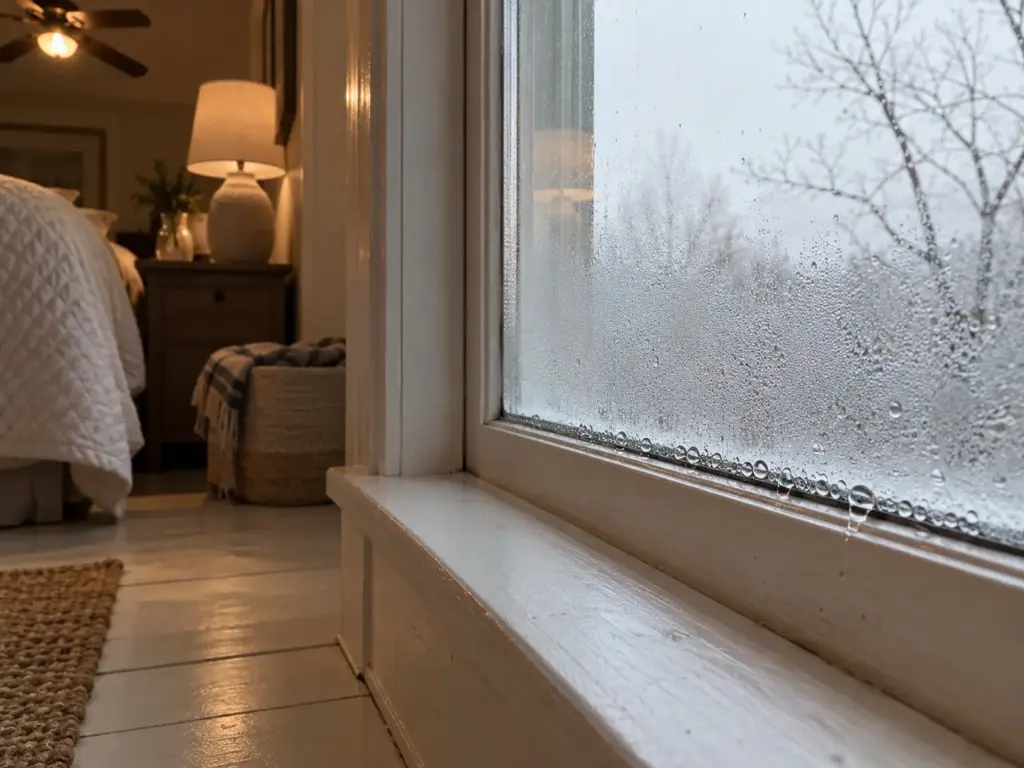
The glass is the coldest thing the room’s air touches
North Dakota State University Extension, in its 2011 release on window condensation, states the mechanism in one line: “When the heated air in your house comes in contact with the cold air next to your windows, it cools.” The cooler air has less room for water, so the excess sticks to the pane, the same way it does on a chilled drink. At bedtime the warm room is carrying all the water it was carrying at supper, and the glass is the one surface in the room that touches the outdoors.
A single pane has very little insulating value, and even a good double pane is a thin barrier next to a wall with insulation and drywall behind it. That is why the water shows up on the glass first and on the wall later, if at all. The arithmetic that ties a room’s humidity to the glass temperature where the film starts is worked through in the dew point arithmetic behind the pane, so this article keeps to the order of events.
The heat goes down and the glass follows
When the thermostat steps down, the room and the glass both start to cool, but they do not cool together. The glass is tied to the outside, a cold surface that goes lower. Meanwhile the dew point of the room’s air, which depends on how much water the air holds and not on the thermostat, stays where it was. So the cold glass can reach that number while the room still feels fine to sit in.
The cold outside moves the line. At 40 percent indoor humidity, NDSU says a double-pane window should begin to show condensation once the outside temperature dips below zero °F (-18 °C), while triple glazing holds off until closer to minus 40 °F (-40 °C). That is a 2011 extension rule, the shape of the thing and not a standard, and how the right indoor number shifts with the outdoor temperature lays out the full bands.
The number nobody publishes
The EPA’s interactive mold house tour treats a wet pane as a reading of the room, a sign of high indoor humidity that should be investigated, and the same page gives the band: “To help prevent mold growth, try to keep the indoor humidity below 60%, ideally between 30 and 50%.” The film is a measurement. The window is the instrument.
What helps is the order of events and a reading to take. Even with the heat up, a door cracked and the exhaust fan running, new windows can still fog on the coldest nights. Some nights beat the free fixes.
Look at the lowest inch of the lower pane before anything else. That strip is the coldest, so the film starts there and clears last in the morning. A film that stays in that strip says the glass is only just under the dew point; a film across the whole pane says it is well under.
The Moisture the Room Keeps Making While the Door Is Shut
The glass decides where the water lands, but the room decides how much there is, and for eight hours no one opens a window or runs a shower. A closed night does two jobs at once: it keeps adding water and it keeps all of it in.
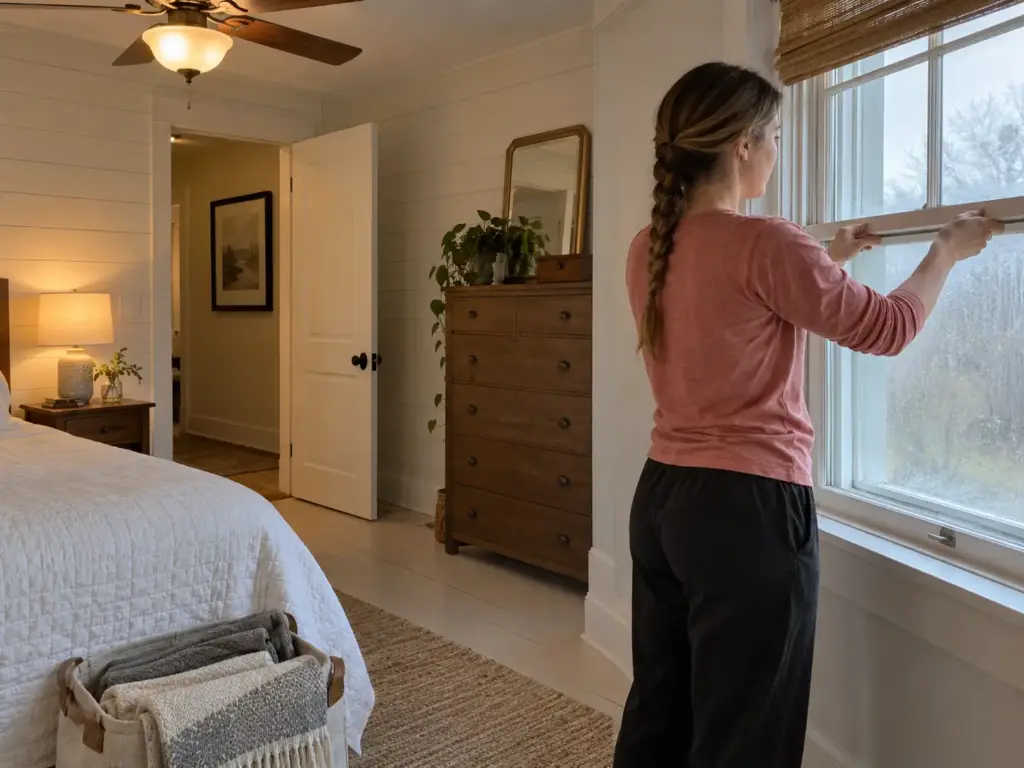
What a sleeping room adds and a shut door keeps
NDSU puts each person’s output at about 3 pints of water vapor per person per day from breathing alone, before the shower, the stove or a load of laundry is counted. A closed bedroom with two people behind a closed door collects the night’s share of that with nowhere to send it, which is the same effect behind why indoor humidity peaks at night.
Curtains add a wrinkle. Closed drapes trap a pocket of cold, still air against the glass. Leaving them open at night is a simple test, and NDSU notes that open drapes can cut the fog behind them, though the energy loss has to be balanced against it. For the curtain side and the peak reading, read why the film is worst after a closed night.
What moves the moisture out, and what each move costs
Old double glazing on a ground-floor apartment can leave the windows very wet most mornings, even with wall vents and trickle vents already open. The towel every morning and a half hour of open windows is the routine that follows, and it works because it throws the water out of the room instead of onto a cloth.
Each way of moving the water out has a price.
An open bedroom door lets the room share the hall’s air, and costs you the bedroom’s quiet and its warmth. Opening a window a crack, a finger’s width, moves moisture out directly, but costs heat on very cold nights. The bathroom and kitchen exhaust fans only help if they end outside; NDSU warns that venting into the attic can cause unseen moisture problems, including mold growth. A shut door that holds moisture also holds carbon dioxide, and the same closed-room effect on carbon dioxide is worth a look if the room also feels stale.
Free fixes come first, one at a time. If the door is the change, the next dawn’s film on the lower pane should be thinner or shorter. If it is not, nothing was lost, and the next change is the next night’s.
The Night, Hour by Hour
Put the three things on one clock: the heat going down, the glass cooling, the room making water. The order matters, because the one that comes first is the one the house controls at bedtime.
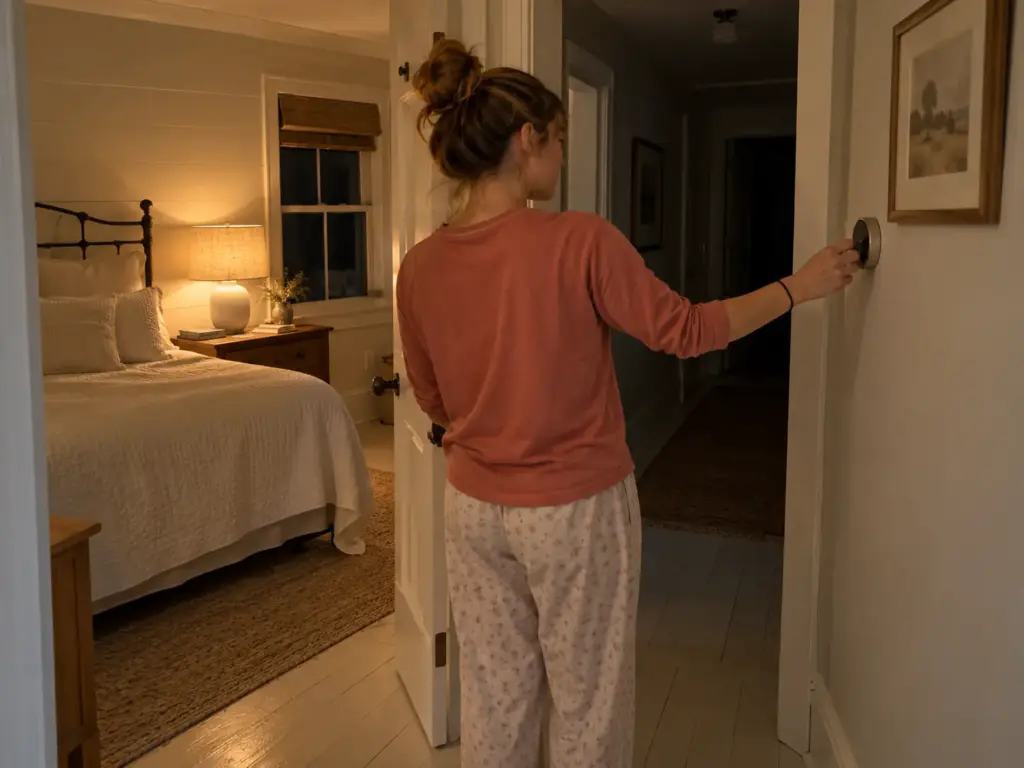
Bedtime: the heat goes down
The thermostat setback comes first, the heat turned down before you sleep. The Department of Energy’s guide for renters estimates you can save as much as 10 percent on heating by turning the temperature back 7 to 10 °F (about 4 to 6 °C) from its normal setting for 8 hours a day. That saving is why people set it, and the same setback is what lets the glass cool. The DOE does not say how far the glass falls, and neither do the EPA or NDSU numbers, so the order is the only thing that can be stated.
The other side of the choice is to keep the window glass warm by keeping the heating on, or to wipe the window every morning. Both are right in their own bills. The cost of holding the heat is in the table at the end of this article.
If you have a hygrometer that keeps a record, bedtime is when it starts to write down the night you cannot watch. Without one, the glass at dawn is the only record you get.
The small hours: the glass crosses the line
Some time after the room has settled to its night temperature, the glass drops below the dew point of the air touching it, and the film begins. The room can still feel comfortable when that happens, because your sense of the room follows the air at bed height, while the film follows the coldest surface in it.
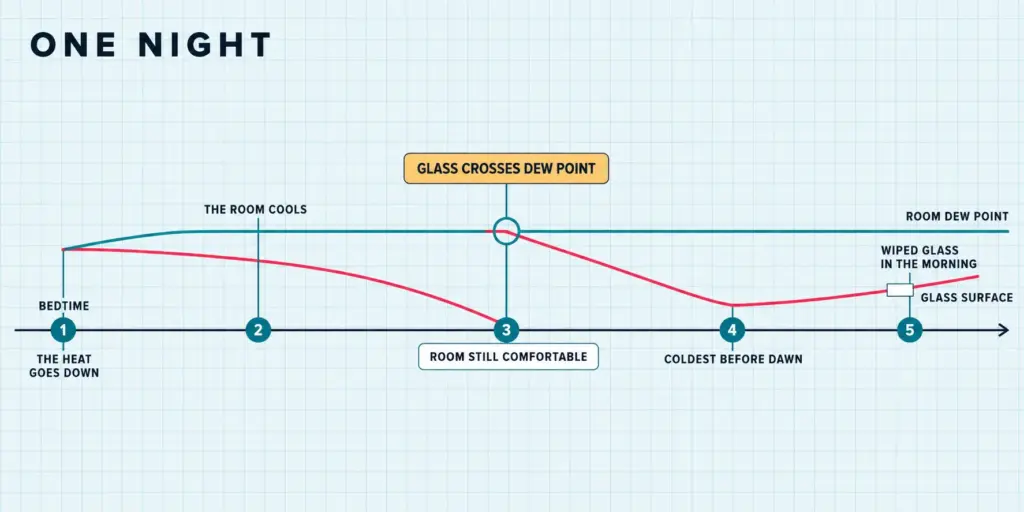
The film starts along the lower edge of the lower pane and spreads upward as the night goes on. (Water that reaches the sill is the point where it stops being a nuisance and starts costing the frame.) Meanwhile the room has not stopped. Two sleepers in a shut room keep adding water, so each hour the glass sits below the dew point is an hour that the supply is being topped up.
Before dawn: the wettest glass of the day
The wettest stretch is the end of the longest run of cooling and the longest run of moisture added to a closed room, which is why the glass shows the whole night at once when you get up. It is also the reading to match with a meter: not the room at bedtime, but the room at the moment the glass looks worst.
And this is why wiping the glass is a reset, not a fix, and why ventilation, not the cloth, is what changes the night. If you wipe the glass, the cloth clears the film, but the room’s humidity and the glass’s temperature are exactly where they were, and tomorrow night restarts the clock.
When It Is the Window and Not the Room
If the room’s moisture sits inside the band and the glass still sweats, the glass is the thing to look at. The question for this section is which part of the problem is the window’s and which part no change to the window will touch.
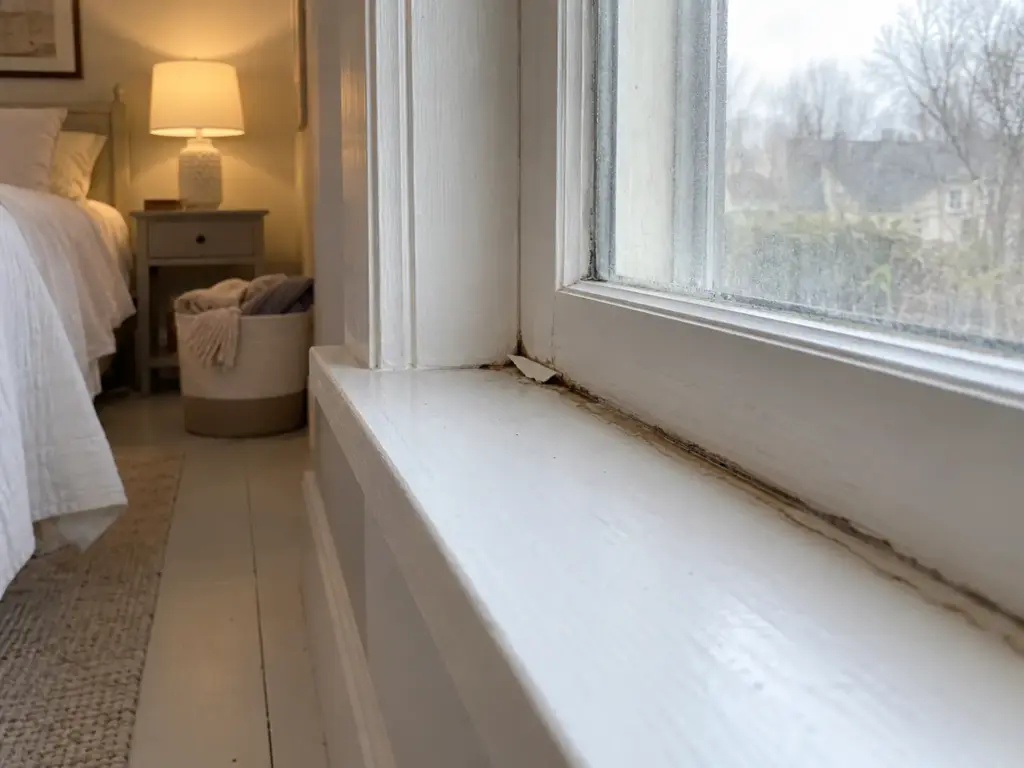
An older pane sweats first, a tighter window keeps more in
Older and single panes start sooner than the double-pane threshold above, because the glass is colder at the same outside temperature.
But a new window can do the same thing for the opposite reason. Condensation along the edges of a window can appear the winter after a replacement, even when the previous winter had no trouble. A tighter window leaks less air, so it keeps more of the night’s moisture in. Condensation is a common problem in well-sealed houses, because less air leaks in to dilute the moisture.
That has a catch that applies to any room: cutting the film from the glass can push the water somewhere else. Wiping the window does not stop condensation on the walls, which can still form.
Where the water sits tells you whose problem it is
Water on the room side of the glass is the room’s moisture. Water on the outside face of a double pane is normal weather and no fault of the room. Water between the panes is a failed window seal, and then the glass is the fault, not the humidity. The three places water can sit on a window are worked through there, with the check for each.
Standing water on the sill every morning is frame damage in the making and leaves its own signs: a dark water line along the lower rail of the sash, paint lifting at the sill. Those are the cue to look at the frame, and whether condensation on windows means mold is the sibling that handles that question.
The One Bedtime Change and the Dawn Reading
The night’s sequence has three levers, and the night temperature drop is only the first: the heat, the moisture and the air. The site’s rule is one change at a time, so this section is the order to take tonight and the reading to take tomorrow.
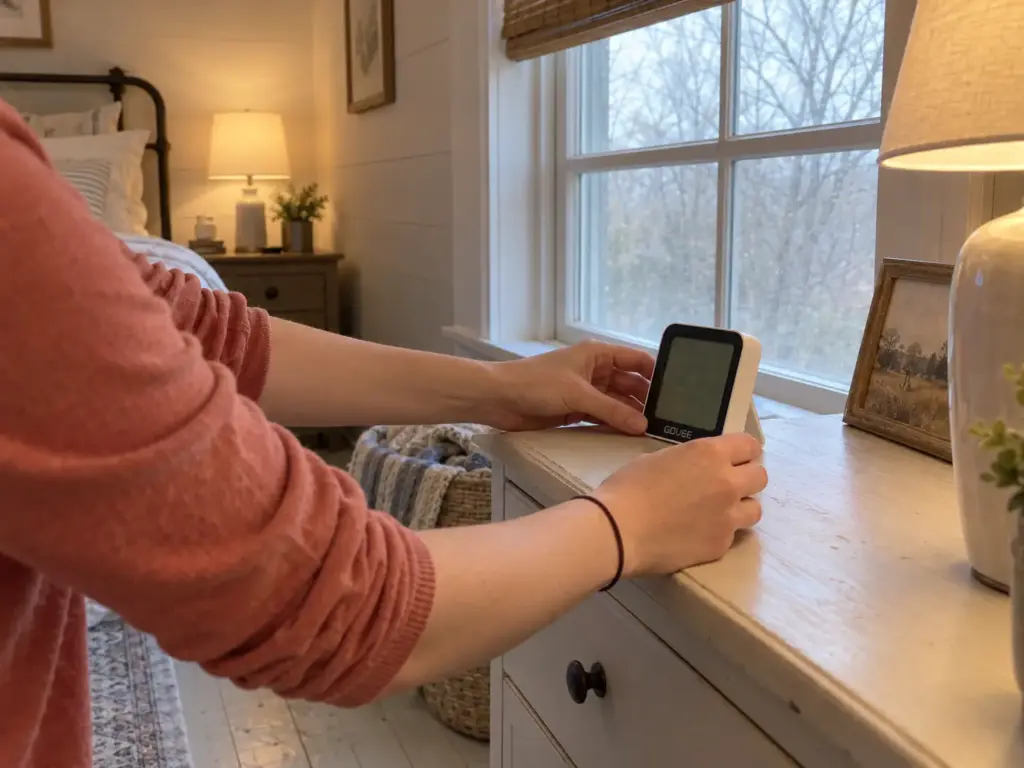
Read the room tonight, before changing anything
The first step is a reading, not a device. Take the room’s relative humidity at bedtime, take the same reading at dawn, and for one of the nights put the meter within a hand’s width of the glass so you can see whether the room or the pane is off. The EPA’s ceiling of 60 percent is the line the dawn number gets compared to, and three readings with one meter covers how to take them.
A meter with a memory makes the night your own.
The Govee H5075 (Amazon) keeps twenty days of readings that the app charts hour by hour, and it can sound an alarm when humidity or temperature crosses a threshold you set. A Pocketables review from December 2019 found its readings matched an older Honeywell hygrometer. The catch is that it is Bluetooth only, and it will not warn you if your phone has shut the app down in the background, so an overnight alarm may never go off.
The review also notes a range of 164 feet in the manual against 260 feet in the Amazon advertising, which does not matter in a bedroom. The missing alert does.
For the same reading on a plain screen, the AcuRite 00613 (Amazon) has a 3-inch display and no app, so you read it at bedtime and again at dawn. A cheap sensor can sit a few points off, so trust the direction more than the decimal; how to trust a cheap humidity checker goes through why.
Put one meter at the glass and keep the other at bed height for the same night. If the two numbers are close and both high, the room is the problem. If the bed-height number is in the band and the glass still runs, the pane is the problem, and the changes below will not reach it.
Change one thing at bedtime
The order is free first, one per night.
First, the door left open or the window cracked a finger’s width. Next, the heat held at its evening setting for one night, or the setback shrunk by a step. Last, the bathroom exhaust fan run during the shower and vented outside. The dawn reading says which one to start with: a high number points at the room and the first and third changes, an in-band number points at the pane and the second.
After each change, ask what the next reading should show.
A cracked window or an open door should drop the dawn humidity, or leave the lower strip of glass drier than the night before. The overshoot is a bedroom that wakes you cold, or one that hears the hall. Move it back half a step, not all the way. Holding the heat should leave the glass drier at dawn with the same humidity, since the water did not change, only the glass.
If you change three things in one night, you cannot tell which one worked. That is the mistake worth avoiding more than any wrong choice of order.
Read the glass again at dawn
The dawn reading goes beside the bedtime reading and the 60 percent ceiling. What a good bedroom humidity level is sets the bedroom’s own band at 30 to 50 percent, and the number that matters most is the highest one the room reached, because that is what the glass answered. A meter that keeps its history shows that peak without you being awake for it.
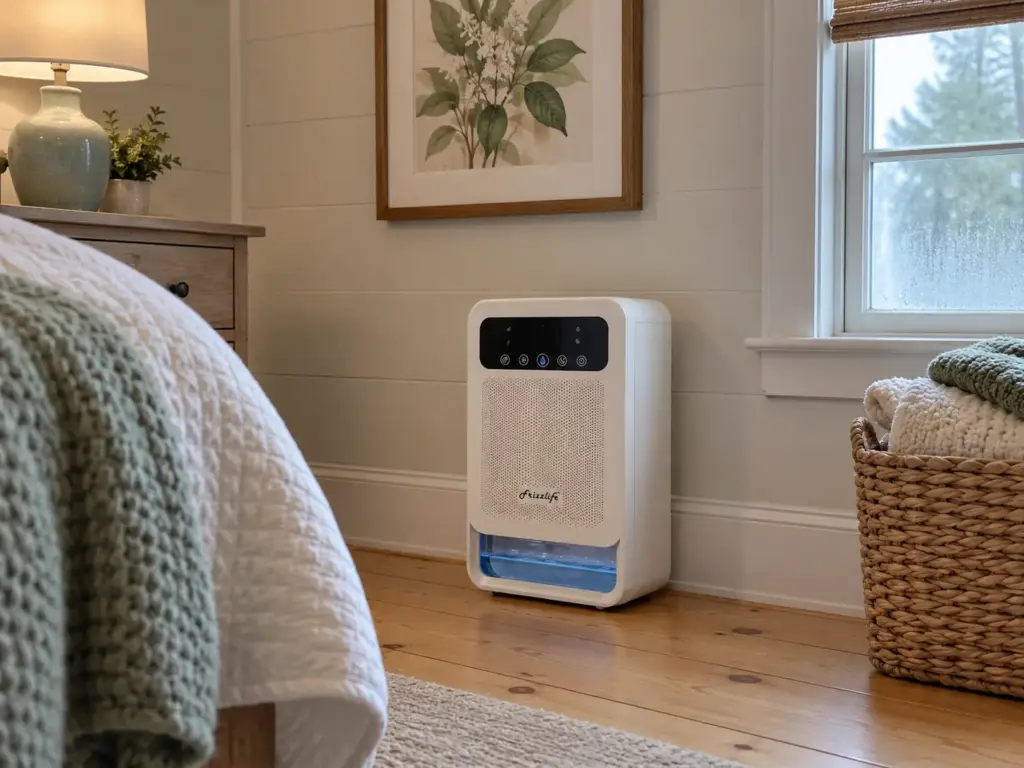
The dehumidifier comes last, and only if the number stays above the band after the free changes. NDSU notes that dehumidifiers generally do little when humidity is below 50 percent, which is common in winter, so a room already in the band gains almost nothing. If the reading is still high, the next decision is a unit like the Frizzlife DH80 (Amazon), a dehumidifier with a 135 oz (4.1 L) tank that has to be emptied, and which dehumidifier fits a room with window condensation makes the choice.
What Each Night Fix Costs
Every fix has a bill, and a reader who keeps the heat on, cracks the window and runs a fan has only moved the cost around. Here are the bills side by side, written once.
The comparison, fix by fix
| The change | What it moves | What it costs |
|---|---|---|
| Keep the heat on | The glass stays warmer | Gives back part of the setback saving |
| Door open | The room shares the hall’s air | The hall’s noise, light and temperature |
| Window cracked | Moisture leaves the room | Heat, on very cold nights |
| Curtains open | Less fog behind them | An energy loss to balance against it |
| Exhaust fan, vented outside | The shower’s water leaves the house | Nothing, unless it ends in the attic |
| Dehumidifier | Water leaves the air | Does little below 50% humidity |
| Wiping the glass | Nothing | The sill and the frame, over time |
The first row has a number behind it. The DOE puts a 7 to 10 °F setback over 8 hours at up to 10 percent on heating, so holding the heat gives some of that back. How much depends on your bill and your rate, and only you can run that multiplication. The fan row is conditional too: NDSU’s warning about venting into the attic means the fan moves the problem instead of solving it.
Write the overnight low next to each dawn reading. A change that held at 20 °F (-7 °C) outside can fail at 5 °F (-15 °C) with the same room and the same habits, and without the outdoor number you will blame the wrong fix.
The nights the film stays anyway
On the coldest nights a thin pane can fog even with the free fixes in place, so some condensation may have to be accepted. A fix that held in November is the one most likely to fail in January.
Two readings tell you what to do next. If the dawn reading sits inside the band and the glass still sweats, the window is the cause and the section on the window applies. If the reading is above 60 percent, the room is the cause and the bedtime change applies. After either, the free fixes first for lowering indoor humidity is the longer list to work down.
Tonight’s Plan: One Meter, One Change, One Look at Dawn
Three things carry out of the night. The heat goes down first and the glass follows it below the room air’s dew point, with the room still comfortable. The room keeps adding water while the door is shut, so the glass is wettest at dawn. And the order that works is one change at bedtime with one reading at dawn, the dehumidifier last.
A month on, check whether the film still starts in the same lower corner on the coldest nights and whether the dawn reading has stayed under 60 percent. If both hold, the fix is the room’s. If the corner keeps sweating while the number is in the band, the window is the part that still needs attention.
Tonight, set a meter a hand’s width from the glass, change nothing else, and read it when you wake. That one number tells you which of the changes above to make tomorrow.
Frequently Asked Questions
01Why is there condensation on my windows at night?
The room cools when the heat drops, the glass cools faster than the air, and the water a shut room keeps making lands on that coldest surface first. The glass falls below the room air’s dew point while the room still feels comfortable.
02How do I stop condensation on my windows overnight?
Change one thing at bedtime, the free one first: open the bedroom door or crack the window a finger’s width. Read the room again at dawn before changing anything else, and bring in a dehumidifier last, only if the reading stays above 60%.
03Why do I get so much condensation on my windows in the morning?
Morning comes at the end of the longest stretch of cooling and of added moisture in a shut room, so the glass shows the whole night at once. The lower edge of the lower pane is usually the wettest strip and the last to clear.
04Does condensation on windows mean the house is too cold?
Not by itself: it means the glass fell below the dew point of the room’s air, and a colder outside moves that line sooner. NDSU’s 2011 rule puts a double-pane window at the start of condensation below zero °F (-18 °C) outside with 40% indoor humidity.
05Should I leave the heat on all night to stop window condensation?
It keeps the glass warmer, but it gives back part of what a setback saves, which the Department of Energy puts at up to 10% on heating for 7 to 10 °F over 8 hours. Try the door or the window first, then compare.