
The bathroom mirror is still fogged long after the shower ended, the meter on the shelf reads in the 60s, and the obvious move, throwing a window open, might be putting more water into the room than it takes out. If you want to lower indoor humidity levels this week with the house you already have, it helps to know what the meter actually reports: relative humidity, a number that moves with temperature as well as with water, so it can fall without a drop of water leaving the room. The sequence below is a ladder you can climb in one evening: read the meter, send the moisture outside, check the window, distrust the heater, let the AC run, and add a dehumidifier last, with a reading at the end of every rung.
Quick Answer
Keep the room below 60% relative humidity, ideally between 30 and 50%, and change one thing at a time, free fixes first.
- Read a hygrometer before and after every change.
- Run the bath fan and range hood until the reading stops climbing.
- Open a window only when the outdoor dew point is lower than the room’s.
- Ignore a drop caused by heating: the water is still there.
- Let the air conditioner run long enough to dry the air.
- Add a dehumidifier last, and stop it inside the band.
Read the Meter Before You Change Anything
Every rung of this ladder ends on a reading, which makes the meter rung zero. Before touching a fan or a window you need three answers: where the meter goes, which number is the stop line, and how far a cheap unit can be trusted when the room sits close to that line.
Where the meter goes and when to read it
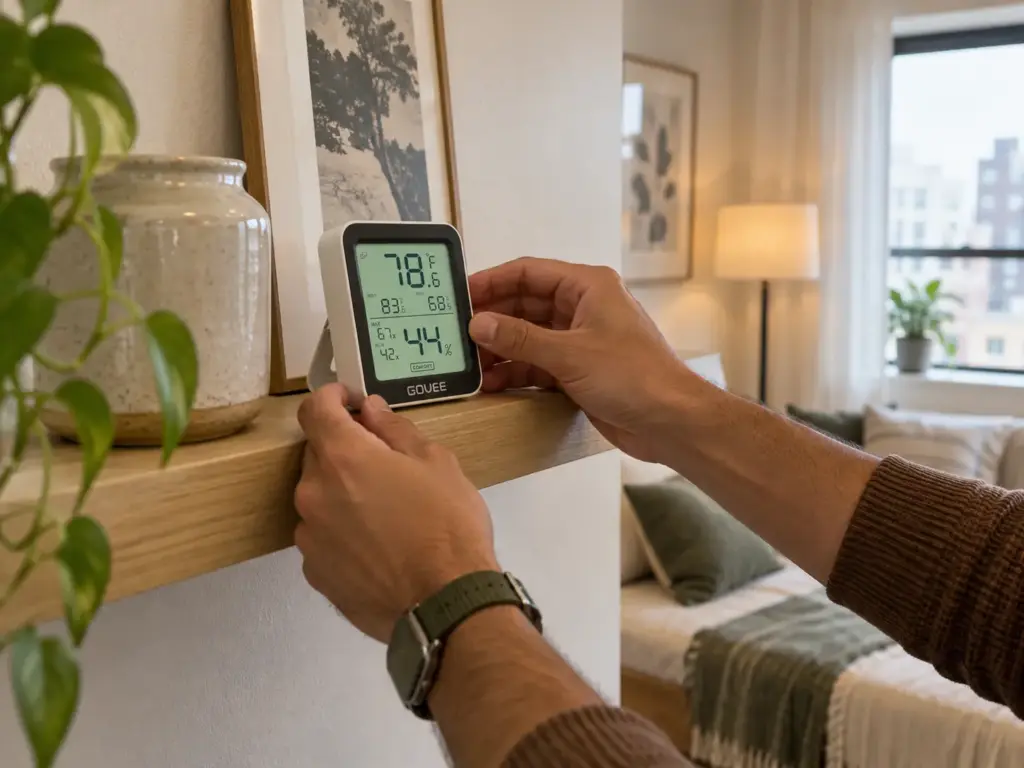
Put it in the room that reads wrong, at the height you actually live at, and keep it away from the bathroom door, the stove, a sunny sill and any vent that blows straight at it. A hygrometer next to a shower curtain reports the shower, not the house. Read it at the same hour each day, and once more about an hour after each change, so a reading belongs to one change and not to three. The habit of reading it is covered under three readings on one meter; here you only need to write the number down.
What 60 and 30 to 50 percent actually mean
The reference is the EPA’s. According to the EPA’s brief guide to mold, moisture and your home, “If possible, keep indoor humidity below 60 percent (ideally between 30 and 50 percent) relative humidity.”
Two numbers, two jobs. The ceiling is 60: above it, the ladder starts. The band is 30 to 50: that is where you stop climbing.
A reading of 58 sits inside the ceiling and outside the band, so the room is acceptable and not yet finished. The full range, and what shifts it through the year, lives under ideal indoor humidity levels.
One rule runs through the rest of this article: change one thing, wait, read again, and stop as soon as the room sits in the band. A reader who opens the window, turns up the heat and starts a dehumidifier in the same hour cannot tell which of the three did the work, or which of them is now drying the room past the band.
Why two cheap meters beat one
The EPA calls a humidity meter a small, inexpensive instrument, and that is the whole case for owning two. The Govee H5075 Bluetooth Hygrometer Thermometer states a humidity accuracy of plus or minus 3% RH and a temperature accuracy of ±0.54°F (±0.3°C), with a Bluetooth range of 164 feet and a log you can export covering two years. That stated margin matters at exactly this spot: a reading of 58 and a reading of 61 can be the same room, so a number within three points of the 60 line is not an answer yet.
The Govee earns its place through that log, which shows whether the room drifts upward over days, something a glance at a dial cannot do. But a log only helps if you open it, and the weak point is durability. Amazon’s summary of the reviews reports that several customers saw the unit quit within six months, and the Bluetooth connection gets mixed feedback, so a reading you cannot trust at month six is no reading at all. The longer case for a cheap humidity checker and how far to trust it is its own article.
A second meter belongs on the same shelf. The AcuRite 00613 Indoor Thermometer Hygrometer runs on one AA battery and lists an operating humidity range of 16% to 98%. It prints no accuracy figure on the listing, which makes it a cross-check and not a reference.
Set the two side by side for a day. If they agree within a point or two, the number is the room’s. If they disagree by six, the number belongs to a meter, and the fix so far has cost you nothing.
Send the Shower, Stove and Dryer Moisture Outside
With a number to read, the first rung is the water the house produces every day. The question here is which of those sources can go outdoors for free, and how to tell that a fan is truly doing it.
Run the bath fan until the meter stops climbing
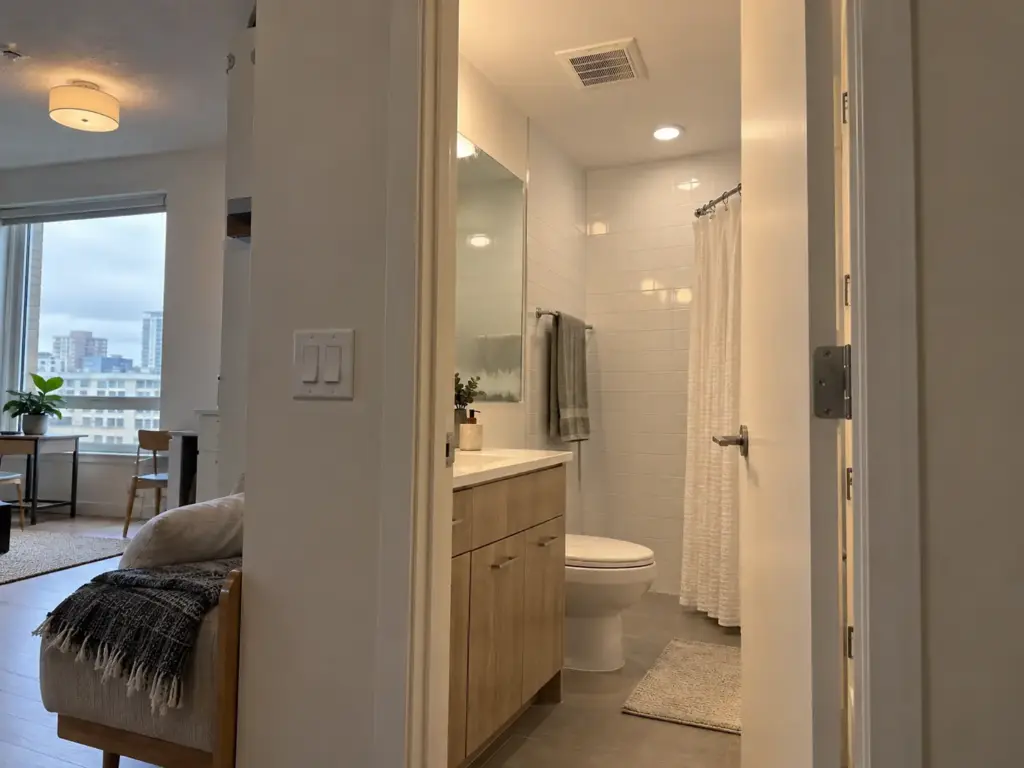
The shower is the biggest daily source, and its steam stays in the room unless something carries it out. The EPA advises running the bathroom fan or opening a window while showering, and using exhaust fans while cooking or running the dishwasher. A fan removes water only while it is running, and that is the whole catch: the switch gets flipped off with the light, and the mirror stays fogged. Mildew on bathroom walls is a common result when the fan is not switched on after a shower.
The stop rule for a bath fan is the meter itself: leave the fan on until the reading has stopped rising and the mirror has cleared, then read it again. If the number keeps climbing after the fan is off, the water is coming from somewhere other than the shower, and finding the source of a high reading is the next job.
Two cheap fixes help here. One is a timer switch, which shuts the fan off if you forget and runs it long enough to remove the humidity after you leave the room. The other is a humidity-sensing switch that turns the fan on above a set humidity and off after a delay.
Judge a bath fan by the mirror and the meter, never by its sound. A loud fan on a crushed or disconnected duct feels busy and moves little, while the glass above the sink clearing fast is the quickest honest check you own.
Check where the fan actually vents
The grille on the ceiling is the only part of a bath fan you can see, and the end of the duct is the part that matters. The EPA’s advice is to vent moisture-producing appliances to the outside where possible, and a fan that dumps into the attic or the soffit has only moved the water to a worse place.
In a northern climate, water can condense on the underside of the roof in winter, and mold in the attic is a costly problem. Treat that as a sign of moisture where it should not be, not as a verdict on every house.
One counter-view belongs here. A bath fan that vents into the attic is a problem in itself: the moist air ends up in the roof structure, where it can condense. That is one house, not a test, and it tells you nothing about yours.
The check is a flashlight and a look: follow the duct from the fan housing and see where it ends. If the duct stops short of a roof or wall vent, the repair worth looking at is a short, dryer-type vent run out a side wall.
The dryer and the range hood
The clothes dryer and the stove make moisture on a schedule, and the EPA names both: vent them to the outside where possible. A dryer exhausting into the room, a basement or a closet puts the water from every load back into the air.
A range hood is the other half. Some hoods recirculate through a filter and a grille, and a recirculating hood sends the steam straight back into the kitchen, so look for a duct that leads outdoors. A lid on the pot costs nothing.
Not every source has a vent. Houseplants, a drying rack and a humidifier turned up too high add water too, and a humidifier’s setting is the easiest one to change. Lower it a notch, wait a day and read the meter.
Compare Dew Points Before You Open the Window
The EPA says to increase ventilation by opening doors and windows “when practical,” and that is a fair concession to how houses work. It gives no test for when practical applies. The open window is the one free fix that can backfire, and what decides it is whether the air outside is drier than the air inside, which relative humidity cannot tell you.

Why outdoor relative humidity misleads
Relative humidity is a ratio: how much water the air holds compared with how much it could hold at its current temperature. Warm air can hold a lot more, so the same percentage means very different amounts of water at different temperatures. The dew point states the water directly. It is the temperature at which the air in question would start to drop out dew.
A building-science Q&A on greenbuildingadvisor.com makes the same point: a lower outdoor dew point replaces indoor water, while an outdoor humidity higher than the room’s can raise the indoor reading.
The weather app can fool you here. The figures below are our own calculation with the standard dew-point formula, not a published table, and they are worth running with your own numbers. Outdoor air at 86°F (30°C) and 55% relative humidity has a dew point near 68°F (20°C). A room at 72°F (22°C) and 60% has a dew point near 57°F (14°C).
The outdoor air reads drier and carries more water. Opening the window in that case adds water to the room, even though the comparison of percentages says it should dry it.
The two-number check before you open anything
Look up the outdoor dew point (a weather forecast usually lists it beside the temperature) and work out the room’s from its temperature and relative humidity, with an online dew-point calculator or a chart. Open the window only when the outdoor number is lower than the room’s. Then close the loop with the meter: read the room an hour later and see whether it moved the way the dew points predicted.
Write the room’s dew point on a sticky note beside the window. Once it is there, the daily decision is one glance at the forecast: outdoor number lower, open; outdoor number higher, leave it shut.
The answer changes during the day, which is the part that makes the window tricky. The same window can dry the room at 7 a.m., when the night has pulled the outdoor dew point down, and wet it by 3 p.m., once the day has pushed that dew point back up. Same window, two different answers.
When the window is the wrong tool
On a muggy afternoon the outdoor dew point sits above the room’s, and the window brings in the wrong air. That is the day for the air conditioner, covered further down. The target itself also shifts with the weather, which is the subject of the humidity band by outdoor temperature.
The window is still the right tool for a different goal. If the room is stale and not damp, opening a window to change the room’s air is exactly what the CO2 article recommends. Different goal, different check.
Heat Moves the Reading, Not the Water
The other tempting free fix is turning up the heat. The EPA is right that warmer surfaces fog less, and the reading on the meter will fall, which looks like success. The question this section answers is whether a lower reading means less water.
Same air, a different number
It does not. Take air at 52°F (11°C) and 70% relative humidity, the cold room that reads damp first thing. Its dew point is near 42.5°F (5.8°C), our own calculation by the same method as above.
Heat that same air to 70°F (21°C) and the meter reads about 37%. Nothing was added, nothing was removed, and the dew point has not moved. The percentage fell because warm air can hold more water. The water stayed.
Heating lowers the relative humidity number and does not remove a drop. A meter that reads 37% in a heated room has told you about the air’s capacity, not about how much water is in it.
The glass still fogs
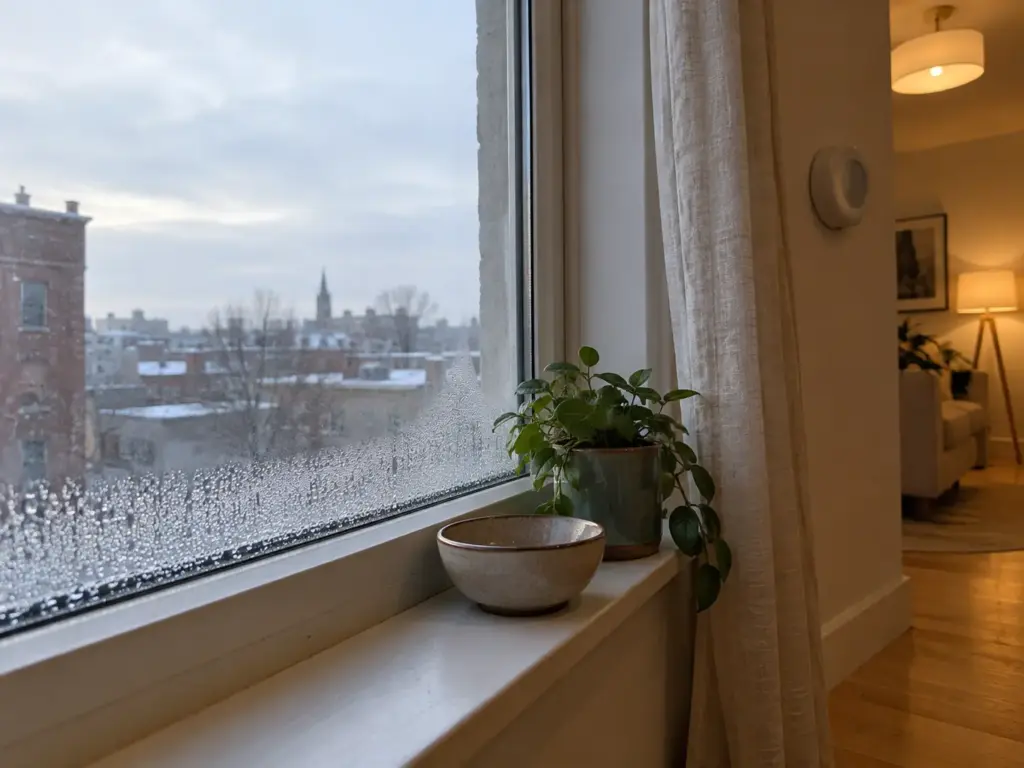
A window pane colder than about 42°F (5.6°C) in that room still fogs, because the air touching it is still at the same dew point. The lower corners of the cold pane go first and dry last, and they show which cold surface sits under the dew point. Treat them as a second meter.
The EPA’s advice for condensation on windows, walls or pipes is to dry the wet surface quickly and reduce the moisture or water source, which splits the job in two: wiping is the reading, and the source is the fix. For the glass itself, raising the air temperature is one of the EPA’s listed actions. The piece on which side of the window the water is on takes it from there.
Use heat to protect surfaces, not to fix the reading
Heat is a good tool for keeping a wall or a pane above its dew point. It is a poor tool for the meter. After heating, only a falling dew point counts as progress: moisture sources sent outside, the air conditioner running, a dehumidifier. If the number dropped because the thermostat went up, you have a warmer room with the same amount of water in it, and the ladder has not moved a rung.
Take the reading before the heat comes on and again after the room has settled. If you only ever look at the second number, the heater will always seem to have fixed it. Better still, take the dew point both times, since that is the number the heater cannot change.
Let the Air Conditioner Run Long Enough to Dry the Air
The air conditioner is the one appliance that removes water while it cools, so it lowers the dew point and not just the temperature. Its order in summer is covered under the summer humidity target; this section keeps to the mechanism and the question of what separates drying from just chilling.
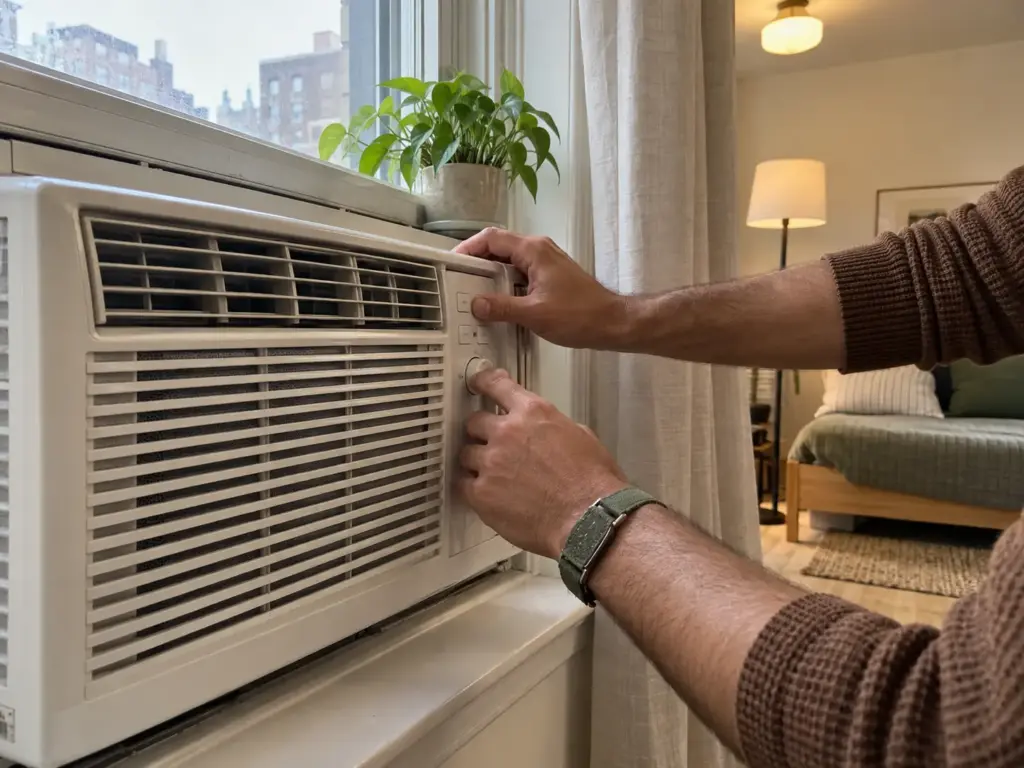
The coil pulls water out of the air only while the unit is cooling. When it idles with the fan still running, nothing is being removed, and a wet coil can give some of that water back to the airstream. A window unit that cycles off quickly on a mild day therefore cools the room without drying it: it never runs long enough to condense much. The room needs run time.
A lower setting buys that run time by chilling the room, which is its own cost, and the longer run costs electricity too. The EPA lists air conditioners and dehumidifiers among the tools to use when needed and ranks neither first, which fits their place here, after the sources.
You can see it work. The drain pan or the condensate line of the unit fills on a sticky day, and the water in it is what the AC took out of the air. The EPA also tells you to keep air conditioning drip pans clean and the drain lines unobstructed, since a blocked one sends that water back into the building.
If the reading still sits above 60 after a long run, the AC is not the problem: something in the house keeps putting water back, and the last section of this article is where to look. When condensation shows on the glass with the unit running, condensation when the AC is on takes up that case.
Add a Dehumidifier Last, With a Number to Stop At
If the reading is still above the band after the free fixes, the device is the last rung, and it has its own failure mode. This section covers when a dehumidifier is worth running and where it should stop. The decision about which one to get is a different article: what to look for before you buy a dehumidifier. No brand is named here on purpose, because the rung is the category.
When the free fixes have stalled
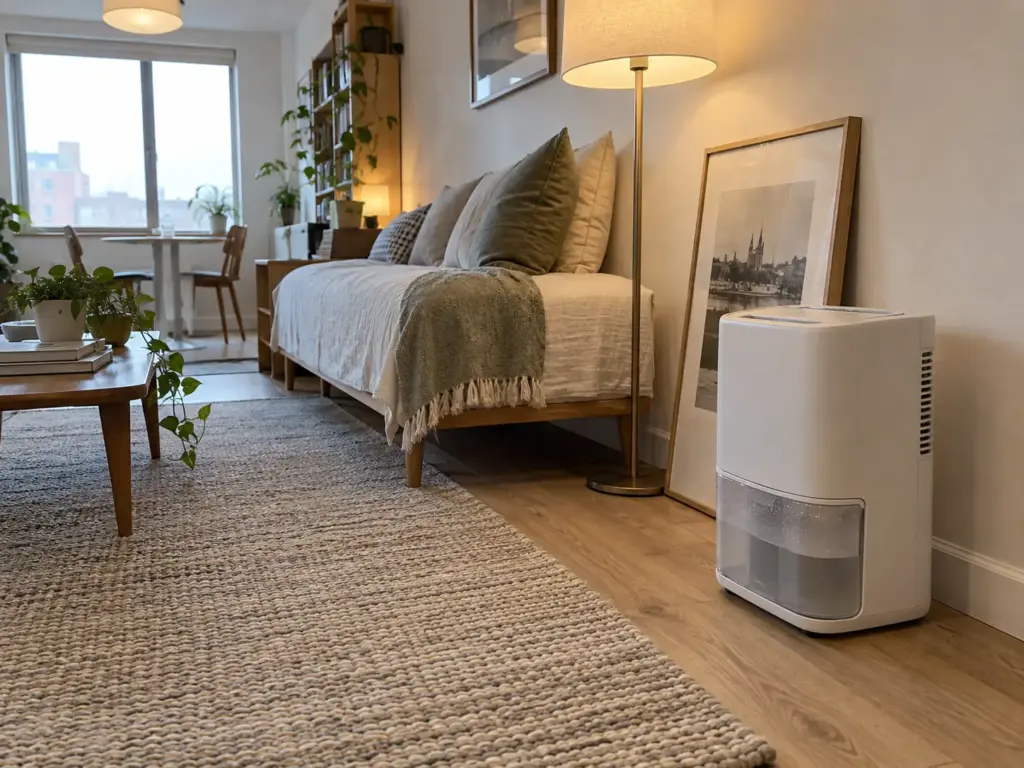
The basement or the damp back room is the usual case: the fan is venting outside, the dew point has been checked, the AC has run, and the number came down from the 70s to the low 60s but will not go lower. That is when a dehumidifier does something the free fixes cannot. Most units pull water out of the room’s air on a chilled coil of their own, regardless of the weather outside. The EPA’s phrase is “when needed,” and this is the need.
The stop rule and the humidistat
Run it until the meter sits inside the 30 to 50 band, then let it stop. A unit that keeps running past the band over-dries the room and wastes power, and the opposite problem has its own article on can indoor humidity be too low.
A built-in humidistat that shuts the unit off at a set reading does the stopping for you. And a unit with no humidistat needs you to be the humidistat, so write the stop number on the tank. If the water you are chasing is on the glass, a dehumidifier aimed at window condensation has its own setup.
The bucket, the drain and the month-three filter
The flaw of the category is the bucket. A dehumidifier with a full bucket stops, a dirty one works poorly, and one with no drain hose and no humidistat leaves the water in a pan where it can go back into the room.
Month three is where it shows: the bucket is full every day, the filter has collected a gray film, and the room still reads 58. A drain hose from the outlet to a floor drain or a sink fixes the first problem. Rinsing the filter, as the unit’s manual describes, fixes the second. If the room still needs the unit every day after that, it is telling you something about the building.
Look at the water in the bucket. Dark, cloudy water on a damp day says the unit is working on a room that is making more moisture than the fixes removed, so the next reading to take is the building’s.
When the Reading Climbs Back, Look at the Building
If the reading falls after a dehumidifier run and creeps back up by the next afternoon, the water is coming from the building and not from the shower. The question is how to tell a building source from a daily one, and when the answer stops being yours to fix.
The pattern that points at the building
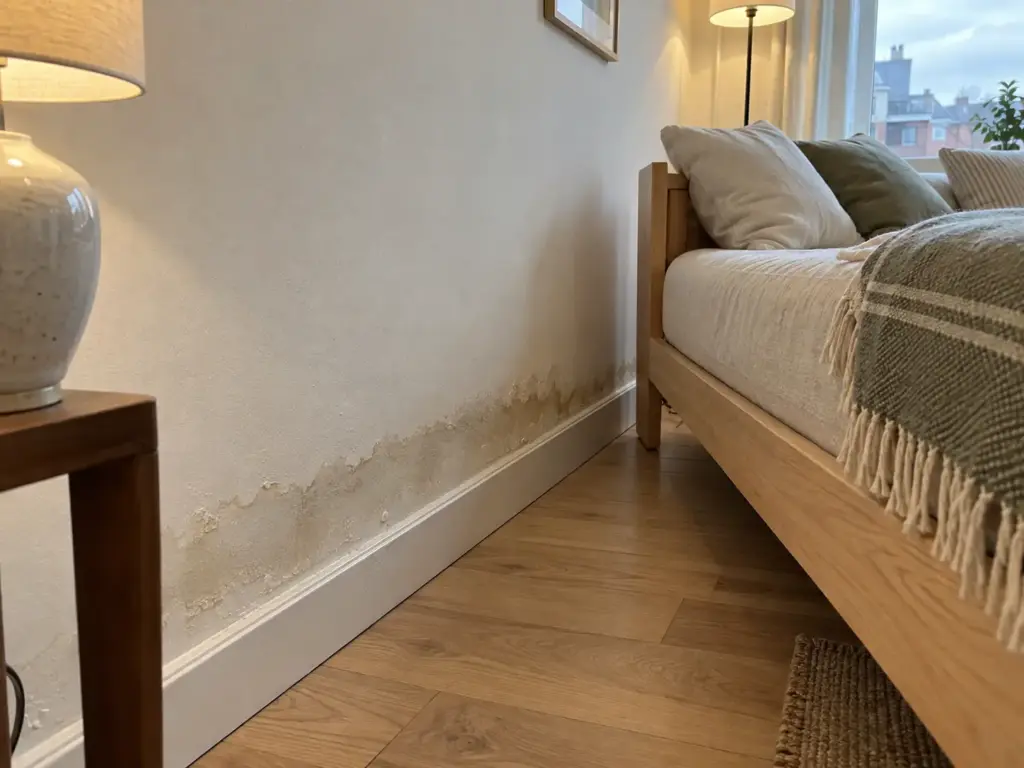
A daily source gives a daily pattern: the number jumps after the shower and the stove, then falls. A building source gives a slow drift that outlasts every fan. How long a high reading lasts times that fall. A reading that returns within a day of dehumidifying, or one that stays above 60 after the whole ladder, is not a bath fan problem.
What a free look can find
Walk the house with a flashlight. Look for a damp corner at the base of an exterior wall, a dark line low on that wall that does not dry when the room does, standing water in a crawlspace or basement, a gutter that dumps beside the foundation, and a window with worn weatherstrip or a loose seal that lets rain in. The EPA lists clearing roof gutters and making sure the ground slopes away from the foundation among its moisture-control steps. A cold wall or a bare cold water pipe is a surface that sweats, and insulating the pipe is the EPA’s answer for the pipe.
These are things to check, and they cost nothing to check. Mold or mildew showing on a wall is a sign that moisture is sitting there, and the EPA’s mold page puts the lever plainly: “The best way to control mold growth is to control moisture.” Its fuller advice is at the EPA’s mold guidance. For the below-grade case, keeping basement humidity low is its own routine.
When to call someone
When the reading stays above 60 after the ladder, or comes back within a day of dehumidifying, treat the source as the building and call the right professional for the thing you found: a roofer for a roof leak, a plumber for a pipe, a foundation or waterproofing contractor for water at the base of a wall. Add a check of your own for later: if the meter is fine for a week and drifts upward over a month, the building is the first place to look again.
One Change at a Time, and a Reading After Each
Three things carry the article. Read the meter and stop at the band, not before and not after. Send the shower, stove and dryer moisture outside before you buy anything. And let the dew point decide the window, because a reading that falls on a warmed room has not dried anything.
For later, check three places in a month: the meter’s reading with the door shut, the dehumidifier’s bucket and filter, and the end of the bath fan’s duct. Whichever one has changed is the one that has started to drift.
For tomorrow, run the bath fan until the reading stops climbing, then read the meter again and write the number down. That single comparison tells you whether the biggest daily source was the problem. The next question, what the number should be through the year, is answered under ideal indoor humidity levels.
Frequently Asked Questions
01How do I lower indoor humidity levels quickly?
Send the shower and cooking moisture outside with the bath fan and range hood, then let the air conditioner run, and read the meter after each step. Add a dehumidifier only if the reading stays above 60%.
02Is 70% humidity too high in a house?
Yes, 70% sits ten points above the EPA’s 60% ceiling for indoor relative humidity. Start with the bath fan and the meter, then work down the ladder, reading again after each change.
03Is 63% humidity in a house a good level?
No, 63% is three points above the EPA’s 60% ceiling, and the band to aim for is 30 to 50%. A cheap meter can be off by about three points, so confirm the number with a second meter first.
04What causes 80% humidity in a house?
A reading that high usually points at liquid water, such as a leak or a wet crawlspace, or at a faulty meter. Check with a second meter, then look at the building. Mold on a wall is only a sign of moisture.