
The air conditioner has run all day and the room is cold, yet it still feels sticky, and the glass of iced water on the table has left a wet ring on the coaster. A unit cools by pulling moisture off a cold coil, so one that shuts off early leaves air that is cool and damp at once, and only a number tells you which. This guide answers what should indoor humidity level be in summer, where the ceiling sits, how to read it with the equipment you already own, and the order to fix a high reading in.
Quick Answer
In summer, keep indoor relative humidity below 60 percent and aim for 30 to 50 percent, the figures the EPA gives. Above 60, damp surfaces have the moisture mold needs. Read the number with a meter first, then change one thing at a time and read again.
The Summer Number: Aim for 30 to 50 Percent, and Treat 60 as the Ceiling
Search for the summer number and you will meet a different figure on every thermostat app and product page, so the first job is sorting the ones a public agency publishes from the ones that are only habit. Three short parts do the sorting: the band and its ceiling, why the posted figures disagree, and what actually sits above 60.

The band and the ceiling
According to the EPA’s guide to mold, moisture and your home, “If possible, keep indoor humidity below 60 percent (ideally between 30 and 50 percent) relative humidity.” Two numbers are working in that sentence: 30 to 50 is the band to aim for, and 60 is the ceiling. Summer does not move either one. What summer changes is how hard the band is to hold, because the air outside carries more water, and the house takes some of it in every time a door opens.
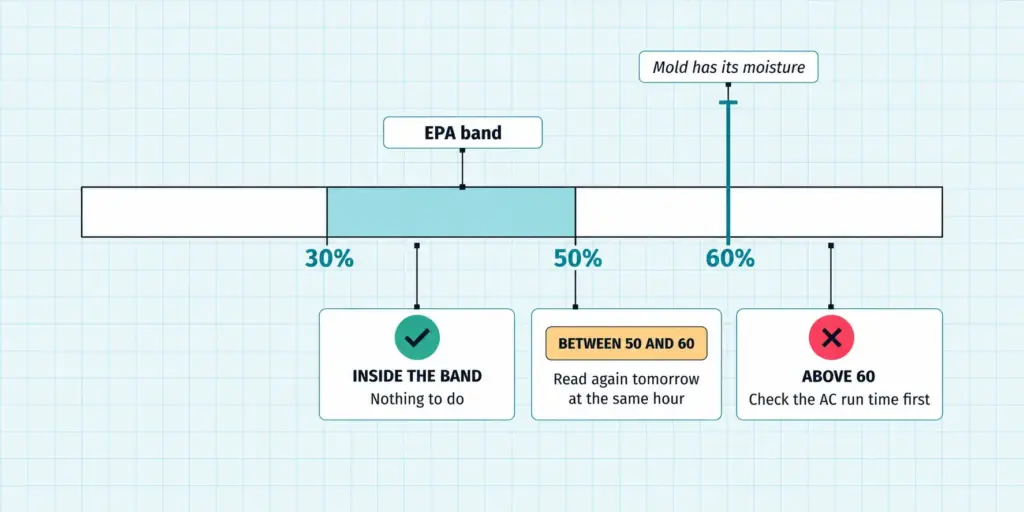
So a meter that reads 55 is above the band but under the ceiling, which makes it a reading to take again tomorrow at the same hour and not an emergency. A number that sits at 58 for a week in July is a room to watch. The one that stays past 60 after the air conditioner has run all day is the room that needs a change.
Why the posted numbers do not agree
A thermostat app, a product page or a neighbor may hand you a tighter band or a “sweet spot” of its own. Treat those as rules of thumb. The useful question is always which agency publishes the figure, and the EPA’s is the one used here. The all-year version of the same band, with the reasoning behind it, lives in the number to aim for in any season.
What sits above 60
The EPA also notes that condensation can be a sign of high humidity. A glass of iced water sweating a ring is ordinary physics on its own.
A window, a cold pipe or a wall that stays wet is different: the air holds more water than those surfaces can stay dry under. Wiping the glass does nothing for the cause, and reading the meter does. Above 60, surfaces stay damp long enough to give mold the moisture it needs, which is why the ceiling is a line and not a preference.
Some houses fight for it all summer. In some houses, getting under 60 percent in summer costs real effort, which makes it a goal to work toward rather than a reason to stop trying. Winter flips the problem, and how the winter number shifts with the cold is the other half of the same question.
Read the Number Before You Change Anything
A sticky evening and a dry-feeling one can read the same on your skin, so a room cannot be judged by feel. The first move is a measurement. The three parts below cover where to put the meter, two ways to read it, and how far to trust a cheap one.

Where to set the meter
Put it at chest height in the middle of the room’s air, away from the air conditioner’s discharge, the kitchen and the bathroom door. Each of those makes a pocket that reads wetter or drier than the room around it. The EPA describes a humidity meter as a small, inexpensive instrument sold at many hardware stores, which makes it the cheapest step before any device.
Carry it from the bedroom to the kitchen and the number moves by room, and the room far from the cold side of the house can read differently from the one next to it. The full method is in how to measure indoor humidity at home.
Two ways to read it
The Govee H5075 is the one with an app. Its humidity accuracy is printed at plus or minus 3 percent RH, its Bluetooth range is 196 feet, and it sends an alert when the reading leaves a range you preset, so 60 percent can be the alarm and you can watch the overnight curve instead of a single glance. Its weak spot is the build and the link: Bluetooth connections can fail to pair, and a meter that quits early leaves you guessing again.
The app one is the obvious pick, and it is the wrong one for a reader who only wants a number to look at each morning. For that reader the AcuRite 00613 is a display-only thermometer and hygrometer, 3 by 2.5 by 1.3 inches, run by one AA battery, with no app and no subscription and an operating humidity range of 16 to 98 percent in its spec block. Its catch is that the humidity accuracy is not printed in the listing text, so you cannot check it against a spec.
Set two meters side by side on one shelf for a full day before you trust either. If they land close together, believe the pair. If they split, the weather outside and a third reading decide which one drifts.
How far to trust a cheap sensor
A printed accuracy of plus or minus 3 means a reading of 60 could be a true 57 or a true 63, and 60 is the exact line you are watching. That is why a second meter for a day settles more than any amount of staring at one number. Sensors in this price class also age: the meter that reads fine in week one and stops answering in month six is the one the reviews keep describing. A cheap humidity checker and how far to trust it goes further into which readings to believe and which to repeat.
The AC That Runs Too Little to Dry the Room
The room is cold and still sticky, which sounds like a contradiction until you remember that a unit dries the air only while it is running. Three parts follow, one for each way an air conditioner can cool without drying: how the coil works, what changes with a window unit, and what the fan setting does.
Cooling is not drying
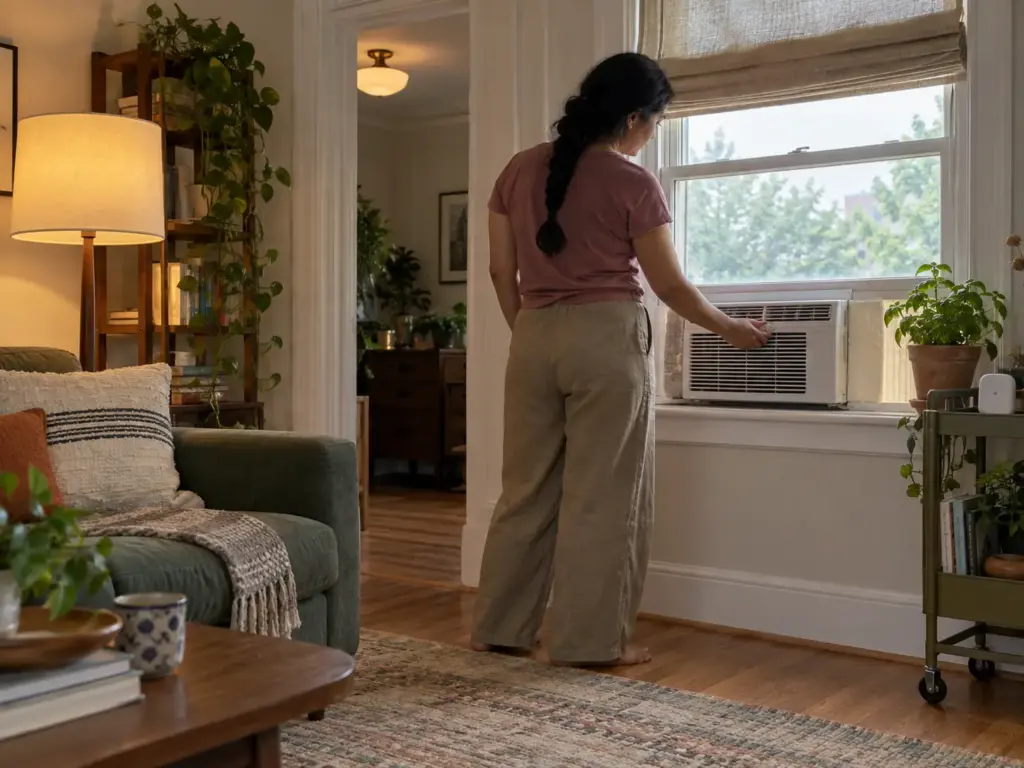
An air conditioner removes water from the air as it cools that air across a cold coil. When the thermostat is satisfied and the compressor stops, the room has been cooled but not dried, and the water that was still in the air stays in the air. That is the usual explanation for a cold, sticky room, and it explains why a glass of iced water sweats in a room that feels comfortable on the thermometer. The same mechanism seen on a window pane is in why condensation shows up when the AC is on.
Run time is the free test. On hot days the air conditioner runs a lot and the house can drop to around 50 percent, which is the same mechanism seen from the house’s side. The EPA guide gives no number of minutes per hour to hit, so treat run time as something to watch and compare day to day, not a figure to chase.
A window unit and no ducts
A renter with one window unit and a thermostat that only shuts the unit off meets this problem in its sharpest form. The room reaches its set temperature fast, the compressor stops, and the air is cool but wet. Upstairs humidity depends on how much the window units run, and sizing a unit for conditions has to be done carefully.
A unit that clicks off every few minutes and leaves the glass sweating is short cycling, and it is not broken. It is oversized for the room, cooling it before it has pulled much water out. You cannot fix that with a setting, but you can slow it down by a degree or two on the dial and watch whether the compressor stays on longer between clicks.
The fan setting, and the flaw of the free fix
Set the fan to ON and it runs continuously, including after the compressor has stopped, which can blow water left on the coil back into the room. AUTO stops the fan with the compressor. This is a mechanism, not a sourced rule, so treat it as a setting to test: switch to AUTO, then read the meter after a full day.
Running the unit longer is the free fix, and it has a flaw written into it. It dries the room but makes it colder, and it adds to the electric bill. The arithmetic is the unit’s rated watts times the extra hours, divided by 1,000 for kilowatt-hours, then times your rate. Do the division with today’s rate and you have the real cost without any figure going stale.
And sometimes the AC is not the fix at all. When the air outside is so wet that the room cannot get below the line, the room ends up hovering at the dew point. No AC will fix that.” On those days the next sections apply, and why your house is so humid covers where the moisture comes from.
The Fixes, One at a Time, With a Dehumidifier Last
When the air conditioner alone does not bring the number under 60, there are several fixes and no reason to do them at once. This is the order, free and likeliest first, with what to read between steps. The sequence is this guide’s own method, not something the EPA sets.

Step one: the AC and the fan, then read
Change one thing in the evening and read the same meter the next morning, not ten minutes later. Humidity in a room settles slowly as the walls, fabrics and furniture give up or take in water, so a reading taken right after a change tells you about the old state. The first change is the one from the last section: let the unit run longer or switch the fan to AUTO, not both.
Read at the same hour every day. A reading taken at breakfast and another at dinner differ because the house and the weather moved, so only like-for-like readings say whether your change worked.
Step two: the sources the house adds
If the number is still above 60, look at what the house itself adds. The EPA advises venting appliances that produce moisture, such as clothes dryers, stoves and kerosene heaters, to the outside where possible, so the first check is simply where the dryer vent exhausts. Run the bathroom fan through a shower and for a while after, run the kitchen hood while cooking, and keep the doors to the wettest rooms closed. How to lower humidity at home holds the full list.
Open the windows only on a dry, mild morning, never a rainy one. A few days of high humidity is sometimes called harmless, but mold on furniture shows the risk can be real, so that view is not a rule to lean on. A reading that drops a couple of points overnight with the exhaust fan running proves the source was inside the house.
Step three: a dehumidifier, only if both fail
Only now does a dehumidifier come in, and the type that fits a single room is a small unit with a built-in humidistat. Its flaws are plain: it adds heat to the room, it makes noise, and the tank has to be emptied. A dehumidifier pulls the most water from a warm room, so it earns its place in a stuffy bedroom or a summer basement and does little in a cold corner.
Picture the reading staying at the same number after the unit has run all day, with the room still smelling damp. That says the source is somewhere the unit cannot reach, such as a wet basement wall, and the next step is the building (see the last section). If the unit does bring the number down, what humidity to set a dehumidifier to is the next decision.
Month Two: The Drain Pan, the Coil and the Meter
A fix that worked in July can stop working in September without anything dramatic happening. The quiet reasons are the unit’s own upkeep and the meter you trust, and the two parts below take them in that order.
The drain pan and the line
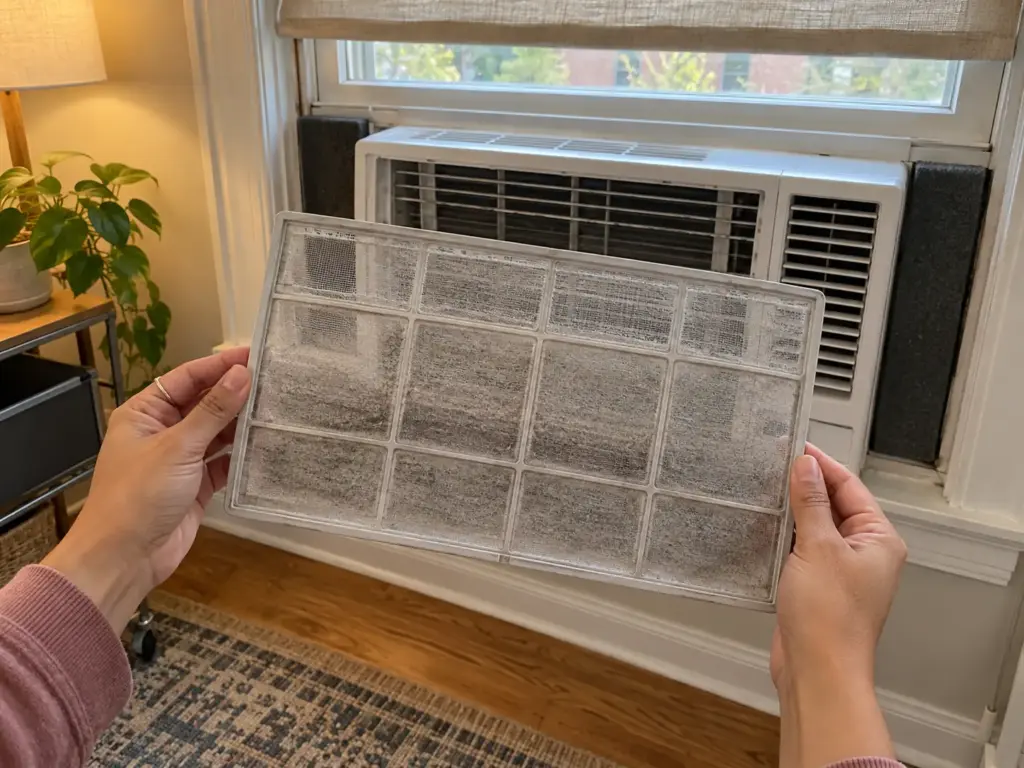
The EPA lists this as ordinary upkeep: “Keep air conditioning drip pans clean and the drain lines unobstructed and flowing properly.” It does not say a blocked line raises the reading, and it gives no number for that effect, so the claim here is only that the check belongs with the unit’s job. Look at the pan, look at where the condensate drain line empties, and check the unit’s filter while you are there, since a loaded filter is a flaw the manual already covers.
It is free, and it is the one check that can change a reading after the settings stop helping. The same unit and the same setting can give a higher number in week eight than in week one. If the reading finally moves after the pan is empty and the line is flowing, the line was part of it. How long high humidity stays indoors is the companion read on why a number lingers.
A meter that drifts
The second month-two failure is the instrument. Compare your meter against a second one for a day, as before, and compare again when the weather turns. The Govee reports of quitting within six months are the reason, because a meter that dies leaves you guessing again, and a meter that drifts is worse, since you keep trusting it.
Write the morning reading on a sticky note or in a phone note once a week, with the outdoor weather beside it. Eight weeks of one line each shows the slow drift that a daily glance never catches.
When the Building Is the Cause, Not the AC
If the number is fine and a wall still shows marks, or the number stays high with every step done, the question changes from the setting to the house itself. The three parts below cover a fine reading with a wall that says otherwise, the cold surfaces furniture sits against, and who to call.
A fine reading and a wall that says otherwise
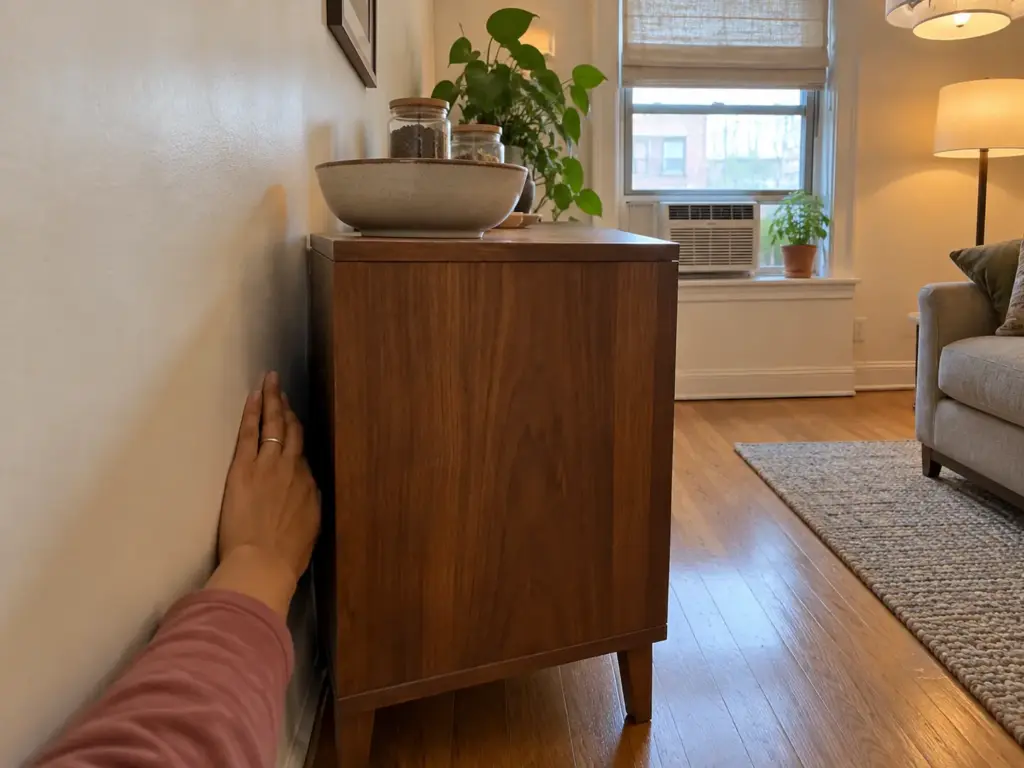
A meter reads the room’s air, not the wall behind the dresser. The EPA lists hidden mold locations that include “the surface of walls behind furniture (where condensation forms),” which is exactly the corner nobody looks at until the furniture moves. When the reading is fine but a wall smells or shows marks, the building is the suspect, and whether condensation on windows means mold covers the same question seen on glass.
Cold surfaces and furniture against outside walls
A wall on the outside of the house runs colder than the room’s air, so moisture condenses on it first and furniture pressed against it blocks the air that would dry it. Mold can grow on the particle board backing of furniture pushed against an outside wall, after a summer with the windows open. The free check is to push the furniture a hand’s width off the outside wall and feel the wall with your palm: the spot that feels cooler than its neighbor at the same hour is where the water is landing. The basement shows the same mechanism in a larger form, and whether basement humidity is worse in summer or winter follows it through the seasons.
Who to call, and for what
A persistent high number with every step done, or marks that keep returning, is a job for a professional who can inspect the building. The call is about the wall, the pipe or the roof edge, not the setting on a unit, so stop adjusting and ask for an inspection of the structure.
Read Tonight, Change One Thing, Read Again Tomorrow
Three things carry the rest. The EPA’s figures are the ones to use: below 60 percent, ideally 30 to 50. Read the number first, then change one thing and read the same meter the next morning. And the air conditioner and its upkeep come first, a dehumidifier comes last, and a wall that says otherwise belongs to the building.
A month from now, take the same meter at the same hour and compare it with tonight’s reading, look at the drain pan again, and see what the number does when the weather turns. Why your house is more humid than outside explains what to expect when the outdoor air changes.
Tomorrow evening, put the meter at chest height in the room that feels stickiest and write down the number. If it is above 60, switch the fan to AUTO or give the unit a longer run, change nothing else, and read again at the same hour the next morning. If it is still above 60 after that, what to look for before you buy a dehumidifier is the next page to read.
Frequently Asked Questions
01Is 60 humidity too high in a house in summer?
Sixty percent sits right at the EPA’s ceiling, so it is the line to stay under, not a comfortable target. Aim for 30 to 50 percent, and treat a week at or above 60 as the cue to check the air conditioner’s run time first.
02Is 70% humidity indoors too high?
Yes, 70 percent is above the 60 percent ceiling the EPA sets for indoor humidity. Read the meter again the next morning at the same hour, then start with the air conditioner’s run time and the fan setting before anything else.
03What is the healthiest indoor humidity level?
The EPA’s figure for the house is 30 to 50 percent relative humidity, with 60 percent as the ceiling. That is a number for the home’s air, read with a meter, and it holds through summer as it does the rest of the year.
04Is a humidity of 50% in a house bad?
No, 50 percent is the top of the EPA’s ideal band of 30 to 50 percent, so it needs no change. A reading between 50 and 60 is still under the ceiling: read again tomorrow at the same hour.
05Should the AC fan be on auto or on in summer?
Set it to auto: the fan then stops with the compressor, while ON can re-blow water left on the coil back into the room. Change the setting, then read the meter after a full day to see whether it helped.