
The shower ended a long while ago, the fan is off, and the number on the shelf sits exactly where it sat at the peak. You are no longer asking what the reading means. You want to know how long indoor humidity levels stay high before the room lets go of them. A reading has no clock of its own: it falls once whatever is adding water has stopped and the room’s air has been swapped for drier air, and walls and furnishings can hand water back while they dry, so the answer belongs to the house, not to the calendar.
Below you get what is being timed, a decay test you run with a meter, the fall that stalls, what to change first and how long to wait before you read again, and the point where days without movement become a question about the building.
Quick Answer
A high reading falls on its own once the source has stopped and the room’s air has been exchanged. No sourced number of hours exists, so time the fall with a meter: a stall can mean the house is handing water back; a reading that holds while the source runs is a steady source that waiting will not clear.
The Clock Starts When the Source Stops, Not When You Notice
Anyone who types this question wants a number of hours, and no source gives one that holds for every house. What can be timed is the fall from a peak, measured against a line you pick, and the only hours figure people tend to quote belongs to a different job. This section sorts those out, so the timing that follows has something to stand on.
The line you are timing against
According to the EPA’s own guide to mold and moisture in the home, “If possible, keep indoor humidity below 60 percent (ideally between 30 and 50 percent) relative humidity.” Read the two numbers as different things. The 60 percent is a ceiling, and the 30 to 50 percent band is where the agency would like the room to sit. A reading of 55 is under the ceiling and still above the ideal band, so whether a room “stays high” depends on which line you hold it against.
The title of this guide uses 60 because it is the ceiling the EPA names. If you want the band that holds all year, the number to aim for in any season has it.
The house often reports the same thing without a meter. The EPA lists condensation on windows, walls or pipes as a sign of high humidity, so a fogged pane is a reading you already have. It is also the fastest part of the picture: the glass dries first, the mirror clears while the number on the shelf has not moved, and the room is the slow part.
What the EPA’s 24 to 48 hours is, and what it is not
The same guide carries the one duration most people half-remember: “If wet or damp materials or areas are dried 24-48 hours after a leak or spill happens, in most cases mold will not grow.” That sentence is about a wet carpet, a soaked wall or a spill, and about getting the material dry before anything grows on it. It is a drying deadline for a thing that got wet.
It does not say how long the air in a room stays humid, and carrying it over to the meter on the shelf gives you a deadline for the wrong problem. If you came here from a leak, the clock that matters is how fast mold grows on a bedroom wall; if you came here because a number will not come down, keep reading.
Sources that stop, and sources that stay
Some sources end when you end them. A shower, a pot of pasta, a load of laundry, a day of rain, an AC that was switched off for the afternoon: once the activity stops, the reading starts to fall, provided there is air exchange, with the damp air moving out and drier air moving in.
Other sources do not stop. A leak keeps adding water, a closed-up room keeps what its occupants and its walls give it, and a building that holds moisture keeps handing it to the air. The first group gives you a curve that bends down. The second gives you a line that stays high no matter how long you wait.
Tracing a high reading back to its source is its own job, and how to trace a high reading to its source walks that tree, so it is not repeated here. What this guide adds is the timing. Readings spread widely from one house to the next, which is one more reason no single hours figure fits every room.
Before you start timing anything, name the line. Write “60” or “50” on a sticky note beside the meter, so every later reading is judged against one number instead of whatever felt reasonable that day.
One more thing belongs in this section, because the rest of the guide leans on it. The right number moves with the weather, and how the right number shifts with the season explains why a reading that is ordinary in one month is a problem in another. Pick the line for the season you are in, whether the problem is summer humidity or winter humidity, then time the fall against that line.
Time the Fall With a Meter, Not With a Guess
The question has no printed answer, so the clock has to come from your own room. The method is simple: note the moment the source stops, read the same spot at set times afterward, and look at the shape the numbers draw. The shape tells you more than any single reading.
Mark the moment the source stops
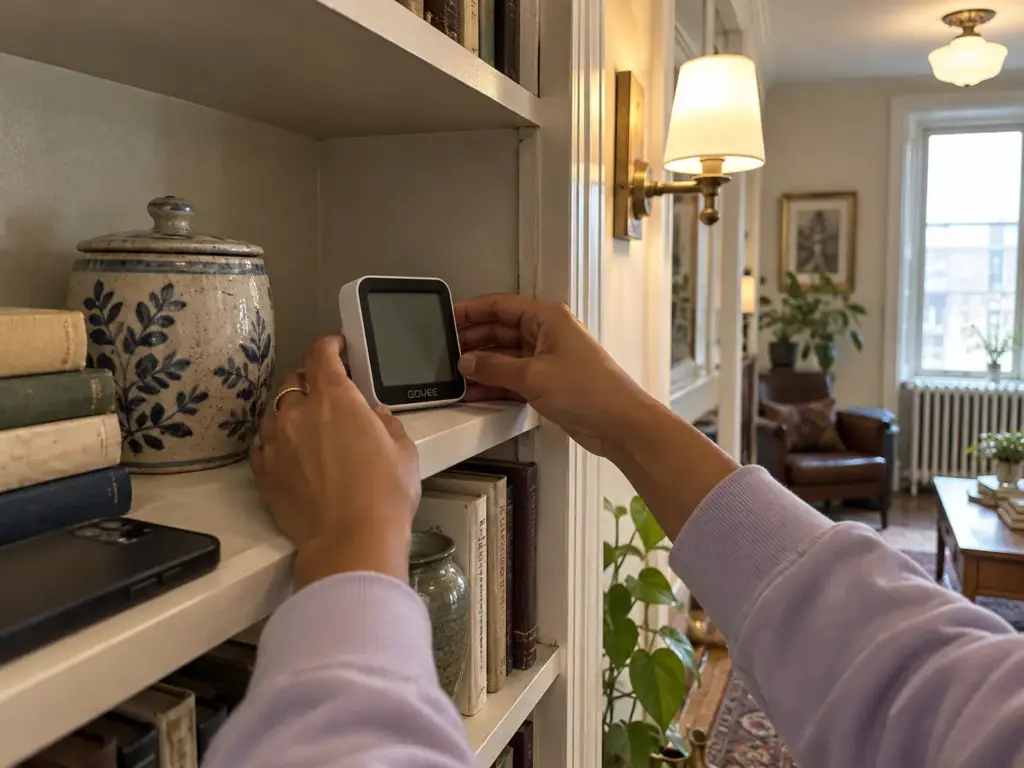
A hygrometer is a small, inexpensive instrument that hardware stores sell, as the EPA puts it, and a cheap one is enough to read a curve. What you need from it is a starting point. Write down the number at the moment the shower ends, right after cooking, when the dehumidifier is unplugged or when the rain stops, since each of those starts its own curve.
That reading is the top of the curve, and every later reading is measured down from it. Without the starting moment, a later reading is just a number with no history.
If the source has no clear ending, such as a leaky wall or a closed room, pick a moment anyway and say what you switched off at that moment. A reading is only comparable to another if you remember what was running during it.
Read the same spot at set times
Place the meter away from the bathroom door and away from the supply vent, at the height of the room’s air, and leave it alone between readings. The air next to a vent or a door is a different air from the room’s, and a meter that wanders from shelf to shelf draws a curve that is half movement. Where to set the meter goes through placement in more detail.
Then come back at set intervals: an hour after the source stops, a few hours after that, the same time tomorrow. Read it every hour if you can, though three or four readings across the first day are enough to draw a shape.
Writing every number down gets old fast, and an app does it for you. The Govee H5075 Bluetooth Hygrometer Thermometer graphs humidity over time in its phone app, so the fall from the peak is drawn without a notebook, and it can alert you when the reading leaves a range you set. The Bluetooth range runs up to 60 m (196 ft), and the temperature spec is ±0.54 °F (±0.3 °C).
The humidity spec is ±3 percent RH, and that band is the limit of what the test can tell you: a drop of one or two points is inside the noise on this meter, so only a fall bigger than that counts as movement. For a cheap humidity checker and how far to trust it, that tolerance is the thing to keep in mind.
If you would rather skip the app, the AcuRite 00613 Indoor Thermometer and Hygrometer is a display-only gauge with no log and no app, run on one AA battery. You read it by eye at your set times and keep the numbers in a notebook, which is enough to run the test. Two catches: the listing does not print the humidity accuracy, so you cannot say how far to trust a small drop, and the listing title describes a pack of five, which is more than one room needs.
Set the meter down once and leave it. The same meter that reads steadily on a shelf reads differently an arm’s length from the bathroom door right after a shower, and moving it between readings turns a curve into noise.
What the shape of the fall tells you
Three shapes come out of the readings, and each means something different. A fast room humidity drop that flattens inside the band means the source ended and the air was exchanged: the room has done what it was going to do. A fall that slows and stops short of your line, still above it, means the house is handing water back, which the next section explains.
And a number that holds level or creeps upward, with the source supposedly off, means something is still adding water. That last one is the reading to take seriously, because waiting will not move it.
The first reading you meet is often humidity at night, and why the number peaks at night covers why that shape looks different from a daytime fall. For this test, compare readings taken at the same hour on different days, so you are not mistaking the night cycle for a stall. Compare like with like, too: a reading taken after rain is not a fair match for one taken on a dry day.
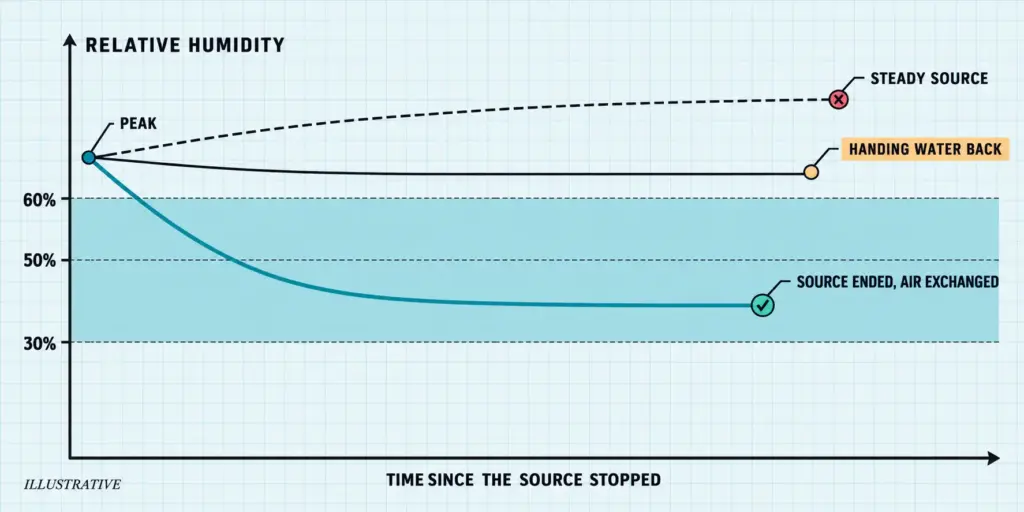
Hold your own readings against those three curves rather than against a number of hours. The curve that matches yours tells you which of the three cases you have.
A Fall That Stalls Means the House Is Handing Water Back
Carbon dioxide has a clock because exhaled air leaves with the air, and how long carbon dioxide levels stay high indoors is a question with a tidy curve. Water does not leave that way. It soaks into walls and finishes, and it comes back out. So a reading can drop and then refuse to drop further without any source running, which is where the stalled readings come from.

Walls and finishes take up water and give it back
A study from Chalmers University of Technology looked at hygroscopic surface materials, clay and gypsum plaster among them, under varying humidity and temperature. In a Chalmers University study on how wall materials take up and release moisture, the materials take up moisture and give it back as indoor conditions change, and the researchers built a model that predicts that response.
The practical reading: walls and finishes act as a slow store of water. When the room’s air dries, the store can hand some of its water back, so the fall slows or stalls even though nothing new is being added. That is the mechanism for a house that holds water, and it is one of the few parts of this guide backed by a study.
And the consequence is easy to miss. A stall does not prove a failed fix, and it does not prove a steady source either. It is what a drying room looks like partway through, which is why the shape over days matters more than any one evening’s number.
The purge that lowers the peak and then stops
The stall itself is not something a study has measured, so it is written here as a report. A repeated window purge can lower the daily high for a while, and then the number may stop falling. If you have opened a window every day and watched the peak come down a little each time, then stop coming down, that is a familiar shape.
A peak that returns slightly lower after each purge is what a drying wall would look like, and the day it stops dropping is either the day the slow part is done or the day a source is still there. The log cannot say which by itself; what it can say is whether the stall still moves a little each day (which fits a drying wall) or sits flat (which fits a source).
Other causes are worth checking in a house that stays far more humid inside than outside. Moisture stored in a new-build concrete floor, from moving in before the materials had dried, is one. Condensate from a drain that has not cleared, evaporating back into the house, is another. One answer pointed to moisture stored in a new-build concrete floor, from moving in before the materials had dried. Another pointed to condensate from a drain that had not cleared and was evaporating back into the house. These are places to look, not verified findings.
Reading it again after the dehumidifier is switched off
A dehumidifier lowers the number while it runs, and that makes it a good test of whether the source is still active. Once a unit is switched off, the reading can come back within hours.
No number of hours should be lifted from a single house. What carries over is the logic. If the reading climbs back quickly after the unit stops, the source was still running while the unit hid it; if it holds near where the unit left it, the room is more likely to have dried.
Watching that rebound by hand means checking the meter repeatedly through a day. The SensorPush HTP.xw logs on the device for 30 days with CSV export, with a typical accuracy of ±1.5 percent RH between 20 and 80 percent, so a stall that runs for days sits on the record without the phone open. The catch matters at the top of the curve: the listing says it can read up to 3 percent high after prolonged time above 80 percent RH, and the offset reverses below 80, so the first readings after a very wet spell may be slightly overstated. For a wall or a basement, reading a cold concrete wall over 24 hours shows what a log like this is for.
What to Change First, and How Long to Wait Before You Read Again
Once the fall has a shape, the next question is what to do about it. The order of the fixes, including the fan setting at the thermostat, is owned by the fixes in order, with a dehumidifier last, so this section covers only the timing: which change comes first, and how long to give it before the next reading.

The exit for the moisture comes first
The EPA’s fix list starts at the source and the outdoor air: vent moisture appliances such as the clothes dryer and the stove to the outside where possible, run the bathroom exhaust fan or open a window when showering, use air conditioners and dehumidifiers when needed, and open doors and windows when practical. A dehumidifier is one step among them, not the first.
For the fan, Healthy Building Science, an inspection firm, recommends running it about 15 minutes after a shower, with the right time depending on bathroom size, materials and windows, and suggests a timer switch. Treat 15 minutes as a starting point. Whether it was enough shows on the meter, not on the clock.
The usual advice breaks in shoulder season, though. Green Building Advisor reported in August 2026 that in mild, humid weather with the AC running little, a bath fan can pull more moisture into the house than it removes. The setting that was right in July can add water in October, and a fix that worked in summer and now does nothing is one sign the problem has moved from the AC to the weather.
That also explains a high reading that lasts a couple of weeks, sometimes months, when the fan does not reach the AC. It is not a verified figure, but it matches the mechanism: shoulder-season air carries water and the equipment barely runs to remove it.
In mild, humid weather, run the bath fan for one shower and read the meter afterward before you make it a habit. If the number rose, the fan was pulling water in, and the setting that worked in summer is the wrong one for the month you are in.
Why one change, then a full reading
You may have three ideas for tonight: open a window, run the fan longer, set up a dehumidifier. Try one. Then wait for the same hour tomorrow and read the same spot. The curve you get is the answer to that one change.
Stack all three and the number may fall, but you will not know which change moved it, and you will not know which one to keep when the weather changes.
But waiting for a full reading matters for a second reason: the walls need drying time. A fall that stalls partway can still be a drying room, and a change judged an hour after it is made may be judged during that stall. Give each change a day, compare it to the same hour on the day before, and only then move to the next one.
A stopgap that stops when you switch it off
A dehumidifier is a stopgap, and the rebound from the previous section is how you use it as a test. Run it, note where the reading settles, switch it off, and read again at set times. If the number returns within hours, the source is still running behind the unit. If it stays down, the room had dried and the unit has done its job.
Check the bucket before you trust a flat reading, since many units stop when it is full and a long run time may hide the fact that the unit quit hours ago. For how long a basement unit should run, how long to run a basement dehumidifier covers the timing of the stopgap.
Days Without Movement Turn the Question Into the Building
A reading that fell fast, a reading that stalled and a reading that never moved are three different answers, and only the last one stops being yours to fix. This section marks the point where the log is worth handing to someone else.

Days with the source off and no movement
If the source is off, the air is being exchanged, and the number still does not fall, the house is not a slow store any more. It is a source. The log is how you tell the difference: a stall that moves a little each day is a drying wall, while a flat or rising line is a steady source.
The EPA’s 24 to 48 hours now applies the way it was meant to. A material that stays wet beyond that window after a leak or spill is a building question, not a weather question, and no amount of waiting on the meter will change it.
Several days of flat readings, with every source switched off, is the cleanest thing a contractor can be shown.
A reading that creeps up, day by day
A line that rises a little each day with nothing new running points at the building. The causes to check are stored water from construction, a condensate drain that does not clear, and condensate from the AC. They are leads to test, not confirmed findings. What causes basement humidity and how to control it goes further for the readers who recognize a flat or rising line in a lower level. For anything on a wall, our guides on mold take over from here.
A line that stays flat through several days with every source off is the most useful thing to show whoever comes to look. Photograph the meter and note what was switched off, so the readings carry their own context.
What to bring to whoever comes
A week of numbers does more than a feeling. Bring the log, the meter’s stated accuracy, the room it was read in, and a list of what was switched off while it was read. With those, a contractor can see the shape instead of guessing at it.
Make One Change Tomorrow, Then Read the Same Spot Again
Three things are worth taking away. The reading falls once the source stops and the air is exchanged, and the clock is your own meter, not a number from a page. A fall that stops short is the house handing water back, which is not the same as a failed fix. And days with no movement, with every source off, turn the question into one about the building, with the log as the evidence.
By month two, read the same spot at the same hour after the same kind of day, and see whether the curve sits lower than it did this week. If it does, the changes worked; if it sits where it was, the source is still there.
For tomorrow, pick the one change that cost nothing, such as the fan after a shower or a window opened on a dry day, make it, and write the reading at the same hour the day after. When the number is lower and you know why, the next step is how to lower humidity at home.
Frequently Asked Questions
01How long does it take for indoor humidity to go down?
It falls once the source has stopped and the air has been swapped, but no sourced number of hours exists. The EPA’s 24 to 48 hours is for drying wet materials. Your own meter gives the answer for your room.
02Does having the AC on reduce humidity?
Yes, when it runs long enough to pull moisture off its cold coil, and a unit that stops early removes little. Read the meter after a full day, and see the summer guide for the fan setting.
03Is 70% humidity too high for a bedroom?
Yes, against the EPA’s line: 70 percent sits above the 60 percent ceiling. Read the room again at the same hour the next day, and look for the source that keeps adding water.
04Why does my humidity come back after I switch the dehumidifier off?
A quick return means the source is still running or the walls are handing water back. Take that as a report, not a rule.
05Does a bathroom fan lower humidity or raise it?
It removes moisture after a shower, with about 15 minutes as one inspection firm’s rule of thumb. In mild, humid weather it can pull more moisture in than it removes, so read the meter afterward.