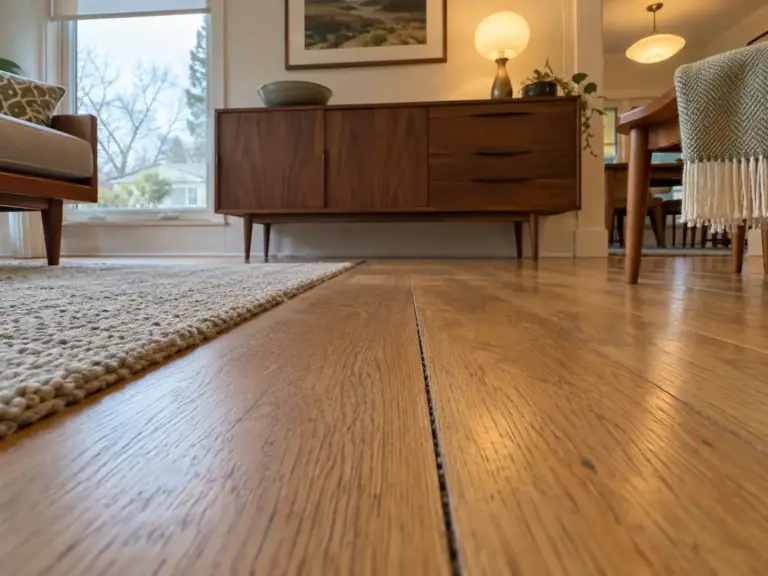
You wipe the lower edge of the bedroom window and your fingers come away wet, or you slide the sofa out and the wall behind it smells closed in. Why is indoor humidity important? Colder air holds less water, so the moisture in a room always lands on the coldest surface first, and a cold wall that stays wet is where the trouble starts.
How damp or dry air affects skin, breathing or sleep is a question for your doctor, and this guide stays with the house. It covers which way your house is off, the EPA’s number and where other numbers come from, what the water does where it lands, where it comes from, and the cheap meter that comes before any machine, starting with the ideal indoor humidity levels for the reader who wants the band settled.
Quick Answer
Indoor humidity matters because it decides where water lands. Air holds less moisture as it cools, so water comes out on the coldest surfaces first, the window glass and outside walls, and from there feeds mold and wall damage. The house reference is the EPA’s: below 60 percent relative humidity, ideally 30 to 50.
Which Way Your House Is Off Decides Everything Else
Before anything gets listed, there is one question to answer: is the house too wet or too dry? The two point in opposite directions, so the direction decides the first move, and the same number on a meter can sit on either side of the problem depending on the season. The neighbor whose windows sweat and the neighbor whose meter reads low in January are asking about the same number, read in opposite directions.
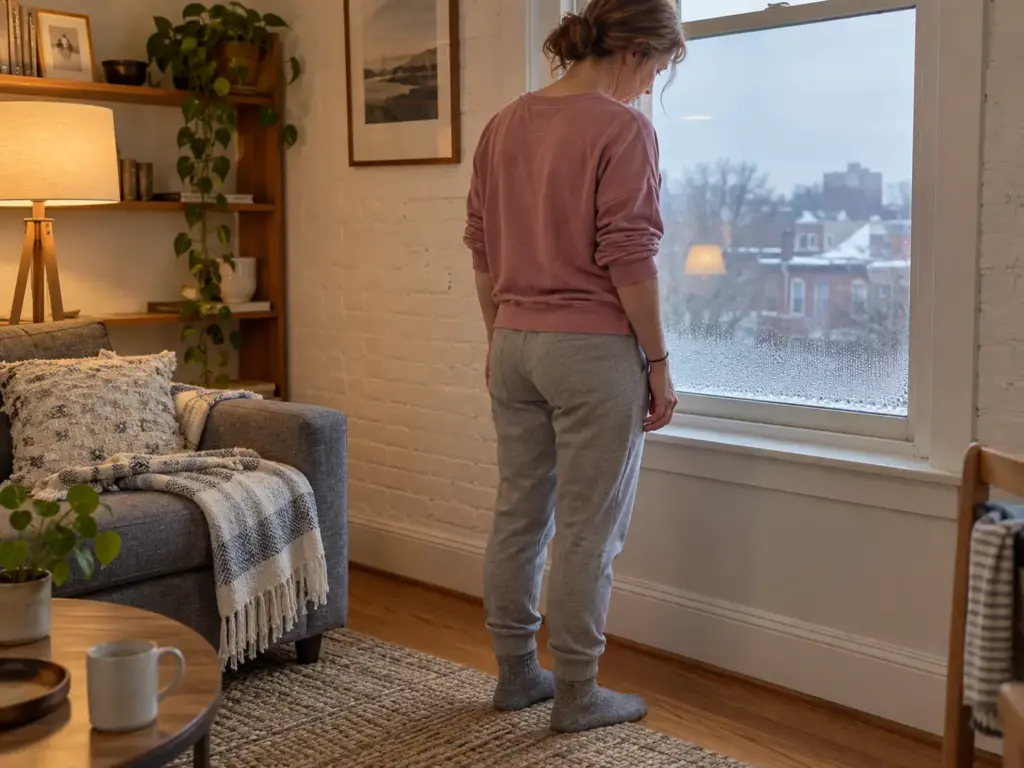
The wet side: the glass, the corner, the smell
The wet side is the one you can see. The EPA’s guide to controlling moisture in a home names the sign: excessive moisture collecting on windows and other cold surfaces (it words it as a humidistat set too high, which is the same reading seen from the humidifier’s side). The other signs are quieter.
A closed smell in a cold corner, a damp patch on an outside wall, the back of a bookcase that feels cooler than the room: each says that water is landing somewhere the air does not move. None of them needs a machine to confirm. They need a minute of looking.
The dry side: winter, and what the house shows
The dry side leaves fewer marks and asks for more reading. Cold outside air carries very little moisture, and heating that air indoors lowers its relative humidity further, so a house can read low in January with nothing wrong in it. A meter that reads low on a cold morning is the sign, and static on a doorknob is the one people name, though the number settles it better than the shock does.
Why indoor humidity can drop so low takes the cause apart. What matters here is that this direction needs a different first move than the wet one.
The one thing to read first on each side
On the wet side, read the lower edge of the coldest window. On the dry side, read a meter, because dry air leaves nothing on the glass. Neither needs a machine yet.
Having the data does not settle what to do. That is the gap a direction closes. A number alone says how much; the side it falls on says what to do about it.
The table sorts the signs.
| What you see | Which way | Read this first |
|---|---|---|
| Window glass wet at the lower edge | Too wet | The same spot on the next cold morning |
| A closed smell in a cold corner | Too wet | The wall behind the furniture |
| Moisture on an outside wall | Too wet | The wall surface, then a meter |
| Meter reads low on cold mornings, static on a doorknob | Too dry | A meter, over 24 hours |
| Meter reads inside the band | Fine for now | The same meter, again next week |
What Relative Humidity Actually Measures
The number on a meter is easy to read and easy to misread. It is a percentage, not an amount, and that is why one room can show a different figure in the afternoon than at dawn with nobody having cooked or showered in between.
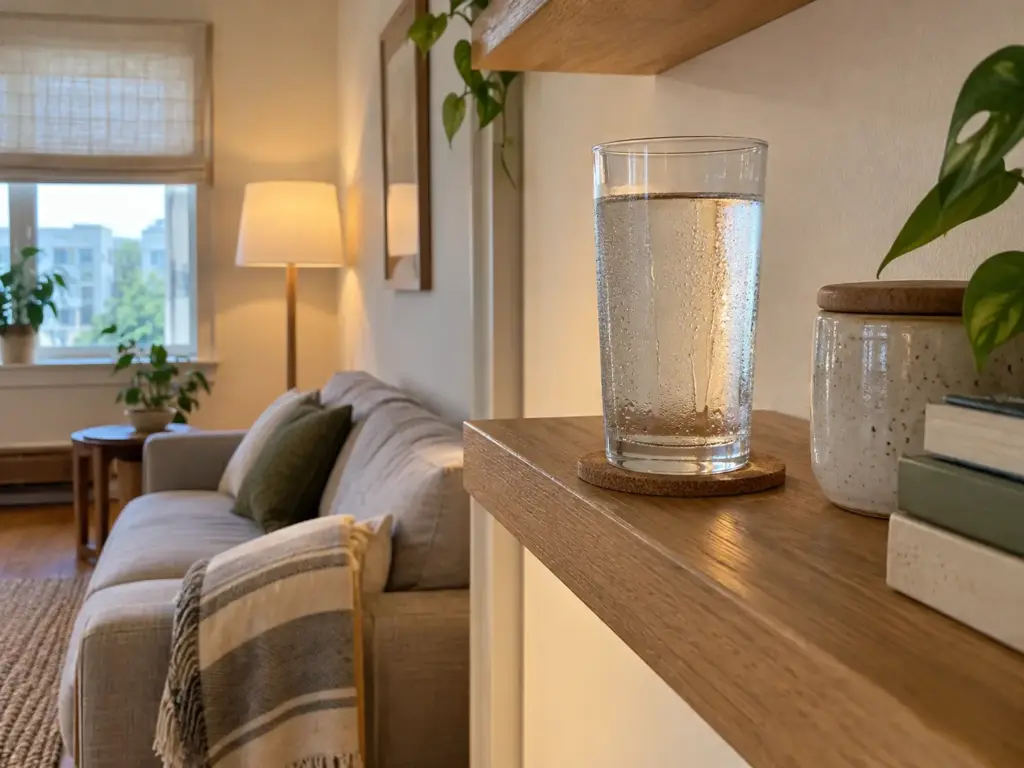
A percentage of what the air can hold
Relative humidity is how full the air is: the water vapor it holds, as a share of the most it could hold at its current temperature. A reading of 40 percent means the air is carrying 40 percent of its capacity. The capacity is not fixed.
The EPA’s moisture page puts the rule plainly, that as temperature falls the air can hold less moisture, so warm air has a high ceiling and cold air a low one. The same water is a small share in a warm room and a large share in a cold one.
Why the same water reads higher when the room cools
Take air at 70 °F (21 °C) and 40 percent. Cool it with no water added and the reading climbs, reaching 100 percent at about 45 °F (7 °C). That temperature is the dew point, the point where the air can no longer hold its water and droplets begin to form. Nothing was added; the room simply got colder than the water could stay a vapor.
So a meter left in one spot reads higher at dawn than in the afternoon whenever the room cooled in between. And that gap says nothing about the house. Why indoor humidity peaks at night takes the dawn reading apart.
Water Lands on the Coldest Surface First
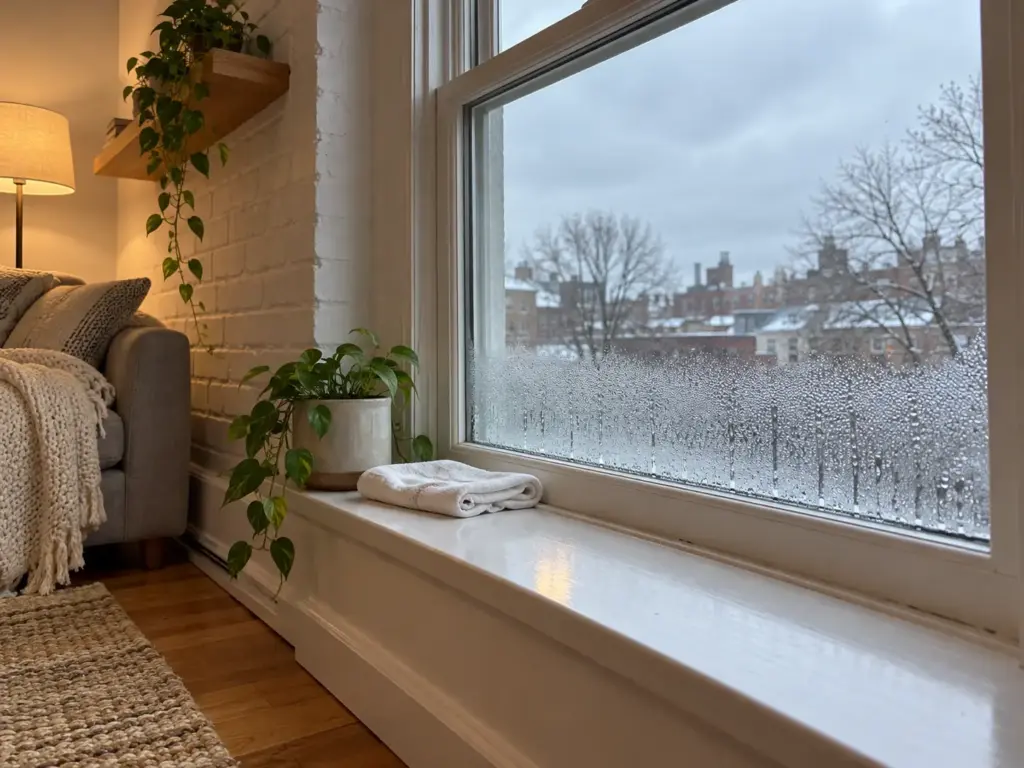
If the reading is a share of capacity, then the place where capacity runs out first is the coldest surface in the room. That makes a window a better instrument than a dial: you can see it from the chair, and it needs no battery. Window condensation is the earliest sign a house gives.
Why the pane sweats before the wall does
The EPA says excess moisture condenses on window glass because the glass is cold. A pane is usually the coldest surface a room has; a wall with insulation behind it keeps its room side warmer, so the glass crosses the line first. That order is useful.
The window warns you before the wall has anything to report. Whether one wet morning matters is a separate question, and whether condensation on windows is normal answers it.
How to read the glass like an instrument
Look at where it is wet and how often. The bottom third of the pane shows it first, and the top stays clear, so the height of the wet band is a rough scale of how far past the line the room has gone. A pane that is wet at the lower edge once in a cold snap and dry by noon says something different from a pane that is wet every cold morning: the first points at the weather, the second at the house.
The EPA’s brief guide to mold, moisture and your home states what the second one means: condensation can be a sign of high humidity. It is a sign about the air in the room, not a defect in the window.
Wipe the wet strip dry once, then look at the same height on the next cold morning. If it fills back in at the same line, the house is making that water. If it stays clear, the last wet pane was the weather.
What a warmer pane changes
The wet glass is also the cheapest thing in the house to fix. The EPA says storm windows and caulking around windows keep the interior glass warmer and reduce condensation there, and a storm window fitted on the inside works better than one on the outside. A warmer pane does not remove any water from the room.
It raises the temperature of the first surface the water would have reached, so the air has to be wetter before it lands there. For the full window story, how to prevent condensation on windows takes it from the pane outward.
What Moisture Does to Walls and Where Mold Starts
Once water lands on a cold surface and stays, the wall behind it is the next question. The harm to a house is slow, which is exactly why water damage gets missed: nothing happens on the day.
Why the damage is slow
The EPA’s wording is careful. Excess humidity for a prolonged time can damage walls, especially when outdoor air temperatures are very low. Both halves matter.
One humid afternoon does not do it; a cold month with a high reading is the case the EPA describes, because the cold is what keeps the wall surface below the line for weeks. A reading that was fine in summer can be wrong in January for the same room.
Cold corners behind furniture
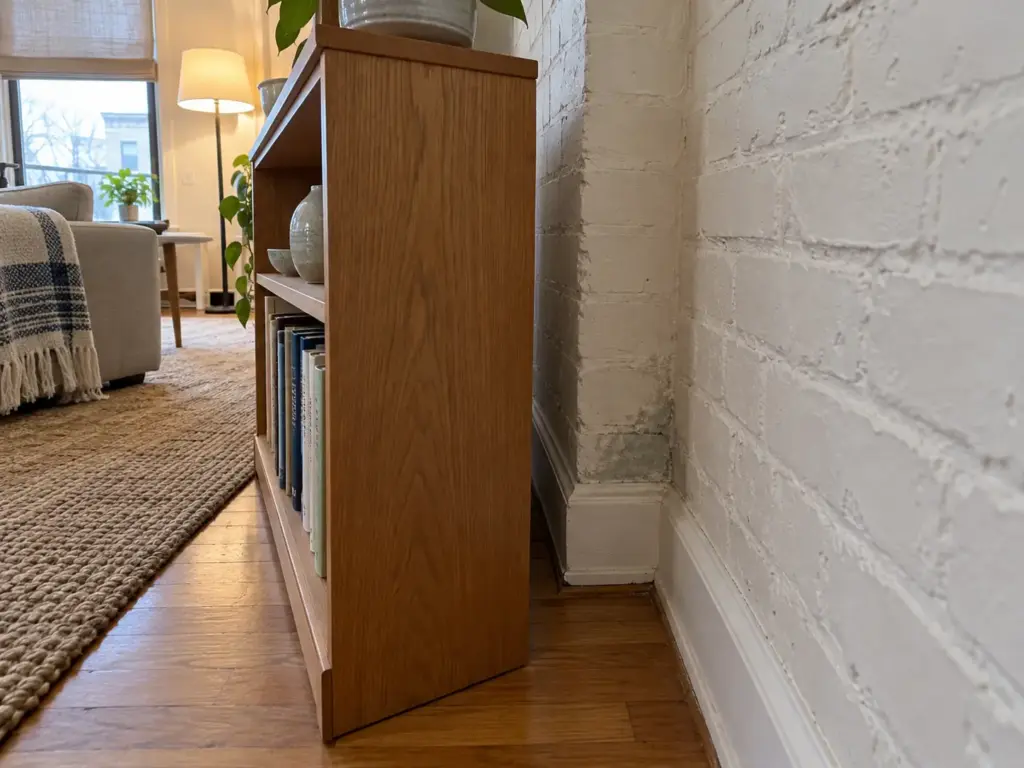
Move a bookcase out and put a hand on the wall behind it. It is often colder than the open wall beside it, and carries a faint musty smell, because furniture blocks the air that would have dried it. According to chapter 2 of the EPA’s mold course, “Mold is frequently found on walls in cold corners behind furniture where condensation forms.”
Still air does not carry water away, so the corner stays damp while the open wall dries. Pulling the furniture a few inches off an outside wall is a free change, and it is the first one to make.
Humid air alone can be enough
Mold does not need a leak. The same EPA chapter says that sometimes the humidity or dampness in the air can supply enough moisture for mold growth, which means a wall can stay wet from the air alone.
But a machine reaches only the air in the room. It does not reach a wall cavity behind drywall, or the dirt under a crawlspace. A dehumidifier can run for days in a sealed crawlspace and still leave the reading high, because the limit is the air it can reach, not the setting.
The crawl had no vents to the outdoors and loose plastic over the dirt. The unit worked; the water kept coming from below. When the wet spot is in the wall, the question is why mold grows on bedroom walls, and the answer is rarely a machine.
One Band, Three Sources, and Why They Do Not Match
Every page prints a different “right” number, and a reader with a meter has no way to tell which one is the standard. This section names the source for each figure used in this guide.

The house reference: below 60, ideally 30 to 50
The house reference is the EPA’s. According to the EPA’s brief guide to mold, moisture and your home, “If possible, keep indoor humidity below 60 percent (ideally between 30 and 50 percent) relative humidity.” Two lines live in that sentence. Sixty is the ceiling, the line above which you act.
Thirty to 50 percent is the target, where the room should sit. The EPA’s mold course prints the same band, which is the same agency repeating itself rather than a second check, so the firm part is the ceiling. The argument for the band itself stays with the page on ideal indoor humidity levels.
Why the ceiling falls in cold weather
The EPA’s moisture page prints a second table, and it changes what “inside the band” means. ASHRAE recommends maximum indoor humidity by outdoor temperature: 35 percent at +20 °F (−7 °C), 30 percent at +10 °F (−12 °C), 25 percent at 0 °F (−18 °C), 20 percent at −10 °F (−23 °C) and 15 percent at −20 °F (−29 °C). Those are the maximum levels ASHRAE recommends, as printed by the EPA.
Read them next to the 30 to 50 band and the conflict shows: at 10 °F outside, the maximum is 30, the bottom of the band. The band is a target for mild weather, not a winter ceiling.
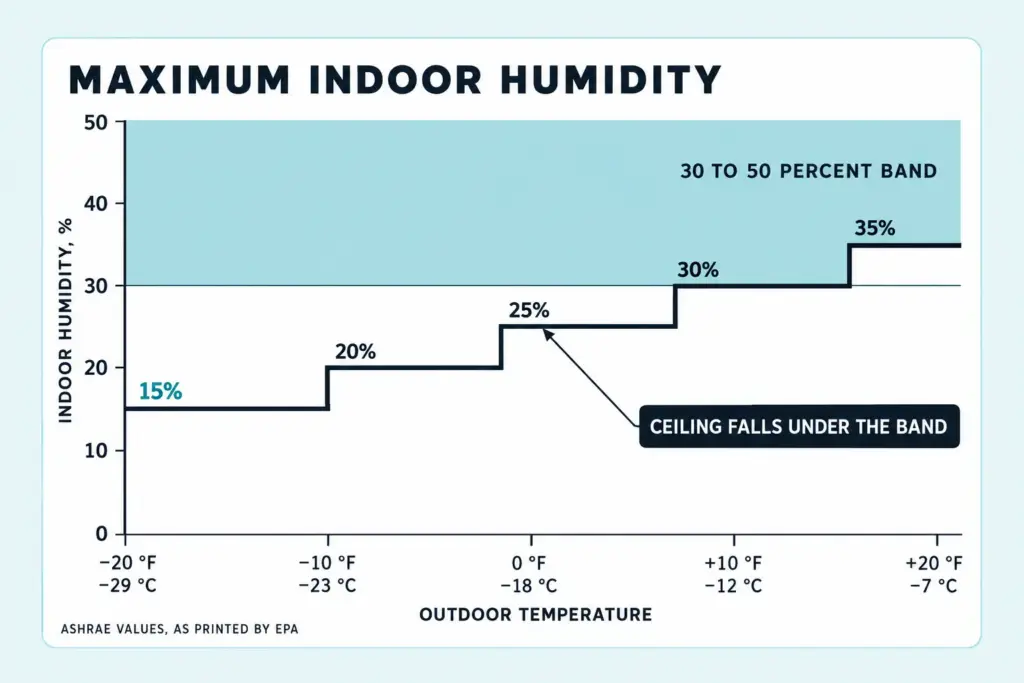
In a hard freeze, then, a meter can read 38 percent, comfortably inside the band, and the glass can still sweat, because the ceiling that day was lower than the band. So the same reading can be fine in October and too wet in the cold. How winter changes indoor humidity levels follows the ceiling through the season.
Why other pages print other numbers
A band of 40 to 60, one of 30 to 45 for winter, a rule of “under 55”: each is a real figure somebody printed, and they differ because they answer different questions. One is a comfort target, one a winter cap, one a summer cap, one a rule of thumb. When a number arrives without the name of the standards group that publishes it, it is a rule of thumb, and it is fair to call it that. This guide uses the EPA’s band and ASHRAE’s table, and says which is which.
When the House Runs Dry Instead
The same house can swing the other way in January, when winter dryness sets in. If the meter reads low and the heat runs all day, the cause is not a flaw in the house: cold air carries little moisture, and heating it lowers the reading further. Whether indoor humidity can be too low reads the dry side in full.
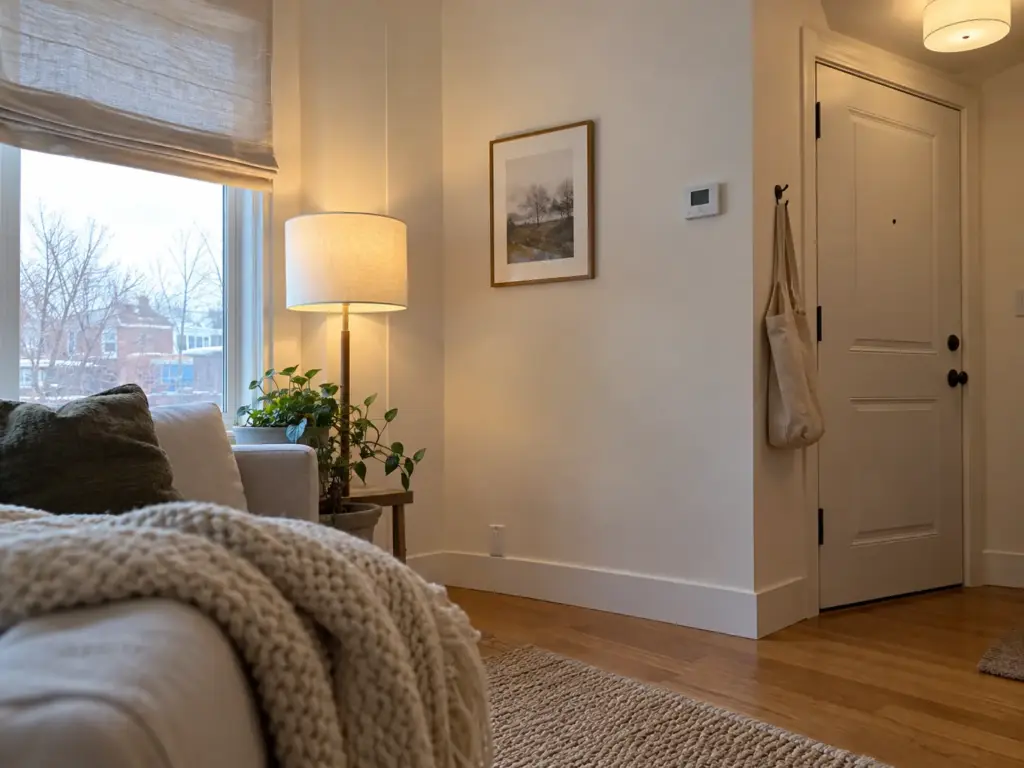
On this side the reading is the whole job; the meter, not a list of signs, is what says how far under the band the room sits. Static electricity on a doorknob is the sign people name for this side, and the meter is the better judge. The point here is the order.
Do not raise the humidity until the meter says the room is under the band, because raising it too far is how the glass starts to sweat; the EPA reads moisture collecting on windows as a humidistat whose set point is too high. A humidifier turned up after one dry morning is an easy way to put water back on the pane the following week. How to make the move in steps belongs to how to raise indoor humidity.
Where the Water Comes From, and When It Is the Building
You cannot choose a fix until you know whether the water is made in the house, carried in from outside, or coming through the building. This section sorts the three and points to the pages that go deeper. The third is the one to watch, because it is the one a machine does not answer.
Made inside: showers, cooking and drying clothes
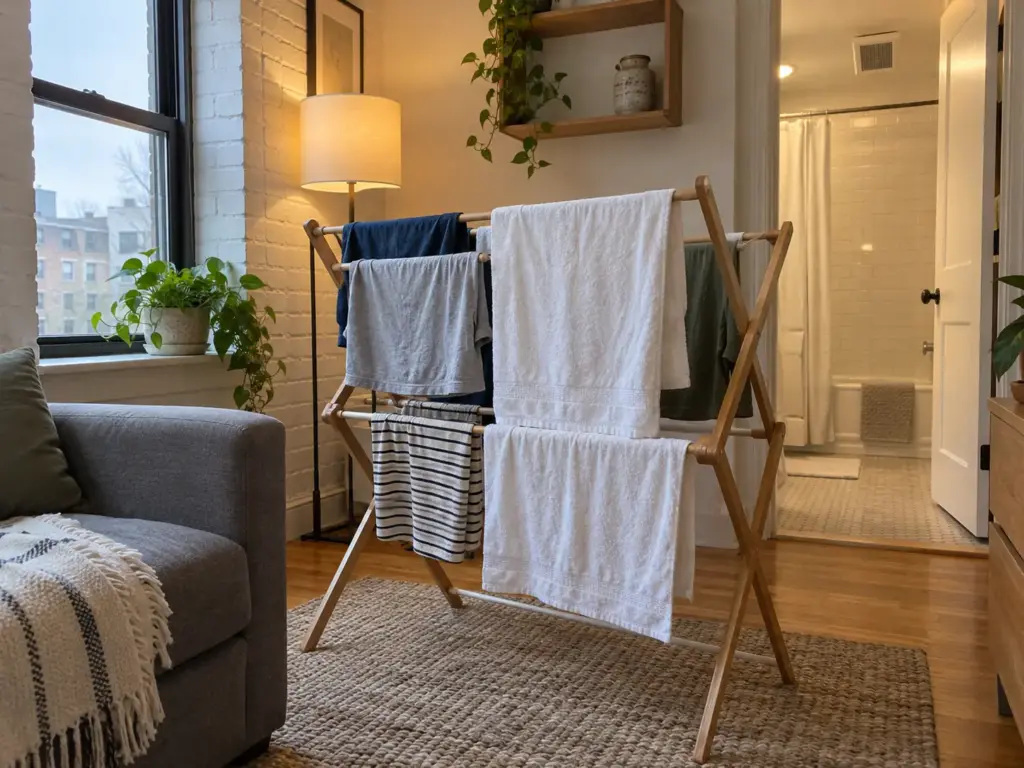
The EPA lists the everyday sources: showers, cooking, running water, boiling and steaming, plants, and drying clothes indoors. A tight, energy-efficient house holds more of that moisture, because it lets less leave. The everyday answers are the EPA’s too: run the kitchen or bath exhaust fan to the outside (not into the attic), vent the dryer outside, put a lid on the pot, and open a window briefly.
A renter who dries laundry on a rack in the one room that is already damp is feeding the room that can least afford it. If the house reads high and you cannot tell why, why your house humidity level is high walks through finding the source.
Carried in: outdoor air and the cold basement
Outdoor humidity comes in with the air, and a house in a wet season reads higher than the same house in a dry one. Why your house is more humid than outside takes up the cases where the inside is the wetter side. The basement is the other way water arrives: it is the coldest, most ground-coupled part of the house, so the cold-surface rule that wets a window wets a basement wall and floor.
What causes basement humidity sorts the routes. The EPA also flags carpet laid on concrete, which can absorb moisture and hold it.
Coming through the building: leaks and seepage
The EPA says water can enter a home by leaking or by seeping through basement floors, and its first fix is to stop that water at the source. Crawlspaces with high relative humidity are common sites of hidden mold growth, particularly over bare earth, and the EPA’s answers are a plastic cover over the dirt and a crawlspace that is well ventilated. With water intrusion, an appliance only chases the water. A leak, seepage or a wet wall is a job for someone who can look at the building, and more weeks of watching a meter will not change that.
A dehumidifier whose bucket fills every day while the meter reading never moves is not undersized. It is pulling water that keeps being replaced, and the source is the building, not the room’s air.
Read the Room Before You Change Anything
Before any change, get a number. A meter is the cheapest purchase in this guide, and it changes more decisions than a machine does, because it turns the glass’s hint into a figure you can read again.
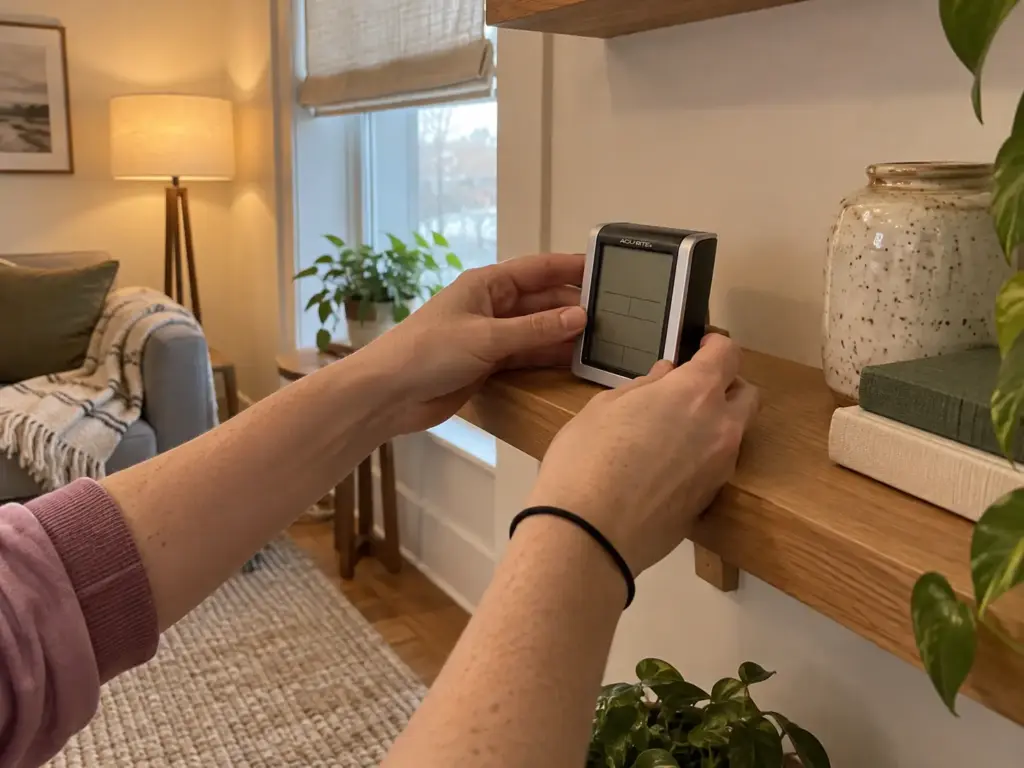
One reading is a clue, 24 hours is a direction
A single reading tells you where the needle sat at that moment, in that spot, at that temperature. A high and a low across 24 hours show the swing, and the swing is what points a direction. Compare the result with the EPA’s brief guide band: above 60 is the reading to act on, 30 to 50 is the target. How to measure indoor humidity covers where to put the meter and how many times to read it.
The free step still comes first, and the glass has already told you the side. A renter who bought a large dehumidifier to bring a room down to 50 percent found no difference in comfort apart from the chill of moving air, while it ran for hours a day. The right order is to get an accurate humidity sensor and verify the readings first. That order is the right one.
Keep the meter off the windowsill and away from the shower door. Air beside cold glass is cooler, so it reads higher than the room does, and you end up measuring the window instead of the house.
The cheap tabletop meter
The cheapest way to answer which side the room is on is the AcuRite 00613, a tabletop thermometer and hygrometer that runs on one AA battery and reads humidity from 16 to 98 percent. Its display keeps the high and low of the last 24 hours, which is the direction a single reading cannot give. The catch is precision.
Bob Vila’s hygrometer test included an AcuRite tabletop monitor with this same 24-hour display, and it was the least precise model tested, reading about 7 percent below actual levels, with no way to calibrate it (the test does not print a model number, so read that as the closest published test of this unit, not a measurement of the 00613 itself). Treat it as a direction, not a number: if it says 45 and the truth is nearer 52, it still tells you which way the day swings.
The step up with a phone history
When you want days of readings without standing beside the meter, the Govee H5075 logs to a phone over Bluetooth, with a listed range of up to 196 feet (60 m) and alerts when a reading leaves a range you set. Bob Vila’s test put its accuracy within 3 percent relative humidity and 0.5 °F, and found it near-perfectly calibrated out of the box and easy to adjust in the app. Its flaw shows up around month six. Amazon’s own AI summary of the reviews, which is a summary and not a review, says several customers report the device quitting within 6 months of use, and that the Bluetooth link gets mixed feedback.
Neither meter is the last word, and the gap between two of them is the margin of error to remember. Put two side by side in the same spot and note how far apart they sit; a few points is normal for cheap sensors, and it tells you how much to trust a reading that lands near a line.
Fixes in Order: Free First, Then a Machine
With the side known and the meter reading, changes come one at a time, and the meter gets read between them. A machine is the last step in the order, not the first, and it only belongs there if the free steps have not moved the number.
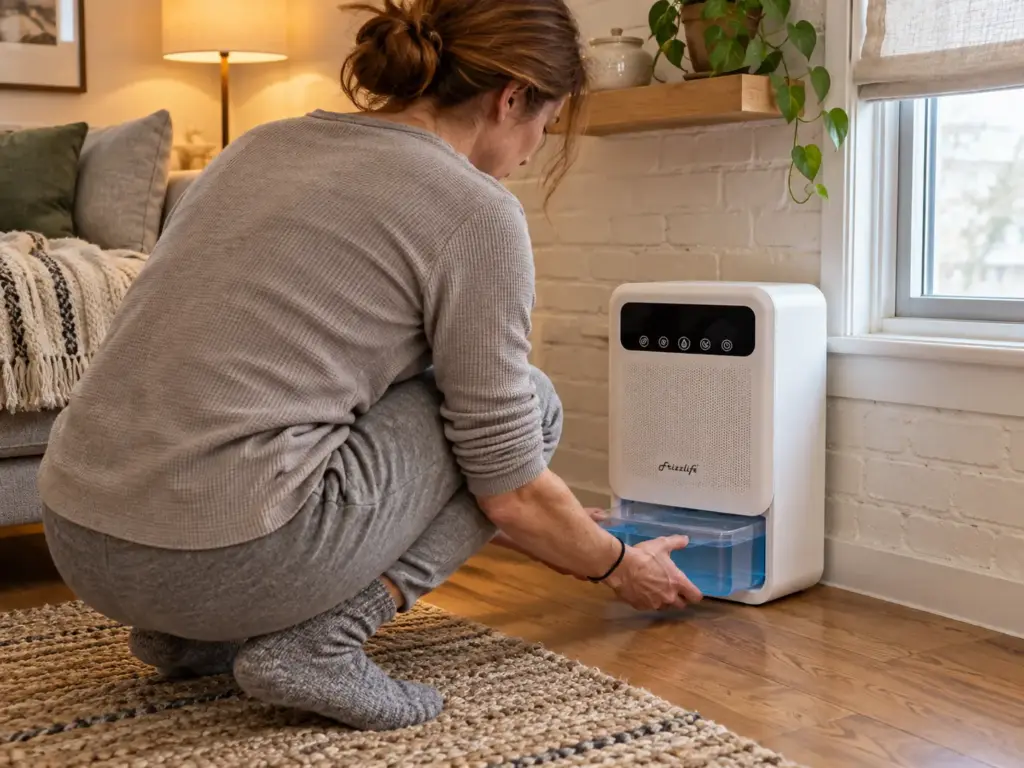
The free changes, one at a time
Start with the water you are making. Run the bathroom fan during and after the shower, and vent the dryer outside.
Read the meter. Next, put a lid on the pot and keep the shower door closed with the fan running, and read again. Then make the glass warmer: caulk around the windows and fit a storm window, which the EPA says keeps the interior glass warmer and reduces condensation there.
Read once more. Three changes, three readings, and you know which one worked. The page on how to lower indoor humidity levels lays the same ladder out in full.
Change one thing, then give the room a day or two before the next reading counts. A meter read an hour after a change shows the change settling, not the result.
If the room reads wet: a small dehumidifier, and its limit
If the reading is still above the line after the free steps, a small one-room unit is the machine to consider for a reader with one window and no ducts. The Frizzlife DH80 is a semiconductor unit rather than a compressor, with a 135 fl oz (4.1 L) tank, a 28 dB sleep mode, auto shut-off and a 1 to 24 hour timer. Read its limits before you read its rating.
The listing itself says the DH80 “does not simply lower it”, describing a unit that holds humidity within a range and is affected by room size, temperature and ventilation. Its 40 oz a day is tested at 86 °F (30 °C) and 80 percent humidity, a hot, wet room, which is more water than an ordinary bedroom offers it, and the listing prints no coverage area. There are only 25 ratings behind it, so it has no long track record to read yet.
Match the machine to where the water is. A small unit sized for one room does nothing about a crawlspace or a wet wall, which is the lesson of the 50-pint unit that ran four days without moving a reading. When you are choosing one, what to look for in a dehumidifier covers the specs that decide it.
If the room reads dry: a humidifier that holds a target
If the meter reads under the band, confirm it on a second reading and check for a draft before buying anything. When a humidifier is the right call, the Levoit Classic 300S holds a target without a timer, because it has a built-in humidistat. RTINGS lists a 6.8 L (1.8 gal) usable tank and an advertised coverage of 505 ft², and its Auto mode aims for 40 to 50 percent by default.
That default is the first thing to change. Against the ASHRAE table, 40 to 50 is above the maximum whenever it is colder than about 20 °F (−7 °C) outside, where the ceiling is 35 percent, and a humidifier chasing 45 on a freezing night is how the glass starts to sweat. RTINGS says the target can be changed in the app, so set it by the outdoor temperature and not by the default. The other cost is upkeep.
RTINGS calls it “a bit of a hassle to clean”: none of the parts are dishwasher-safe, and the tank has tight spots that are hard to reach. For the steps of the move itself, how to raise indoor humidity is the page that owns them.
Read the Lowest Edge of Your Coldest Window Before You Buy Anything
Three things carry over from all of this. Indoor humidity matters because it decides where water lands, and the coldest surface takes it first. Read the direction before the number, and read the number against the EPA’s below 60 percent, ideally 30 to 50, remembering that the ceiling drops in the cold. Change one thing at a time, free changes first, and read the meter between them.
In a month, set the two meters side by side again and see whether they still agree, and look at the glass on the first cold morning. If a meter has drifted or quit, you will find out then, not in the middle of a winter you were sure you had measured.
Tomorrow, look at the lower edge of the coldest window in the house and write down which way it points: wet, clear, or a reading that says dry. Then take that to the ideal indoor humidity levels page, which turns the direction into a number worth acting on.
Frequently Asked Questions
01How bad is 70% humidity inside?
At 70 percent, indoor humidity is above the EPA’s below-60 line. For the house, that means the coldest surfaces will collect water and mold has the moisture it needs, so find the source and read the glass.
02Does having AC on reduce humidity?
Often it does: an air conditioner’s cold coil pulls water out of the air, but it depends on the unit and the room. If the glass still sweats with the AC running, the source is still inside the house or in the building.
03Is 80% humidity in a bedroom bad?
At 80 percent, a room is well above the EPA’s ceiling of 60 percent, so water will land on cold surfaces overnight. Check the meter against a second one first, since a cheap meter can read several points off.
04Is 90% humidity in a house bad?
At 90 percent, the air is wet enough that a machine alone will not fix it. Look for a leak, seepage or a closed-off space first, and call a professional if the source is in a wall or the crawlspace.
05Can I trust a cheap hygrometer?
Trust a cheap hygrometer for direction, not for the last point. One test found a cheap AcuRite monitor reading about 7 percent low, with no way to calibrate it, so put two side by side and note the gap.