
The AC has been running since lunch, the thermostat says the house is cool, and the room still feels damp the second you walk in. So why is my house humidity level high when the air is cold? Because cool and dry are two separate readings, and only the hygrometer on the shelf tells you which one you have.
A number that high is rarely “the house” in general: it is moisture arriving faster than the house gets rid of it, and the pattern of the reading (when it climbs, where, with the AC on or off) says which moisture source is running. The sections below follow the number first, then the moisture you make, the AC and its fan, the one room and the rain, and finally the stopgap and what it does by month two.
Quick Answer
A house reads high when moisture arrives faster than it leaves. The pattern of the reading names the source: a jump after the shower, a rise once the AC stops, one closed room, or a climb in the rain. Change the one you can switch off or vent, then read the number again.
Read the Number, Then the Hour It Moves
One reading says the house is damp and says nothing about why, and a machine is the wrong first answer to a single number. This section fixes the line, shows where the meter belongs, and turns one reading into a pattern, so each section after it can say “if it looks like this, look there.”

Where the Line Sits and What a Meter Costs to Trust
The reference is public and short. According to the EPA’s guide to mold and moisture, “Keep indoor humidity low. If possible, keep indoor humidity below 60 percent (ideally between 30 and 50 percent) relative humidity.” So 60 is the ceiling that sends you looking for a source, and 30 to 50 is the band you are aiming for.
The all-year version of that target lives in the number to aim for in any season; this article only needs the ceiling.
A meter is a small, inexpensive instrument, and where you put it matters more than which one you pick. A meter on a shelf beside the kitchen doorway reads the stove, not the house. Set it at chest height in the middle of the room’s air, away from the AC’s discharge, the bathroom door and the stove, because a sensor beside any of them reports that spot rather than the room.
Remember that a humidity percentage is relative to temperature. Compare readings from the same hour, never a cold night against a warm afternoon.
The Govee H5075 reads humidity and temperature and talks to an app over Bluetooth, which makes it the easier one for spotting a pattern across a day. The AcuRite 00613 is the budget way to do the same job: a 3-inch display you read by eye and write down on paper, which is enough to see the 60 line and the change after one fix.
Neither listing states how far off its humidity reading can be, and the Govee listing does not confirm that its app keeps a history, so run two meters side by side for a day before you believe either one, because a cheap sensor can sit a few points off. If you want to sort the cheap ones before buying, how to trust a cheap humidity checker goes through it. You can find the Govee H5075 here and the AcuRite 00613 here.
Three Readings That Tell More Than One
You glance at the meter and it sits well above the line. Soon after the shower it has jumped, and by evening it has settled back. That movement is the information the single number hides, and three readings capture it:
- Just before a shower or before you start cooking.
- Ten to twenty minutes after, with the room as you left it.
- Late in the evening, with the AC off or idle.
Write them down for two or three days. A house that spikes and settles has a different problem from one that never settles, and the table below says which is which.
The Pattern-to-Source Table
Each row is a way the reading can behave, the source it points to, and the free check to run first. These are mechanisms, not thresholds: none of them needs a number to be useful.
| What the reading does | What it points to | The first free check |
|---|---|---|
| Jumps at the shower or the stove, then falls back within an hour | Moisture you make | Run the exhaust fan |
| Stays high after the AC shuts off | The AC and its fan | Set the blower to AUTO and read between cycles |
| High in one closed room only | The room or its wall | Open the door and read both sides |
| Climbs when it rains | The building | Look at the wall, the attic and the crawlspace |
| High no matter the weather | The ground or a leak | Look for wet materials |
If you are reading this in winter, a high number usually has a different cause, such as a humidifier set too high or glass that sweats against the cold, and how the winter number shifts with the cold covers that case.
A Jump at the Shower or the Stove Is Moisture You Make
The pattern that clears fastest is the one that peaks right after something in the house uses water. It is also the cheapest to fix, because the source is a switch. This section ties the jump to the shower, the stove, the dishwasher, laundry and the dryer vent, and gives one free change for each.
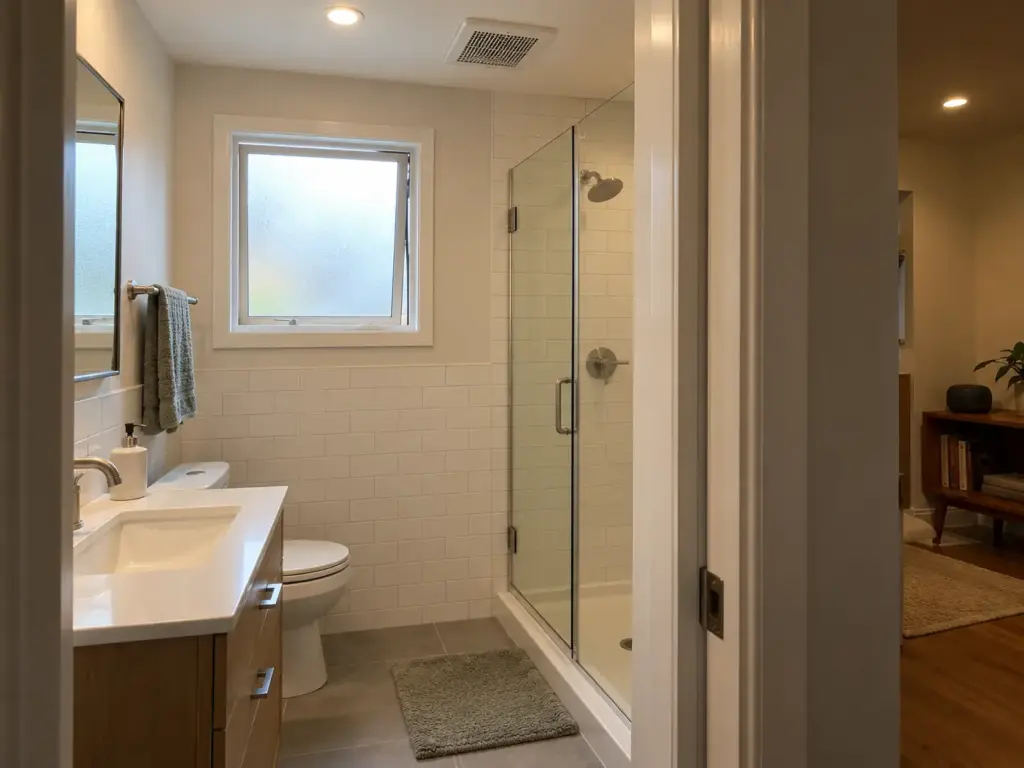
The Shower and the Stove
The bathroom mirror clears, but the hallway meter stays up long after. The steam did not leave; it spread. The EPA’s advice for this is plain: run the bathroom fan or open a window when showering, and use exhaust fans or windows when cooking or running the dishwasher. A fan only helps if it sends the air outside, and a bathroom fan that vents into the attic does not remove the moisture, it relocates it to a place you rarely check (section four comes back to that attic).
The method matters as much as the fan. Change one thing: run the fan through the shower and for a while after it, then read the meter at the same hour the next day. Do not also move the AC setting that day, because two changes at once leave you unable to say which one worked.
Laundry and the Dryer Vent
A clothes dryer exhausts the water from the load it is drying. The EPA says to vent moisture-producing appliances, dryers and stoves among them, to the outside where possible, and a dryer that vents indoors puts its water straight into the house. Laundry drying indoors on a rack in a closed room does the same thing more slowly, like a small humidifier left running. If the jump in your log lines up with laundry day rather than the shower, the vent is the first thing to trace.
Reading It Again After One Change
Once you have made the one change, the second reading is the verdict. If the number now falls back faster after the shower, the source was the one you vented. If it does not, the fan was not the answer and the next section is. For the full order of free fixes, how to lower humidity at home lays it out; this article stays on finding which one applies.
Read the meter just after the shower and again an hour later. If the second reading is not lower, the fan is not your source, and the AC is the next suspect.
Still High With the AC Running Is the Fan Setting and the Run Time
An AC removes moisture only while its coil is cold and wet, so a house can feel cool and still read high. The one setting that decides whether that water leaves the house or returns to it is already on your thermostat, and it costs nothing to test.
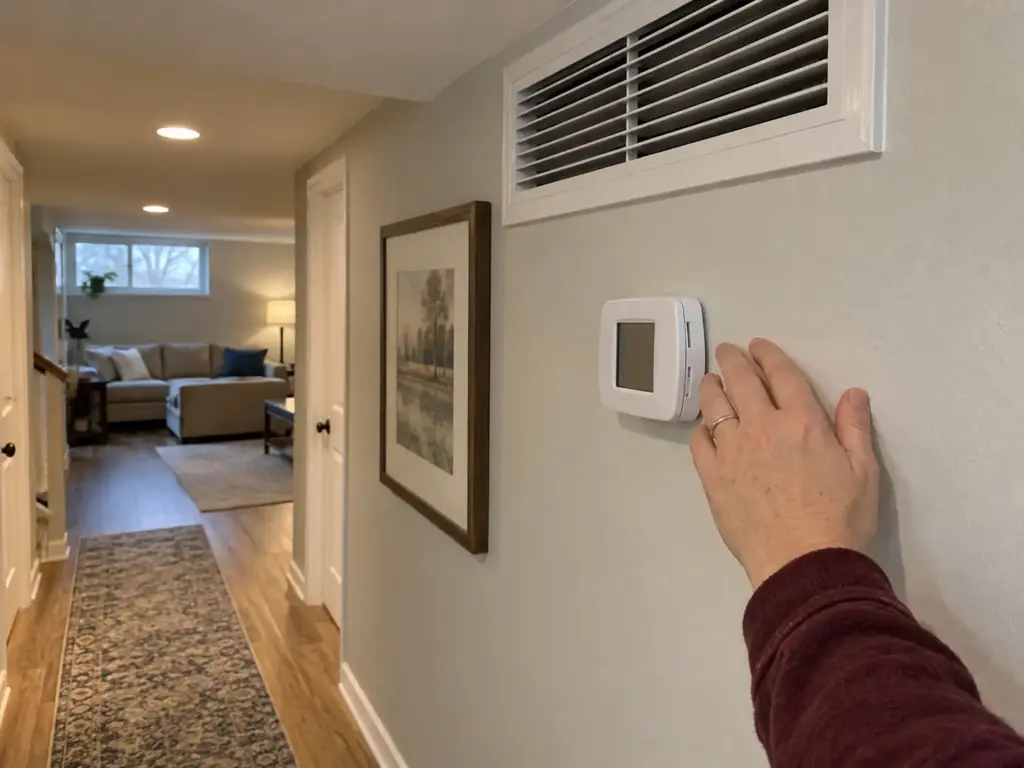
Why the Water on the Coil Can Come Back
You hear the compressor stop, the blower keeps going, and the air coming out of the register feels damp. That is the moisture on the cold coil being picked up again. A Florida Solar Energy Center study on fan settings found that “net moisture removal was reduced significantly when the fan operated continuously,” and that a fan running after the compressor stops re-evaporates some of the condensed moisture from the cooling coil and drain pan back into the space. The same coil-water mechanism shows up at the window, which is the subject of why condensation shows up when the AC is on.
The usual name for this failure is dragging humidity back into the house, and the first thing to check is the fan setting: is the blower set to auto or on?
The Fan Test: AUTO, Then Read Between Cycles
This test is the article’s own design, with the study as its mechanism. It is a way to find out, not a promise:
- Note the meter’s reading at a set hour, with the blower on ON if that is where it sits now.
- Set the blower to AUTO and change nothing else.
- Let the system run through several normal cycles.
- Read the meter at the same hour and compare.
If the number drops, the fan was putting water back. If it does not move, cross the fan off and keep tracing. Either way you now have a before and after rather than a guess.
Short Runs, Thick Filters and the Blower Speed
A cycle that ends too soon cools the air without pulling much water off the coil. That short cycling is the second thing to look at, and an oversized AC is a common reason for it: the air conditioner cools the room fast, stops, and the coil never has the AC run time it needs to drop the air below its dew point and drain the water away.
Much of the dehumidifying happens in the first minutes of a run, so a system that only runs in short cycles may miss much of it. Very short runs can mean the unit is oversized for the house, which is worth checking with the installer. Take both as one person’s rule of thumb each, not a standard.
Airflow is the third. Airflow matters as much as runtime: pulling a thick filter out of a return can push the humidity up within a day.
Too much air moving over the coil leaves no time to condense and drain the water, and a blower sized too large for the ductwork can do the same. A restrictive filter slows the air and a bulky one is not automatically wrong; the runtime and the airflow have to be right together. If your reading rose after a filter change, that is the first thing to undo and read again.
None of that is checked against a standard page; the study covers duty-cycling devices, and these are what people reported. A window unit follows the same coil rule, but its fan knob is the only setting you have, so the same AUTO-style test applies if the unit has one. For where the fix order goes from here, the summer order of fixes owns the rest of the sequence.
Change only the fan setting, and read the meter before you touch the thermostat temperature. A new setpoint moves the cooling and the fan test together, and you lose the answer.
High in One Closed Room, or After Rain, Is the Building
When the house reads fine and one room does not, or the number climbs on a rainy day, the moisture is arriving from outside the air itself. No setting on the thermostat will move it. This section separates the building case from the air case with a free test, and says when the fix is not a purchase.

One Room Reads Higher Than the Rest
You shut the spare-room door and, a day later, that room’s meter reads higher than the hallway’s. Read the same hour in the room and in the hallway, door open and then door shut.
A gap that opens only with the door shut points to the room (no air moving in or out, a source inside, or a cold wall), not to the whole house. An interior room with no window and a tight door, or a gap under the door that moves too little air, behaves this way. That is a very different job from fixing the AC.
The Number Climbs with Rain or a Storm
A reading that rises with a rainy day is the building taking on water, not the air making it. Outside air gets in through air leakage and infiltration, and through an attic whose ventilation is not doing its job. Look for disconnected vents and duct leaks in the attic, and check where the ducts attach, since leaks there let attic air into the house.
Checking the attic on a schedule is worth it, because during a long storm the air there can reach near 100 percent and water can drip from the ducts. After a storm that stalled over the house for a week, the humidity there was close to 100 percent and water was dripping from the duct work.
A plugged AC overflow drain is another source, since water backs up in the pan. Neither is a setting, and a rental or a house with no attic access can still apply the same logic to the walls it can see. If the inside seems wetter than the weather outside would explain, why your house is more humid than outside walks through the mechanism.
Ground water belongs here too. A crawlspace, a basement and a slab can all feed the reading in every weather, which is the “high no matter the weather” row of the table. The causes are the subject of what causes basement humidity, so this article only tells you to look.
When a Wet Spot Lasts Past Two Days
The EPA says to dry wet materials within 24 to 48 hours to prevent mold. Turn that around: a spot that stays damp past two days is a building source, not a humidity setting.
The same guide treats condensation on windows, walls or pipes as a sign of high humidity, so the glass is a reading, not only a window problem. The damp that returns to the same wall after a dry week is not the air. What a lasting wet wall becomes is the story of why mold grows on bedroom walls and ceilings.
Shut the door of the suspect room for a day, then read both sides at the same hour. The gap between them tells you whether the room has its own source or the whole house does.
The Stopgap and Month Two: A Dehumidifier That Stops at a Full Bucket
When the source is outside your control or still being traced, a standalone dehumidifier in the main room is the usual stopgap. It is also where the story changes by month two.
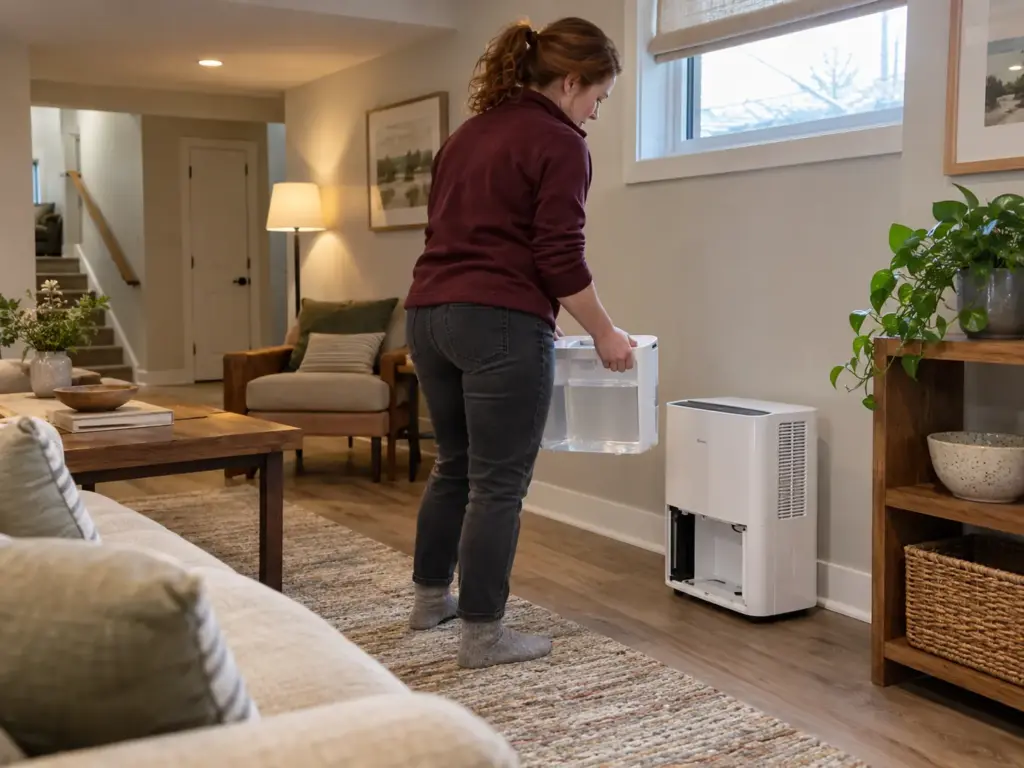
What a Stopgap Buys You
A dehumidifier with a built-in pump and a humidistat is the usual stopgap, rather than a whole-house unit, while the source is found. It buys you time and a lower number, and that is all it buys. It lowers the reading without touching the cause, so keep taking the reading at the same hour while you trace.
A unit that runs all week and holds the number flat is telling you the source is still there. For the setting to run it at, what humidity to set your dehumidifier to is the next stop.
The Bucket, the Pump and the Drain
The flaw that repeats is simple: a standalone unit stops when its bucket fills, and the room stays high. A standalone unit that stops when its bucket fills runs only off and on, and the reading stays high in between. If the pump is left off, the bucket fills and shuts the unit down.
A pump and a drain line only fix that if the line is actually connected. The AC’s overflow drain deserves the same look, since a plug there sends water back into the house. A smart plug on the fan and the dehumidifier lets both be switched from an app.
Put the dehumidifier on a smart plug only after the drain is set. A full bucket that stops the unit is the problem people run into most often.
The Reading a Month From Now
Month two is when the stopgap stops being a stopgap. Check the bucket or the drain line, the AC’s overflow drain, and the attic or crawlspace on a schedule rather than once, because a single look can miss what regular checks catch. How long the moisture takes to leave once the source is fixed depends on the house, and how long high humidity stays indoors gives the recovery time to expect.
One Change for Tomorrow, and the Number to Read After It
Three things carry the rest. The EPA’s line is 60 percent, with 30 to 50 percent as the target. The pattern of the reading points to the source (shower, fan setting, one room or rain), and the free change for that source comes first. And one change, then read the number again: a dehumidifier is the stopgap that hides the source, not the answer to it.
A month from now, read the same meter at the same hour, look at the bucket and the drain, and take the reading after the first heavy rain. Those three tell you whether the change held.
For tomorrow, pick one. Either set the blower to AUTO, or run the exhaust fan through the shower and for a while after, then take the reading at the same hour the day after. Once the source is found and the number still needs help, what to look for before you buy a dehumidifier is the next decision.
Frequently Asked Questions
01How do I fix high humidity in my house?
Change one thing at a time, free ones first. Run the exhaust fan through the shower, or set the blower to AUTO, then read the meter again at the same hour. The full order of fixes is in how to lower humidity at home.
02Is 70% humidity in a house too high?
Yes. It is above the EPA’s ceiling of 60 percent. Read the meter again the next morning at the same hour, then start with the source your pattern points to: the shower, the fan setting, one room or the rain.
03Should I turn on the AC if humidity is high?
It can help, because the AC removes moisture while its coil is cold and wet. If it runs too briefly, or the fan is set to ON, the water can return to the rooms. Try AUTO and read the meter between cycles.
04Is it bad to live in a house with high humidity?
For the house, a reading above 60 percent gives mold the moisture it needs, and glass or walls that sweat are a sign of it. Whether it affects a person is a question for a doctor.