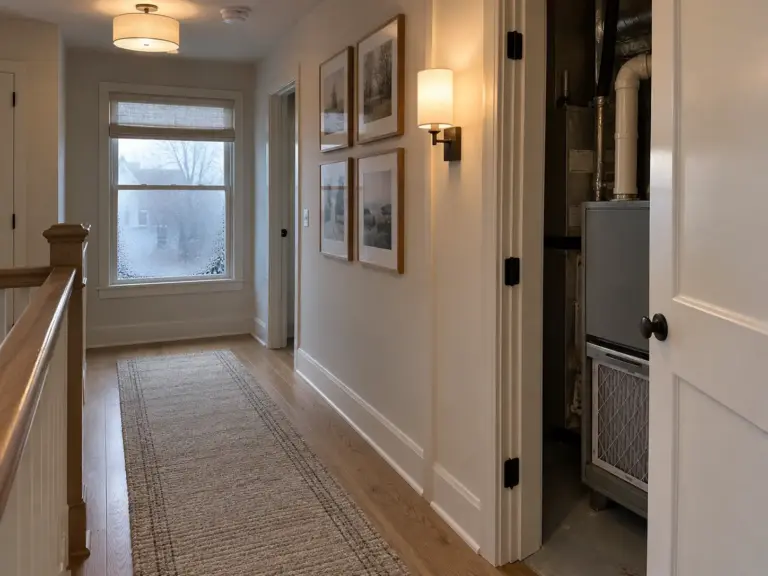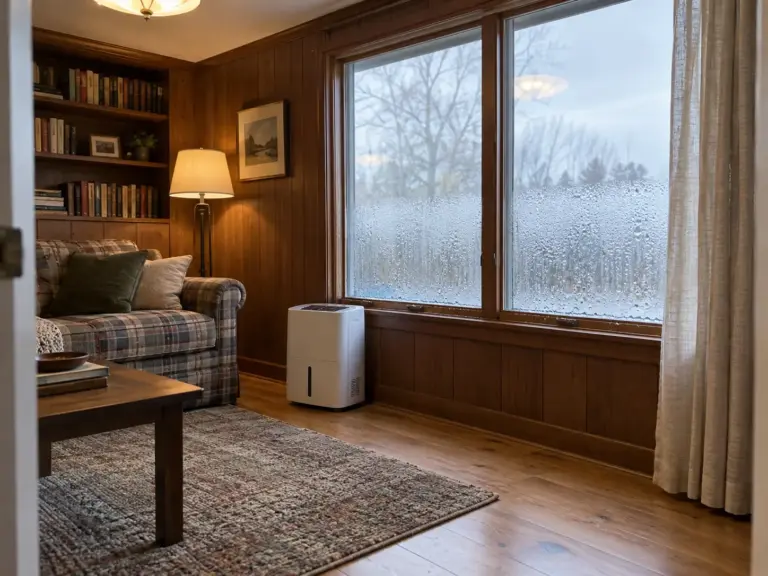
The unit has been running for an hour, the room feels cool, and the glass along the bottom of the pane is beaded with water. It looks like the air conditioner is making it, but condensation on windows when the AC is on is almost never water the unit added. The unit cools the room and, more to the point, the glass, and the moisture the house already holds settles on the coldest surface it can find. What follows is how to read the room with the unit running, tell fog over the whole pane from fog beside the unit, adjust the setting, sort the unit’s own drip from the room’s moisture, and put the fixes in order.
Quick Answer
The AC adds no water to the house. It chills the room and the glass, and moisture already in the air condenses wherever the pane drops below that air’s dew point. A humidity reading taken with the unit running, plus where the fog sits (whole pane or only beside the unit), shows whether the room or the unit is the cause.
The Unit Cools the Glass, but the Water Was Already in the Room
Before any fix, it helps to settle what an air conditioner does to moisture and what it cannot do. The unit pulls some water out of the air as a side effect of cooling, and it makes every surface it blows on colder. The fog is the result of those two things racing each other.
What the Unit Takes Out and What It Cannot Add
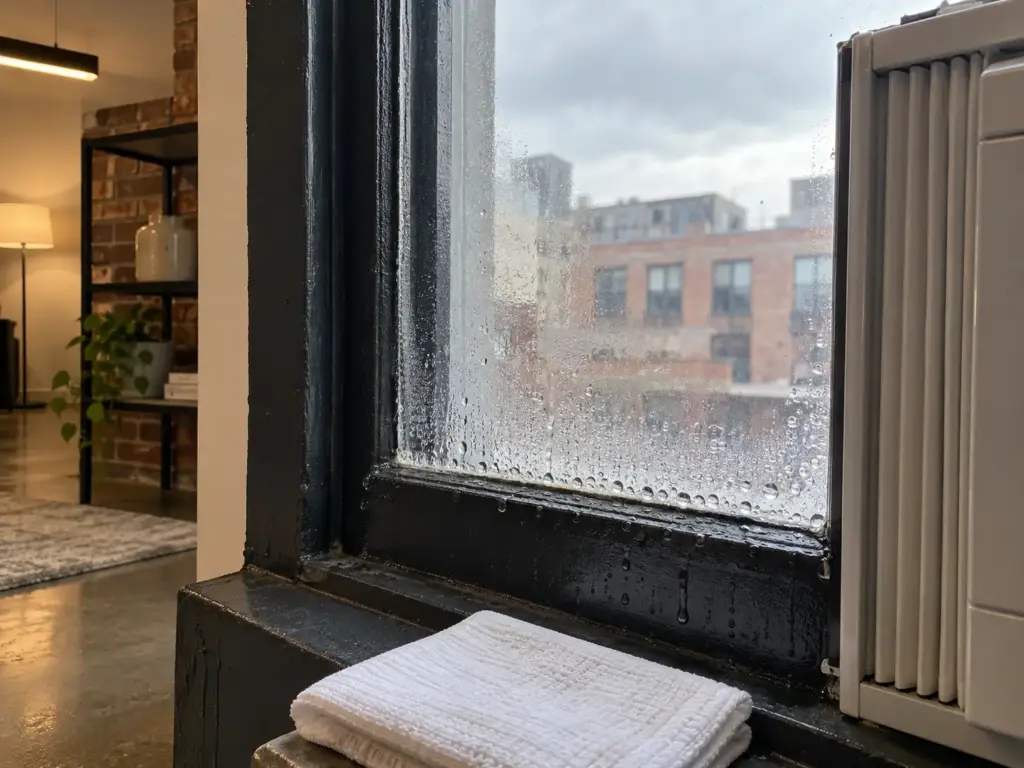
A window air conditioner or a portable unit has no source of water. Every drop on the glass came from the room’s air: cooking, showers, laundry drying indoors, breathing, plus whatever humid air leaks in around the sash and the unit itself (humid air infiltration, in the trade’s words). The EPA lists air conditioners and dehumidifiers as the tools to use when needed in the EPA’s guide to mold, moisture and your home, which tells you where it places the unit: as part of the answer to humidity, not the source of it.
So the question is never whether the AC creates the water. It is whether the AC is removing moisture faster than the house is adding it, and that depends on how long the unit actually runs.
Why the Pane Is the First Place the Water Shows
A glass surface colder than the dew point of the air touching it collects water, and the window is usually the coldest large surface in the room. The AC makes that surface colder quickly. The room’s moisture comes down more slowly, because the unit has to cycle air through its coil again and again to remove it.
That gap in speed explains an odd pairing you may recognize: the glass sweats while the room feels cool and clammy at once (cold and damp are not opposites). The cooling ran ahead of the drying, and glass is where the mismatch becomes visible first.
Why It Can Start the Week the Unit Goes In
If the pane stayed dry all spring and fogs the first warm week the unit goes into the sash, nothing about the window changed. The glass is simply colder now than it was, and humid summer air carries more water to meet it. Indoor humidity in summer has the range to hold to in that season. The bedtime version of this, when the glass drops overnight with no unit involved at all, is covered in what the glass does overnight.
Wipe one pane dry when the unit has just been switched on, then watch how long the film takes to come back. If it returns while the room still feels cool, the unit is cooling faster than it is drying, and that is a setting problem before it is a window problem.
Read the Room With the Unit Running
The glass cannot tell you whether the room is out of range. Only a reading can, and it has to be taken while the unit is on, because a reading from the weather app or from last April says nothing about this room today.

The Band the Glass Is Judged Against
The standard most houses are held to comes from the EPA, which says to “keep indoor humidity below 60 percent (ideally between 30 and 50 percent) relative humidity” in the EPA’s guide to mold, moisture and your home. That is a ceiling and a target, not a promise that the glass stays dry. On a cold pane the glass can sweat at a reading inside the band, because it is the surface temperature that decides, not the room average. When you want the whole range and what each part means, the full humidity range walks through it.
Take the Reading With the Unit On
Put a hygrometer (a humidity meter) in the room at about chest height, away from the unit’s outlet and away from a wall that backs onto a bathroom or kitchen. Leave it a full day if you can.
A single glance tells you very little. A week shows the pattern, such as whether the 60 line gets crossed only at the end of a long cooling run, or all day. If you have never taken a reading in a house, how to measure indoor humidity covers the method and where meters mislead.
Any meter already on a shelf is the free first step. A product only earns a place if you want a record or an alert.
How Close to the Line a Cheap Meter Can Call It
Accuracy decides how fine a call you can make. The SensorPush HTP.xw states a typical humidity accuracy of plus or minus 1.5 percent RH, and its listing says it reports dew point beside humidity, which is the number the glass is really judged against. The catch is on the connection side: seeing it from outside the house needs the G1 WiFi Gateway, sold separately, and the listing puts the battery at 1 to 2 years typical.
A cheaper route is the Govee H5075, stated at plus or minus 3 percent RH, with an app alert that fires when the reading leaves a range you set. Set it at 60 and it will tell you whether the unit holds the room under the line through a day or a night. The listing’s review summary is the weak spot: several customers report it stopped working within six months, and Bluetooth connectivity is described as mixed.
At plus or minus 3 points, a displayed 58 can be a true 61, so a meter like that can tell you the room is far from the line but not whether it is a point or two on either side.
The AcuRite 00613 is the plain tabletop option, one AA battery and nothing to set up, with a stated operating range of 16 to 98 percent RH. Its listing prints no humidity accuracy at all, which makes it the weakest choice for a call that sits near 60. For a reading of 75 versus 45 it is plenty.
Check any new meter beside an older one on the same shelf for an afternoon before trusting a 58 or a 61. If the two disagree by more than a few points, you know your margin for the 60 line before you start changing settings.
Whole Pane or Only Beside the Unit
The same fog has three possible sources, and the pane itself shows which one. Reading the place on the glass turns a reading into a decision.
Fog Over the Whole Pane Points at the Room
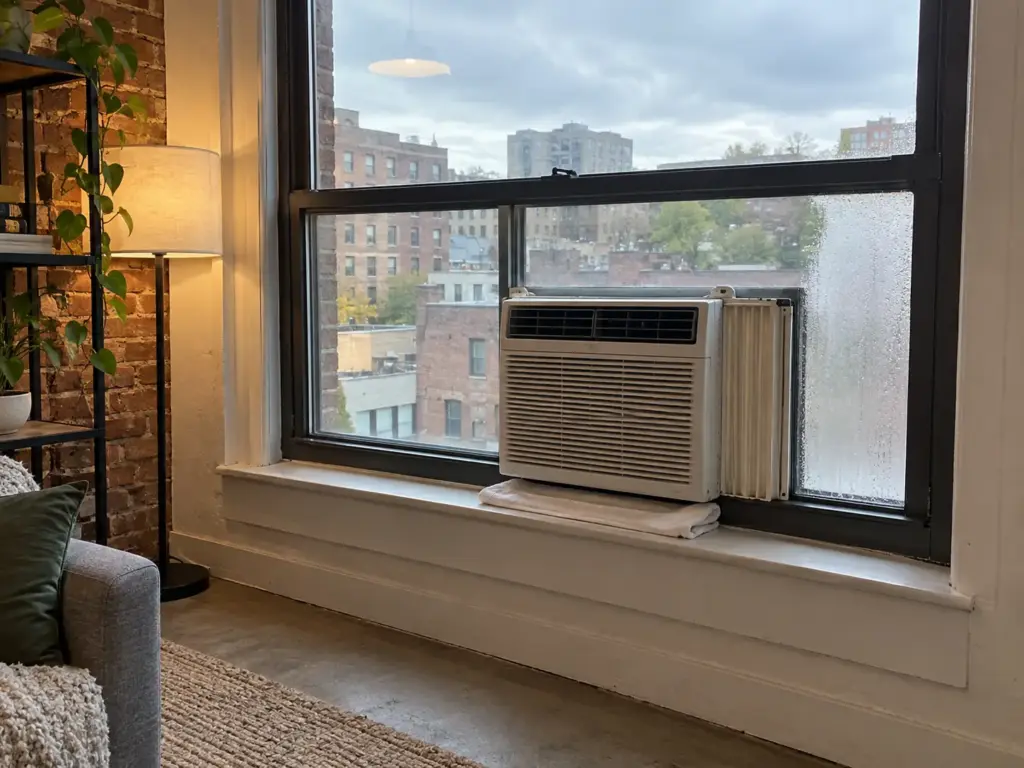
If the film covers the whole pane, or several windows away from the unit, judge it against the reading you just took. Above the EPA’s 60 percent ceiling, the room’s moisture is the likely cause, and the guide’s own advice is to dry the wet surface and reduce whatever is feeding the moisture.
The unit is then doing its job in a room that is too wet for it to keep up with. If you want to know whether that film is ordinary or a problem, whether condensation on windows is normal owns that question and the wipe test.
Fog Beside or Under the Unit Points at the Gap
When the film sits only on the glass beside or under the unit, or at the unit’s edges, suspect the install and the cold air thrown at the glass. An improperly installed room air conditioner leaks as much air as a 6-square-inch hole (15 cm²), according to Natural Resources Canada’s ENERGY STAR guide to room air conditioners. Every one of those gaps lets humid outdoor air flow past a pane the unit has chilled, and the cold stream from the outlet can aim straight at it.
The reading will not help much here. The room can read inside the band while the strip of glass beside the unit still sweats. That is a window seal problem, and you fix it at the gaps, not the setpoint.
Fog Between the Panes Is Not This Article
If the water sits inside a double or triple pane and wiping the room side does nothing, the seal of the glass unit has failed and no setting will clear it. That belongs to when the fog sits between the panes, which covers what replacement involves. And if a film stays after you have dried the glass and cut the moisture, whether the fog is a mold sign is the next thing to read, on the house side only.
A Setting That Cools Without Drying the Air
If the reading and the pane both point at the room, the next puzzle is why a unit that works left it damp. The answer sits in how long it runs, not in whether it runs.

Short Cycles and an Oversized Unit
A unit removes moisture only while its compressor is on and air is moving over the cold coil. One that reaches the thermostat’s number quickly shuts off, and the moisture that leaked in during the pause stays.
ENERGY STAR makes the point about sizing directly: “An oversized unit will cool the room, but only remove some of the humidity,” per Natural Resources Canada’s ENERGY STAR guide, which describes the result as a damp, clammy room. Its sizing guide runs from 5,000 BTU per hour for 100 to 150 square feet, to 10,000 for 400 to 450, and 12,000 for 450 to 500, with 10 percent off for a heavily shaded room and 10 percent on for a sunny one. Read the BTU rating on your own box against your own room.
The same pattern shows up in everyday use. A moderate setpoint can leave the unit short cycling. You will have a cold room that still feels extremely clammy, because the unit hits its number faster than it removes the humid air still leaking in. If your unit is the right size and this still happens, the leaks are the problem, and finding where the moisture comes from is the next read.
The Fan Speed Is the Free Setting
This is the first change to make, and it costs nothing. ENERGY STAR’s advice is to set the fan low on humid days, since slower air movement removes more moisture.
The obvious instinct is the opposite, high fan, because it feels like more cooling. But a fast fan pushes air across the coil before it has time to give up its water, and the room cools while the moisture stays. Switch it, leave everything else alone, and read the room again the next day.
The Setpoint Argument, Both Ways
Two sources disagree, and both are reasonable. Some people argue for a very low setpoint, around 71 or 72°F (about 22°C), which keeps the unit running long enough to dehumidify a leaky room, where 75°F (24°C) lets it cycle off.
ENERGY STAR Canada says the opposite for the bill: set the thermostat as high as is comfortable, typically 25°C (77°F). The reading decides which side your house is on. If the room sits under 60 with the fan low, the higher setpoint is the efficient answer. If the humidity stays above the line, try a lower setpoint, one degree at a time, and read again.
After a week of readings, look at when the reading crosses 60. If it climbs right after the unit shuts off, you are looking at short cycling, and the fan and setpoint are the levers. If it sits high all day with the unit running, the load is larger than the unit and the fix lies in the moisture sources.
When the Water Is the Unit’s Own Drip
Not every wet spot is the room’s moisture. The unit drains its own water, and that water has its own failures.
Three Kinds of Water That Look Alike
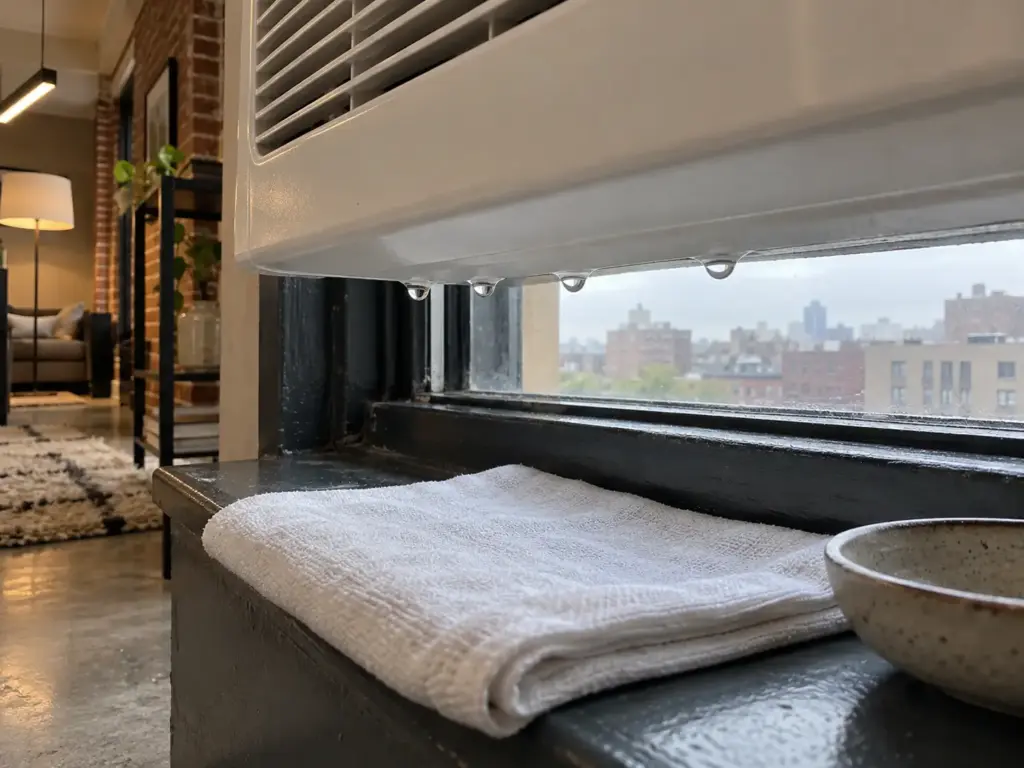
Fog on the room side of the glass is the room’s moisture. Water on the outside of the glass, the frame or the sill is usually the unit’s own condensate, a kind of exterior condensation that the unit is built to shed. Fog between the panes is a failed seal.
The first two are easy to confuse because both leave a wet stripe at the bottom of a window. A clogged pan in a window unit often shows up as water along the unit’s ends rather than a drip, which looks like a leak.
The Drain Plug Trade-Off
The GE manual says to leave the drain plug in, because removing it reduces efficiency. Opinions split on the drain plug: some drill a hole in a unit that came without one and do not mind a drip that falls outside, while others pull the plug once to see how much water comes out, then put it back.
Leaving that hole open is said to cost efficiency and raise the electricity bill, so the safer habit is to keep it shut. If you have to drain the pan to stop a drip, the pan has buildup, so clean it first.
How the unit should sit to let water leave is a question for the maker’s manual for your exact model, and this article prints no direction for it.
What Fails After Seasons of Use
Many window units rely on a slinger ring, a fan-blade ring that picks up the condensate and throws it onto the hot condenser coil to evaporate. When the pan clogs, that cycle breaks. A unit that worked for months and then began to drip often has a pan full of buildup.
Units of this kind can run without dripping when new and start dripping after several years of use. Self-evaporating units in a humid climate can also wear out fast when the fins corrode. Neither is a failure rate, but both point to where to look: the pan first, then the fins. Both are single reports, not a failure rate, but they agree on where to look: the pan first, then the fins.
A central system has a coil and a drain pan of its own. The central-system coil and its drain pan are covered in the furnace-filter article.
The Fixes in Order, and Where a Dehumidifier Fits
With the cause located, the order of the fixes matters more than the list. A reader who changes three things in one evening cannot tell which one worked, or which one overshot.

Free First, One Change at a Time
Start with the fan, set low on humid days, and read the room after a full day. Then the setpoint, a degree at a time, and read again. After that, the unit’s side gaps and the pan, since a leaky install feeds the room more humid air than the unit can pull out.
Alongside that, cut the sources: run the bathroom exhaust fan during and after showers, use the range hood when cooking, and dry clothes anywhere but the room. There are more of these in free ways to lower humidity at home. The EPA’s rule covers all of it: dry the wet surface and reduce the source.
Seal the Gap, Then Read the Room Again
If the film sits beside the unit, close the gaps before you touch the setpoint: the side panels, the window sash around the unit, any weatherstripping that has shrunk. Then wait a day and read the room with the unit running. A sealed install means less humid air reaching the cold glass, and it also means the unit has less to keep up with.
If the frame itself stays wet after all of this, that is a building matter rather than a setting: moisture damage behind the frame is worth reading about before it spreads.
When a Dehumidifier Is the Next Decision
If the reading stays above 60 after the fan, the setpoint, the gaps and the sources, the room has more moisture than the AC alone will remove, and a dehumidifier is the last step. It has a cost of its own: it adds heat to the room, makes noise, and leaves a bucket to empty or a hose to run. Which one fits a given room is covered in the best dehumidifier for condensation on windows by room size.
The general version of all of this, for any window and any season, is in how to prevent condensation on windows.
Fan Low Tonight, the Same Reading in a Month
The AC cools the glass, and the water on it was already in the room. A reading taken with the unit running, plus the place on the pane, tells you whether the room or the unit is the cause. And the fixes go in order, one change at a time, with a reading between each.
A month from now, take the same reading with the unit on and compare it with this week’s. If the numbers drifted up, look at the pan and the side gaps first, since both change slowly and quietly.
Tomorrow, set the fan to low, leave the thermostat where it is, and note the humidity at the end of the day. That one number tells you more about the next change than the glass can.
Frequently Asked Questions
01Why do my windows get condensation when my air conditioner is on?
The unit chills the glass below the dew point of the room’s air, so moisture the house already holds lands on the pane. Check the room’s humidity with the unit running: above 60 percent points at the room.
02Should I be worried about condensation on windows?
A film that wipes off is a moisture sign to act on, not an emergency. Dry the glass and cut the source. If a dark spot appears or the frame stays wet, read whether the fog is a mold sign.
03Does condensation on windows mean the house is too cold?
No, it means the glass is colder than the dew point of the room’s air, which is a surface problem more than a room-temperature one. The humidity reading with the unit running decides which way it is off.
04Should you wipe condensation off windows?
Yes, the EPA advises drying the wet surface quickly and reducing the moisture source. Wiping also shows which side the film is on, and whether condensation on windows is normal covers that test.
05How do I stop condensation on windows when the AC is on?
Set the fan low, adjust the setpoint a degree at a time, close the unit’s side gaps, and cut moisture sources, reading the room between changes. A dehumidifier comes last: see the dehumidifier pick for window condensation.