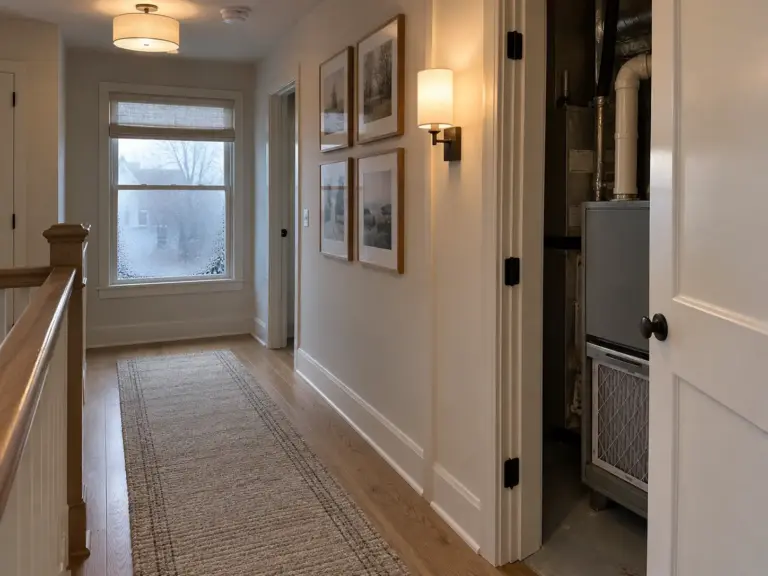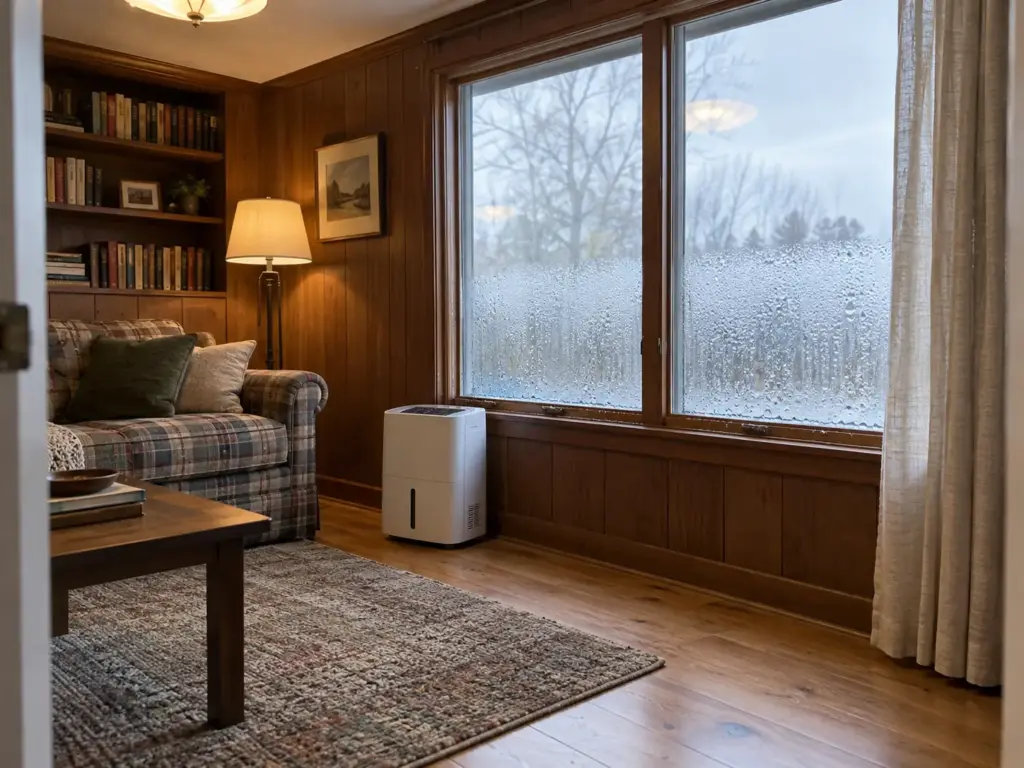
The morning condensation is back, the bottom third of the pane is running toward the sill, and a tab for the best dehumidifier for condensation on windows is already open on your phone. Before that tab becomes an order, one fact about the pane decides whether the purchase works: glass wets because it is the coldest surface the room’s air touches, so a dehumidifier helps when the room’s air is the wet side and does nothing for a pane that is simply too cold.
This guide runs that glass check first, then sizes a unit in pints for the room you actually have (a bedroom of about 120 sq ft, ten by twelve feet, in a rental with one window and no ducts, is the working example), says where the unit should stand, what a night of running costs in watts, and what is wrong with each pick. It also names the cases where a vent or a window is the answer and a unit is the wrong first purchase. If you want the whole map of fixes before the device, start with stopping condensation on windows.
A dehumidifier pulls moisture out of the room air that the cold glass would otherwise collect, so it stops fog on the room side of the pane when the room’s air is the wet side. It cannot lift a cold pane above the dew point. Check the room first, then size the unit to the room, not to the window. Of the three kinds on the market, only one dries a whole room.
| Kind of unit | What it does for a sweating window, and the room it fits | Its flaw |
|---|---|---|
| Compressor | Cools a coil, condenses the room’s moisture into a tank or a hose. The kind that dries a bedroom or a wetter room, sized in pints a day. | Pump models are where the month-two complaints cluster, and the fan is louder at the speed that dries. |
| Thermo-electric (Peltier) | A small cooled plate. Fits a closet or a very small space; one independent test left a Peltier unit stalled at 63% RH in a room. | Removes too little water to move a bedroom’s reading. |
| Desiccant | A wheel of drying material instead of a cold coil. Keeps working in a cold room where a compressor coil struggles. | Draws more watts and blows warmer air than a compressor of the same size. |
Check Which Side of the Glass Is Wet Before You Buy Anything
The shopping tab asks which unit; the glass asks an earlier question. Either the room’s air is carrying too much moisture, or the pane is simply colder than the air can tolerate, and a dehumidifier can only work on the first. The EPA treats window condensation as an alarm to investigate, not as a verdict, and that is the right way to read the wet bottom third of your pane: it tells you to look, and what you find decides whether a device belongs in the plan.

The room side, the outside and the gap between the panes
Water can sit on three different surfaces of a window, and only one of them is the room’s business. Wipe a strip of the window glass with a dry cloth. If the strip fogs back on the room face, you have room-side condensation: the room’s air is wetter than that pane allows, which is the case the wipe test exists to confirm.
If the water is on the outside face, the room is fine and the glass is doing its job. If it is fog between panes that never wipes off, the sealed unit has a failed seal, and fog trapped between the panes is a window repair that no dehumidifier reaches.
On the room face, the pattern carries information. According to the EPA’s interactive mold house tour, “Condensation on windows can be a sign of high indoor humidity, which has many possible causes and should be investigated.” Water that returns along the whole bottom third of the glass at the same hour every cold morning says the room is wet. Water that stays in one corner or along one frame edge points back at the glass or the frame, which is colder at that spot than the rest.
A single pane sets its own threshold
Here the number you were told to hit can be the wrong number. A construction trade journal’s guidance on single glazing puts it plainly: with an average winter outdoor temperature of 30°F (-1°C), condensation shows up at about 30% indoor relative humidity, a level inside the EPA’s 30% to 50% band, and its answer is to switch to double pane.
The reasoning is dew point. Room air at 70°F (21°C) and 50% RH starts depositing water on any surface below roughly 51°F (11°C); at 40% RH the figure falls to about 45°F (7°C). A single pane on a freezing day sits far below both.
So a dehumidifier takes the room from 55% down to 40% and the glass may look better, because the dew point fell by several degrees, yet the same pane can fog again the first night the temperature outside drops another ten. The unit lowers the moisture. It cannot warm the pane. That is the whole reason this check comes before the purchase.
A room with nowhere for its moisture to go
The other early exit is a room that makes moisture and has no path out. Picture a bathroom window above a tub with no exhaust fan over the tub, water pooling on the sill, and mold found on the sill later. That room did not have a humidity problem so much as a ventilation problem, which is a distinction worth keeping. A dehumidifier fights the water that is already in the air; it does not replace the fan that should have carried a shower’s worth of steam outside before it reached the glass.
If the wet window is in a bathroom, the bath fan comes first and costs nothing, and a damp window there is a ventilation question before it is a humidity level to bring down. If it is a bedroom, why it sweats overnight covers the sequence of a closed room filling with the moisture of two sleepers, and that article ends where this one begins. The order is cheap first: wipe the strip, watch which face re-fogs, run the exhaust fan, and only then let a unit enter the plan.
Put a piece of tape across the wet strip at the end of the day, then check it in the morning. If the water returns above and below the tape in the same band, the room’s air is the source. If the glass beside the frame is wet and the middle is dry, the cold is coming through the frame, and a unit will not reach it.
Compressor, Thermo-Electric or Desiccant: Which Kind Dries a Room
All three kinds go by the word dehumidifier on the box, but they dry a room very differently, and for a window that sweats the kind decides more than the brand does. The tiny cube on a marketplace listing that promises a dry room for a fraction of the price is usually the second kind, which is where most disappointment starts.
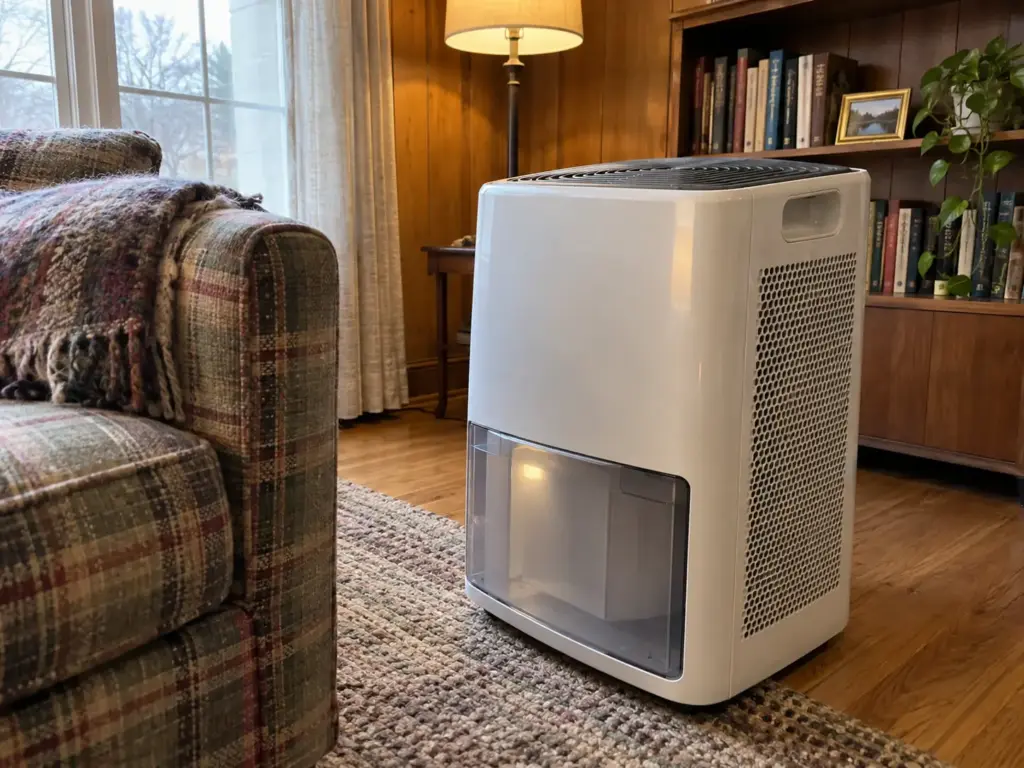
Compressor units, the ones that dry a room
A compressor unit pulls room air across a cold coil, the water in the air condenses on the coil, and the water drips into a tank or out a hose. It is the same principle as an air conditioner’s coil that drips in summer, aimed at the room instead of the outdoors. Capacities in pints a day and the government sizing chart in the next section both describe this type, and if you are drying a bedroom or a wetter room in a heated house, a compressor dehumidifier is the kind to buy.
Thermo-electric and desiccant units, and why most rooms outgrow them
A thermo-electric dehumidifier, the Peltier kind, cools a small plate instead of a coil. It is silent and cheap to run, and it extracts so little that one independent test left the room’s reading stalled at 63% RH with the unit running. That is a closet or a gym bag, not a bedroom.
A desiccant dehumidifier uses a wheel of drying material that adsorbs moisture and is then warmed to release it. It holds up in cold rooms where a compressor coil cannot, at the cost of more watts and warmer air out of the unit.
For a window that wets because the room is humid, the honest answer is a compressor unit unless the space is tiny or unheated. The other two earn their place where the compressor fails, and a heated bedroom is not that place.
Cold rooms, warm rooms
A compressor coil pulls the most water from a warm room and little from a cold one, so the unit that dried the room in October may drain a smaller tank in January. Capacity labels are measured under a set laboratory condition (an independent test notes 65°F (18°C) and 60% RH), so a bedroom at a lower humidity gets fewer pints than the box says. And the colder the room, the more the coil can ice over, which is why the cold, damp garage and the heated bedroom behave like different machines.
If you want the full buying checklist rather than the version tuned to a sweating window, what to look for before you buy covers the criteria that apply to every room.
Size It in Pints for the Room You Actually Have
The pints on the box and the pints a room needs are different numbers, and the government sizing chart is built on how wet the room is, not on the window. That matters for a sweating pane, because glass wets long before walls do, and a chart row meant for sweating walls is the wrong row for most bedrooms that only fog.
The band the room should sit in
Start with the target. The EPA’s own humidity band for a home is below 60% relative humidity, ideally between 30% and 50%. Those two numbers frame the job: a unit’s work is to bring a room above 60% down toward the band, not to chase the lowest reading it can show. The bedroom band sits in the same 30% to 50% window for sleeping, and in cold weather the target slides lower still, which is the logic behind a set point by outdoor temperature.
The chart: how many pints per day for a room this size
Natural Resources Canada’s ENERGY STAR guidance on choosing a dehumidifier by capacity sizes by how wet the space is. For a small-to-medium room (under 185 m²), a slightly to moderately damp one (its bands run 50% to 75% RH) needs 10 to 15 liters a day, a very damp one (75% to 90% RH) needs 11 to 20 liters, and a wet one with sweating walls or floor (90% to 100% RH) needs 15 to 25 liters.
Converted at one liter to 2.11 US pints, that is about 21 to 32 pints a day, 23 to 42, and 32 to 53. A bedroom of ten by twelve feet is about 120 square feet, roughly 11 m², well inside that column. The chart’s humidity bands are the Canadian ones, not the EPA’s, so the chart sizes the unit and the EPA band sets the target.
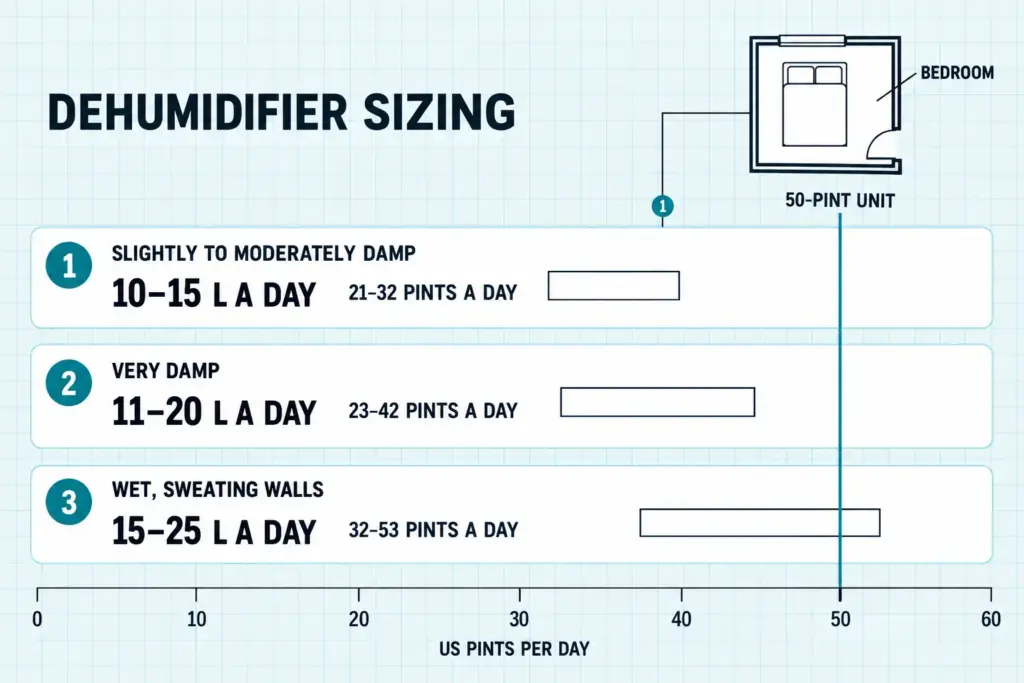
The chart cannot say this, and it is inference rather than a source: a room whose glass runs wet but whose walls stay dry sits in the first row, not the last, because glass wets before walls do. That puts a 10 by 12 bedroom with sweating windows near 21 to 32 pints a day, and it is why a 50-pint unit is more machine than the room asks for. The label figure overstates what the unit delivers at a bedroom’s lower humidity, so the gap is smaller than it looks on paper, but it is still a gap.
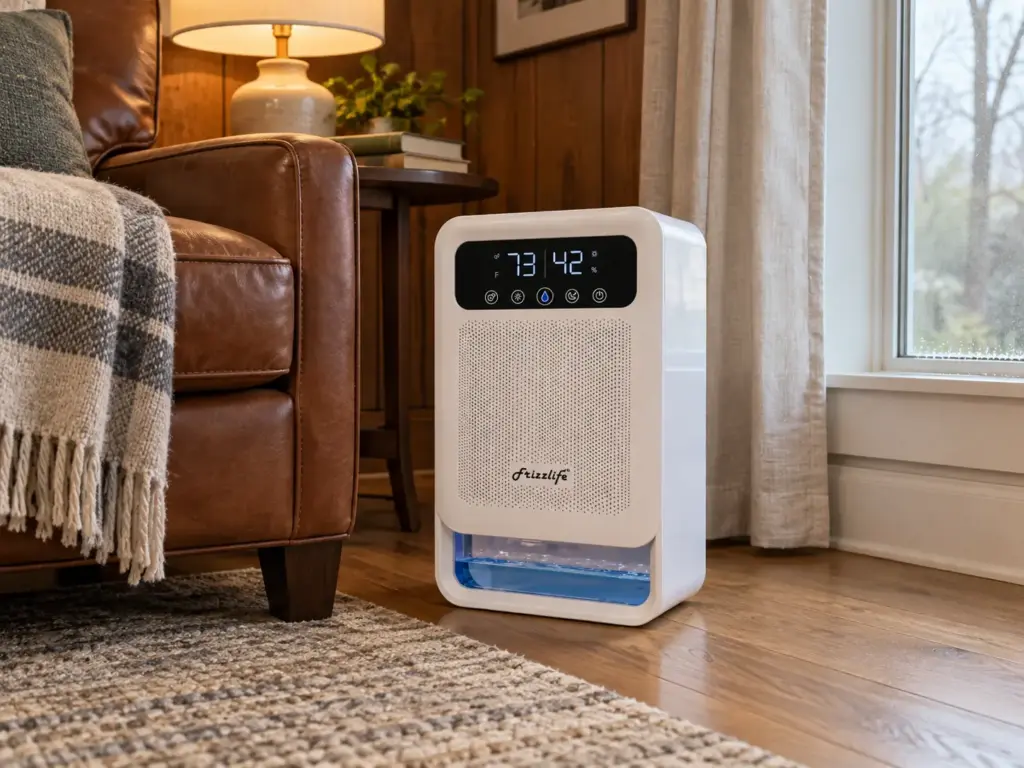
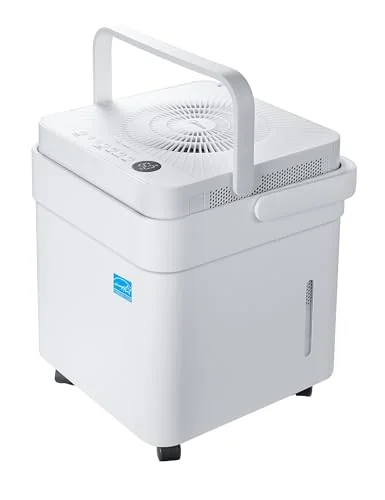
For a small room, the compact option in the Amazon listings is the Frizzlife DH80, which carries a 135 oz tank (about 4 liters, or roughly 8.4 pints of water). The tank is worth testing against the first row for a bedroom, but the listing does not make a rated pints-per-day figure easy to confirm, so read that line on the listing, and check which kind of unit it is, before ordering. If the listing prints no pints figure, treat it as a closet or small-space unit. No repeated complaint about this particular model turned up; that is an absence of evidence, not a finding.
Oversize or undersize: the two rules that disagree
The government page says, in so many words, “Remember: It’s better to oversize than undersize !” The opposing rule says oversizing mostly wastes power, and it has a mechanism behind it: a unit far above the room’s need pulls the reading down fast, cycles off at its humidistat setting, and then draws watts every time it restarts and pulls its fan at full speed. An undersized one runs all night and never reaches the band. Both rules are right about what they describe, and the useful answer sits between them: size to the chart row you actually fall in, then go up one step if the room is a cold one where the coil pulls less than the label.
One built-in feature settles part of the argument. ENERGY STAR units carry a humidistat that holds a target humidity by cycling, so an oversized unit with a humidistat at least stops itself, and NRCan puts their average use about 15% below a standard model. The number to compare between units is the integrated energy factor, in liters of water removed per kilowatt-hour.
A well-sized unit shuts itself off by mid-morning once the room is in the band. One that never shuts off is too small for the room, or the source of the moisture has not been found, and the second is far more common than the first.
Count how many days it takes the tank to fill in the first week, then again a month later. A unit that fills daily at first and every three days or so after a month means the room is drying. A tank that fills daily forever points at a source still pouring moisture into the room.
Put It Where the Door and the Window Can Stay Shut
A dehumidifier dries the air that reaches it, so where it stands and what stays open decide whether it works on this room or on the whole street. This is the least settled part of the decision, so it is stated here as mechanism and as a reasonable expectation, not as a measured rule.
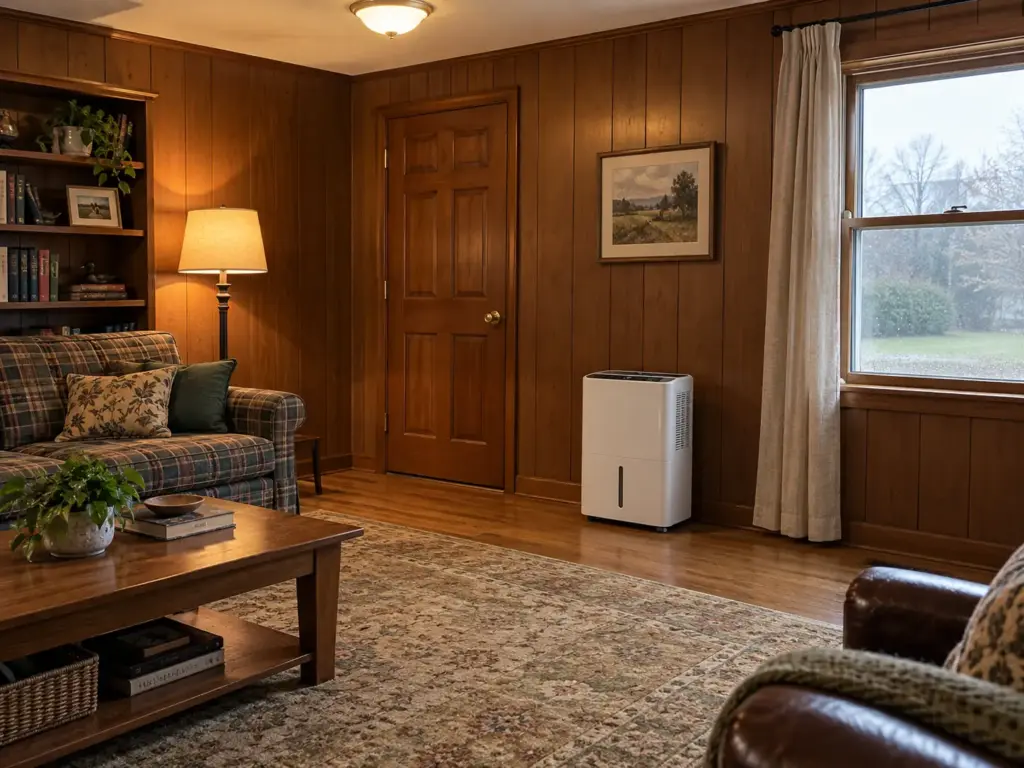
Closed door, closed window
The unit only removes water from the air that passes through its intake. If a window is cracked to let the damp out while the unit runs, the unit processes a stream of outside winter air as well, and that is the reason not to do it. The exhaust fan or a cracked window belongs to the shower, not to the hours the unit is running.
The door matters in the same way. A shut door keeps the unit working on one room instead of the hallway, where moisture drifts in from the kitchen and the bath. In one UK test of a single-glazed cottage, a unit stood on the landing with the bedroom door shut and the morning fog was gone; it is one house, not a measurement, but the mechanism is easy to follow. A smaller volume of air gets dried faster, and the reading holds.
Against the wall or off it
Dehumidifiers need open space at the intake and the exhaust, and the manufacturer’s manual is the authority on how much. Push a unit tight to a wall or a curtain and it recirculates its own dried air or starves its fan. Leave the intake and the exhaust clear and follow the manual’s clearance; no distance in feet belongs in an article that has not read your model’s manual.
Standing the unit on a hard floor and not on a rug or against bedding is plain common sense, but the specific rule is about airflow: the fan should pull room air in from the side the manual names and send it out the other side without a wall blocking it.
Between the unit and the glass
The placement question people ask is whether to put the unit near the window. No fixed distance from the glass is established, so what follows is mechanism: the glass is the coldest surface in the room, so it dries last, and a cold spot near a draft at the frame dries later still. As the room’s reading falls, the water on the bottom of the pane thins from the bottom up, because that is where the cold air settles. A reading that falls while the pane still wets points back at the glass as the cold side, which means the unit is working and the window is the limit.
The test is a meter, not a guess. Three readings with one meter shows how to read the room at the unit’s intake, at the bed, and at the glass, so the number from the window is the one that tells you whether the glass is still the problem.
Run the first night with the door shut and the window closed, and take one reading at the glass before bed and one at the unit’s intake when you wake. Two numbers within a few points of each other mean the room is mixing well; a wide gap means the glass corner is a pocket the unit is not reaching.
Drain, Noise and Watts: What a Night With the Unit Costs
After pints and placement, the unit lives in the room, so its tank, its fan speed and its wattage become the part you feel every day. A unit that dries the glass and wakes the sleeper is a trade-off the listing never shows and week one makes obvious.
The tank, the hose and the built-in pump
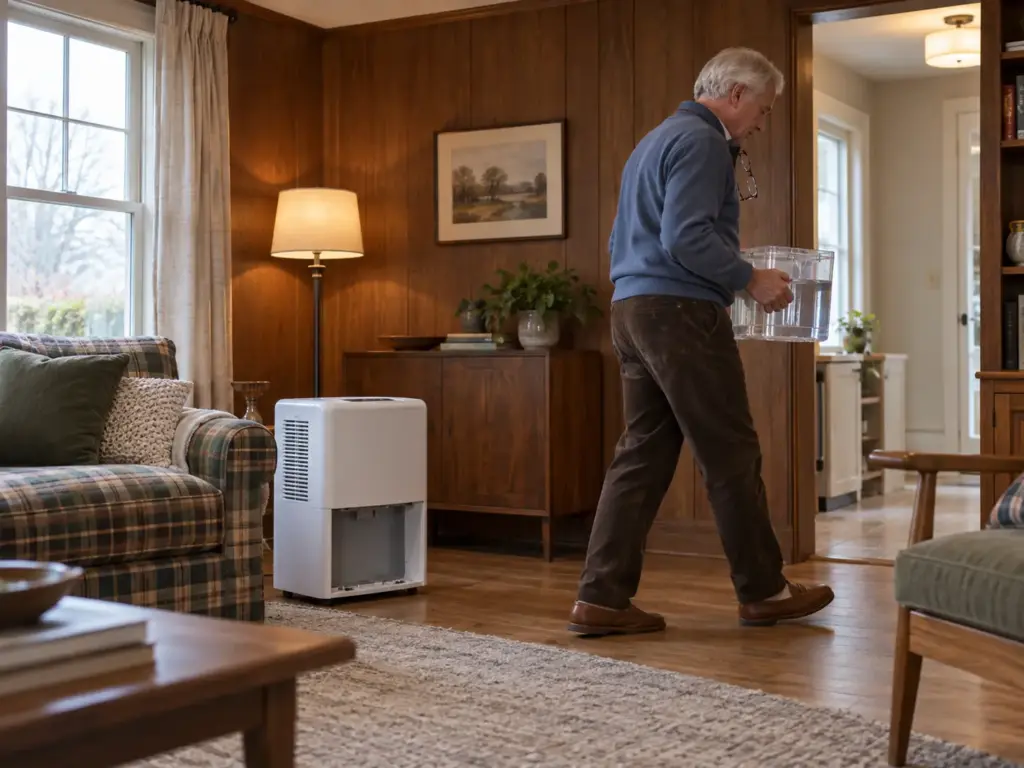
There are three ways the water leaves. The water tank you carry is simplest and has nothing to break, but it fills; a gravity drain hose to a floor drain or a sink never fills and needs a drain lower than the unit; a built-in condensate pump lifts water to a higher drain, and the pump is where the month-two failures live.
Failures tend to come down to recalls, internal pumps and refrigerant leaks, and the pump complaint repeats across units, so a pump model deserves a clear reason to exist in your plan. That is one person’s count, not a failure rate, but the pump complaint repeats across units, so a pump model deserves a clear reason to exist in your plan. Dehumidifiers with a pump and drain hose has the whole decision in its own article.
How loud it is at the speed that dries
An independent test measured a spread of 48.1 to 73.3 dBA across the units it tried, at their top fan speeds, and top-exhaust units ran louder than side-exhaust ones. For a bedroom that spread, in decibels, is the difference between a hum and a vacuum cleaner. Read the dBA at the speed that actually dries the room, not at the lowest setting printed on the first line of a listing, because a unit held on its quietest fan speed pulls fewer pints than the label.
Watts times hours, with your own rate
Running cost is arithmetic, and the arithmetic lasts longer than any dollar figure. Multiply the unit’s watts by the hours it runs, divide by 1,000 to get kilowatt-hours, and multiply by the rate on your bill.
An independent test drew 512 W from a 50-pint compressor unit; eight hours at that draw is about 4.1 kWh (512 × 8 = 4,096 Wh). A small low-energy unit measured in a UK test at 68°F (20°C) and 60% RH drew about 219 W, so eight hours is about 1.8 kWh, a little over 40% of the larger unit’s draw. Over a 30-night month of eight hours, the larger unit is roughly 123 kWh, the smaller one about 53.
Those are ceilings. A unit with a humidistat cycles off when the room reaches the target, so a night rarely costs eight full hours. The integrated energy factor, the liters of water removed per kWh, is the number that tells you which unit does more drying for the same electricity; the 50-pint unit above is rated at 2.01 L/kWh. A higher figure at the same pints means a cheaper night.
Look at the airflow figure beside the pints. A 430 CFM fan in a 120 square foot room with an 8-foot ceiling (960 cubic feet) turns over the room’s whole volume about 27 times an hour at full speed, which is a lot of air for a small bedroom and part of why the larger units sound bigger than they look.
The Shortlist, With the Flaw Written Beside Each Pick
With the room sized and the unit placed, the shortlist is short on purpose: what each pick fits, and what is wrong with it. The bestseller is not the answer for every room, and in this one it is more machine than the glass needs.
The Midea Cube, for the room that really sweats
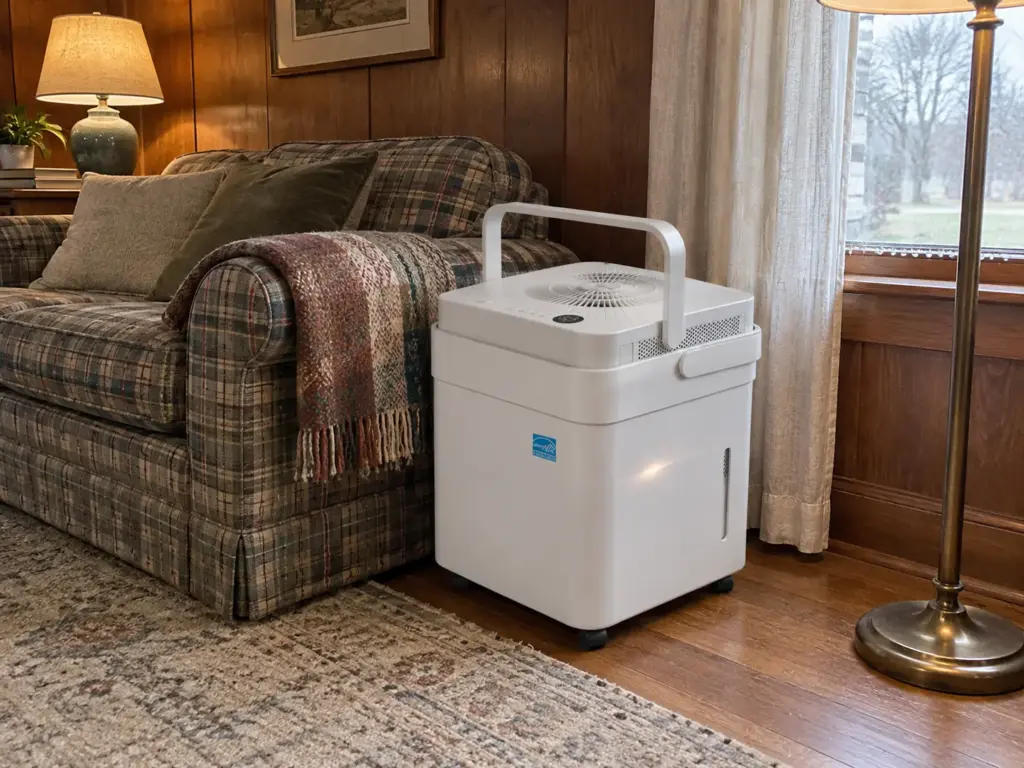
The Midea Cube 50 pint is the big, well-known unit in this class, and it fits one row of the chart cleanly: the wet room with sweating walls, where 32 to 53 pints a day is what the room asks for. It carries Midea’s 50 pints-a-day rating, a manufacturer claim of covering up to 4,500 square feet, a 34-pint tank, a 430 CFM maximum airflow, an ENERGY STAR mark, and a measured draw of 512 W with an integrated energy factor of 2.01 L/kWh in an independent test. For a basement that floods or a room with walls that sweat, those figures are what the chart wants.
Then the obvious pick stops being obvious. For a ten-by-twelve bedroom whose glass runs but whose walls stay dry, it sits above the first chart row by a margin, and the same capacity that helps in a wet space means a bigger fan, a bigger draw and a unit that cycles more often. It is a sound choice if the room really sits in the sweating row; it is oversized for the room most people are shopping for.
The model on the listing matters too. The listing seen is the MAD50S1QWT-A variant, rated at 490 W, while the independent test measured the MAD50S1QWT at 512 W, so check the model name on the page you land on. This is the no-pump version; the pump-failure complaints that circulate belong to pump variants as a class, and no complaint specific to this listing was verified.
The small unit from the sizing section
The compact option from the sizing section stays where it was introduced. Whatever you choose for a small bedroom, make the pints-per-day figure on the listing the deciding line, because a tank size alone says nothing about how much water a unit pulls in a day.
The bedroom list lives elsewhere
A bedroom needs a quieter, smaller unit than the one above, and the full model list for that room has its own article: the best dehumidifiers for a bedroom. One line carries over from everything above: if the glass is the cold side, none of the units above is the answer, and a better vent, a sealed gap or a better window comes before another box.
Month Two, and When the Device Is the Wrong Tool
The unit that dries the room in week one can still leave the glass wet in month two, and the reason is rarely the unit. This is the stretch no listing covers, and it is where a purchase either settles into the house or becomes a box in the corner with no clear job.
What month two looks like
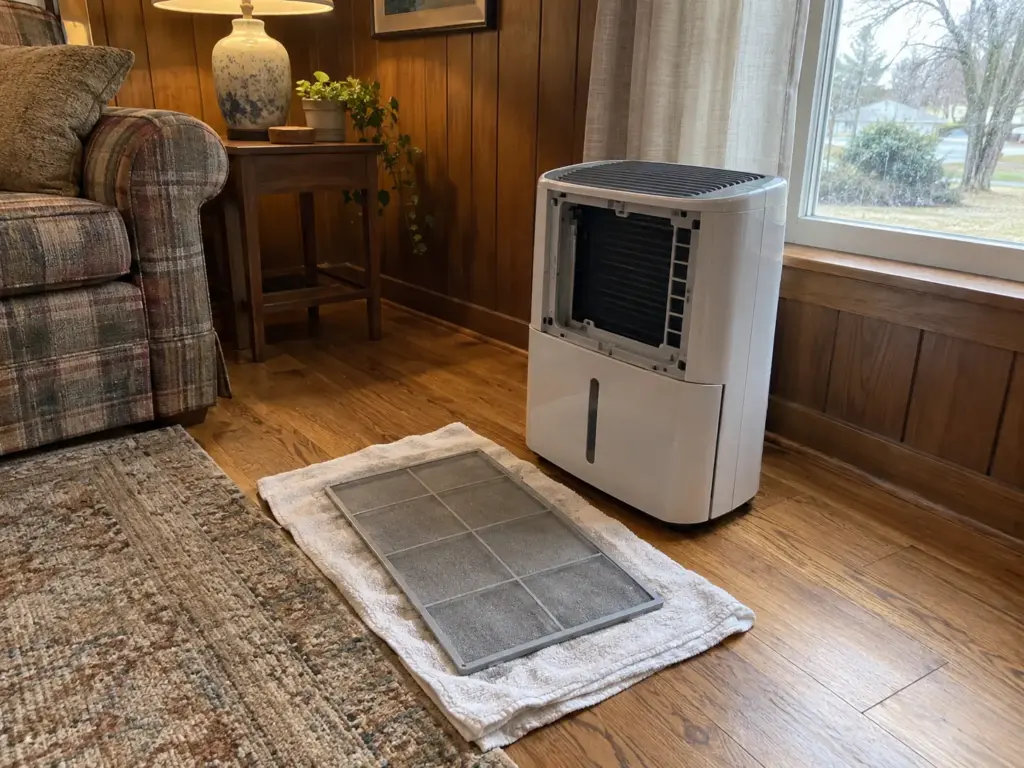
The healthy pattern is a tank that empties less often. In the first weeks the bucket may fill daily; a month later every few days, as the room dries and the unit has less to pull. The unhealthy pattern is the unit still running, the tank still full, the pane still wet and the sill darkening, which means the room is not the only source and the device has become the wrong tool.
The other month-two story is the hardware. Dehumidifiers can fail early, and the usual causes are recalls, failed internal pumps and refrigerant leaks. That tells a buyer where to look: the pump, the coil, the refrigerant circuit, and the recall notices before the warranty runs out. One person’s tally is not a failure rate, but it tells a buyer where to look: the pump, the coil, the refrigerant circuit, and the recall notices before the warranty runs out.
The signs that point at the building
A wet sill that stays wet, a dark water line, or mold on the window frame or mold on the sill is a building question, and the key is whether it clears. Wet and then dry is normal glass; only if it stays is it a sign that something needs fixing in the wall or the window. A furnace that moves too little air is another suspect, so a dirty furnace filter belongs on the list before a second unit. And if the window wets on the days the air conditioner runs, condensation when the AC is on is a different cause with a different fix.
If the reading in the room falls into the band but the pane still wets, the glass is the cold side, and the free changes (a vent, a sealed gap, a better window) come before another unit.
The next decision: the set point
The free changes come first, and free fixes first lists them in order, with a dehumidifier placed last. Once a unit is in the room and the glass check says it belongs there, the next question is the humidity setpoint, how low to set it, and what humidity to set your dehumidifier to answers it by outdoor temperature.
If the unit has to run longer every week to hold the same reading, stop adding hours and look at the source. A room whose moisture keeps arriving is telling you about a leak, a vent or a missing fan, and a longer run only pays for the wet glass, not for the cause.
Read the Glass, Size the Room, Then Watch the Tank
Three things carry the whole decision. Check which side of the glass is wet before you buy, because a dehumidifier works on the room’s air and cannot warm a cold pane. Size the unit by the room’s pints, not by the biggest number on the shelf, and stand it where the door and the window stay shut. Read the flaw written beside each pick, and keep the free fixes in front of the purchase.
A month from now, read the tank and the glass together. A tank that empties less often and a pane that stays dry on the room side mean the room is drying; a tank that fills every day and a pane that still wets means the source has not been found.
Tomorrow, wipe a strip of glass and read the room’s number on a meter, then run the unit for a night with the door shut and read the number again in the morning. That single before-and-after tells you whether the next purchase is a device, a vent or a window.
Frequently Asked Questions
01Will a dehumidifier get rid of condensation on windows?
It does when the room’s air is the wet side, because the unit lowers the moisture that the cold glass collects from the air. It does not when the pane itself is the cold side, such as a single pane in a freezing week. Wipe a strip and watch which face fogs first.
02What is the number one dehumidifier on the market?
There is no single number one, because the right unit is the one whose pints per day match how wet your room is. A 10 by 12 foot bedroom with wet glass sits near 21 to 32 pints; a room with sweating walls needs 32 to 53.
03What is the best thing to stop condensation on your windows?
Lower the moisture at its source and vent it out while it is made, with a dehumidifier as the last step rather than the first. If the pane is the cold side, a unit alone will not clear it, and a vent or a better window comes first.
04Does condensation on windows mean the house is too cold?
No, it means the glass surface is colder than the dew point of the air touching it, whatever the thermostat reads. A room at 70°F (21°C) can sit beside a single pane on a freezing day that is far below that dew point.
05Can I run a dehumidifier with the window open?
Not as a rule, because an open window feeds the unit outside air, so it ends up drying the street instead of the room. Open the window for the shower, then close it before the unit runs.