
You slide the filter out of its slot and the lower edge is damp, there is a wet ring on the floor of the closet, and down the hall the landing window is fogged. The filter is dated last year, so the question writes itself: can a dirty furnace filter cause condensation? At the unit, yes, though rarely on its own.
A clogged filter starves the evaporator coil of air, a colder coil ices, and the melt is more water than the drip pan holds. The answer below comes in two halves (water at the unit, fog on the glass), the one change is a swap followed by a look at the drain, and a filter that is wet again within days points to a different problem.
Quick Answer
Not directly. A clogged filter cuts the airflow over the indoor coil, the coil can ice, and the melt can overflow the drain pan and soak the filter, which is the water at the furnace. Fog on a window is room humidity meeting cold glass, and the filter reaches it only through that humidity.
Water at the Unit and Fog on the Glass Are Not the Same Problem
The question carries two kinds of water, and a house can have either one or both on the same morning. Water at the furnace or air handler belongs to the unit, while fog on the pane belongs to the room. Sorting out which one you have comes before naming any cause.

Water That Shows Up at the Filter, the Pan or the Floor
Water at the unit announces itself in a few predictable places: a wet air filter, standing water in the drip pan under the coil, a darkened patch at the base of the cabinet, or a puddle on the floor. Every one of those is the equipment’s own water, and none of it says anything about the humidity in your living room.
One exception to know before you worry: a high-efficiency furnace (the condensing kind) makes water by design and sends it down its own drain line, so a wet drain on that unit can be normal, and the manual says which kind you have. Water standing in the pan or soaking the filter is not normal on any of them.
A pan that keeps filling has two common causes: a frozen coil or a drain that is not draining. Those two causes leave the same puddle, and telling them apart is most of the job.
| What to compare | Water at the unit | Fog on the glass |
|---|---|---|
| Where it shows | Filter, pan, cabinet base, floor | Room side of the pane, mostly at the sill |
| What wipes it | A towel, but it returns until the source is found | A thumb, and it returns when the room and glass meet again |
| What makes it worse | A stopped drain, an iced coil, a leaking return duct | Showers, cooking, a cold spell |
| First thing to check | The filter, then the drain line and pan | The room’s relative humidity |
| Who owns it | The unit | The room’s humidity |
Fog That Wipes Off the Glass and Comes Back
Fog on the room side of a window is a different animal. The window glass is colder than the room’s air can tolerate, so the moisture in that air settles on the nearest cold surface, and it settles there whether the furnace filter was changed last week or last year.
Run a thumb across one strip of the glass and see which side is wet. Wet on the room side means the humidity is meeting a cold surface. If the strip fogs over again in a few minutes, the room is still carrying more moisture than that glass can take, and the window condensation guide walks through the glass half in full.
The filter is not on the list of things that put water on a pane, only on the list of things that might move the room’s humidity, which comes up again below.
For the question of whether a little fog is normal at all, whether condensation on windows is normal settles it for the common case.
The Two-Minute Test That Tells Them Apart
You need no tool for this. With the thermostat set to off, open the filter slot and look at three things: the filter, the pan or the floor around the cabinet, and whether any of it is wet. Then go wipe a strip of the window.
Two looks, two minutes, and the answer is usually obvious, though not always the one you expected. The filter in the slot can be damp on its lower edge while the glass at the far end of the hall is dry, or the other way round, which is exactly why they need separate answers.
Wipe a strip of the glass and open the filter slot inside the same two minutes, then trust whichever one is wet. If both are wet, work on the unit first, because a wet unit can feed the room’s humidity but the glass can never feed the unit.
How a Clogged Filter Ends Up Soaked
If the water is at the unit, the order of events is short and runs in one direction. The filter is where the story ends, not always where it starts.
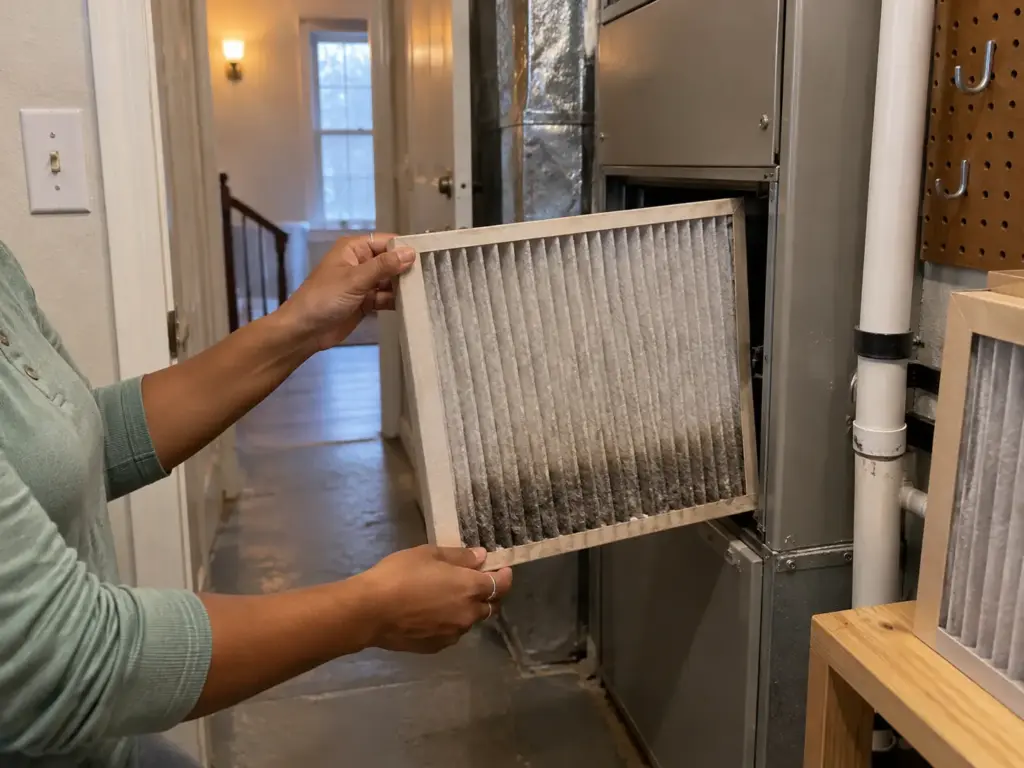
Less Air Over the Coil Means a Colder Coil
A clogged filter lets less air through, and the evaporator coil sitting behind it then has less warm air passing over it to hold its temperature up. A colder coil pulls more moisture out of whatever air does reach it, and once the coil drops below 32°F (0°C) that moisture freezes on the fins instead of running to the pan. Central air and a heat pump have the same coil, so the chain is the same whichever you own.
A dirty filter is one of the most common causes of an AC coil freezing, because the airflow drops and the coil gets too cold. That is the usual way the mechanism is described.
The same chain explains why condensation shows up when the AC is on, though that cooling cycle case on the glass is its own question.
When the Ice Melts, the Pan Is Not Big Enough
A frozen coil is only half the trouble. When the system shuts off or the ice thaws, the whole sheet melts at once, and a pan built to catch a slow drip cannot hold it, so the drain pan overflow lands on whatever sits below.
The technician added that a freeze-up does not stay at the coil: the ice reaches the metal and the insulation around it, and the melt can turn up at the base of the unit and in the return duct. His estimate was at least a couple of gallons, which is his estimate and nothing more precise than that.
A detail from the same answer saves a lot of worry. The thicker copper line wrapped in black insulation is allowed to be damp: “The suction pipe, which has black rubber insulation, will naturally sweat.” That is why it is insulated.
The small line is the one to watch, because “The small 3/8’s line should always be dry and warm.” A damp sleeve on the big line is not a freeze, and a wet small line is a lead.
Why the Wet Filter Is Often the Symptom, Not the Cause
Pull a dripping filter out and the instinct is to blame it. The quieter question is what it was sitting next to. Clearing the main drain line can empty the secondary drain pan, and a clogged filter is not always the cause.
A clogged drain line, a pan out of level, or a leaky return duct can each soak a filter that was only a little overdue. The water has to go somewhere, and a stopped condensate drain line sends it into the pan and then past it.
A clogged drain can also turn a nuisance into a flood. A stoppage in the overflow pipe is a common reason a pan stops draining. When the safety shutoff, the float or cutoff switch that should stop the unit before the pan overflows, fails to do its job, the pan keeps filling and the floor gets the rest.
So a wet filter is a reason to look at the pan and drain before you decide the filter was the whole story.
The Filter Reaches the Glass Only Through the Room’s Humidity
If the glass is what bothers you, the filter is not a cause of it, only one of many things that can move the room’s humidity, and it has to be measured before it is blamed. The route exists on paper, but no source puts a number on it.
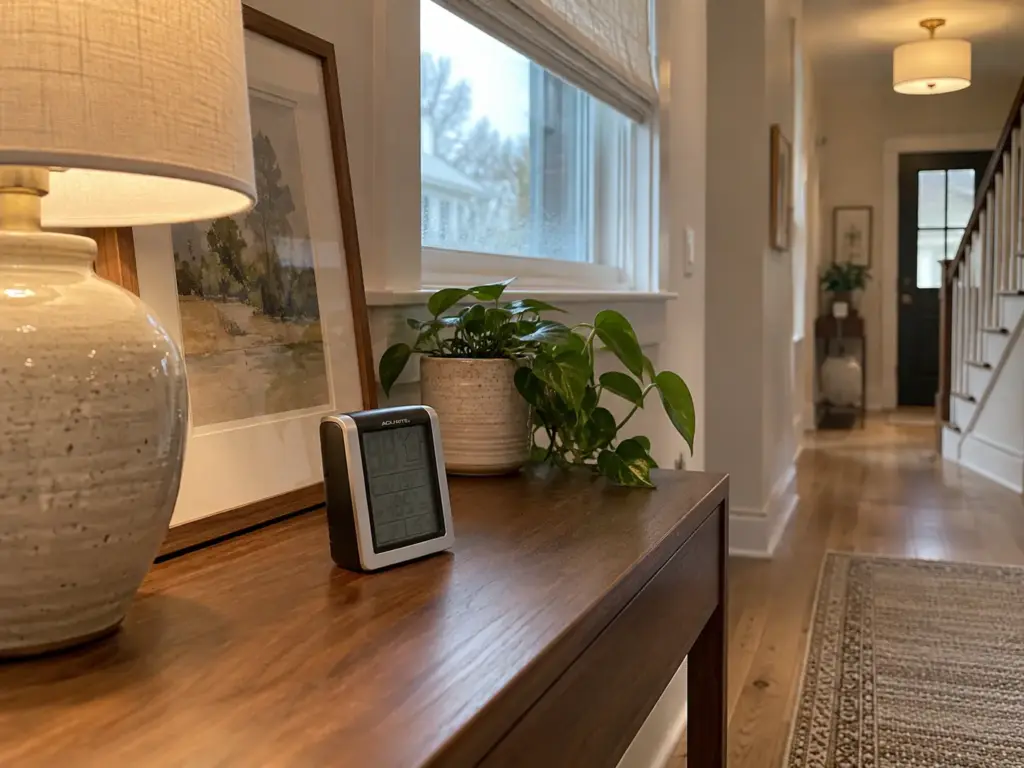
The test is a reading before the swap and another after.
What the Glass Is Actually Reacting To
Glass fogs when its surface sits below the dew point of the room’s air, the temperature at which that air can no longer hold its moisture. High humidity raises that temperature, and a cold week lowers the glass, so the two meet sooner.
The EPA’s mold house tour gives the band to measure against: “try to keep the indoor humidity below 60%, ideally between 30 and 50%.” It says of the glass itself, “Condensation on windows can be a sign of high indoor humidity, which has many possible causes and should be investigated.”
It does not name the filter. It does name the bathroom exhaust fan and the cooking range hood as the moisture to vent, which is worth taking literally: the shower and the stove reach the glass long before the furnace does. The humidity range the EPA gives is the same band on its own page, with what the numbers mean room by room.
The filter route has a gap in it. A coil that ices and thaws puts moisture into the return air and into the house, so the room’s reading can rise. A reading above 50% is a watch, above 60% is the line, and the filter swap is a test of whether the reading moves, not a promise that it will.
The Reading to Take Before You Swap Anything
The free fixes come first and need no instrument. Put a hand against the glass to feel how cold the surface is, and run the bathroom fan longer after a shower and the hood while cooking.
Then take a reading, change the filter, and take another reading a day later, at the same spot and the same hour. Two readings an hour apart at different times of day prove nothing, because a room’s humidity swings with cooking, showers and who is home.
For the reading itself, a plain hygrometer on a shelf at sitting height does the job. The AcuRite 00613 is a thermometer and humidity gauge with a 3-inch display, so the room’s relative humidity sits next to the EPA band where you can read it.
Its limits are the limits of any cheap hygrometer: it reads one spot, not the room, a small sensor like this can be off by a few points, and the listing title does not claim logging or a stated accuracy, so neither is promised here. One reading is a snapshot. Three readings, one meter shows how to check whether to believe the number before you act on it.
Read the room before the swap and again after it, at the same spot and the same time of day. Keep the hygrometer off the window sill and away from the kitchen, because the sill is the coldest spot in the room and will always read high.
Why a Cold Week Makes the Same Room Fog Sooner
Outdoor temperature sets how cold the glass gets, so a room that reads fine in October can fog in January with the same filter, the same people and the same humidity. The band you aim for moves with the weather: humidity by outdoor temperature lays out how.
That is why a foggy pane on the first hard-cold morning does not prove the new filter failed. The number that looked fine last month can be the wrong number this week.
Swap the Filter First, Then Look at the Drain
The free change comes first, and a reading comes between changes, because a swap, a drain flush and a duct repair done in a single afternoon leave no one knowing which one worked. One change, then read.
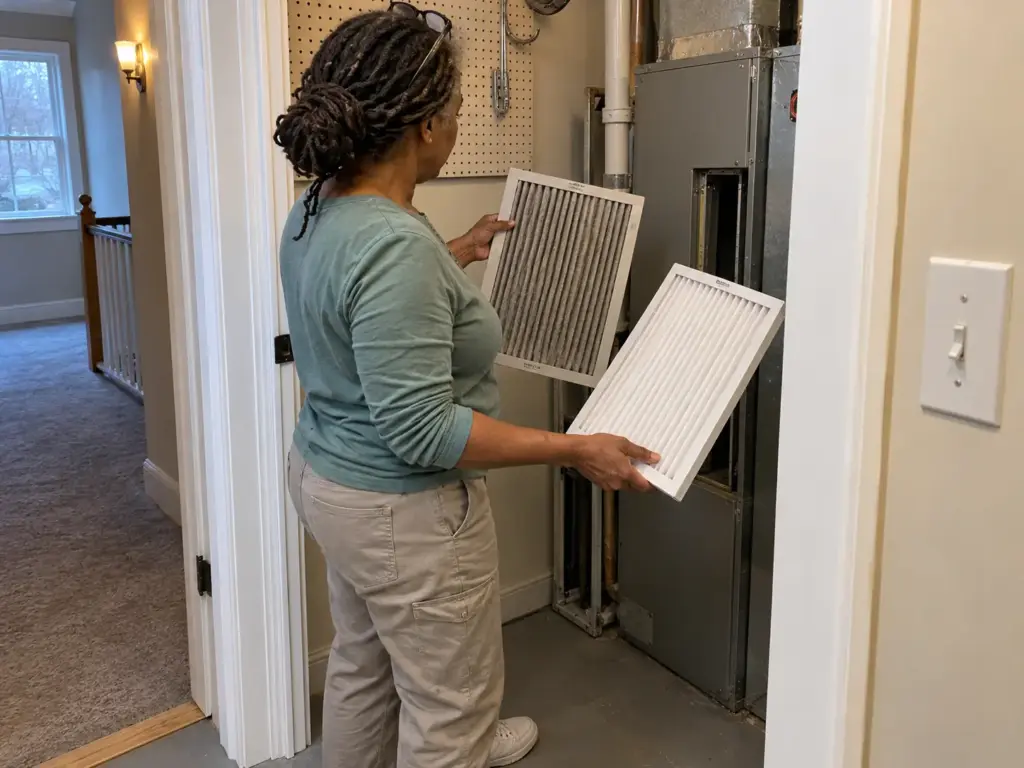
Swap the Filter and Read the Room a Day Later
Measure the filter in the slot before you buy anything, since the nominal filter size printed on the edge and the actual size are not the same thing. A 1-inch pleated MERV 8 filter is the usual kind of filter replacement, and the size and thickness should match the old one.
Match what the system was built for, too: a denser filter than the slot and blower were sized for can restrict airflow the same way a dirty one does. The swap changes nothing if the drain has stopped, so do not treat the new filter as the repair.
The slot is the part you touch, not the cabinet. With the thermostat off, slide the old filter out, look at the pan and the floor while the slot is open, and close it again before you power anything back on.
Clear the Drain Line Before You Call Anyone
If the filter is wet and the pan has standing water, check the drain next. A sensible order is cheap: clear the line first, check the pan second, and the filter third. A wet/dry vacuum on the drain’s outdoor end, followed by a vinegar flush, is a common home fix for a clogged line, and a change in the sound of the vacuum shows that a clog came out.
Slime is the usual culprit in a clogged drain line. Algae or biofilm, the white slime that grows in damp drain lines, is a common cause of a clog.
That is as far as a homeowner’s afternoon goes. Anything past the drain line, a cracked pan, a safety shutoff that does not trip or a duct that leaks, is a technician call, and the manual comes first.
Let the Unit Dry Before It Runs Again
If the coil did ice, the unit has to finish thawing before it runs normally again. One routine after a freeze: turn the AC off, run the fan for about an hour, then turn the AC back on and check every half hour for water and for how the drain is handling it.
His customer ran the fan for an hour and a half and still collected about a quart every half hour to 45 minutes, which is that customer’s count and not a typical one. If there is a lot of water, the ice is still melting.
After a day of normal running, read the hygrometer again. If the water at the unit is gone and the room’s reading sits inside the band, the filter was driving the problem. If it did not move, the filter was never the main cause.
What a Filter Does Between One Swap and the Next
A week after a swap, everything looks fine. The claim that matters is what the same filter does at the point the printed intervals tell you to change it, and the printed intervals disagree.
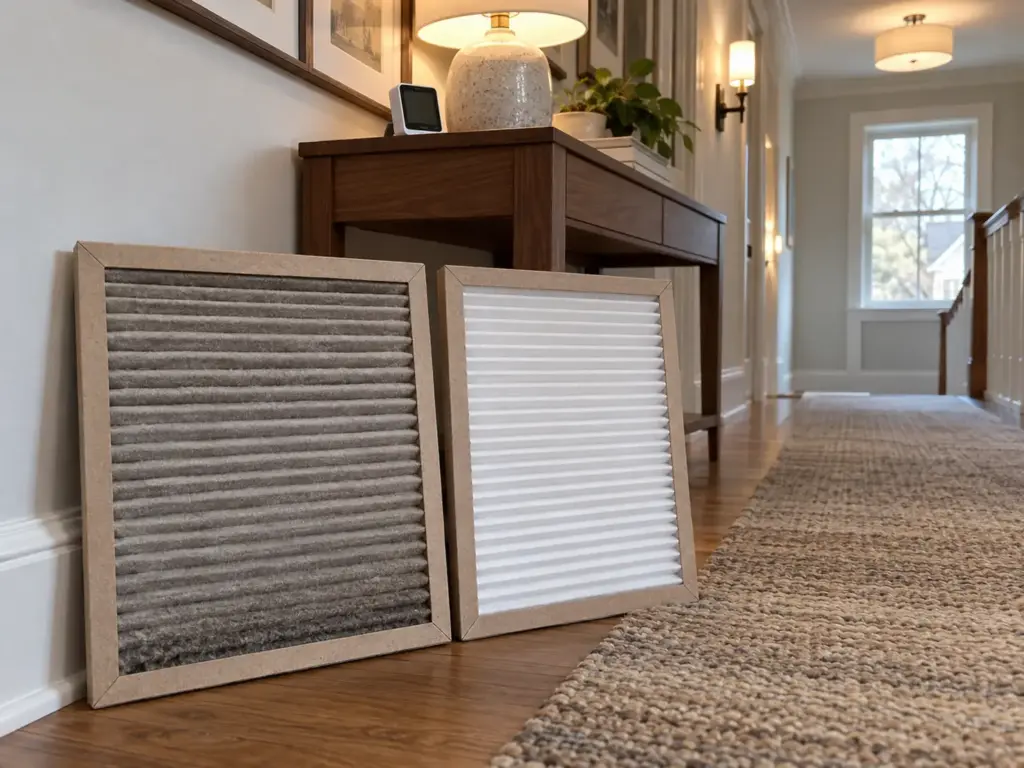
Why the Printed Intervals Disagree
Filter sellers and contractor pages give one to three months, sixty to ninety days, ninety days with a look every month, or three to six months, and for homes with pets or dust the advice drops to somewhere between twenty and forty days. No federal number appears in this article because none was opened, and the spread above is a disagreement between sources, not a rule.
A pleated filter in a 1-inch slot loads faster than a deeper one, so a house with pets or a lot of dust sits at the short end of that spread, and a house that is rarely occupied can sit at the long end. The one thing every source does agree on is the monthly check.
A Monthly Look That Costs Nothing
Open the slot, pull the filter and hold it up to a light. It is overdue when you cannot see the light through the pleats or when the surface has gone from white to dark gray, and the lower edge, where the air comes in, darkens first.
A filter dated last year, like the one in the opening, is not an interval problem so much as a no-one-looked problem, and it is easy to fix with a note on the slot cover, a phone reminder or a marked date on the frame. (A pen is plenty.)
If the filter is still pale at a month, leave it. Swapping on how the filter actually looks beats swapping on whatever interval the box prints.
Reading the Trend Instead of One Day
The question after the swap is whether the room settles or keeps climbing, and for that a line beats a point. The Govee H5075 is a Bluetooth hygrometer and thermometer that reports to a phone app, so you can see the room across a day or a week instead of one reading.
It needs a phone to show the trend, the listing title does not say how much history it keeps, and like any cheap sensor it can be off by a few points, so treat the shape of the curve as more reliable than any single value. If one reading is enough, the AcuRite from earlier is the budget route. A cheap humidity checker you can trust covers the choice between the two.
And if the reading stays above the band after a fresh filter and a dry unit, the filter was never the source. Why the humidity in a house runs high is where the source hunt continues.
When It Is Not the Filter, and When There Is No Filter at All
A filter can be innocent. One that comes back wet within days, or a pane that fogs with a brand-new filter in the slot, points away from the filter and at the building or the room.
The Filter Is Wet Again Within Days
A new filter that soaks through within a few days is not a filter problem. The technician’s fork in the same answer was either that the unit froze and thawed, or that the pan has a crack. A cracked pan, a drain that stopped or a leaky return duct all need inspection and repair, and that is a technician call, not a weekend job.
Duct sealing is part of that repair: contractor guides name mastic sealant and foil-faced tape for the seams, and the work belongs to the person who can see the duct. A musty odor near the unit or the return grille is one more reason to have the pan looked at.
A cutoff that fails to stop the unit before the pan fills is the same failure in another form, and a good reason to have someone check the safety shutoff.
One detail from the same answer is easy to miss: a customer found water at the bottom right front corner of the return duct after the freeze had thawed. If the filter is dry and the floor by the duct is not, that corner is the place to look.
A Pane That Fogs With a New Filter in the Slot
With a fresh filter, a dry unit and glass that still fogs, the answer is on the humidity side again, as the section above laid out. The filter has been ruled out, and what is left is moisture the house is making or holding.
The next decision is the room, not another swap: a dehumidifier sized to the room is the device route, though a hygrometer and the free fixes should come first.
If a dark speck has started to show in the caulk, a dark speck in the caulk tells you whether it is a passing mark or something that stays, and why windows sweat overnight explains the dew-point sequence that fogs the glass while you sleep.
A Rental With a Window Unit and No Ducts
If you live in an apartment with no furnace closet, there is no central filter to change, and the question as asked does not apply to you. The glass half still does.
A window unit or a mini split has a washable or replaceable filter of its own, and the same chain (a clogged filter, less airflow, a colder coil) can happen there too, but the fix lives in that unit’s manual. For the fog on your window, the hygrometer, the bathroom fan and the free fixes are your tools, because without ducts the room’s humidity is the whole story.
Swap Once, Look at the Drain, Read the Room Again
A dirty filter does not wet the glass by itself, and the water at the unit points to the drain or a freeze before it points to the filter. One change at a time lets you tell which one worked, and the reading after each change is what makes the change count.
A month from now, open the slot and look at the lower edge of the filter, then compare the hygrometer’s reading with the one you took before the swap. If the filter has darkened early or the reading has crept up, one of them has changed, and the other tells you which.
Tomorrow, do two things: change the filter with the thermostat off, and look at the pan and the drain while the slot is open. Read the room a day later. If the unit is dry and the reading sits in the 30% to 50% band, you are done. If the filter is wet again within days, call a technician, and skip the dehumidifier until the unit is sorted.
Frequently Asked Questions
01What are the signs that my furnace filter is dirty?
A dirty filter looks gray and clogged when you hold it to a light, and the airflow at the vents feels weaker than it did. It is also overdue if it is past the change interval printed on the frame. A damp lower edge means look at the pan.
02Why am I getting condensation in my furnace?
Water at the unit usually comes from a frozen evaporator coil that thawed, a clogged condensate drain line, a pan out of level, or a leaky return duct. It shows at the filter, the pan or the floor. Check the drain line first, before you blame the filter.
03Is it better to have a clean or dirty HVAC filter?
A fresh filter is better, because airflow across the coil is what keeps it from icing. A filter denser than the system was built for restricts airflow the opposite way. Measure the slot and match what the system was designed to take.
04Why is my furnace filter soaking wet?
The likeliest cause is melt from a frozen coil or an overflowing pan. Replace the wet filter, then find the source in the pan and drain. If the new filter is wet again within days, call a technician.
05Can a dirty furnace filter cause condensation in the house?
Only indirectly, through the room’s high humidity, and no source says by how much. Furnace filter condensation on the glass is a humidity question first. Read a hygrometer against the EPA band of 30% to 50% before the swap and again a day after, at the same spot.