You wiped the same strip of glass again this morning, and somewhere between the cloth and the coffee the question came up: can condensation on windows cause health problems? That is a question for your doctor, and a window has no way to answer it. What a window can answer is what the water is doing to the house.
The pane is colder than the room’s air, so the room’s moisture lands on it, and whatever does not evaporate runs on to the frame, the sill and the wall around them. This article follows that water: where it goes, what one winter of the same wet spot turns into, the fixes in the order to try them, and the signs that the problem is the building and not the air.
Quick Answer
The water on the glass is a reading: the pane is colder than the room’s air, so the room’s moisture settles on it. What that water damages is the house, meaning the frame, the sill and the wall behind them. It turns into a building problem when the same spot is wet again after you wipe it.
Where the Water Goes After It Leaves the Glass
The glass is the part you can see, and the part that matters is wherever the water runs next. Glass is a poor insulator, which makes the window the coldest surface in the room and the first place the room’s moisture lands. A Cornell Cooperative Extension fact sheet on window condensation (reviewed in 1999, so take it for the mechanism and not for today’s window numbers) puts a single pane at about R-1 and a double pane at about R-2, against R-11 to R-20 for a typical wall beside it. From the pane the water has three places to go, and each one is harder to see than the last.
The Sill Takes the First Hit
Whatever does not evaporate runs down the glass and sits on the sill, and the sill is usually wood under a coat of paint. The same Cornell sheet is direct about it: “Daily melting and dripping of water onto the sill may cause paint and structural damage.” In wood, structural damage eventually means rot. Wood damage occurs fairly easily once the water puddles, and it is the puddling, more than the sweating, that does it.
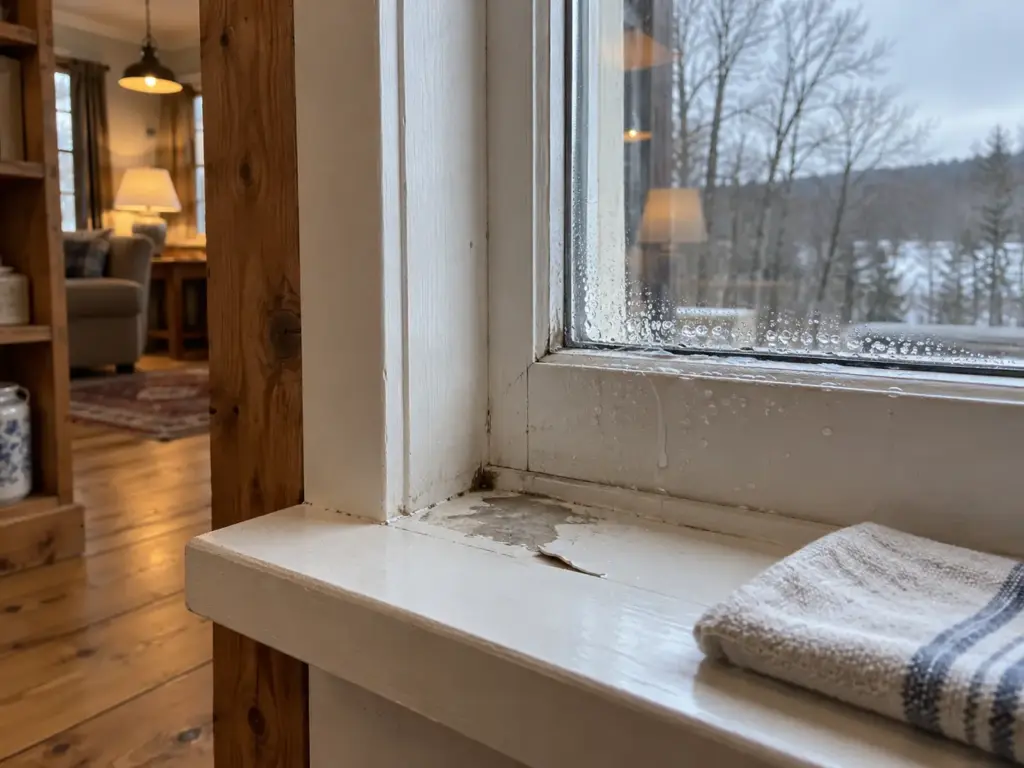
The order of events is predictable. The paint along the bottom edge of the frame goes first, the sill under that paint softens next, and the wall under the sill is the last place anyone looks.
Photograph the lower corner of the sill and the paint below it from the same spot, with the same light, once a week. A flake that is starting to lift is hard to see day to day and obvious across four photos.
The Wall Behind the Window
Cornell goes one step further and reads heavy window condensation as a sign of “potential concealed condensation,” meaning moisture in the attic or inside the walls, so the wet glass can be the visible end of a wetter house.
Leaking windows can end in wall rot or sheathing rot behind the frame. That is a leak case and not a condensation case, but it shows where water goes once it gets past the frame. Over time, that can cause a bit of mold and water damage around the edge of the window. Notice the over time, which no source turns into a number.
Water on the inside of the glass is also, in the EPA’s mold course, a possible sign of high humidity: warm, humid air meets a cold surface and condensation forms. That is the room’s half of the story, and it comes back in the fixes. If a dark speck sits on the caulk, the answer to when the spot on the caulk is mold has its own article, and a stain that spreads down the wall under the sill is the territory of mold on bedroom walls.
Damp Frame or Damp Wall: How to Tell
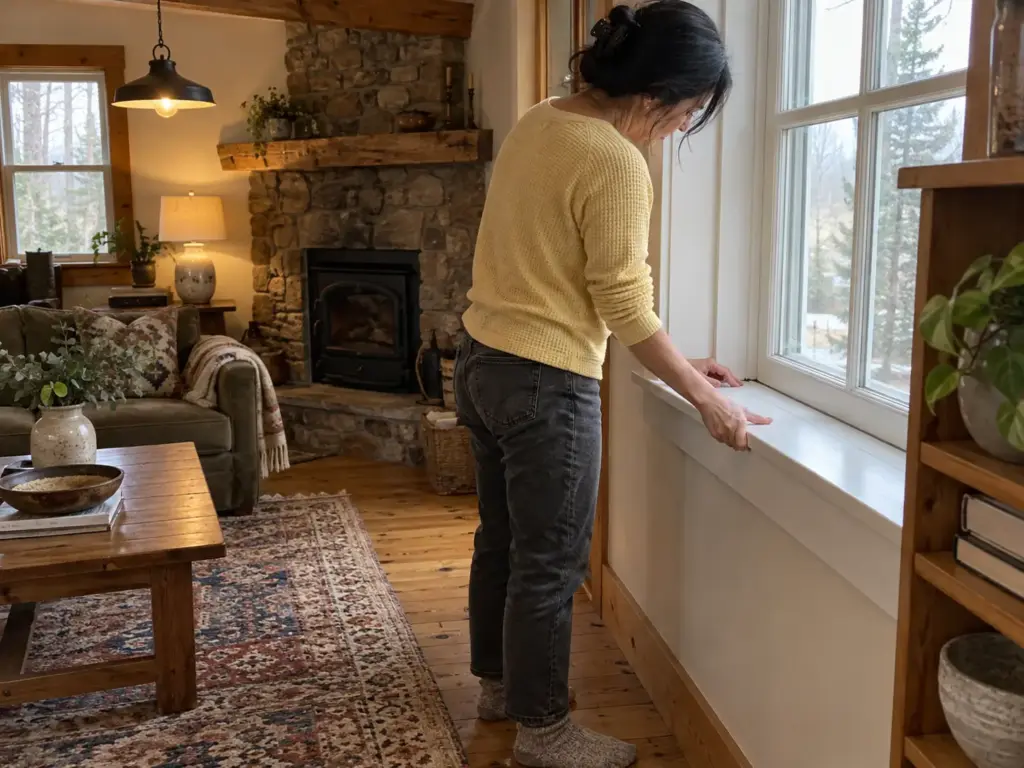
Three checks come before any tool, and they go in this order. Look at the paint along the bottom of the frame for a bubble, a lifted edge or a dark line. Hold a flashlight flat against the wall under the sill and sweep it sideways, which shows a stain, a ridge or a blistered patch that room light hides. Then lay the back of your hand flat on the wall just below the sill and on a patch three feet (about 90 cm) to the side: damp drywall feels cooler and slightly clammy next to dry drywall.
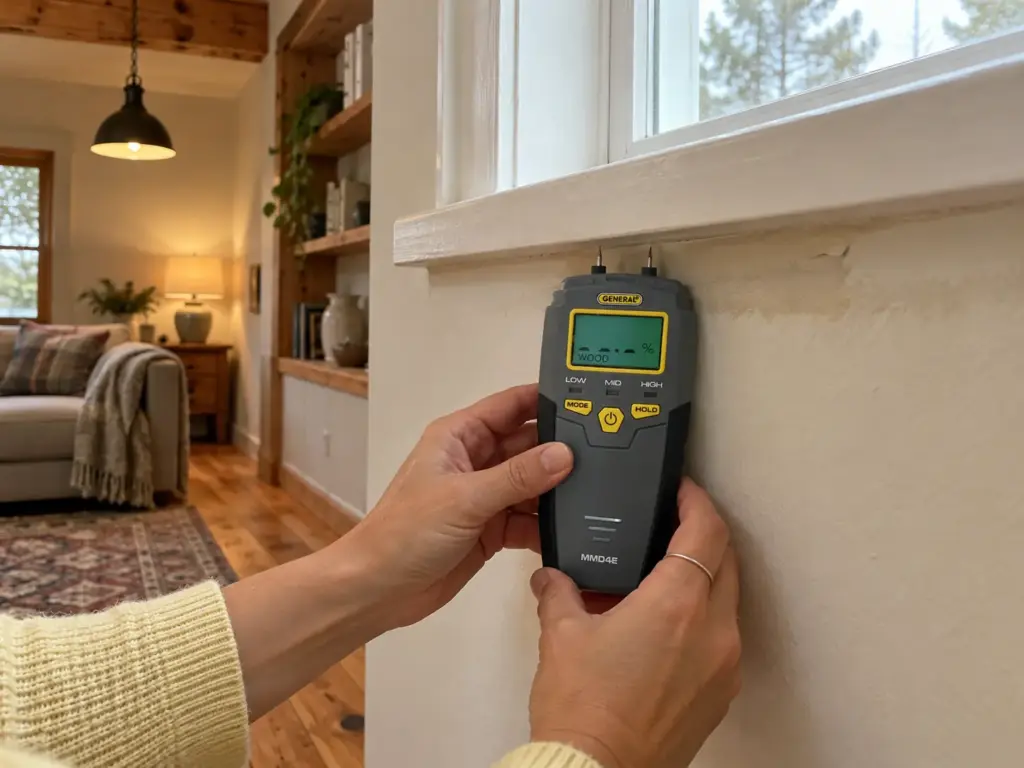
When the hand and the light disagree, or you want a number, a moisture meter reads the wood and the drywall behind the paint. The General Tools MMD4E is made for wood, drywall and other building materials and has a water-leak function, and Lowe’s reviewers give it 4.4 out of 5 across 202 reviews. One reviewer testing it on white pine found it slow to settle when the wood is dry, so hold it still on the sill for a few seconds before you decide the wood is fine.
Take a reading on the sill, one on the wall under it and one on a wall far from any window. The gap between those three, more than any single number, is what separates a damp frame from a damp wall.
One Wet Spot, Every Morning, All Winter
The damage is slow, and no single morning shows it. What the glass does overnight is a one-night story; this section follows the same wet spot across a heating season. Sources that describe the outcome say over time and stop there, and that is fair, because the date depends on the wood, the paint and the room. So instead of a calendar, here are three things to look at and what each one means.
The First Cold Week: A Cloth Is Enough
The first hard cold brings beads on the lower glass, and by noon they are gone. That is the room’s moisture at work, and it needs a cloth, not a project.
The habit to build is wiping up the liquid water each morning before it starts puddling. It costs nothing, it keeps the water off the sill, and a bit of fog is not a big deal. What it does not do is change the cause, so it buys time and nothing more.
Wipe the glass from the top down, finish with the sill, and use a towel you can wring out. A cloth drawn across the pane pushes the water to the lowest point, which is the wood.
Drapes matter more than they look. Cornell notes that closed drapes and shades separate the cold glass from the warm room and let it cool further below the dew point, so the window that is covered all day is the one that sweats the most.
The Weeks After: Paint, Caulk and the Edge of the Frame
If the same corner is wet every morning, the signs show up in a set order. First a dark line appears at the lower corner of the sill, where the same drop sits day after day, and the paint at that spot lifts into a small flake. Next the caulk along the bottom of the glass darkens or pulls away from the frame, which hands the water a path past the glass and into the frame itself. Last, the edge of the frame feels soft or looks stained, which is where it shows.
Each of those is a different answer. A lifted flake means the paint has been wet more than it has been dry. A gap in the caulk means water now has somewhere to go, and re-caulking is the building’s fix, not the humidity’s. A soft edge means the material has already taken the water, which is the point where the room’s reading stops being the whole story.
The Spot That Comes Back After You Wipe It
Here the usual advice, it is just the room’s humidity, starts to fail. If you have done the fixes in the next section, the meter sits in range and the same corner is wet again by the next morning, the room is not the cause any more. The window, its seal or the wall behind it is. Fog that stays between the two panes is a separate case, a failed seal that takes years and not a winter, and whether the windows need replacing is its own question.
The Fixes, Free Ones First, One at a Time
The sections above say what to watch; this one says what to change, and the order is the point. A change that is not followed by a reading does not tell you whether it worked, and three changes at once tell you even less. The ladder below runs free and likeliest first.

Step One: Read the Room Before Touching Anything
The first purchase is a reading, and it comes before any device. According to the EPA’s humidity guidance, indoor relative humidity “should be kept below 60 percent — ideally between 30 percent and 50 percent, if possible.” That band is a ceiling for mild weather. As the temperature outside drops, the glass gets colder and the number the room can hold without sweating slides down, which is why the humidity that matches the outdoor temperature is lower than 50 percent in a hard freeze.
For the reading itself, the Govee H5075 is a Bluetooth hygrometer-thermometer with custom alerts, so it can warn you when the room crosses the 60 percent line. Its battery is the catch: reviewers report poor battery life in cold places and frequent replacements, so keep it on a shelf in the room and not on the windowsill. If you do not want an app, the AcuRite 00613 is a plain thermometer and hygrometer for the shelf.
A cheap meter can be off by a few points, so a reading near 60 is a direction and not a verdict. How to read a meter covers placing it and trusting it.
Steps Two to Four: Curtains, the Bath Fan and the Humidifier Dial
These three are free, and the full list of free ways to lower humidity goes further than this page does. Do them one at a time.
Step two is to open the curtains and blinds during the day, as Cornell advises, so room air moves across the glass. The next reading should show the glass drying sooner after sunrise. The catch is that the room loses a little of the heat the closed drapes were holding in.
Step three is to run the bathroom fan during and after a shower, and to check where its duct ends. A fan that vents outside takes the moisture out of the house; one that vents into the attic only moves the damp to the attic. Cornell adds a flaw of its own: a fan exhausts heat along with the moisture, so put it on a timer or a humidistat instead of leaving it running. The shower-time peak on the meter should now be lower and shorter.
Step four is to turn the humidifier down in a cold snap. Some people with a whole-house humidifier set it between 35 and 45 percent on ordinary winter days and drop it low in a cold snap, with the dial marked so it can be found again. Take it one notch at a time and read the meter after each, because the room will feel drier, and that is the price of this step.
The meter lags the change. After a longer fan run or a lower humidifier dial, the glass dries before the number settles, so wait a full day before you judge a step and before you take the next one.
The Last Steps: The Thermostat and the Dehumidifier
Step five is a few degrees on the thermostat, and it goes late on purpose. Warmer glass stays above the dew point, so the beads stop forming, but Cornell puts it last because heating the house higher costs fuel and works against saving heat. If you take it, go up a little at a time and read the meter again after each change.
Step six is a dehumidifier, and only if the reading is still above the band after the free fixes.
The Frizzlife DH80 suits a small room: a 135 oz (4.1 L) tank, up to 40 oz of moisture a day in the maker’s test at 86°F (30°C) and 80 percent RH, and a sleep mode rated at 28 dB. The flaw sits exactly where a window sweats. The maker says not to run it below 50°F (10°C), because it has no defrost, and to shut it off for an hour after three hours of cold running until the frost melts.
It also has no built-in humidistat, so it runs whether the room needs it or not. Which dehumidifier suits the room is its own decision, by room size.
Window film and plastic sheeting are sometimes suggested, but they treat the cold glass and not the moisture. They are not a step on this ladder. They are not a step on this ladder.
A tight, newly built house is the other case. Cornell says that in a house with very little air leakage, the best remedy is to cut the moisture made inside or to ventilate it out mechanically, for example with an air-to-air heat exchanger (an ERV or HRV), which removes moisture while keeping part of the heat. That is a bigger purchase than the ladder above, and an older house with leaky windows rarely needs it, so it comes after these six steps and not before them.
Signs the Problem Is the Building, Not the Air
The fixes above work when the room is the cause. This section is for the other case, where the water keeps coming back whatever the room does, and the answer is a person who can open a wall.
The Wet Spot That Returns After a Wipe
The sign that decides is simple: the meter is in range, the curtains are open, the fan has run, and the same spot is wet again. New windows do not change the physics of a cold night.
In a deep cold snap, new windows can pick up a fair amount of condensation even when the humidity is moderate. An occasional wipe is fine, and the water must not pool. The reading, not the window’s age, is what decides.
A Soft Sill, a Stain Past the Frame
A stain that runs from the frame onto the wall, paint lifting under the sill, a sill that dents: the water is already in the material, and another meter will not help. The call is a window installer, a carpenter or a contractor. Cornell’s note about concealed condensation extends the call, because it may include the attic and the exhaust-fan duct and not only the window.
If the water is getting in around the frame, Cornell’s list of window-side fixes starts with caulk and weatherstripping to cut the air leaking through and around the window, and adds a second layer of glazing such as a storm window. Those are jobs for the building, and a contractor can say which one this window needs.
A sill that is only wet on the surface is dry by noon. A soft one dents under a thumbnail pressed into its underside, and it stays cold and damp long after the glass has cleared.
Fog Between the Panes
Fog that stays between the two panes is not condensation from the room. It is a failed seal in the insulated glass unit, and wiping does nothing to it. Whether the windows need to be replaced depends on that seal, on the frame and on the age of the unit, and it belongs to its own article.
Tomorrow’s Reading and Next Month’s Check
Three things to carry out of this page:
- Read the room first and change one thing at a time, so you know which change worked.
- The damage sits in the sill, the frame and the wall behind the glass, not on the glass.
- A wet spot that returns after a wipe, a soft sill or fog between the panes is the building’s call.
In a month, look at the same corner and the sill under it, and compare the meter’s reading after a week of the new routine with the one you started from.
Tomorrow, make whichever change the room does not have yet: open the curtains in the day, or run the bathroom fan after a shower. Then read the meter the next day. If the glass dries and the number falls, you have found the fix. If you want the full prevention routine, how to prevent condensation on windows is the place to go next, and if you are still not sure the amount of water is ordinary, is it normal has the answer.
Frequently Asked Questions
01Does condensation on windows mean the house is too cold?
Not usually. It means the glass is colder than the room’s air can hold its moisture against, which is a humidity and window question more than a thermostat one. Read the meter before you touch the heat.
02Should I wipe condensation off windows?
Yes, when it is wet enough to run: wipe it each morning before it pools on the sill, where the wood takes the damage. It costs nothing, but it does not fix the cause.
03Is it bad to have condensation on windows?
For the house, it is bad when it returns daily, because the sill, the frame and the wall behind them take the water. A light film now and then is the room’s moisture at work; is it normal has the test.
04Do I need new windows if I get condensation?
Not usually. Fog between the panes is the case for replacement; water on the room side is mostly the room. See whether the windows need replacing before you spend.
05What humidity should I keep to stop windows sweating?
The EPA’s band is 30 to 50 percent, and below 60 at most. In a hard freeze the glass can sweat inside that band, so the target slides lower as the outside temperature drops; see humidity by outdoor temperature.