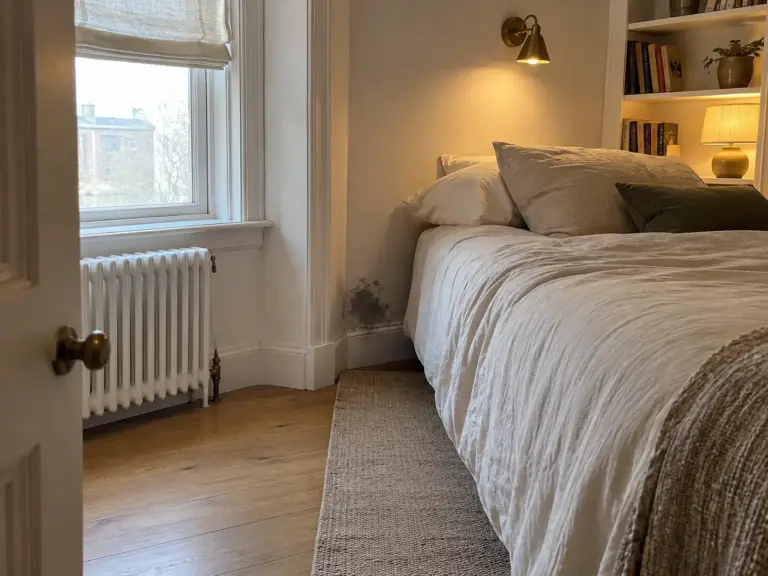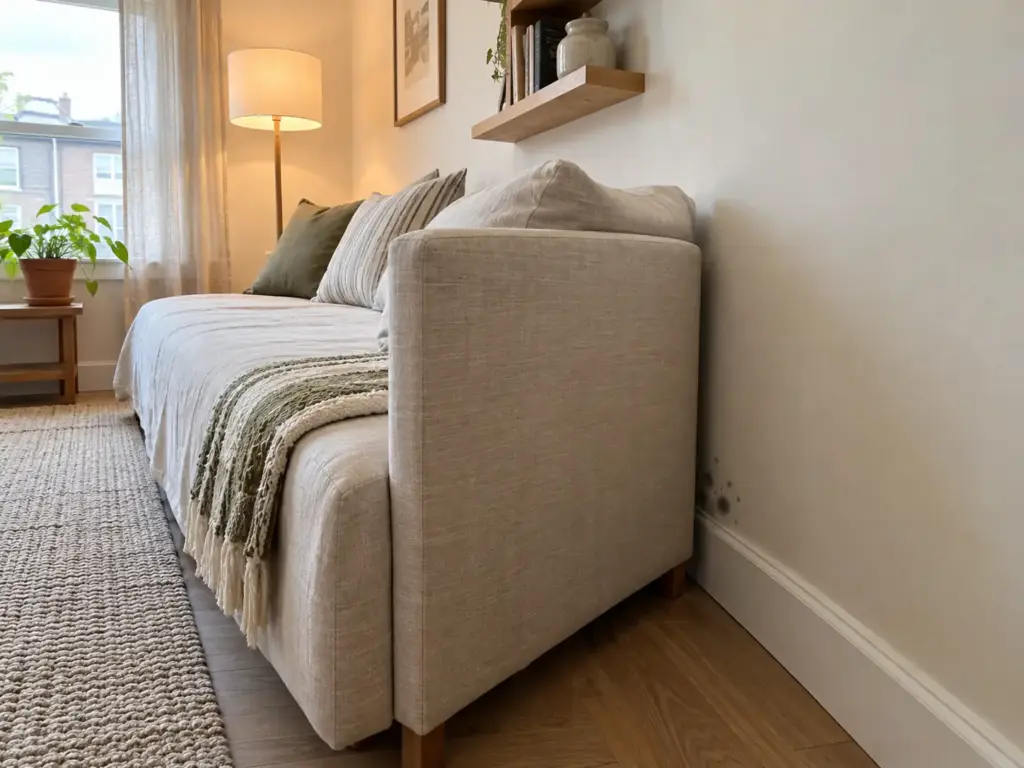
You pull the bed away from the wall for the first time in a year and find a gray patch low in the corner. Before any cleaning plan comes the question that has you standing there with your phone out: how fast does mold grow on bedroom walls, and how long has this one been at it? Mold needs water, so the pace is set by how long the wall’s surface stays wet, and a leaking pipe and a cold wall in a humid room keep very different clocks.
Whether the patch matters for the people who sleep in that room is a question for a doctor; this guide reads the wall, the water and the room’s humidity. Below you will find both clocks and a week of readings that shows which one is yours. The causes behind the patch live in why mold grows on bedroom walls in the first place.
Quick Answer
Mold on a bedroom wall has no single growth speed. The EPA’s 24 to 48 hours is a drying window after a leak or spill, not a growth rate. A room’s own damp wall runs on how long its surface stays wet, so the first job is finding out which clock you are on.
How Fast Mold Grows on a Bedroom Wall Starts With a Drying Window
The number repeated on almost every cleanup page is real, but it answers a different question from the one you typed into the search box. Before you start counting days backward from the morning you spotted the patch, it helps to separate a standard from a schedule.
What the EPA’s 24 to 48 Hours Measures
The one clock with a public standard behind it is a drying window. According to the EPA’s brief guide to mold and moisture, “If wet or damp materials or areas are dried 24-48 hours after a leak or spill happens, in most cases mold will not grow.” Read it slowly, because the condition sits inside the sentence: if dried.
The clock starts at the water, not at the patch, and the sentence is about prevention. It is not a rate of growth, and it is not a waiting period after you clean.
The same guide adds the other half. Every kind of mold needs water or moisture to grow, and the EPA adds that the spores will not grow where moisture is absent, so a wall that dries stops being a growth site and a wall that gets wet again starts over. What matters on a room wall is therefore how many hours its surface stays wet, far more than how old the patch looks.
A painted wall that was damp for an afternoon and dry by supper never starts the clock. The same wall behind a headboard can stay cold and clammy for a month, and visible mold there points to a surface that has stayed wet, not one that was wet for an afternoon.
Why a Day-by-Day Schedule Is Not a Rate
Some cleanup companies stretch that single window into a mold timeline: colonies by day two, thicker by day three, and onward from there. The EPA’s sentence says nothing of the kind. It describes wet materials after a leak or spill, and it stops at whether growth starts.
Mold can start growing on wet building materials within days, which is why the drying clock matters.
Count by a schedule and you can scare yourself with a timetable that does not fit your wall, or relax because the patch is “only” two days old. A rate needs a surface that stays wet, and the schedule never asks whether yours does.
A Leak Runs on Hours, a Damp Room Runs on How Long It Stays Wet
If the 24 to 48 hours belongs to a leak, the wall in a room with no leak runs on a slower clock, and the straight thing to do is say what is known about that clock and what is not.
The Building Clock
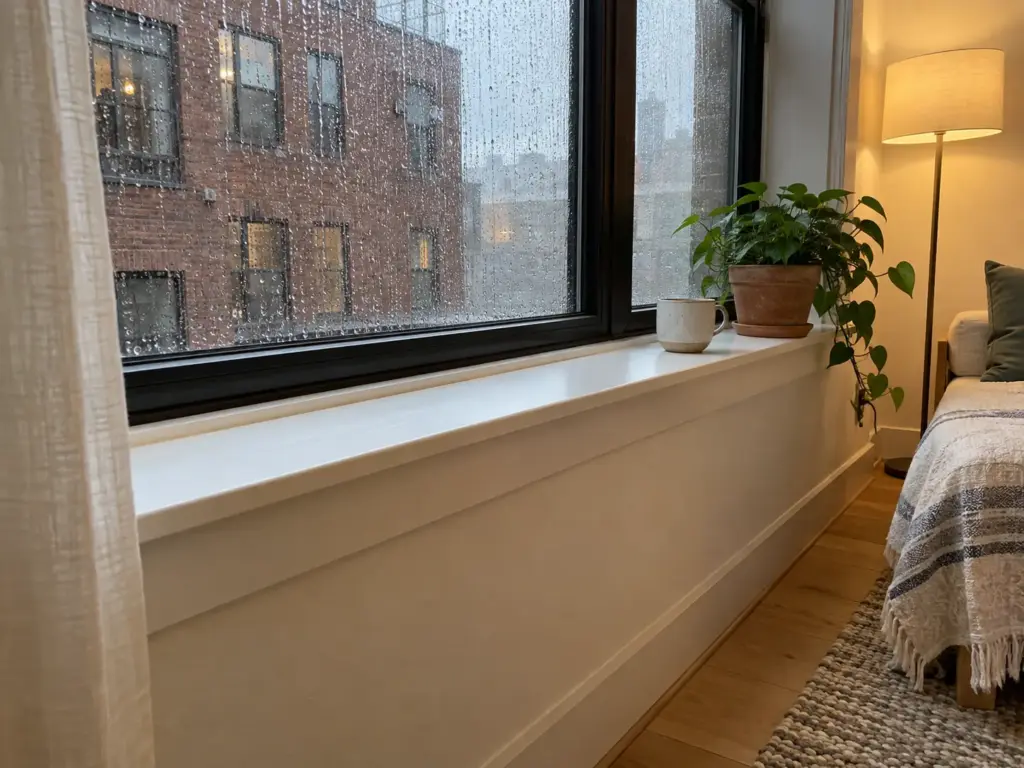
Water arrives from outside or from a pipe: a roof leak, a window that lets rain past its flashing, a supply line inside the wall. The material gets wet all at once, the EPA’s drying window starts, and the pace is counted in hours and days.
One common shape is rainwater leaking into a basement storage closet, with mold on several of the stored items. That is a leak’s clock. That is a leak’s clock. Water was delivered, it stayed, and the only real fix is at the source, which the section on the building below takes up.
The Room’s Clock
In a room, nothing arrives. The wall sits colder than the air around it, or a bed blocks the little air that would dry it, and the surface stays damp for a stretch of every night. No number of days or weeks goes on that stretch here, because no published figure gives a growth rate per day for a painted bedroom wall with a bed against it. What can be said is what sets the pace: the hours per day the surface stays wet.
A windowsill wiped clean can show growth again within a couple of weeks. That is not a measurement, but it has the shape of a room’s clock: a clean, a return, and no leak anywhere in the story. But it has the shape of a room’s clock: a clean, a return, and no leak anywhere in the story.
The same wall can also sit on both clocks. It stays dry for several days, then goes wet again on the first cold night, which is why one look at noon misreads it. How long a room stays above the line is its own question, covered in how long indoor humidity stays high above 60%.
What the One Published Growth Model Is, and Is Not
A mold growth rate model does exist. Hukka and Viitanen’s 1999 mold growth model for wood uses differential equations to describe how fast a mold index climbs, and it was fitted to pine and spruce sapwood. That is careful lab work on one kind of wood.
A painted bedroom wall, with paint, a paper-faced drywall surface and a bed in front of it, is not that sample, and the model is not a countdown for your corner. A leak timeline is real and a lab model is real; neither is this wall, which is why its pace has to be read in the room instead of looked up.
The Cold Outside Wall Sets the Room’s Clock
If the room’s clock is how long a surface stays wet, the next question is which surface, and in a bedroom the answer is almost always the coldest one with the least air moving across it.
Why the Outside Wall and the Corner Go First
Air carries water as vapor, and cold air carries less of it. When room air touches a surface colder than its dew point, the water settles on the surface.
Take a bedroom at 68 °F (20 °C) and 50% relative humidity: its dew point is about 49 °F (9 °C). A wall at 52 °F (11 °C) sits above that, so it stays dry. But the thin layer of air touching a 52 °F wall is cooled with its moisture unchanged, and by the arithmetic that layer sits close to 90% relative humidity. The gauge on the dresser says 50 and the wall lives at 90.
Raise the room to 60% and the dew point climbs to about 54 °F (12 °C), and now the same wall is below it. The mechanism is the one that fogs a window pane, slower and out of sight behind the headboard. The same cold exterior wall, seen on window glass, is why a pane beads over a cold night.
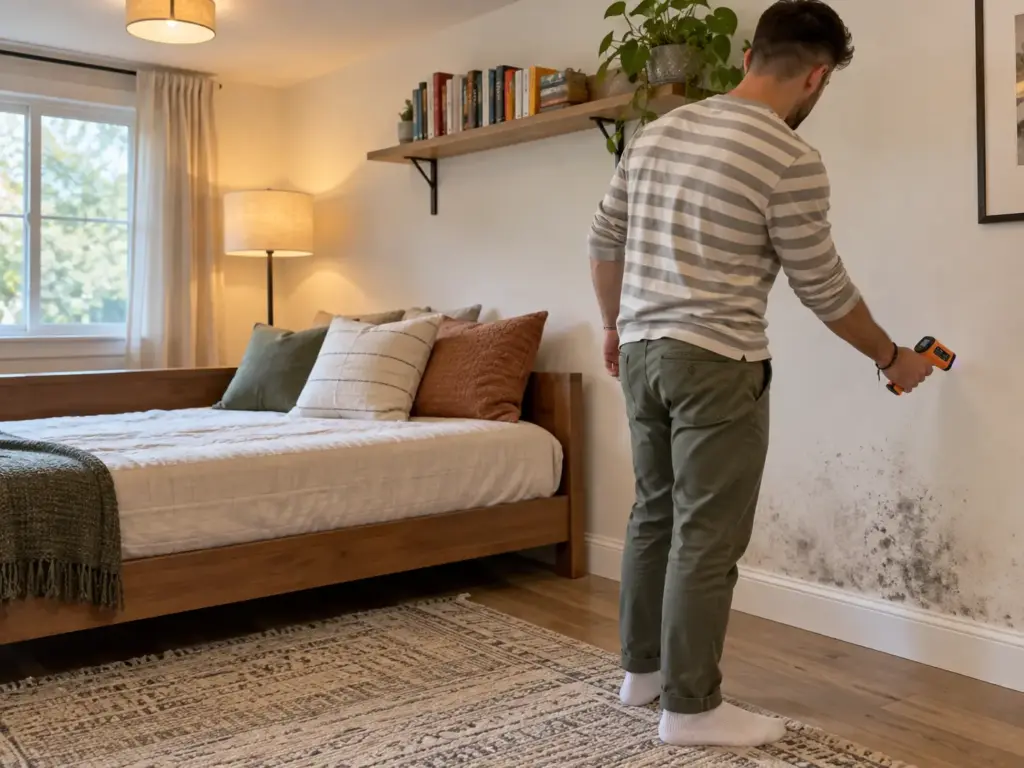
Start with the free check. Slide your palm along the wall behind the bed in the morning, then along an interior wall in the same room. An outside wall that feels cold and a little clammy is already telling you which surface is on the clock, usually before there is anything to see.
To put a number on what the palm feels, an infrared thermometer such as the TempPro TempScan TP30 reads a surface in under half a second, and its 12:1 distance-to-spot ratio and 1.5% accuracy are plenty for comparing a wall with its neighbor. It reads the surface and never the air, so it cannot hand you the dew point on its own; for that you pair it with the humidity reading from the next section and run the comparison above.
Scan the wall behind the headboard and then a spot on the same wall a few feet away, at the same height. The gap between the two readings points at the cold spot, and it holds up even if the thermometer is a degree or two off.
The Bed, the Dresser and the Paper Face
A bed or a dresser pushed flat against that wall blocks the little air that would dry it, and keeps the surface colder than the open wall beside it. Drywall adds its own part: mold feeds on organic material, and the paper face of drywall and the paint over it supply that. So the wall behind the furniture is the cold one, the still one and the one with something to eat, all at once.
Winter humidity in a closed bedroom, with the heater running, can feed a patch on a windowsill that returns a couple of weeks after a clean. It is the same stack of conditions, only on a sill instead of behind a headboard.
Winter and Summer Run the Clock Differently
In winter the outside wall is cold and the room air is warm, so the surface can sit below the dew point for entire nights. A cold aluminum window frame in winter sweats for the same reason: its surface sits below the dew point.
In summer the pressure comes from the other side. Some restoration companies write that humid weather compresses their timelines, without putting a figure on it, and a humid bedroom can sit above 60% for hours with the AC cycling off. Both seasons can drive it, and no published standard ranks one over the other, so the season that matters is whichever one your readings land in.
Time Above the Line Matters More Than the Peak
A reading at noon tells you almost nothing about a wall that gets wet at night, so the free check is the same gauge read at the same hour for a week.
Read the Same Hour Every Day for a Week
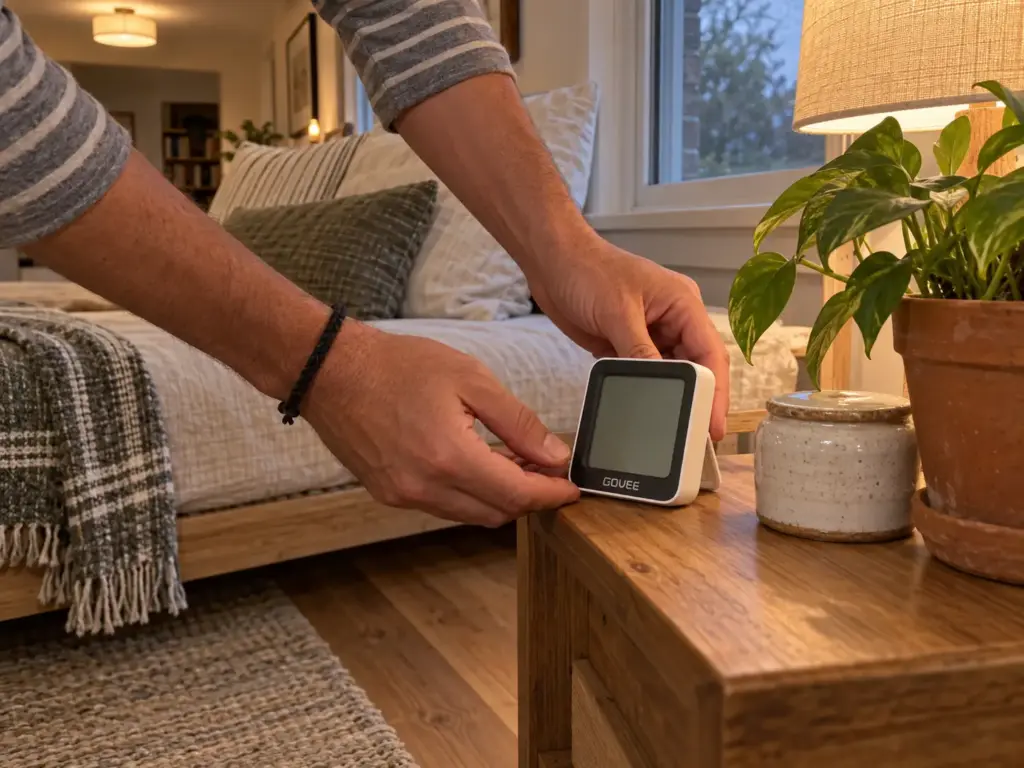
The EPA’s ceiling for indoor humidity is 60%, ideally between 30% and 50%, and it notes that a small, inexpensive meter from a hardware store measures it. Set that line as your reference. If the placement is new to you, begin with how to measure indoor humidity with one meter.
Then change nothing for seven days. Read the gauge first thing in the morning, before you open the door, when the room has been closed the longest, and again in the evening. Write the numbers down.
A logging unit does that writing for you. The Govee Indoor Hygrometer Thermometer H5075 pairs over Bluetooth, keeps 20 days of readings in its app and shows the graph without anyone standing at the gauge. Its rating is ±3 %RH and ±0.54 °F, so a reading of 58 can really be 61. Read the trend and treat any single number with suspicion.
If you would rather skip the app, the AcuRite 00613 hangs on the wall and shows humidity and temperature at a glance. It has no memory and no graph, so the notebook becomes the log. The listing is a five-pack, which the product name does not say, so expect extras.
Keep the gauge on the same shelf all week, on an inside wall and away from the window, the vent and the door. Moving it halfway through the week changes the readings more than the weather does, and the week stops being comparable.
Why a Single Peak Misleads
A room that reads 45% at noon and sits above 60% for six hours before morning is on a different clock from a room that never leaves 50%, even though the daily average could be identical. The average hides the nights, and the nights are where a cold wall gets wet. What counts is the time above the threshold, the number of hours spent over the line, not the single highest reading.
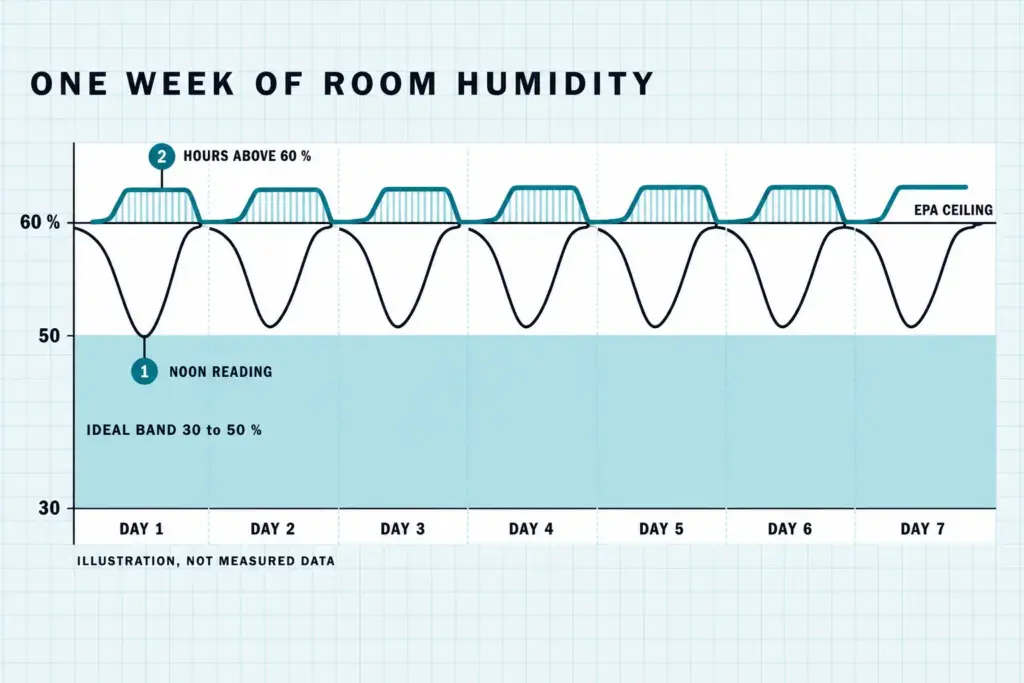
On a logger’s graph this looks like a ledge rather than a peak. Humidity climbs after the door shuts at bedtime, stays flat through the night and drops soon after the door opens in the morning. If your week draws that ledge above 60%, the wall has the moisture it needs for as long as the ledge lasts.
What a Week of Readings Says About Which Clock You Are On
A week of numbers only helps if it ends in a decision, so this section says what each pattern means and what the wall adds that the air cannot.
Humid Room, Cold Wall: the Room’s Clock
The direction comes first. If the room’s humidity spends hours above the line, the palm and the thermometer both say the wall is the coldest surface, and the patch has come back after a cleaning, you are on the room’s clock. The water source is the room itself, and the change belongs to the room: the last section puts those changes in order.
Running a dehumidifier straight away is the common first move, and it fails when the readings do not support it. A room that reads 50% can still have a cold wall sitting near 90% at its surface, as the arithmetic earlier showed. In that case the better first call is to warm or air the wall, with a little ventilation, before drying the room.
Dry Room, Wet Wall: the Building’s Clock
The opposite pattern points the other way. The air stays at or below the line all week, and the wall still feels wet or the patch keeps appearing.
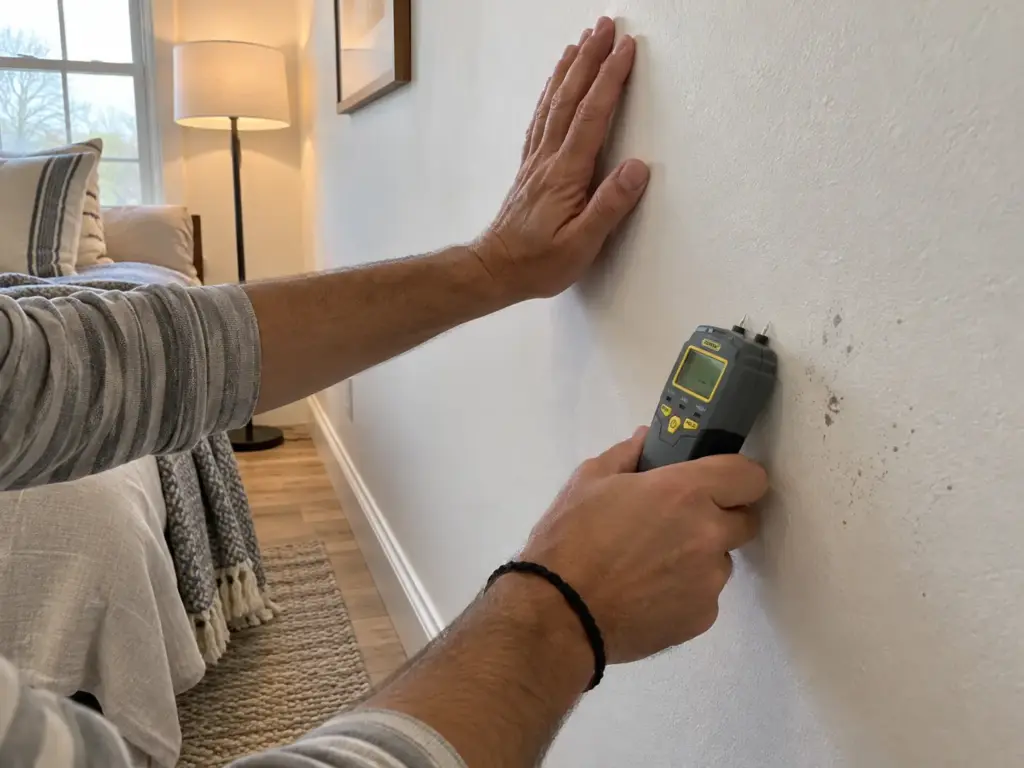
A hygrometer cannot see inside the wall, so the next reading comes from the wall itself. The General Tools MMD4E is a pin meter: you press two stainless steel pins into the surface, and it shows moisture as a percentage on a building-material scale of 1.5% to 33%. The pins leave two tiny holes that a dab of paint covers. Its listing calls it a tool that “Detects mold & humidity”, which is the listing’s wording; a moisture meter reads moisture in the material and cannot count spores or tell you a patch is mold.
Compare, do not look up. Take a reading on a dry spot of the same wall, at the same height, and then at the edge of the patch. The gap between the two is the evidence, and the number printed on any box is not.
Repeat the meter reading on the same two spots on three different days. A wall that reads high and steady across days is holding water. One that reads dry in the afternoon and wet the next morning is following the room’s humidity, not a leak.
Cleaning Does Not Reset It
The EPA is plain about this: if you clean up the mold but do not fix the water problem, then, most likely, the mold problem will come back. So a patch that returns after a wipe is the wall reporting that it is still wet. A windowsill that grows back in a couple of weeks is seeing exactly that.
The return itself is the reading. For the method of the cleaning, how to remove mold on a bedroom wall under 10 square feet has it. The EPA’s advice for hard surfaces is detergent and water, then dry completely, and the drying only counts if the water source is fixed too. The wipe changes the surface and leaves the water as it was.
When the Pace Says It Is the Building, Not the Room
Some paces have nothing to do with the bedroom, and the readings tell you when to stop adjusting the room.
Water From Outside or a Pipe
When water arrives from outside or from a supply or drain line, the wall is back on the building’s clock, and nothing in the room’s humidity will move it. The EPA’s instruction is to fix plumbing leaks and other water problems as soon as possible and to dry items completely.
The signature is a wall that is wet in the same spot after a dry week, while a room-driven wall dries out on a dry day. If you suspect a pipe or a building leak, how to detect water leaks at home early is the next decision.
Behind the Drywall
Mold you cannot see sits behind paint and paper, and the room’s humidity says nothing about it. The pattern is a dry room, a wet wall and a patch or stain that appears and returns, and only the wall reading finds it.
In a rental, a fix that only pulls the carpet, replaces the pad and paints over the mold is not going to fix the problem. Carpet padding and wood framing behind a wall hold water the same way. Paint covers a surface; the wet material underneath stays wet.
The Size Line
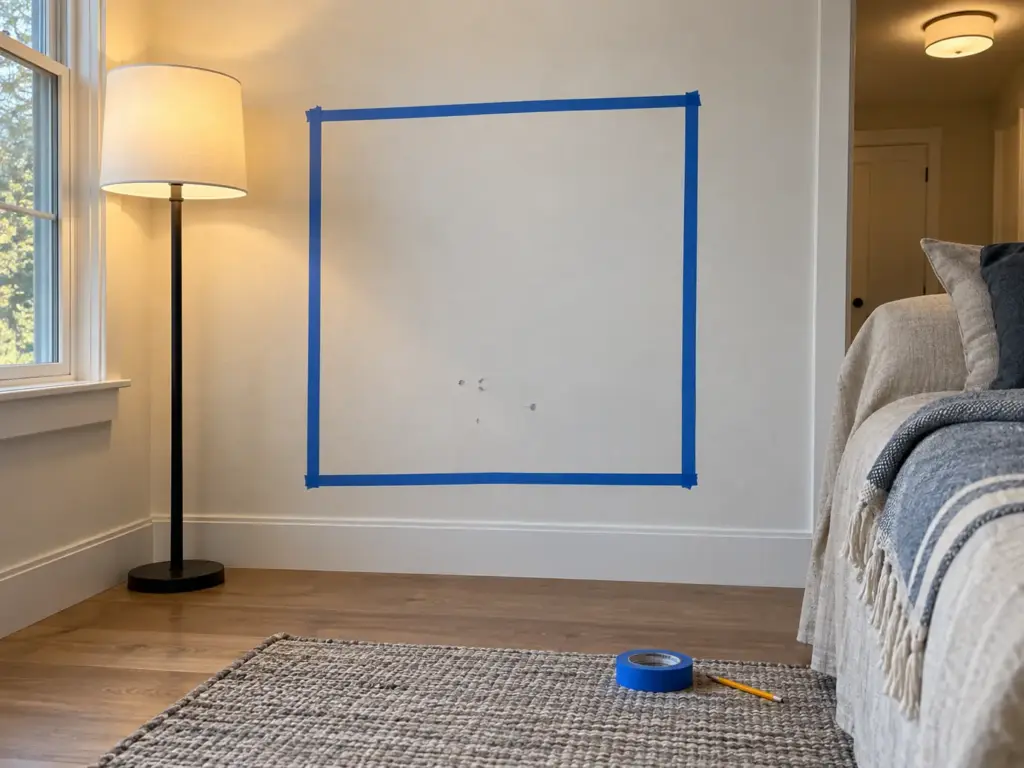
There is a size at which the job changes hands. The EPA’s cleanup page puts it this way: “If the moldy area is less than about 10 square feet (less than roughly a 3 ft. by 3 ft. patch)”, in most cases a homeowner can handle the cleanup.
The EPA’s guide to cleaning up mold at home sends anything larger, or any case with a lot of water damage, to a different guide written for larger jobs.
The room fix is the wrong tool there. A patch bigger than a 3 by 3 foot square, or water you cannot trace, is a job for professional remediation, and the readings you took this week are what you hand that person.
If It Is the Room, Change One Thing at a Time
When the readings say the room is the cause, the fixes come in order, free ones first, with the same reading taken again between each, so you know which change moved the clock.
Pull the Bed and Dresser Off the Wall
Move the bed or the dresser a hand’s width, about 4 inches, away from the outside wall so air can pass behind it. Then change nothing else. The first thing to move is the feel of the wall under your palm in the morning, before any gauge budges, and the next seven mornings at the same hour show whether the hours above the line shrank.
The order of the other prevention steps belongs to how to prevent mold on bedroom walls below 60% humidity. This step comes first because it costs nothing.
Run the Air Before You Buy Anything
If the ledge is still above the line, add ventilation: run the bathroom exhaust fan or crack a window during the hours your readings are highest, and take the reading again for a week. Small habits help on a window: opening the curtains daily, wiping condensation, and keeping the blinds a little above the sill so air keeps moving across the glass.
The longer list of free ways to bring humidity down is in how to lower indoor humidity, free fixes first. Watch for the overshoot too: below 30% you have left the EPA’s band, and the wall no longer needs the help.
Write the change next to the date in the same notebook as the readings. When the ledge drops, you will know which change did it, and when it does not, you will know which one to undo before trying the next.
Only Then, a Dehumidifier
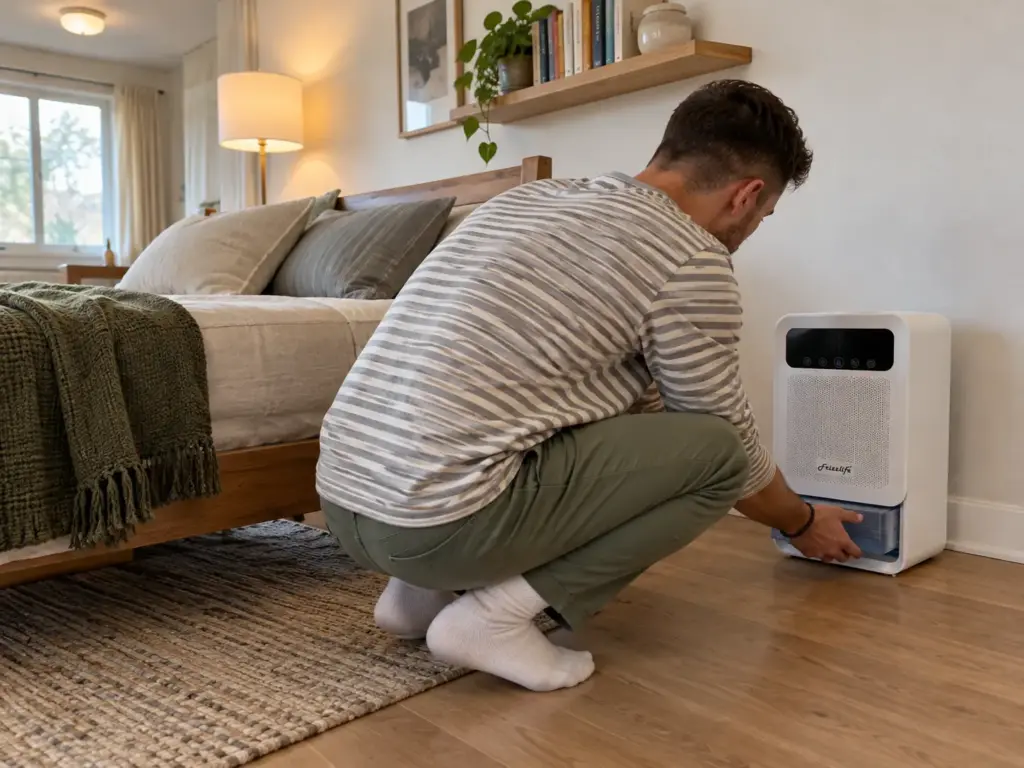
A dehumidifier is the last change, and only for a room whose readings stay above the line after the first two. It pulls moisture out of the air, not out of a wet wall, so it does nothing for the building’s clock. The Frizzlife DH80 is a small unit sized for one bedroom, with a 135 oz tank and a 28 dB sleep mode. Its limits are worth reading before you click: humidity cannot be set by hand, the semiconductor design is slower than a compressor unit, and its 40 oz a day, about 2.5 US pints, is rated at 86 °F and 80% relative humidity, which is warmer and wetter than a bedroom, so expect less.
When the wall has dried and stayed dry, the next decision is the surface, and whether to remove mold before painting a wall picks up from there.
Find Your Clock First, Then Move the Bed
Three things carry over from all of this:
- The 24 to 48 hours is a drying window after a leak or spill, not a rate of growth and not a wait after cleaning.
- The room’s clock is time above the line, read over a week at the same hour, because a single peak hides the nights.
- A wall that stays wet while the room does not belongs to the building, and a patch larger than the EPA’s 10 square feet changes who does the job.
A month from now, read the gauge at the same hour and set it beside the first week. If the gauge sits below the line and the wall still feels clammy to the palm, the wall is the problem, not the room.
Tomorrow, pull the bed a hand’s width off the outside wall, leave everything else as it is, and read the same gauge at the same hour for seven mornings. That one change and those seven numbers will tell you more about the pace than any schedule, and they are what you hand to a professional if the wall turns out to need one.
Frequently Asked Questions
01Will mold stop growing on a wall if it dries?
Yes. Mold needs water, so a wall that dries stops being a growth site, as the EPA puts it for every kind of mold. It can start again if the wall gets wet, which is why the cause matters more than the patch.
02How long after a leak can mold show up on a wall?
The published clock is a drying window: dry the material within 24 to 48 hours and in most cases mold will not grow.
03What time of year is mold on a bedroom wall worst?
It depends on the wall and the room, not the calendar. In winter an outside wall can sit below the room’s dew point for whole nights, and in humid weather the room itself can stay above 60%. No standard ranks the seasons.
04How fast does mold grow inside a wall?
No published figure gives a rate for the inside of a wall. The pace follows how long the material stays wet, and mold behind drywall is a building problem that a room fix cannot reach.
05Does cleaning a patch reset the clock?
No. The EPA says that if the water problem is not fixed, the mold problem will most likely come back. A patch that returns after a wipe means the wall is still wet.