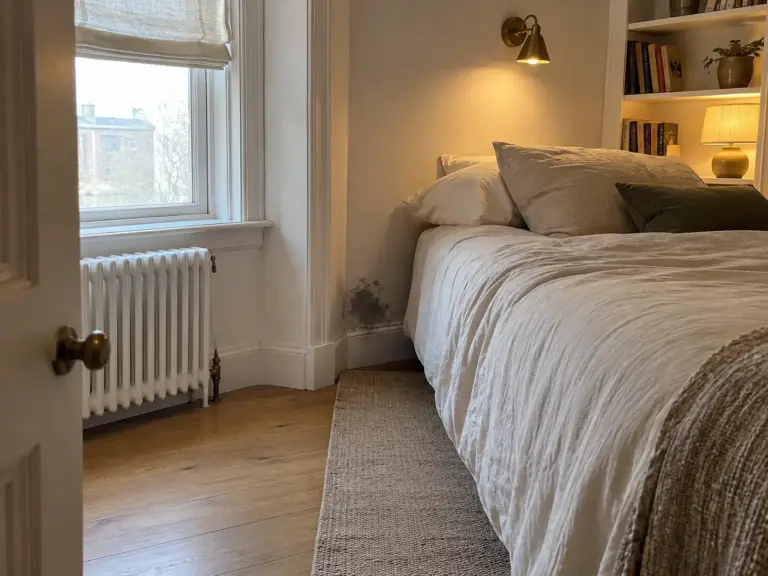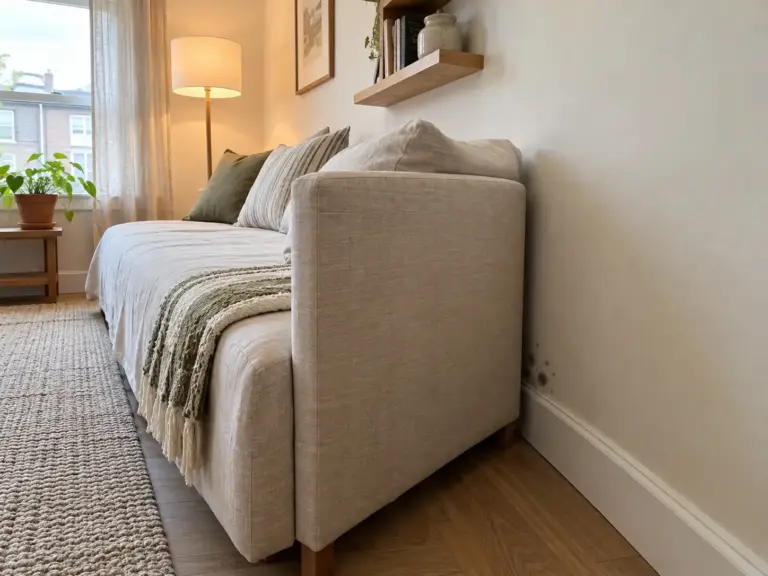
You have just finished cleaning a patch off the wall, you are standing in the doorway, and the real question is how to prevent mold on bedroom walls when the room has one window, the bed fits only against the outside wall and the wall is not yours to open. A closed bedroom adds water to its own air all night, and the coldest surface that air can reach is that same outside wall, so the moisture settles where nothing moves it. Whether mold in a room matters for anyone’s health is a question for a doctor; this page stays with the wall, the room’s humidity and what you can change. What follows is a sequence of readings rather than a shopping list: the night humidity first, the cold wall second, the air third, a device only if the number stays high, and a check a week and a month later.
Quick Answer
Change one thing at a time, in this order, and read the room between each step.
- Read the bedroom’s humidity at bedtime and at dawn for several days.
- Hold it under 60 percent relative humidity, ideally 30 to 50 percent.
- Pull the bed and wardrobe a hand’s width off the cold outside wall.
- Move the air: run the bath fan, open the window only when outside air is drier.
- Add a dehumidifier only if dawn stays over 60 percent, then read again at a week and a month.
The Night Reading Comes First
The wall is where the mold shows up, but the room is where the water comes from, and a bedroom changes most while nobody is looking. So the first number to take is not on the wall at all. It is the humidity of the air by the bed, read twice a day, because a single reading at noon with the window open tells you about the window.
What the EPA’s 60 Percent Line Means in a Bedroom
The reference is public and short. According to the EPA’s guide to mold and moisture in the home, “If possible, keep indoor humidity below 60 percent (ideally between 30 and 50 percent) relative humidity.” Read it as a ceiling and a target: over 60 is the direction to fix, and the 30 to 50 band is where a room has margin to spare. What humidity a bedroom should sit at has the band for this one room on its own.
That puts the problem on the air rather than on a dirty wall, which is why a patch returns after the scrubbing. If a patch keeps recurring after cleanup, the place to look is behind the wall, and the same logic applies one step earlier: if the humidity never changed, the wall never had a reason to stay dry.
But the 60 is a room-wide number, and the wall reads a different one. At 68°F (20°C) and 60 percent humidity, the dew point is about 54°F (12°C), so any surface below that collects water from the air; drop the room to 50 percent and the dew point falls to about 49°F (9°C). An exterior wall behind a bed can sit under both on a winter night. So 58 percent at the nightstand is not a pass for the plaster behind the headboard, and the band is the better goal than the ceiling.
Bedtime and Six a.m., Two Readings
A sleeping room is a small sealed box with a source in it. Sleeping and breathing in a closed room every night is enough to raise the humidity, which is the mechanism behind why indoor humidity peaks at night: the door is shut, the window is closed, and nothing carries the moisture away until morning. The two-reading routine is this page’s own method rather than an agency’s rule. The EPA supplies the ceiling; the hours to take it come from how a closed bedroom behaves.
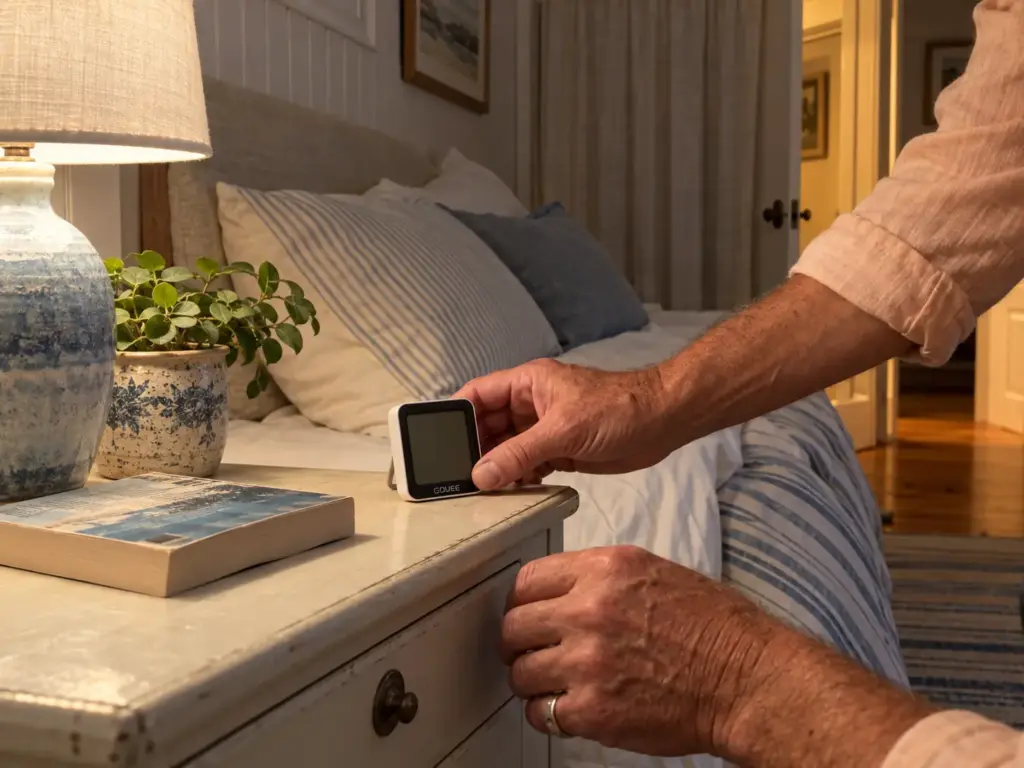
Put the meter at mattress height, away from the window and off the outside wall. Read it at bedtime. Read it again at dawn, before the door or the window opens. Do this for five nights or more and write both numbers on the same line, because one night is weather and five nights is a pattern.
What the pair says decides the next move. Bedtime under the line and dawn over it means the sleeping room itself is adding the water, which points to the air, covered in the third section below. Both over the line means the water arrives from somewhere else in the house (showers, cooking, laundry, an appliance venting indoors) and moving the bed will not be enough on its own.
Before buying anything, try the free test. Take the reading, open the window for ten minutes, and take it again. If the number falls, the outside air is drier than the room’s and the window is a tool. If it climbs, the window is feeding the problem, and that is worth knowing before a night of leaving it open.
Logging both hours without getting out of bed is where the Govee H5075 earns its place. Its humidity accuracy is ±3% RH, its temperature accuracy is ±0.54°F (±0.3°C), its Bluetooth range is 196 ft (60 m), and the phone app can alert when the reading leaves a range you set. The listing’s own review summary says the connection is mixed and that several customers report it stopped working within six months, so copy the first weeks of numbers somewhere other than the app.
Take the dawn reading before you stand up and open anything. A door opened to reach the bathroom lets the hallway’s air in, and the number you wanted, the one the sleeping room made, is gone in a couple of minutes.
What a Cheap Meter Cannot See
Every hygrometer reads the air at the spot where it sits, and nothing else. It cannot tell you what the wall behind the bed is doing, and a reading of 58 next to the lamp can sit beside a wall that is wetter than that. A tolerance of ±3 points also means 58 and 62 are not distinguishable, so treat anything from the mid 50s to the mid 60s as a “read it again tomorrow” zone rather than a verdict. How to measure indoor humidity covers the three readings that make a single meter more honest.
For the reader who wants the number without a phone in the middle, the AcuRite 00613 is a tabletop display that runs on one AA battery and is rated for 16 to 98 percent humidity. It has no app, no history and no alerts, so the notepad is the log. A budget unit like this one can also sit a few points off, and it reads one spot in the room, which is the same limit the Govee has. Either one answers the question this section asks, whether the room is over the line at night, and neither one says anything about the wall.
Pull the Bed Off the Cold Wall
If dawn reads high, the water in the air has to land somewhere, and it lands on the coldest surface in the room: the outside wall, behind the bed and the wardrobe, where the air never moves. This is the free change that needs no landlord. It comes second only because the first reading tells you whether it is the one you need.
The Gap Behind the Bed and the Wardrobe
The EPA names the surface of walls behind furniture as one of the places where condensation forms, and the reason is plain physics: a bed pushed flush to the wall blocks the room’s warmth from reaching it and traps still air against the cold surface. Why mold grows on a bedroom wall has the full cause; here the job is the move. Pull the bed and the wardrobe about a hand’s width off the outside wall (roughly 4 inches, 10 cm), keep stacks of boxes and bags off that wall entirely, and in winter leave the closet doors open a little so the air can pass into the space behind the clothes.
If the same cold surface shows water on the window glass at dawn, you are looking at the same mechanism on a pane, and what condensation on windows overnight is telling you explains how to read it. A fogged window is the wall’s warning, visible one step early.
The gap has a cost, and it should be named. It collects dust, which someone has to vacuum out from behind a bed, and in a small room it takes floor away that you may not have to give. Even so, it is a cheaper trade than a new device.
Then take the dawn reading again, over several days, before anything else changes. One change, then read.
The wall also answers to the palm of your hand. Press it flat on the wall behind the headboard in the morning after a night with the bed against it, and the surface tends to feel cool and slightly clammy. Press it on the same spot after a week with the gap, and a wall that has stopped holding water feels like the rest of the room.
Reading the Wall Itself
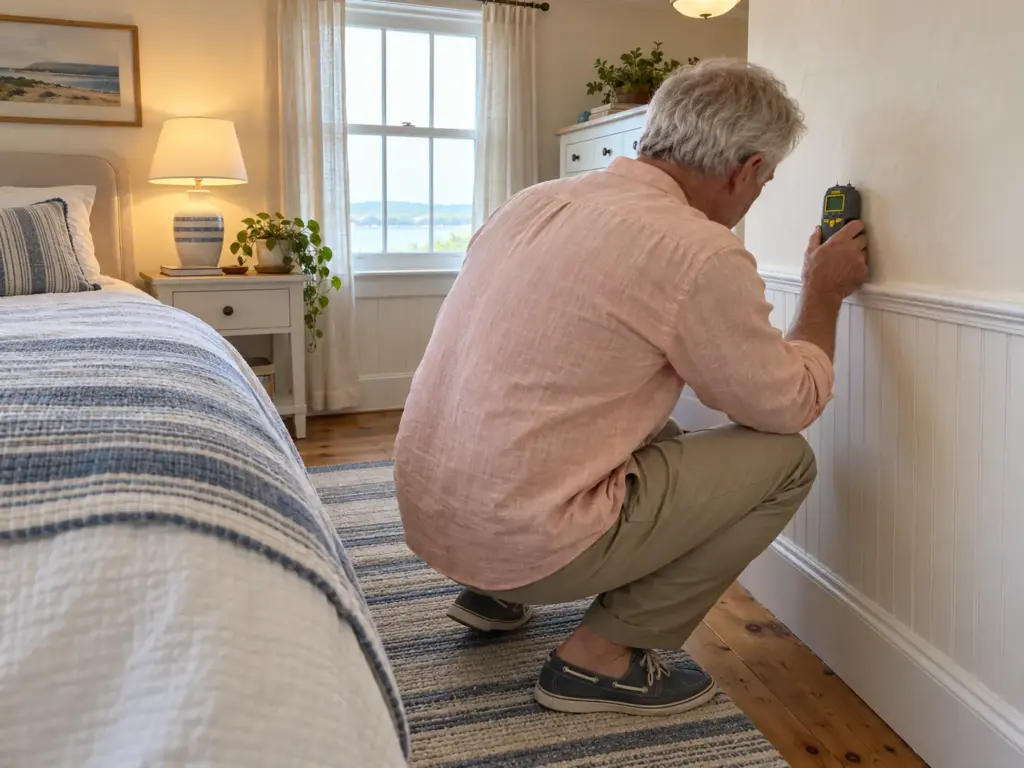
The room’s humidity and the wall’s moisture are two different numbers, and mixing them is the common mistake. A hygrometer reports water in the air as a percent of what the air can hold. A pin-type meter such as the General Tools MMD4E reports moisture content in the material, on a scale made for building materials (1.5 to 33 on this one, with a wood scale of 5 to 50), and the figure on its screen cannot be set beside a percent humidity. It finds a wet wall; it does not measure the air.
The practical way to use it is as a comparison. Take a reading on the bedroom’s outside wall behind the bed, then take one on an interior wall in the same house that has no reason to be wet, and see how far apart they are. The gap between those two numbers tells you more than either number alone, and a second pass after a week of the new gap tells you if it is closing.
The flaw is in the pins. The listing’s review summary says they bend after about 30 uses and that the accuracy reviews are split, so use it a handful of times for a purpose rather than every morning out of curiosity. Each reading also leaves two small holes in the paint where the pins press in, which matters in a rental. And the meter runs on a 9V battery, so check it before you trust a low reading.
Pick the wall reading spot once and mark it with a small pencil dot you can hide behind a picture. A reading an inch away can be a different number, and a pattern only appears if every visit lands on the same square of wall.
When the Wall Stays Wet After Both
Suppose the bed has been off the wall for a week, the dawn reading in the room is under 60, and the wall is still damp to the palm or still reads high at the pins. Then the water is not coming from the room’s air, and the next section will not help. The wall has a source of its own, and the last section of this page covers it.
Suppose instead that the dawn reading is still over the line. Then the room is still the source, and the air is next.
Move the Air the Bedroom Already Has
With the bed off the wall and a second reading in hand, the next change costs nothing. The bedroom has a door and a window, and there is usually a bathroom fan down the hall, and each one moves moisture out only under a condition. Learning those conditions is the whole section.

Vent the Shower, Not the Bedroom
A shower puts a large amount of water into the air in minutes, and that water goes wherever the air goes. The EPA’s advice is to run the bathroom exhaust fan or open a window when showering, and to vent dryers, stoves and similar appliances to the outside where possible. In practice that means the fan running during the shower and for a while after, until the mirror clears, with the bathroom door closed so the steam does not wander toward the bedroom.
The other source in the bedroom is the one you carry in. Laundry drying on a rack adds water to the room for hours, and a wet towel on the rail adds it more quietly. The sign that the bedroom is holding the shower’s water is a towel that is still damp on the rail by midmorning.
The fan has its own flaw: on its highest setting it is loud, and a fan that is too loud is a fan nobody runs long enough. Run it on a lower setting for longer instead of high for a minute.
The Window Only When the Outside Air Is Drier
The window dries the room only when the air outside holds less water than the air inside. In a humid summer or a damp coastal week it works the other way and brings moisture in. That is the condition, and it is this page’s own mechanism rather than a sourced figure: before leaving the window open for the night, take the outside reading (the meter on the sill for a few minutes will do) and compare it with the bedroom’s. Why a house can be more humid than outside shows why the two so often disagree.
Some people end up sleeping with the window open to counter the growth, and notice it late. It is a reasonable instinct that works only on the right nights, and on the wrong ones it feeds the wall.
In winter the rule shifts again. Cold outside air is usually drier, but it also chills the room and cools the very wall you are protecting, which pushes the surface closer to the temperature where water collects. Open it for minutes, not for the whole night.
One more thing belongs here, as a warning rather than a tip. Running a room humidifier is sometimes suggested. A comment suggests running a room humidifier. For this problem that is the wrong direction, because a humidifier adds water to a room that already holds too much of it.
The Door and the Closet at Night
A bedroom door left a few inches open lets the room’s air mix with the rest of the house, which helps when the hallway is drier than the bedroom and does the opposite when it is not. Carry the meter into the hall once to find out which case you have. Closet doors work the same way: a sealed closet on an outside wall is another pocket of still air, so open them a little.
These moves come with their own price. A door ajar lets in light and noise, an open window lets in cold and, in summer, damp, and a fan on high makes a sound you will notice at the worst time.
Make one change, take the dawn reading, and only then make the next. A reader who changes three things in one night cannot tell which one worked. Other free ways to lower indoor humidity lists the rest in the same order.
Move the damp things out before bedtime, not after. Towels go to the bathroom rail, the laundry rack leaves the room, and the dawn number reflects what the bedroom itself does when it is left alone.
A Dehumidifier Only If the Reading Stays High
If dawn is still over the line after the gap and the moving air, the room holds more water than three free changes remove. That is the point where a device earns a place, and it is the last one on the list. Buying it first is the most common way to skip the readings that would have said whether it was needed.
What the Reading Has to Say Before You Buy
The decision rule is a number. The dawn reading is still above 60 percent after the three earlier steps, on several days in a row, and the weather outside is not the whole explanation. If that is you, the room is a candidate for a unit; if the reading has settled under the line, the money stays in your pocket.
Before choosing one, find two numbers on any listing. The first is the unit’s water-removal rating for a room of your size, which is how a dehumidifier is meant to be compared. The second is whether it has a humidistat, a set point you can dial to the 30 to 50 percent band. What humidity to set a dehumidifier to is the next question once the unit is chosen.
And do not let a dehumidifier cover a leak. A hygrometer and a gap change more bedrooms than a new unit does, and when the water is coming from inside the wall a unit only hides the reading while the source keeps feeding it.
The Flaw of a Small Unit
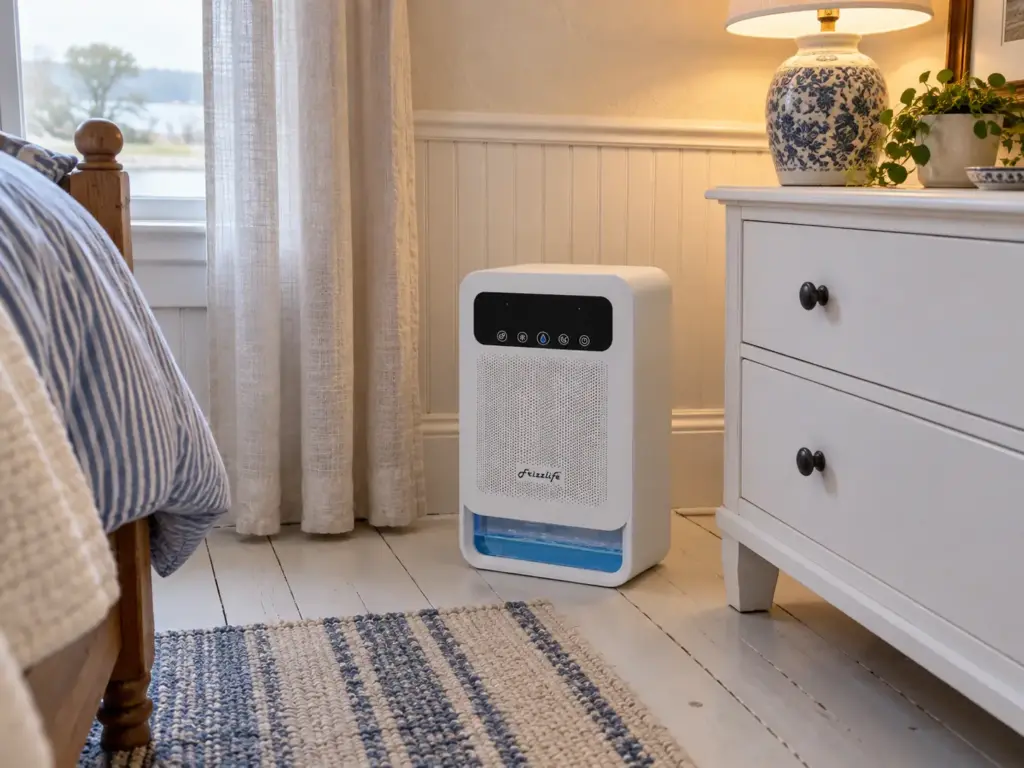
For a small bedroom with a sleep mode, the Frizzlife DH80 is the one on this page. It is a semiconductor unit with a 135-ounce (about 4 L) removable tank, a sleep mode listed at 28 dB, a timer from one to twenty-four hours, and an automatic shut-off when the tank is full. Its limit comes first: the listing says it “automatically balances humidity based on room temperature and conditions,” so the 30 to 50 percent band cannot be dialed in by hand. The meter from the first section does the judging, and the unit does what it does.
The listing also gives a tank size, not a water-removal rating, and no coverage in square feet, so the rating for your room’s size is the figure to find before trusting it. This is the weakest fit of the products on this page for a reader who wants a set point, which is why it comes last and with the caveat attached. If that matters to you, dehumidifiers for a bedroom compared puts units with a humidistat side by side.
The Bucket That Fills Every Morning
Every dehumidifier with a tank shares the same flaw. It fills, and it shuts off when it is full, which means a unit that fills by midafternoon stops working for the rest of the day. It also has to be emptied by hand, it adds a little heat to the room, and it makes noise, small at a 28 dB sleep setting but there all night.
The bucket is not the result. A full bucket at dawn in the first week with a dawn reading that has not moved means the room is not the whole source, and that is the cue to look at the building. The number on the meter is the only proof, and it comes before the bucket in importance.
A Week and a Month Later, or the Building
A dry wall the morning after proves nothing. The proof is the same reading a week later and again a month later, and the same proof also tells you when the problem is not the room.

The Second Reading, a Week Later
A good week looks like this: dawn within the band on most mornings, the wall dry to the palm and, if you bought the pin meter, a reading that has stopped climbing. A bad week looks like the readings you started with. If that is what you have, go back one step, never forward two.
The growth returns after cleanup unless the moisture is fixed. The EPA agrees, saying the background spores that remain after cleanup “will not grow if the moisture problem has been resolved.” So the target is the water, not the spores. If the patch returns anyway, how to remove mold on a bedroom wall under 10 square feet has the steps for the second cleaning, and whether to remove mold before painting a wall is the question that follows a dry month.
The Third Reading, a Month Later
Take the same reading a month later, the same meter in the same place, and choose a morning after rain. A wall that reads fine three mornings in a row and wet on the fourth, after a day of rain, tells you the room is only part of the story. The weather outside reaches the wall in ways the room’s air does not.
Write the date of each wall check on the back of the meter, not in a phone note you will lose. A short list of dates with a dry result beside each is the evidence that decides whether to stop.
When the Water Is in the Building
The EPA gives water a clock: it is important to dry water-damaged areas and items within 24 to 48 hours. Past two days, a wet wall is no longer a question about the room’s air. Look for hidden moisture and a water leak you have not found yet: a roof leak, a pipe leak in the wall, gutters and downspouts that spill against the foundation, ground that slopes toward the house, a damp crawlspace under the floor.
The first sign is a patch that keeps coming back after the room is under control, or a wall that stays wet at the pins while the air reads fine. The EPA’s own line for what a household can handle is about 10 square feet, a patch of roughly three feet by three; larger areas, or a lot of water damage, call for a professional for the house. In a rental, the report goes to the landlord with your readings attached, because the fix belongs to the building.
One limit applies to everything on this page: it is a reading of one spot in one room, and nothing here sees inside a wall. What an air quality monitor can and cannot see about mold is worth a look before you rely on a shelf monitor to settle the question.
Set the Meter by the Bed Tonight, Then Read It Again in a Month
The sequence matters more than any single item in it. Read the night first, bedtime and dawn against the 60 percent line, because the wall is only the place where the room’s water shows up. Make the free moves in order with a reading between each: the gap behind the bed, then the air. And add a device only when dawn stays high after those, with a week-and-month check at the end, or call in the building when the wall stays wet.
For later, take the same dawn reading and press the same patch of wall a month from now, on a morning after rain, and compare the two numbers with the first week’s.
The one change to make tomorrow is small. Put a meter at mattress height by the bed, write down the number as you lie down, write it again before you stand up, and let the pair of readings decide what you do next.
Frequently Asked Questions
01How to stop mold from growing on walls in a bedroom?
Keep the room’s humidity under 60 percent, ideally 30 to 50, by reading it at bedtime and at dawn. Then move the bed a hand’s width off the cold wall and let the air move.
02Why am I getting mold on my bedroom walls?
The wall is the coldest surface in a room that holds moisture overnight, and the air behind furniture stays still. The cause is moisture, not dirt; the full check for why mold grows on a bedroom wall is its own page.
03What removes mold on bedroom walls?
For a patch under about 10 square feet, the EPA starts with detergent and water and a dry wall. A bottle comes second; the best mold remover for bedroom walls, or just detergent compares them.
04How to prevent mold on bedroom walls in winter?
Winter makes the outside wall colder, so the gap behind the bed matters more. Cold outside air is often drier but it chills the room, so open the window for minutes rather than all night.
05Should I sleep with the bedroom window open to prevent mold?
Only when the air outside is drier than the air inside. In a damp week it adds moisture, so read the outside and inside numbers before the night, not after.