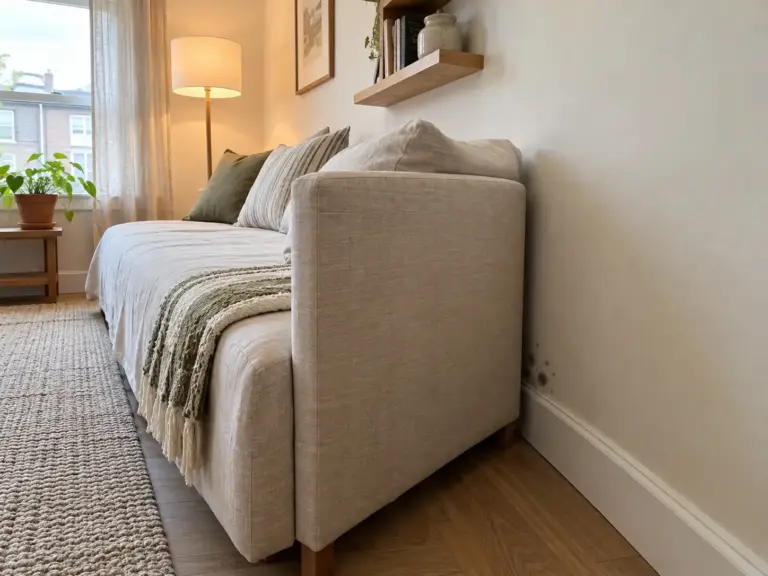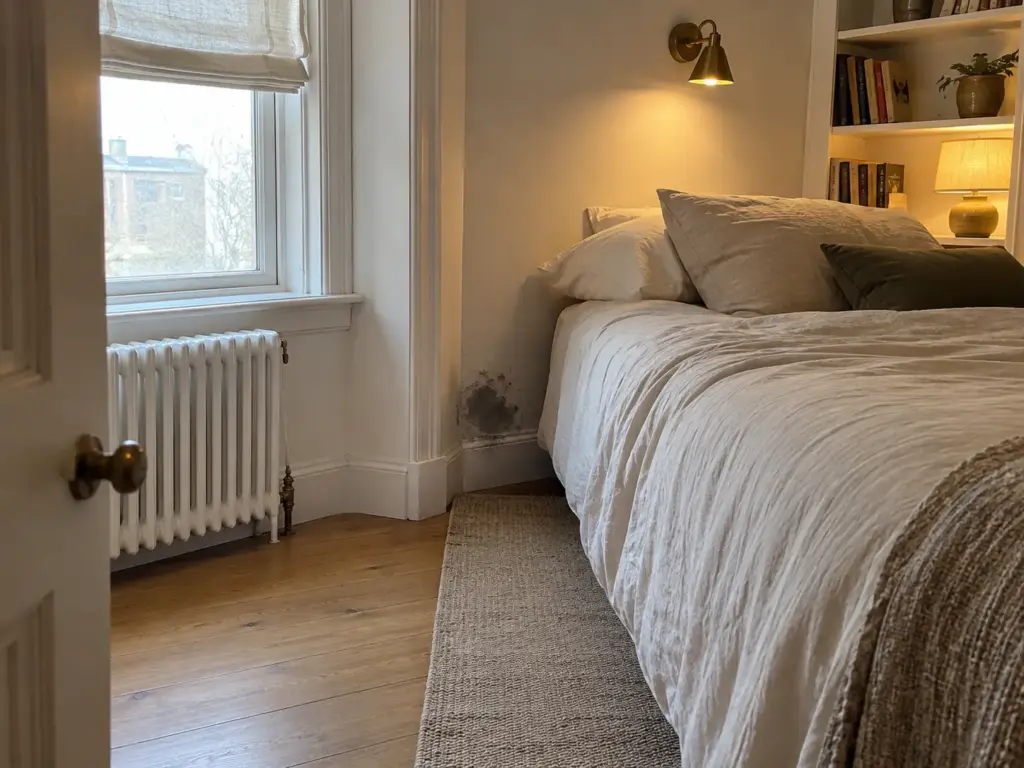
You pull the bed a hand’s width off the outside wall and there it is: a gray-black patch low in the corner, one you could not see from the pillow. It is late, the room is quiet, and you type the question that brought you here: is mold on a bedroom wall dangerous? A patch on a wall is the visible end of a wall that stays damp, and what it does next depends on the water behind it, not on its color. Three checks on the wall, taken in order, tell you how serious yours is and whose job it becomes.
Quick Answer
For the house, a mold patch is a moisture and building problem, and three checks on the wall set how serious it is: its size against the EPA’s roughly 10-square-foot line, whether water still reaches the wall, and whether the mold is hidden or comes back after cleaning. They decide whether the job is yours or a professional’s.
What Mold Does to a Bedroom Wall, and Where Your Question Stops
The question you typed has two readings. One is about the house: what the patch is doing to the wall and how big a job it is. The other is about a person, and no tape measure or meter can answer it. This section settles which reading the wall can answer, so the measuring that follows has a clear purpose.
What the patch costs the wall
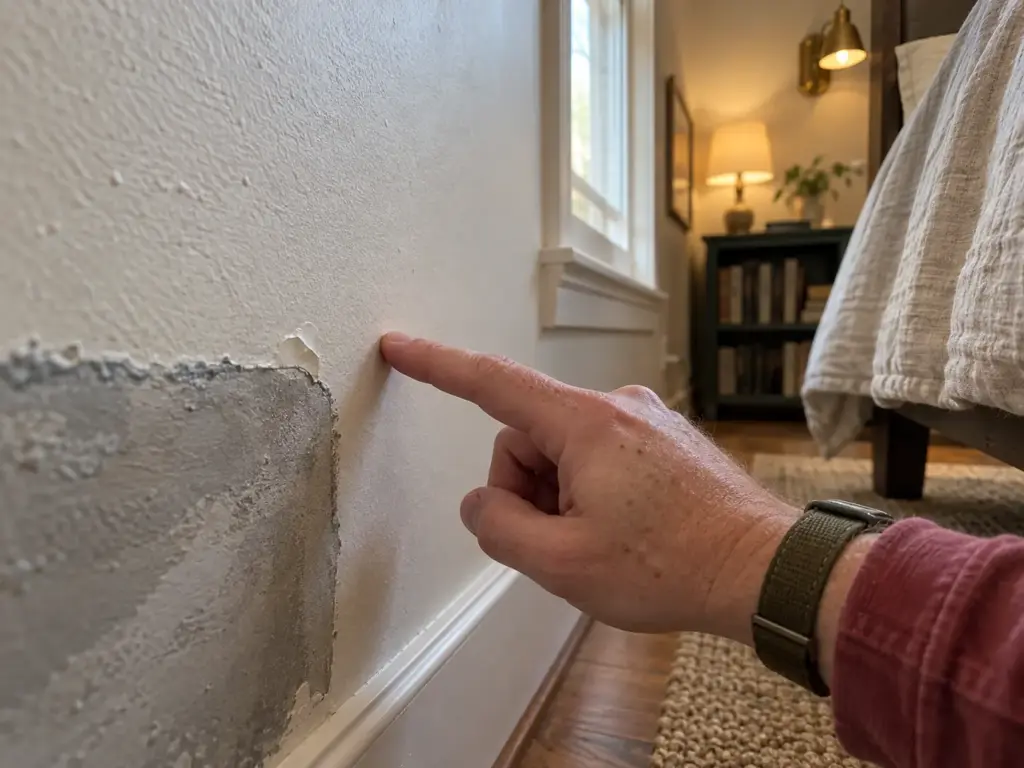
The cost a patch carries is the wall itself. As the EPA’s guide to mold, moisture and your home puts it, “Molds gradually destroy the things they grow on.” On a bedroom wall that reads as softened drywall, lifting paint, a finish that stains, and, where a ceiling tile or a carpet stays wet, material that may have to be thrown away instead of cleaned. That is the damage you can see, and it is the honest meaning of serious for a house, and it is the house damage a patch can really cause.
What keeps the wall damp, whether a cold outside wall with still air pressed against it or water intrusion from outside, is the story told in why mold grows on bedroom walls. The same moisture often starts at the glass, which is the subject of what window condensation does to the wall behind it.
One EPA instruction shapes everything after this: do not paint or caulk moldy surfaces. Paint laid over mold is likely to peel, and it hides the one thing that tells you whether the wall is still wet. Painting comes last, once the wall is cleaned and dry, and removing mold before painting a wall covers that order.
Run a fingertip along the line where the paint meets the gray-black area. A blister, a lifted edge or a paint film that feels soft means the wall has held water longer than the patch suggests, and this shows up well before any smell does.
Why the color is not the verdict
The two camps on a patch like yours arrive fast. Opinions differ: some hold that no amount of mold is acceptable in a bedroom, and others call the worry mostly a myth. Neither is a standard figure. Neither is a standard figure. The EPA says there are no federal limits for mold or spores, so there is no number for either side to quote.
Color is a species question, and naming a species takes a lab. The wall does not wait for the answer. The EPA’s cleanup guidance is the same whatever the color, which means the three checks in this article work identically on black, green or white. The common instinct says black is the worst case and pale is nothing, but a small black patch on a dry wall with no source behind it is a smaller job than a pale one that fills a corner of a wall that stays wet.
Where the question about people goes
Whether anyone is sick, or could be, is not a question a wall can answer, and nothing in this article tries. The EPA’s own sentence is the right one: “If you have health concerns, consult a health professional before starting cleanup.” That question belongs to a doctor, not to the person holding the tape measure. From here on, the subject is the wall, its water, and whose job the repair is.
Reading the Patch: Its Size, and Whether Water Still Reaches It
The wall gives its answer through two readings you can take in one sitting: how big the patch is, and whether the wall is still wet. The first is quick. The second decides more, and it is the one most people skip because the patch is what they can see.
Measure the patch before you touch it
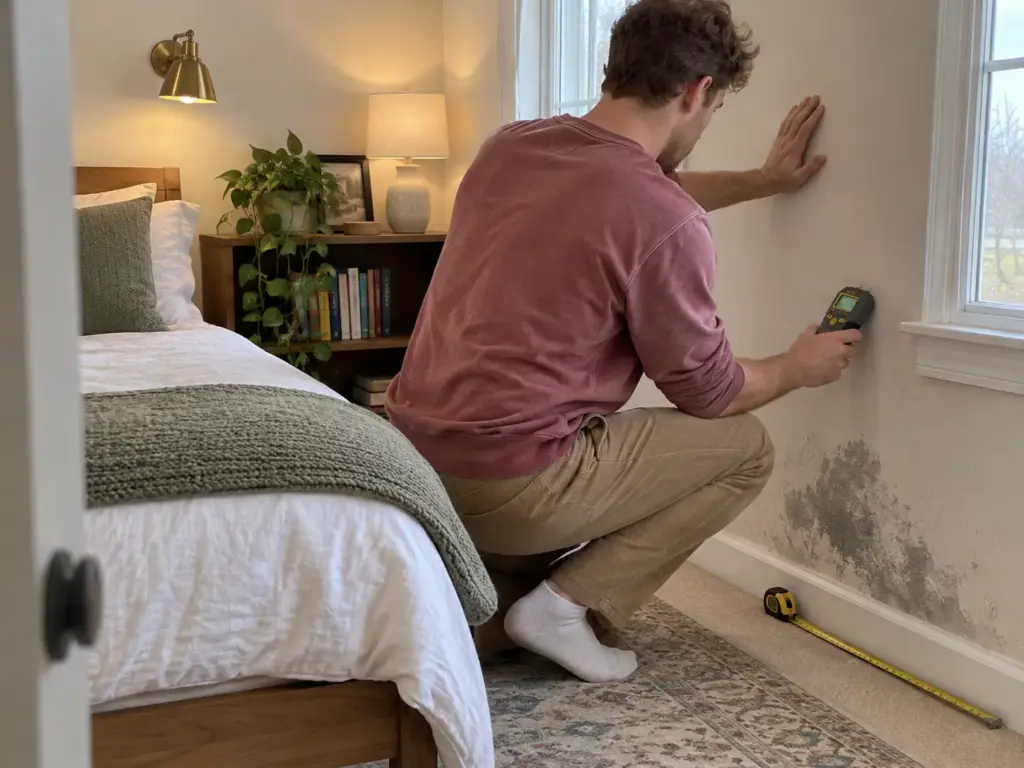
Lay a tape across the widest part of the patch instead of judging by eye. A patch in a corner often runs onto the second wall, and a gray-black area that looks like a hand’s width at the pillow can turn out to be much wider once the bed is moved all the way out.
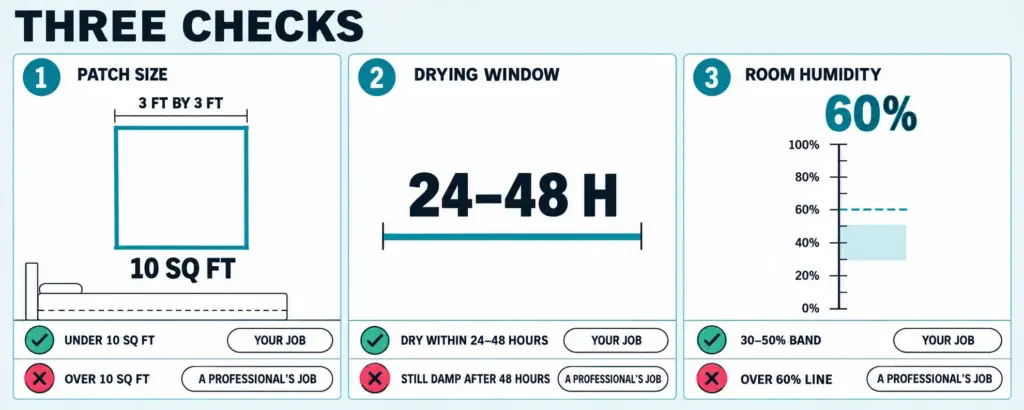
The EPA draws its line at “less than about 10 square feet,” roughly a patch 3 feet by 3 feet. Under it, the owner can usually do the cleanup. Above it, or with heavy water damage, the EPA points to a more involved job, and how to remove mold under 10 square feet holds the how-to, detergent and water included, for the patch that passes the size check.
Check whether water still reaches the wall
Size tells you how much mold grew. It does not tell you whether it is still growing.
Moisture control is the real job, and the EPA’s rule is that when wet or damp material is dried within 24 to 48 hours after a leak or spill, in most cases mold will not grow, and the full clock is laid out in how fast mold grows on a bedroom wall. A wall that is still damp after two days has a source, and the source is the problem. The patch is only the receipt.
The order matters here, because the reader who changes three things at once cannot tell which one worked. Take the changes one at a time, free first, and read the wall between them:
- Pull the bed or the dresser a hand’s width off the outside wall and open a window for ten minutes. The reading to expect over the next day or two is a wall that no longer feels clammy where the furniture used to sit.
- Press the flat of your hand against the wall first thing in the morning, and again in the afternoon. Note cold, damp or dry at each hour, and mark any damp spot.
- Only then bring in a meter.
For the third step, a pin moisture meter such as the General Tools MMD4E shows whether the wall still holds water. It has three lights for low, normal and high readings plus a percent readout. Press the pins into a dry stretch of the same wall first, then beside the patch: the difference between the two is the finding, not the figure on the display.
Its limits are plain. It can be slow to settle on low readings, and that was in wood, not drywall or plaster, so it is a caution for a bedroom wall rather than a verdict. And it reads only between its two pins, which says nothing about the wall behind them.
If the wall is still damp after the free changes, the water may be coming from inside it, from a pipe or from outside. How to detect a water leak early is the next question to read.
One report is worth keeping straight. A bathroom ceiling that was cleaned, dried and painted with mold-resistant paint stayed clear for a couple of years, in a room that was still poorly ventilated. It is a single report, and it supports drying the surface and moving air; it does not show that a paint fixes anything. The same point holds from the other direction: the mold comes back unless you work out why it is growing.
The reading also depends on the hour. A patch that feels dry to the hand at 4 p.m. and cold and slightly damp the next morning is the one that has a source, because the wall is catching moisture overnight that the afternoon air then pulls back out.
Press the back of a hand to the outside wall at the hour you wake and again in the afternoon. A wall that is cold and slightly damp only in the morning points to condensation from the room; one that is damp all day points to water coming from somewhere else.
Read the room against the 60 percent line
The wall’s dampness has two possible parents, and a reading of the room separates them. The EPA says to keep indoor relative humidity below 60 percent, ideally between 30 and 50 percent; the EPA’s 60 percent line is a ceiling, and a good humidity level for a bedroom sits well under it.
Put a hygrometer on the nightstand and read it at the hour the wall is coldest. A reading above the line points to a damp room, and the change that follows is the free one: run the bathroom exhaust fan longer after showers and read again, with a dehumidifier coming after that, not before. A reading under the line, beside a wall that is still damp, points to a cold wall or a leak, and moving furniture and air matters more than any device.
The number depends on the wall, though, not only on the room. Air at 70 °F (21 °C) and 50 percent humidity reaches its dew point against a surface near 50 °F (10 °C), so a corner of outside wall that runs that cold can sweat while the nightstand reads comfortably under the line. The room’s reading is where you start; the wall’s own temperature is why you pressed your hand against it first.
For the reading itself, the Govee H5075 pairs with an app that keeps a history, which is the useful part when you want to see several nights side by side. The AcuRite 00613 is the plain-gauge version for a reader who does not want an app and shows the number only. Both share one limit: a cheap hygrometer reads the air where it sits, not the wall, and it can be off by a few points, so treat a reading near the line as a question and not an answer. Change one thing, wait a day, and read it again.
The Patch You Cannot See: Smell, Furniture and What a Test Can Settle
The third check is the hardest because the evidence is not on the surface. A smell with no patch, or a small patch behind a dresser, can be the visible end of something bigger, and the surface you are looking at may be the smallest part of it.
Where mold hides behind a bedroom wall
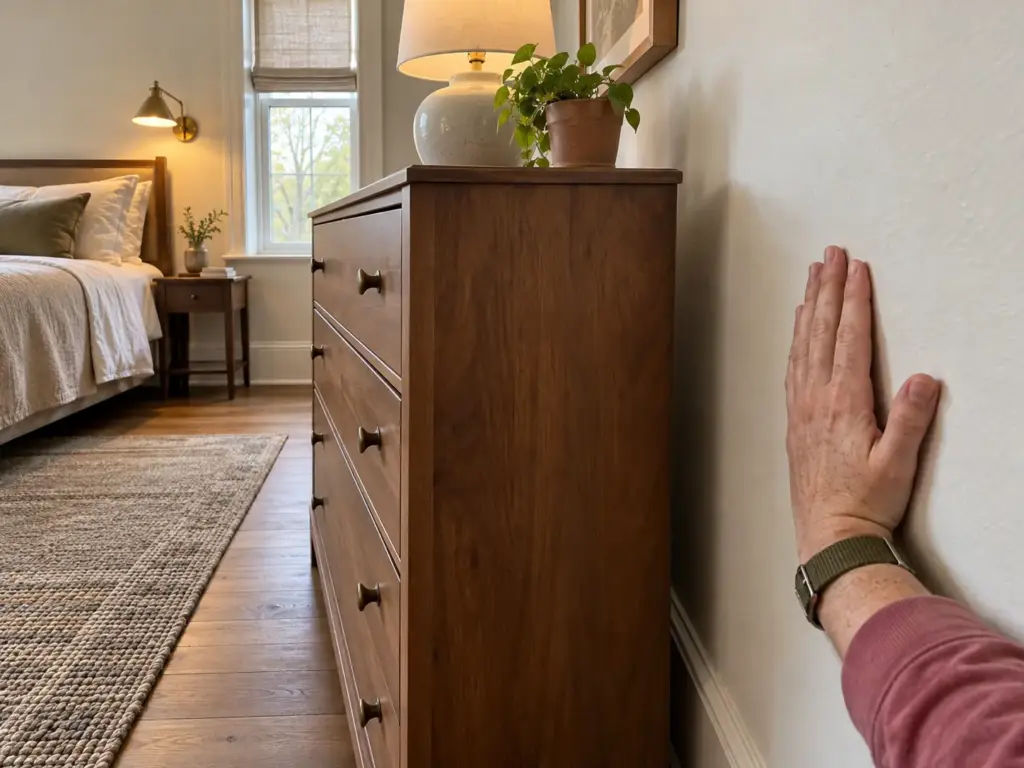
The EPA names the places. Hidden mold can sit on “the surface of walls behind furniture (where condensation forms),” as covered in when window condensation is a sign of mold, and also:
- inside the wall, around pipes
- behind drywall
- behind wallpaper, on its underside
A bed pushed flat against a cold outside wall is exactly the furniture the EPA means: it keeps the surface still, cold and out of sight.
The clue that points to hidden growth is often the smell. A musty smell that is strongest when the bedroom door has been shut all day and weakest after a window has been open for an hour describes a room with a damp wall, not a closed jar of old laundry.
The other clue is a patch that returns after a wipe. When it shows up again in the same spot, the cause is still there. Take it as one input to the three checks, not a verdict on its own.
What a test kit settles, and what it cannot
A DIY test kit feels like the sensible next step, and it is the wrong one in most cases. According to the EPA’s guidance on whether a mold test is needed, “In most cases, if visible mold growth is present, sampling is unnecessary.” The reason is built into the standard: the EPA states there are no federal limits for mold or spores, so a lab number has no federal limit to be checked against. A kit’s result is a figure with nothing to compare it to, and it will not tell you whether the water has stopped.
Surface sampling has one honest use, which is confirming that a cleanup worked. For the monitor-and-kit half of the question, what a mold monitor can and cannot see is the article that owns it. Here the building threshold is what matters.
Why opening the wall is not the first move
Some suggest chopping a hunk out of the drywall to see whether anything grows behind it. The EPA warns that disturbing hidden mold can release spores, and that removal of wallpaper can lead to a massive release of spores when mold grows on its underside. The impulse is understandable and the order is wrong. The EPA warns that disturbing hidden mold can release spores, and that “removal of wallpaper can lead to a massive release of spores” when mold grows on its underside. Opening the wall is a step with a cost, and it belongs after a plan, or to a professional.
The checks that open nothing come first: the hand flat on the wall, the pin meter between a dry stretch and the patch, and the hygrometer read at the same hour each day.
If you can only check one hidden spot, check the strip of wall behind the biggest piece of furniture on the outside wall, with a hand flat on it in the morning. That is the surface the EPA names, and the one a bed or dresser keeps still and cold.
When It Is a Professional’s Job, and What a Renter Does First
The three checks end in one of two jobs. This section names the triggers that move the work out of the owner’s hands, then covers the renter, whose first move is a written report and not a wipe-down.
Three triggers that move the job out of your hands
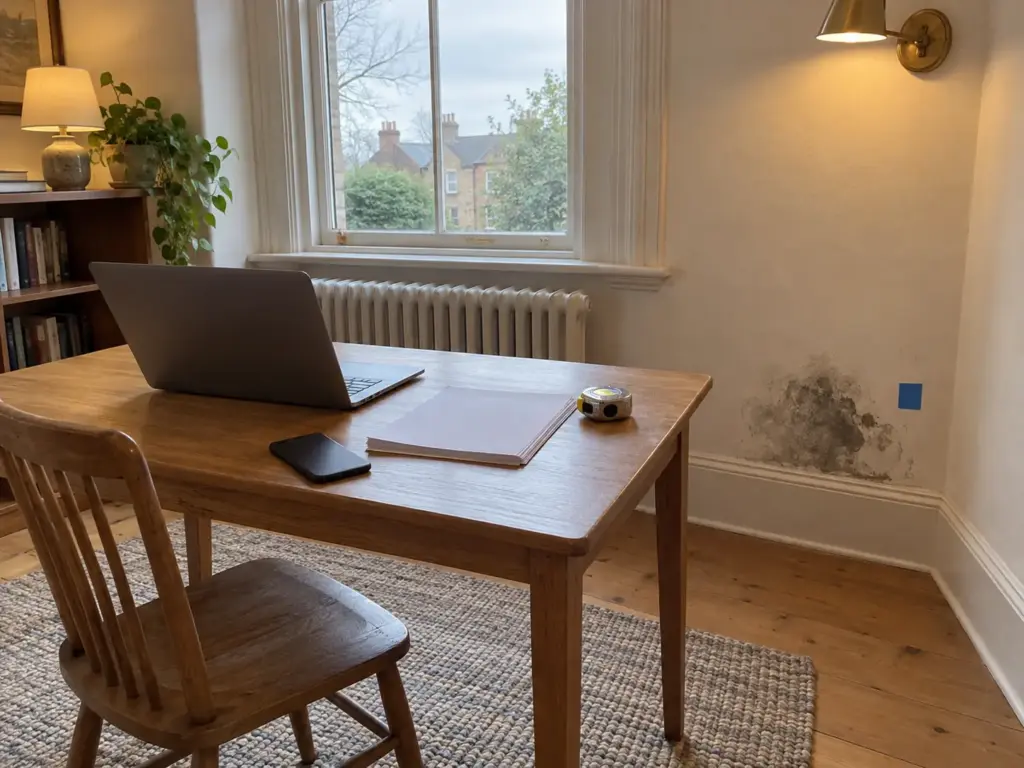
The EPA’s mold cleanup guidance for homes gives the cases. The first is a patch of more than about 10 square feet with heavy water damage. The second is water damage from sewage or other contaminated water, where the EPA says to call in a professional with experience in buildings damaged by contaminated water. The third is an HVAC system (heating, ventilation and air conditioning) that may be contaminated: if you know or suspect it is, the EPA says not to run it.
Whatever the size, the same cleanup page repeats the rule that comes before all of them: fix plumbing leaks and other water problems as soon as possible. A professional who cleans the wall and leaves the pipe has sold you the same patch for later.
What to check before anyone opens the wall
Before a contractor starts any mold remediation, or cuts into the drywall, check their experience and ask for references, and ask them to follow published guidance, such as the EPA’s. Ask what they will measure about the water first. A job that starts with the source, and not with the wall’s surface, is the one that will not repeat.
If you rent, write it down first
The EPA’s advice for renters is direct: report plumbing leaks and moisture problems immediately to the building owner, manager or superintendent. If the problem is not fixed, contact local, state or federal health or housing authorities. The report is the record, and the record is what the later steps lean on, so it goes in writing, with a copy kept.
Photograph the patch with a tape measure laid across it and put the date in the filename. A size and a date are what a landlord’s reply, or a contractor’s quote, gets measured against.
The patch is the visible end; the next decision is the water. When the room’s humidity is what feeds the wall, finding why your house humidity is high comes next, followed by how to lower indoor humidity, free fixes first. And how to keep mold off a bedroom wall below 60 percent humidity holds the order that keeps the wall dry once the source is found.
Measure, Touch the Wall, Write Both Down
Three things carry the answer. The wall’s verdict comes from three checks in order: size against the 10-square-foot line, water still reaching it, and hidden or returning. A small patch with the water stopped is the owner’s job, the three triggers belong to a professional, and a renter writes it down before anything else. Color and a lab number change nothing about what the wall needs.
The check worth repeating comes a month later: look at the same corner at the same early hour, hand flat on the wall and the hygrometer read at the same moment. A wall that is dry first thing in the morning while the bed sits where it used to is the proof the source is gone.
Tomorrow, measure the patch with a tape, put the back of a hand on the wall when you wake up, and write both numbers down. If the wall is damp, the article to read next is the one on the water, not on the cleaner.
Frequently Asked Questions
01Is a small mold patch on a bedroom wall serious if I leave it alone?
A small patch is not a reason to wait: left alone it keeps feeding on a wall that stays damp, and the paint over it lifts. Under about 10 square feet and with the water stopped, it is usually the owner’s job.
02Does the color of mold on a wall change what I do?
Not for the wall. The EPA’s cleanup steps are the same whatever the color; the size, the water and whether the mold is hidden decide the job. The species is a lab question.
03Do I need a mold test to know how serious the patch is?
In most cases no. The EPA says sampling is unnecessary when growth is visible, and there are no federal limits for mold or spores, so a lab number has nothing to be compared with.
04Can mold be inside a bedroom wall without showing on the surface?
Yes. The EPA names the surface of walls behind furniture, areas around pipes, and behind drywall or wallpaper. A musty smell with no visible patch is the usual sign.
05What should a renter do if the landlord ignores a mold patch?
Report the moisture in writing to the owner or manager, keep dated photos with a tape measure in frame, and if it is not fixed, contact local, state or federal health or housing authorities, as the EPA advises.