Your living room smells musty after a week of rain, the sofa sits flush against the outside wall, and you have a phone open on a product page for the best air quality monitor for mold. The honest answer fits in one line: none of them finds mold. A monitor reads the air at its own spot, and moisture lands on the coldest surface in the room, which is almost never the shelf where the monitor sits. This page covers what a monitor does read, the one number worth checking before you buy anything, the wall it cannot see, what a vendor’s mold-risk score is made of, which monitor earns a place in a damp house, and when a test kit or a professional is the answer; if you are still deciding what a monitor should measure at all, pick the reading first.
Quick Answer
No air quality monitor identifies mold or its spores. A monitor reads the humidity and temperature that let mold start, so it points you at a room to check, not at a wall. The line to read against is relative humidity below 60 percent, per the EPA.
What an Air Quality Monitor Reads When Mold Is the Worry
The answer above leaves one question open: if the monitor cannot see mold, what on its screen is worth a look? Most of the numbers only sit near the question, and two of them carry it. Sorting them takes a few minutes and decides whether any monitor is worth buying for this problem.
The particle reading counts spores along with everything else
A monitor’s particle sensor shines a laser through a small stream of air and counts what scatters the light, sorted by size. Wirecutter’s test write-up describes the sensor in the AirGradient ONE, a Plantower PMS5003, as exactly this laser-scattering type, the kind used across consumer monitors. It reports how many particles, never what they are, and the size range it counts is one that mold spores share with smoke, pollen, dust and cooking.
Air quality meters cannot tell what a particle is, so naming mold takes air sampling that a lab analyzes. A cheap particle meter sold for mold testing is not a valid method. Other things fall in the same size range a particle meter reads, so a particle count cannot name mold.
Watch the particle line through one evening and the point shows itself. It climbs while dinner is cooked, falls back by bedtime, and the wall has not changed at all. The sensor was counting the stove.
A VOC reading is a prompt to look, not a result
The VOC (or TVOC) figure moves with cleaning sprays, fresh paint, air fresheners and cooking. A musty smell can nudge it, but the number names no cause, and the sensor does not pretend to. In the AirGradient ONE the VOC sensor and the NOx sensor are one chip, a Sensirion SGP41, which Wirecutter’s text says tracks relative changes rather than absolute concentrations: good at noticing that something changed, not at saying what.
Treat a rising VOC line the way you treat a smell. It is a reason to walk the room and look at the wall corners, the window frames and the back of the closet. What each of these numbers stands for in general is the subject of what each reading on a monitor stands for.
Humidity and temperature are the readings that carry the question
Mold needs water, and the relative humidity and temperature lines are the two that speak to how much water the air is holding and at what temperature it holds it. The EPA puts moisture control at the center of mold control, and nothing else on a monitor’s screen touches that. The catch is where the two numbers are read. Air that touches a cold wall cools, cooler air holds less moisture, and its relative humidity rises, so the percent on the shelf is the floor and the wall’s own figure runs higher.
The table sorts the five usual readings by what each can and cannot say about the problem.
| Reading on the monitor | What it can say about mold | What it cannot say |
|---|---|---|
| Relative humidity | Whether the room’s air sits above the 60 percent line where mildew starts | Whether the wall behind the sofa is wetter than the shelf |
| Temperature | Whether the room is at 60 °F (16 °C) or warmer, the other half of the mildew pairing | How cold the outside wall is, which is where moisture lands |
| Particles (PM2.5) | That something is in the air in a size range spores share | What it is: smoke, dust, cooking and spores read alike |
| VOCs | That the air changed after a spray, paint, cooking or a musty smell | The cause of the change |
| CO2 | How much outside air the room is getting, which bears on how long moisture lingers | Anything about moisture or mold directly |
The Humidity Number to Check Before You Buy Anything
The one reading that decides whether a monitor is worth buying at all costs far less than a monitor, and the EPA names it first. Before the number, though, come the changes that cost nothing, because they are also the ones that teach you something.
The EPA’s line, and the band it prefers
Start with what the house already has. Wipe the condensation off a window, run the bathroom exhaust fan during the shower and after it, use the range hood while you cook, open a window for ten minutes, and pull the sofa off the outside wall. The EPA’s own list of ways to cut humidity includes the fans, the open windows and venting a dryer or a stove to the outside.
Make one of these changes, read the room’s humidity the next day, then make the next. Three at once and you will not know which one worked, or which one overshot (a window opened on a humid afternoon can bring in more moisture than it lets out). The rest of that list, in order, is in how to lower humidity at home.
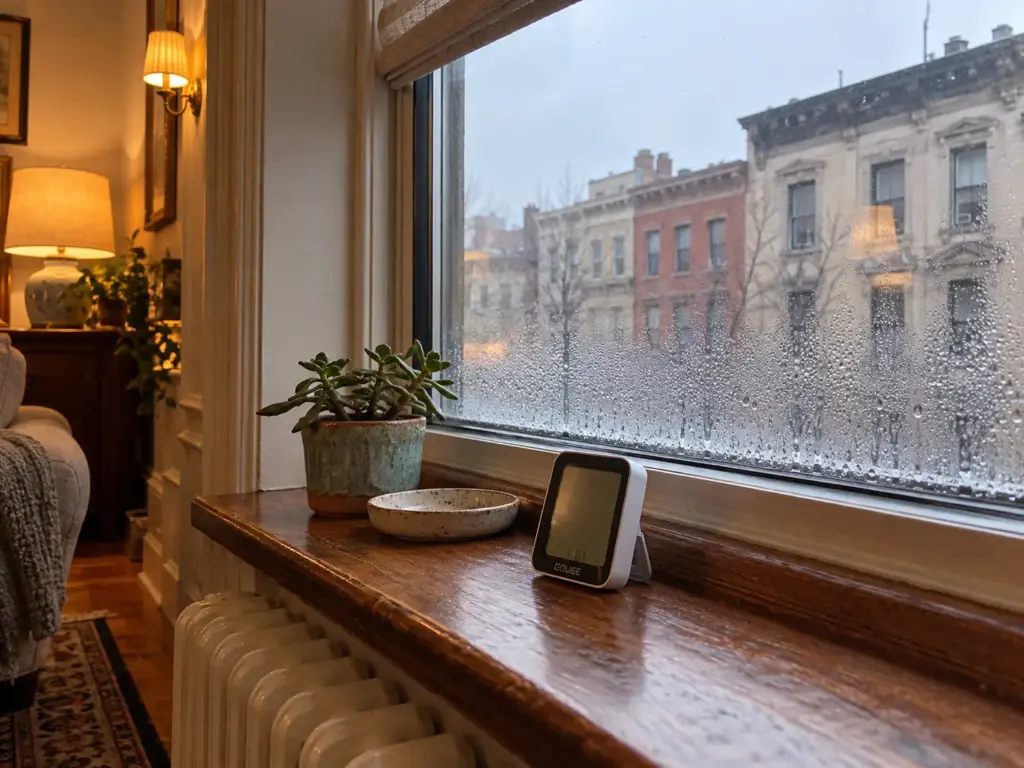
The number to read against comes from the EPA’s guide to mold, moisture and your home: “If possible, keep indoor humidity below 60 percent (ideally between 30 and 50 percent) relative humidity.” The same page says condensation on windows, walls or pipes is a reason to dry the wet surface quickly and cut the source, because condensation can be a sign of high humidity. Sixty percent humidity is a ceiling and 30 to 50 is where you aim. A room that reads 55 is under the line, but only just, and the next section explains why the wall can sit above it.
Why 60 percent in a warm room is where mildew starts
UGA Extension’s tips on removing and preventing mold and mildew name the pairing: “Mildew usually begins to grow when relative humidity remains at 60 percent and the temperature is 60 degrees Fahrenheit or higher.” Most heated homes sit well above 60 °F (16 °C), so in practice the temperature half of that sentence is nearly always met and the humidity decides.
UGA adds the part that explains why scrubbing alone fails: mildew can return whenever dampness approaches 60 percent again. Wiping the stain is the pause, and bringing the number down is the repair.
Read it over several days, not at one glance
The same room reads differently at breakfast and at night, and differently again after a wet day. A single glance at a meter is a photograph of one moment. A few days of readings at the same hour is the trend, and the trend is what tells you whether the room is damp or just had a damp afternoon.
The Govee H5075 Bluetooth Hygrometer Thermometer is the class of meter the EPA describes: a small reader for humidity and temperature, with a phone app that keeps the history so three mornings sit side by side instead of living in your memory. It reads the air at the spot where it sits, so it says nothing about the wall behind the sofa, and the history is something you view in the app. If you already own a meter that logs, skip it. How far to trust a cheap meter’s number is covered in a cheap humidity checker and how to trust it.
Read the room’s humidity at the same hour for three days running, early, before the shower, the stove or the dishwasher has run. One reading taken after a wet afternoon or a long shower tells you about that afternoon, not about the room.
Why the Cold Wall Matters More Than the Middle of the Room
A monitor on a shelf reads the air at the shelf, and mold is a surface problem. So the useful question moves from how humid the room is to where the moisture actually lands, and what that surface is doing while the room’s number looks fine.
Condensation lands on the coldest surface
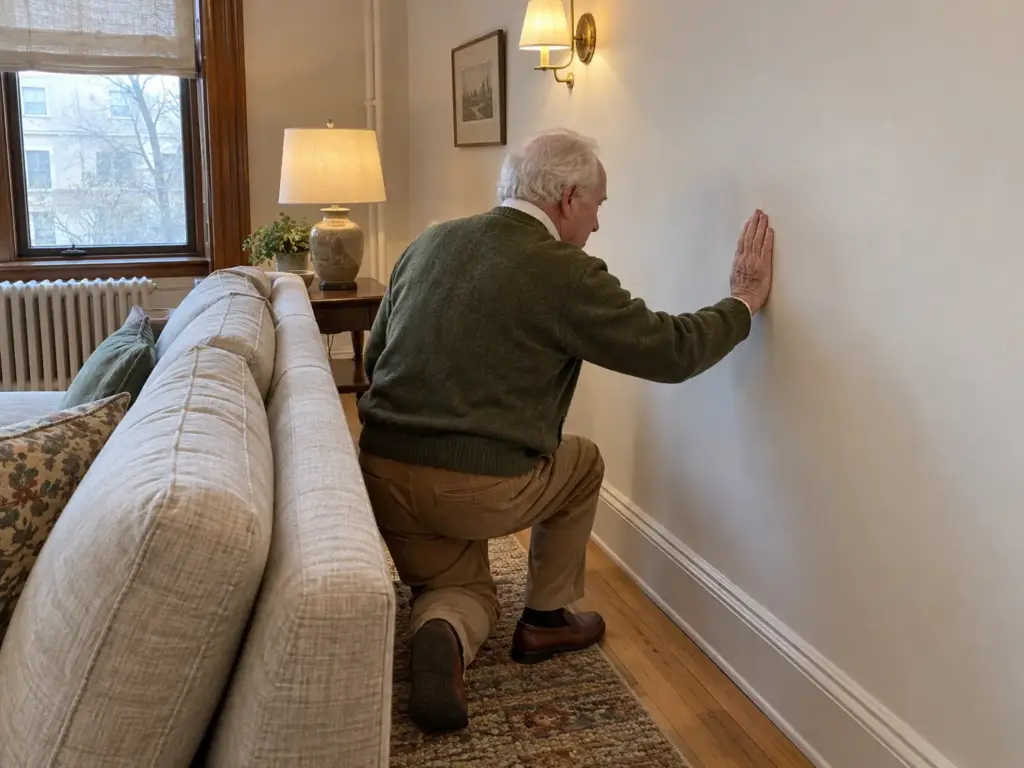
Warm indoor air carries water vapor, and the cooler a surface is, the less vapor the air touching it can hold. Take a room at 70 °F (21 °C) and 50 percent relative humidity: its dew point sits near 50 °F (10 °C). Any surface colder than that, such as an outside wall in midwinter, a window pane or an uninsulated cold-water pipe, pulls water out of the air and wears it as a film. The hygrometer in the middle of the room keeps saying 50 percent, and it is right about the middle of the room.
The EPA describes the same thing from the fixing side. Among its ways to prevent condensation are covering cold surfaces, such as cold water pipes, with insulation and raising the air temperature. Both act on the surface, not on the air a monitor reads. The window is the visible case, and whether condensation on windows means mold follows that film into the frame and the sill.
The wall behind the sofa
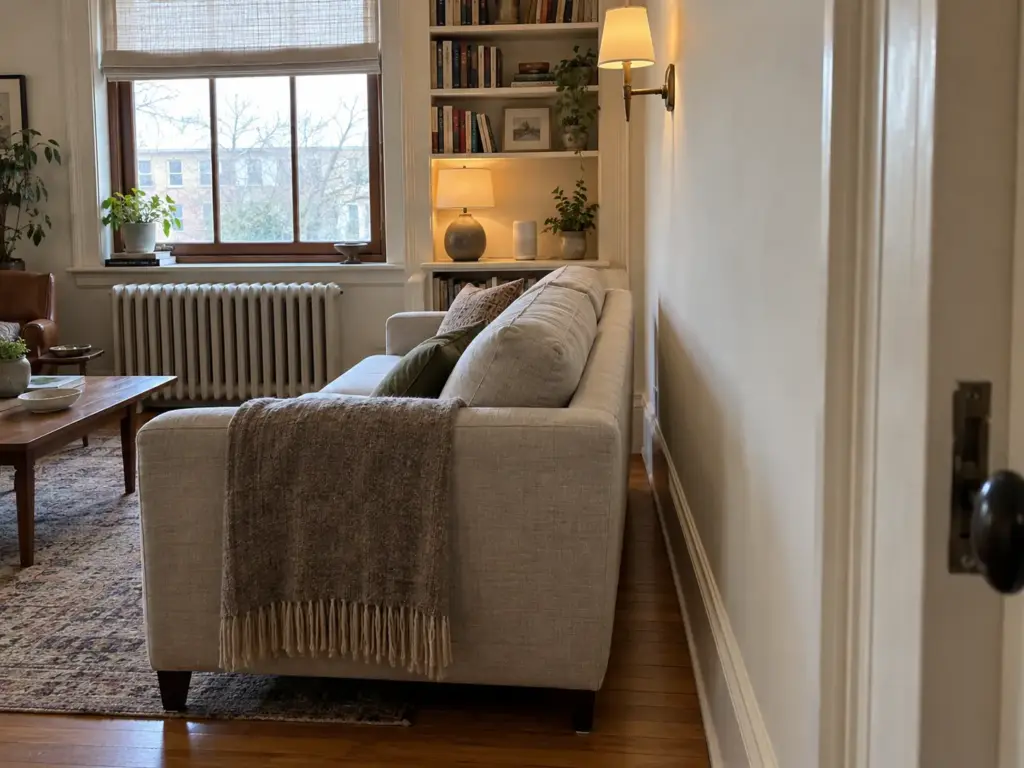
The EPA lists the surface of walls behind furniture, where condensation forms, among the places hidden mold turns up, and says to suspect it when a building smells moldy and the source is out of sight. A sofa or wardrobe pushed flat against an outside wall does two things at once: it keeps the room’s warmth from reaching that patch of wall, and it stops air from moving across it. The patch runs colder and stays damper than the rest of the room, in the one spot nobody looks.
That is how a monitor in the middle of the room can read under 60 percent while the wall behind the furniture sits above it, and both numbers are true.
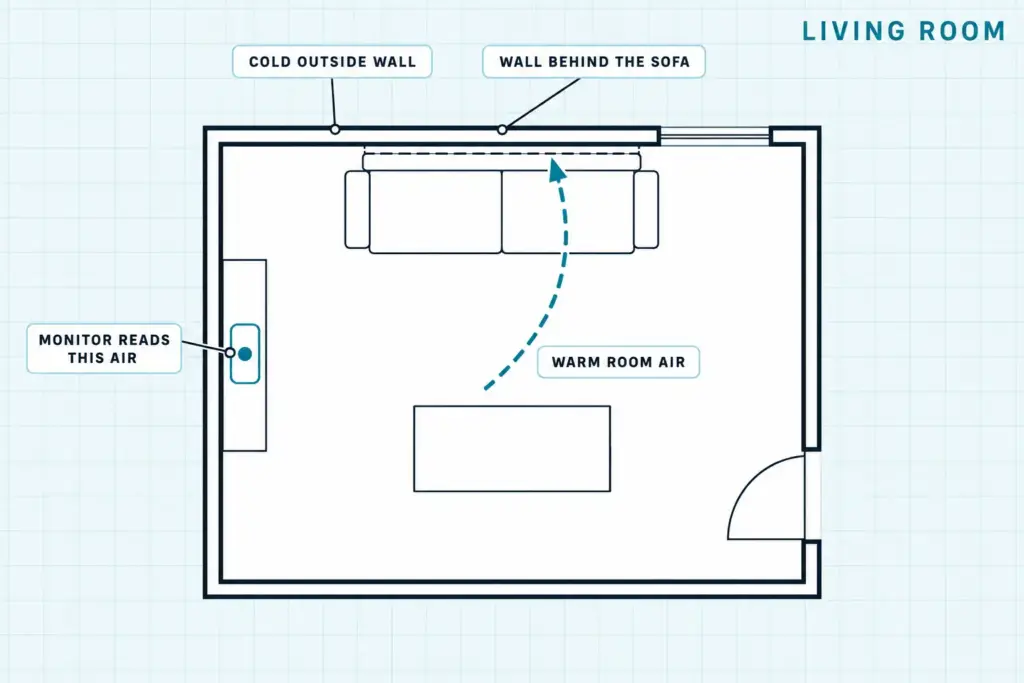
The pattern that sends the check to the wall instead of the air is a smell that returns after rain and fades in a dry week. Air does not do that. A wet surface does.
There is no home monitoring that can confirm mold. What a monitor can do is watch the conditions, and then go and look at the wall.
Looking is easy when the wall is bare. Behind drywall, wallpaper or a built-in, looking means taking something apart, and the EPA warns that pulling wallpaper off over mold can release a large amount of spores. For the hidden case the EPA’s advice is to consider an experienced professional, which is where the last section of this page ends up.
Pull the sofa a hand’s width off the outside wall and leave it there for a few days before you decide anything. If the musty smell eases once air can move across that patch, the furniture was part of the problem, and no monitor was needed to find it.
Where the monitor goes so its reading means something
Put it in the room that smells, at about breathing height, away from the shower, the stove, any vent and the window. Those are the places that read too wet, too hot or too moving to stand for the room. Those placement rules are rules of thumb for a reading that represents the room’s air, and none of them gets the monitor any closer to the wall.
How to use the reading with the wall in mind: if the room reads above 60 percent, the cold surface is almost certainly above it as well, since cooler air reads higher at the same moisture. If the room reads 50 percent and the smell is still there, the monitor has told you the room’s air is fine, which is the moment to stop reading the shelf and start looking at one outside wall at a time.
There is also a cheap way to get the wall’s side of the story. With two loggers, set one in the middle of the room and one in the gap behind the furniture, and let them run side by side for a few days. The distance between the two lines is the answer a single monitor cannot give.
What a Mold-Risk Score Is Actually Built From
One manufacturer does sell a number labeled mold risk, and it is the one place a monitor appears to answer the question directly. What goes into that number, and what stays out, matters more than the color it shows.

A score from humidity, temperature and time
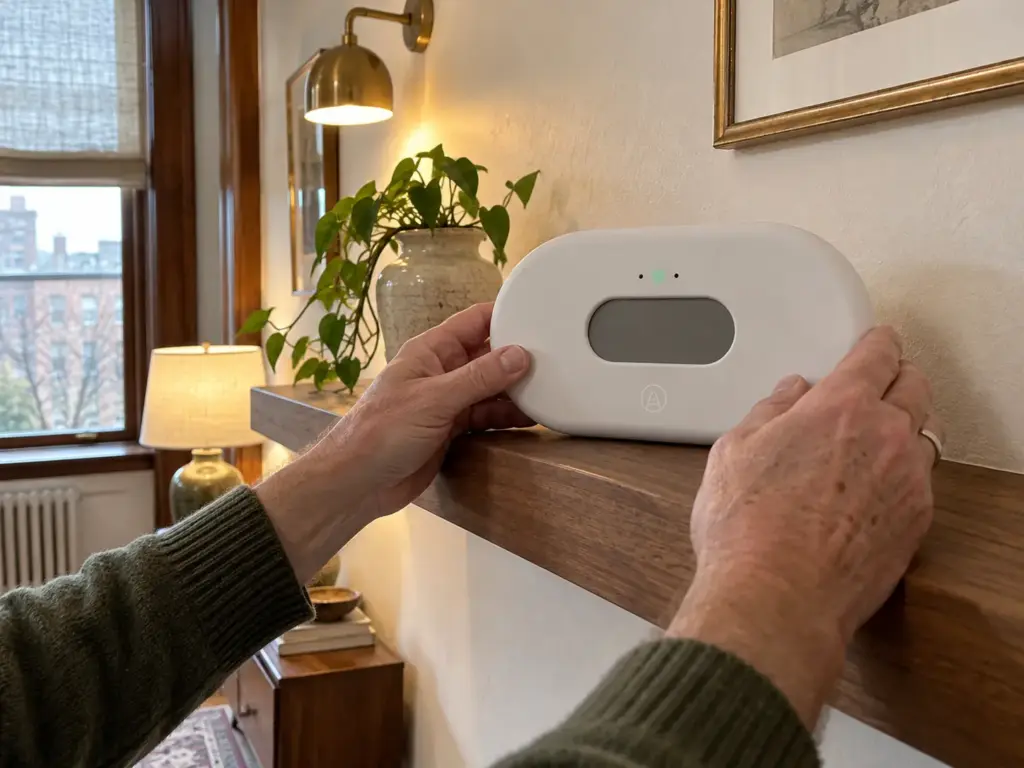
The Airthings Wave Mini carries a mold risk indicator, a score from 1 to 10 shown in its app. Airthings’ help center says the score comes from three inputs: temperature, humidity and time. It is always based on the previous 48 hours of data, recalculated once an hour on a rolling window.
That is a description of conditions, not a detection. No spore is counted anywhere in the calculation, so the score says how closely the last two days resembled what mold likes, and it cannot say that mold is there. It is also the score of the spot where the monitor sits, which carries the limit from the last section along with it: a green score on the shelf can sit a few feet from a wet patch behind the sofa.
The rolling window has a practical effect too. A fix you made this afternoon is diluted by the other 40-odd hours in the window, so the humidity line shows a change within hours while the score takes a day or two to follow. Read the humidity for what changed and the score for the pattern.
Why the first two days read blank
Because the score needs 48 hours of readings, a fresh Wave Mini shows no mold-risk indication for its first 48 hours, and the same wait applies after you move it to a different room, per Airthings’ help center. That is the unit’s one stated limit, and a practical one. A monitor carried from the bedroom to the living room to the basement for comparison restarts the clock at every stop and never gets to show a score.
Pick the room that smells, set the monitor down, and leave it alone for two days. For the same reason, a score that reads green on day three tells you about days one to three, not about the wet week that ended before the unit came out of the box.
What a good or fair band means depends on the material
Airthings splits the scale into three colors. A score of 0 to 3 is green and good, with little risk (the maker notes that some possibility always remains above zero). A score of 3 to 5 is yellow and fair, where mold will grow especially on vulnerable materials such as textiles and wood. A score of 5 to 10 is red and poor, with a high risk for all kinds of materials.
The score itself knows temperature, humidity and time. It does not know what your room is made of, so the same number lands differently in different rooms. A fair reading is the vendor telling you which surfaces to inspect first: the upholstery, the wardrobe, the wood floor, the back of the headboard. Then you walk over and look.
A score is also only as good as the humidity sensor under it, so humidity sensor accuracy matters here. How far a home sensor can be trusted, and how it drifts, is covered in how far a home air quality monitor can be trusted.
Which Monitor Is Worth Keeping in a Damp House
If the free checks say the room is damp and the wall keeps being the suspect, a monitor that logs humidity and temperature over weeks is the useful purchase. Here is one monitor you can buy today, one you cannot, and a cheaper kind of sensor that suits a known leak.
The monitor that logs the readings that matter
A single glance cannot show the evening rise, the weekend, or the wet day. A monitor kept in the room for two weeks can, and that trend is what a damp house needs.
The Airthings 2960 View Plus logs humidity and temperature along with CO2, VOCs and PM2.5, shows its readings on a screen on the device with a color indicator, and keeps them in an app. For this problem only the humidity and temperature log matters; the rest of what it carries is not about mold.
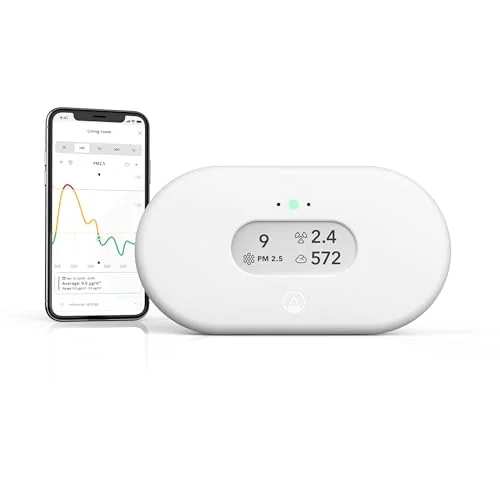
Two things to know before it goes on a shelf. The radon sensor has nothing to read in many homes, so that part of what you are paying for sits idle. And with no NOx monitor, it says nothing about a gas stove, which matters if the stove is part of your questions. Wirecutter’s testers prefer another monitor’s display and dashboard and keep this one as their radon pick, which tells you where its strength lies: a broad panel in a tidy app, not a mold tool.
If the damp room is the only question, the humidity logger from earlier does the same job for a fraction of the cost. The View Plus earns its place only when you also want CO2 and particle readings from the same shelf.
Put the logger in the room that smells, at about breathing height, and leave it there. Every move restarts the wait of any score it computes, and a log chopped into one-day pieces from five rooms compares nothing.
The AirGradient ONE, and why it has no button here
The AirGradient ONE is Wirecutter’s top pick. It tracks fine particles in three sizes, CO2 with an NDIR sensor, VOCs and NOx, plus temperature and humidity, and its hardware and software are open source. This page cannot point you to a current listing for it, so it stays a name here and not a button.
Its catch is integration. Homey and Home Assistant work natively, community-written code adds HomeKit, and as of September 2025 there was nothing for Alexa or Google Home. That matters only if you want the humidity line somewhere other than its own app and screen. For mold, the sensors that count in it are the same two that count in any logger: humidity and temperature.
Water-leak sensors, when the damp has one known source
When the damp has a known source, a water leak sensor beats a humidity monitor because it reports the event itself. Wireless water sensors placed under or near water tanks, washing machines and ice makers catch the places a slow leak starts, and they can report to a phone. Some are very loud.
These sensors do not log humidity, and they do not need to. A pan under the washer going wet is a fact, not a probability. The pairing that suits a damp house is a logger for the trend in the room and sensors at the suspected sources, and water leaks at home and how to catch them early goes through the second half.
Mold Test Kits, and When the Wall Needs a Professional
The kits sold for this problem are mostly petri dishes and air-pump cartridges, not monitors, and they answer a different question. This section closes the loop on what a kit tells you and where a person has to be called for a wall that stays suspect.
What a test kit proves, and what it cannot
A typical kit asks you to leave a dish open for about an hour, or to run a small pump through a collection cartridge (the spore trap kind), then mail the sample to a lab. The EPA says there are no federal limits for mold or spores, so a sample has nothing official to be compared against. In most cases, it adds, where visible mold growth is present, sampling is unnecessary, and the move is to fix the moisture.
Spores float through indoor and outdoor air everywhere, and the EPA says it is impossible to get rid of all of them indoors. “Spores found” is therefore almost always the result. Mold is everywhere, so any test needs a comparison to outdoor levels at the time of testing. A kit that analyzes a single sample takes shortcuts, because there is nothing to compare it with.
Sampling does have a job. The EPA says surface sampling may help show whether an area has been cleaned adequately, and that it should be done by professionals with experience in designing sampling protocols and interpreting results. A log covering a rainy week and a dry one tells the next person more than any single sample can.
The 10 square foot line
The EPA draws the line between a homeowner’s job and a professional’s at about 10 square feet, roughly a 3-foot by 3-foot patch. Below it, in most cases, you can do the work yourself: scrub hard surfaces with detergent and water, dry them completely, and fix the water problem first or the mold comes back. Do not paint or caulk over a moldy surface, because paint applied over it is likely to peel. Porous materials such as ceiling tiles and carpet may have to be thrown away, since mold fills their empty spaces.
Above 10 square feet, or after a lot of water damage, or when the water was sewage or other contaminated water, the EPA sends you to a professional. It also says not to run the heating and cooling system if you know or suspect it is contaminated with mold, because that could spread it through the building. The EPA does not recommend a biocide such as chlorine bleach as routine cleanup practice. The moisture is the job.
Hidden mold sits in a different category. Behind drywall, behind wallpaper, in walls around leaking or condensing pipes and on the surface of walls behind furniture, the EPA says investigating is difficult and takes caution when potential sites must be disturbed, so consider hiring an experienced professional. A musty smell with no visible source is the case for a professional inspection and, if it finds growth, mold remediation, not for a bigger sensor.
What to hand the next person
A professional starts with questions that your monitor can already answer. Hand over the humidity and temperature log, the date the smell started, dated photos of the wall before anyone touches it, and your best account of where the moisture intrusion comes from, whether that is the roof, a pipe, a window or a basement wall.
If you rent, the EPA tells you to report plumbing leaks and moisture problems immediately to the building owner, manager or superintendent, and says persistent water problems that go unaddressed can be taken to local or state housing authorities. A written date and a log make that report harder to wave away. The building side of the problem, where the moisture comes from and why it lands on walls and ceilings, continues in why mold grows on bedroom walls and ceilings.
Read the Outside Wall’s Side of the Room Before You Buy
No monitor names mold, and the one sold with a mold score estimates conditions from two days of humidity and temperature. What it reads is whether the room has what mold needs, and that is a job a meter does for a fraction of the cost of a multi-sensor monitor.
Three things to carry out of this page:
- No monitor identifies mold. It reads the humidity and temperature that let mold start, so it points at a room to check, not at a wall.
- The number to check first is relative humidity under 60 percent, read at the same hour for a few days, with the free changes made one at a time.
- A kit or a professional answers the wall; a logger and a leak sensor answer the room.
In two weeks, open the log and ask two things: whether the room is back under the 60 percent line after your changes, and whether the smell still returns after rain.
Tomorrow evening, take one reading on the outside wall’s side of the room, change one thing (the sofa, the fan, a window), and read it again the next day. That reading, taken before any purchase, tells you whether you need one.
Frequently Asked Questions
01Do air quality monitors detect mold?
No, a home air quality monitor cannot detect mold, because humidity, temperature, particle, VOC and CO2 readings never name mold or its spores. It shows whether the room holds the conditions mold needs.
02What is the best home air quality monitor for monitoring mold?
The most useful kind logs relative humidity and temperature over weeks, kept in the room that smells, because it watches the conditions mold needs. A plain hygrometer does the same job for far less, so a multi-sensor unit earns its place only if you also want CO2 or particles.
03What is the most effective device for detecting mold?
No device confirms mold from the air in a home; the most effective check is a visible stain, or a musty smell that traces to a wet source. A remediation or inspection professional then checks the wall itself.
04What humidity level is too high for mold?
The EPA says to keep indoor relative humidity below 60 percent, ideally between 30 and 50 percent. Mildew usually starts when humidity stays at 60 percent in a room at 60 °F (16 °C) or warmer.
05Is a mold test kit worth it?
Rarely, because the EPA says no federal limits exist to compare a sample against, and that sampling is unnecessary in most cases where growth is visible. Fixing the moisture comes first.