You are standing in the lowest room your household uses, and the monitor on the shelf shows a screen full of numbers: CO2, particles, temperature, a humidity bar. Not one of them is radon, the number the house was waiting for. Radon is a gas that rises out of the soil and gets in through cracks and gaps in the building, and a sensor made to count CO2 or particles has nothing inside it that can register that gas; only a unit with its own radon chamber can.
So the best air quality monitor with radon is a short list. This guide sorts it: which boxes read radon at all, why a state test comes before any purchase, the one monitor that does read it, why its number settles slowly, how to read that number against 4 pCi/L, and when the fix belongs to the building instead of a device.
Only a monitor with its own radon sensor reads radon, and of these three that is the Airthings View Plus. Its first figure is a short reading, not the year-round average, and a result of 4 pCi/L or higher means a longer test or a radon professional, never a purifier or an open window.
| Monitor | Reads radon? | What it does read | What it cannot tell you |
|---|---|---|---|
| Airthings 2960 View Plus | Yes, with its own radon sensor | Radon, PM2.5, CO2, VOC, temperature, humidity, air pressure | A day-one radon figure as the year-round average; it has no NOx sensor |
| Aranet4 Indoor Air Quality Monitor | No | CO2 | Anything about radon |
| Temtop S1 PM2.5 Air Quality Monitor | No | PM2.5 and temperature | Anything about radon |
A monitor reads radon only if it carries a radon sensor
The shelf in the lowest room can hold three monitors with tidy, confident screens, and only one kind of sensor inside any of them can see a gas that comes out of the ground. This section sorts the boxes by what they actually sense. The wider question of which reading the house needs first has its own guide; this page is about the one reading most monitors skip.
Radon is not carried by the sensors that read the room
Radon is a soil gas that starts in the rock and ground under the building, and radon comes into a home through cracks and gaps where the structure meets the ground. A sensor that counts particles, infers CO2 or reports a VOC index is measuring the room’s air, and none of those readings touches a gas seeping up from below. The EPA guide to radon testing names the detectors commonly used for long-term radon tests: alpha track and electret ion chamber devices. So a radon air quality monitor is one that has a radon detector inside it, and the sensor list is the line to read before anything else on the box.
A radon sensor also works on a slower clock than the rest. A unit that keeps logging radon on a shelf is a continuous radon monitor, and the maker’s accuracy figure for the View Plus is quoted at 7 days and again at 2 months, never at one hour.
What the CO2 and the particle monitors do read
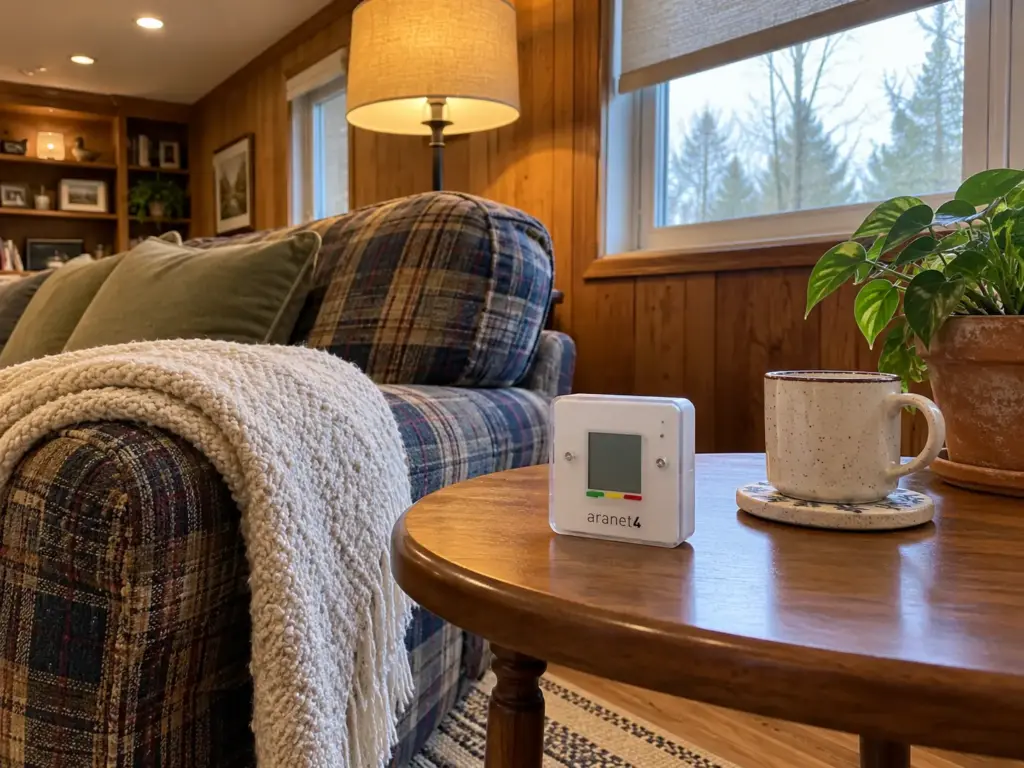
A CO2 detector tells you how stale a room’s air is, which is useful and a different question. The Aranet4, a wireless CO2 detector, is a good example of a monitor that is good at what it reads and silent about radon. That is not a defect, only a different job. Dedicated CO2 sensors such as the Aranet are often preferred over all-in-one monitors.
A particle monitor counts particles. The Temtop S1 reports PM2.5 and temperature, which is useful for smoke and dust and says nothing about a gas rising from the foundation.
Why an all-in-one is the exception, not the rule
The doubt about an all-in-one is the right instinct for any one box that claims every sensor: reliability and accuracy are harder to judge when one housing holds many sensors. Seven sensors in one housing means seven different principles behind seven numbers, and most monitors on a list like this carry no radon sensor at all. That is why the sensor list is the first thing to check on any monitor, ahead of the screen, the app and the look of the unit.
For every other reading, what each reading on a monitor stands for goes through them one at a time. This page stays with radon.
The test that costs nothing comes before any monitor
A monitor is the second thing to buy here, not the first. The test the EPA describes is what any monitor’s number has to match, and in many places the first test is a phone call to the state radon office. Everything in this section is the protocol that makes a radon number count, whichever box produced it.
Call the state radon office first
The EPA’s advice to a household with a radon question starts with a contact, not a purchase: the state radon program, through its state radon office, has the information for your area.
Many states offer a free, state-funded radon test. Those programs also supply the EPA’s guidance on what to leave closed during a test. Whether your state offers a test, and on what terms, is the state office’s answer to give, and a household that asks before buying finds out in one call. (If the answer is no, the call cost a few minutes.)
The 48 hours and the closed house
The rules come from the EPA’s guide to radon testing, and they are short enough to follow as a sequence:
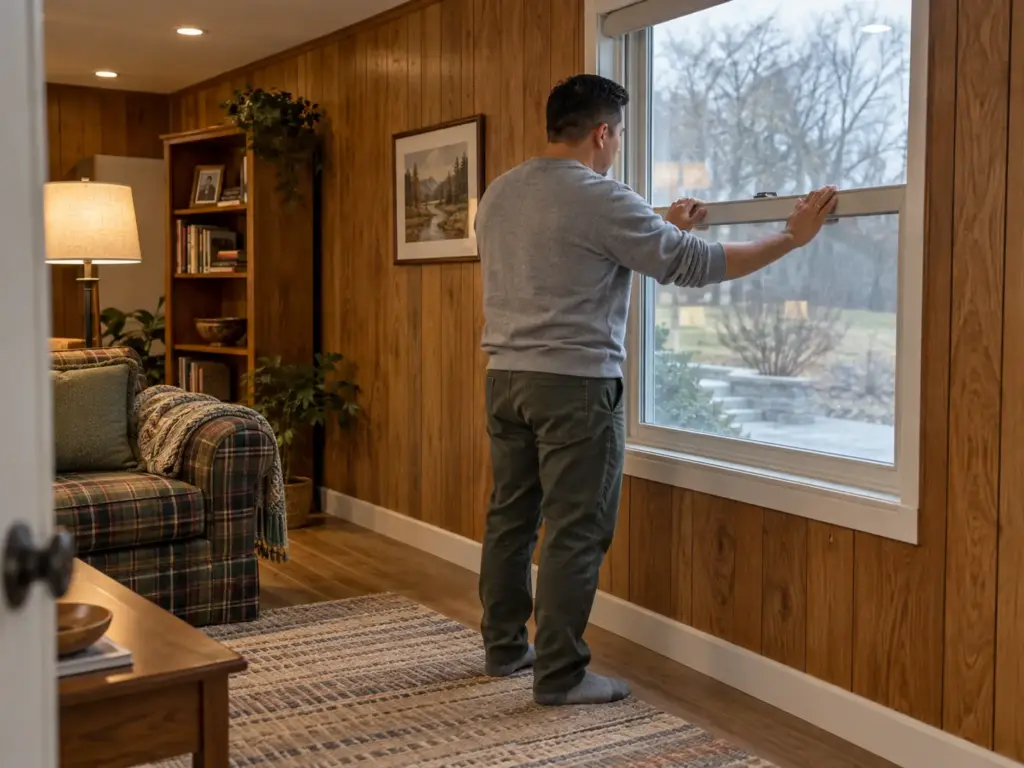
- Close windows and outside doors at least 12 hours before the test begins.
- Keep them closed through the whole run of a two to four day test.
- Let the test run a minimum of 48 hours; the EPA says that holds for all radon tests.
A proper test has rules: how long the monitor must read, which windows and doors stay closed, and which fans and filters are running, with the test done when no one is going in or out.
A monitor adds placement rules of its own. Airthings’ sheet for the View Plus asks for at least 3 ft (90 cm) from vents, fans, windows or doors, and never in conditions above 85 percent humidity.
The EPA’s closed-house rule is written for a test of two to four days, and a monitor running for weeks is a different test, but the habit carries over. A window sash lifted for ten minutes inside that 12-hour stretch is test interference: it breaks the condition the test assumes, and the number that comes out is a reading of a different house.
Count back 12 hours from the planned start and latch the last window then. The closed-house clock starts when the final window shuts, not when the test is opened, so windows shut an hour before the start leave the test 11 hours short.
The lowest level the household uses, not “the basement”
The EPA’s wording is the lowest level of the home that could be used regularly, which is wider than any one room. “Basement” is the usual case and not the rule: a finished lower level the family uses every evening qualifies, and so does a basement the household could use even if it mostly does not. If living patterns change and the household begins occupying a lower level, the guide says to test that level again.
That lower level is also where a basement humidity sensor has a different job. The damp-wall question and the radon question can share a room without sharing a sensor.
The Airthings View Plus, the one monitor in this list that reads radon
Of the three boxes in the table, one carries a radon chamber. This section says what it reads, what the maker states about its own accuracy, and the flaws that come with it. Every spec below is the manufacturer spec, taken from Airthings’ own product sheet.
What it reads, from the maker’s own sheet
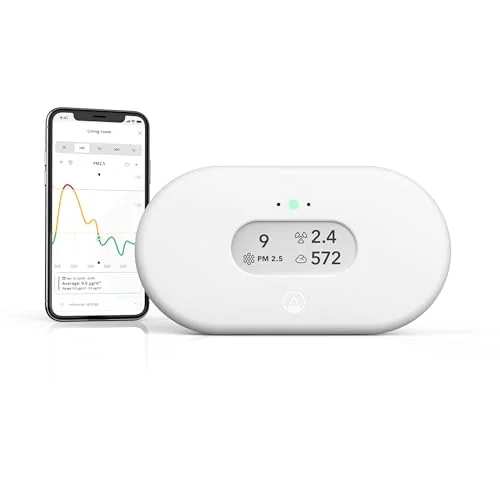
The Airthings 2960 View Plus lists seven sensors: radon, PM2.5, CO2, VOC, temperature, humidity and air pressure. Radon is read by a passive diffusion chamber with a range of 0 to 500 pCi/L. The unit runs up to two years on six AA batteries or on USB-C, and it reports over Wi-Fi through a hub. Of all those lines, the accuracy figure matters most for a radon pick, and it gets its own section further on.
Where it goes in the room
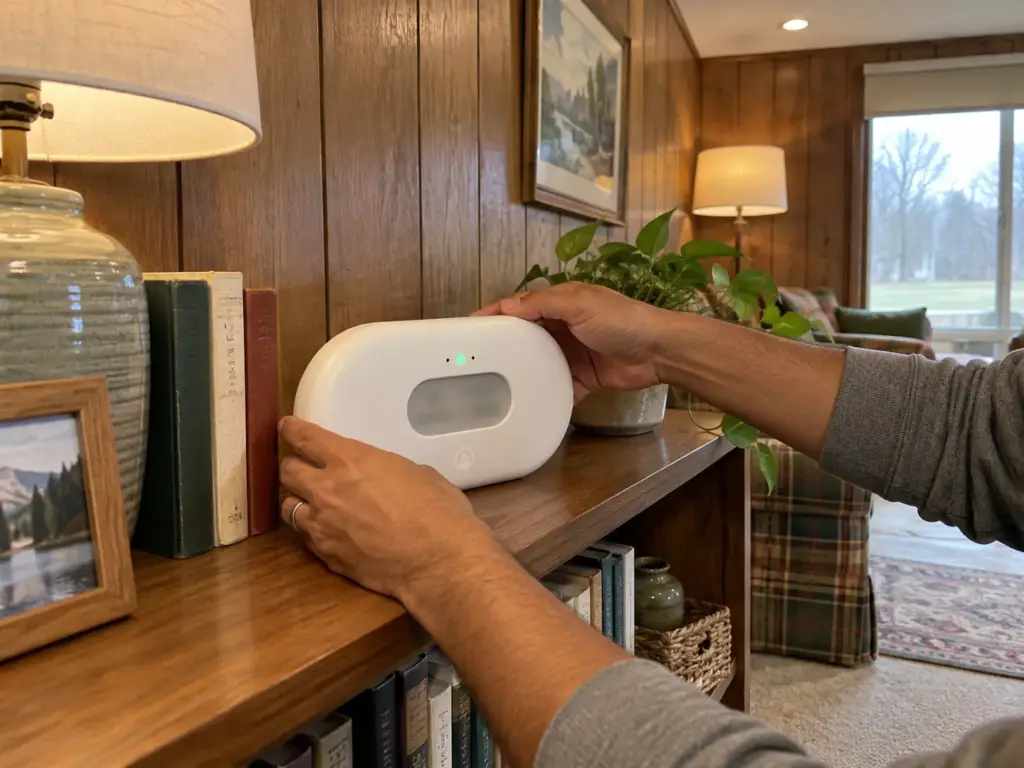
The maker’s placement rules are the ones that decide a radon reading: at least 3 ft (90 cm) from vents, fans, windows or doors, never in conditions above 85 percent humidity, and at breathing height, no higher than 6 ft. A monitor on a windowsill or over a vent has other air moving across it besides the room’s. A shelf at seated height in the lowest room the household uses can meet all three rules at once.
Run a tape measure from the vent, the window and the door to the spot on the shelf before the monitor goes up. Three feet looks like a lot until the shelf is measured, and the wall beside a window and the shelf beside a floor register both fail it by eye.
It is the only monitor in the table whose sensor list includes radon, which is why it is the pick here and also why the next section is the fair-warning one.
What it gives up
The radon figure takes a long time to settle. Airthings gives its accuracy as about 10 percent at 7 days and about 5 percent at 2 months, measured at 5.4 pCi/L, and those are the maker’s numbers. The sensor list also has no NOx, so nitrogen oxides go unread. Reliability and accuracy are fair questions to carry into the purchase, and the answers are not always easy to find.
This is not the budget route, and the cheaper monitors give up more than they save: the other two boxes in the table give up radon entirely. And yet I would not put the View Plus in the cart before the call to the state office. If a state test is on offer, or the house has no lower level the household uses, this monitor may be the second purchase or none at all. In a house with a low reading it also spends its two years with little to report, which is good news and a modest use for a gadget.
Why the number takes weeks to settle
The screen shows a radon figure within the first day, and that figure is a short reading. This section is about radon monitor accuracy over time: why the same box tells a different story in the first week and after two months. The difference lies in the length of the test and not in a fault of the unit.
A short test and a long test do not measure the same thing
A short-term radon test stays in the home from 2 to 90 days; a long-term test runs more than 90. The EPA explains why the length matters, in its guide to radon testing: “Because radon levels tend to vary from day to day and season to season, a short-term test is less likely than a long-term test to tell you your year-round average radon level.” That sentence is the whole reason a first-weekend figure is not an answer.
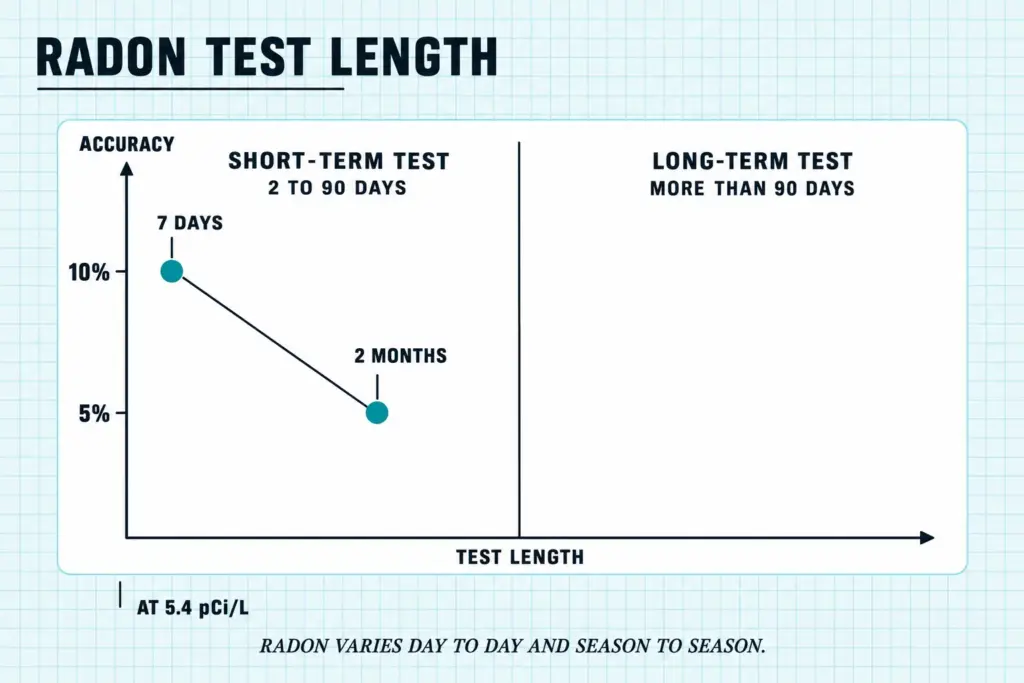
A long-term result is more likely to tell you the year-round average. A monitor left running for months sits closer to that long test than to a weekend one, which is why the maker’s accuracy figures come with a number of days attached. Here an accuracy figure is a band that holds under stated conditions, and for radon the stated condition is the length of the run.
What the maker says about the first week and the second month
Airthings gives the View Plus’s radon accuracy as about 10 percent after 7 days and about 5 percent after 2 months, at 5.4 pCi/L. Both are accuracy at one level, not an accuracy band for every level, and both are the maker’s figures. Read the pair together: the same unit in the same room is expected to be closer to its final answer after two months than after one week, and neither number is a statement about the first day.
Radon detection is sometimes called inaccurate, and some say one-off tests have contamination problems. The EPA’s answer is that test devices used properly give accurate and reliable results, while admitting variability in precision and accuracy. But accurate, in the EPA’s sentence, is a condition and not a promise, and it moves the variable to the part a household controls: the days, the closed house and the level of the home.
Write the date next to every radon figure you copy down. A number with no start date cannot be told apart from the first-weekend reading, and the first-weekend reading is the one the maker’s own curve says to trust least.
The month of the year does not have a single answer
The search box gets “what month is radon the highest,” and the plain answer is that no month wins. The EPA’s wording is variation, day to day and season to season, and it names no peak month. That variation is the reason a long-term test shows the year-round average better than a short one. A monitor that reads one level on the first weekend and another a month later is not necessarily failing; the sensor averages over a longer window as the days pile up.
Reading the number against 4 pCi/L
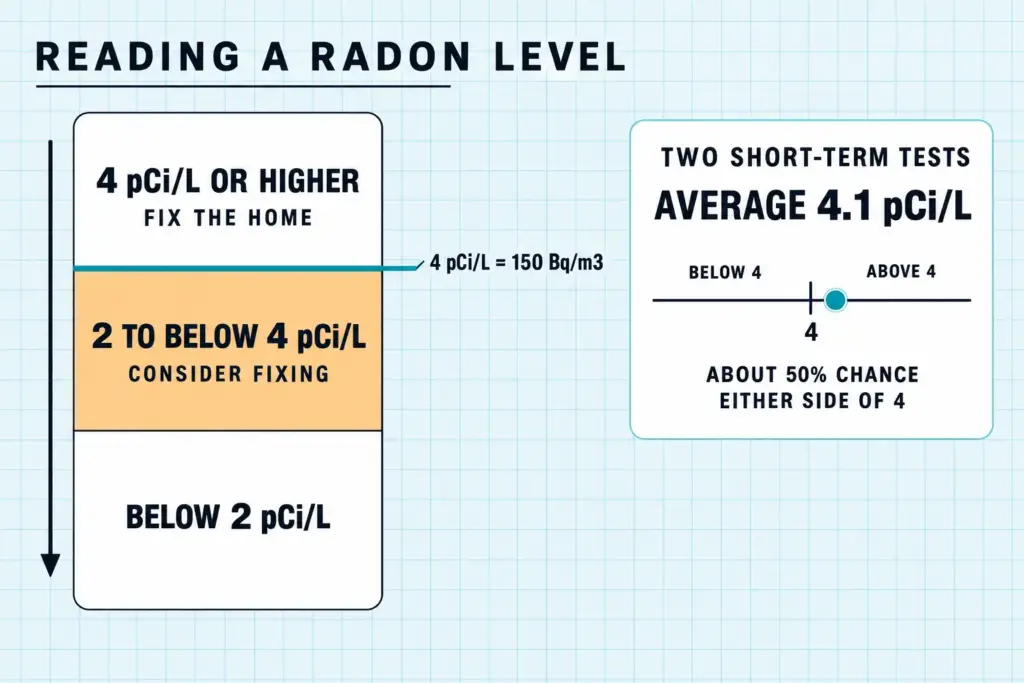
Once the number settles, one line decides what a home radon reading means: the EPA action level of 4 pCi/L, which is 150 Bq/m³. Near that line a single number is not enough. The rest of this section covers the cases where a second test beats a first one.
The line at 4, the window from 2 to 4
The EPA’s rule has two edges. Fix the home if the radon level is 4 pCi/L or higher; consider fixing when it is between 2 and 4 pCi/L. Read your result as one of three bands: below 2, from 2 to below 4, and 4 or higher, with 4 pCi/L equal to 150 Bq/m³.
Airthings prints its own scale, which breaks at 4 and at 2.7 pCi/L. That is the maker’s band and not the EPA’s, so the band shown on the unit and the EPA’s line are two different scales. Read the EPA’s first, and treat the maker’s as a convenience of the screen.
Two tests that average 4.1
The EPA gives one example worth memorizing: if the average of two short-term tests is 4.1 pCi/L, there is about a 50 percent chance the year-round average sits on either side of 4. Near the line, a second test or a long one decides, and a first number does not. A short result of 3.8 is not much farther from the line than that 4.1, so it deserves the same second look. And the easy reading of 3.8, that it is under 4 and therefore fine, is the one to resist.
Run the second test the same way as the first: same room, same shelf, same closed-house conditions. Two results from different setups cannot be averaged fairly, and the EPA’s 4.1 example only works when both numbers measured the same place.
The map of radon zones does not decide whether to test
The EPA map of radon zones is where many readers look up their address first, and the page that carries it is blunt: “This map should not be used to determine if individual homes need to be tested.” The 150 Bq/m³ figure sits on that page too, along with the instruction to test wherever you live. A low-zone address still gets a test.
“Test once and return it” against the EPA rule
Some people buy a highly rated monitor, read it once and send it back. That is a cheap way to try a model, but a single reading tells you little about its long-term accuracy. Readings from a monitor should move with daily and seasonal cycles. A number that never moves is a warning sign of a stuck sensor, not a reassurance.
The reasoning is half right, and the half that is wrong is the half that matters. Daily and seasonal fluctuation is exactly what a short reading cannot average out, which is the EPA sentence from earlier in this guide. A short result near 4 can land on either side.
For radon, a one-time test can be enough when it keeps the 48-hour minimum and the house stays closed, and the result is well below the EPA action level of 4 pCi/L. My own rule of thumb is that a first number far from 4 can be believed sooner than one close to it, whatever the box says.
When the fix is the building, not a device
A reading of 4 or higher does not send you back to the shelf for a better monitor. Radon comes in through the building, so the part that changes the number is a professional job on the building. This section covers where a high number points and what a household does next.
Radon enters through the cracks and gaps
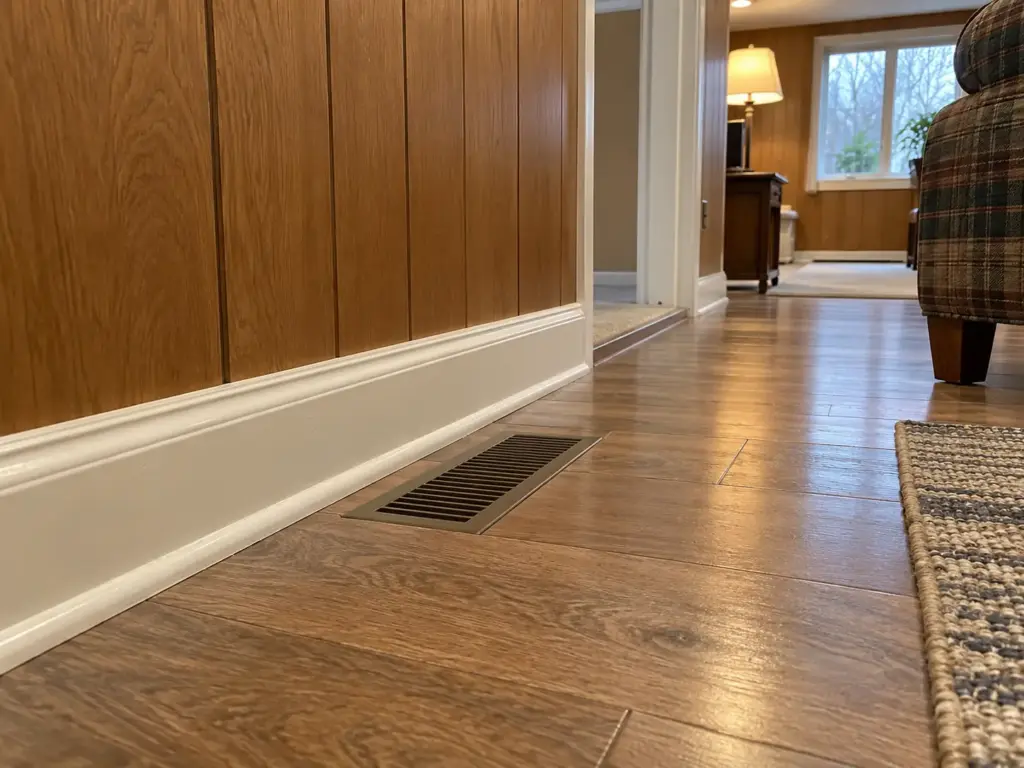
By the EPA’s account, the air that carries radon into a house comes through cracks and gaps in the building. That makes the reading a description of the foundation cracks and gaps and the lowest level in use, not of how the room is lived in. A window opened for a day changes that day’s reading, but it leaves the source untouched, which is the ground under the house.
The other readings on the same screen describe the air in the room, not the ground, and that is easy to miss. A low CO2 figure and a high radon one can sit in the same room at the same time, because one is about how much outside air the room gets and the other is about what the foundation lets through. A tidy-looking screen with five good numbers and one bad one is still a bad screen, and the bad number is the one that points at the building.
The same foundation sits behind a different complaint. What makes a basement damp is also a story about the ground, the walls and the water they let through, so the two questions share a cause even though they do not share a sensor.
The state radon office and a qualified professional
The first call is the state radon office, and it points to qualified radon professionals. The fix for a high reading is radon mitigation: a mitigation system installed by a qualified professional. This page does not describe the installation, because that is the professional’s job, and the monitor’s part in it ends at the number.
What to bring to the call is short: the result, the dates, the level of the home it was taken on, whether the windows were shut for the 12 hours before, whether it was a short or a long test, and whether it came from a monitor or from a lab kit. Those details are what let the person on the phone tell a settled number from a first-weekend one.
A renter cannot change the building. The next call is the owner or the landlord, with the result and the dates of the test in hand. That order is this article’s own reasoning about leases, not an EPA rule, and a lease may say something different.
What the EPA-hosted study did and did not measure about air cleaners
An EPA-hosted study of portable air cleaners measured radon progeny, the decay products, not the gas.
In that study the air cleaners that were effective at removing particles were also effective at removing radon progeny, and the concentration of unattached progeny can increase with increasing air cleaning. That is what it measured. It does not settle the question for the gas itself, and this page does not claim an answer in either direction. A purifier is a filter for the air in a room, and the EPA’s fix for a high reading remains the mitigation system above.
A house with no basement, and the check for later
“Radon is a basement problem” is the belief that keeps a slab-on-grade house from testing at all. It is also the last question to settle before a monitor goes on its shelf for the long run.
Radon can be a problem in any type of home
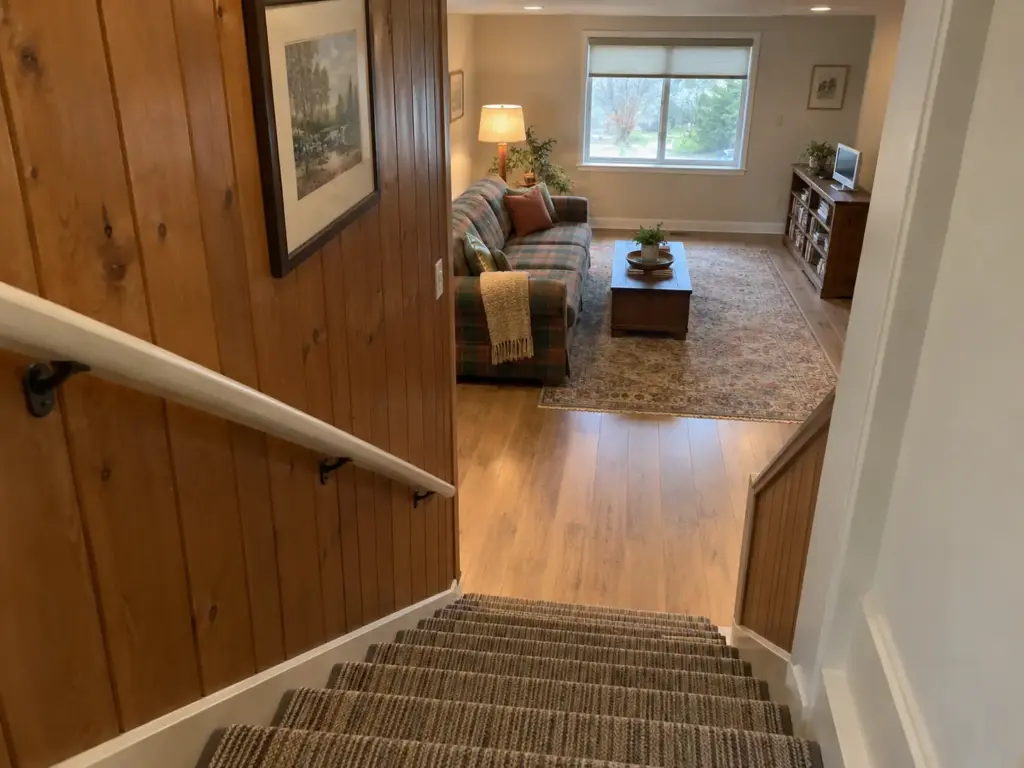
Many people assume radon is only a closed-basement problem. The EPA guide says radon can be a problem in all types of homes, with or without basements, and it lists slab-on-grade foundations among the house types it covers. A ground-floor apartment and a ranch on a slab belong to the same list as a house over a cellar.
The belief survives because a cellar is where people picture a gas collecting, and a slab house has no cellar to point at. But the route in is the one the EPA names, cracks and gaps in the building, and a floor that touches the ground can have those as easily as a wall below grade can. Without a basement, a household can skip the whole question of a radon test without ever having asked it, and that is how an address with a flat concrete floor ends up with no reading at all.
Where the monitor goes in a slab house
In a house with no basement, the lowest floor in regular use is the ground floor, the lowest level that could be used regularly. The monitor goes on that level, in an occupied room, with the maker’s 3 ft clear of vents, windows and doors. If the household later begins to occupy a lower level, such as a finished basement, the EPA says to test that level again.
A renter follows the same placement, then works through the lease, the landlord and the state office in that order. (Again, that order is this page’s reasoning.)
In a small ground-floor unit with one window unit and no ducts, the shelf in the occupied room is a better spot than a hallway closet. The closet is where nobody lives, and the number is meant to describe where somebody does.
The check at two months
Read the monitor’s radon figure at two months, not at week one. The maker’s own curve says that is where the unit approaches its stated accuracy, about 5 percent at 5.4 pCi/L.
The figure that matters is the one the unit shows after the household’s real routine: windows closed at night, the door of the lowest room shut, the shelf left alone. It is not the one from the first weekend.
A unit left up through a change of season also lets you watch the variation the EPA describes, day to day and season to season, instead of taking it on faith; a figure that drifts a little while the household’s habits stay the same is the variation at work, and a figure that jumps after a renovation or a new lower-level room is a reason to test that level again.
A house that passes the radon question may still have a damp wall, and a monitor chosen for damp walls has a different shopping list.
The order that works: call, close, test, then read at two months
Three things carry over. A radon number comes from a sensor built for radon and from a test run by the rules: 48 hours at minimum, the house closed, the lowest level in use. The first figure a monitor prints is a short reading, and the year-round average takes longer. At 4 pCi/L or higher the next step is a qualified professional and a second or longer test, not a purifier and not a window.
The check for later is the monitor itself: look at the figure on its screen at two months, because that one, and not the first weekend’s, is the number to act on.
Tomorrow, make one call to the state radon office and ask whether a test is on offer where you live. After that, close the lowest room’s windows 12 hours ahead, run the test for the full 48 hours, and read the result against 4 pCi/L before deciding whether the monitor is the next purchase or a purchase at all. If the average comes back at 4 or higher, the call goes back to the state office, which points to qualified radon professionals, as the EPA guide lays out.
Frequently Asked Questions
01What air quality monitor can detect radon?
Only a monitor with its own radon sensor can detect radon, and among the three monitors in this article that is the Airthings View Plus. The Aranet4 reads CO2 and the Temtop S1 reads PM2.5 and temperature, so neither reads radon.
02What is the most accurate radon monitor?
No source here ranks radon monitors by accuracy, and the EPA says test devices used properly give accurate and reliable results, so the test days and closed-house rules matter more than the brand. Airthings puts the View Plus at about 10 percent after 7 days and about 5 percent after 2 months.
03Are there any air purifiers that help with radon?
An EPA-hosted study measured portable air cleaners on radon progeny, the decay products, not on the gas, so it does not answer the question for the gas. The EPA’s fix for a high reading is a mitigation system installed by a qualified professional.
04What month is radon the highest?
No single month wins: the EPA says radon levels vary from day to day and season to season, which is why a long-term test shows the year-round average better than a short one.
05Do I need a radon test if my area is low on the map?
Yes, a home in a low zone still needs its own test, because the EPA says its radon zone map should not be used to decide whether an individual home is tested.