
All-in-one on a box describes a bundle, not a measurement, and the gap shows up at the shelf. A humidity and air quality monitor sits by the sofa and reads comfortably dry while the window glass three steps away is beaded with water. Part of that is mechanism: the humidity sensor lives inside a housing that also holds a fan, a laser and gas sensors, and warmer air at the same moisture reads a lower relative humidity. This article goes through what the box reads, why its humidity number needs a second look, and which reading to act on first, with a separate hygrometer as the check that settles it.
Quick Answer
A combined monitor’s humidity reading is good enough to follow the room and its trend, and not good enough to treat as an exact number. Put a second hygrometer in the same room at the same height, and trust the box’s figure only once the two agree after a day.
What a Humidity and Air Quality Monitor Puts in One Box
The label is the first thing to take apart. An all-in-one air quality monitor is several sensors on one circuit board, one housing and one app, and each reading on that screen is taken a different way, so “the box says” is really six or seven separate statements with six or seven different margins of error. Before choosing between a combined air quality monitor and two separate units, it helps to pick the reading first, because the question you are asking decides how much of the box you will actually use.
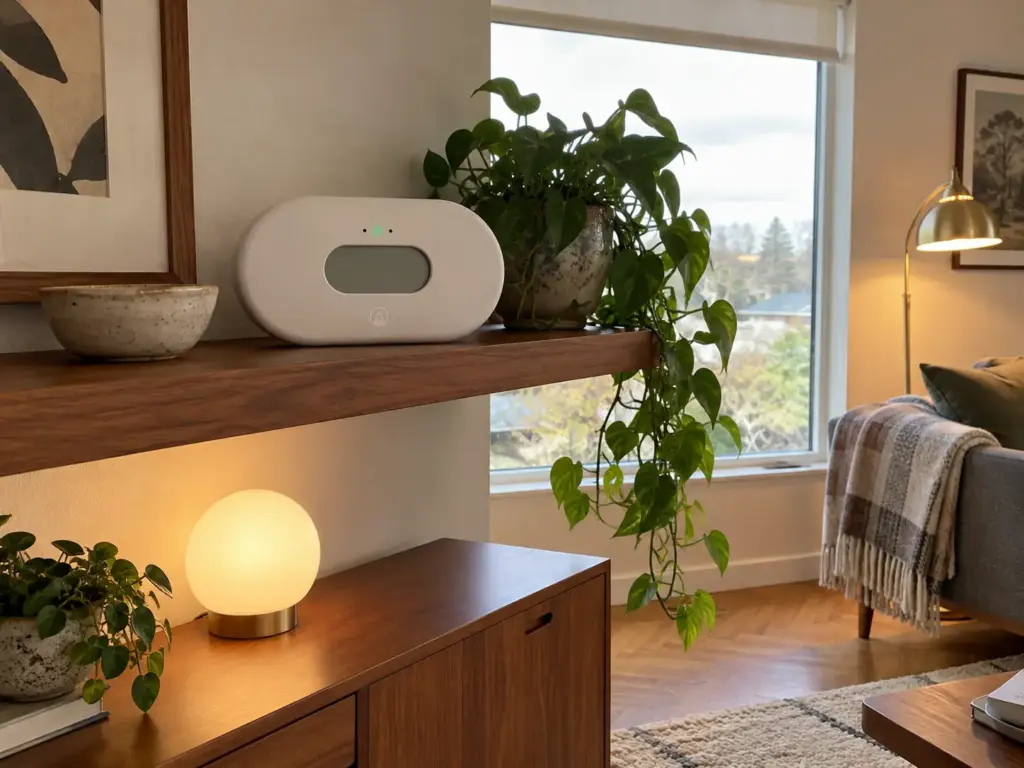
The readings and the units they come in
Every number on the screen carries a unit, and the units are the part worth keeping straight. Relative humidity is a percent. Temperature comes in °F with °C beside it, which is why many of these boxes double as an air quality and temperature monitor.
PM2.5, the fine particles, is stated in micrograms per cubic meter (µg/m³), and some boxes also print PM1.0 and PM10; the part behind those figures is a laser particle sensor, an optical particle counter that sizes particles by the light they scatter. CO2 is in parts per million (ppm), the unit any CO2 monitor reports.
Past that point the lists split. The 16-in-1 listing adds a formaldehyde sensor (HCHO) and TVOC, and one unit in this group adds radon. For the full catalog of what each sensor does, see what an air quality monitor measures. This article stays with the reading that drives most house decisions in a home air quality monitor, which is humidity.
The widest multi-sensor unit here is the Airthings 2960 View Plus, which packs radon, PM2.5, CO2, VOC, humidity, temperature and pressure into one housing and connects over WiFi. Its listing prints an operating humidity limit (under 85 percent) and no humidity accuracy at all, which is the gap to know about before a humidity decision rides on its screen.
Which of them are measured and which are estimated
Some of the numbers are read straight off a sensor, and some are the maker’s scaling of a reading. Relative humidity belongs to the first group, with a catch: it is a ratio that only means something at a given temperature, so the box has to read the moisture and the temperature together and compute the percent.
A VOC index belongs to the second group. It is a relative number the maker sets on its own scale, not a concentration, so a “VOC of 150” on one brand does not compare with another brand’s. The AQI label on a particle reading is a category built on top of the PM number, not a second measurement. And every sensor drifts as it ages (the maker’s calibration decides by how much), which is one more reason a single figure is a starting point.
After a week most people stop reading six numbers and watch two. The box did not change; the attention did.
Why the Humidity Figure Can Read Dry Inside Its Own Box
The reading that decides a humidity question is the one the spec sheets forget to print an accuracy for, and the box itself is part of the reason. A monitor that is also running a fan and a laser is a small heater, and the humidity sensor sits inside it.
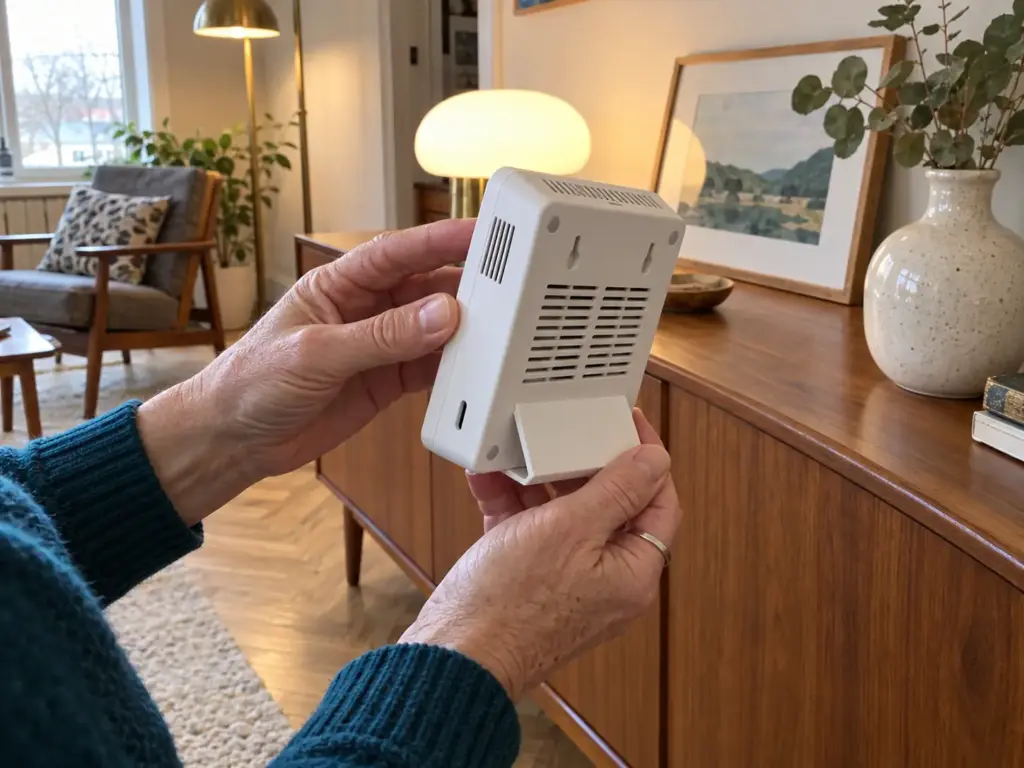
What warm air does to a relative humidity reading
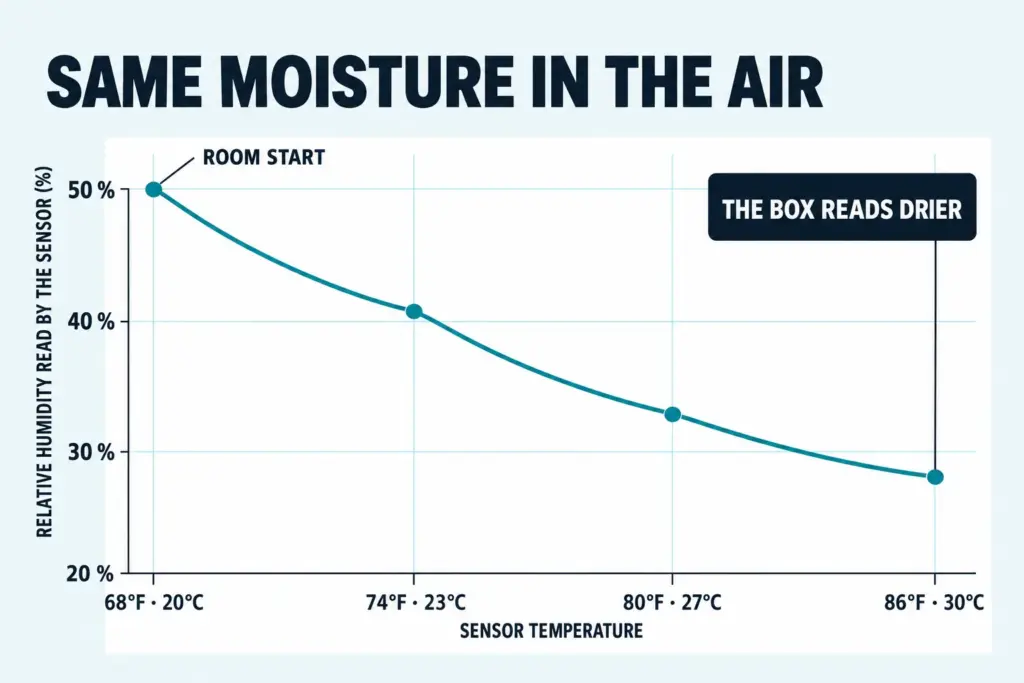
Relative humidity compares the moisture the air holds with the most it could hold at that temperature. Warm the air without adding any moisture and the ratio falls, because the warmer air could carry more (the dew point, the temperature at which that air would start to shed water, does not move, which is why it is the steadier number). So a sensor that sits a little warmer than the room, surrounded by the same moisture, reports a lower relative humidity than the room really has. In a combined box that sensor shares its housing with a particle fan, a laser and gas parts that all give off heat (the heat from its own components is the offset at work), and BreatheSafeAir’s review of the Temtop S1+ reads a vent on the back of the unit as the likely way air reaches the temperature and humidity sensor, which puts that sensor in the same housing as the parts that warm up.
The offset is not constant. By the mechanism it should grow as the box keeps running and the room around it cools, and it should barely show in the first minutes after plugging in. The chart below traces how steeply the reading falls as the sensor warms.
What is printed, and what is not
Read the listings side by side and the pattern is plain. The 16-in-1 prints a humidity sensor accuracy of ±2 to ±3% RH, with no temperature or humidity level beside it. The Temtop S1 and the Airthings View Plus print no RH accuracy on the listings at all. What they print instead is an operating range, 10 to 99 percent for the Temtop and under 85 percent for the Airthings, and a range says where a sensor works, not how close it gets.
A band with no conditions cannot be checked against your room. Accuracy at a mid-range humidity and a comfortable temperature says little about the damp evening when the glass sweats, which is the evening you bought the box for. The EPA’s siting guide, quoted in the next section, says temperature and humidity swings can disturb some sensors, so the conditions are not a footnote.
Where the reading is weakest
One reviewer’s test gives the shape of it. BreatheSafeAir compared the Temtop S1+ against a traceable reference in one room and found that near 50 percent RH and 77°F (25°C) the S1+ almost always matched, while “as relative humidity increases, the accuracy of both devices will drop.” Good in the middle, weaker as the air gets damp, and damp is where most of the decisions are. That is a single reviewer’s test in a single room, and it is a reason to check rather than a rule.
A second test points the other way round. The same site found the Qingping Air Monitor Lite reading 3 to 8 percent higher on relative humidity than two other monitors in the same room, one of them a reference unit. Neither result tells you what your own box does. Together they say that two boxes in one room can disagree by several points, and that the disagreement is worth finding before you act on either number; the full question of how accurate air quality monitors are has its own article.
The Temtop S1 is the plainest example of the combined-box humidity question, so it sits here as a card.
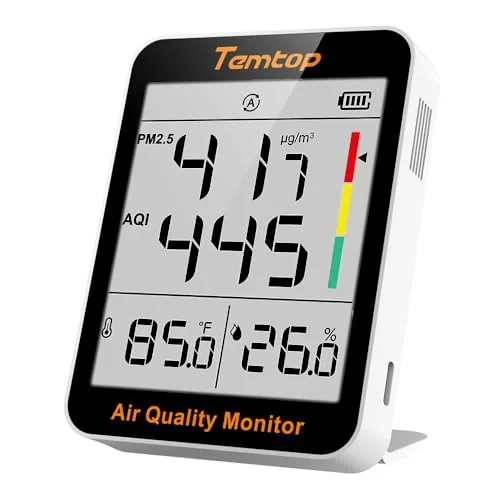
Take the first comparison reading after the box has run for several hours with the room at its usual temperature, not in the first minutes after plugging it in. The offset builds with the heat and the cooling room, so a quick look at plug-in time flatters the box.
Where the Box Sits Decides Which Humidity You Read
The same room has more than one humidity. There is the air at breathing height in the middle of the room, and there is the air against the cold surface by the window, and a single box reads whichever spot it was put in. In a rented apartment with one shelf, one window and one outlet, the choice between them can feel like a coin toss.

Breathing height and clear air
The EPA’s guide to siting and installing air sensors puts indoor sensors near the typical breathing zone, about 3 to 6 feet for an adult, and away from sources of pollution such as a toaster and sinks such as air cleaners. It also asks for clear airflow around the unit: “Sensors should have free air flow and not be placed behind furniture or tucked away in corners.” A box wedged between a bookcase and the wall is reading the pocket it sits in.
That rules out the usual places a box ends up. The kitchen counter reads the kitchen. The shelf next to a humidifier reads the humidifier’s plume. Floor level and the top of a cabinet read air that is not the air anyone is sitting in.
The airstream and the window
The same EPA guide warns that windows, doors and heating and cooling ducts can bring rapidly changing temperature and humidity that disturb some sensors, so a box on the sill or above a vent reads the draft. And yet the window is where the humidity problem shows itself. Condensation on windows, walls or pipes is the EPA’s sign of high humidity, and the answer lies at the source, not at the glass; whether the condensation on a window is normal is its own question.
For the room as a whole, the number to read against is the EPA band. The agency’s brief guide to mold, moisture and your home says to “keep indoor humidity below 60 percent (ideally between 30 and 50 percent).” That band answers the room question, and it has an edge: on the same evening the air a short way from cold glass runs more humid than the air on the shelf, because air touching a cold surface loses heat and its relative humidity rises. The gap between those two numbers is the reason to move the box.
One box cannot be in both places
The common advice is to put the box where you spend the most time, and for CO2 and particles that is the right answer. For a condensation or mold question it is wrong, because that question is asked at the cold surface and the bedside shelf never sees it. One box cannot sit in both places, so decide which question you are asking this week.
The tidy answer is a second reading at the cold spot while the combined box stays at breathing height. The SensorPush HTP.xw fits that role: it reads temperature, humidity and barometric pressure over Bluetooth and shares neither the combined box’s heat nor its airstream. No humidity accuracy figure is confirmed for it here, so it works as a second opinion at the cold spot and not as a reference. When the second opinion says the wall is wetter than the shelf, the mold question is the next article to open.
Before buying a second unit, carry the box to a spot a short way from the cold glass, out of any draft, for one evening and write the number down. Put it back at breathing height and write that one down. The gap between the two is the case for a second unit, and if it is small, you have saved the purchase.
Which Reading to Act On First, and the One Change After It
A box that prints six numbers never says which one comes first. The order is the part the listings leave out: humidity first, because the public guidance gives it a band, then CO2, then particles, and one change at a time so the next reading means something.
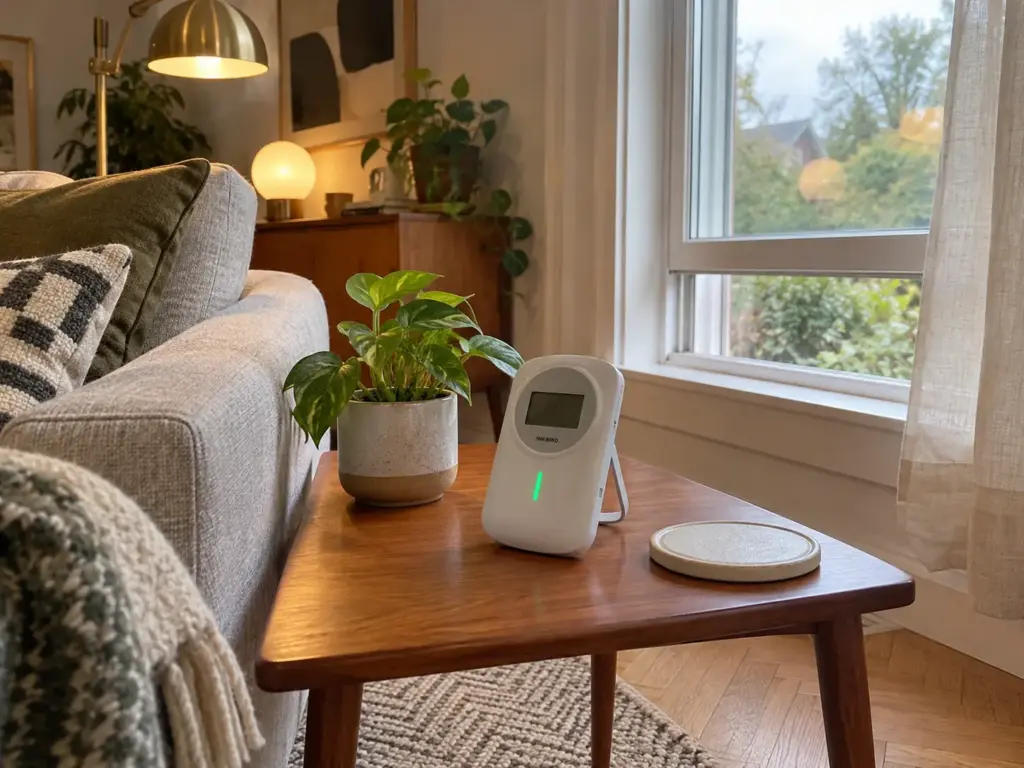
Humidity out of range
Start with the EPA band from the last section, below 60 percent and ideally between 30 and 50. If the number sits above it, the change belongs at the source. Vent the dryer and the stove to the outside where you can, run the exhaust fan through the shower and a while after, or lower the humidifier setting by one step.
Pick one of those, make it, and read the number again before touching anything else. It should move toward the band over the next few hours; if the glass sweats again the same evening, the source is still running. A dehumidifier in a damp room moves the number too, but it treats the reading and leaves the source where it was, so it comes after the free changes, not before.
If the number sits below the band, as it can in a dry room in the heating season, the change goes the other way. Raise the humidifier setting by one step, or shorten the time a window stays open, and read again. A second step made before the first one has shown up is how a room overshoots, and an overshoot shows up as damp glass in a room that was dry the night before. When the reading will not come down and the cause is not obvious, lower the humidity at home walks through the sources in order.
CO2 climbing with the door shut
In a closed room (a bedroom with the door shut is the classic case) the CO2 line climbs, and a stuffy room is that line in numbers. The change is ventilation: the window or the door, so fresh air replaces the stale. The box shows the result within minutes, which makes this the quickest feedback loop on the screen. No CO2 threshold is written here on purpose; the sourced numbers and the order of changes live in the article on how to lower the carbon dioxide level at home.
The window that fixes the CO2 can raise the humidity on a damp day, which is why the order matters. A reader who opens the window to fix one number and then sees the humidity climb has not found a fault in the box. For a CO2-only reading, the INKBIRD Indoor Air Quality Monitor NDIR CO2 Detector, an NDIR CO2 sensor, answers the window question with no humidity sensor in the housing to disturb it. Whether it also reads humidity is not something this article can confirm, so do not buy it to double as a hygrometer.
Particles jumping while the stove is on
Particles spike during cooking, and the change that follows is the range hood. The box shows the spike on the way up and the fall once the hood is running, which is also a useful test of where the box sits. A box that barely twitches while a pan smokes two rooms away is telling you where it is.
Three readings can light up at once on one evening, and three changes in the same evening leave you unable to say which one worked. The combined box makes that mistake easy, because everything it reads is on one screen.
Make one change per evening and read the same number at the same hour the next day. A window opened for CO2, a fan run for humidity and a hood switched on for particles on the same night will all look like success on the screen, and none of them will tell you which one did the work.
When Two Separate Units Read the House Better
The combined box earns its place in one room with one question. Past that, a separate hygrometer and a separate CO2 meter each give a reading the box cannot, and neither one has the other’s sensors warming it.
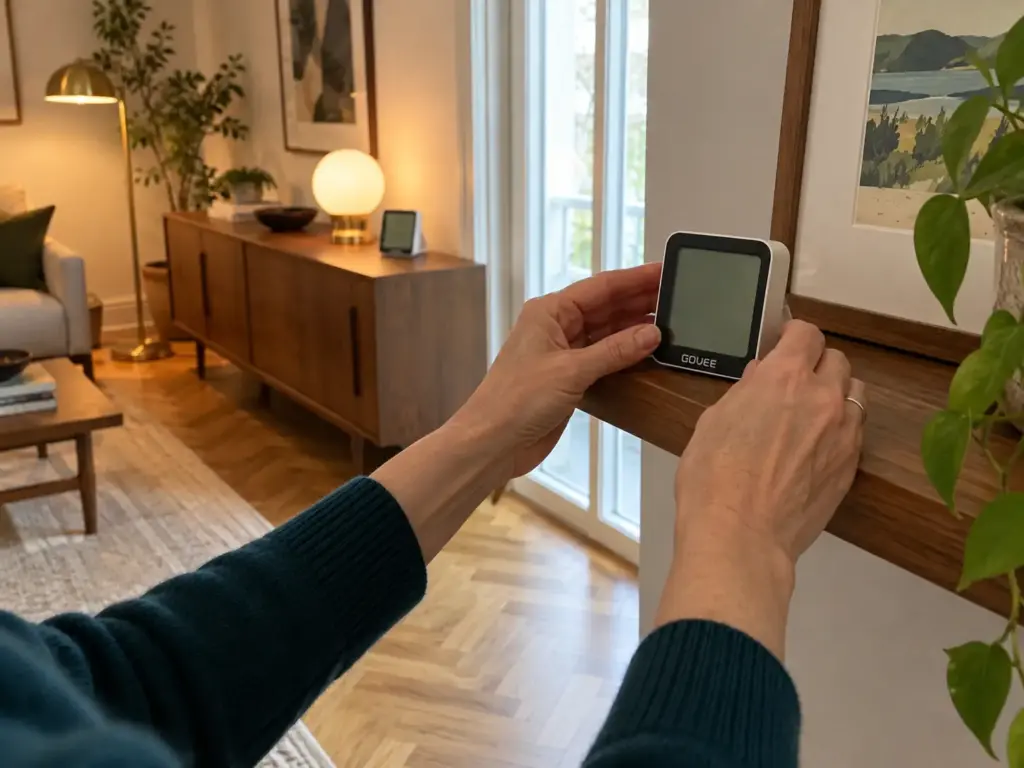
When the combined box is enough
One room, one question, and a trend you are following over days: that is the combined box’s home ground. If the reading you care about is whether the CO2 fell after you opened the door, or whether the humidity is drifting up over a week, the absolute error matters less than the direction, and a box that is consistently a few points off still shows the direction. If the budget is the constraint, the cheapest air quality monitors are worth a look before you spend more on this one.
The obvious pick for a first purchase is the single box, one app and one battery, and for one room it is a sensible one. But a reader usually ends up looking at one number and ignoring the rest of the app.
When it is the wrong buy
The box is the wrong buy when humidity has to be read at a second spot, such as the cold wall, the basement or a nursery‘s temperature, or when CO2 needs a sensor with nothing else in the housing. The EPA’s mold guide calls a humidity meter a small, inexpensive instrument, and the argument that follows is about places, not price: a pair of single-purpose units reads two spots where one box reads one. A separate hygrometer does not share the box’s particle intake or its heat, and a CO2 meter carries no humidity sensor to disturb.
For the humidity half, the Govee Indoor Hygrometer Thermometer H5075 reads temperature and humidity with Bluetooth app control, one line and one number for the wall of the second room. No humidity sensor accuracy figure is confirmed for it here, so it earns its place as a second opinion, not as a reference. How to pick and trust a cheap indoor humidity level checker has its own pillar, and a cold concrete wall has its own pick in a basement humidity sensor.
The CO2 half of the pair is the Aranet4 Indoor Air Quality Monitor, which reads NDIR CO2 alongside temperature, humidity and pressure on an e-ink screen. Its humidity accuracy is not something this article can confirm either, so for humidity it is one more opinion, and the CO2 line is what it is there for.
The two-unit answer has a price of its own: two apps, two batteries, two places to look. Checking that against your own habits is part of the decision, and what to look for in an air quality monitor lays out the checklist.
What the Spec Sheet and the App Leave Out
Past the readings, a combined box lives or dies on three things the listing puts in small print: how the app shows the room, how the unit is powered, and how long the sensors last.

Averages, peaks and the export
An app can smooth the very event you bought the box to see. BreatheSafeAir found that the Qingping Air Monitor Lite app’s “24-hour view defaults to 15-minute periods,” and that the exported data is in 15-minute periods too, so a short spike is averaged away before it reaches a file. That is one reviewer’s test of one unit, not a verdict on every app, and it points at three questions worth asking of any box: does the screen show the peak value or a rolling average, what is the logging interval, and can the data export leave the app.
A particle spike from a pan lasts minutes. If the logging interval is fifteen minutes, the spike you wanted is the one thing the record does not contain.
Power, battery and the sensor that wears out
Power decides where the box can go. The Temtop S1 listing title carries a 60-day battery life, which lets it sit anywhere in the room, while a box that runs on USB power goes where the outlet is, and the outlet is rarely where the air question is. Read the battery line on the listing of the unit you are about to buy, since a figure from one model says nothing about another.
Particle sensors and gas sensors are parts that wear, which is why sensor lifespan belongs in the buying decision and not in a footnote, along with whether the maker offers recalibration. The detail on warm-up and replacement sits in our related guides, and the buyer’s checklist above is the place to start.
A listing’s claim and its missing unit
Put a listing’s claim next to its flaw and the picture clears. The 16-in-1 listing describes “an astounding 0.001-grade unit accuracy,” with no unit given, and prints a humidity accuracy of ±2 to ±3% RH with no conditions stated. A number without its unit is not a spec, and a band without its conditions cannot be checked against your room. The same page also makes a health promise, which is a claim about people, and this article stays with what the box does to a reading in a room.
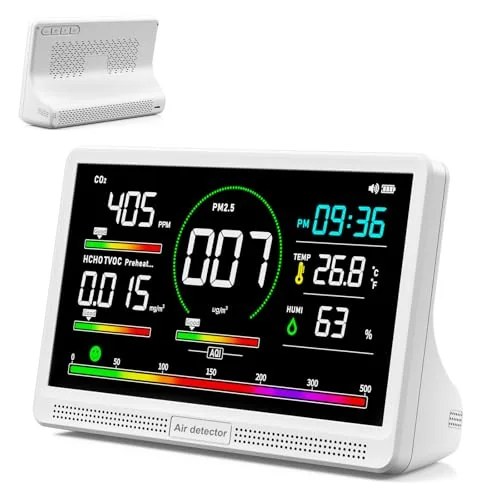
The 16 in 1 Air Quality Monitor Indoor 7″ Display is the box with the most readings and the least information about its humidity figure.
What the Box Cannot See Behind the Plaster
The box reads the air of one room. The wall has its own moisture, and a number from a shelf says nothing about it.

Room humidity and wall moisture are different readings
Picture a dull patch on a plaster wall and a perfectly normal number on the shelf. Both can be true for weeks.
A wall can read much wetter than the room air around it, and a room box cannot answer whether a damp-proof course has failed, because wall moisture content is a different measurement from room humidity. No room box answers that, because wall moisture content is a different measurement from room humidity. Such a case marks the limit of what a room box can tell you, and it does not set a rule.
The EPA’s line from the mold guide still applies: condensation or moisture on windows, walls or pipes signals high humidity, and the answer is at the source. The box’s number does not replace looking at the wall.
When the reading points at the building
The signs that the question has moved from the air to the building are plain. The same patch returns after you dry it, the wall is cold to the hand, and the source is outside the room. That is a professional’s question and not a monitor’s. A shelf cannot judge a wall, and neither can the monitor standing on it.
A room monitor’s limits include other measurements too. Radon is a separate reading with its own device, and the pick of air quality monitors that read radon has its own article. Carbon monoxide is a home-safety matter, and a monitor’s CO reading is not a carbon monoxide alarm. A certified alarm is a separate device on the household’s list, and if one sounds, the rule is to leave the house and call the fire department.
The next decision depends on what the readings did: lower the humidity, or find where the water comes from.
Trust the Trend First, Then Check the Number Against a Second Reading
The combined box is a good instrument for a room and a poor judge of one exact number, and the pages above reduce to three habits:
- Use the box for the room and the trend, and hold its humidity figure as provisional until a second reading in the same room agrees with it.
- Remember that the spot decides the humidity: breathing height for the air of the room, the cold surface for the window and the wall.
- Take one reading, make one change, and read again before touching a second thing.
For later, look at the box’s humidity beside a separate hygrometer in the same room after a few days of running, and look at the app’s average beside its peak, because those are the two places a combined box drifts from what the room is doing. If CO2 is the number you are watching, the next stop is how to measure carbon dioxide in a room and trust the number.
Tomorrow, place a second hygrometer a short way from the box at the same height, leave both alone for a day, and compare the two numbers. If they sit apart, the gap is the number to carry in your head every time you read the box.
Frequently Asked Questions
01How do you tell if your house has poor air quality?
Read the numbers a monitor prints, humidity, CO2 and particles, against their ranges, and watch the room’s own signs, such as condensation on the glass. For humidity, the EPA band is below 60 percent, ideally 30 to 50 percent.
02Does high humidity affect air quality?
High humidity feeds condensation and mold on cold surfaces, and it shifts the monitor’s own humidity reading too. The EPA says to keep it below 60 percent, ideally between 30 and 50 percent. Find where the moisture comes from before buying anything.
03How accurate are air quality monitors?
They are accurate within a band that differs by reading and by unit, and humidity accuracy is the band most spec sheets leave blank. Ask what conditions a printed figure was measured at, then check the box against a second reading in the same room.
04What is the best way to monitor indoor air quality?
Put one monitor at breathing height in the room that matters, add a second humidity reading at the cold spot, and judge the trend over days instead of one glance. Keep both out of drafts and away from cooking.
05Is a humidity and air quality monitor worth buying, or is a hygrometer enough?
A hygrometer answers a humidity question alone, and the EPA calls a humidity meter a small, inexpensive instrument, while a humidity and air quality monitor adds CO2 and particles in one housing. Buy the box for one room with several questions, and a separate hygrometer where humidity is the only one.