Your basement dehumidifier runs all summer, its bucket full every time you look, and then stops cycling in winter. You can’t tell whether the unit is doing its job or the room is simply drier for six months. If you want to know how to keep basement humidity low for good, whether the basement is finished or not, start from where the water comes from.
It reaches a basement by three roads: in from outside through the ground and the wall, out of what the basement itself makes (a dryer, a drain, a pit, a cold pipe), and out of the air that is already in the room. A dehumidifier only works on the third road, so the other two have to be trimmed first or the reading never holds. This article follows the order the water arrives, and the unit comes last.
Quick Answer
Hold the basement below 60 percent relative humidity, ideally 30 to 50, by fixing the water in the order it arrives and reading the room between changes.
- Read the room at the foot of the cold wall and mid-room.
- Stop outside water: clear gutters, extend downspouts, check the grade.
- Cut the basement’s own moisture: vent the dryer, cover the pit, wrap cold pipes.
- Rule out the wall if the same damp band returns after rain.
- Add the dehumidifier last, with doors closed and a drain route.
- Read the room again after each change before making the next.
Read the Room Before You Change Anything
A musty odor or a clammy feel sends most people straight to a unit, and it is the wrong first move. The same 70 percent points to different water in different basements, and every fix below only makes sense measured against a number you took yourself.
What the Number Is Held To
The public reference is short. According to EPA’s guide to mold, moisture and your home, “If possible, keep indoor humidity below 60 percent (ideally between 30 and 50 percent) relative humidity.” Sixty is the ceiling you stay under, and 30 to 50 is where a damp basement should land once the work is done. The cold months want a lower number than that, and the winter number is lower in a page of its own.
Where in the Basement to Read It
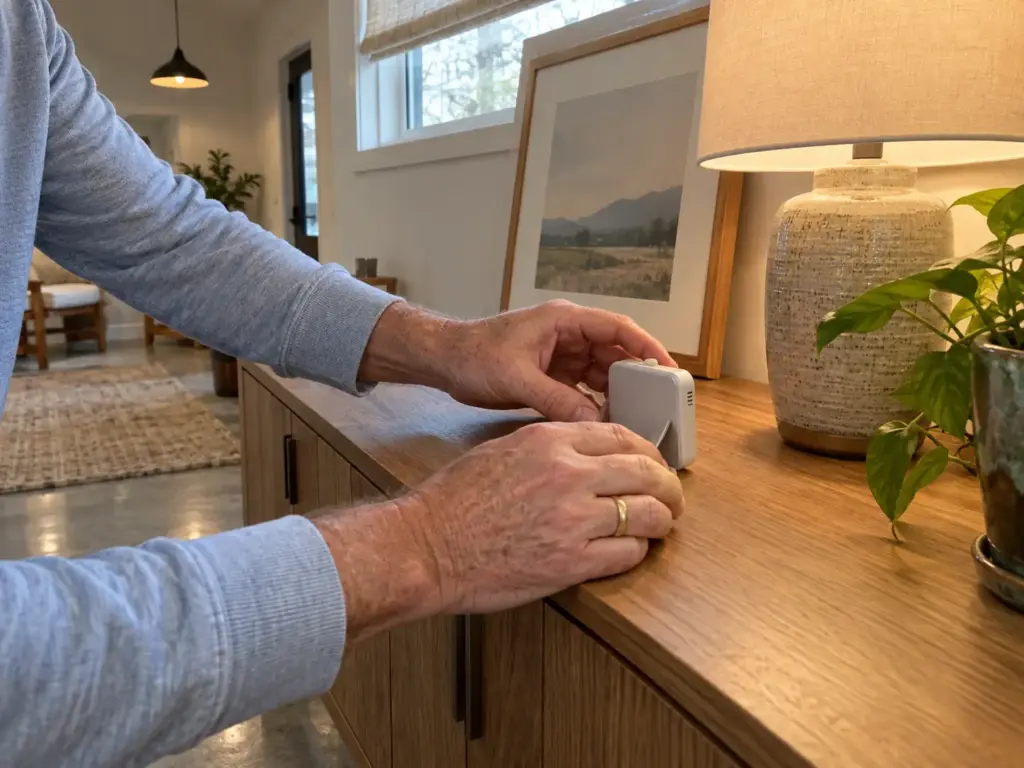
A meter on the stair landing reads the stair. Put one in the middle of the room, and a second at the foot of the coldest wall, which is usually the outside wall or the one below grade. Concrete holds the cold, and the same moisture in cooler air reads as a higher relative humidity, so the wall reading can run ahead of the middle of the room. That gap is the first clue to what the wall is doing.
If the two numbers match, the room is one mass of air and a room-wide fix will move both. If the wall runs well ahead, the wall is the problem, and a unit in the middle of the floor will fight it forever. Where to put a sensor on cold concrete is covered in a sensor that lives on a cold concrete wall.
One caution on the unit’s own gauge. Midea owners on the Amazon page for the Cube 50 describe a built-in reading that sticks or fails, while one reviewer who set a separate hygrometer beside the unit for two days saw it land within a point or two of the meter. A cheap standalone meter is the number you act on.
What a 63, a 70 and an 80 Are Telling You
A basement meter that shows 63, 70 or 80 is over the 60 percent ceiling in all three cases, and the readings differ in how far, not in kind.
A 63 is a few points of work, and the free fixes below may be enough. A 70 is ten points over and points to a source feeding the room. An 80 is twenty over and suggests water still arriving today, not a number to live with.

Whatever the number is, write it down with the date and the spot. One reading per change, taken far enough apart to show the change, is how you will know which fix worked and which one did nothing.
Write every reading down with the date, the spot and whether it rained that week. A damp week and a dry week can look like two different basements, and the note is what tells you which fix to credit.
Stop the Water That Comes From Outside
A basement cannot be held at 50 percent while rain is coming through the ground at the wall. This is the cheapest fix on the list, so it goes first here.
Grade, Gutters and Downspouts
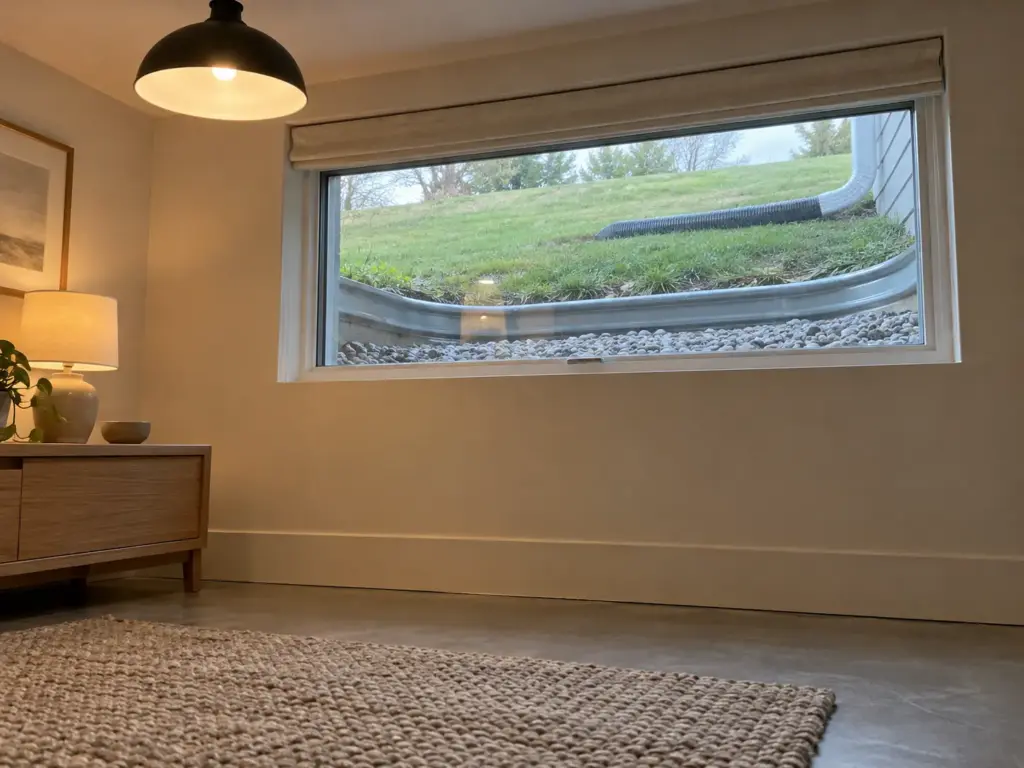
EPA lists ground that slopes away from the foundation and gutters kept clear and carried away from it as the first line against basement moisture. You can check both from the ground, with no ladder: walk the outside of the house, look at where the soil meets the foundation and whether it falls away or leans in, and see where every downspout ends. Before setting a unit to dry anything, check the grade and make sure everything is pitched away from the house.
A downspout that ends right at the corner of the house can explain a damp corner in the room below, because it drops a whole roof’s worth of rain beside the wall. Extending it a few feet, or carrying it to a splash block that sends the water off, costs almost nothing and changes what the wall has to deal with.
For how water gets in once it is at the wall, where the water gets in covers seepage, cracks, the wall-floor joint and vapor moving through the concrete itself.
The Reading After the Next Rain
Nothing here is bought. Clear what already runs, extend what already discharges, and then wait for rain.
Read the room at the foot of the wall a few days after the next heavy rain, not the same afternoon, because concrete takes time to give up what it took in. If the number at the wall has dropped toward the middle of the room, the outside water was a real share of the problem. If it has not moved, you have learned something too, and the next two sections are where to look.
Cut the Moisture the Basement Makes Itself
Once the outside is handled, what is left is made inside: the dryer, the drains, the pit, the cold pipes. Each is cheap to fix and each shows up in the reading, and ENERGY STAR is direct that reducing the sources of moisture reduces how much dehumidifying the room needs. That is the whole case for doing this before you buy anything.
The Dryer and Its Vent
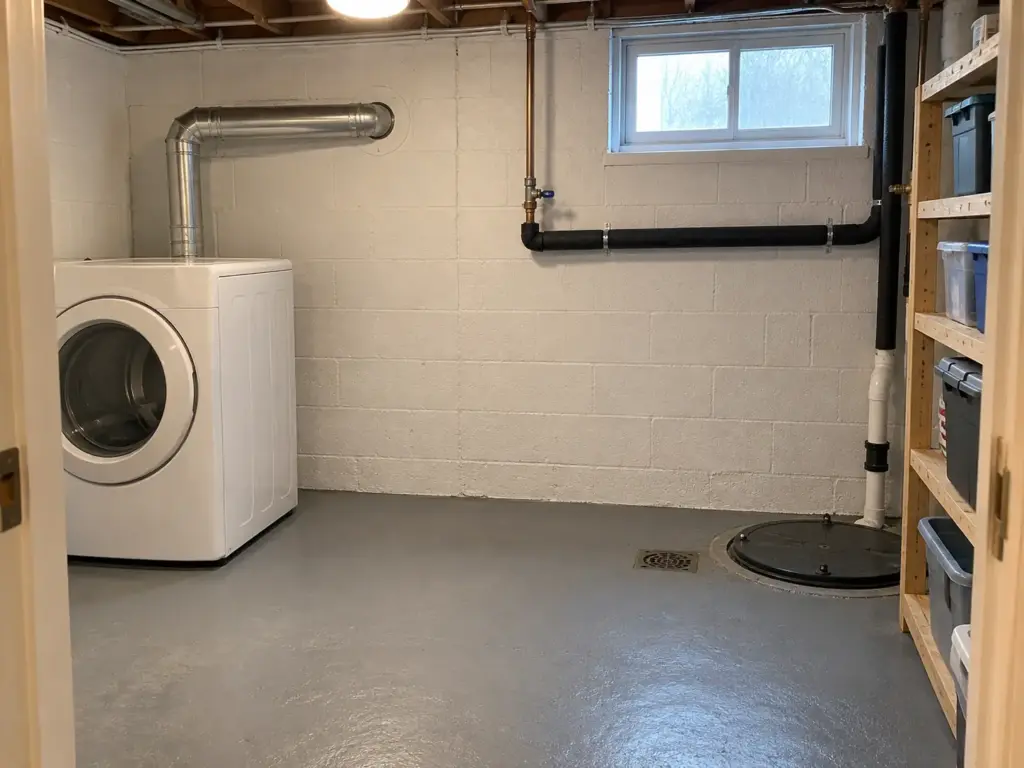
A clothes dryer pushes a load’s worth of water vapor into the air, and EPA names it, along with the bath fan, as a source to vent outside. The check is whether the dryer vent actually reaches the outside through a rigid run rather than a loose hose draped toward a window well.
Run the bath fan above the basement through the shower, and the vapor never travels down the stairs. Read the room after laundry day against the day before.
The Floor Drain and the Sump Pit
An open sump pit is a small standing pond with a lid you are not using. A covered pit gives off less water to the room, and a sump cover is the free fix. The floor drain’s trap should hold water so sewer air stays out, and a drain that has stopped holding water is a plumbing call. The mechanisms of how that water arrives belong to our main guide; here the point is only that these two are moisture makers to cap.
Cold Water Pipes and the AC Drip Line
On a hot afternoon, a bare cold-water pipe sweats because it is colder than the dew point of the room, and the beads you see on it are the room’s moisture turning to liquid. The same pipe in the next room, wrapped in foam insulation, stays dry. EPA lists insulating cold surfaces as a moisture fix. Keep the air conditioner’s drain line unobstructed too, since a clogged one backs up and adds water you did not plan for.
A unit that runs all the time except winter, drained to a floor drain, uses a lot of electricity, and the cost is real. The seasonal pattern is the useful detail: some of the moisture a unit pulls in July can come from the dryer, the drain and the pipe, not only from the air.
Change one moisture maker per week and read the room before the next change. Cover the pit this week, wrap the pipes next, and the numbers tell you which one carried the weight. Do all three the same weekend and you will never know.
Rule Out the Wall Before You Blame the Air
After the first three sections, a reading that still sits high with a visible damp band at the foot of the wall is not an air problem. It is a building one, and no unit fixes a wall that keeps sending in water.
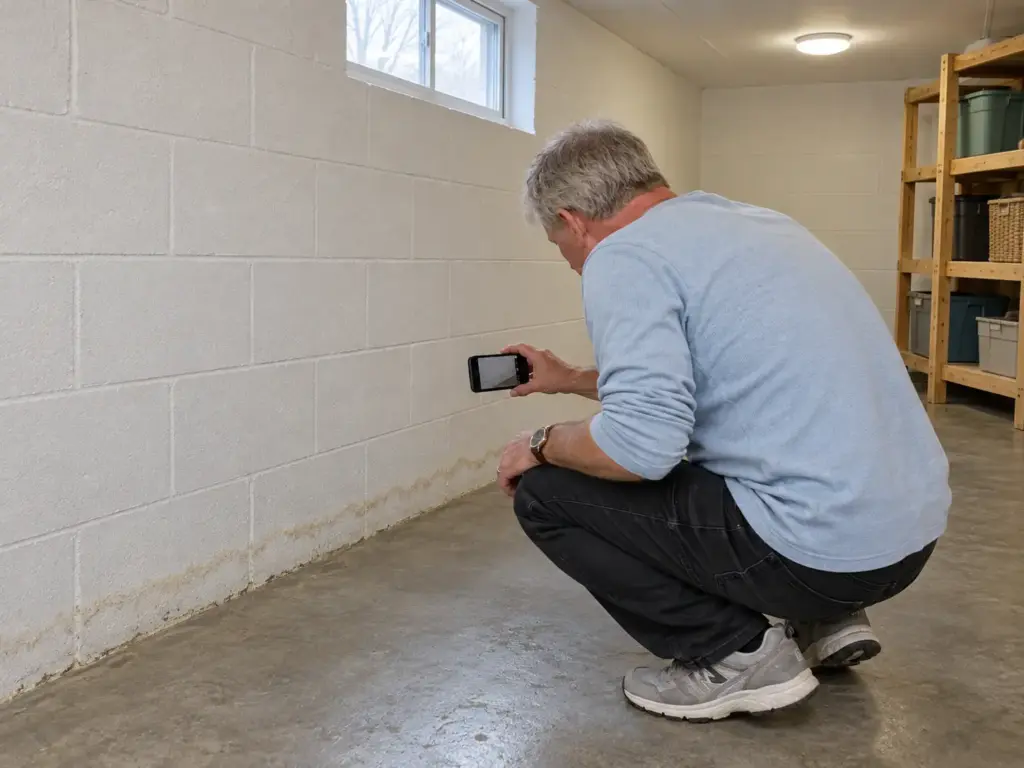
The tell is a high reading, a damp band or a pale mineral line along the lowest course of the block wall, in the same place after rain. A cold wall can also be the wet surface even when the building is dry: the number at the wall rises while the middle of the room does not, which is the gap from the first section showing up again. It is the same mechanism you may know from a window, where moisture lands on the coldest surface first, and when the cold surface is the glass explains it there.
Cracks and the wall-floor joint are the building’s job. Sealing a small one by hand is reasonable, but a leak that returns after sealing, or work like drain tile or a French drain, is for a waterproofing professional, not for a bigger machine.
A 2024 stack-exchange answer lists the water table, the grade, the gutters, sealing and a bigger unit all in one breath, as if they were one decision. They are an order, and a dehumidifier cannot out-run a source that is still active.
If the pale line is back in the same place after the next rain, the fix is on the wall. The free fixes first article covers the cheaper options for the rest of the house.
Set the Dehumidifier Last, and Drain It
Everything above reduced what is left for the unit to do, and now it works on what remains: the humidity in the air. This is also the section where the flaw gets written next to the recommendation, because no unit is perfect.
How Big, Where, and What It Stops At
ENERGY STAR’s dehumidifier guide sizes capacity in pints per day (a 24-hour rating), so dehumidifier size is chosen by the size of the space and how damp it is without dehumidification. If you are replacing a unit, it suggests judging by how much water you empty per day, and it advises erring toward the larger unit rather than the smaller.
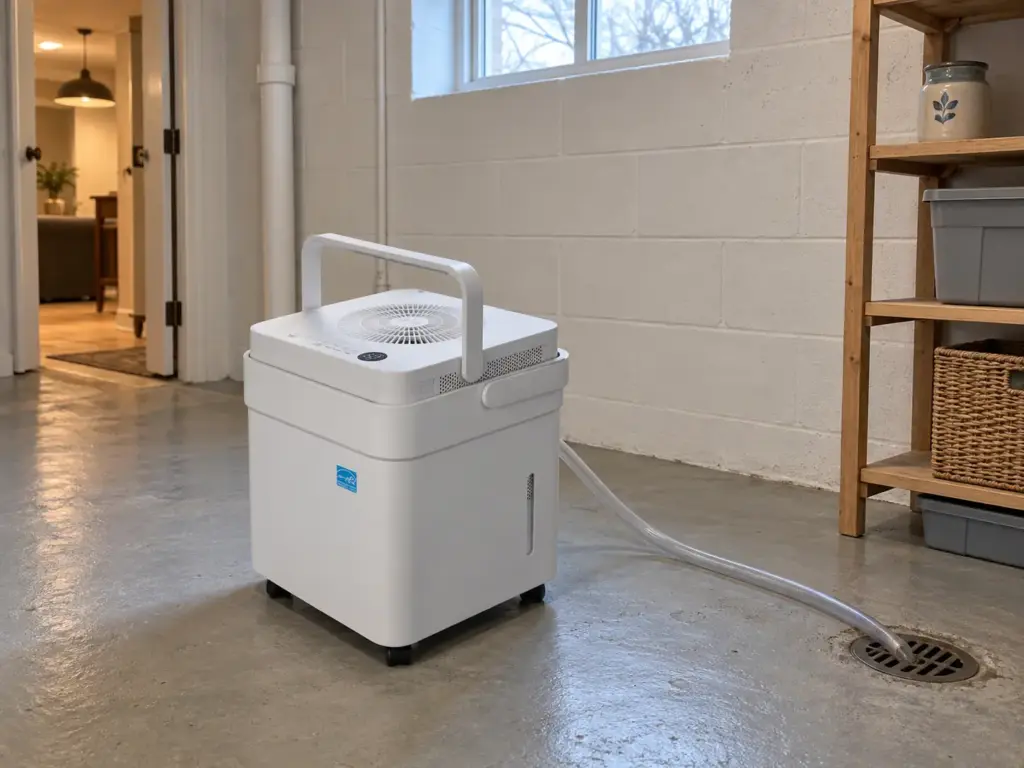
Doors and windows to the space should stay closed while the unit runs, and the unit goes away from walls and furniture so air can circulate. The air right around it warms slightly, which is expected, not a fault.
A built-in humidistat is the stop rule: set it to the number you want the room to hold, and the unit shuts off when it gets there. Without one, a hygrometer hung beside the unit tells you when to stop. Whether to open windows instead has its own answer in the dew-point check from the earlier link. For the buying checklist this section only starts, what to look for before you buy goes further.
The Drain Route Decides the Routine
A full bucket of water weighs about 40 lb, and a unit you must carry to a sink every morning becomes a chore that gets skipped. ENERGY STAR notes that some units have a fitting for a hose that runs straight from the bucket, and the question that follows is where the hose goes.
If a floor drain or sump sits lower than the unit, gravity does it. The Midea Cube 50 Pint Dehumidifier for Basement is a 50-pint (per 24 hours, the listing’s figure) unit rated for 4,500 square feet, in the version without a pump, with a 4.2-gallon bucket and an included drain hose, so water runs to the floor drain and the bucket is never lifted.
Its weak point is the humidity sensor. The gauge can stick on one reading, and some units arrive with a sensor that will not read low. A separate hygrometer is the check, and the built-in gauge is only a guide.
If the drain sits higher than the unit, or there is none at all, a pump has to lift the water. The Frigidaire 50 Pint Dehumidifier with Built-In Pump does that. A complaint roundup describes pumps that fail so owners end up emptying the bucket by hand, plus compressors that quit earlier than expected and slow service, though that write-up covers a related Frigidaire model and is not confirmed to be this exact one.
Treat the pump as the part to test in the first week, and keep the bucket route working as a fallback. For how the models line up, basement dehumidifiers compared is the next stop.
The Cold-Basement Limit
A standard unit has a floor, and a cold basement can drop below it. As ENERGY STAR puts it, “Frost can form on the condensing coils if the air temperature drops below 65 degrees,” and 65°F is about 18°C. When frost builds, the compressor keeps cycling while the bucket stays empty, and the unit has to be switched off to defrost.
Some carry an anti-frost sensor, and models specified for lower temperatures exist. One manufacturer’s sheet for the Hisense DH50KP1WG lists operation down to 38°F (about 3°C), 46 dB(A) on low, and a pump lift of 16 feet, which shows how much that spec varies from brand to brand.
Beyond the cold limit, the unit’s flaws are running hours on the bill, noise in the room, and warm exhaust. Running cost is arithmetic: nameplate watts times hours run, divided by 1,000, gives kilowatt-hours, and the rate on your bill finishes the sum.
Set the humidistat inside the 30 to 50 percent band, nearer the top than the bottom, not at the lowest number the dial allows. A unit chasing a number the room will not reach runs day and night, and the extra hours show up as kilowatt-hours, not as a drier basement.
What a Unit That Never Stops Is Telling You
A unit that runs all summer is often called undersized, but it may simply be fighting a constant moisture source. The standard does not say that. ENERGY STAR sizes by pints per 24 hours and says to err toward larger, but it never equates a long run with a bad fit. A unit that never stops is a reading to check, in order, before you call the unit wrong.
Check These Before the Unit
A unit can run nonstop and still hold the room only in the middle range, which is a sign the moisture source is strong, not that the unit is failing. On a looser setting it cycled less, and the humidity rose to 60 to 67 percent. The models are old, but the pattern holds: a long run can mean the unit is holding a hard target, not failing.
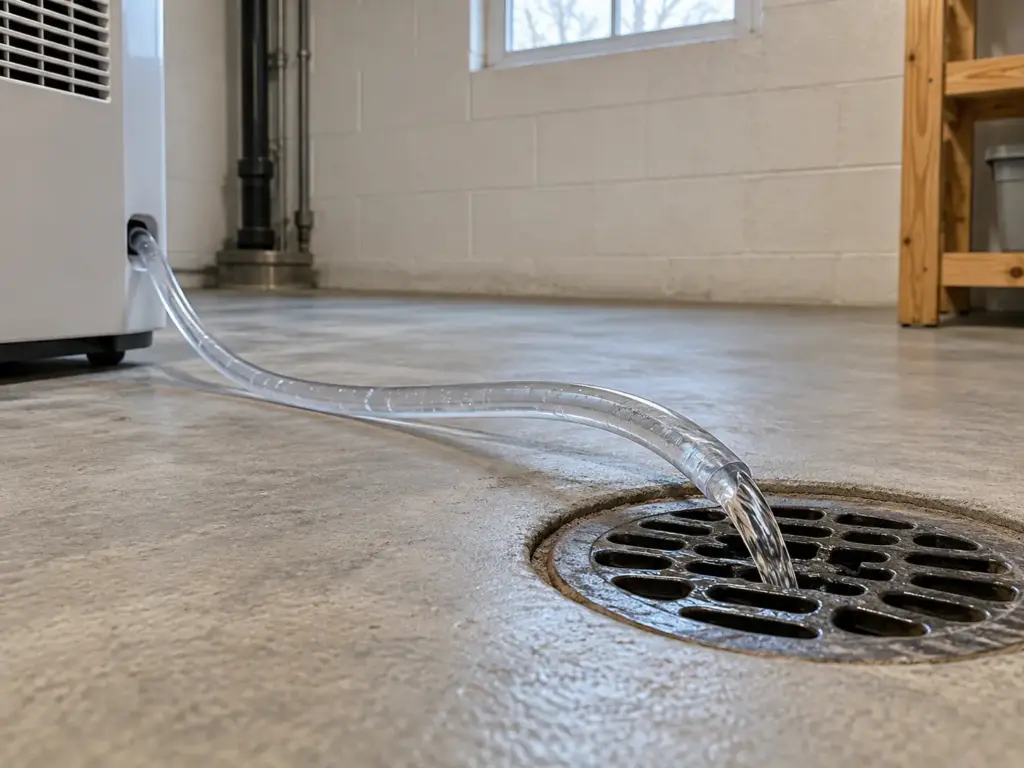
Work through the list in order. Are the stair door and any windows closed? Is the drain flowing or the hose kinked?
Is the dehumidifier setting where the reading should land? Is the unit pulled away from the cold wall? And is the reading you trust from a meter other than the unit’s own?
Most long runs end at one of these, and none costs anything. If all five pass and the unit still never stops in July, the source is probably still active: back to the wall and the outside water.
What a Long Run Costs, as Arithmetic
A unit that runs all day costs what it costs, and a dollar figure here would be out of date by next season. Read the nameplate watts, multiply by the hours it ran that day, divide by 1,000, and you have kilowatt-hours. Multiply by the rate printed on your bill and that is the daily cost.
Compare a week with the door open against a week with it closed, and the arithmetic does the arguing for you. A unit that cycles off for a few hours each afternoon costs a fraction of one that never stops.
For the season question, which season the basement is worse in takes it from here.
The Year in a Basement: What to Check Each Season
One routine only holds if it has a calendar. Set the checks by season and you are not finding out in July what you could have seen in April.
Spring and Fall: The Water From Outside
Clear the gutters and downspouts EPA names, check that the pit still has its cover, and walk the grade again, since soil can settle over a winter and change the slope. Take a wall reading after the first heavy rain of the season.
Summer: The Unit and the Reading
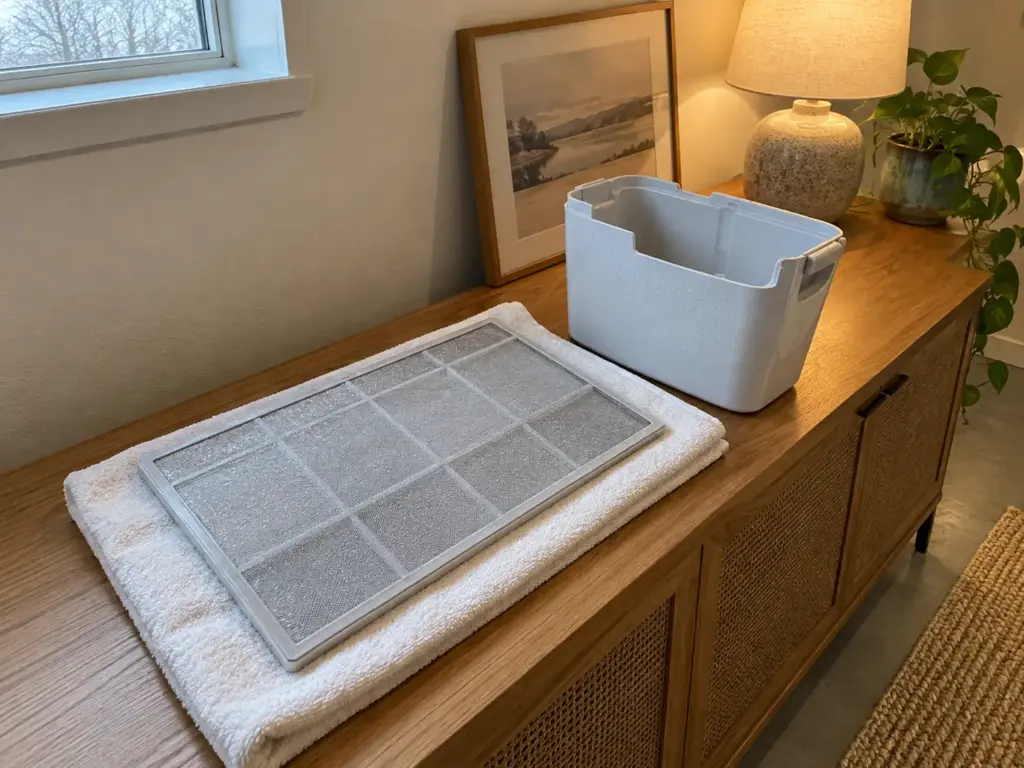
The bucket or drain, the filter and the coil: clean them as the manual says, since the manual is the authority on the unit. The filter and the drain line only show their true state around the third week of summer, once the unit has been running full-time. Read the wall and the middle of the room side by side. If the gap has widened since spring, the wall is changing.
Winter: The Cold Limit and the Lower Number
A standard unit stops drying below the 65°F line ENERGY STAR gives, so a cold basement that dips below it needs a lower-temperature model or a rest from dehumidifying. The target also drops in the cold months; the EPA band for the rest of the house sets the baseline, and the winter sibling lowers it. Once your basement holds a dry reading, the next question is how its air reaches the rooms above, which is what reaches the floors above answers.
Walk the Outside After the Next Rain, Then Read the Wall Twice
Three things carry over from all of this. Read the room first, at the wall and in the middle, because every other step is measured against that number. Fix the water in the order it arrives (outside, inside, the wall) and read the room again between changes so you know which fix did the work. Then add the dehumidifier last, drained by a hose or a pump, and treat its long runs as a clue to check before calling it undersized.
A month from now, take the wall reading and the middle-of-the-room reading again, side by side, and compare them with today’s. If the wall has closed the gap, the outside work held. If the unit’s hours have dropped, the inside work did too.
Tomorrow, the one change is free: walk the outside of the house after the next rain and note where each downspout ends. Then read the foot of the cold wall a few days later, and write the number down next to today’s.
Frequently Asked Questions
01How do I make my basement less humid?
Cut the water that comes from outside first, then the moisture the basement makes itself, then rule out the wall, and run a dehumidifier last. Read the room between each change so you know which one worked.
02Is 70% humidity too high for a basement?
Yes, 70 percent is ten points over the EPA’s 60 percent ceiling, and the target is 30 to 50. Take a reading at the foot of the wall and in the middle of the room, then start with the outside water.
03Is 80% humidity in a basement normal?
It is common in a damp basement, but 80 percent sits twenty points over the ceiling, which points to a source still active, not a number to live with. Check the outside water and the wall first.
04Is 63% humidity in a basement a good level?
Not yet, since 63 percent is three points over the 60 percent ceiling and the aim is 30 to 50. The winter number is lower still, and the winter basement target sets it out.
05Should I open the basement windows to lower humidity?
Not as a rule, because ENERGY STAR says to keep doors and windows closed while a unit runs. Opening them helps only when the outdoor air is drier; the dew-point check covers how to tell.