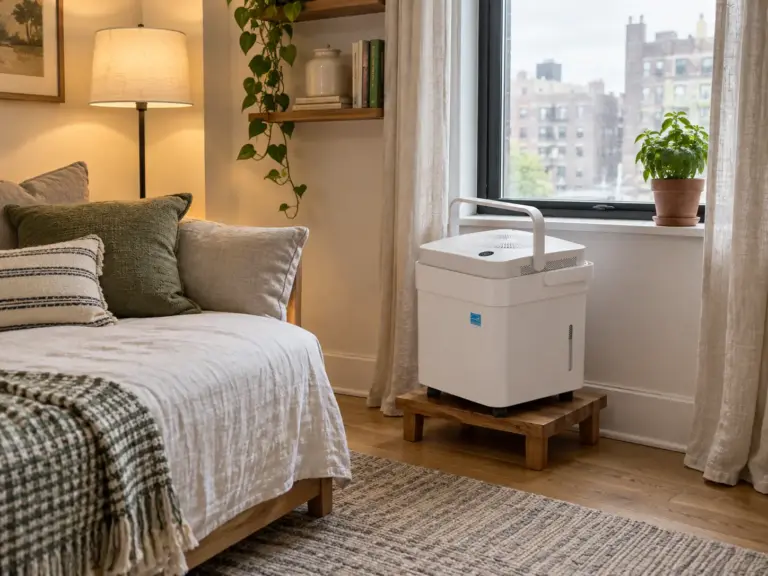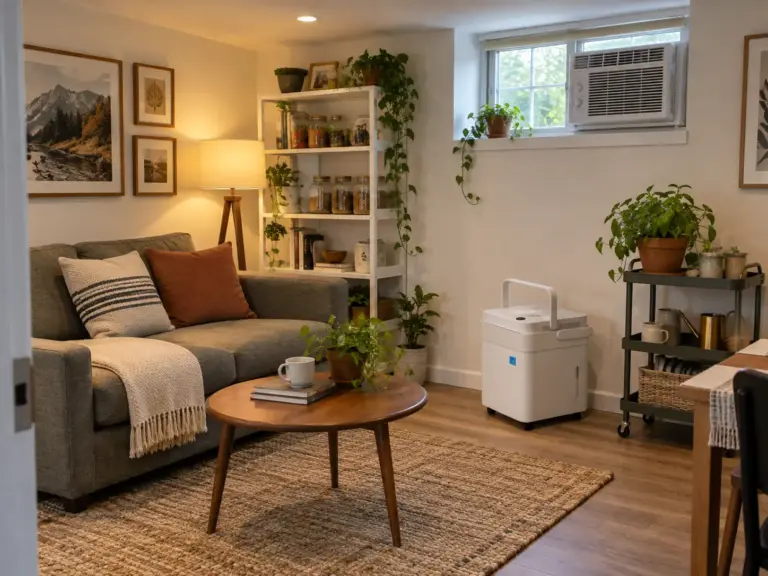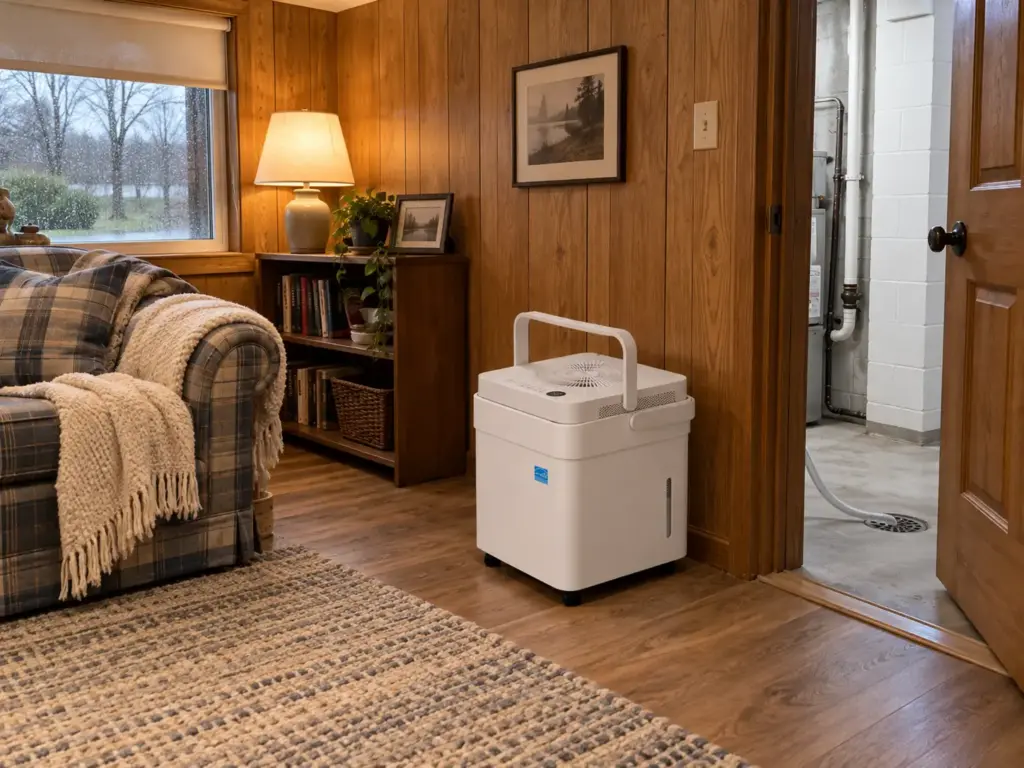
The question “which dehumidifier is best for a basement” gets the same answer on nearly every box: 50 pints a day. That figure is a rating at one temperature and one humidity (one maker’s own page prints it as 65°F and 60% relative humidity for 24 hours), and a basement in March can sit well under the first. Below 65°F (18°C), frost can form on a compressor unit’s condensing coils, and the compressor then cycles without removing water, so the machine that dried the room in July can run all week in a cold corner and leave the reading exactly where it started. Two things in your house settle the pick before any brand does, the drain and the coldest reading, so this guide takes the drain first, then the daily chores, then the temperature, then what the record looks like by month three, and it hands the size question to the article that owns it.
A persistently damp basement wants a 50-pint compressor unit that drains by gravity hose, and the model matters less than three facts about the room: where the water can go, how cold the basement gets, and whether the unit’s own sheet prints a lowest working temperature. The table starts each case with a pick.
| Where to start | Your basement | What decides it |
|---|---|---|
| Midea Cube 50 | A floor drain, or a hose that can run downhill to one | Gravity does the draining, so there is no pump to wear out |
| Honeywell TPFIT50PWK or GoveeLife | A utility sink, a window or a condensate line above the unit | A built-in pump lifts the water, up to the lift stated on each page |
| The unit’s own spec sheet | A basement that runs under 65°F (18°C) | A printed lowest working temperature; most listings print none |
| Midea Cube 20 | One finished room or a storage room, not the whole floor | Sized for one room: small tank, small coil |
What a Damp Basement Asks of a Dehumidifier
Before any model gets a name, a damp, musty basement has to settle two things: the number the air should reach and the reason the water is there at all. This section sets the target and the class, so the picks that follow have something to be measured against, and it closes on the case where no machine is the answer. If the basics of choosing a unit are still new, what to look for in a dehumidifier before you buy covers the room-by-room version; this guide is the basement case.
The number to reach
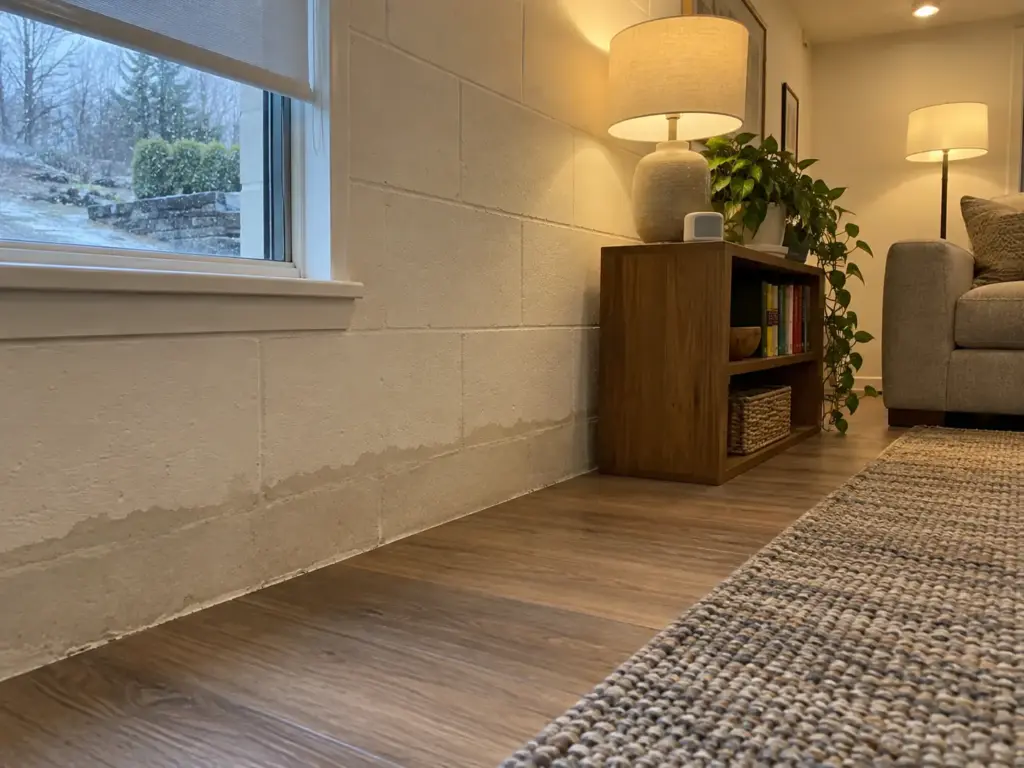
You open the basement door after a night of rain and the smell reaches the kitchen before your foot reaches the second step. That points one way: the air down there is too damp, and the number that confirms it comes from a meter, not from a nose. The ceiling and the band come from the EPA’s brief guide to mold and moisture, which says to “keep indoor humidity below 60 percent (ideally between 30 and 50 percent) relative humidity.”
A basement with a below-ground floor can feel humid and smell musty no matter what is done, even with no leaks or standing water. A cheap hygrometer can read well above the 45 to 50 percent goal. Once a unit is running, the useful record is a starting reading, a target, and a second reading a few weeks later.
The meter matters more than it sounds. A cheap hygrometer can be off by a few points, so a reading of 65 is a direction more than a decimal, and a sensor screwed flat to a cold wall reports the wall’s chilly surface instead of the room’s air. A basement humidity sensor that reads cold concrete honestly is the longer version of that choice, and the before-and-after pair of readings is the only proof a unit is working.
Leave a hygrometer on a shelf at chest height, away from the wall and off the floor, for several days before you shop, and write down a morning and an evening reading. A steady 52 and a steady 72 are two different shopping lists, and a reading that jumps after rain points at water getting in, which no unit will stop on its own.
Why 50 pints is the class for a persistently damp basement
The pints-per-day rating is the water a unit removes in 24 hours under a stated condition, and the condition is the part that falls off the box. One maker prints its 50 pints at 65°F and 60% humidity, which is a mild day, and a basement in early spring runs colder than that. A rating is a promise made in a test room, kept only as long as the basement looks like the test room.
Within that caveat, the 50-pint class is the one that suits a basement that stays damp. It has the coil and the fan to keep up with a wall that gives moisture back every day. The 35-pint and 20-pint sizes are for finished rooms and storage areas, where less water is moving, and the square-foot ranges for each size belong to the sizing article linked further down.
A unit that is too small for the room barely dents the humidity and runs for hours without catching up, so the power is wasted and the basement still smells musty. For a very damp basement, the bigger size is the safer pick, especially in humid climates. Two voices, one direction.
A unit that runs all day while the reading stays put is telling you something about the room, not about the machine. If the walls and the floor hand back as much water as the coil takes out, the reading flattens at whatever level the unit can hold, and a bigger tank or a better brand does not change that balance. Cool air makes the balance worse, because cool air holds less water to begin with and the same coil pulls fewer pints out of it.
When the machine is not the problem
A dehumidifier takes water out of the air. It does nothing about the water that keeps coming in, and a basement that is taking on water will fill every bucket the unit can produce while the reading never moves. Before any purchase, find out which kind of damp the room has: where the water in a basement comes from sorts the three sources, liquid water, vapor moving through the walls and floor, and warm air from outside, and the checks are cheap.
The outside checks come first, and they cost nothing. The usual outside fixes are gutters and downspouts that empty far from the foundation, soil that slopes away from the house, and a French drain where the ground collects water. These outside fixes are common advice rather than tested results, but they all point the same way, away from the wall. A dehumidifier bought while water keeps coming in only treats the symptom, again and again. Fix the source first.
Warm air is the quieter source, and it works in summer. Air at 75°F (24°C) and 70% humidity, drifting in through a gap at the rim joist and cooling to the basement’s 65°F (18°C), ends up close to 100% humidity, because it has reached its dew point, which is the damp feel and the sweating cold surfaces without a single drop coming through the wall. Warm, humid outside air that enters and cools to basement temperature sees its relative humidity climb. Here a dehumidifier does help, but sealing the gap is cheaper than running a unit against it for a whole season.
There is a simple way to tell the wall from the air. Tape a square of aluminum foil flat against a damp-looking wall, sealing all four edges, and leave it for a day or two. Droplets on the room side of the foil point at the air; dampness underneath, against the wall, means moisture is moving through the masonry. The second result is a building question, and no pint rating answers it.
Some of this is a job for a professional rather than a plug-in: standing water after rain, a wall that stays wet for days, or mold growing on drywall that has been soaked. At that point the machine is a bandage and the building is the repair. And a reading that settles inside the 30 to 50 percent band after the outside work means nothing needs buying.
The Drain Decides the Pick Before the Brand Does
Once the class is settled, the question is where the water goes. A bucket that somebody has to carry up the stairs every morning is how a good unit ends up unplugged, and the drain a house really has is rarely the floor drain that product photos assume. Match the unit to the drain and most of the shopping is already done.
A floor drain or a downhill hose: the simple case
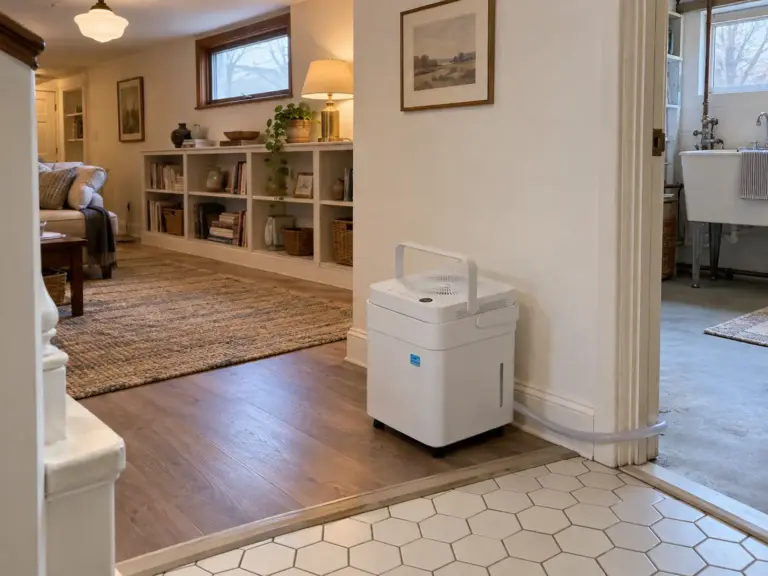
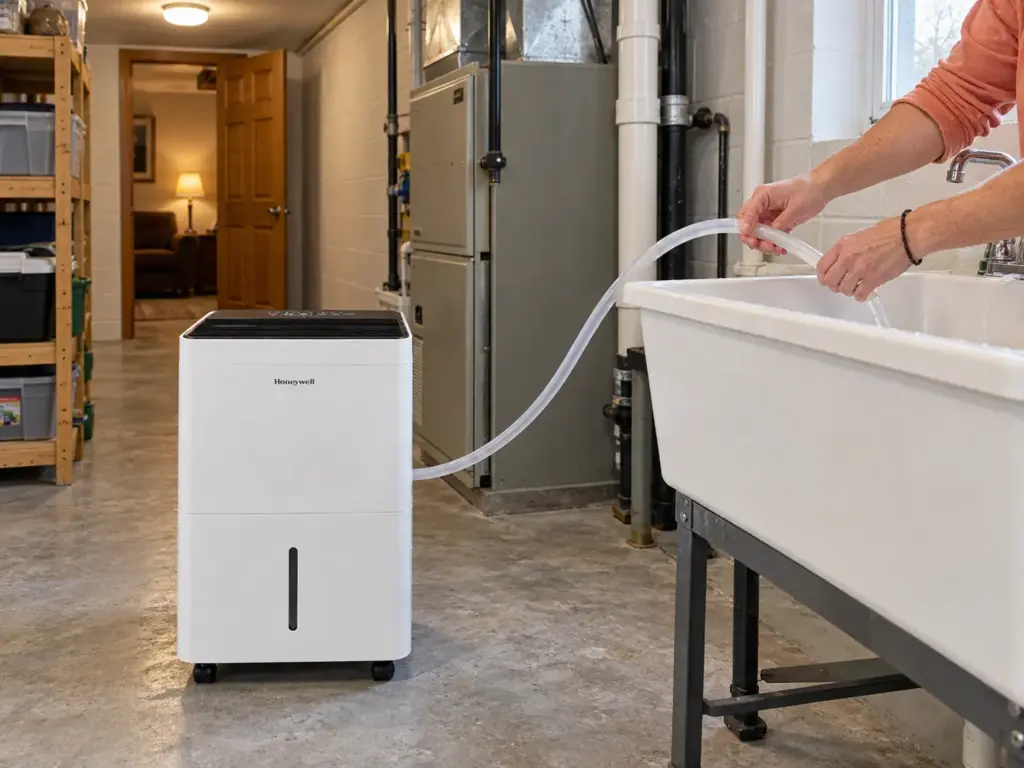
If the basement has a floor drain, or a utility sink that a hose can reach while sloping downhill the whole way, a plain gravity drain hose does the work and there is nothing in the path to wear out. ENERGY STAR describes the fitting: some units let you attach a hose directly to the bucket and direct it into a floor drain or a sump pump, so there is nothing to empty. Pumps that are already in the basement are worth a look before buying new hardware. Before routing a dehumidifier hose into one, confirm the existing pump can handle the extra water.
Gravity fails quietly in only one way, and it is not the way people expect. A sag in the hose is harmless as long as the far end sits lower than the unit’s drain outlet. A hump is the problem: any stretch that climbs above the outlet, even a loop thrown over a pipe or a joist, stops the water until it fills the rise, and the tank then fills as if no hose were attached. The same goes for a drain that sits only a few inches above the outlet.
Let the hose finish well away from the house, so the water does not creep back through the soil around the foundation.
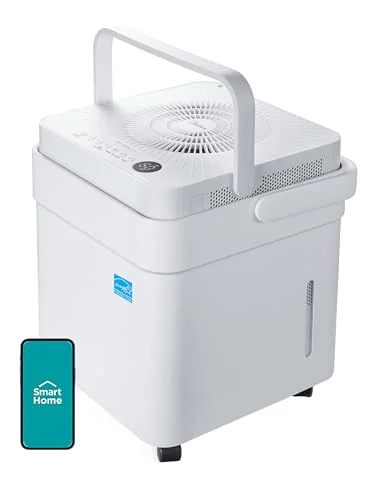
The Midea Cube 50 is this case in a single unit: a 50-pint rating, a tank of about 4.2 gallons (15.9 liters), a drain hose in the box and a Wi-Fi app. Its Amazon page carries a summary of owner reviews that credits it with removing moisture and with a large tank that can run up to a week without emptying. The same summary reports a humidity sensor with “inaccurate readings,” quality control that owners rate anywhere from superb to bad, and noise that some find too loud. The sensor line is the one to take seriously, because a unit that trusts a wrong reading shuts off early or runs on, and the shelf meter from the last section is the check on it.
A utility sink or a drain above the unit: the pump case
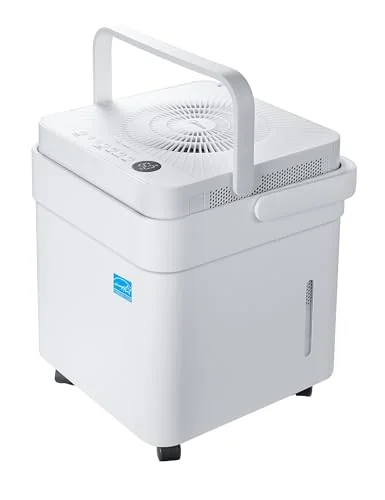
The ordinary basement is often not the one in the photos: a utility sink by the furnace, no floor drain, or a finished lower level in a rental. When the nearest drain sits above the unit, a hose cannot do the job, and the choice becomes a built-in pump or a bucket. Where to drain a basement dehumidifier goes through the routes in detail; the units that fit them follow here.
How high a pump can lift is a stated figure, not a measured one. The Midea pump version’s sheet says 16.4 feet vertically, the Honeywell’s page says water drains up to 15 feet, and the GoveeLife page lists a 16-foot hose. A hose length is not a lift, so for a sink that sits a few feet above the floor all three have room to spare, and for a window across the basement the number to check is the vertical rise plus the length of the run. Measure the climb before you read the spec.
A utility sink within reach is the simplest drain, because nobody has to remember to empty a bucket by hand. A unit with an automatic drain pump routed to a sink needs little more than a look at the air filter screen every few weeks. Two working setups, both described within the first year.
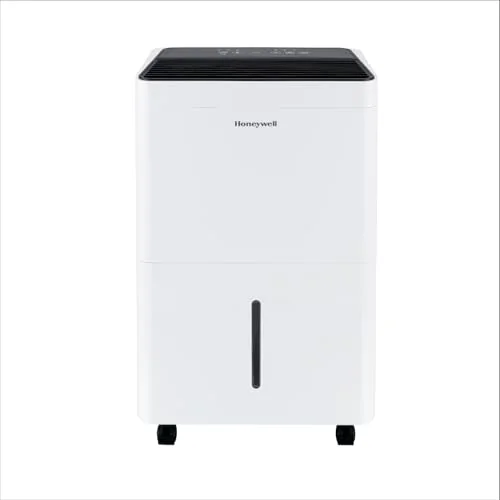
The Honeywell TPFIT50PWK is the pump unit with a stated 15-foot lift and the weakest record of the group. Its page sits at 2.5 stars on 115 ratings, and Amazon’s summary of owner reviews reports malfunctions after about six months, repeated E3 error codes, and customers who describe a unit that breaks within months.
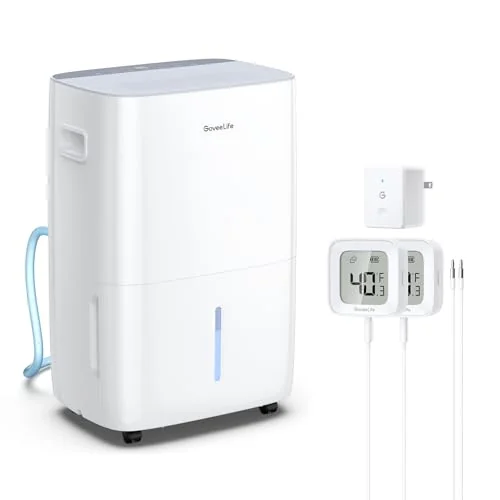
The GoveeLife is the second pump option, with a 16-foot hose and a 1.8-gallon tank. Its page prints the 50-pint rating at 65°F and 60% humidity for 24 hours, which makes it one of the few that tells you the condition behind the number. Its page carries no summary of owner reviews, so there is no repeated complaint to report; that is a gap in the record, not a clean bill. The square-foot coverage in its title is the maker’s own line, and sizing is left to the article that owns it.
The pump is the part that fails
A pump is worth it when the layout makes draining a nuisance, but a gravity hose is simpler, because pumps can fail. Nothing in a pump is exotic, a small motor pushing water through narrow passages inside a damp cabinet, and anything that moves water that way is exposed to grit and scale.
The pump looks like the obvious upgrade, and where the drain sits above the unit it is the only automatic option. But where a hose can run downhill, the better call is gravity, because the pump adds a part that can fail and a lift limit to a job gravity does for nothing. If the pump is the only way out, treat it as a part with a lifespan, and keep a removable tank in the plan, since a tank that lifts out can still be emptied by hand on the day the pump quits. Dehumidifiers with a pump and a drain hose settles pump versus hose in its own article; this guide only matches units to drains.
A pump failure also hides. When a pump quits, the tank fills and the unit stops at full, and from the stairs a lit display looks like a working machine while the room drifts back up the humidity scale for days. That is the argument for a shelf meter that does not depend on the unit’s own electronics, and for reading it on a schedule, not only when the smell returns.
Once the hose is attached, run water through it or start the unit, and walk the line from the machine to the drain with your hand. Every stretch that climbs above the unit’s outlet stops the flow, even briefly, and a sag in between does no harm. Fix the hump with a clip or a short length of board, and the tank stops filling as if no hose were there.
Tank, Weight and Noise: What You Live With Every Day
The daily chores are the part of a dehumidifier that week-one reviews measure and a household meets for years. This section is about what happens on the stairs with a full bucket, and at the foot of the bed when the compressor kicks in.
How often the bucket fills
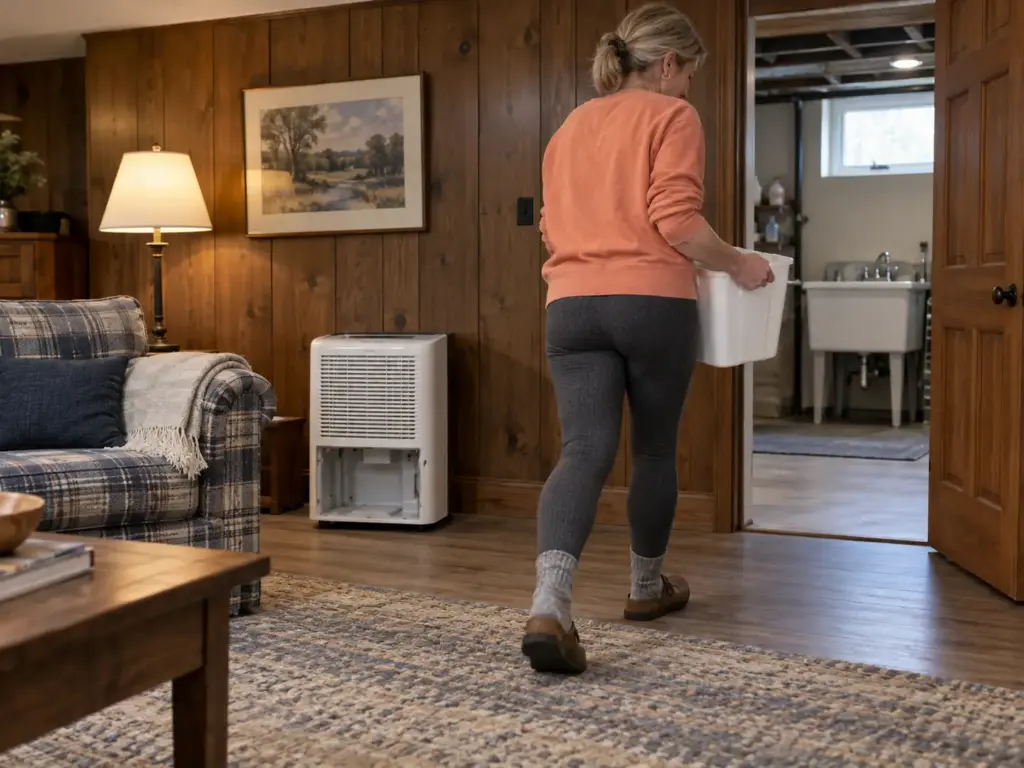
Tanks in this guide run from under a gallon to about four. The AEOCKY holds 0.8 gallons, the GoveeLife 1.8, the Honeywell 7.1 liters (about 1.9 gallons), the Frigidaire 2.7, the Midea Cube 20 about 3.2 and the Midea Cube 50 about 4.2. Water weighs roughly 8.3 pounds a gallon, so a full Cube 50 tank is about 35 pounds of water before the bucket itself, and the AEOCKY’s is under 7.
The arithmetic of a full day explains why a small tank turns into a chore. At its full rating a 50-pint unit pulls 6.25 gallons a day (50 pints at 8 pints to the gallon), so even the largest tank here fills in roughly 16 hours of full-rate work. Few basements ask for the full rating all day, but Amazon’s summary for the AEOCKY says owners see about 3.2 gallons pulled per day and a tank that fills at least three times, which is the same sum from the other side.
Most portable units shut themselves off when the bucket is full, and ENERGY STAR notes the automatic shutoff as a feature, since it protects the floor. It also stops the drying. A full bucket that goes unemptied lets the humidity creep right back up, and the bucket fills faster than most people expect. The reading drifts for a day or two before anyone notices, and the unit looks innocent the whole time.
The tempting answer to a full bucket is a bigger bucket. But a 4-gallon tank only moves the chore from twice a day to once, and 35 pounds of water on a staircase is its own chore. A hose to a drain removes the job; a bucket only rearranges it. How often a tank fills follows from how long the unit runs, and how long to run a basement dehumidifier works through that schedule.
If the bucket is the plan, choose the spot by the walk to the sink, not by the nearest outlet. Count steps rather than feet: a full tank carried up even one stair is the chore that gets skipped, and a skipped bucket means the unit has stopped drying.
The noise from the next room
Noise figures on a box are decibels the maker measured in the maker’s room. The sheet for the Midea pump version lists three sound ratings, 49.5, 48.0 and 54.5 dBA, and the AEOCKY page claims about 40 dB at its highest setting. As a rule of thumb, every 10 dB step sounds about twice as loud, so if those two had been measured the same way (they were probably not), a gap of 8 to 14 dB would mean somewhere between a bit under twice and nearly three times the loudness.
Owners disagree, and the disagreement is informative. Amazon’s summary for the Midea Cube 50 says some find it relatively quiet and others find it too loud, while the summaries for the Frigidaire and the AEOCKY both praise quiet operation. Noise varies from room to room, so it is worth testing in the space where the unit will sit.
A basement is the worst acoustic setting for this job. A concrete floor and block walls bounce sound back instead of absorbing it, and the floor above acts like a drum skin, so a unit sounds louder down there than the number on its sheet and the hum can carry straight up into a bedroom overhead. That is a property of the room, not of a brand. The free fix comes before any shopping for a “quiet” model: stand the unit away from the wall, off bare concrete, on a rubber or foam mat, which also keeps a vibrating cabinet from walking across the floor.
Running cost belongs here too, since it is the other thing you live with. The sheet for the Midea pump version rates the input at 480 W, which is 0.48 kWh for each hour the compressor runs, or 4.8 kWh over ten hours of running. Multiply by the rate on your bill. Actual draw moves with the compressor cycling, so a plug-in watt meter on the outlet gives the true figure for your unit.
Below the Frost Line: What a Cold Basement Does to a Compressor Unit
Every choice so far assumes the unit is drying the air, and below a certain temperature a compressor unit may not be. This section judges each pick against the coldest reading the basement shows. Here the honest answer is sometimes that a sheet says nothing at all.
What ENERGY STAR says happens at 65°F
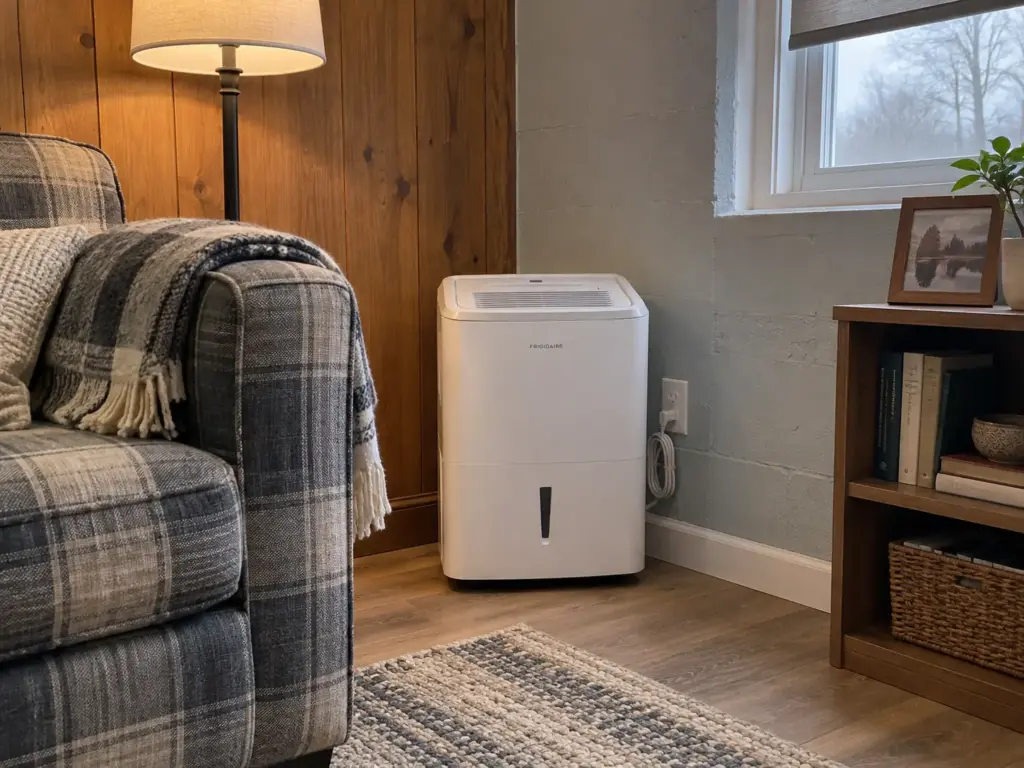
A compressor dehumidifier works by pulling room air across a cold coil, so water condenses on the coil and drips into the tank. The coil is always colder than the air passing over it. Cool the air enough and the coil drops below freezing, and the water freezes on it instead of draining. ENERGY STAR’s dehumidifier guidance puts the line at 65°F (18°C): “Frost can form on the condensing coils if the air temperature drops below 65 degrees,” and the compressor may then cycle on and off without removing moisture from the air.
Some units carry an anti-frost sensor that switches them off when the air gets cold enough. Without one, the guidance says that when frost builds up the unit should be switched off and left to defrost before it runs again. Either way the room is not being dried while that happens. For a basement that typically falls under 65°F, the advice is to look for a product specified for lower temperatures.
Picture the cold concrete corner in March. The unit is running and the fan is moving air, the bucket stays almost empty, and the shelf meter reads what it read yesterday. Nothing is broken.
The coil is iced, with frost on the coils, or the cycle is defrosting, and the box rating that promised 50 pints was set at a warmer temperature. A bucket that stays nearly empty while the unit runs is the sign.
That makes the pints on the box a number that depends. It holds at 65°F and 60% humidity, the condition one maker prints on its page, and the same unit in a 55°F (13°C) room is a different machine. The figure that matters for a pick is not the pints on the box but the pints at the temperature your basement actually has, and most pages never print that second number.
A cold basement suggests buying a unit rated for low temperatures. Before that, read the room: the lowest reading and how long it lasts decide whether the problem is a few weeks a year or half of them.
Where you take that reading matters. Cold air pools at the floor, and the slab and the outside walls are the coldest surfaces in the room, so a meter at chest height in the middle of the space can read several degrees warmer than the corner where the unit’s intake will sit. Put the meter where the unit would stand, leave it for the week, and note the lowest number. A unit lifted onto a low stand pulls its air from a layer that is less cold than the slab, which costs nothing to try, though it is a mitigation and not a rating.
The one minimum printed in the sources we could read
Of the pages and sheets read for this guide, one prints a lowest working temperature. The Midea Canada sheet for the pump version of the Cube 50 lists an ambient temperature of 5 to 32 with the unit cell left blank; the sheet is metric, so the numbers read as °C, which is 41 to 90°F, alongside a humidity range of 35 to 85 percent. Set against ENERGY STAR’s line, the printed floor sits 24°F under the 65°F at which frost can start.
The two statements do not contradict each other. One describes the physics for a unit with no protection, the other is a maker saying where its unit is meant to run, and a printed floor says nothing about how many pints the unit removes at that floor.
One caution on the listing in this guide: the Cube 50 here is the no-pump version, so the 41°F belongs to its pump version. The sheet that ships with the unit you buy is the one that settles it.
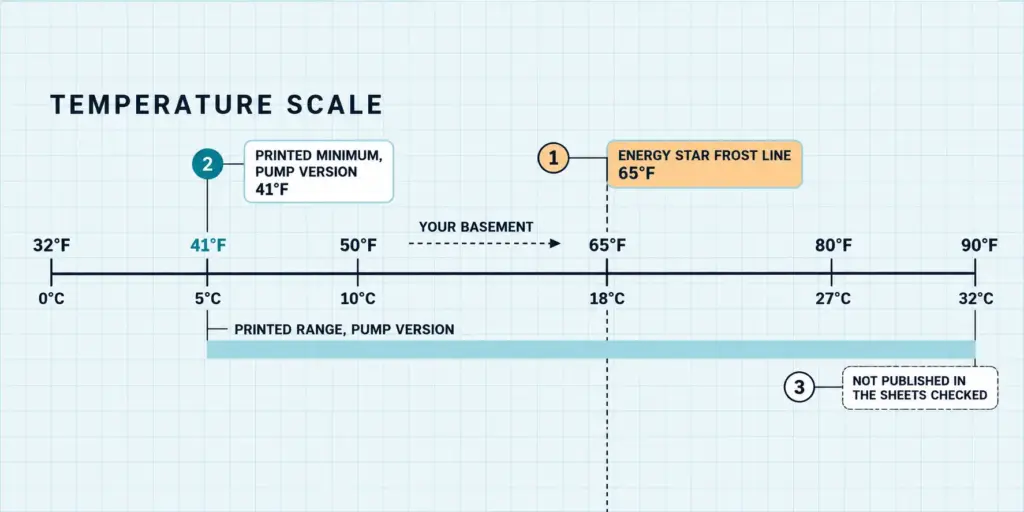
Use the scale with a number of your own: the lowest reading the shelf meter shows in your coldest week, not the average. A meter that stores its minimum is enough. If that lowest reading stays above 65°F, none of this applies and the drain decides.
Between 41°F and 65°F, the printed floor is a reason to ask what the unit does in between, since a floor is a permission to run, not a promise to dry. Under 41°F, even the one printed floor has run out.
Where the others leave the line blank
Everywhere else the line is blank. The Honeywell page lists “Low Temp Operation” among its features and prints no temperature next to it (it also lists automatic defrost). The other listings read for this guide print no minimum either.
The AEOCKY page gives two capacity figures from its maker: 50 pints a day in a hot garage at 95°F (35°C) and 95% humidity, and 38 in a damp basement at 86°F (30°C) and 80%. Both conditions sit well above what a cold basement shows, and neither was measured for this guide. A feature name is not a number, and a test condition is not a limit.
Where a sheet is silent, the useful move is a question to the maker before the purchase, and these are the three to ask:
- What is the lowest air temperature the unit is rated to run at?
- Does it have an anti-frost sensor or a defrost cycle, and what does it do when it triggers?
- At what temperature and humidity is the pint rating measured?
If no answer comes back, pick the unit that prints one.
The moves come in an order, and each one gets a reading before the next. First, read the coldest number. Second, find the printed floor or the maker’s answer. Third, if the basement does sit under 65°F for weeks, look at the bucket after a cold week: a bucket that fills as usual says the unit is coping, and one that stays empty says it is not.
Only then does it make sense to look at a different family of machine. A desiccant unit does not rely on a cold coil, which is why it turns up as the answer for cold spaces; the trade-off is a smaller rating and generally more electricity per pint. A thermo-electric (Peltier) dehumidifier also skips the compressor, but it moves very little water. Both sit outside the six picks here.
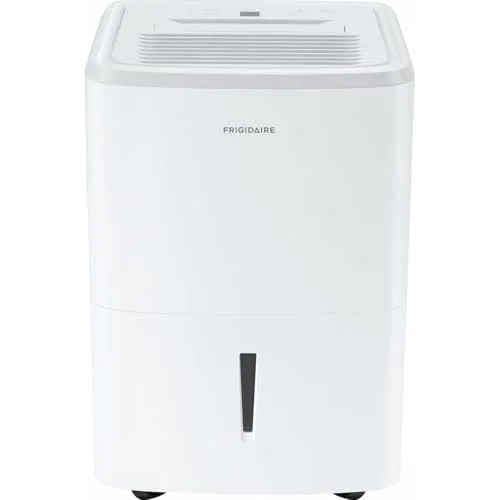
The Frigidaire 50-pint is a plain hose-drain unit with a 2.7-gallon tank and Wi-Fi, no pump, and no printed minimum operating temperature. Amazon’s summary of owner reviews reports failure after two months for some, connection problems with the Wi-Fi, and a build that some call flimsy. In a basement that may fall under 65°F, it is the pick that needs the question above answered first.
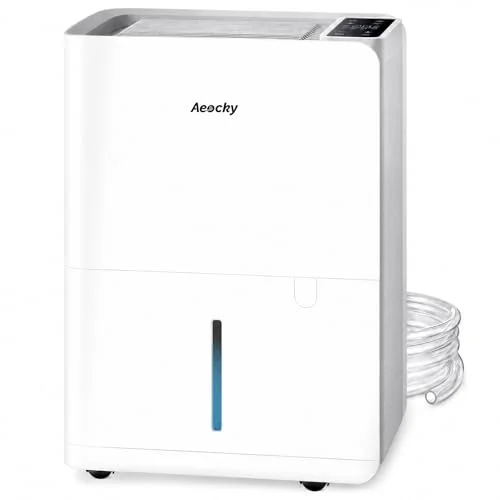
The AEOCKY 50-pint is the compact one, and it only makes sense with the hose attached. Its tank holds 0.8 gallons, and Amazon’s summary says owners see the tank fill at least three times a day, so without a continuous drain it becomes the bucket chore from the last section. No minimum temperature is printed, and the maker’s capacity figures above are the maker’s own.
A last caveat applies to every card in this section. A basement that sits under 65°F for half the year may not need a compressor unit running in January at all, and whether to run a dehumidifier in winter takes that question on. The target moves with the season too, since cold concrete and winter air change what the room should read, and what basement humidity should be in winter gives the number to read against.
What Goes Wrong by Month Three
The cold line decides whether a unit dries at all. Month three decides whether it still does, and the record there is a short list of the same few complaints, repeated by people who have already lived with the machine.
Pumps and humidistats
Two parts account for most of the trouble: the pump and the humidistat, the sensor that tells the unit when to run. The pump story is already on the table. Pumps can fail, and when one does the water has nowhere to go. Some models flag a pump fault with an error code. A Wi-Fi app that drops its connection, as the Frigidaire’s owners report, is an annoyance; a pump that quits or a sensor that misreads changes what the room does.
A humidistat malfunction is the quieter fault. Amazon’s summary for the Midea Cube 50 singles out the sensor, with owners reporting inaccurate readings. A sensor inside the unit reads the air at the unit’s own intake, which sits low in the room where the air is often cooler and damper than at shelf height, so even a good one reads differently from a meter across the room.
The unit is guessing, and the shelf meter is the check. If the unit’s reading is high, it runs on after the room is dry; if it is low, it shuts off while the room is still damp.
On the first day, put the unit’s display next to the shelf meter and compare them. A gap of several points that stays the same is an offset you can set around. A gap that keeps changing is a reason to trust the shelf meter and ignore the display. Then set the target by the shelf meter, and what humidity to set the dehumidifier to covers the number itself.
How long a portable lasts
Lifespan is the hardest part to predict, so it is worth reading the warranty along with the reviews.
Another says they have not heard of a new one “lasting over a year.” A third compresses it to a rule: “Portables are disposable. Run them for two years and replace when they die.”
Reliability is mixed. Review summaries for the Frigidaire are split, and some of the smaller units draw complaints about failing early. Amazon’s summaries pull in opposite directions on single pages: owners of the Frigidaire are split on reliability, with failure after two months reported next to units that run for hours without trouble, and the smaller Midea has multiple reports of units dying after a few hours of use.
Read together, the evidence supports a plan, not a panic. Treat a portable as a consumable with a horizon of two to three years, and buy accordingly: a drain path that needs no pump, a filter you can reach, and no feature worth paying extra for that you would lose with the machine. Write the purchase date on the back of the unit with a marker, so the first hot, damp summer after the third year is not a surprise.
The filter you can rinse in a minute
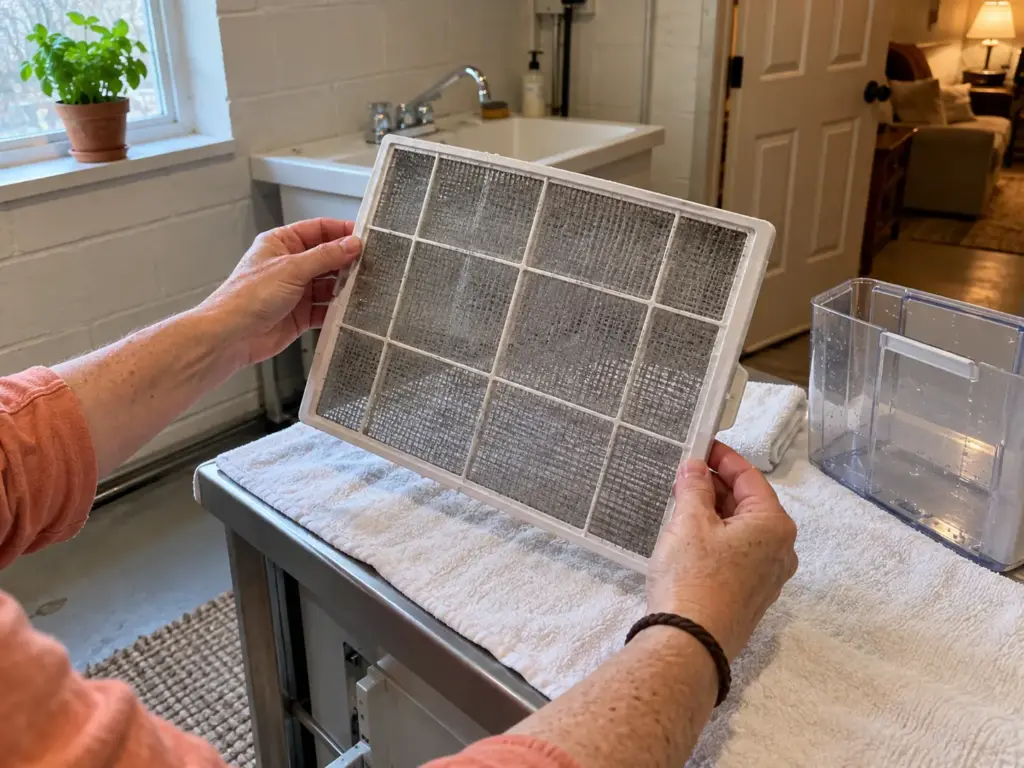
At month three, the one part a reader can fix in a minute is the air filter screen. Some models, the Honeywell among them, list a washable dust filter among their features. Slide it out, rinse it, let it dry fully, put it back. A screen furred with dust starves the coil of air, which makes the unit run longer for fewer pints, and it is the cheapest repair in this guide.
The second month-three failure is not mechanical. The unit that was left full and off for the winter is the one that smells in spring: a tank holding standing water and a damp coil make a stale, musty odor that the first run of the season blows into the room. Empty the tank, wipe it dry, and let the unit sit open to the air before it goes into storage.
When a unit seems to have stopped working, the checks come in an order, free and quickest first, with a look at the shelf meter between them:
- Look at the tank and the hose. A full tank or a hump in the line stops the unit and looks exactly like a breakdown.
- Look at the room’s temperature. Under 65°F (18°C), an iced coil or a defrost cycle can mimic a failure, and the unit may recover once the room warms.
- Rinse the filter screen, let it dry, and give the unit a day.
- Compare the display with the shelf meter. If the display says the room is dry and the shelf says 62, the sensor is the fault.
- Only after those four, suspect the pump or the compressor, which is where a warranty claim starts.
A unit that passes those checks and still does nothing is a warranty question, and the purchase date on its back is where that conversation starts.
Put a recurring note on your phone for the filter screen at month three, then once a month through the damp season. The first rinse shows how fast your basement loads it, and that rate, not the manual’s interval, is the schedule that fits your room.
Where the Reviews Disagree, and Where Size Takes Over
Owners agree on the class and split on the brand and on how big to go. This section names the disagreement, then hands the sizing to the article that owns it, and finishes with the case where a smaller unit is the right answer.
Brand: the split a box cannot settle
A shelf of 50-pint units reads like a family of cousins: the same rating, a similar tank, a Wi-Fi app. What differs is the failure each model collects, and the owner summaries point to a different weak spot on each page: a humidity sensor on the Midea Cube 50, a pump on the Honeywell, Wi-Fi and a flimsy feel on the Frigidaire, a tiny tank on the AEOCKY, and units that quit after a few hours on the smaller Midea. The name on the front predicts less than the line that page’s owners keep repeating.
So the page to read before buying is the owner summary, and three lines of it matter: what breaks, how soon, and whether it is the part your basement leans on. A pump complaint decides nothing for a hose-drain basement. A tank complaint decides everything for a bucket one. The brand story only matters where it predicts one of those.
That is a reason to shop the weak spot, not the logo. If the drain is a hose, the pump complaint never applies. If a shelf meter is going to be the judge, the sensor complaint costs little. If a hose is going to the drain, the small tank stops mattering.
The same flaw is a deal-breaker in one basement and a footnote in the next.
Oversizing: two opposite rules
Sizing advice runs in two opposite directions, and both are partly right. ENERGY STAR’s guidance says it is better to oversize than undersize, and it adds a check for anyone replacing a unit: judge by how much water you empty each day. For a very humid basement, the common advice is to size up.
The opposing rule is about what extra capacity buys. Once the humidity reaches the set point, any unit idles, so a bigger one gets there sooner and cycles off sooner; the extra capacity shows up as faster recovery after a wet day, not as a lower final reading. It also typically draws more power when it runs and carries a heavier tank.
Cubic footage is the better measure, since a basement with a tall ceiling holds more air than its floor plan suggests. Cubic footage makes more sense.” A basement with a tall ceiling holds more air than its floor plan suggests.
Neither rule settles the question alone, and this guide does not either. How big a dehumidifier your basement needs takes the room, the starting reading and the volume and turns them into a number of pints.
When one room is the whole job
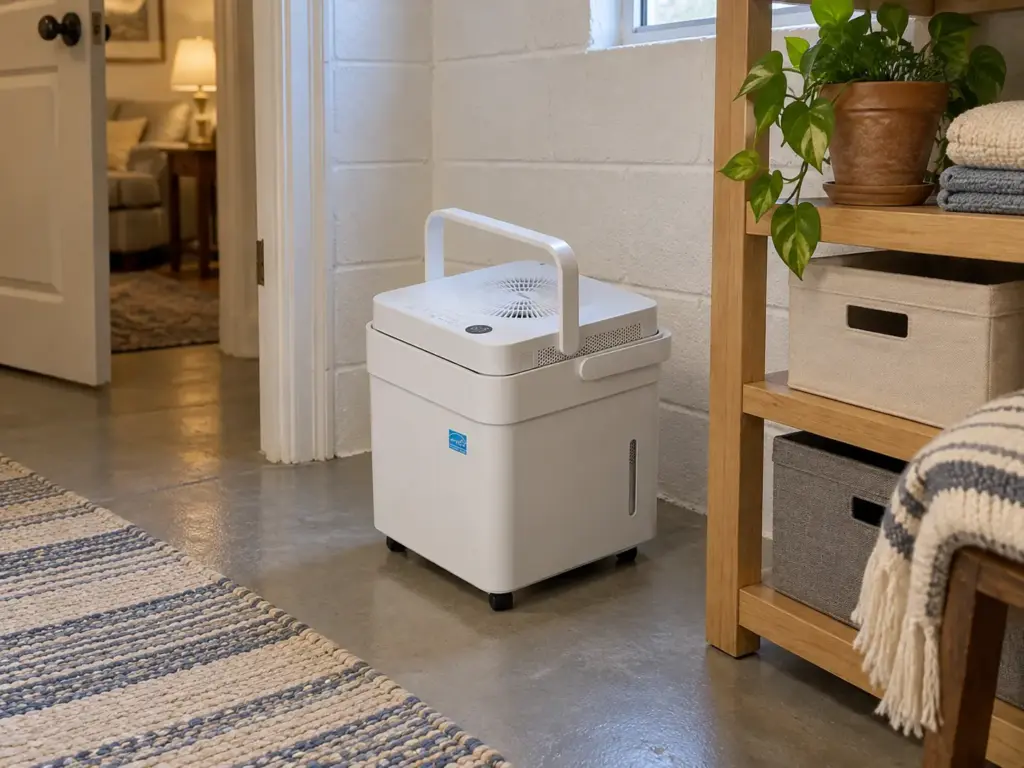
Not every damp space is a whole unfinished basement. A single finished room, a laundry corner or a storage room that holds the damp is a 20-pint job, and the 50-pint units above would be oversized for it, with a heavier tank and more power draw than the room needs. The Midea Cube 20 is the small version: a 3.2-gallon tank (roughly 27 pounds of water when full), a drain hose and Wi-Fi. The coverage line in its title is the maker’s own and is not repeated here; the unit is for one room.
Amazon’s summary of owner reviews finds it effective and compact, and also reports multiple cases of units that died after a few hours of use, plus a machine that is heavy, particularly when emptying the bucket. The first complaint is the one to weigh against a small purchase: a return window is the protection on a unit like this.
Once any unit is running, the work shifts from choosing to keeping. The reading has to stay inside the band through the next rain, and how to keep basement humidity low once the unit is running is the next decision.
The Drain, the Thermometer and the Spec Sheet Pick the Unit
A damp basement does not need the unit with the most features. It needs the one whose drain route, lowest temperature and failure record match the room it will actually live in. Three things carry that choice:
- The drain you have picks the family: a gravity hose where one can run downhill, a built-in pump only where the drain sits above the unit, and a bucket as the last resort.
- The unit’s own sheet comes before its brand, and a blank where the lowest working temperature should be is a question for the maker, not a pass.
- A meter on the shelf is the check on the unit’s display, because the display is a guess and the shelf reading is the room.
For later, two readings are worth a note on the calendar. After the first week with the door shut, look at the shelf meter: a number that has stopped falling above the band means the room is still taking on water, or the unit is iced or full. At month three, look at the filter screen, since a furred screen is the first sign of a unit working harder for fewer pints.
Tomorrow, make one change and take one reading. Walk from the spot where the unit would stand to the nearest drain or sink and note whether the route climbs anywhere, then put a meter on a shelf and write down the coldest number it shows this week. After seven days those two notes tell you which of the three families to buy, and whether the outside checks might make a purchase unnecessary. The next question, whichever unit wins, is keeping the number down through the next rainy stretch.
Frequently Asked Questions
01What is the best type of dehumidifier for a basement?
A compressor dehumidifier in the 50-pint class is the best type for a basement that stays damp, because it keeps pace with moisture that returns daily. Desiccant and thermo-electric types suit small or cold spots, not the whole basement. Below 65°F (18°C), read the unit’s sheet for a lowest working temperature.
02Which dehumidifier is best for a basement with no floor drain?
A unit with a built-in pump, such as the Honeywell TPFIT50PWK or the GoveeLife, sends water uphill to a utility sink or condensate line. The other route is a bucket you empty by hand. Check the maker’s stated lift against the vertical climb to your drain.
03What month should you run a dehumidifier in your basement?
Run it whenever a shelf meter reads above the EPA’s ceiling of 60 percent, which in most basements means the warm, humid months. In the cold months the coil can frost, so check the unit’s sheet before running it.
04Will a dehumidifier fix a basement that keeps taking on water?
No, a dehumidifier removes moisture from the air, not water that leaks or runs in from outside, so it fills its bucket while the reading stays put. Fix the source first, such as gutters and grading, then use the unit for what is left.
05How often will I need to empty the bucket?
It depends on the tank and the weather: a small tank can fill three times a day in wet spells, while a 4.2-gallon tank lasts roughly 16 hours at a full rating. A hose to a drain removes the chore.