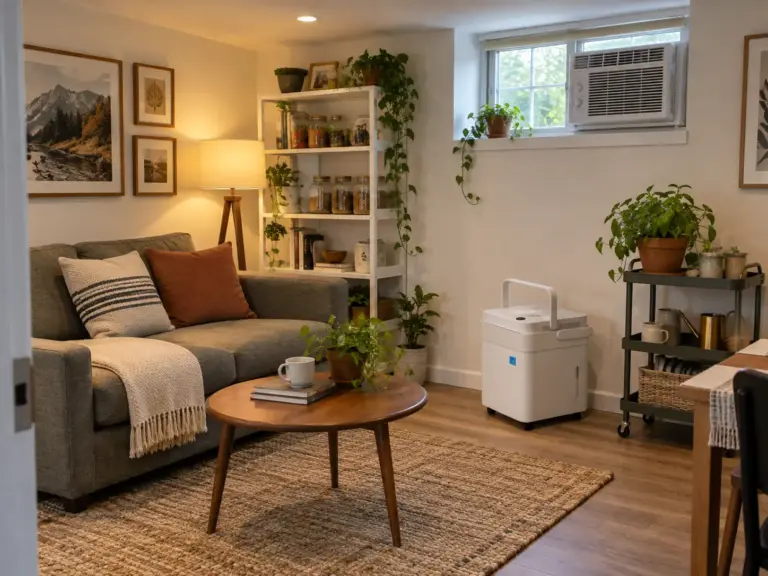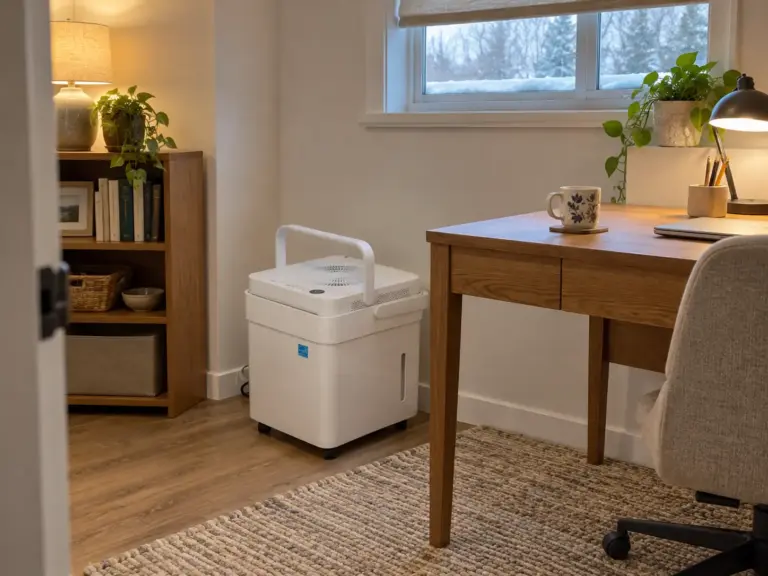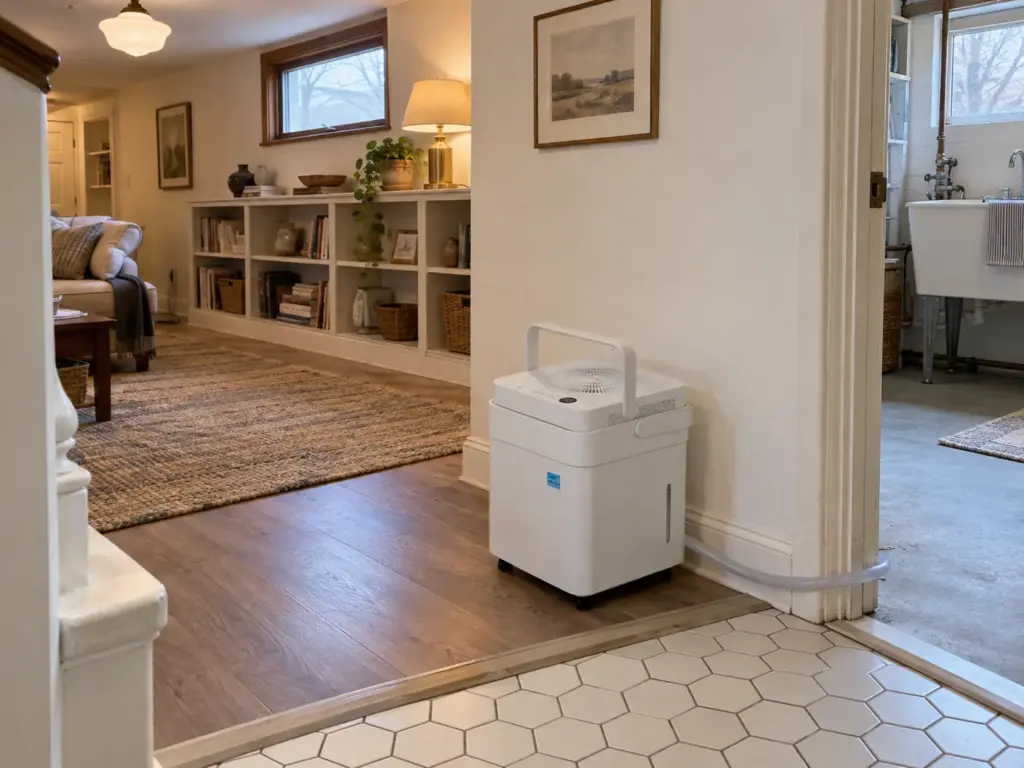
You come down the stairs and the bucket is full again, the float switch shut the unit off sometime before six, and the air in the room is already creeping back up. There is no floor drain in sight, which leaves one question: where to drain a basement dehumidifier when the house does not hand you an obvious place. The machine does not settle that, because condensate leaves only by gravity, so the route comes down to heights: is there a drain lower than the unit’s drain port, or not. What follows is the one reading that decides gravity or pump, the drains an ordinary basement already has, how to lay the hose, the sump pit that may not be yours to use, and what slips by the second month.
Quick Answer
The water has to go downhill to a drain the house already has, so check in this order:
- Read the unit’s drain-port height and the height of every drain in reach.
- Pick the lowest drain that sits below the port.
- Run the hose downhill, with no sag and no kink.
- If every drain sits above the port, plan for a pump, with the bucket as the fallback.
The One Reading That Decides Gravity or Pump
The bucket is not the problem. The difference in height between the unit’s drain port and the lip of the drain is, and every section below hangs on that single reading, so take it before you buy a hose or move the unit.
Water Only Runs Downhill
A dehumidifier pulls moisture out of the air onto a cold coil, and the water drips into the tank. The drain port on the housing lets that water leave by hose, but nothing pushes it. A compressor unit has no pump unless it was built with one, so the hose carries water only as far as gravity allows, and a destination higher than the port cannot work however neatly the hose is laid.
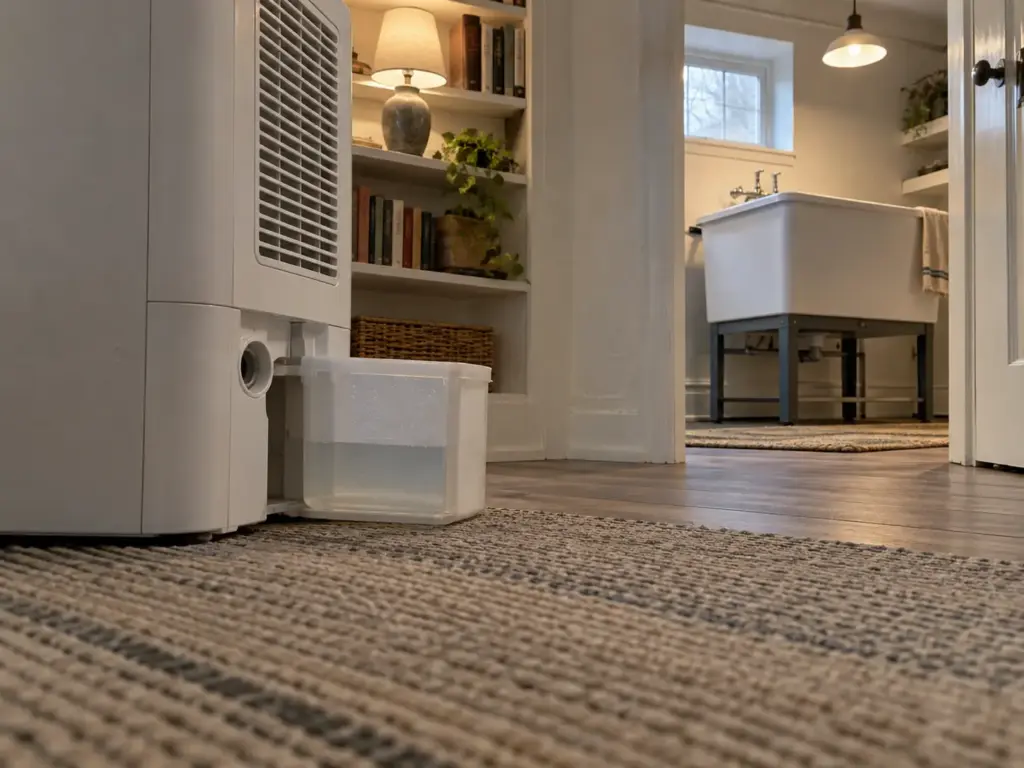
The port sits low on the casing, and that catches people out. A drain that looks high, say a floor drain with a raised collar or a tub rim a few inches off the slab, can still be above the port. With a wet basement and no drain or sump, there is nothing lower to send the water to, so it has to be lifted or carried, and a hose alone does neither.
Measuring the Drop
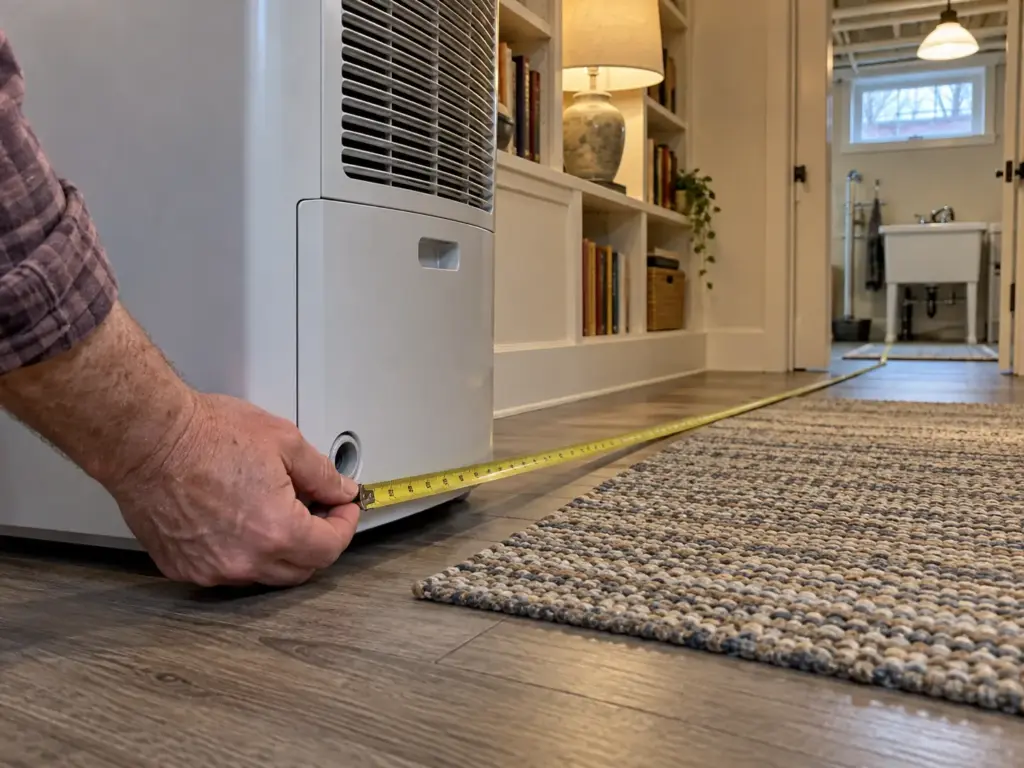
The tool is a tape measure. Stand it on the floor beside the unit and read the height of the drain port, then stand it on the floor at each drain you could reach and read the height of its lip. If a lip is lower than the port, with room for the hose to fall the whole way, gravity works for that drain. If not, that drain belongs to the pump question.
No standard publishes a minimum drop, so the test is a plain yes or no, not an inch count.
Take every measurement from the slab, not from the unit’s base. The port rides on the housing, so a unit sitting on a foam mat or a pallet reads higher than the same unit on bare concrete, and that few-inch difference is often the whole decision.
Why the Box Matters
A unit with no pump shows how little the machine decides. The Midea Cube 50 Pint Dehumidifier is the no-pump variant, rated at 50 pints a day for up to 4,500 square feet, and it ships with a drain hose and a garden-hose style adapter. Its continuous draining feature does exactly one thing, which is hand the water to gravity, so everything after the port is your route and your reading.
Know the catch before you build around it. The listing sits at 3.5 out of 5, with 102 mentions of mixed quality control in the review summary, and the humidity sensor is a common complaint. A sensor that misreads changes how long the unit runs, and so how much water your route has to carry.
If you are still choosing the unit itself, what to look for in a dehumidifier before you buy covers sizing and features. Here the unit is already in the basement.
One more check before any hose: the port thread. Some ports take a 3/4 inch hose thread and others a 5/8 inch garden-hose thread, so the thread is not something to assume. Read the manual or measure the port before ordering anything.
The Drains a Basement Already Has, Checked in Order
A basement with no floor drain usually has another place where water leaves. This section lists them lowest first and says what each one asks of you.
The Laundry Tub and the Washer Standpipe
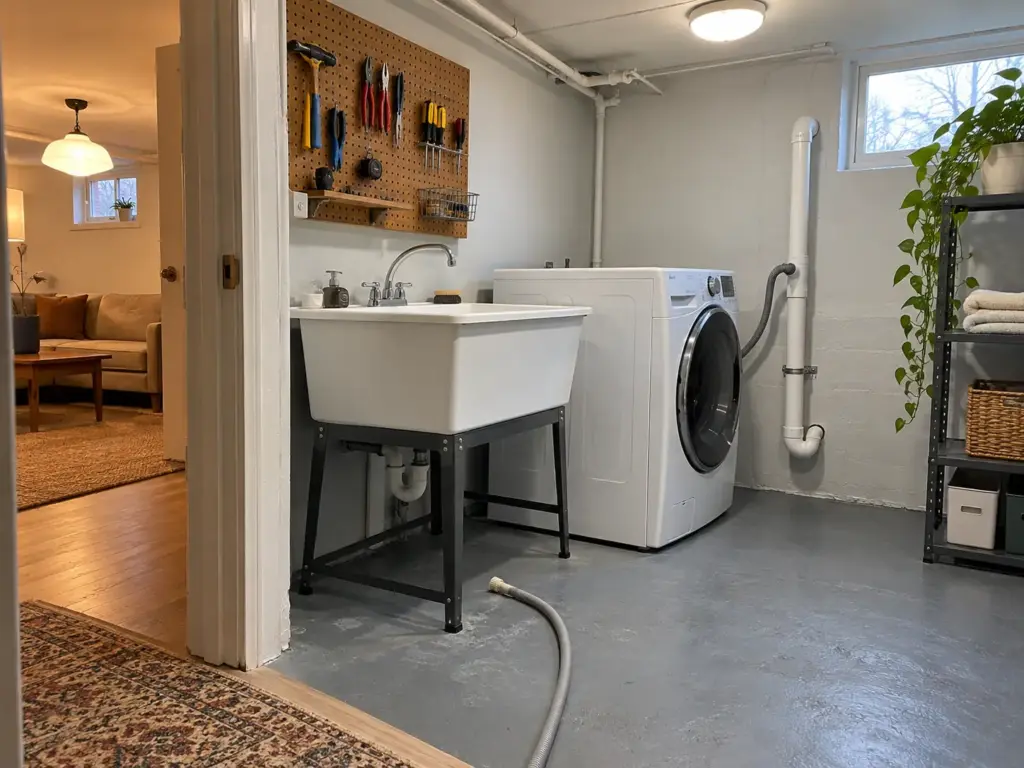
The lowest destination below the port wins, and in a finished basement that is usually the laundry tub or the washing machine standpipe, a plain gravity drain with a downhill slope all the way. A standpipe is the easier of the two to reach, but the washer’s own drain hose has to keep its place, and the dehumidifier hose does not share it. Give the dehumidifier its own spot at the top of the pipe.
Whichever you pick, the end of the hose stays above any standing water in the drain. A hose end sitting under water keeps the water from leaving cleanly and can let drain water creep back up the line, the backflow problem plumbers leave an air gap to prevent.
A Utility Sink, and When It Is Too High
A sink looks like the obvious answer. But a sink’s lip is above a floor-standing unit’s port most of the time, and the water cannot climb to it. Where the sink is lower, run the hose over the edge and you are done. Where it is not, the sink is a reason to read the pump and drain hose question instead of another hose.
A Floor Drain or an Open Pit, if the House Has One
A floor drain is the lowest and simplest target when you have one in reach. An open sump pit works the same way, with one condition that gets its own section further down: whether the pit is really open, or sealed into a radon system.
Two destinations you will see suggested do not make the list. The furnace or AC condensate line belongs to that equipment and tying into it is a plumber’s call, and a rain barrel leaves the hose end sitting in water, which is the siphon problem again.
The Hose Run: Slope, Kinks and the End That Slips
The destination is chosen. Now the hose has to get there without a sag that holds water and without an uphill stretch that stops the flow.
A Continuous Downhill Run, No Sag, No Kink
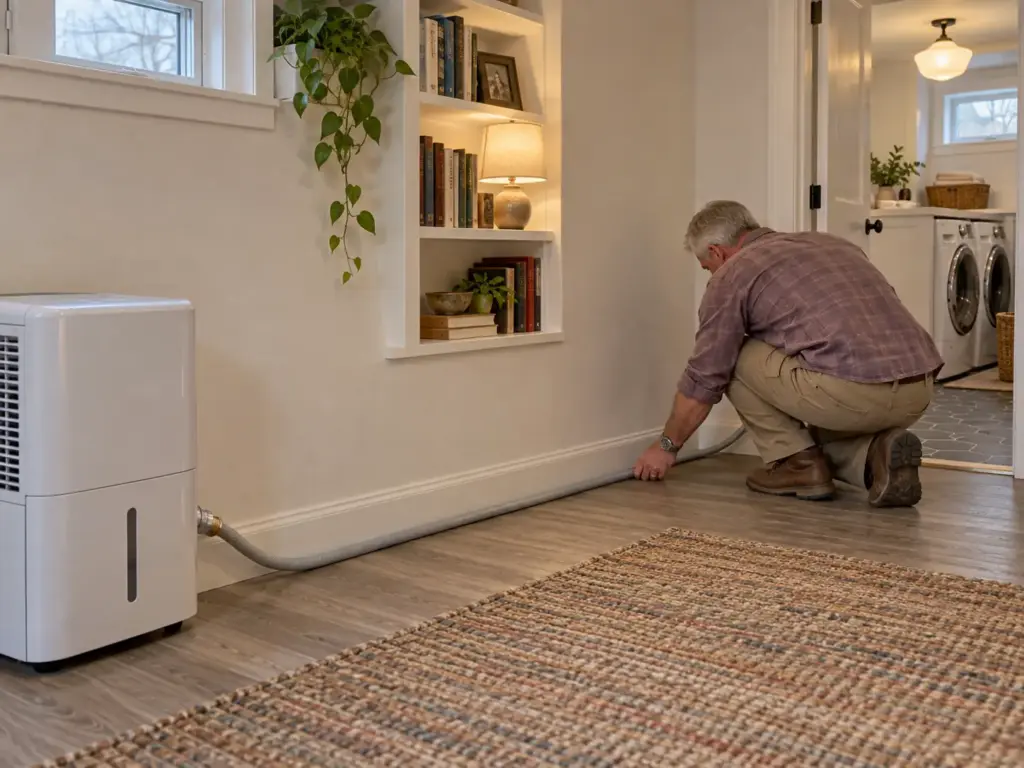
Water in a hose follows the lowest point it can find. A sag holds a pocket of water that keeps the line half full, and an uphill stretch, even a short one over a floor joist or a pipe, stops the flow completely. A kink does the same at one spot. Trace the whole length with your hand from the port to the drain, because the dip that causes trouble is often under a rug or behind a shelf where you would never see it.
The Pour Test at the Port
Before spending anything, pour a small amount of water into the drain port and watch the hose end. If it arrives at the drain, the slope works. If the water stops partway, you have found the sag or the climb, and you found it for free. Clamp the hose end to the drain or the pipe, then look at it again in a week, because an unclamped end drifts out under its own weight and the water ends up on the slab.
Which Length: the Short Hose or the 12-Foot One
Pick the length from the distance, not from habit. When the tub is close, the 5-foot drain hose with a 3/4 inch FHT thread and a brass interface keeps the run short, where gravity does its work without help. It carries 4.6 stars from 95 ratings, though one of the eight mentions of how it functions is negative and the text of that complaint is not visible, so there is nothing to quote and nothing to invent.
For a drain across the room, the 12-foot drain hose has the same thread, brass connectors and a PVC body. Its trouble is the connector. Leaking is the most repeated complaint in its review summary, with 26 mentions and 16 of them negative, so the connector deserves a close look before you install it.
Both hoses are 3/4 inch, so confirm your port first, as above. A hose that does not match the port leaks at the join no matter how good the hose is.
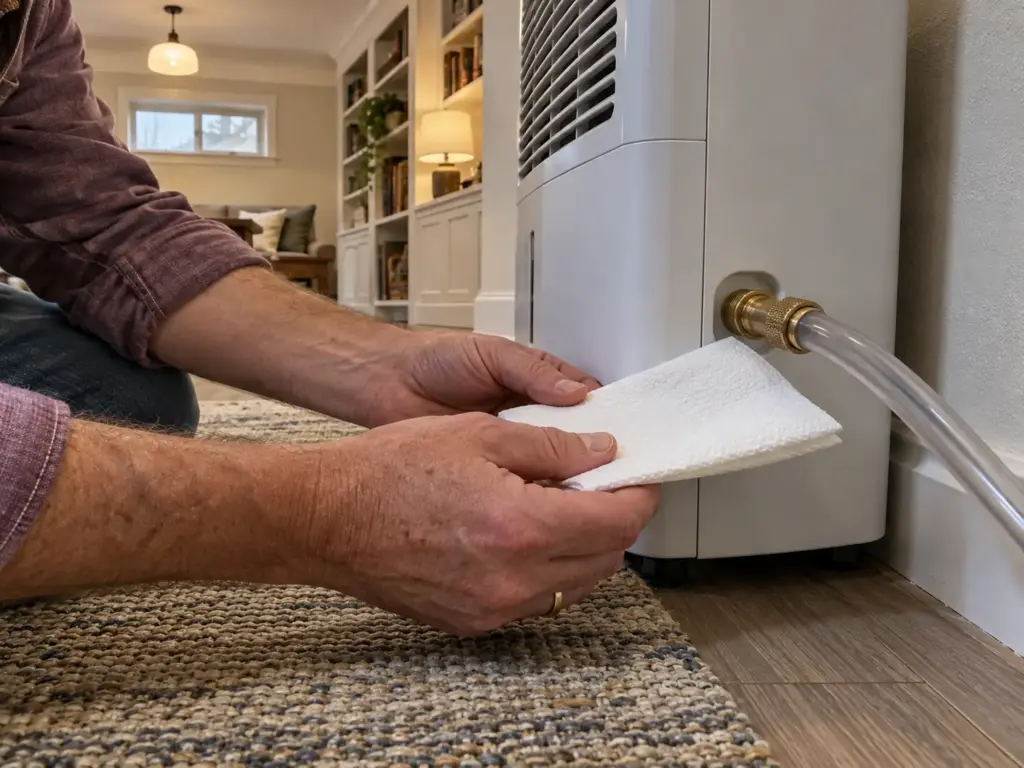
Fold a dry paper towel under each brass connector and look at it the next morning. A weep at the thread is too slow to see on the floor, but it shows up as a damp patch on the paper, and a connector that looks fine on day one can start to weep weeks later.
The Sealed Sump Pit: A Drain That May Not Be Yours to Use
The pit in the floor looks like a ready-made drain, and in a house with a radon mitigation system it can be part of that system. This is a check on the house, not on anyone’s health: whether a hole in a lid is a hole in the seal.
Open Pit or Sealed Lid: Which One Yours Is
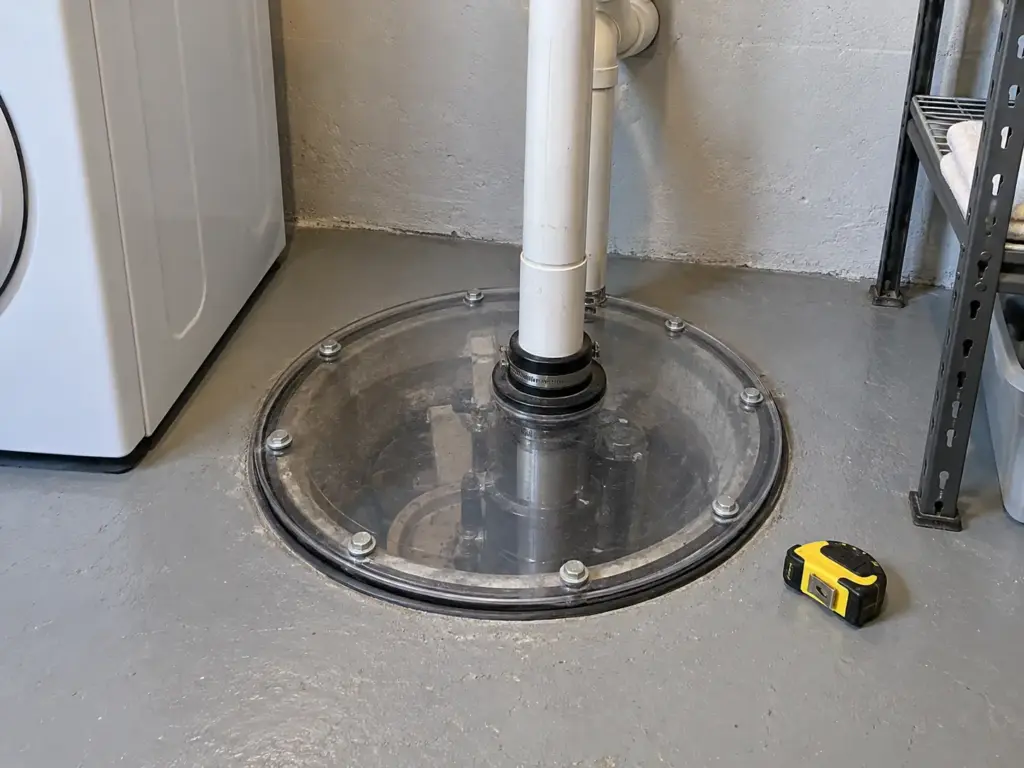
Lift a corner of the lid if it moves. A pit with a loose, flat cover is open for practical purposes, and a hose can go in under it. A pit with a lid that sits down on a rubber gasket, with pipe coming off it and going up the wall, is sealed, and that changes the answer.
The reason is soil gas. According to the Building America guide on sealed sump covers, “Uncovered or improperly sealed sump pumps can also allow radon and other soil gases to enter the basements and crawlspaces.” A drain hose through a lid is a penetration. If the lid was not made for it, the hose is a hole in the seal.
What a Sealed Cover Looks Like
The same guide says the 2009, 2012 and 2015 International Residential Code require a gas-tight, removable cover on any installed sump pump, and that ENERGY STAR new-home requirements call for the lid to be mechanically attached with a full gasket seal. Lids designed to be air-tight carry grommets around every penetration, whether wiring, discharge pipe or radon vent. If yours has a grommet for the electrical cord and the discharge pipe and none for a hose, there is no place for a hose to go.
A lid sealed at install can also lose the seal later, when someone cuts a notch into it to pass a hose. The notch looks small, but the seal is the point of the lid.
When to Call a Radon Contractor
In a house in EPA Radon Zone 1, the guide says a radon test after the cover goes on confirms it is sealed. So when the pit is part of a radon system, it is not a free drain for the dehumidifier. Call a radon contractor and use another drain. That is a house answer, and a contractor is the right person to give it.
No Drain Within Reach: The Window, the Shelf and the Outside Pipe
Some basements have no drain at all within hose range. These are the three workarounds readers describe, each with its one weakness, ranked honestly at the end.
Out Through a Window
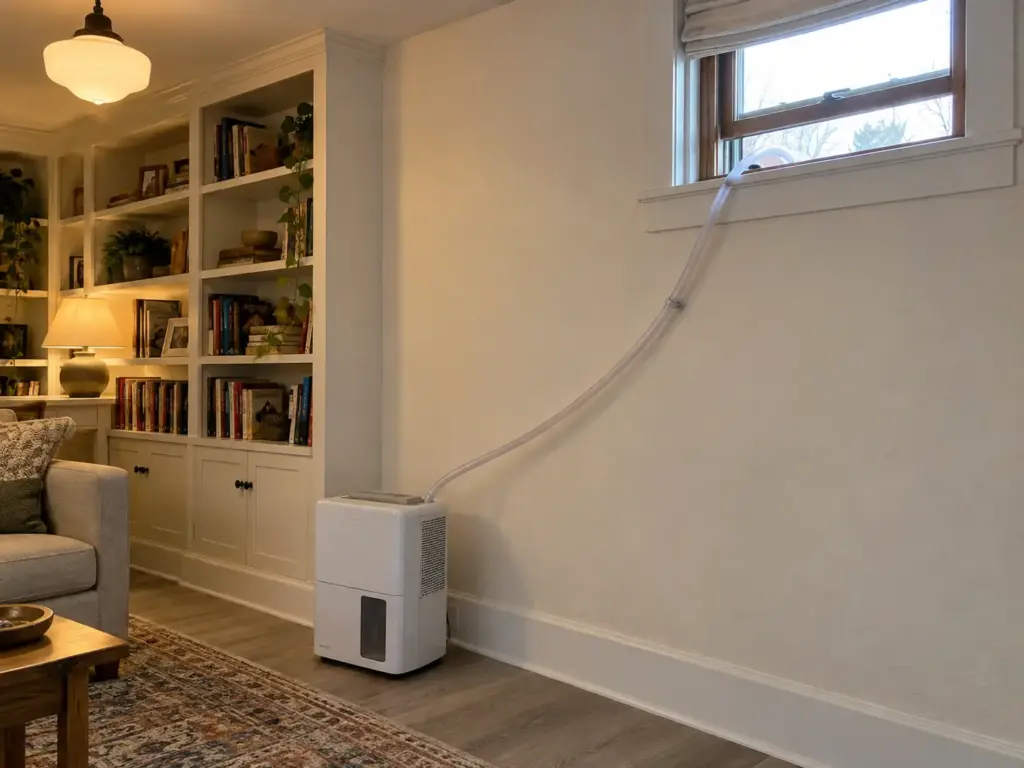
The hose has to climb from the port to the sill, and a hose that climbs works against gravity, so unless the unit sits above the sill, the water stops at the climb. The window also stays open to the outside for as long as the hose is there, and in a basement that means cold, bugs and a security gap.
Check the hose with the sash fully down and the unit running. A sash that pinches the hose looks exactly like a pump failure: the tank fills while the hose end stays dry, and nothing is actually broken.
Up on a Shelf or a Sturdy Stand
Raising the unit gives the hose its fall, and for many basements it is the only fix that costs next to nothing. The weakness is weight and stability: a unit with water in its tank is a falling object, and it vibrates. Your tape measure and the manual decide the height. Use a stand built to carry the load and check it again after a few days.
Through the Wall to the Outside
This is the permanent route, and its weakness is the job itself. It needs a hole through the foundation wall and someone qualified to make it, and an outside line with water standing in it can freeze in winter.
None of the three beats a drain the house already has. Of the three, the stand comes first, since it adds nothing to the house. The window follows as a seasonal fix, and the wall comes last, as the job to hire out.
When Gravity Loses: Handing the Job to a Pump
If every drain is higher than the port, the tape measure has given its answer. The unit needs a condensate pump, and the choice belongs in the one with a pump and a drain hose, not here. Pumps come in two kinds: one built into the unit and a separate box that sits on the floor and pushes the water up and away.
A built-in pump has its own flaw: the float switch can fail, and the tank may not empty fully. That is worth knowing before you count on it. A pump also has a check valve that stops the water in the line running back to the unit, and a valve that sticks after a few months lets a hose full of water drain backward into the tank.
The bucket is the fallback, and it is not a failure. The arithmetic is simple: divide the unit’s rated pints a day by the tank size and you get the trips per day at that rating, and in a damp week the real number sits close to it. Run hours set the water volume, which is why how long to run a basement dehumidifier belongs next to this decision.
Month Two: What Slips, Slimes and Fills Again
A route that works in week one has three ways to fail, and each shows up as the bucket filling again or a wet spot on the floor under the hose.
Week One: The Hose End and the Connector
The hose end slips out of the drain and the connector weeps. Both are cheap to check: look at the drain where the hose enters, and look at the towel under the connector. A cheap alarm on the floor catches what you miss, and leak detectors are the way to know the morning the floor is damp, not three days later.
Week Four: The Slime in the Line
A film of bio-slime grows inside a hose that carries condensate, and it slows the flow. Cleaning advice splits here: a vinegar mix about every 90 days on one side, diluted bleach monthly on the other. They cannot both suit your unit, so follow its manual, and never mix one cleaner with another.
Month Three: The Float Switch and the Winter
The float switch on an internal pump is the part that fails quietly, so listen for the pump when the tank is full. In winter, a line that runs outside can freeze, and a hose that carried water all summer will stop.
A partly clogged line has a trick of its own. The bucket fills sooner at month three because the hose is slow, and that reads as a stronger leak than the basement really has. Before you decide the water is getting worse, run the pour test again.
When the Water Is Not the Unit’s Problem at All
A bucket that fills faster than it should is sometimes the building telling you where the water comes from. A dehumidifier treats the air, not the wall.
What the Humidity Should Read
The target is public. According to the EPA’s mold course on indoor humidity, “Indoor relative humidity (RH) should be kept below 60 percent — ideally between 30 percent and 50 percent, if possible.” A reading near 60 percent means the unit will be working, and the drain will be used, all day. Measure first, because a hygrometer changes more decisions than a new unit does, and a basement humidity sensor is the cheapest way to know where you stand before you reroute anything.
Put the hygrometer on the coldest wall side of the basement, not by the stairs. Air from upstairs mixes in at the stairs and reads drier than the wall does, so the number there flatters the room.
A Bucket That Never Slows Down
A unit that runs all day without getting the room to the target points to water intrusion, not to a small unit. A wall that is wet at the base after rain and a dehumidifier running flat out are one problem seen from two sides, and a bigger machine only makes a bigger bucket. The order for that case is in how to keep basement humidity low: water first, the unit last.
Once the source is handled and the reading comes down, the next question is the target. What humidity to set your dehumidifier to picks up from there.
Take the Tape Down the Stairs Before You Buy Anything
Three things carry the whole article. The port height against the drain height decides gravity or pump. The lowest drain below the port wins, and the hose runs downhill the whole way, with its end above any standing water. A sealed pit or a drain above the port sends you to a radon contractor or to a pump, not to a bigger hose.
Look again a month from now: put a dry towel under the connector, look at the drain where the hose enters, and notice whether the bucket (or the line) fills sooner than it did in week one, because a slower line or a loosened end shows up there first.
Tomorrow, set a tape from the port to the drain you picked and take the reading. If the drain is lower, run the hose. If not, the answer is in the pump article, not in another hose.
Frequently Asked Questions
01Where can I drain my dehumidifier in my basement?
Into any drain lower than the unit’s drain port: a floor drain, a laundry tub or standpipe, or an open sump pit. A sealed radon pit does not count, and a sink usually sits too high.
02Can I dump dehumidifier water into the sink?
Yes, by hand, or by hose if the sink is lower than the port. Most utility sinks are higher than a floor-standing unit, so the bucket or a pump is the usual answer.
03How many hours a day should I run my dehumidifier in my basement?
It depends on how far the humidity has to fall and how much water comes in. The basement dehumidifier run-time article covers it.
04Should the hose end sit in the drain water?
No. Keep the end above any standing water in the drain so the water cannot siphon back toward the unit when the flow stops.
05Will a dehumidifier pull moisture out of drywall?
It lowers the room’s humidity, and damp surfaces dry slowly into that drier air. It does not stop a leak behind the wall, which needs its source fixed.