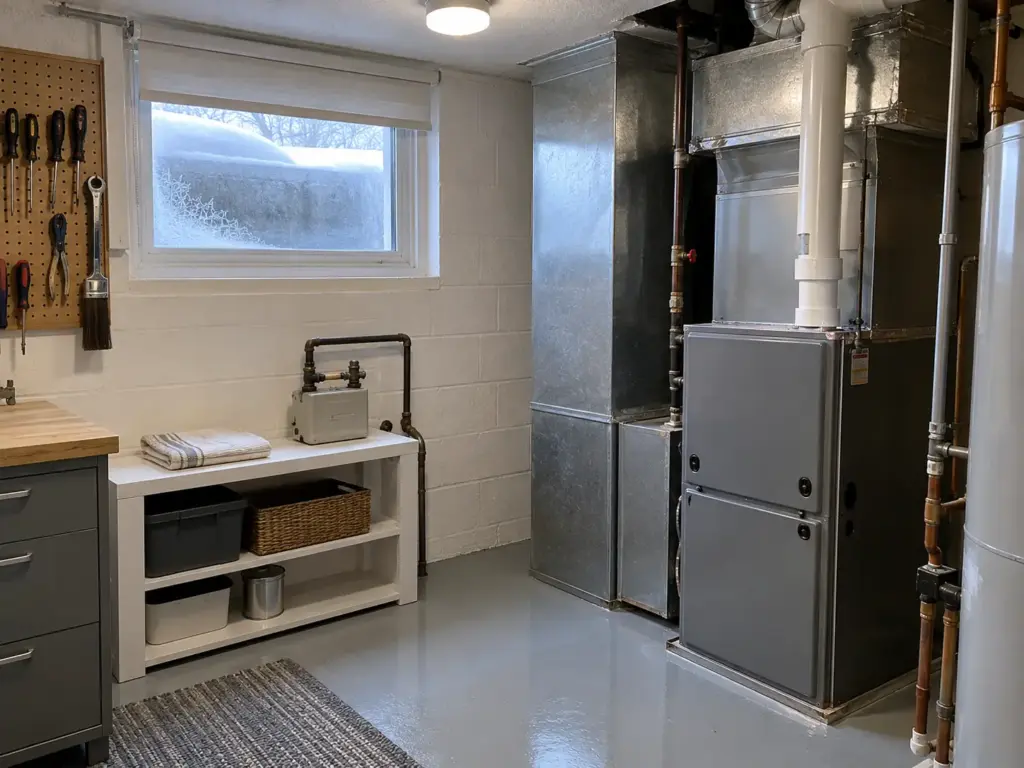
Your meter on the shelf reads 42%, and the lowest course of the wall by the furnace is beaded with water anyway. So what should basement humidity be in winter, when the number and the wall disagree? Air gives up its water to the coldest surface it touches first, and a basement is mostly cold surface: poured concrete, a rim joist, a cold water pipe, a window well.
What follows is a band that slides with the weather outside, a test that uses your hand instead of the display, and one change at a time. If the water is arriving from the ground, as vapor through the concrete, rather than from the air, what puts the water in a basement in the first place is the better place to start.
Quick Answer
A winter basement belongs at about 30% to 40% relative humidity, stepping down as the outdoor cold deepens, to under 30% when it is 0 to 10 °F (-18 to -12 °C) outside. Water on a cold wall, pipe or window means the number is already too high, whatever the meter says.
The Winter Number Starts Near 40% and Falls With the Cold
The ideal basement humidity in winter comes as a band, 30% to 40%, and the band deserves a closer look than it usually gets. It is a ceiling for an ordinary week of winter, not a figure to hold until spring, and it was written with windows in mind rather than concrete. This section traces where the band comes from, how it slides once why indoor humidity shifts with the cold starts to bite, and why two good sources hand you two different numbers.
What the EPA and ENERGY STAR Actually Say
Start with the frame, because everything else hangs on it. According to EPA’s guide to mold, moisture and your home, “If possible, keep indoor humidity below 60 percent (ideally between 30 and 50 percent) relative humidity.”
Two numbers, two jobs. Sixty percent is the line you do not cross, and 30% to 50% is where the air should sit. Neither is a winter figure and neither is a basement figure; both describe a house.
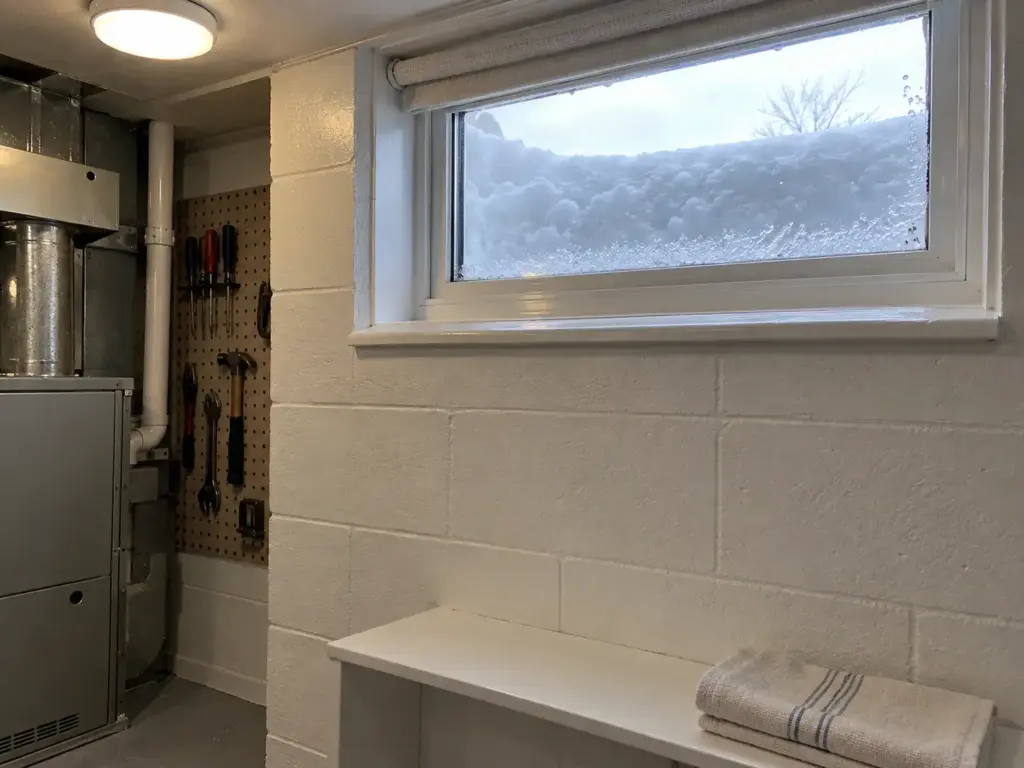
The winter figure comes from ENERGY STAR’s dehumidifier guidance. It gives the same 30% to 50% as the best range for a building, then adds that in colder climates, during the heating season, 30% to 40% is the range that prevents window condensation. Read the purpose inside that sentence: the 40% exists to keep a cold pane dry. A basement wall is a cold surface of its own, and a much larger one, which is why the next section matters more than this one.
A reading that passed in October is the wrong reading the first week the outdoor temperature drops. The air did not get wetter; the walls got colder. The winter number has to be held against this week’s weather, not against a figure printed once.
Why the Cold Pushes the Number Down
The EPA and ENERGY STAR give one band for the whole season. A table from MnCEE, the Minnesota Center for Energy and Environment, lets the number move with the thermometer outside. Its steps for relative humidity, by outdoor temperature:
- Under 40% when it is 20 to 40 °F (-7 to 4 °C) outside
- Under 35% at 10 to 20 °F (-12 to -7 °C)
- Under 30% at 0 to 10 °F (-18 to -12 °C)
- Under 25% at -10 to 0 °F (-23 to -18 °C)
- Under 20% at -20 to -10 °F (-29 to -23 °C)
- Under 15% below -20 °F (below -29 °C)
The table is a general guide for whole houses and it cites no standard, so read it as a rule of thumb that happens to be shaped like the physics. Its own caveat is the useful part: when it is extremely cold out, even 40% can still leave condensation on windows and wall surfaces. Indoor humidity by outdoor temperature walks through the whole-house version of this table. The basement version starts at the cold wall.
The mechanism is simple to state. Humidity is relative: the same amount of moisture in the air reads higher as the air gets colder. The water in the air has not changed. The air’s room for it has shrunk, and the percentage rises to say so.
Tape a note beside the meter with the row of the table that today’s outdoor low falls into. When the low slides into the next row, the target steps down with it, and a reading that was fine last week becomes the one to question.
Why Two Good Sources Give Two Numbers
The flat band and the table look like they disagree. The flat 30% to 40% gives one number for the whole season; the table gives six. Both are right, because they answer different questions.
Put them together this way: 30% to 40% is the ceiling for a normal winter week, and the table is what that ceiling becomes in a cold snap. Keep the flat band as the default and let the thermometer outside pull it down. The same MnCEE page also sets a basement dehumidifier at 55%, which looks like a contradiction and is not. That is a device setting for a different season and a different job, and it belongs to the last section, not this one.
If winter is the season you are unsure about, whether a basement is damper in summer or in winter takes the comparison the other way.
The Coldest Wall Sets the Basement’s Real Number
A meter in the middle of the room reports the room. The wall reports itself, and in winter it is the colder of the two. That gap is why a basement can read 40% on the shelf and still bead water at the baseboard, and it is why the target in this article is read against the wall.
Where to Read It, and Where Not to
Take the room number mid-room, away from the cold wall and away from the dehumidifier’s exhaust. Where a basement humidity sensor goes gives the placement, and how to measure indoor humidity covers the three readings across a day. A meter taped to the cold wall reads the thin layer of air pressed against it, which is neither the room’s number nor the one the published bands describe.
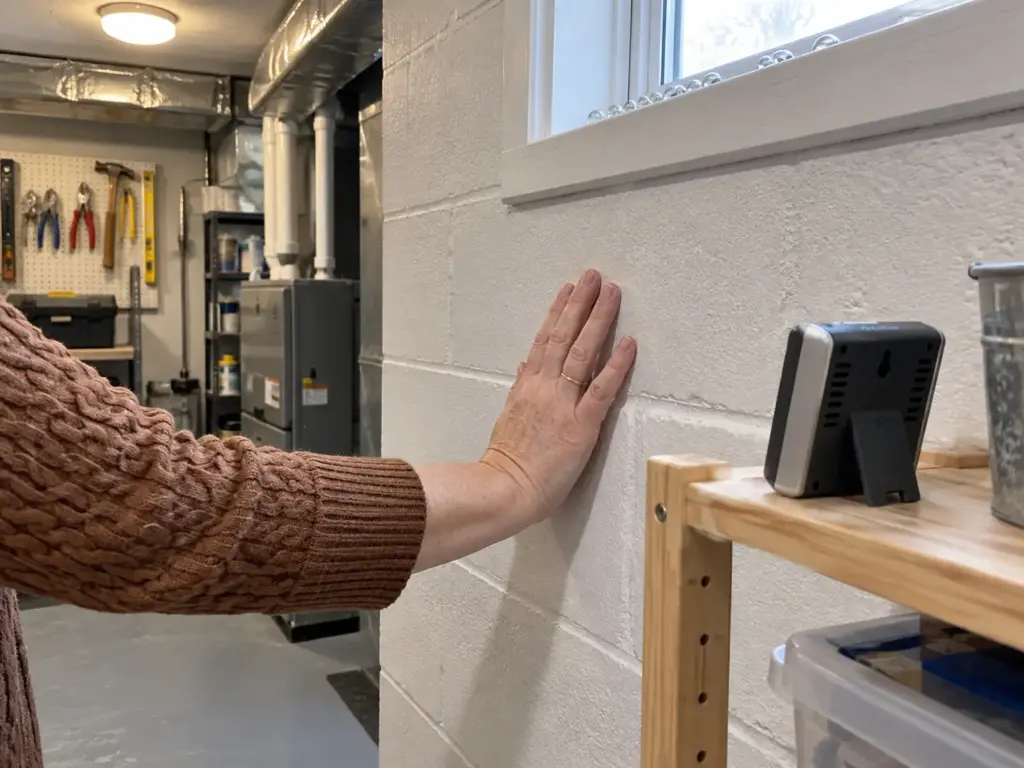
The wall gets checked a different way, by eye and by hand. Look along the lowest course and into the corners of window frames for beads, a dark line, a wet band at the base, or frost at the corner of the glass. Then lay a palm flat on the coldest stretch. A surface that feels cold to the hand is a surface the air can reach its dew point on.
For the room reading itself, the AcuRite 00613 Indoor Thermometer Hygrometer is the budget place to start. It records the daily high and low, which is the part that earns its place, because one reading is a snapshot and the pair shows how far the room swings between furnace cycles. The listing gives a humidity operating range of 16% to 98%, a clip, magnet or stand mount, and one AA battery.
Set against that, no humidity accuracy figure is published in anything read for this page, so treat a single digit as an estimate and trust the trend. And it measures the room, so it cannot tell you the wall is beading. Only the eye and the hand do.
The Dew Point Arithmetic
Water forms on any surface colder than the air’s dew point. Take a basement at 60 °F (16 °C). At 40% relative humidity its dew point is about 36 °F (2 °C); at 50%, about 41 °F (5 °C); at 60%, about 46 °F (8 °C). These come from the standard Magnus approximation, so they are a calculation, not a measurement.
A wall at 40 °F (4 °C) stays dry at 40% and beads at 50%. A warmer basement shifts every row up: at 65 °F (18 °C) and 65%, the dew point is about 53 °F (12 °C).
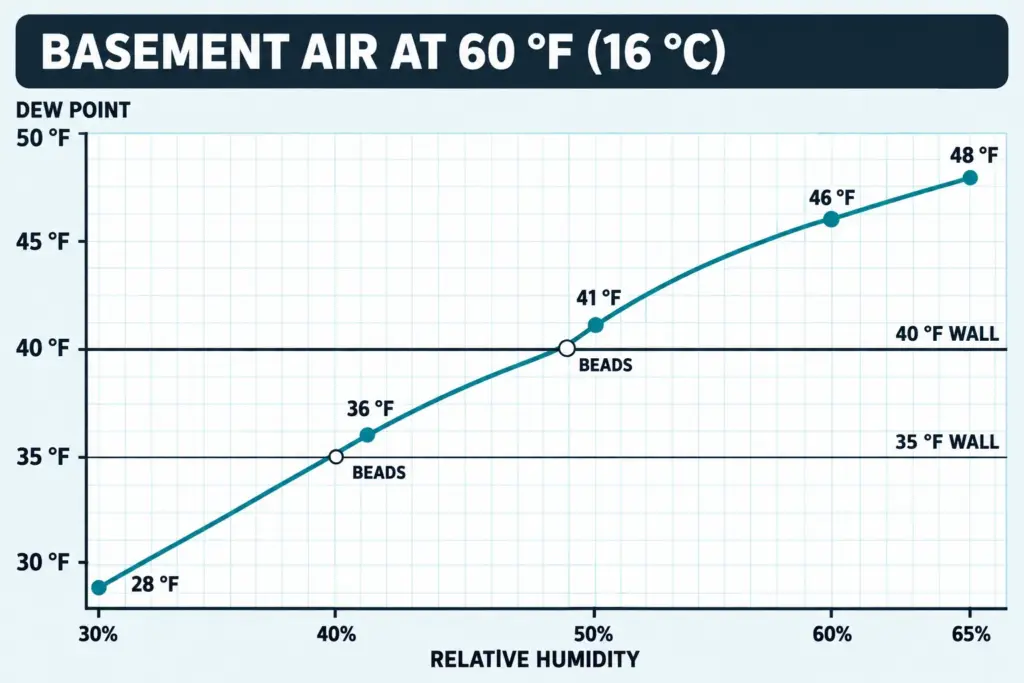
The wall’s own temperature is the one input this page cannot supply, and no figure here pretends to. Run the same arithmetic with a wall you have touched. The change that follows is small and specific: lower the number until the cold surface stops beading, then read again. The reading at the wall, not the average of the room, says when to stop.
What Beading Tells You and What It Doesn’t
Water on a cold wall, window or pipe is the EPA’s own sign that humidity is too high. Condensation on basement walls is the same mechanism as how condensation builds on a cold pane overnight, only on masonry. Beads that clear when the air is dried are condensation, and the answer is the air. The EPA’s line is 60 percent: below it, the air alone rarely causes trouble, unless water is dripping onto windows or surfaces.
Touch the wall before you read the meter. A wet or cold-to-the-hand surface at 45% is an answer the display cannot give, and it tells you which way to move the number before you move it.
A wet patch that returns after days of dry air is a different matter. If it comes back after the room has been in the band for a while, the water is arriving from outside: a leak, snowmelt moving through the wall, a downspout dumping against the foundation. No setting fixes that, and a professional does. When beads have turned into a stain or a dark growth, why mold grows on walls and ceilings is the next step.
The Humidifier Upstairs and the Cold Snap Move It Too
Two things change the basement number without anyone going downstairs: the setting on the humidifier upstairs, and the first hard stretch of cold. Both read as a basement problem. Neither is one.
What the Setting Upstairs Does Downstairs
A basement can run noticeably more humid than the floors above it, even with a whole-house humidifier. Expecting the same number downstairs as upstairs is a common mistake. That is an expectation, not a measurement, but it matches the mechanism. Water vapor spreads through a house on its own, and the basement, as the coldest room, reads the highest percentage for the same water.
The reflex with a high basement reading is a dehumidifier. When a humidifier is running overhead, the better first move is to turn the humidifier down, because the dehumidifier would then be removing water the house keeps adding. MnCEE notes that energy auditors tend to prefer individual room humidifiers over a whole-house unit, since a set point that nobody revisits keeps adding water to the entire house.
The ordinary-house version is a portable humidifier one floor up, which does the same thing on a smaller scale. Turn it down first, a notch, on its own dial or on the whole-house humidistat, before the basement is touched. The opposite direction has its own answer in whether basement humidity affects the rest of the house.
Reading Through a Cold Snap
One reading is a snapshot, and the target steps down when the outdoor temperature does, so the meter has to log across the change. The same 38% can sit under the table’s number one week and above it the next.
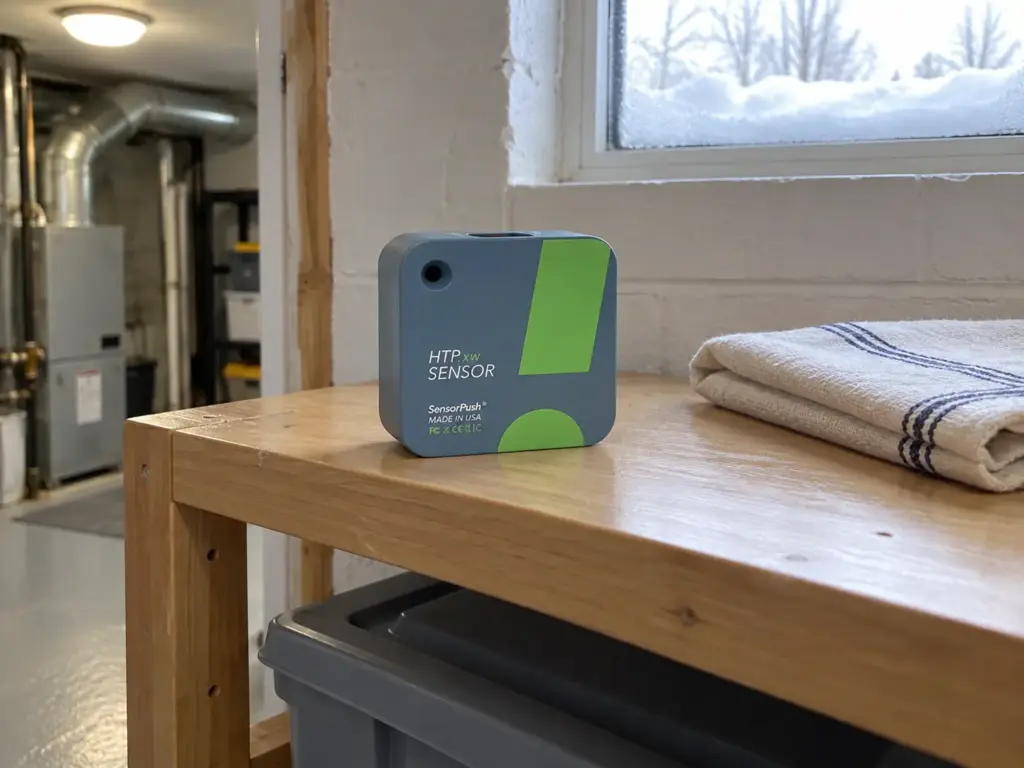
The SensorPush HTP.xw is built for that job. It stores readings on the sensor itself for close to a month and sends them to a phone, with a typical humidity accuracy of ±1.5% relative humidity, so a log across a cold stretch shows the climb overnight, with the furnace cycling and the house shut up, that a single morning reading never does. The manufacturer’s own caveat matters in exactly this room: prolonged exposure to more than 80% relative humidity can put an offset of up to +3% into the readings, and a basement’s wet week is that exposure. After a long damp spell, a high reading deserves a second meter before it deserves action.
Lower the humidifier in steps, not to the floor; when indoor humidity runs too low covers the bottom of the band. Setting a dehumidifier too low can dry out materials, so make changes one at a time and watch the result.
After turning the humidifier down a notch, give the basement meter a day or two before judging it. A reading taken that evening is still mostly the old setting, and changing the humidifier and the dehumidifier on the same day tells you nothing about either.
The One Change to Make, and the Reading to Take After It
By now the winter basement humidity number is a band, the wall is the test and the upstairs setting is a suspect. What follows is the order to try the fixes in, with a reading between each.
Free First, in This Order
One change, then a reading a day or two later, then the next. Never two together: lowering the humidifier and starting a dehumidifier the same afternoon leaves no way to tell which one worked.
- Lower the humidifier setting upstairs a notch. The basement meter should drift down over a day or two. Free fixes for lowering indoor humidity covers the house-wide version.
- Check that the dryer vent runs outside, not into the room. If damp air has been landing in the basement, the meter should step down once it is sent out.
- Cover the sump pit with a lid. An open pit is a small pond giving off vapor, and a lid cuts what reaches the room.
- Run the bath fan through a shower and for a while after, so the shower moisture leaves the house instead of drifting downstairs.
- Look at the cold water pipe and the window frame for beads. A sweating pipe says what the wall says; wrapping it removes the cold surface, while a beaded frame means the number is still too high for that glass.
Do not chase the number below about 25% to 30%. Under 30% the room is on the dry side of the EPA’s band, and a basement rarely needs to go lower outside the deepest rows of the table.
When the Dehumidifier Is the Next Step
The dehumidifier comes only after the free changes, and only if the wall still beads. A winter basement is where a compressor unit is weakest.
ENERGY STAR notes that frost can form on the condensing coils when the air temperature drops below 65 °F (18 °C), and that the unit should then be switched off to defrost. A 60 °F (16 °C) basement is under that line, so a unit can run for days, collect almost nothing and leave the bucket near empty. Whether to run a dehumidifier in winter takes the run decision; this page only gives the room’s number.
Some owners run a basement dehumidifier all year except winter and drain it to a floor drain, accepting the electricity cost so the basement does not grow mold. A basement finished in spring can surprise its owners in winter, when the number climbs above the floors upstairs. A summer unit answers a summer question.
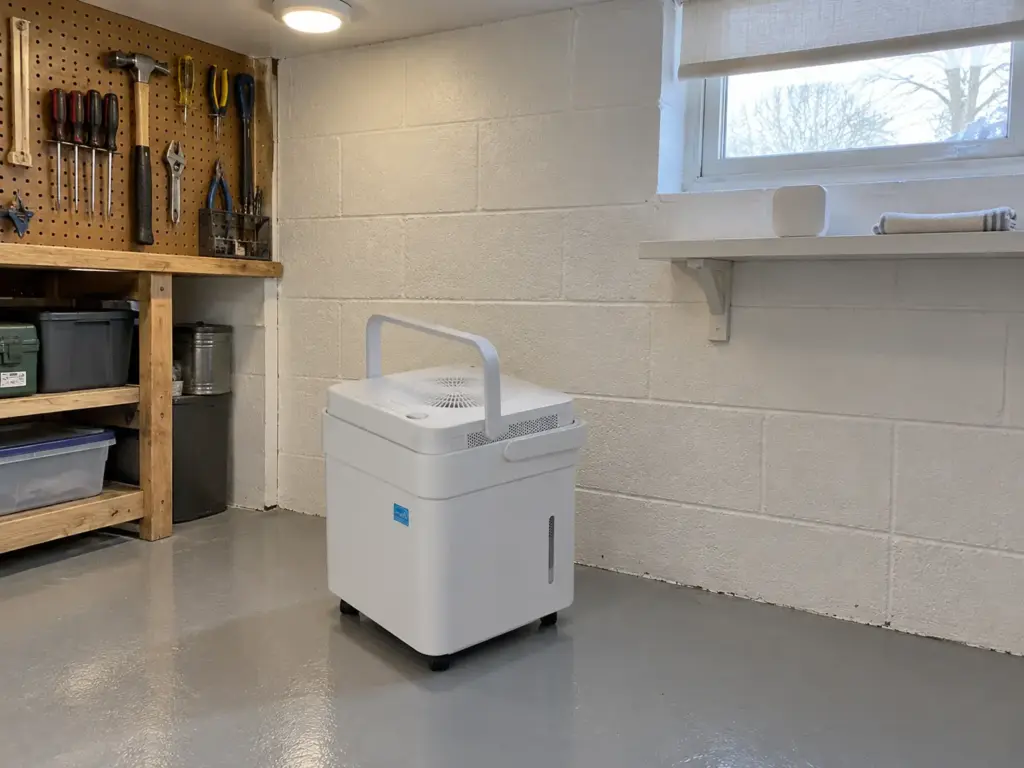
Where a dehumidifier is the answer, the Midea Cube 50 Pint Dehumidifier for Basement in its no-pump version is sized for the job: 50 pints a day, a listed coverage of 4,500 square feet, a 4.2-gallon tank, and drainage by bucket or by the included hose to a floor drain. Its humidity control is listed from 35% to 85%, which matters this time of year, because the table above asks for under 35% in a deep cold snap and the dial stops at 35%.
Three limits sit beside that. The listing’s own review summary flags the humidity sensor for inaccurate readings, and build quality draws mixed opinions. The manufacturer does not publish a minimum operating temperature, so the 65 °F frost line applies.
And with no pump, the water leaves by gravity or by the bucket. Judge the result by the separate meter, never the unit’s display. What to set a dehumidifier to is where the setting is settled.
Read It Again
The same meter, the same spot, a day or two later, and the wall at the same hour of the day. If the cold surface is dry and the room sits inside the band, stop. If it does not, make the next change, not two. Once the winter reading is right, how to keep basement humidity low is the year-round version.
Where the Number Lands When the Wall Stays Dry
Three readings are worth keeping. The winter number is a ceiling near 40% that steps down with the outdoor cold, from the EPA’s 60% line and 30% to 50% band, through ENERGY STAR’s 30% to 40% heating-season range, to MnCEE’s table that ends at 15%. The coldest wall decides: 60 °F (16 °C) air reaches its dew point near 36, 41 and 46 °F at 40%, 50% and 60%. And free fixes come first, one at a time, with a reading after each.
The check for later is the next time the outdoor temperature drops a step, and again at the first thaw, when snowmelt can put water against the wall. Look at the lowest course of the wall and the window frame, scroll the meter’s log across the change, and check the humidifier setting upstairs. By month three of a damp winter, a sensor that has sat above 80% for weeks is the one to compare against a second meter.
The change to make tomorrow is to lay a hand on the coldest stretch of wall, then look at the setting upstairs. Lower it a notch, and read the basement again in a day or two.
Frequently Asked Questions
01Is 50% humidity too high for a basement in winter?
At 50% a basement sits inside the EPA’s 30% to 50% ideal band but above the 30% to 40% winter figure, so it is a limit to question rather than a target. If the coldest wall beads at 50%, it is already too high.
02Is 60% humidity in a basement bad?
Sixty percent is the EPA’s ceiling, not a target, and in a winter basement any cold surface near 46 °F (8 °C) will bead at that level. What puts the water in a basement covers the sources.
03Is 70% humidity too high in a house in winter?
Yes, 70% is well above the EPA’s 60% ceiling and far above any winter figure, and cold windows and walls will bead at that level. Start with the humidifier setting upstairs, then try the free fixes for lowering indoor humidity.
04What month should you run a dehumidifier in your basement?
Go by the reading and the temperature rather than the calendar, because frost can form on a dehumidifier’s coil when the air drops below 65 °F (18 °C). See whether to run a dehumidifier in winter.
05Can basement humidity be too low in winter?
Yes. Below 30%, the bottom of the EPA’s ideal band, the reading is on the dry side, and 25% to 30% is about the floor to hold. See when indoor humidity runs too low.