The first real snow of the winter is coming down past the window, and the two numbers you can check disagree: the weather app puts the air outside in the high eighties, and the small meter on the shelf says about 20. Both are telling the truth.
That is the whole answer to what people type with the storm still going, is air dry when it snows. Yes, and the storm is not even the driest the winter gets. Snow only falls out of air that is close to full, but at 25 to 32°F “full” is a thimble, and warming that air to 70°F adds no water, so the shelf meter lands near a fifth. What dry air does to a person is a question for a doctor, not for a meter, so this page stays with the house, the number, the window glass and the machine, and it covers why the gauge reads high while the air is dry, what the heating does on the way in, how the flake itself gives the air away, and what to do on the storm day and after it.
Quick Answer
Yes. Snow forms in air close to saturation, so the outdoor gauge reads high, but air at 25 to 32°F holds very little water. Heated to 70°F it leaves the house near 20 percent, under the EPA’s 30 percent floor, and the clear night after the storm reads lower still.
Why the Gauge Says 90% While the House Reads Dry
Two numbers that cannot both be right sit in the same hour: an app in the high numbers and a meter in the low ones. They can both be right because they use the same word for two different things, and before any fix it pays to know which meaning each number is in.
Snow Needs Air Close to Full
Snow crystals only grow where the air is nearly saturated. The National Weather Service’s note on how snow crystals grow puts the requirement at a relative humidity of 70 percent or higher in the growth layer aloft, where the air sits around 0 to 10°F. At ground level during a snowfall the gauge usually reads in the same high range, and the reason is the snow itself passing through the air. So the app’s 80 or 90 percent is accurate: it is what a snowing sky looks like on a gauge.
Relative humidity is a share: how full the air is compared with what it could hold at its current temperature. Absolute humidity is the amount of water actually there. The app reports the first. The cracking wood floor and the spark off the doorknob follow the second. The two numbers behind winter dry air are the same ones the snow day adds up.
A High Percentage of a Very Small Glass
Cold air holds very little water, so a nearly full glass of it is still a small amount. Picture a shot glass at 90 percent beside a pint glass at 40 percent: the pint glass holds many times more water, and the shot glass is the one reading higher. A weather app that says 50 percent outdoors next to a shelf meter at 16 in the same hour is the same arithmetic, two true numbers in one house with the temperature difference between them doing the work. Why a high outdoor percentage is the general rule of a cold day has the long version, and the snow day is its loudest case.
The Dew Point Is the Number to Compare
The dew point is the temperature at which the air would be full, and it measures the water itself instead of a share. NOAA’s explanation of dew point gives the comparison that settles the confusion: a 30°F day at 100 percent relative humidity feels less humid than an 80°F day at 50 percent. Two days that both read 80 percent outside can hold completely different amounts of water, and only the dew point tells them apart.
One small clue shows up before any calculation. The same app often reads higher on the storm morning than on the clear day after it, even though the clear day is the drier one inside. The percentage and the water move in different directions, and that is the first sign the percentage is the wrong number to carry indoors.
What Heating Does to Snow-Day Air Between the Door and the Meter
With the gauge explained, the question is what happens when that air comes inside. The furnace takes no water out and puts none in, so every change on the meter is a change in the size of the room’s glass and not in what is in it.

Same Water, Warmer Room
Warm air can hold far more vapor than cold air, so the same amount of water is a smaller share of a bigger capacity. Draw in outdoor air at the door, heat it to 70°F, and the vapor count stays where it was while the percentage falls. What happens to the water between the furnace and the room is written out in full elsewhere, and this page only carries the snow-day numbers through it.
Where 32°F Air at 90% Lands at 70°F
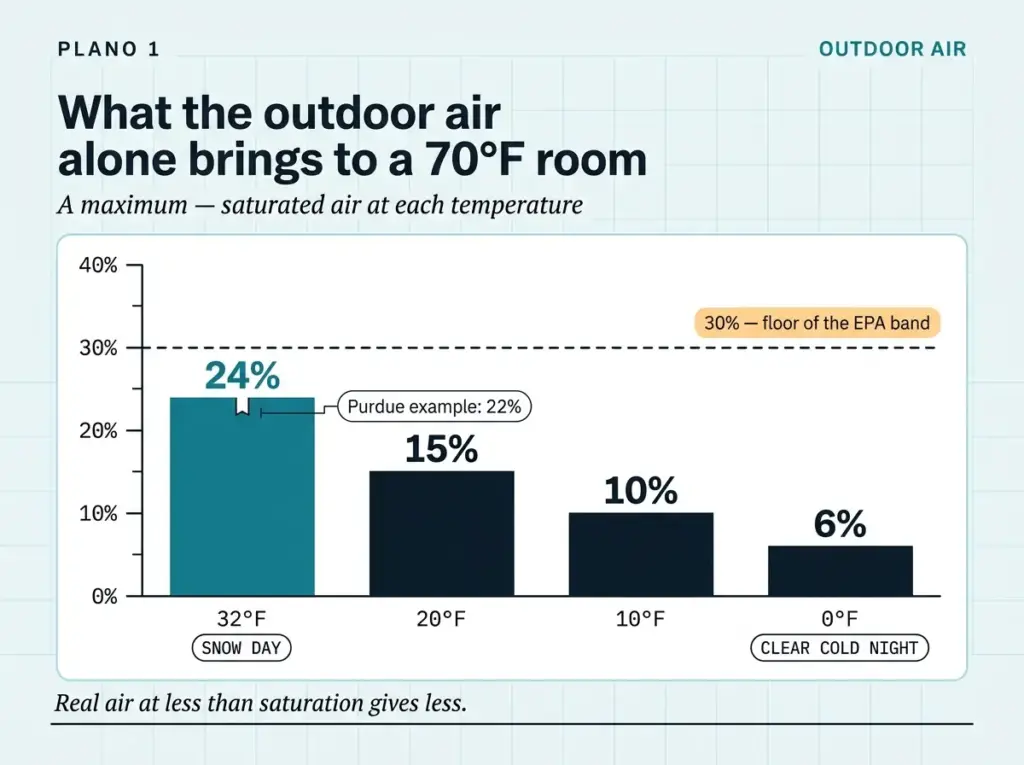
Purdue University works the example on the same psychrometric chart that building engineers use. What heating does to the same air: outdoor air at 32°F and 90 percent relative humidity, warmed to 70°F, arrives at about 22 percent. Purdue’s own line under the example reads, “Nothing was removed — this is why heated buildings are so dry, and why humidifiers exist.”
A snow day a few degrees colder lands lower. The same chart gives completely saturated 25°F air at about 18 percent once it reaches 70°F. So a house on a snow day reads between the high teens and the low twenties, and never much above that, however wet it looks through the glass.
If the weather app shows a dew point, use it instead of the percentage. A dew point near 20°F means the same room, heated to 70°F, lands around 15 percent at most. A dew point near 30°F puts it in the low twenties. The app already did the hard half of the sum.
The Snow-Day Reading Against the EPA’s 30 to 50 Percent
The EPA’s 30 to 50 percent band is the indoor target, with 60 percent as the limit to stay under. A snow day leaves dry indoor air, below the floor of that band, with no humidifier anywhere in the story, so the first reading is a data point about the weather and says nothing yet about the house. The band and who set it is worth knowing before you decide a number is wrong.
The house also makes water: cooking, showers, laundry, people. A lived-in home reads a few points above the arithmetic of the outdoor air alone, so the arithmetic is the floor the house starts from. And the reading drifts. It sits lowest at the start of the storm and creeps up as the day goes on and the boots and the stove pile on moisture, so a single noon reading says very little.
Two Days, One Furnace, Opposite Readings
The snow day is the one stretch when the outdoor gauge sits at its winter highest. The clear, cold night that follows is the other half of the same winter, and the same house on the same thermostat setting reads very differently on the two.
The Storm Is the Wettest the Winter Air Gets
Heavy snow needs moisture, and that moisture needs air that is not bitterly cold. According to the National Snow and Ice Data Center, “Because snow formation requires moisture, very cold but very dry areas may rarely receive snow.” Why very cold air rarely snows comes down to the temperature near the ground: most heavy snowfalls arrive with relatively warm air at the surface, typically 15°F or warmer.
That makes the storm the high point of the winter in both the percentage and the amount of water. It is also the best the winter will do for the shelf meter, and it still lands under the floor.
The Clear Night Behind It Is the Driest
After the storm passes, a colder and drier air mass usually settles in, the sky opens, and the dew point drops toward 0°F. A 0°F dew point holds a small fraction of the water a 32°F one carries. By the same chart’s arithmetic, even completely saturated 0°F air reaches only about 6 percent at 70°F, so any 0°F night leaves a heated house in the single digits. How low the reading goes on the coldest nights shows what that looks like in a lived-in room.
The window glass tells a related story. It is often fogged by the end of the storm day and perfectly clear on the night after, even though the house is drier on the second day. The glass follows the outdoor temperature as well as the indoor percentage.
What the Outdoor Temperature Tells You Before You Read the Meter
How cooling air changes the percentage and not the water is the principle behind the whole section: the same water reads higher or lower as the temperature moves. Run it forward and the outdoor temperature predicts the indoor reading before you touch a meter. The most that saturated outdoor air can give a 70°F room, by the same chart:
- 32°F outside: about 24 percent
- 20°F outside: about 15 percent
- 10°F outside: about 10 percent
- 0°F outside: about 6 percent
Real air is never fully saturated, so the actual number is lower. Same furnace, same room, opposite readings. The reading to expect for each outdoor temperature carries the full table.
A reading far above the range for that outdoor temperature points to the house adding water. One far below it points to the meter or to the building. And the trap waiting in a later section is a humidifier turned up for the storm, which sets a target the clear night cannot hold.
Jot the outdoor temperature beside every indoor reading for a week, one line in a notes app. By the second cold snap you hold a table that fits your own house, which no chart in a guide can do.
What the Flake Tells You About the Air
With the two days set against each other, the reader can read the air with no instrument at all. The snow carries the information in how big it is, how it sticks and how much water it holds.

Powder at 10°F
Environment and Climate Change Canada gives the working numbers for snow-to-liquid ratios: a ratio of 10 to 1 is common, fluffy snow runs 15 to 1 or higher, and heavy wet snow comes in near 5 to 1. The powdery dusting at 5 to 10°F is the air with the least water of the winter. The air that made it had little water to give.
One correction belongs here, because it gets repeated. Powder does not mean the air aloft was dry. The crystal still needed air near saturation to grow, as the National Weather Service says. What is small is the amount of water that air held at that temperature, so the ratio climbs and the snow is light.
Heavy Wet Snow Near 32°F
The big wet storm near 32°F is the other end: the air with the most water the winter carries.
Ten inches of powder and ten inches of slush differ by a factor of three in the water they hold. At 5 to 1, ten inches of heavy wet snow melts to about 2 inches of water. At 15 to 1, ten inches of fluffy snow melts to about two-thirds of an inch. The mat by the door gets the difference.
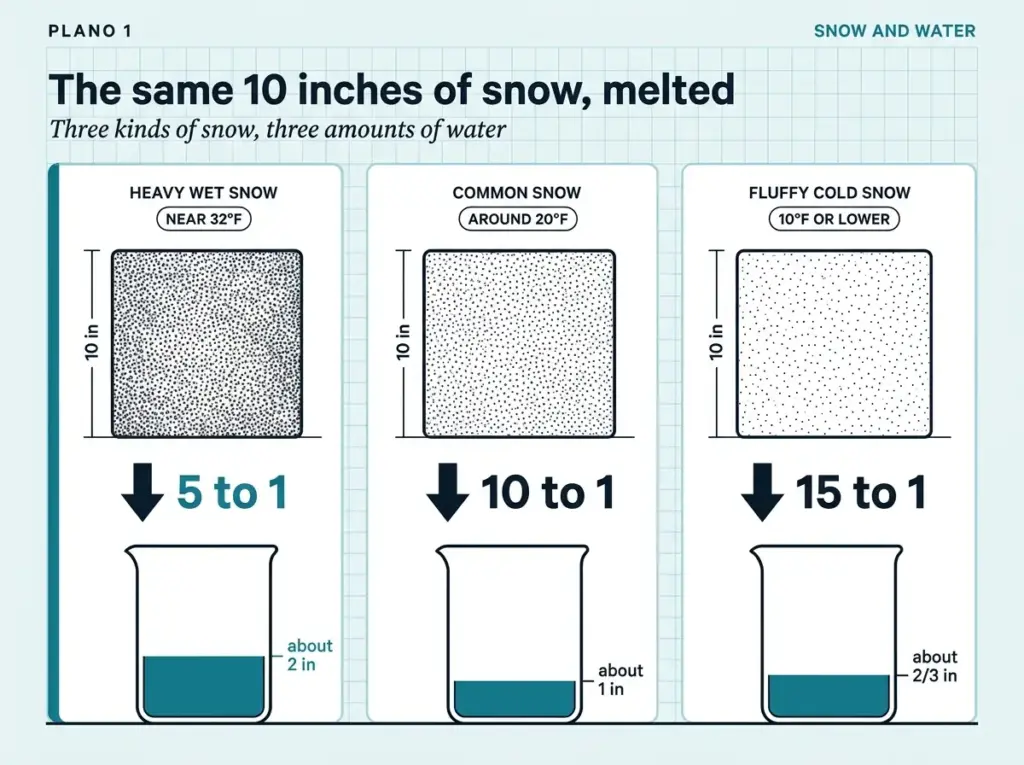
What that means for the next day is straightforward. A powdery snow predicts the house reading at the bottom of its range on the clear cold night. A slushy storm predicts a snow-day reading a few points higher inside, as in the sections above.
Why a Flake That Stays Sharp on Your Sleeve Is a Clue
Hold out a dark wool sleeve on the porch and watch what lands. A snowflake that stays a flake, still sharp on the wool, is the air telling you how little water it had before the furnace got it. A fat wet clump that soaks in on contact is the opposite.
NSIDC’s account of what snow needs to form is consistent with that reading: very cold, very dry air rarely snows at all. The first dusting after a cold snap leaves a dry rustle on the porch boards, where the wet storm leaves a puddle on the mat, and the house reads the difference by the next morning. The rule for any cold day, snowing or not covers the days when there is no flake to read.
Read the Room After the Storm, Not During It
With the air explained, there is a reading to take and a habit to skip. The number that decides is the one taken on the shelf after the storm, and the one change on the snow day itself is to leave the dial alone.

Wet Boots and Melting Snow Raise One Room, Not the House
The storm day brings water into one place: the boots and the melting snow by the door, laundry hung to dry indoors, a house sealed with the storm windows shut. A meter in the hallway reads higher than a meter in the bedroom at the far end, so a reading means something only in the room where it was taken. Put the meter on a hall shelf beside the wet boots and it reads a different house from the one the bedroom has, and the gap closes within a day of the boots being put away.
Read the room twice: at the end of the storm day and again the morning after, when the house has settled. The storm afternoon is the exception and the morning after is the winter. If the wash has to dry indoors, where to hang the wash without raising the whole house keeps it under the 60 percent limit.
Which Meter to Read It With
A meter is the cheapest step in the article, and a free reading changes more decisions than any device. Which cheap meter to trust gets into the margins of each model, and the short version follows.
The first meter to buy is the TempPro TP50 Digital Hygrometer: plain LCD, accurate to within 2 to 3 percent, with a high and low memory, one AAA battery and no app or setup.
Reliability is its weak point, since several units quit working after a month of use, which is why a second one beside it is the check. If the reading needs a history, the TempPro TempAir TP357 keeps a one-year graph in its app with no account and answers what the room did overnight on the snow day. Its battery runs down quickly, and some units read temperature and humidity inaccurately. For comparing two rooms on the same evening, bed against hall, the Govee Indoor Hygrometer H5075 has an app that makes the comparison easy, but its connectivity is mixed and some units stop working within six months.
How to take the three readings covers the end-of-day and next-morning routine this section asks for.
Set the meter on an inside wall at chest height. A window sill reads the cold pocket next to the glass, and the top of a radiator reads a hotter, drier pocket. Neither is the air you live in.
The One Change on a Snow Day Is to Leave the Dial Alone
Free comes first, in order. Leave the humidifier alone on the storm day and let the moisture the house already makes do its work: the boots on a tray in the hall, the wash on a rack in the room that reads lowest. Then read the meter again at the end of the day.
The trap is a humidifier turned up for the snow day. It sets a target the clear night cannot hold, and the glass sweats two days later. What the EPA says about condensation on windows is plain: moisture collecting on windows, walls or pipes is a sign of high humidity, so you dry the surface and reduce the source. And opening a window after the storm, the other instinct, does nothing useful, as why opening a window after the storm does not help explains.
When It Is the House, and Where a Humidifier Stops
The reading is in, the free changes are done and the meter is still low. The cause is now either the building or the number itself, and the machine comes last, aimed at a figure the window glass will accept.
When the Dryness Is a Door, a Duct or a Fan and Not the Weather
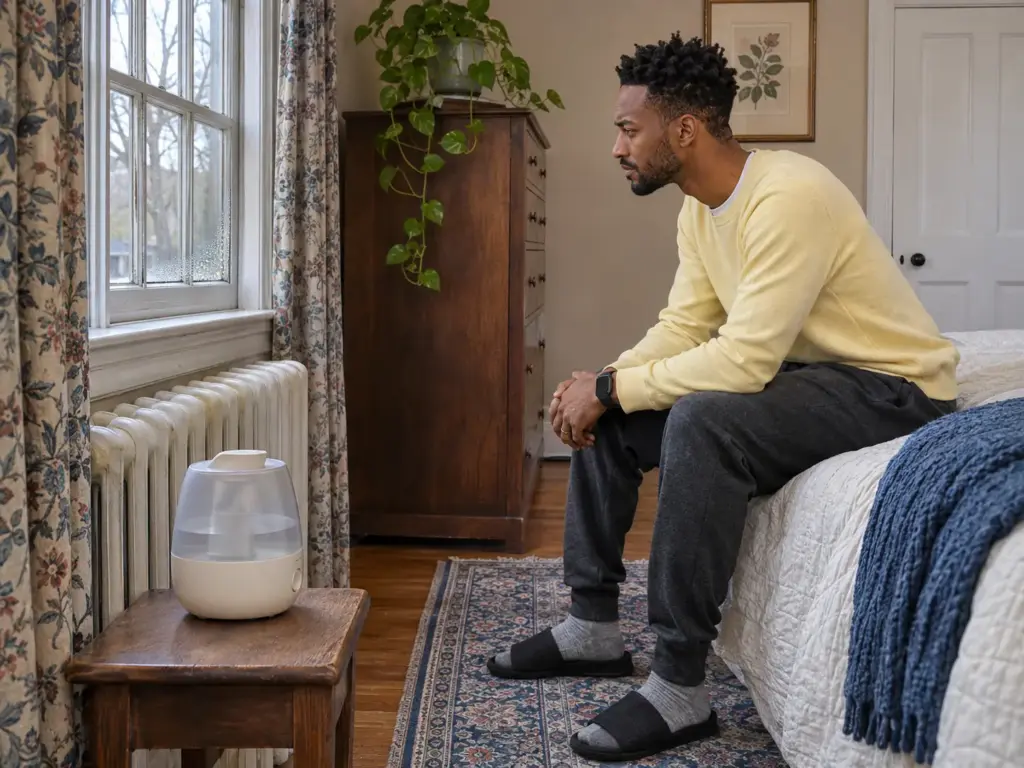
Some houses fight to hold 40 percent while it snows outside, even with new windows and doors, because the moisture leaves through the attic and the ducts. The causes the weather does not explain are a door that will not close tight, weatherstripping worn flat, duct leaks and attic bypasses, a drafty envelope, and a bathroom exhaust fan or a range hood run longer than the job needed. Seal the leaks first and humidify only what is left over. Which signs in the house are the air and which are the building helps sort the two.
A cooler room needs less water for the same percentage, so the thermostat down a degree makes the reading easier to hold. If the meter still lands under the band after all that, what to do when the reading lands under 30 percent is the next stop.
The Glass Sets How High You Can Go
The glass is the alarm, and window condensation is its signal. The highest relative humidity in a room is always at its coldest surface, and the colder it is outside, the lower the indoor humidity the glass can take before it runs. The EPA’s guidance on moisture on windows and walls calls condensation the sign to dry the surface and reduce the source, and the reading climbs through the night, as what the glass does hour by hour overnight shows.
The wipe test settles it. Run a hand across the room side of the lower pane in the morning: dry means the setting is fine, wet means it went too far. The wipe test on the room side of the glass has the details. This is the limit on a humidifier, and it is the reason the number you aim for moves with the weather.
Pick the Humidifier Last, and Size It by What It Puts Out
The size of the tank is not the output. Two one-gallon units running all day in a leaky house move the meter from the mid-teens to the high twenties and no further, because the leaks eat the difference. How to size a humidifier by gallons a day is the arithmetic that turns the reading into a device.
Three units cover the range.
The DREO 4L Humidifier HM311 is the budget unit: a 4 liter tank, a little over a gallon, 36 hours of run time, 28 dB, top fill. Durability is mixed, since some units break after five months and some stop working after two days.
The Levoit Classic300S is the mid pick, with a 6 liter tank, up to 60 hours and a rating for 505 square feet. Its built-in sensor and auto mode tie the setting to a number instead of a dial, but output is mixed: some units do not raise humidity at all, and leakage is a known complaint. The DREO 6L Smart Humidifier HM713S is the larger unit for a room that stays dry with a small one, and the only pick here with its output printed in milliliters per hour, 500 ml/h, about 12 liters over a full day at the maximum. Mist output is the complaint, with little or none on some units, and several leak.
A humidifier reads its own output at the spout, and that reading runs high. Trust the meter across the room instead. The two disagree all winter, and the meter across the room is the one that tells you what the room has.
Expect the first month to flatter any of them: the number climbs a little and the room feels settled. By the third week a white film on the dresser beside an ultrasonic cool mist unit shows that the water sets the upkeep, because that film is the calcium in tap water left behind once the mist evaporates. One unit in the bedroom for the night and one in the living room beat a bigger unit parked in the hall.
When the time comes to set the dial, what setting to use for each outdoor temperature is the page that ties it to the weather outside.
Set the Dial to the Cold Outside, Not to the Snow
The snow day is the wettest the winter air gets, and the house still reads under the EPA’s floor. The outdoor temperature predicts the indoor number, the clear night behind the storm is the driest the same room will read, and the flake on a dark sleeve tells you which air mass you are in. The reading after the storm is the one that counts, the dial stays alone on the storm day, the glass sets how high a humidifier can go, and sometimes the dryness is the building and not the weather at all.
The first clear, cold night after a storm is the check to run later: compare the bedroom reading that morning with the storm-day reading, look at the lower pane for a film, and glance at the shelf next to any humidifier for white dust. A second cold snap tells you whether the setting you chose holds when the outdoor temperature drops again.
Tomorrow, take one reading at the end of the day and one the next morning, on an inside wall, and write the outdoor temperature beside each. Move the humidifier dial only after that, and only to the number the cold outside allows.
Frequently Asked Questions
01Is the air dry while it is snowing?
Yes. Snow falls from air close to saturation, so the outdoor gauge reads high, but at 25 to 32°F that air holds very little water. Heated to 70°F, it leaves a house around a fifth on the meter, under the EPA’s 30 percent floor.
02At what temperature does air get dry?
There is no single temperature. The colder the air, the less water it can hold, so heating it indoors drops the percentage: about a fifth at 32°F and in the single digits at 0°F. The dew point and the meter on the shelf are the numbers to read.
03How do I know if the air in a room is dry?
Put a small humidity meter in the room and read it at the end of the day and the next morning. Under the EPA’s 30 to 50 percent band is dry. The thermostat and the weather app cannot tell you.
04How do I fix dry air in a house in winter?
Free changes first, in order: seal the leaks, lower the thermostat a degree, let the moisture the house already makes (wet boots, a rack of laundry) do its work, then read the meter again. A humidifier comes last, aimed at a number the window glass will accept.
05Should I turn the humidifier up during a snowstorm?
No. The storm day is the highest the winter reads, and a unit set for it makes the glass sweat two days later when the clear night arrives. Read the room after the storm, then set it.